• 검색 결과가 없습니다.

The Influence of Vestibular Stimulation Training on Static Balance during Standing in Healthy Young Adults

N/A
N/A
Protected

Academic year: 2021

Share "The Influence of Vestibular Stimulation Training on Static Balance during Standing in Healthy Young Adults"

Copied!
6
0
0

로드 중.... (전체 텍스트 보기)

전체 글

(1)

Balance during Standing in Healthy Young Adults

The Journal of Korean Society of Physical Therapy

Hwa-Young Cho, PT, MPh; Su-Hee Choi, PT, MS; Sam-Ki Seo, PT, PhD

1

Department of Occupational Therapy, College of Health Science, Seonam University;

1

Department of Physical Therapy, College of Health Science, Seonam University

Purpose: We  investigated  a  better  method  to  enhance  the  vestibular  system  including  balancing  by  comparing  the  vestibular stimulation exercise (VSE) and galvanic vestibular stimulation (GVS). 

Methods: The study was performed with 40 subjects randomized into four groups, including a control group, a VSE group,  a GVS group, and a VSE with GVS group. The subjects of VSE performed a forward and backward roll, a right side and left side  roll, and an equilibrium board in vestibular stimulation training. GVS was applied for 10 minutes and the cathode and anode  side were then changed and GVS was then applied for the remaining 10 minutes. GVS was applied for 20 minutes to the  subjects of this group after completion of the VSE program.

Results: In the control group, all conditions were significantly decreased (p<0.05) compared to the VSE with GVS group. 

Also, the center of pressure (CoP) surface was more significantly decreased (p<0.01) and the CoP speed was significantly  decreased in the one legged stance (p<0.05) in the control group compared to the GVS group. 

Conclusion: These findings suggested that GVS training increases balance ability in a narrow width. VSE with GVS training  is therefore recommend as the superior method. Using GVS or VSE with GVS training is considered to clinically improve  balance ability by stimulating the vestibular system. 

Keywords: Balance, Center of pressure, Vestibular stimulation exercise, Galvanic vestibular stimulation Received: September 30, 2011

Revised: November 24, 2011 Accepted: November 26, 2011

Corresponding author: Sam-Ki Seo, [email protected]

I. Introduction

Balance on normal standing has been explained as the ability to maintain the body’s center of gravity (COG) over its base of gravity (BOG) with limited postural sway.

1

The postural adjustments underlying good standing balance result in an integration of vestibular, vision-into effective motor responses, and afferent input-proprioceptive, that minimize the body’s center of mass within its BOG.

2

The vestibular organs in sensory input from many sources are used to maintain balance.

3

The vestibular apparatus is located in the inner ear and comprises two parts: the semicircular canals and the otolith organs.

4

Angular acceleration stimulates the semicircular canal primary while transient linear acceleration stimulates the otolith organs and changes in head position with respect to gravity.

These stimuli lead to tonic and phasic vestibulospinal and vestibuloocular reflexes, which act on the limbs and head to maintain posture.

5

It is known that the vestibular system is disturbed and stimulated by changing the position of the head.

Ayres has theorized that vestibular system exercise has an influence inclusive of on-going sensory experiences and that therapy including vestibular stimulation may activate synapses.

She also founded the use of vestibular simulation as an aspect of sensory-integrative treatment developed for children with learning disorders.

6

Also, vestibular stimulation exercise has been used in generally widespread treatment programs for children and infants.

7

Galvanic vestibular stimulation (GVS) produces a pattern of

firing in the vestibular nerves that mimics the natural rotation of

the head approximately in its roll plane.

8

Also, it has predictable

(2)

and large effects on the balance system.

3

GVS evokes the pattern of muscle activity, taking into account the orientation of all body segments from the head to the feet.

Several forms have been suggested for quantification of balance, involving measuring the movement of the COG under various testing conditions. The center of pressure (CoP) changes the quantified control of posture in a quiet stance in the anterior-posterior (A/P) and medial-lateral (M/L) directions.

9

To measure the vertical force projected on these directions by a standing subject, force platforms are commonly used. The direction and magnitude of the sway is determined by the changes in the relative pressure on each foot as the subject sways in any direction.

10

A number of studies have examined the effect of vestibular stimulation exercise (VSE) or GVS on static balance during standing. However, they do not compare VSE with GVS.

Therefore, the purpose of this study was to search for a better method to enhance the vestibular system for even balancing by comparing VSE, GVS, and VSE with GVS.

II. Methods

1. Subjects

The study was performed with 40 volunteer students from S University in Nam-won city from April 18th to May 16th 2011.

The subjects agreed to participate in the experiment after the aims of the study were explained. The participants are randomized into four groups including a control group (n=10, age=21.5±2.7 years, height=171±7.0 cm, weight=61.6±6.5 kg), the VSE group (n=10, age=23.5±1.7 years, height=167.8±8.1 cm, weight=61.9±13.6 kg), the GVS group (n=10, age=21.6

±1.9 years, height=165.2±6.8 cm, weight=61.9±12.3 kg), and the VSE with GVS group (n=10, age=20.8±1.2 years, height=170.2 ±6.2 cm, weight=66.7±8.1 kg). The subjects are able to independently stand with their feet together in a straight line for over 1 minute and they are able to perform a one legged stance on their dominant side for over 15 seconds. Also, they were able to forward roll and backward roll. However, participants who showed signs of a vestibular problem, or had any other medical disorder were excluded.

2. Experimental methods

All subjects were tested before training. Vestibular stimulation training was conducted 5 times a week for three weeks. 6 subjects performed a pre-experimental process for 5 days to set the intensity of the training.

1) VSE

In this study, the vestibular stimulation exercise suggested by Hwang

11

and Park

12

was modified and used. It included a forward and backward roll, a right side and left side roll, and an equilibrium board in vestibular stimulation training. The roll was performed independently 15 times for 3 sets, and the equilibrium board exercise was passively performed with assistance from a supporter 20 times for 3 sets. Also, a 1 minute rest was given between each exercise. The equilibrium board was applied in the supine position, prone position, and long sitting position.

2) GVS 

In this study, GVS (ENDOMED 581, Enraf Nonius co., Netherlands) was delivered through self-adhesive plate electrodes (medical electrode 2223, Bioprotech, Korea), in which the electrode radius is 2.5 cm and the electrodes were coated with electrode gel. The electrodes were placed on the mastoid process of the temporal bone. 10 minutes after application, the cathode and anode sides were changed and GVS was applied for the remaining 10 minutes. The phase duration for the standard stimulus was 300 ms, the phase interval was 700 ms, with a single-phase rectangular waveform, and the stimulus intensity was 1.5 mA. The subjects performed a stable stance position with closed eyes.

13

3) VSE with GVS

For the subjects of this group, GVS was applied for 20 minutes after completion of the VSE program.

3. Measurement

For a measured balance, we used a balance measuring system,

BioRescue (RM INGENIERIE, France). The measurements

were performed in two positions, a tandem stance and a one

legged stance. The tandem stance was measured at 1 minute

intervals, and the subjects stood on their non-dominant foot

placed in front of their dominant foot. The one legged stance

(3)

was measured at 15 seconds, with the subjects standing on their dominant foot. The subjects took a break with closed eyes for 5 minutes in each test. The measurements were taken two times and the average value was used.

4. Statistical analyses

The SPSS 18.0 statistical program is used for data analysis. The repeated measure of ANOVA is used for comparing the pre and post exercise according to position. The turkey post-hoc test was applied. The statistical significance level α was 0.05.

III. Results

1. Comparison of CoP surface at tandem stance The average values for the CoP surface before and after training in the control group were 3055.05±1997.68 mm

2

and 3264.15±2330.30 mm

2

, respectively. Also, the VSE group was 3135.80±1450.76 mm

2

and 2669.63±967.54 mm

2

at before and after training, respectively. In the GVS group, the CoP surface was 2823.50±1085.75 mm

2

and 977.60±595.41 mm

2

at before and after training, respectively. For the average CoP surface before and after training, the VSE with GVS group were 2134.00±840.40 mm

2

and 709.70±431.78 mm

2

, respectively.

The CoP was significantly decreased in the control group compared with the VSE with GVS group (p<0.05) (Figure 1).

Figure 1. Comparison of CoP surface at tandem stance.

*p<o.o5

VSE: Vestibular stimulation exercise GVS: Galvanic vestibular stimulation

VSE with GVS: Vestibular stimulation exercise with galvanic vestibular stimulation

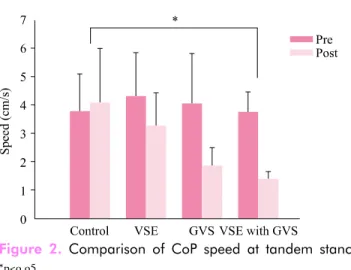
2. Comparison of CoP speed at tandem stance The average values for the CoP speed before and after training in the control group were 3.77±1.49 cm/s and 4.07±1.96 cm/s, respectively. The average values showed a decrease in the CoP speed from 4.24±1.61 cm/s to 3.27±1.20 cm/s in the VSE group and from 4.01±1.87 cm/s to 1.82±0.59 cm/s in the GVS group and from 3.75±1.0 cm/s to 1.38±0.38 cm/s in the VSE with GVS group. There was a significant decrease in the control group compared to the VSE with GVS group (p<0.05) (Figure 2).

Figure 2. Comparison of CoP speed at tandem stance.

*p<o.o5

VSE: Vestibular stimulation exercise GVS: Galvanic vestibular stimulation

VSE with GVS: Vestibular stimulation exercise with galvanic vestibular stimulation

3. Comparison of CoP surface at one legged stance

Before and after training, the average values for the CoP surface in the control group were 2834.30±1990.62 mm

2

and 3015.50±

1816.41 mm

2

, respectively. The average values showed a decrease from 3121.85±2059.37mm

2

to 845.65±594.17 mm

2

in the VSE group and from 1803.60±862.96 mm

2

to 446.85±

175.72 mm

2

in the GVS group and from 2054.75±1101.79 mm

2

to 347.05±159.37 mm

2

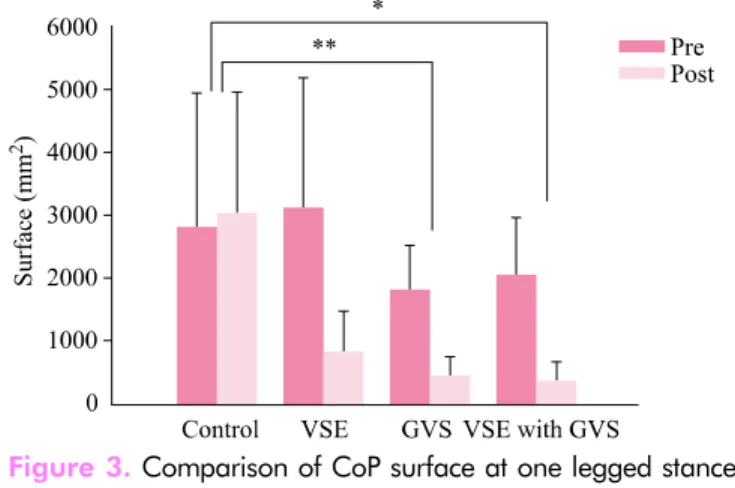
in the VSE with GVS group. There was

a more significant decrease in the control group compared to the

GVS group (p<0.01). In addition, there was a significant decrease

in the control group compared to the VSE with GVS group

(p<0.05)(Figure 3).

(4)

Figure 3. Comparison of CoP surface at one legged stance.

*p<o.o5

VSE: Vestibular stimulation exercise GVS: Galvanic vestibular stimulation

VSE with GVS: Vestibular stimulation exercise with galvanic vestibular stimulation

4. Comparison of CoP speed at one legged stance

The average values for the CoP speed before and after training in the control group were 6.11±3.29 cm/s and 5.73±4.00 cm/s, respectively. The average values showed a decrease in the CoP speed from 4.36±1.41 cm/s to 3.62±2.04 cm/s in the VSE group and from 3.71±1.70 cm/s to 1.94±0.53 cm/s in the GVS group and from 5.27±1.95 cm/s to 1.53±0.39 cm/s in the VSE with GVS group. There was a significant decrease in the control group compared to the GVS group and in the control group compared to the VSE with GVS group (p<0.05)(Figure 4).

Figure 4. Comparison of CoP speed at one legged stance.

*p<o.o5

VSE: Vestibular stimulation exercise GVS: Galvanic vestibular stimulation

VSE with GVS : Vestibular stimulation exercise with galvanic vestibular stimulation

IV. Discussion

Problems in balance create problems in the functional tasks required for carrying out activities of daily living.

14

As outlined in the introduction, the balance system organizes the whole body response to the vestibular signal.

3

There are two methods for firing a vestibular signal, where one method is a vestibular stimulation exercise by natural head movement,

15

and the other is a GVS-evoked input as a real head movement in space.

3

In this study, we investigated a better method for improving balance by vestibular stimulation.

Hwang reported that vestibular stimulation affects balance in children with central nervous system dysfunction.

11

Also, Park reported that VSE is an effective method for enhanced maintenance of balance in cerebral palsy.

12

However, the findings in this study disagree with those of Hwang and Park.

There were decreases but these were not significant. This is because the healthy young adults were exposed to a vestibular stimulated environment and the training was short term. Also, the differences may be due to the differences in the subject’s characteristics such as height, weight, foot length, etc.

The standing ability in the tandem stance reflects the degree of postural steadiness with a narrow base of support in the M/L direction.

16

GVS modulates the ongoing vestibular signal by increasing the firing rate afferents on the cathode side and decreasing the firing rate on the anodal side, causing standing subjects to sway towards the anodal side.

17

For that reason, the GVS electrode was applied at a location for stimulation from the right side to the left side and from the left to the right side.

Therefore, while a significant decrease in the GVS group on the tandem stance was expected, this was not shown. This is due to the short training session.

A GVS signal conveys head movements and evokes an automatic response that can be modified by other sensory information about balance, which stabilizes the head in gravito-inertial space.

18

Loss of a somatosensory input evokes a massive increase in the GVS sway response. Moreover, in the complete loss of somatosensory input, the GVS response has a greater order of magnitude.

3

In our study, GVS showed a significant difference in the one legged stance that has a narrow width. Therefore, we believe that the GVS training was an effective method to maintain balance in narrow stance.

In this study, all the measurements have shown a significant

(5)

decrease in the VSE with GVS group. This shows the combined effect of VSE and GVS. It is assumed that the VSE with GVS method stimulated the vestibular system naturally and artificially. Therefore, a significant result has been shown in any posture in this study.

In this study, GVS training is suggested to increase balance ability in narrow width. Also, VSE with GVS training is recommend as the superior method. Seo et al

19

reported that the visual cue and postural task affect the balance ability in normal subjects. Also, the difficulty of posture affects static balance ability. Therefore, we applied two difficult positions because our study’s subjects are healthy and young. However, this shows the limitation of our study, so further study needs to include subjects who have s balance problem.

In the previous studies, the physiologic cause of falls proved to be lack of equilibrium, unstable posture, weakness of leg muscles and reduction of leg joint flexibility.

20

The subjects were exposed to a dangerous environment with an unstable condition or narrow width. Especially, a patient with a problem has fallen in such an environment. For the GVS or VSE with GVS training patients, the balance ability in a difficult condition improved, maintaining stability and preventing fall risk. Using GVS or VSE with GVS training is considered to clinically improve balance ability by stimulating the vestibular system.

Author Contributions Research design: Seo SK

Acquisition of data: Cho HY, Choi SH

Analysis and interpretation of data: Cho HY, Choi SH Drafting of the manuscript: Cho HY

Administrative, technical, and material support:

Research supervision: Seo SK

References

1. Fishman MN, Colby LA, Sachs LA et al. Comparison of upper-extremity balance tasks and force platform testing in persons with hemiparesis. Physical Therapy. 1997;77(10):

1052-62.

2. Chandler JM, Duncan PW, Studenski SA. Balance performance on the postural stress test: Comparison of young adults, healthy elderly, and fallers. Physical Therapy. 1990;

70(7):410-5.

3. Fitzpatrick RC, Day BL. Probing the human vestibular system with galvanic stimulation. Journal of Applied Physiology.

2004;96(6):2301-16.

4. Carter JR, Ray CA. Sympathetic responses to vestibular activation in humans. American Journal of Physiology- Regulatory, Integrative and Comparative Physiology. 2008;

294(3):R681-688.

5. Potter CN, Silverman LN. Characteristics of vestibular function and static balance skills in deaf children. Physical Therapy. 1984;64(7):1071-75.

6. Ayres AJ. Sensory integration and learning disorders. Los Angeles, CA, Western Psychological Services, 1972: 113-129.

7. Ottenbacher K. Developmental implications of clinically applied vestibular stimulation. Physical Therapy. 1983;63(3):

338-42.

8. Day BL, Reynolds RF. Vestibular reafference shapes voluntary movement. Current biology. 2005;15(15):1390-94.

9. Winter DA, Prince F, Frank J et al. Unified theory regarding a/p and m/l balance in quiet stance. Journal of Neuro- physiology. 1996;75(6):2334-43.

10. Nichols DS, Glenn TM, Hutchinson KJ. Changes in the mean center of balance during balance testing in young adults.

Physical Therapy. 1995;75(8):699-706.

11. Hwang SS. Effects of vestibular stimulation on balance and fundamental psychologic process of choldren with central nervous system dysfunction. Dankook University. Disser- tation of Doctorate Degree. 1998.

12. Park MO. Effects of vestibular stimulation training on balance for the children with cerebral palsy. Dankook University.

Dissertation of Master's Degree. 2009.

13. Cho WS. The effects of balance, flexibility and proprioception by horse riding simulator and galvanic vestibular stimulation to normal adults. Seonam University. Dissertation of Doctorate Degree. 2010.

14. Kim GW, Ko JY, Baek SG. The reliability of a pediatric balance scale based on the raters’ clinical work experience and test experience. J Kor Soc Phys Ther. 2010;22(6):35-42.

15. Ivanenko YP, Grasso R, Lacquaniti F. Effect of gaze on postural responses to neck proprioceptive and vestibular stimulation in humans. The Journal of Physiology. 1999;519(1):301-14.

16. Jonsson E, Seiger A, Hirschfeld H. Postural steadiness and weight distribution during tandem stance in healthy young and elderly adults. Clinical Biomechanics. 2005;20(2):202-8.

17. Wardman DL, Taylor JL, Fitzpatrick RC. Effects of galvanic

(6)

vestibular stimulation on human posture and perception while standing. The Journal of Physiology. 2003;551(3):1033-42.

18. Wardman DL, Day BL, Fitzpatrick RC. Position and velocity responses to galvanic vestibular stimulation in human subjects during standing. The Journal of Physiology. 2003;547(1):

293-9.

19. Seo SK, Kim SH, Kim TY. Evaluation of static balance in postural tasks and visual cue in normal subjects. J Kor Soc Phys Ther. 2009;21(4):51-6.

20. Lee YW, Choi SJ, Song CH. The effect of a balance training

program to improve the balance of aged patients with diabetes

mellitus. J Kor Soc Phys Ther. 2010;22(3):23-30.

수치

Figure 1. Comparison of CoP surface at tandem stance.
Figure 3. Comparison of CoP surface at one legged stance.

참조

관련 문서

We analyzed angular displacement of thoracic and lumbar spine and linear displacement of center of mass for evaluatione of spinal stability and standing

목 폄하고 sharpened Romberg 유지시간 변화에서 집단 내 변화를 분석한 결과 고속 MHRT군은 훈련 6주 후가 훈련 전 MHRT군은 훈련 6주 후가

The Effect of Lumbar Stabilization Exercise on Lumbar Muscle Strength and Body Balance in Patients with Chronic Low Back Pain.. Graduate School of Public

PURPOSE: This study examined the effects of both lower extremities proprioceptive neuromuscular facilitation training with functional electrical stimulation on the balance and

In the present study, to examine the effects of weight shift training with electrical sensory stimulation feedback on the balance ability of adult hemiplegic

PURPOSE: This study examined effects of the untact trunk stabilization exercise program on muscle thickness, trunk strength, maximal expiratory flow, and static balance.. METHODS:

Purpose: This study was to investigate the effects of unilateral muscle fatigue in knee and ankle joints on balance and gait in healthy adults.. Methods: Exercise