• 검색 결과가 없습니다.

Effect of Weight Shift Training with Electrical Sensory Stimulation Feedback on Standing Balance in Stroke patients

N/A
N/A
Protected

Academic year: 2021

Share "Effect of Weight Shift Training with Electrical Sensory Stimulation Feedback on Standing Balance in Stroke patients"

Copied!
7
0
0

로드 중.... (전체 텍스트 보기)

전체 글

(1)

Research Article Open Access

Effect of Weight Shift Training with Electrical Sensory Stimulation Feedback on Standing Balance in Stroke patients

Da-young Kim, PT, MS·Yong-jun Cha, PT, PhD

1†

Department of Physical Therapy, Daejeon Hankook Hospital

1

Department of Physical Therapy, College of Health and Medical Science, Daejeon University

Received: July 8, 2015 / Revised: July 9, 2015 / Accepted: August 15, 2015

ⓒ 2015 J Korean Soc Phys Med

| Abstract |

1)

PURPOSE: The purpose of this study was to investigate the effect of weight shift training with electrical sensory simulation feedback on quiet standing balance in hemiplegic stroke patients.

METHODS: 30 stroke patients were equally allocated at random to an experimental group or a control group.

Patients in both two groups underwent comprehensive rehabilitation physical therapy for 30 minutes per day for 5 days per week for 4 weeks. Members of the experimental group received additional weight shift training with electrical sensory simulation feedback was conducted for 15 minutes after 30 minute sessions, whereas members of the control group underwent additional leftward/rightward weight shift training by themselves after 30 minutes per day for four weeks. COP (center of pressure) path lengths, COP velocities, and foot forces were measured before and immediately after the 4-week training period in both groups and results were compared.

†Corresponding Author: [email protected]

This is an Open Access article distributed under the terms of the Creative Commons Attribution Non-Commercial License (http://creativecommons.org/licenses/by-nc/3.0) which permits unrestricted non-commercial use, distribution, and reproduction in any medium, provided the original work is properly cited.

RESULTS: COP path lengths significantly decreased by 3% after training in the experimental group and this was significantly greater than that observed in the control group (p<0.05). In both groups, foot forces of affected sides showed significant increases after intervention, whereas foot forces of unaffected sides showed significant decreases (p<0.05). No significant difference was observed between the two groups with respect to these changes.

CONCLUSION: Weight shift training using electrical sensory simulation feedback has a positive effect on quiet standing balance in hemiplegic stroke.

Key Words: Weight shift training, Electrical sensory stimulation, Balance, Stroke

Ⅰ. Introduction

Stroke is a neurological deficit resulting from cerebral hemorrhaging or cerebral vascular occlusion. Signs and symptoms of stroke include an inability to move or feel on one side of the body, problems understanding or speaking, and equilibrium disorder (de Haan et al, 2015;

Jun et al, 2014; Mehrpour et al, 2014). The patients with

stroke have significant problems with motor feedback,

because of a loss of balance, muscle weakness, and

(2)

abnormal movement pattern (Chinsongkram et al, 2014;

Kwon and Shin, 2013).

79 to 87% of people that experience stroke suffer from foot force disequilibrium (Laufer et al, 2000), most suffer from hemiplegia, that is, paralysis affecting one side of the body, and these patients tend to place 61 to 80% of body weight on the lower extremity of the unaffected side when standing (Dickstein et al, 1984).

In cases of hemiplegia, rehabilitation teaches the importance of placing body weight on the affected side, since this improves balance and promotes a symmetrical standing posture (Lee et al, 2012). In addition, tactile sensory stimulation during the initial stage of impairment aids functional recovery, and this form is treatment is more effective when provided consistently and repetitively (Craik, 1982; Koh et al, 2015).

A number of previous studies in stroke have suggested various clinical treatments, such as, weight shift training based on a neurodevelopmental approach (Jette et al, 2005;

Tyson et al, 2006), task oriented training (Michaelsen et al, 2006), visual feedback training (Ahn and Ahn, 2011), auditory feedback training (Plummer-D'Amato et al, 2008), and others. However, few studies have been performed on therapeutic intervention using electrical sensory simulation by tactile stimuli. Therefore, this study was performed to examine the effect of weight shift training using electrical sensory simulation feedback on quiet standing balance in hemiplegic patients after stroke.

Ⅱ. Method

1. Subjects

We recruited hemiplegic patients after stoke at Daejeon

‘H’ hospital. General characteristics of subjects (age, gender, weight, height, etc.) were obtained using questionnaires. The inclusion criteria were:

(1) Definite diagnosis of hemiplegia after stroke.

(2) Lower extremity spasticity level (< grade 2 by the MAS (modified Ashworth scale)).

(3) No sensory deficiency

(4) A Korean Mini Mental State Examination (MMSE-K) score of >24 points.

(5) No major orthopedic problem.

(6) Ability to stand independently without orthosis.

(7) Ability to maintain a quiet standing posture indepen- dently >5 minutes.

(8) The provision of informed consent prior to partici- pation.

2. Procedure

30 hemiplegic patients volunteered to participate in the study. We ensured all patients were able to understand the purpose of the study and follow instructions and experimental methods and procedures in accordance with the ethical standards of the Declaration of Helsinki. The University of Daejeon Institutional Review Board granted approval for the study.

The 30 hemiplegic patients were allocated equally and randomly to an experimental group or a control group.

Members of both groups underwent comprehensive rehabili- tation for 30 minutes per day, 5 days per week for 4 weeks.

In the experimental group, weight shift training using electrical sensory simulation feedback was conducted for 15 minutes after comprehensive rehabilitation sessions, whereas in the control group, patients conducted leftward/

rightward weight shift training by themselves for 15 minutes per day.

3. Intervention

1) Weight shift training with electrical sensory stimulation feedback

During the 4-week intervention period, weight shift

training with electrical sensory stimulation feedback was

implemented on experimental group using a functional

(3)

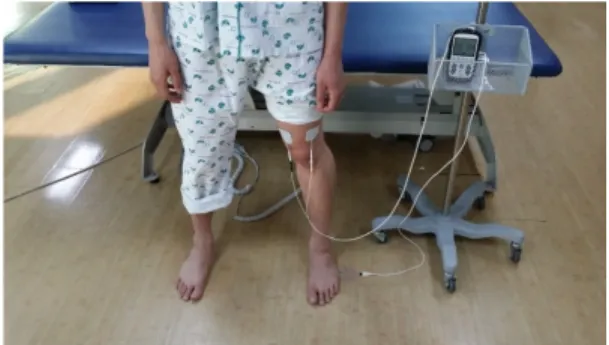
electrical stimulation (FES) therapeutic unit (Novastim CU-FS1, CU Medical Systems Inc., Korea) for 15 minutes after comprehensive rehabilitation therapy. The foot switch (Novastim CU-FS1, CU Medical Systems Inc., Korea) of the FES unit was attached to the bottom of the intermediate lateral region of the affected side sole of each patient using tape. The foot switch was positioned so that it could be pressed when a patient’s weight completely moved to the lateral affected side. The FES program was set so that electrical stimulation output could be felt when the patient’s weight was moved laterally in a standing position. The intensity of electrical stimulation was set individually to the minimum sensory stimulation level that could be felt by the patient. The electrical stimulation applied to the Quadriceps femoris. During training, the foot switch was pressed for 10 sec. and this was followed by 5 sec rest.

This process was then repeated to a total of 60 cycles per 15 minute session (Fig. 1).

Fig. 1. Weight shift training with electrical sensory stimulation feedback

2) General weight shift training

During the intervention period, patients in the control group underwent general weight shift training after comprehensive rehabilitation sessions by shifting his/her weight to the lateral side of the affected side by himself/herself in a standing posture. Patients shifted weight for 10 sec., rested for 5 sec, and repeated the process to a total of 60 cycles per 15 minute cycle.

3) Comprehensive rehabilitation of the nervous system During comprehensive rehabilitation sessions the experi- mental and control groups received Neuro Development Therapy based on Bobath or Proprioceptive Neuromuscular Facilitation from physical therapists with at least two years of clinical careers experience for 30 minutes per session.

4. Measurement device

In this study, to measure balance in a standing posture, static plantar pressure was measured using a Zebris Plateform (Zebris Medical GmbH, Germany). This unit is 700mm long, 400mm wide, and 21mm high and weighs 6.5kg; the sensor zone is 542 × 339 mm in size and contains 2560 sensors.

To measure static plantar pressure, the patient was instructed to place both feet on the Zebris Platform and keep eyes forward while maintaining a static standing posture. The Stance Analysis mode was selected to measure static plantar pressure for 13 sec. Group COP path lengths, COP velocities, and foot forces were measured and compared. During measurements, an assistant accompanied patients to prevent accidents.

5. Data analysis

The statistical analysis was conducted using SPSS ver.

18.0 for Windows. After testing data for normality, Wilcoxon-signed rank tests were conducted to compare balance abilities before and after intervention in each group.

Mann-Whitney U tests were conducted to compare changes in balance ability before to after intervention in the two groups. Statistical significance was accepted for p values

< 0.05.

Ⅲ. Results

1. General characteristics of the study subjects

Of the 30 subjects that participated in the present study,

(4)

Table 1. General characteristics of the study subjects

Experimental group (n=13) Control group (n=12) p

Gender (male/female) 10/3 7/5 0.411

Affected side (left/right) 2/11 6/6 0.097

Age (years) 58.54 ± 12.32 60.58 ± 15.40 0.716

Period (week) 12.74 ± 8.30 12.86 ± 6.91 0.969

Height (cm) 165.92 ± 6.31 163.83 ± 8.45 0.488

Weight (kg) 65.08 ± 13.08 61.17 ± 9.71 0.408

Values are frequencies or means ± standard deviations

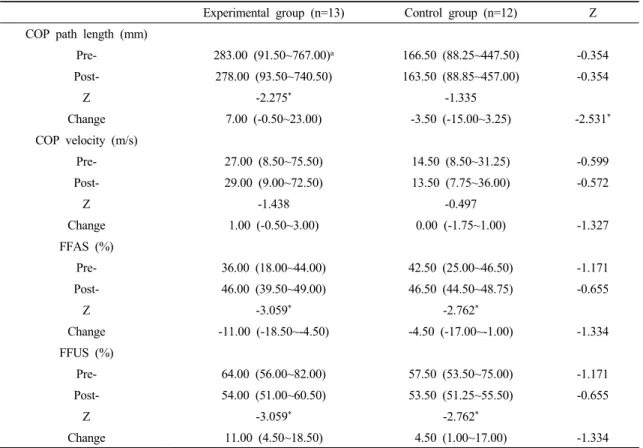
Table 2. Comparison of balance abilities before and after training in the experimental and control groups

Experimental group (n=13) Control group (n=12) Z COP path length (mm)

Pre- 283.00 (91.50~767.00)a 166.50 (88.25~447.50) -0.354

Post- 278.00 (93.50~740.50) 163.50 (88.85~457.00) -0.354

Z -2.275* -1.335

Change 7.00 (-0.50~23.00) -3.50 (-15.00~3.25) -2.531*

COP velocity (m/s)

Pre- 27.00 (8.50~75.50) 14.50 (8.50~31.25) -0.599

Post- 29.00 (9.00~72.50) 13.50 (7.75~36.00) -0.572

Z -1.438 -0.497

Change 1.00 (-0.50~3.00) 0.00 (-1.75~1.00) -1.327

FFAS (%)

Pre- 36.00 (18.00~44.00) 42.50 (25.00~46.50) -1.171

Post- 46.00 (39.50~49.00) 46.50 (44.50~48.75) -0.655

Z -3.059* -2.762*

Change -11.00 (-18.50~-4.50) -4.50 (-17.00~-1.00) -1.334

FFUS (%)

Pre- 64.00 (56.00~82.00) 57.50 (53.50~75.00) -1.171

Post- 54.00 (51.00~60.50) 53.50 (51.25~55.50) -0.655

Z -3.059* -2.762*

Change 11.00 (4.50~18.50) 4.50 (1.00~17.00) -1.334

amedian (25%~75%)

COP: center of pressure, FFAS: foot force of affected side, FFUS: foot force of unaffected side.

*: p < 0.05
two patients in the experimental group and three patients in the control group dropped out due to lack of participation during the intervention period, and thus, the numbers of subjects that completed the present study were 13 in the

experimental group and 12 in the control group. No

significant intergroup difference was observed with respect

to sex, affected regions, ages, time after onset, or heights

or weights (Table 1).

(5)

2. Comparison of balance ability levels before and after intervention in the two groups

Balance ability levels before and after intervention in the experimental and control groups are as shown in Table 2.

In the experimental group, COP path lengths significantly decreased by 3% and FFAS (foot forces of affected side) significantly increased by 28%. On the other hand, FFUS (foot force of the unaffected side) significantly decreased by 19% after intervention (p<0.05). In the control group, FFAS significant increased by 9% and FFUS significantly decreased by 7% (p<0.05).

A significant difference in post-training changes in COP path lengths was observed between the two groups, and a greater mean decrease was observed in the experimental group (p <0.05). However, post-training changes in Velocity, FFAS, and FFUS were not significantly different in the two groups (p>0.05).

Ⅳ. Discussion

This study was conducted to examine the effects of weight shift training using electrical sensory stimulation feedback on balance in a quiet standing posture and to check the potential of training as an intervention in adult hemiplegic patients after stroke.

According to the results of the present study, the experimental group showed a significant decrease by 3%

in mean COP path length (p<0.05). Although the control group also showed a decrease in COP path lengths, this decrease was not significant. Stroke patients with hemiplegia have postural control difficulties due to the phenomenon of weight load displacement toward the unaffected side and reduced balance ability, and exhibit increased instability and postural sway (Johannsen et al, 2006). According to a study conducted by de Haart et al (2004) excessive postural sway and instability in the coronal plane are important for measuring balance ability in stroke patient,

and their recovery can best reflect the effects of balance training. Therefore, the decrease in center of pressure path lengths shown by the present study can be regarded as an increase in balance ability obtained by weight shift training.

Mean foot force ratio of affected sides showed significant increases from 36.0% to 46.0% in the experimental group and from 42.5% to 46.5% in the control group (p<0.05).

The foot force ratio of unaffected sides showed significant decreases from 64.0% to 54.0% in the experimental group and from 57.5% to 53.5% in the control group (p<0.05).

Although both groups showed improvements in the symmetry of lower extremity weight bearing, the experimental group showed a little more improvement.

Given the results of a previous study, which indicated sensory inputs from skin play an important role in balance control (Zhang and Li, 2013), weight shift training with electrical sensory stimulation feedback is considered to influence balance control. In addition, as shown by a previous study, hemiplegic patients make more conscious efforts than normal controls, not to fall during postural control and this makes hemiplegic patients select the safest and easiest way for postural control (Kusoffsky et al, 2001).

This result might be due to the fact that weight shift training using electrical sensory stimulation feedback facilitates safe conscious postural control.

Although both intervention programs were effective for improving balance ability while standing in hemiplegic patients after stroke, the weight shift training using electrionic sensory stimulation feedback has greater effects on center of pressure path lengths and bearing weight symmetrically on the two lower extremities than the leftward/rightward weight shift training by themselves. Therefore, the weight shift training using electrical sensory stimulation feedback can assist clinicians and trainers in developing an appropriate exercise program to improve balance ability in adult hemiplegic patients.

However, the present study has limitations, as the

(6)

number of subjects involved was small, the training period was only four weeks, and results were obtained immediately after training, and thus, its results cannot be generalized.

Therefore, a long-term study is required in a larger cohort to confirm our results regarding the effects of intervention to enable the generalization of results.

Ⅴ. Conclusion

In the present study, to examine the effects of weight shift training with electrical sensory stimulation feedback on the balance ability of adult hemiplegic patients while standing, the experimental group underwent comprehensive rehabilitation and weight shift training with electrical sensory stimulation feedback and the control group underwent comprehensive rehabilitation and general leftward/rightward weight shift training five times per week for four weeks. After intervention, the experimental group showed significant decreases in center of pressure path lengths and the experimental and control groups showed significant decreases in the foot force ratios of unaffected sides and significant increases in the foot force ratios of affected sides. In addition, the experimental group showed larger decreases in center of pressure path lengths after intervention than the controls. These findings indicate weight shift training with electrical sensory stimulation feedback is effective at improving balance ability in adult hemiplegic patients. 

References

Ahn MH, Ahn CS. Comparison of effects of feedback vs repetitive task training on lower extremity function in patients with chronic hemiplegia. J Korean Soc Phys Med. 2011;6(1):9-17.

Chinsongkram B, Chaikeeree N, Saengsirisuwan V, et al.

Reliability and validity of the Balance Evaluation Systems Test (BESTest) in people with subacute stroke. Phys Ther. 2014;94(11):1632-43.

Craik RL. Clinical correlates of neural plasticity. Phys Ther.

1982;62(10):1452-62.

de Haan B, Stoll T, and Karnath HO. Early sensory processing in right hemispheric stroke patients with and without extinction. Neuropsychologia. 2015;73:141-50.

de Harrt M, Geurts AC, Huidekoper SC, et al. Recovery of standing balance in post-acute stroke patients: a rehabilitation cohort study. Arch Phys Med Rehabil.

2004;85(6):886-95.

Dickstein R, Nissan M, Pillar T, et al. Foot-ground pressure pattern of standing hemiplegic patients. Major characteristics and patterns of improvement. Phys Ther. 1984;64(1):19-23.

Jette DU, Latham NK, Smout RJ, et al. Physical therapy interventions for patients with stroke in inpatient rehabilitation facilities. Phys Ther. 2005;85(3):238-48.

Johannsen L, Broetz D, and Karnath HO. Leg orientation as a clinical sign for pusher syndrome. BMC Neurol.

2006;6:30.

Jun HJ, Lee JS, Kim KJ, et al. Effect of auditory biofeedback training and kicking training on weight-bearing ratio in patients with hemiplegia. J Korean Soc Phys Med.

2014;9(4):363-73.

Koh K, Kwon HJ, Yoon BC, et al. The role of tactile sensation in online and offline hierarchical control of multi-

finger force synergy. Exp Brain Res. 2015; In press.

Kusoffsky A, Apel I, and Hirschfeld H. Reaching-lifting-placing task during standing after stroke: Coordination among ground forces, ankle muscle activity, and hand movement. Arch Phys Med Rehabil. 2001;82(5):650-60.

Kwon HR, Shin WS. The effects of visual direction control on balance and gait speed in patients with stroke.

J Korean Soc Phys Med. 2013;8(3):425-31.

Laufer Y, Dickstein R, Resnik S, et al. Weight-bearing shifts

of hemiparetic and healthy adults upon stepping on

(7)

stairs of various heights. Clin Rehabil. 2000;14(2):

125-9.

Lee YW, Shin DC, Lee KJ, et al. The relation between asymmetric weight-supporting and gait symmetry in patients with stroke. J Korean Soc Phys Med.

2012;7(2):205-12.

Mehrpour M, Motamed MR, Aghaei M, et al. Unusual recovery of aphasia in a polyglot Iranian patient after ischemic stroke. Basic Clin Neurosci. 2014;5(2):173-5.

Michaelsen SM, Dannenbaum R, Levin MF. Task-specific

training with trunk restraint on arm recovery in stroke:

randomized control trial. Stroke. 2006;37(1):186-92.

Plummer-D'Amato P, Altmann LJ, Saracino D, et al. Interactions between cognitive tasks and gait after stroke: a dual task study. Gait Posture. 2008;27(4):683-8.

Tyson SF, Hanley M, Chillala J, et al. Balance disability after stroke. Phys Ther. 2006;86(1):30-8.

Zhang S, Li L. The differential effects of foot sole sensory

on plantar pressure distribution between balance and

gait. Gait Posture. 2013;37(4):532-5.

수치

Fig.  1.  Weight  shift  training  with  electrical  sensory  stimulation  feedback
Table  2.  Comparison  of  balance  abilities  before  and  after  training  in  the  experimental  and  control  groups

참조

관련 문서

The outcomes suggest that patients with hemiplegia can improve their gait ability and standing balance through body weight support treadmill training.. Key

PURPOSE: This study aimed to compare the impact of exercise with that of functional electrical stimulation (FES) and transcutaneous electrical nerve stimulation (TENS) on

PURPOSE: The purpose of this study is to evaluate the functional effects of action observation plus functional electrical stimulation (FES) treatment on the weight distribution

PURPOSE: This study examined the effects of integrating transcutaneous electrical nerve stimulation into treadmill gait training by applying functional electrical stimulation on the

CONCLUSION: Significant differences in static balance ability were observed between the three conditions. In this study, tactile feedback was found to be the most effective

Abstract The muscle activity and balance ability of the acute stroke patient has been checked by the functional electrical stimulation using biofeedback fusion postural

Key Words : Transcutaneous electrical nerve stimulation, Taping, Stroke, Balance, Gait, Quality of life... 하지만 단기 간의 운동만으로 다리기능에

Conclusion : The vibrotactile bio-feedback providing pressure information in real time can support an improve in static balance ability, uniform weight bearing