J Korean Soc Radiol 2018;79(3):152-160 https://doi.org/10.3348/jksr.2018.79.3.152
INTRODUCTION
Although the native arteriovenous fistula (AVF) is recom- mended as the first choice dialysis access for most patients with better outcomes (1-3), the usage of hemodialysis catheter is un- avoidable in some patients; these include using catheter as a bridge before maturation of AVF or waiting for renal transplan- tation, and in elderly and diabetic patients having unsuitable vessels for AVF. The National Kidney Foundation-Kidney Dis-
ease Outcome Quality Initiative issued Clinical Practice Guide- lines for Vascular Access in 2006 recommend that less than 10% of prevalent hemodialysis patients should be maintained on central catheters as their permanent dialysis access. Howev- er, catheter usage in prevalent hemodialysis was reported from 2% to 45% among 20 countries in 2013, in which most coun- tries except Japan reported more than 10% usage of catheter as prevalent hemodialysis access (4).
There are several complications associated with tunneled he-
Assessment of Venographic Abnormalities during Replacement of Dysfunctional Tunneled Hemodialysis Catheters and Outcome of Endovascular Salvage Techniques
기능부전 터널식 투석용 도관의 교체 시 시행한 정맥조영술 결과의 분석과 혈관 내 치료 기술의 결과
Pae Sun Suh, MD
1, Seon Young Park, MD
1, Jinoo Kim, MD
1, Chang Kwon Oh, MD
2, Su Hyung Lee, MD
2, Je Hwan Won, MD
1*
Departments of 1Radiology, 2Surgery, Ajou University School of Medicine, Ajou University Hospital, Suwon, Korea
Purpose: To assess the venographic findings of central venous abnormalities before exchanging dysfunctional tunneled hemodialysis catheters and the outcome of en- dovascular salvage techniques.
Materials and Methods: A total of 110 episodes of tunneled hemodialysis catheter dysfunction in 78 patients undergoing catheter-directed hemodialysis treatment from January 2011 to December 2015 were retrospectively evaluated. Venography was per- formed before catheter exchange, and the following procedures were conducted ac- cording to the venographic findings: balloon disruption of a fibrin sheath, angioplasty for central vein stenosis, or stent insertion. Technical success was defined as at least one successful session of hemodialysis with the exchanged catheter. Patients were followed until the study endpoints or the last hospital visit.
Results: Venography showed abnormalities in patients with 67 of the 110 exchanged catheters, including central vein stenosis (n = 27), fibrin sheath formation (n = 17), and thrombus formation (n = 12). Technical success was confirmed in all cases. The estimated 30-day catheter patency for all assessable catheters was 61.7%. Nine cath- eters were removed during the follow-up period because of suspected catheter-relat- ed infections.
Conclusion: In approximately 60% of cases of dysfunctional tunneled hemodialysis catheter, abnormal venographic findings were observed in the patients. Following appropriate endovascular techniques could be helpful in improving catheter patency with a low risk of procedure-related complications.
Index terms Renal Dialysis Catheters Venography
Endovascular Procedures
Received January 9, 2018 Revised May 10, 2018 Accepted May 16, 2018
*Corresponding author: Je Hwan Won, MD Department of Radiology, Ajou University School of Medicine, 164 Worldcup-ro, Yongtong-gu, Suwon 16499, Korea.
Tel. 82-31-219-5863 Fax. 82-31-219-5862 E-mail: [email protected]
This is an Open Access article distributed under the terms of the Creative Commons Attribution Non-Commercial License (http://creativecommons.org/licenses/by-nc/4.0) which permits unrestricted non-commercial use, distri- bution, and reproduction in any medium, provided the original work is properly cited.
modialysis catheters that can reduce catheter survival, includ- ing central vein stenosis, thrombus, and fibrin sheath formation which can lead to catheter dysfunction causing inadequate di- alysis, and catheter-related infection. Up to 52% of tunneled hemodialysis catheters are reported to be removed within one year due to catheter dysfunction and catheter-related infection, and some of the reports suggest catheter dysfunction as the main reason for non-elective removal (5-8). In these cases of catheter dysfunction, subsequent catheter replacement is most- ly required, but prior catheter dysfunction itself is reported to be the strong predictor of hemodialysis catheter failure due to anatomical alterations in the central vein (5, 6), including pre- mentioned central vein stenosis, thrombus, or fibrin sheath for- mation.
Therefore, the purpose of this study was to assess the venog- raphy findings of central venous abnormalities before exchang- ing dysfunctional tunneled hemodialysis catheters and also to assess the outcome of endovascular salvage techniques.
MATERIALS AND METHODS
Patients
From January 2011 to December 2015, a total of 78 consecu- tive patients undergoing catheter-directed hemodialysis treat- ment for 110 episodes of tunneled hemodialysis catheter dys- function were evaluated retrospectively. This retrospective study was approved by our Institutional Review Board (AJIRB-MED- MDB-15-508) and the requirement for informed patient con- sent was waived.
Tunneled hemodialysis catheter dysfunction was defined as inadequate dialysis session due to decreased blood flow rates (< 300 mL/minute) and frequent arterial and venous pressure alarms. The patient population included 33 men and 45 wom- en, with a mean age of 67 years (median, 7 years; range, 25–86 years). Five patients were temporarily undergoing catheter-di- rected hemodialysis treatment in the setting of acute kidney in- jury; remaining seventy-three patients were using central cathe- ter as their permanent dialysis access, mostly in the setting of established end-stage renal disease except in one patient who un- derwent bilateral nephrectomy due to emphysematous pyelone- phritis. All of the patients previously underwent hemodialysis catheter insertion using tunneled single catheter with two dis-
tinct lumens: Hemo-Flow hemodialysis catheter (14.5 Fr, Med- comp, PA, USA), and Palindrome hemodialysis catheter (14.5 Fr, Covidien, Ireland).
Techniques
The patients were placed on the angiography table, and blunt dissection was performed under local anesthesia with 1% lido- caine hydrochloride at the site of the indwelling catheter to free the cuff from the surrounding tissue at the exit site. Under fluo- roscopic guidance, a 0.035-inch guide wire (Terumo Corp., To- kyo, Japan) was inserted through the one of double lumen of the hemodialysis catheter, with a wire tip placed in the inferior vena cava. After partially withdrawing and positioning the catheter tip at brachiocephalic vein level, 10 mL non-ionic con- trast material (Bonorex Iohexol 350; CMS, Seoul, Korea) mixed with 5 mL saline were injected manually at another lumen, and serial digital subtraction angiography was performed. All imag- es were assessed by the performing radiologist and categorized as normal or abnormal venography. Focal or segmental luminal narrowing of brachiocephalic vein or superior vena cava was considered as central vein stenosis, thin contrast tracking along the catheter was considered diagnostic of fibrin sheath forma- tion, and filling defects around the catheter or elsewhere inside the central vein were considered diagnostic of thrombus forma- tion. The following interventional procedures were performed according to the venographic findings; catheter exchange with or without tip position adjustment, balloon disruption of a fi- brin sheath, or angioplasty for central vein stenosis or occlu- sion. A new tunneled hemodialysis catheter was advanced over the wire under fluoroscopic guidance, with the tip placed in the appropriate position after one session of venography in normal cases. Although the venography showed abnormality, simple catheter change was performed in case of non-significant lumi- nal narrowing less than 50% caused by central vein stenosis or thrombus. Catheter tip was repositioned deeply in case of the luminal narrowing or fibrin sheath formation above the level of superior vena cava-right atrium junction. Interventional proce- dure was performed regardless of the degree of venographic abnormality in the patients with recurrent catheter dysfunction after catheter exchange with or without tip position adjustment.
An endovascular stent was indicated in cases of recurrent or re- maining venous stenosis after several sessions of balloon angio-
plasty. Immediate evaluation of catheter function was performed manually in the intervention room using a 20-cc syringe, en- suring adequate aspiration and forward flow on completion of the catheter exchange.
Follow-Up
Technical success was defined as at least one successful ses- sion of hemodialysis with the exchanged catheter. Catheters were removed if complication was encountered (mechanical problem, suspected catheter-related infection) and in these cas- es subsequent catheter exchange were performed into tunneled or non-tunneled catheters according to patient status. Catheters were also removed in cases when they were no longer needed (AVF maturation, recovery of native kidney function, renal transplantation, patient death), or the patient refuses to keep catheters. They were followed up to one of these end-points or to the point of last hospital visit. The reason for catheter remov- al, the duration of catheter up to the point of removal or to the last hospital visit were recorded. Complications were classified as major and minor according to society of interventional radi- ology classifications, with catheter-related infection included as major (9).
RESULTS
Venography findings were considered abnormal in 67 out of 110 exchanged catheters (60.9%); central vein stenosis in 27 (40.3%, out of 67 abnormal venography), fibrin sheath forma- tion in 17 (25.4%), thrombus formation in 12 (17.9%), complex findings of more than two abnormalities in 9 (13.4%), and two
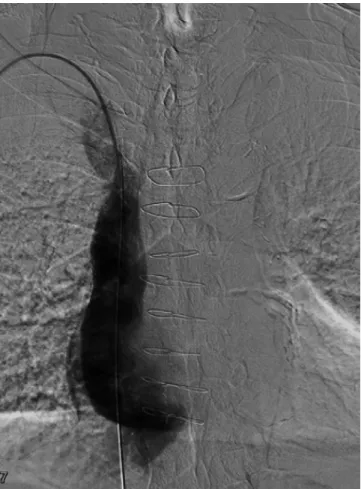
cases of in-stent restenosis where central venous stenting was done previously (Table 1). Additionally, simple fluoroscopic im- ages taken before withdrawal of dysfunctional catheter revealed inappropriate positioning or wedging of the catheter in 4 cases among 43 catheters showing normal venography findings (Fig. 1).
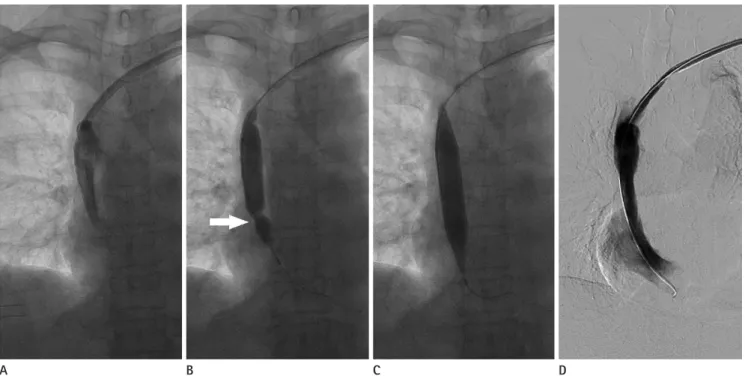
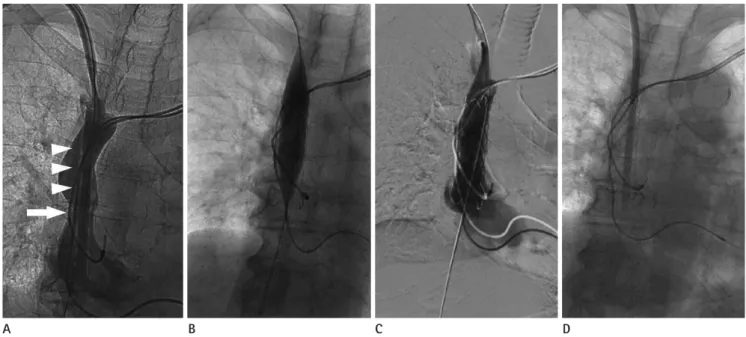
Among 67 abnormal venography cases, 34 catheters were ex- changed with or without catheter tip position adjustment. Bal- loon disruption of fibrin sheath was performed in 9 cases and balloon angioplasty of central vein stenosis or occlusion was performed in 20 cases. Balloon was used for both fibrin sheath disruption and central venous angioplasty in one complex case showing combination of fibrin sheath formation and central vein stenosis. Endovascular stent was placed in 3 cases accord- ing to the indication, which were all complex cases (Figs. 2–5).
All of the catheters showing normal venography findings were simply exchanged with or without catheter tip position adjust- ment. Manually assessed immediate catheter function was good
Table 1. Venography Findings
Venography findings n (n = 110) %
Abnormal 67 60.9
Central vein stenosis 27 40.3
Fibrin sheath formation 17 25.4
Thrombus formation 12 17.9
Complex* 9 13.4
In-stent restenosis 2 3
Normal 43 39.1
With mechanical problem 4 9.3
Without mechanical problem 39 90.7
*Two or more combined findings of central vein stenosis, fibrin sheath for- mation, thrombus formation.
Fig. 1. Normal venography findings in 75-year-old male. The patient was managed with simple catheter exchange over the wire without additional intervention.
in all cases and technical success rate was 100%.
Among exchanged 110 catheters, 29 catheters were lost to follow-up returning to referring hospital after the procedure, and remaining 81 catheters were followed up to the point of re- moval or to the point of their last hospital visit. The estimated 30-day catheter patency was 61.7% for all of the assessable cath- eters, and among them, 63% for catheters showing abnormal venography findings and 59.3% for catheters showing normal venography. Among assessable catheters showing abnormal ve- nography findings, estimated 30-day catheter patency for each interventional procedures are as follows; 60.7% for catheter ex- change with or without catheter tip position adjustment, 75%
for balloon disruption of fibrin sheath, and 70% for balloon an- gioplasty of central vein stenosis or occlusion. The mean follow- up duration per catheter was 74.8 days (range, 3–389 days) with 67 catheters (82.7%) removed and 14 catheters (17.3%) pre-
served function at the end of the study with mean duration of 96 days (range, 25–321 days). The reasons for catheter removal are listed in Table 2. The most common reason for catheter re- moval was catheter dysfunction, in 31 out of 67 removed cathe- ters (46.3%). Other reasons for catheter removal included matu- ration of AVF in 11 (16.4%), suspected catheter-related infection in 9 (13.4%), mechanical catheter problems such as catheter dislodgement and injury in 7 (10.4%), patient death in 5 (7.5%), patient refusal in 2 (3%) and each one cases of renal transplan- tation and recovery of native kidney function. The removed 9 catheters due to suspected catheter-related infection were equiv- alent to 1.1 episodes/1000 catheter days.
During the follow-up period, 32 re-intervention episodes were required in 26 catheters (38.8%, out of 67 removed catheters) due to recurrent catheter dysfunction, involving 13 patients with a 30-day catheter patency of 53.8%. The most common Fig. 2. A 68-year-old female.
A. Venography reveals central vein stenosis at junction of superior vena cava-right atrium.
B. The patient was managed with catheter exchange over the wire with adjustment of catheter tip position, avoiding the site of central vein stenosis.
A B
Fig. 3. A 51-year-old female.
A. Venography reveals fibrin sheath limiting contrast flow along the catheter insertion pathway.
B, C. Balloon angioplasty was performed to rupture the fibrin sheath using a 14 mm × 4 cm Atlas percutaneous transluminal angioplasty dilata- tion catheter (Bard peripheral Vascular). Note the waist formation at the balloon during partial inflation (arrow).
D. Repeated venography after the intervention no longer visualizes contrast flow limitation.
A B C D
Fig. 4. A 45-year-old female.
A. Venography reveals central vein stenosis at SVC level.
B. Balloon angioplasty was performed at the level of stenotic central vein using a 12 mm × 8 cm Mustang balloon (Boston Scientific Corporation).
C. Repeated venography after the intervention reveals improved stenosis at SVC level.
SVC = superior vena cava
A B C
reason for recurrent catheter dysfunction was central vein ste- nosis, followed by complex cases of more than one abnormal venography findings. More than one re-intervention was re- quired in 8 patients (five required two, one required three, and two required more than three re-interventions). The maximum number of re-intervention was eight in one patient over the span of 11 months.
DISCUSSION
Hemodialysis catheter dysfunction is reported to be one of the main reasons for non-elective removal of hemodialysis cath-
eter, with requirement of subsequent catheter exchange. This cre- ates disadvantages for the patients with increased cost and in- creased morbidity (5-8, 10). In current study, mechanical problems such as catheter malposition or wedging was much less common than other well established causes of catheter dysfunctions such as central venous stenosis, fibrin sheath formation, and throm- bus formation, which is consistent with previous studies (11).
There have been variety of techniques described for the man- agement of dysfunctional hemodialysis catheter resulting from causes other than mechanical problems in past years, including conservative method using thrombolytic agents to dissolve fi- brin clots and thrombus, which has been described for almost 30 years (12). However, with the emerging issues of thrombo- lytic therapy becoming refractory with recurrent flow problems in cases of persistent thrombus and fibrin sheath (13), fibrin sheath stripping was discovered as an alternative endovascular technique, followed by other techniques such as catheter ex- change over the wire and balloon disruption of fibrin sheath.
The reported success rates of these techniques vary with each study, and controversy remains regarding their outcomes. Our 30-day catheter patency rates for abnormal and normal venog- Fig. 5. A 81-year-old female.
A. Venography reveals complex findings of central vein stenosis at SVC level (arrow) with fibrin sheath along catheter insertion pathway (arrow- heads).
B. Stenosis of SVC remained after several sessions of balloon angioplasty (not seen), and a 20 mm x 6 cm Palmaz Genesis peripheral stent (Cordis) was placed in the SVC despite the fact the patient had cardiac pacemaker installed.
C. Repeated venography after the intervention reveals improved stenosis and disappearance of fibrin sheath.
D. New catheter was inserted over the wire and lasted for 47 days.
SVC = superior vena cava
A B C D
Table 2. Reason for Catheter Removal
Reason for removal n (n = 67) %
Dysfunction 31 46.3
Arteriovenous fistula maturation 11 16.4
Infection 9 13.4
Mechanical problem* 7 10.4
Patient death 5 7.5
Others† 4 6.0
*Catheter dislodgement, injury, and leakage.
†Patient refusal, renal transplantation, and recovery of native kidney function.
raphy cases (59.3–63%) are in the range of those previous re- ports regarding various techniques for the management of dys- functional hemodialysis catheter (43.9–76.1%) (14-20).
Venography was also performed in most of the previous re- ports for assessment of underlying cause of catheter dysfunc- tion, through indwelling catheter either in the original place or pulled back. The difference between prior studies and current study is that venography was optional in prior studies with some portion of study population not receiving venography due to suspected infection or other miscellaneous reasons, while ve- nography was performed in all cases of dysfunctional catheter exchange in current study. The rate of abnormal venography findings was 60.1% in current study, which is within range of 47–79% reported in previous studies (10, 11, 16, 19-22).
The estimated 1.1 catheter-related infection episodes/1000 catheter days in current study is lower than previously reported catheter-related infection rates, which were 1.42–5.2 episodes/
1000 catheter days (23-25). Five patients expired and had cath- eter removed during the follow-up period. Simple catheter ex- change over the wire was performed in four patients and one pa- tient received balloon angioplasty at central vein due to thrombus formation. Most of the deaths happened after more than one week of catheter exchange, suggesting low possibility of proce- dure-related morbidity. One patient who expired after three days from catheter exchange was in the setting of acute kidney injury due to sepsis and the death was thought to be attributed to septic shock. There was no other evidence of morbidity or mor- tality, suggesting that performing venography and subsequent intervention with catheter exchange over the wire is safe and has low risk of catheter-related infection or other complications.
Our study has limitations. First, it was a retrospective study with relatively small patient population. Also, patients were al- lowed to enroll more than once, since all dysfunctional hemo- dialysis catheter exchange cases were included in the study re- gardless of the presence of previous experience of catheter dysfunction. The outcome of the exchanged catheter was con- sidered to be independent of the previous catheter, and the pro- portion of cases having repeated catheter dysfunction leading to repeated re-interventions was not low. As reported in previ- ous study, the presence of previous experience of hemodialysis catheter insertion and/or dysfunction may play as the most pow- erful predictor of hemodialysis catheter dysfunction (5), and it
may have affected the catheter patency rate presented in cur- rent study. Lastly, due to the fact that our institution is a tertiary referral center, some portion of study cases were lost to follow- up after the procedure, and substantial portion of study cases had to be assumed for successful session of hemodialysis by having no more referrals issuing catheter dysfunction.
In conclusion, approximately 60% of dysfunctional tunneled hemodialysis catheter showed abnormal venography findings, with central venous stenosis being the most common abnor- mality followed by fibrin sheath formation. Appropriate endo- vascular techniques were performed according to the venogra- phy findings and the catheter patency was comparable with previous reports regarding various techniques for the manage- ment of dysfunctional hemodialysis catheter. Also, the rate of complications such as catheter-related infections was low. These findings implicate that performing venography before exchange of dysfunctional tunneled hemodialysis catheter with subse- quent appropriate act could be helpful in improving catheter patency with low risk of procedure-related complications.
REfERENCES
1. Lee H, Manns B, Taub K, Ghali WA, Dean S, Johnson D, et al.
Cost analysis of ongoing care of patients with end-stage renal disease: the impact of dialysis modality and dialysis access. Am J Kidney Dis 2002;40:611-622
2. Lacson E Jr, Wang W, Hakim RM, Teng M, Lazarus JM. Asso- ciates of mortality and hospitalization in hemodialysis: po- tentially actionable laboratory variables and vascular access.
Am J Kidney Dis 2009;53:79-90
3. Allon M, Daugirdas J, Depner TA, Greene T, Ornt D, Schwab SJ. Effect of change in vascular access on patient mortali- ty in hemodialysis patients. Am J Kidney Dis 2006;47:469- 477
4. Robinson BM, Akizawa T, Jager KJ, Kerr PG, Saran R, Pisoni RL. Factors affecting outcomes in patients reaching end- stage kidney disease worldwide: differences in access to renal replacement therapy, modality use, and haemodialy- sis practices. Lancet 2016;388:294-306
5. Little MA, O'Riordan A, Lucey B, Farrell M, Lee M, Conlon PJ, et al. A prospective study of complications associated with cuffed, tunnelled haemodialysis catheters. Nephrol Dial
Transplant 2001;16:2194-2200
6. Shingarev R, Barker-Finkel J, Allon M. Natural history of tunneled dialysis catheters placed for hemodialysis initia- tion. J Vasc Interv Radiol 2013;24:1289-1294
7. Sampathkumar K, Ramakrishnan M, Sah AK, Sooraj Y, Ma- haldhar A, Ajeshkumar R. Tunneled central venous cathe- ters: experience from a single center. Indian J Nephrol 2011;
21:107-111
8. Quarello F, Forneris G, Borca M, Pozzato M. Do central ve- nous catheters have advantages over arteriovenous fistulas or grafts? J Nephrol 2006;19:265-279
9. Sacks D, McClenny TE, Cardella JF, Lewis CA. Society of in- terventional radiology clinical practice guidelines. J Vasc Interv Radiol 2003;14:S199-S202
10. Leblanc M, Bosc JY, Paganini EP, Canaud B. Central venous dialysis catheter dysfunction. Adv Ren Replace Ther 1997;4:
377-389
11. Gray RJ, Levitin A, Buck D, Brown LC, Sparling YH, Jablonski KA, et al. Percutaneous fibrin sheath stripping versus trans- catheter urokinase infusion for malfunctioning well-posi- tioned tunneled central venous dialysis catheters: a pro- spective, randomized trial. J Vasc Interv Radiol 2000;11:
1121-1129
12. Schwab SJ, Buller GL, McCann RL, Bollinger RR, Stickel DL.
Prospective evaluation of a Dacron cuffed hemodialysis cath- eter for prolonged use. Am J Kidney Dis 1988;11:166-169 13. Macrae JM, Loh G, Djurdjev O, Shalansky S, Werb R, Levin
A, et al. Short and long alteplase dwells in dysfunctional hemodialysis catheters. Hemodial Int 2005;9:189-195 14. Garofalo RS, Zaleski GX, Lorenz JM, Funaki B, Rosenblum
JD, Leef JA. Exchange of poorly functioning tunneled per- manent hemodialysis catheters. AJR Am J Roentgenol 1999;
173:155-158
15. Merport M, Murphy TP, Egglin TK, Dubel GJ. Fibrin sheath stripping versus catheter exchange for the treatment of failed tunneled hemodialysis catheters: randomized clinical trial. J Vasc Interv Radiol 2000;11:1115-1120
16. Angle JF, Shilling AT, Schenk WG, Bissonette EA, Stadtlander KS, Hagspiel KD, et al. Utility of percutaneous intervention in the management of tunneled hemodialysis catheters.
Cardiovasc Intervent Radiol 2003;26:9-18
17. Crain MR, Mewissen MW, Ostrowski GJ, Paz-Fumagalli R, Beres RA, Wertz RA. Fibrin sleeve stripping for salvage of failing hemodialysis catheters: technique and initial results.
Radiology 1996;198:41-44
18. Haskal ZJ, Leen VH, Thomas-Hawkins C, Shlansky-Goldberg RD, Baum RA, Soulen MC. Transvenous removal of fibrin sheaths from tunneled hemodialysis catheters. J Vasc Interv Radiol 1996;7:513-517
19. Janne d'Othée B, Tham JC, Sheiman RG. Restoration of pa- tency in failing tunneled hemodialysis catheters: a com- parison of catheter exchange, exchange and balloon dis- ruption of the fibrin sheath, and femoral stripping. J Vasc Interv Radiol 2006;17:1011-1015
20. Oliver MJ, Mendelssohn DC, Quinn RR, Richardson EP, Rajan DK, Pugash RA, et al. Catheter patency and function after catheter sheath disruption: a pilot study. Clin J Am Soc Nephrol 2007;2:1201-1206
21. Shanaah A, Brier M, Dwyer A. Fibrin sheath and its rela- tion to subsequent events after tunneled dialysis catheter exchange. Semin Dial 2013;26:733-737
22. Alomari AI, Falk A. The natural history of tunneled hemo- dialysis catheters removed or exchanged: a single-institu- tion experience. J Vasc Interv Radiol 2007;18:227-235 23. Weber E, Liberek T, Wołyniec W, Gruszecki M, Rutkowski B.
Survival of tunneled hemodialysis catheters after percuta- neous placement. Acta Biochim Pol 2016;63:139-143 24. Ewing F, Patel D, Petherick A, Winney R, McBride K. Radio-
logical placement of the AshSplit haemodialysis catheter: a prospective analysis of outcome and complications. Nephrol Dial Transplant 2002;17:614-619
25. Ervo S, Cavatorta F, Zollo A. Implantation of permanent jugular catheters in patients on regular dialysis treatment:
ten years’ experience. J Vasc Access 2001;2:68-72
기능부전 터널식 투석용 도관의 교체 시 시행한 정맥조영술 결과의 분석과 혈관 내 치료 기술의 결과
서배선
1· 박선영
1· 김진우
1· 오창권
2· 이수형
2· 원제환
1*
목적: 기능부전 터널식 투석용 도관의 교체 전에 시행한 정맥조영술 소견을 분석하고 이에 따른 혈관 내 중재시술의 결과 에 대해 분석하였다.
대상과 방법: 2011년 1월에서 2015년 12월 사이에 터널식 투석용 도관을 통하여 투석을 받는 환자 중 도관의 기능부전으 로 교체를 시행 받은 78명(110예)을 대상으로 후향적으로 연구하였다. 도관의 교체 전 정맥조영술의 결과에 따라 적절한 중재시술을 시행하였다. 기술적 성공은 도관 교체 후 적어도 한 번 이상의 성공적인 투석의 진행으로 정의하였다. 환자들 은 도관 제거일 또는 마지막 병원 방문일까지 추적 관찰하였다.
결과: 67개의 도관의 교체 전 정맥조영술에서 중심 정맥 협착, 섬유소집, 혈전 형성 등의 비정상적인 소견이 관찰되었다.
모든 증례에서 기술적 성공이 확인되었으며, 30일 도관 생존율은 61.7%였다. 추적 기간 동안 도관감염이 의심되는 9개의 도관을 제거하였다.
결론: 기능 부전 터널식 투석용 도관의 교체 시 약 60%에서 비정상적인 정맥조영술 소견이 관찰되었다. 이에 따른 적절한 혈관 내 중재술을 시행한 결과 도관 생존율은 이전의 다른 연구들과 비견할 만하였으며 시술과 관련된 합병증의 위험도는 낮았다.
아주대학교 의과대학 아주대학교병원 1영상의학과, 2외과