• 검색 결과가 없습니다.

KOH 활성화처리된 메조기공 탄소를 이용한 실내 포름알데히드 제거

N/A
N/A
Protected

Academic year: 2021

Share "KOH 활성화처리된 메조기공 탄소를 이용한 실내 포름알데히드 제거"

Copied!
5
0
0

로드 중.... (전체 텍스트 보기)

전체 글

(1)

KOH 활성화처리된 메조기공 탄소를 이용한 실내 포름알데히드 제거

유미진⋅박성훈*⋅전종기**⋅박영권

서울시립대학교 환경공학부, *순천대학교 환경공학과, **공주대학교 화학공학부 (2011년 9월 9일 접수, 2011년 9월 30일 심사, 2011년 10월 10일 채택)

-

Removal of Indoor Formaldehyde Using Mesoporous Carbon Activated with KOH

Mi Jin Yu, Sung Hoon Park*, Jong-Ki Jeon**, and Young-Kwon Park

School of Environmental Engineering, University of Seoul, Seoul 130-743, Korea

*Department of Environmental Engineering, Sunchon National University, Suncheon 540-742, Korea

**Department of Chemical Engineering, Kongju National University, Cheonan 331-717, Korea (Received September 9, 2011; Revised September 30, 2011; Accepted October 10, 2011)

본 연구에서는 메조기공 탄소(CMK-3)를 KOH로 활성화 하여 실내공기 오염물질인 포름알데히드 흡착에 사용하였다.

활성화는 KOH 처리한 CMK-3를 700 ℃의 반응기에서 질소분위기로 수행하였다. 활성화된 시료의 특성은 BET, XRD,

XPS, FT ‐IR을 통해 분석하였다. 포름알데히드의 흡착능은 활성화에 의해 향상되었으며, 이는 활성화에 의해 메조기공

탄소의 산소작용기와 질소 작용기의 생성에 기인하는 것으로 판단된다.

In this study, a mesoporous carbon (CMK-3) activated using KOH was applied to the adsorption of formaldehyde, a repre- sentative indoor air pollutant. Activation process was carried out by putting KOH‐treated CMK‐3 in a reactor maintained at 700 °C in N 2 atmosphere. The activated sample was characterized using BET, XRD, XPS and FT ‐IR analysis. The form- aldehyde adsorption performance of the mesoporous carbon was improved, which is attributed to the formation of oxygen and nitrogen functional groups on the mesoporous carbon surface by the activation process.

Keywords: formaldehyde, CMK-3, KOH, adsorption

1. Introduction

1)

Indoor air pollution in a new house is usually caused by volatile organic compounds (VOCs) emitted from building materials and home appliances[1]. Aldehydes are representative indoor-air-polluting VOCs emitted mainly from building materials and tobacco smoke[2]. In particular, formaldehyde (HCHO) has been recognized as a toxic VOC that can cause allergy and severe diseases. Modern people spend more than 80% of their daily lives indoors and their health is threatened significantly by indoor air pollution. Increased air-tightness in buildings aimed at energy saving makes the congestion of indoor air and accu- mulation of pollutants even more serious[3].

As public interest in environmental pollution increases and the regulation on working environment becomes stricter, the need for efficient recovery of VOCs is increasing, leading to continuous efforts for developing relevant processes and facilities. Adsorption, scrubbing and advanced oxidation have been widely used for treatment of VOCs such as formaldehyde, among which adsorption is the most widely

† 교신저자 (e-mail: [email protected])

used one[4]. Lee et al.[5] investigated adsorption-desorption characteri- stics of methyl ethyl ketone (MEK). Shin et al. reported application of silver nanoparticles for removing indoor formaldehyde[3].

The ordered mesoporous carbon materials, recently developed by using mesoporous silica as the mold, have been widely used as adsorbent and support due to its high chemical stability and large BET surface area[6]. Mesoporous carbon materials are also used for other various purposes, e.g., as nano-material support and sensor. Among them, synthesis of silica-templated mesoporous carbons such as CMK-3 has received particularly large attention[7-10]. By filling the pores of mesoporous silica material with carbon material, carrying out pyrolysis, and removing the silica matrix, one can synthesize an ordered mesoporous carbon material. In particular, CMK-3, among others, is a useful material used not only as adsorbent but also as catalyst support because it is easy to synthesize and the mold material SBA-15 is cheap[11]. We have recently applied CMK-3 to adsorption of formaldehyde[12]. However, activation of CMK-3 using KOH for the purpose of formaldehyde adsorption has never been reported.

In this study, removal of formaldehyde using KOH-treated CMK-3

was investigated. The relation between the adsorbent properties and the

(2)

Table 1. Physical Properties of Mesoporous Carbons

Sample Specific surface area (m 2 /g)

Total pore volume (cm 3 /g)

Ave. pore diameter (nm)

Micropore Area (m 2 /g)

Micropore Volume (cm 3 /g)

CMK-3 1178 1.28 3.8 142 0.05

CMK-3-KOH 1130 0.73 - 480 0.2

Relative pressure (P/P 0 )

0.0 0.2 0.4 0.6 0.8 1.0

Q uantity absor be d ( m 2 /g )

CMK-3 CMK-3-KOH

(a)

Pore size (nm)

2 4 6 8 10 12

P ore vo lu m e (m 2 /g )

CMK-3 CMK-3-KOH

(b)

Figure 1. Nitrogen adsorption-desorption isotherms (a) and pore size distributions (b) of CMK-3 and CMK-3-KOH.

adsorption performance was analyzed.

2. Experimental

2.1. Synthesis and Activation of Mesoporous Carbon

SBA-15 (2-d hexagonal) was used as the mold material. Sucrose and sulfuric acid were used as the carbon precursor and the acid catalyst, respectively. For detailed synthesis procedure, one can refer to the literature[13].

The mesoporous carbon CMK-3 synthesized from SBA-15 was treated with KOH to upgrade its property. After dissolving KOH in distilled water, the solution was mixed with CMK-3 with the KOH/

char mass ratio of 1. The mixture was dried for 2 h on a hot plate to evaporate moisture and was then dried again for 24 h in an oven maintained at 110 ℃. The reactor was cleaned with N 2 gas with the flow rate of 50 mL/min. The dried sample was pulverized before being introduced into the reactor. The reactor was heated up to 700 ℃ and maintained at that temperature for 1 h. The sample taken out of the reactor was neutralized with 5-M HCl solution, washed with distilled water, and dried for 24 h in an oven maintained at 110 ℃. The meso- porous carbon treated this way will be referred to as CMK-3-KOH hereafter.

2.2. Characterization of Mesoporous Carbon

The crystal structure of the synthesized mesoporous carbon powder was analyzed by X-ray Diffraction (XRD, Rigaku D/MAX- Ⅲ) using a Cu light source (K α radiation = 1.541 Å).

Pore volume, pore size, and specific surface area of the activated and non-activated mesoporous material samples were measured. TriStar

(Micromeritics) was used at -196 ℃ to obtain the nitrogen adsorption- desorption isotherms for pretreated samples, from which the specific surface area and total pore volume were calculated using the Brunaure- Emmett-Teller (BET) method. The pore size distribution was obtained by the Barrett-Joyner-Halenda (BJH) method.

X-ray Photoelectron Spectroscopy (XPS) measurement was carried out using AXIS-NOVA (Kratos. Inc) to analyze the elements existing on the material surface by measuring kinetic energy distribution of emitted electrons.

FT-IR was used to analyze chemical functional groups existing on the sample surface. The FT-IR measurement was conducted from 550 to 4000 cm -1 to identify oxygen (-COOH, -OH, -COO, -C=O, etc.) and nitrogen functional groups.

2.3. Adsorption of Formaldehyde on Mesoporous Carbon Adsorption experiments were carried out using 100 ppm formal- dehyde gas at 30 ℃. Detailed description of the experimental proce- dure can be found in the literature[14]. The formaldehyde concen- tration was measured using a formaldehyde analyzer (4000 Series, Woori System, Korea) at 0, 10, 40 and 80 min.

3. Results and Discussion

3.1. Characterization of Mesoporous Carbon

The physical properties of the mesoporous carbon were summarized

in Table 1. As is shown in this table, the specific surface area of

CMK-3 was 1178 m 2 /g. CMK-3-KOH had a slightly decreased but still

high specific surface area (1130 m 2 /g). While CMK-3 had pores with

their average diameter of 3.8 nm, CMK-3-KOH had significantly

(3)

Table 2. Surface Elemental Composition of Mesoporous Carbons

Sample Atomic surface concentration obtained by XPS (%)

C O N

CMK-3 96.67 2.11 -

CMK-3-KOH 91.12 8.33 0.30

(a)

(b)

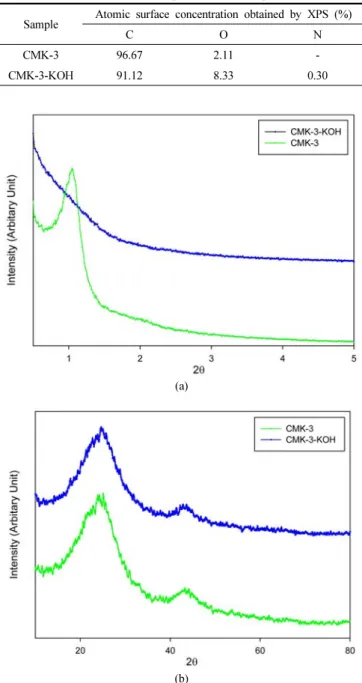
Figure 2. XRD patterns of CMK-3 and CMK-3-KOH: (a) low-angle, (b) high-angle.

(a)

(b)

(c)

Figure 3. XPS spectra of mesoporous carbons: (a) O1s of CMK-3, (b) O1s of CMK-3-KOH, (c) N1s of CMK-3-KOH.

increased micropores due to partial destruction of mesopores by KOH treatment at high-temperature (700 ℃). Figure 1 shows the nitrogen adsorption-desorption isotherms and the pore size distributions of the mesoporous carbons. The nitrogen adsorption-desorption isotherms of CMK-3 and CMK-3-KOH are compared in Figure 1(a). Both samples exhibited type IV isotherms, which are typical for mesoporous mater- ials, with a leap at relative pressure (P/P 0 ) of 0.5.

The surface elemental compositions of the mesoporous carbons anal- yzed by XPS are shown in Table 2. Compared to CMK-3, CMK-3- KOH had less carbon and more oxygen. Nitrogen was also observed on the surface of CMK-3-KOH, which was not the case for CMK-3.

This result can be attributed to the formation of oxygen and nitrogen

functional groups on the surface of CMK-3 during the activation process, which may enhance the adsorption performance. It is pre- sumed that the formation of oxygen functional groups stemmed from KOH treatment, whereas the nitrogen functional groups were formed by high-temperature treatment.

XRD analysis was performed to investigate the effect of activation

on the crystal structure of the mesoporous adsorbents. Figure 2 com-

pares the XRD patterns of CMK-3 and CMK-3-KOH. From the low-

(4)

Figure 4. FT-IR spectra of mesoporous carbons. Figure 5. Change in formaldehyde concentration due to adsorption on CMK-3 and CMK-3-KOH.

angle and high-angle patterns of XRD, it was shown that the meso- structure of CMK-3 had a 2D-hexagonal XRD pattern. In the mean- time, the low-angle pattern of CMK-3-KOH (2(a)) showed that the mesopore structure of CMK-3-KOH was destructed, which is attributed to the rapid KOH treatment at high-temperature (700 ℃).

Figure 3 shows the O1s and N1s spectra of mesoporous carbons obtained by XPS analysis. In the O1s spectra (3(a), 3(b)), the largest peak was generally observed at the binding energy level of 532.8 eV (±0.5 eV), which is C=O peak[15], although the peak intensity was changed by activation. Both CMK-3 and CMK-3-KOH showed four peaks. The peaks observed at the binding energy levels of 531.1 eV (±0.5 eV), 535.1 eV (±0.5 eV), and 537.6 eV (±0.5 eV) are C-OH, O3 and O4 peaks, respectively[15]. Figure 3(c) shows the N1s spectrum of CMK-3-KOH. Two peaks were observed in the N1s spectrum at the binding energy levels of 399.2 eV (±0.5 eV) and 400.9 eV (±0.5 eV), which represent nitrogen atom and pyridine-like nitrogen, respectively [16].

Figure 4 shows the FT-IR spectra from which the functional groups formed on the activated mesoporous carbon surface can be identified.

As was reported in the literature[17,18], the intensity of the C=O or C=N peak appearing at 1700 ∼1800 cm -1 was increased by KOH treat- ment. It is also shown that the intensities of the C-O peak appearing at 1200∼1300 cm -1 and the nitro group peak or C=O peak appearing at 1300∼1400 cm -1 were increased by KOH treatment.

3.2. Adsorption of Formaldehyde on Mesoporous Carbons Figure 5 shows the experimental results of formaldehyde adsorption on CMK-3 and CMK-3-KOH. Adsorption occurred most rapidly for the first 10 min. CMK-3 showed a high adsorption efficiency of about 50% resulting from its high specific surface area (1178 m 2 /g). CMK-3 -KOH exhibited even better adsorption performance than CMK-3 despite its slightly smaller specific surface area (1130 m 2 /g), which can be ascribed to increased oxygen and nitrogen functional groups indicated by surface composition, XPS and FT-IR analyses. In parti- cular, the surface composition analysis showed that CMK-3-KOH had

a larger amount of oxygen functional groups (8.33%) than CMK-3 (2.11%) and also had nitrogen functional groups that were not observed on the surface of CMK-3. The higher adsorption efficiency of CMK-3-KOH than that of CMK-3 is in good agreement with the result shown in Figure 4; the peak intensities of CMK-3-KOH at the wave numbers 1200 ∼1300 cm -1 , 1300 ∼1400 cm -1 , and 1700 ∼1800 cm -1 decreased to a larger extent as a result of adsorption than those of CMK-3.

4. Conclusions

In this study, mesoporous carbon, one of the ordered mesoporous materials that have been widely used as adsorbent and catalyst support due to their high chemical stability and large BET surface area, was applied to adsorption of formaldehyde after activation using KOH. The activation improved the formaldehyde adsorption performance in spite of a slight reduction of the specific surface area. XRD analysis result indicated that the mesoporous carbon structure was destructed after KOH treatment. XPS analysis showed that oxygen and nitrogen functional groups were formed by the activation process. From the FT-IR spectra, it was shown that CMK-3-KOH had higher peak intensities for the oxygen and nitrogen peaks than CMK-3 and that the decrease in the peak intensity due to adsorption was larger for CMK- 3-KOH than for CMK-3. It is believed that the formation of oxygen and nitrogen groups on the mesoporous carbon surface by activation led to improved adsorption performance despite the destruction of mesoporous carbon structure.

References

1. D. I. Kim, J. H. Park, S. D. Kim, J. Y. Lee, J. H. Yim, J. K. Jeon, S. H. Park, and Y. K. Park, J. Ind. Eng. Chem., 17, 1 (2011).

2. S. S. Kim, D. H. Kang, D. H. Choi, M. S. Yeo, and K. W. Kim, Building Environ., 43, 320 (2008).

3. S. K. Shin, J. H. Kang, and J. H. Song, J. Korean Soc. Environ.

(5)

Eng., 32, 963 (2010).

4. J. K. Lim, S. W. Lee, S. K. Kam, D. W. Lee, and M. G. Lee, J. Environ. Sci., 14, 61 (2005).

5. H. U. Lee, J. S. Kim, C. Han, and H. K. Song, Hwahak Konghak, 37, 120 (1999).

6. M. Kang, D. Kim, S. H. Yi, J. U. Han, J. E. Yie, and J. M. Kim, Catal. Today, 93-95, 695 (2004).

7. R. Ryoo, S. H. Joo, and S. J. Jun, J. Phys, Chem. B, 103, 7743 (1999).

8. S. Jun, S. H. Joo, R. Ryoo, M. Kruk, M. Jaroniec, Z. Liu, T.

Ohsuna, and O. Terasaki, J. Am. Chem. Soc., 122, 10712 (2000).

9. M. Kang, S. H. Yi, H. I. Lee, J. E. Yie, and J. M. Kim, Chem.

Commun., 1944 (2002).

10. A. B. Fuertes and D. M. Nevskaia, Micropor. Mesopor. Mater., 62, 177 (2003).

11. R. Ryoo and S. A. Jun, J. Korean Ind. Eng. Chem., 12, 1 (2001).

12. H. B. An, M. J. Yu, J. M. Kim, M. Jin, J. K. Jeon, S. H. Park, S. S. Kim, and Y. K. Park, Nanoscale Res. Lett., 7, 7 (2012).

13. J. H. Yim, D. I. Kim, J. A. Bae, Y. K. Park, J. H. Park, J. K.

Jeon, S. H. Park, J. Song, and S. S. Kim, J. Nanosci. Nanotechnol., 11, 1714 (2011).

14. J. Y. Lee, S. H. Park, J. K. Jeon, K. S. Yoo, S. S. Kim, and Y.

K. Park, Korean J. Chem. Eng., 28, 1556 (2001).

15. H. Darmstadt, C. Roy, S. Kaliaguine, S. J. Choi, and R. Ryoo, Carbon., 40, 2673 (2002).

16. Y. Xia and R. Mokaya, Adv. Mater., 16, 1553 (2004).

17. M. Kilic, M. E. Keskin, S. Mazlum, and N. Mazlum, Int. J. Miner.

Process., 87, 1 (2008).

18. M. S. Shafeeyan, W. M. A. W. Daud, A. Houshmand, and A.

Shamiri, J. Anal. Appl. Pyrolysis, 89, 143 (2010).

수치

Table 1. Physical Properties of Mesoporous Carbons
Figure 2. XRD patterns of CMK-3 and CMK-3-KOH: (a) low-angle,  (b) high-angle.
Figure 4. FT-IR spectra of mesoporous carbons. Figure  5.  Change  in  formaldehyde  concentration  due  to  adsorption  on  CMK-3 and CMK-3-KOH.

참조

관련 문서

In this study, activated carbon was prepared from rice husk by chemical activation method using KOH, NaOH, com- bination of NaOH + Na 2 CO 3 and combination of KOH + K 2 CO 3

Abstract−Adsorption of pure carbon dioxide and methane was examined on activated carbon prepared from pine cone by chemical activation with H 3 PO 4 to determine the potential

Abstract : Batch adsorption studies were carried out for equilibrium, kinetics and thermodynamic parameters for adsorption of coomassi brilliant blue G (CBBG) using

Lee, Equilibrium, kinetics and thermodynamic parameters studies on Metanil Yellow dye adsorption by granular activated carbon, Appl. Lee, Isotherms, kinetics

In this work, activated carbon fibers (ACFs) were oxyfluorinated and their adsorption ability for the low concentration of hexavalent chromium in an aqueous solution

Waste citrus peel-based activated carbon (WCAC) was prepared from waste citrus peels by activation with KOH. The removal of Cu and Pb ions from aqueous

Variation adsorption amount and removal rate of NH 4 -N on activated biochar treated with different molarity KOH through cabonization of rice hull biochar.. The values were

The adsorption ability of wood-based activated carbon to adsorb methylene blue (MB) and crystal violet (CV) from aqueous solution has been investigated.. Adsorption