Introduction
With the changes in marine ecosystems caused by rapidly changing climate regimes, the major fishing countries of the world have continued to monitor long-term alterations in nearby marine ecosystems in order to predict trends in the vari- ations (Graham, 1995; Montevecchi and Myers, 1997; Planque and Taylor, 1998). Recently, some changes in marine ecosystems caused by climate changes have been observed around the Korean peninsula, especially in the South Sea and Japan /East Sea (Kang et al., 2000; Kim and Kang, 2000; Park et al., 2000; Zhang et al., 2000; Kang et al., 2002; Ginger and Kang, 2003).
Yellowtail (Seriola quinqueradiata), which pop-
ulates Korean waters, is a commercially impor- tant migratory fish caught mostly around the coast in winter (NFRDI, 1998). In Japan, which is adjacent to Korea, numerous studies have examined yellowtail ecology (Okata, 1976; Mura- yama, 1992a), resource variation (Kobata, 1986;
Hara, 1990a, b; Hara and Murayama, 1992; Mu- rayama and Kitahara, 1992), migration (Tanaka, 1972; Murayama, 1992b), and fishing conditions and distributions (Uchino, 1977; Hiyama, 1998).
In Korea, Kim et al. (2002a, b) examined fluctua- tions in the catch and distribution of yellowtail in Korean waters and the formation of the fish- ing ground around Jeju Island, while Han and Lee (1974) examined the migration of yellowtail shoals to the Japan/East Sea. However, despite the fact that yellowtail plays an important eco- nomic role for fishers in the area, there have been no recent studies of the long-term variation in
Winter Warming and Long-term Variation in Catch of Yellowtail (Seriola quinqueradiata)
in the South Sea, Korea
Seung-Jong Lee* and You-Bong Go1
Marine and Environmental Research Institute, Cheju National University, 3288 Hamdeok-ri, Jocheon-eup, Jeju-do 695-814, Korea
1Division of Applied Marine Science, Cheju National University, 1 Ara-dong, Jeju-do 690-756, Korea
The relationships among long-term climate variation at the southern part of the Korean peninsula, oceanic conditions in the South Sea, Korea, and variation in the winter catch of yellowtail (Seriola quinqueradiata) were analyzed using 32 years of time-series data from 1971~~2002. In the early 1990s, winter climatic conditions at the southern part of Korean peninsula shifted from a cool to a warm regime with higher air temperature, relative weak wind speed, and lower relative humidity. Also, the winter water temperature at 50 m depth became consistently higher in the South Sea. The annual winter catch of yellowtail in the South Sea increased dramatically in the early 1990s, as did that of anchovy, which is the major food organism for yel- lowtail. From the results of correlation analysis, we found that the winter catch of yellowtail was more closely related to the increasing of air temperature, water tem- perature and anchovy catch.
Key words : yellowtail, South Sea, winter, climatic conditions, warm regime
*Corresponding author: [email protected]
─
─ 319 ──
yellowtail catch in relation to environmental changes, such as changes in the climate and ocean conditions.
Therefore, this study investigated seasonal variation in the catch of yellowtail, for which a major fishing ground exists in the South Sea of Korea in winter, using long-term data, and exam- ined the relationship between long-term environ- mental changes and the variation in the winter catch of yellowtail.
Materials and Methods
1. Weather conditions
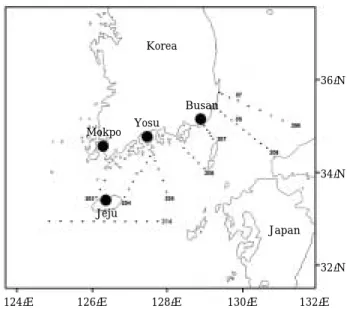
The variation in weather conditions at the southern part of Korea was examined using long- term time-series data for air temperature, wind speed, relative humidity, and sea level pressure from four regions: Mokpo, Yeosu, Busan, and Jeju (Fig. 1). These data were collected over 32 years, from 1971~2002, by the Korea Meteorological Administration (KMA). Each meteorological fac- tor anomaly was used the value which an aver- age of the regional monthly mean minus the monthly actual value from the KMA data from 1971~2000.
2. Oceanic conditions
Variation in the long-term oceanic conditions of the South Sea were examined using bimonthly observational water temperature data at a depth of 50 m, which is a major swimming zone for yel- lowtail, at 53 stations along eight observational lines (Line 203, 204, 205, 206, 207, 208, 209, and 314; Fig. 1). These data were collected over 32 years (1971~2002) by the National Fisheries Research & Development Institute (NFRDI). The water temperature anomaly was used the value which an average of the normal value at each point, from 1966~1995, from data of sea condi- tions in Korean Waters (NFRDI, 1997) minus the monthly actual value at each station.
3. Catch data
Published catch data for yellowtail and ancho- vy, which is a major food resource for yellowtail, were obtained from the Korean Ministry of Mari- time Affairs and Fisheries (MOMAF). Yearly and monthly catch data from 1971~2002 for four regions at the southern part of Korea, i.e., Jeolla-
nam-do, Gyeongsangnam-do, Busan, and Jeju, were used for this study. Yellowtail data were derived from the total fishing catch, while ancho- vy data were derived from powered anchovy drag net, drift gill net, and set net catches.
4. Seasonal classification
The seasonal classification of yellowtail and anchovy catch and environmental factors were as follows: spring, from March to May; summer, from June to August; autumn, from September to November; and winter, from December to Feb- ruary. Mean values was used for this study. For water temperature, which was observed every other month, winter values were represented by the mean of data from February and December.
5. Statistical analysis
Correlation analysis was performed to examine the relationship between the catch of yellowtail and environmental factors in the South Sea in winter. Owing to differences in the units of mea- surement, all data were standardized prior to analysis using the formula (Xi-X)/SD, where Xiis observational data for variable i, and X and SD are the mean and standard deviation, respective- ly (Johnson and Wichern, 1988).
Fig. 1. Map showing the meteorological data observation area (black circle) by KMA (Korea Meteorological Administration) and water temperature observa- tion stations (dotted points) by NFRDI (National Fisheries Research & Development Institute) in the South Sea of Korea from 1971 to 2002.
124�E 126�E 128�E 130�E 132�E
36�N
34�N
32�N Korea
Busan Mokpo Yosu
Jeju
Japan
Results
1. Annual changes in winter environmental factor anomalies
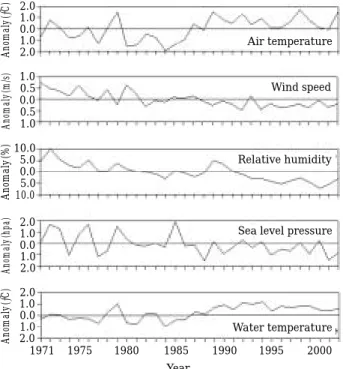
Fig. 2 shows the long-term variations in climat- ic factor anomalies, such as air temperature, wind speed, relative humidity, and sea level pressure, at the southern part of Korea, and the winter water temperature anomaly at a depth of 50 m in the South Sea.
The air temperature anomaly ranged from -2.0�C (1984) to 1.7�C (1998). Temperatures for most years until the mid-1980s were lower than that of an average year by 0.5~2.0�C; after this time, the temperature began to increase. After the late 1980s, air temperatures were consistent- ly higher than average.
Variation in the wind speed anomaly ranged from -0.5 m s-1(1992) to 0.7 m s-1(1971). Until the late 1980s, the wind speed was similar to or greater than that of an average year. However, after the 1990s, the wind speed was consistently lower, and the winter wind speed tended to de- crease steadily.
Variation in the winter relative humidity anom- aly ranged from -7.2% (2000) to 10.0% (1972).
Until the early 1990s, the relative humidity was similar to or greater than that of an average year. After the early 1990s, the relative humidity was consistently lower.
Variation in the sea level pressure anomaly ranged from -1.5 hpa (1988) to 1.9 hpa (1985).
Until the late 1970s, the variation in sea level pressure was irregular; after the 1980s, the sea level pressure was similar to or lower than that of an average year, except in 1985.
Variation in the winter water temperature anomaly at a depth of 50 m ranged from -1.0�C (1984) to 1.2�C (1994). From the late 1980s to 2002, water temperatures were consistently higher than average by 0.5~1.0�C. The water temperature anomaly varied similarly to the air temperature anomaly. Thus, winter at the south- ern part of Korea gradually became warmer be- ginning around the 1990s, as did water tempera- ture in the South Sea.
2. Horizontal distribution of the winter water temperature anomaly in the South Sea
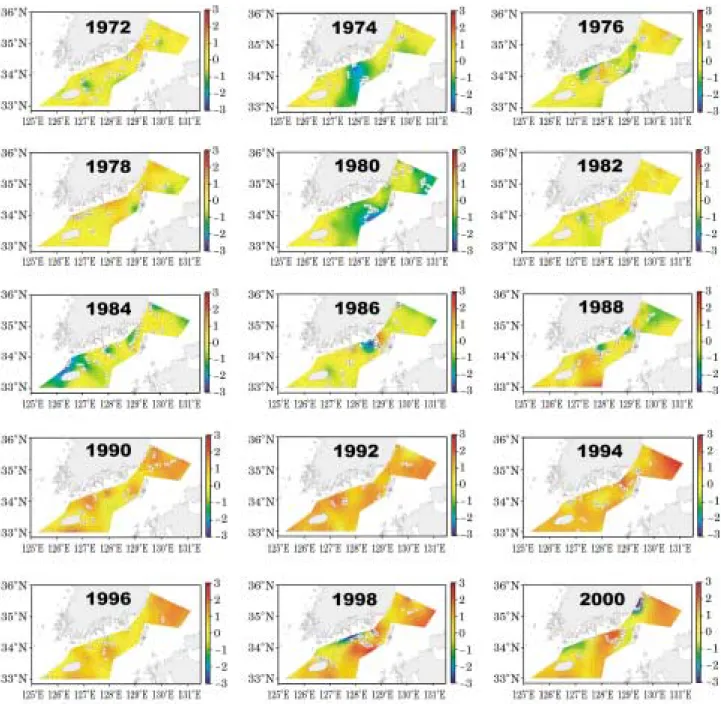
Fig. 3 shows the horizontal distribution of the winter water temperature anomaly at a depth of 50 m in the South Sea over time. In the 1970s, the water temperature anomaly ranged from -2.4 to 1.5�C throughout the whole South Sea, and, in most areas, it was similar to or lower than that of an average year. In 1974, a cold wa- ter zone, with a temperature 1~2�C lower than average, formed in the middle of the South Sea.
In the 1980s, the water temperature anomaly ranged from -2.7 to 2.4�C. Particularly in 1980 and 1984, water masses that were lower in tem- perature than average by 2�C were found in the middle of the South Sea and northwest of Jeju Island, respectively. In contrast, in 1988, a water mass that was higher in temperature than aver- age by 1~2�C was found east of Jeju Island.
From the 1990s on, the water temperature anomaly ranged from -2.6 to 2.7�C. Except for cold water zones that were lower in temperature than average by 2�C that formed in 1998 and 2000, water masses with temperatures 1~2�C higher than average were widely distributed in most areas, unlike in the 1970s and 1980s. Exam- ination of winter oceanic conditions in the South Sea over time showed that high-temperature
2.0 1.0 0.0 - 1.0 - 2.0
Anomaly(�C)Anomaly(�C)
Air temperature
Wind speed 1.0
0.5 0.0 - 0.5 - 1.0
Anomaly(m/s)
Relative humidity 10.0
5.0 0.0 - 5.0 -10.0
Anomaly(%)
Sea level pressure 2.0
1.0 0.0 - 1.0 - 2.0
Anomaly(hpa)
Water temperature 2.0
1.0 0.0 - 1.0 - 2.0
Anomaly(�C)
1971 1975 1980 1985 1990 1995 2000
Year
Fig. 2. Annual changes of meteorological factor anomalies in the southern part of Korea and water tempera- ture anomaly at a depth of 50 m in winter in the South Sea of Korea from 1971 to 2002.
water masses appeared mostly in the 1990s, in comparison with the 1970s and 1980s.
3. Annual changes in yellowtail catch
Fig. 4 shows the annual variation in yellowtail catch in Korea, including the South Sea, over 32 years, from 1971~2002. The mean catch of yel- lowtail in Korea over the 32 years was 3,848 M/T.
In 1971, the mean yellowtail catch was 761 M/T;
this increased steadily during the 1980s and
reached 6,218 M/T in 1989. However, a large de- crease in yellowtail catch began in 1990, with only 2,233 M/T caught in 1992. After this, the catch increased to 9,620 M/T, the maximum cat- ch, in 1998.
Variation in the yellowtail catch in the South Sea was similar to that in Korea. The catch from the South Sea accounted for at least 65.5% of the total catch of yellowtail in Korea during the period of investigation. These results indicate that the catch of yellowtail began to increase
Fig. 3. Biennial variation in the horizontal distribution of water temperature anomaly at a depth of 50 m in winter in the South Sea.
markedly from the late 1990s, and yellowtail was mostly fished from the South Sea.
4. Seasonal variation in yellowtail catch in the South Sea
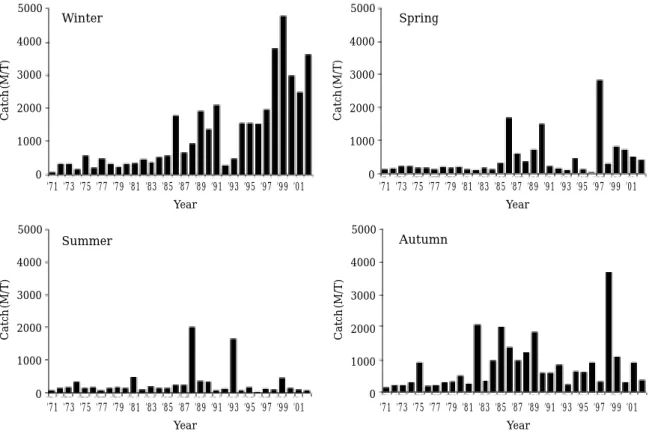
Fig. 5 and 6 show the variation in the yellow- tail catch and the proportion of the yellowtail catch from the South Sea by season from 1971~
2002, respectively. During the period examined,
the mean winter catch, at 1,212 M/T, was higher than the catches of the other seasons. The winter catch was as low as 500 M/T until the early 1980s, showed a rapid increase from the mid-1980s, and was high, over 3,000 M/T, after the late 1990s.
The spring and autumn catches showed similar trends, with mean catches of 436 and 787 M/T, respectively. Both spring and autumn catches were high in the late 1980s and 1990s. After the early 2000s, however, both spring and autumn catches tended to decrease. Among the seasons, the mean summer catch was the lowest, at 276 M/T. The summer catch was as low as 500 M/T during the period of investigation, with a slight increase in the 1988 and 1993.
The proportion of the yellowtail catch from the South Sea differed between winter and the other seasons, for which the catch decreased over time (Fig. 6). The winter proportion of yellowtail catch from the South Sea increased rapidly from 31.5%
in the 1970s, to 50.3% in the 1990s, and to as much as 72.5% in the early 2000s.
5. Annual variation in winter anchovy catch in the South Sea
Fig. 7 shows the annual variation in the winter
12000
10000
8000
6000
4000
2000
0
Catch(M/T)
1971 1975 1980 1985 1990 1995 2000
Year Total catch
South sea
Fig. 4. Fluctuations in annual catch of yellow tail in Kor- ea from 1971 to 2002.
Winter
’71 ’73 ’75 ’77 ’79 ’81 ’83 ’85 ’87 ’89 ’91 ’93 ’95 ’97 ’99 ’01 Year
5000
4000
3000
2000
1000
0
Catch(M/T)
5000
4000
3000
2000
1000
0
Catch(M/T)
’71 ’73 ’75 ’77 ’79 ’81 ’83 ’85 ’87 ’89 ’91 ’93 ’95 ’97 ’99 ’01 Year
Spring
5000
4000
3000
2000
1000
0
Catch(M/T)
’71 ’73 ’75 ’77 ’79 ’81 ’83 ’85 ’87 ’89 ’91 ’93 ’95 ’97 ’99 ’01 Year
Summer
’71 ’73 ’75 ’77 ’79 ’81 ’83 ’85 ’87 ’89 ’91 ’93 ’95 ’97 ’99 ’01 Year
5000
4000
3000
2000
1000
0
Catch(M/T)
Autumn
Fig. 5. Seasonal variations in the catch of yellow tail in the South Sea of Korea from 1971 to 2002.
catch of anchovy in the South Sea. In general, the winter anchovy catch remained near approx- imately 20,000 M/T until the early 1990s, rapidly increased after the mid-1990s, and reached about
40,000 M/T in the early 2000s. In 2002, the win- ter catch of anchovy reached a maximum of 55,889 M/T.
6. Correlation analysis
Table 1 gives the correlation coefficients bet- ween the winter catch of yellowtail in the South Sea and environmental factors including meteo- rological variable anomalies, and the winter anchovy catch. The winter catch of yellowtail showed significant positive correlation with an- chovy catch (r==0.741, P⁄0.01), air temperature (r==0.468, P⁄0.01) and water temperature (r== 0.433, P⁄0.05).
On the other hand, the winter catch of yellow- tail showed significant negative correlation with wind speed (r==-0.512, P⁄0.01), relative humid- ity (r==-0.548, P⁄0.01) and sea level pressure (r==-0.364, P⁄0.05).
Discussion
According to the report of the Intergovernmen- tal Panel on Climate Change (IPCC), global warming has accelerated as the average global temperature has increased by about 0.6�C since 1860 (IPCC, 2001). The signs of global warming are distinct, as atmospheric and water tempera- tures around Korea have increased since the 1990s (Hahn, 1994; Choi et al., 2003; Kwon et al., 2003). Climate changes have caused variation in the stocks and catches of commercial fisheries worldwide. Beamish and Bouillon (1993) investi- gated the correspondence between long-term pat- terns in the Aleutian Low Pressure system and trends in salmon catches and found that both the climate and the marine environment may play an important role in salmon production. Hollow- ed et al. (1998) also reported increasing trends in
60000
50000
40000
30000
20000
10000
Catch(M/T)
19710 1975 1980 1985 1990 1995 2000
Year Winter
3 years moving average
Fig. 7. Annual change of the winter anchovy catch in the South Sea of Korea from 1971 to 2002.
Table 1. Results of correlation analysis for the winter yellowtail catch (Y) and environmental variables (X)
Y X1 X2 X3 X4 X5 X6
X1 ++0.741** ++1.000
X2 ++0.468** ++0.392* ++1.000
X3 -0.512** -0.554** -0.462** ++1.000
X4 -0.548** -0.771** ++0.008 ++0.545** ++1.000
X5 -0.364* -0.355* ++0.026 ++0.359* ++0.546** ++1.000
X6 ++0.433* ++0.471** ++0.873** -0.591** -0.262 -0.106 ++1.000
Y, catch of yellow tail; X1, catch of anchovy; X2, anomaly of air temperature; X3, anomaly of wind speed; X4, anomaly of relative humidity;
X5, anomaly of sea level pressure; X6, anomaly of water temperature.
*, significant at 5% level; **, significant at 1% level.
Fig. 6. Seasonal variations in catch proportion of yellow tail in the South Sea of Korea from 1971 to 2002.
Catch proportion
100%
80%
60%
40%
20%
0%
1970s 1980s 1990s 2000s
Year
Autumn Summer Spring Winter
33.1
17.4
18.0
31.5
15.8
28.3
17.9
50.3
12.9
72.5 14.4
8.1
2.4 41.5
23.7
12.2
total salmon catches, primarily as a result of increased salmon production in Alaska after the intensification of the Aleutian Low Pressure sys- tem. Klyashtorin (1998) examined the relation- ships between long-term dynamics of catches of major commercial fish species and indices such as the northern hemisphere surface air tempera- ture anomaly, the Aleutian Low Pressure Index (ALPI), and the Atmospheric Circulation Index (ACI) in the Atlantic and Pacific, and found that the ACI was more closely related to long-term fluctuations in the major commercial fish stocks than were the other indices. In addition, in Kor- ean waters, the variation in commercial fisheries catches was caused by climatic changes such as the warming that occurred after the late 1980s or early 1990s around the Korean peninsula.
Kang et al. (2002) and Kang and Kim (2002) reported that squid has replaced saury, cod, and walleye pollock as the major fishery in the Japan /East Sea since the late 1980s and that the catch of mackerel increased in the early 1990s. Also, anchovy, mackerel, and jack mackerel catches increased, while sardine and filefish catches decreased in the northern East China Sea in the 1990s (Kim and Kang, 2000; Zhang et al., 2000).
These phenomena indicate that environmental changes, such as climate change, have led to sig- nificant changes in oceanic ecosystems, including changes in both higher trophic levels and prima- ry producers.
In this study, the winter air temperature at the southern part of Korea increased from the aver- age by about 0.7�C since the 1990s, accompanied by lower wind speeds and drier weather. In addi- tion, winter water temperature at a depth of 50 m in the South Sea increased by about 0.7�C since the 1990s, similar to air temperature. In particu- lar, the variation in the winter air temperature anomaly is similar to and correlated with that of water (r==0.873, P⁄0.01, Table 1). Therefore, meteorological changes at the southern part of Korea are closely related to variations in oceanic conditions in the South Sea in winter, indicating that global warming has occurred at the south- ern part of Korea since the 1990s, resulting in continuous dryness caused by decreases in rela- tive humidity, weaker seasonal winds, and incre- ases in winter air temperature.
Yellowtail is a migratory fish that forms a major fishing ground in the southwestern South Sea area centered on Jeju Island in winter; it therefore was caught mostly in winter (NFRDI,
1998; Kim et al., 2002b). The total catch of yel- lowtail in Korea increased from the late 1990s.
In particular, the winter catch showed a rapid increase after the late 1990s compared with that of other seasons. Thus, we conclude that the dis- tinctive increase in the winter yellowtail catch since the 1990s is closely related to global warm- ing, which caused variation in meteorological and oceanic conditions in the South Sea area.
Generally, the migration of yellowtail, which is a warm-water species, depends on the formation of warm water masses. Hara (1990a, b) reported that yellowtail populations, residence time, and the period of fishery formation increased with increases in warm water masses caused by an inflow of the Tsushima Warm Current into the west coast of Japan. In the South Sea of Korea, water masses with higher than average tempera- tures have occurred since the 1990s. Considering that most yellowtail fishing grounds are formed in the South Sea in winter, warmer water masses in this area may have played an important role in increasing the yellowtail fishery-forming peri- od compared with that in the 1970s and 1980s, resulting in improved yellowtail production in winter.
Small pelagic fishes such as anchovy, sardine, common mackerel, and horse mackerel are major food resources for yellowtail, which is a high trophic-level piscipredator. Yellowtail is not very selective in its prey choice (Kubo, 1966; NFRDI, 1998). The anchovy catch has steadily increased since the 1990s; this fish has a simple age struc- ture, grows rapidly in its early stages, and tends to form large groups. Its recruitment and food resources are considerably affected by various environmental factors. Anchovy lives near the sea surface, is a warm-water fish, and is very sensitive to variations in the climate (Kawasaki, 1993; Watanabe et al., 1995; Kim, 2003). Ginger and Kang (2003) reported that the climate regime shift that occurred in the late 1980s around the Korean peninsula caused an increase in copepod biomass, which is a major food resource for an- chovy (Arthur, 1976; Hirakawa et al., 1997) in the South Sea of Korea. Thus it is supposed that changes in the marine environment in this area, such as the increase in winter water tempera- ture since the 1990s caused by global warming, favorably affected anchovy populations and led to the improvement of anchovy production. In addition, the winter catches of anchovy and yel- lowtail in the South Sea were highly positively
correlated (r==0.741, P⁄0.01, Table 1). Therefore, an increase in anchovy caused by winter warm- ing may lead to the provision of favorable food resources for yellowtail that migrate to the South Sea in winter and may have contributed to the increase in this yellowtail population.
Meteorological factors affect the formation of the yellowtail fishing ground; in particular, fish- ing ground formation is closely related to low pressure systems passing through the fishing ground (Mitani, 1954; Mori, 1964; Kubo, 1966).
Using data for set net catches of yellowtail, Mori (1964) proposed that meteorological factors strongly affect the migration and existence of yellowtail. Mitani (1954) also reported that the number of yellowtail increased several days be- fore or after a low pressure system passed throu- gh the fishing ground. We found that the atmos- pheric pressure has consistently been lower than average since the mid-1980s. Low pressure in winter may indirectly affect the yellowtail popu- lation migrating to the coast, resulting in the improvement of the yellowtail catch, but the cor- relation between these factors is still unknown.
Therefore, it is necessary to thoroughly examine the effect of atmospheric pressure on fishing ground formation in yellowtail.
Future studies should develop this forecasting model by adding appropriate environmental fac- tors that are closely related to the ecology of yel- lowtail, as well as factors such as changes in fishing fleet operations in the coastal area and catch per unit effort (CPUE) since the 1970s, for greater precision.
Acknowledgments
This work was supported by a grant from the Academic Research Fund of the Cheju National University Development Foundation of 2004.
References
Arthur, D.K. 1976. Food and feeding of larvae of three fish- es occurring in the California Current, Sardinops sagax, Engraulis mordax and Trachurus symmerticus. Fish.
Bull., 74 : 517~530.
Beamish, R.J. and D.R. Bouillon. 1993. Pacific salmon production trends in relation to climate. Can. J. Fish.
Aquat. Sci., 50 : 1002~1016.
Choi, Y., K.Y. Nam, H.S. Jung and W.T. Kwon. 2003. Esti- mating and correcting urban bias in surface tempera- ture time series of Korea. Inter. J. Climato., 23 : 577~
591.
Ginger, A.R. and Y.S. Kang. 2003. A comparison of three marine ecosystems surrounding the Korean peninsula:
Responses to climate change. Pro. Oceanogr., 59 : 357~
379.
Graham, N.E. 1995. Simulation of recent global tempera- ture trend. Science, 267 : 666~671.
Hahn, S.D. 1994. SST warming of Korea coastal waters during 1881~1990. KODC Newsletter, 24 : 29~38. (in Korean)
Han, H.S. and B.H. Lee. 1974. On Shoals of the Yellowtail (Seriola quinqueradiata T. & S.) migrating to the East Sea of Korea. Bull. Natl. Fish. Res. Dev. Agency, 12 : 27~36. (in Korean)
Hara, N. 1990a. An Abundance Index of Yellowtail Immi- grating into the Sea of Japan and Its Yearly Variation.
Nippon Suisan Gakkaishi, 56 : 19~24. (in Japanese) Hara, N. 1990b. Yearly Fluctuations of Yellowtail Catch in
Set Net Fishery along the Coastal Area of the Sea of Japan. Nippon Suisan Gakkaishi, 56 : 25~30. (in Ja- panese)
Hara, N. and T. Murayama. 1992. Long-term Fluctuations in Abundance of the Yellowtail Immigrants in the Coastal Areas of Japan. Nippon Suisan Gakkaishi, 58 : 2219~2227. (in Japanese)
Hirakawa, K., T. Goto and M. Hirai. 1997. Diet composi- tion and prey size of larval anchovy, Engraulis japoni- cus, in Toyama bay, Southern Japan Sea. Bull. Jap.
Sea Natl. Fish. Res. Inst., 47 : 67~78.
Hiyama, Y. 1998. Spatial and temporal variability in fork length of young yellowtail in the Japan Sea. Bull. Jap.
Sea Natl. Fish. Res. Inst., 48 : 27~35.
Hollowed, A.B., S.R. Hare and W.S. Wooster. 1998. Pacific basin climatic variability and patterns of northeast Pacific marine fish production. Holloway, G., P. Muller and D. Henderson (Eds), Biotic impacts of extratropical climate variability in the Pacific (pp. 89~104). Proceed- ings ‘Aha Huliko’ a Hawaiian winter workshops, Uni- versity of Hawaii at Manoa, January 25~29, 1998.
IPCC. 2001. Climate Change 2001: The Scientific Basis.
Contribution of Working Group I to the Third Assess- ment Report of the Intergovernmental Panel on Cli- mate Change. Houghton, J.T., Y. Ding, D.J. Griggs, N.
Nogurer, P.J. van der Linden, X. Dai, K. Maskell and C.A. Johnson (Eds), Cambridge University Press, Cam- bridge, United Kingdom, 881pp.
Johnson, R.A. and D.W. Wichern. 1988. Applied multivari- ate statistical analysis. Prentice Hall, London, 594pp.
Kang, Y.S., J.Y. Kim, H.G. Kim and J.H. Park. 2002. Long- term changes in zooplankton and its relationship with squid, Todarodes pacificus, catch in Japan/East Sea.
Fish. Oceanogr., 11 : 337~346.
Kang, Y.S., S.A. Kim and S.W. Bae. 2000. Changes in eco- system components induced by climate variability off the eastern coast of the Korean Peninsula during 1960
~1990. Pro. Oceanogr., 47 : 205~222.
Kang, Y.Q. and S.A. Kim. 2002. Zooplankton in the Korean waters. In: D. Lee (Ed), Ecology of Korea. Bumwoo Pub- lishing Co. Seoul, Korea, pp. 331~343. (in Korean) Kawasaki, T. 1993. Recovery and collapse of the far east-
ern sardine. Fish. Oceanogr., 2 : 244~253.
Kim, J.T., H.G. Rho and S.H. Kim. 2002a. Studies on the Forming Mechanism of The Fishing Ground of Yellow tail, Seriola quinqueradiata, in the Adjacent Sea of Jeju Island. Bull. Kor. Soc. Fish. Tech., 38 : 20~35. (in Korean)
Kim, J.T., H.G. Rho, S.H. Kim, J.C. Ko, Y.H. Ahn and C.M.
Choi. 2002b. Characteristics of Catch Fluctuation and Distribution of Yellow tail, Seriola quinqueradiata, TEMMINCK et SCHLEGEL, in Korean Waters. Bull.
Kor. Soc. Fish. Tech., 38 : 11~19. (in Korean)
Kim, S.A. 2003. Changes in fisheries resources in relation to variability of oceanic environments. J. Kor. Soc. Fish.
Res., 6 : 11~20. (in Korean)
Kim, S.A. and S.Y. Kang. 2000. Ecological variation and El Ni~no effects off the southern coast of the Korean Penin- sula during the last three decades. Fish. Oceanogr., 9 : 239~247.
Klyashtorin, L.B. 1998. Long-term climate change and main commercial fish production in the Altlantic and Pacific. Fish. Res., 37 : 115~125.
Kobata, T. 1986. On the Tendency of Long-Term Decreas- ing Catch of Adult Yellowtail, Seriola quinqueradiata in Its Pacific Sub-population. Bull. Jap. Soc. Sci. Fish., 57 : 1181~1187. (in Japanese)
Kwon, W.T., Y. Choi, J.H. Oh and H.J. Baek. 2003. Under- standing of regional climate change in Korea. In : The first symposium on climate change, oceanography and fisheries, Nat. Fish. Res. & Dev. Ins. Busan, pp. 17~
20.
Kubo, I. 1966. Special Fishery Resources. Chapter 9 Yellow -tail. Kouseisha-kouseikaku Press, Tokyo, pp. 346~387.
(in Japanese)
Mitani, F. 1954. Studies on the Fishing Conditions of Some Usefull Fishes in the Western Region of Wakasa Bay-I.
Relation between the Catch of the Yellow-tail, Seriola quinqueradiata (Temminck et Schlegel), and the Meteo- rological Factors. Bull. Jap. Soc. Sci. Fish., 20 : 89~95.
(in Japanese)
Montevecchi, W.A. and R.A. Myers. 1997. Centurial and decadal oceanographic influences on changes in north- ern gannet populations and diets in the north-west Atlantic : Implications for climate change. ICES J. Mar.
Sci., 54 : 608~614.
Mori, I. 1964. On the secular variation of catch of the Yel- low-tail, Seriola quinqueradiata T. and S., in the Me-
shima fishing ground (fixed net) of the East China Sea.
Bull. Jap. Soc. Sci. Fish., 30 : 1~5. (in Japanese) Murayama, T. 1992a. Growth of the Yellowtail, Seriola
quinqueradiata in the Japan Sea Coast in Recent Years.
Nippon Suisan Gakkaishi, 58 : 601~609. (in Japanese) Murayama. T. 1992b. Migration of Young Yellowtail in the
Japan Sea, Estimated from Tagging Experiments. Nip- pon Suisan Gakkaishi, 58 : 417~426. (in Japanese) Murayama, T. and T. Kitahara. 1992. Long-term Trends in
Abundance of the Yellowtail, Seriola quinqueradiata Immigrants in the Coastal Areas of Japan. Nippon Sui- san Gakkaishi, 58 : 409~416. (in Japanese)
National Fisheries Research and Development Institute.
1998. Ecology and fishing grounds of major fish species in the Korean coastal and offshore area. Ye-Moon Pub- lication Co., 304pp. (in Korean)
National Fisheries Research and Development Institute.
1997. Climatic Atlas of T, S, DO in Korean Waters (1966
~1995). Ye-Moon Publication Co., 268pp. (in Korean) Okata, A. 1976. Ecological Studies on the Biological Pro-
duction of Young Amberfish Community in the Sendai Bay-III. Movement of the Young Amberfish. Bull. Jap.
Soc, Sci. Fish., 42 : 1101~1113.
Park, J.H., K.S. Hwang and Y.S. Kang. 2000. Variation of Fishing Condition and the Winter Warming in Korean Waters. J. Kor. Soc. Fish. Res., 3 : 77~87.
Planque, B. and A.H. Taylor. 1998. Long-term changes in zooplankton and the climate of the North Atlantic.
ICES J. Mar. Sci., 55 : 644~654.
Tanaka, S. 1972. Migration of Yellowtails along the Pacific Coast of Japan Observed by Tagging Experiments-I.
Results from Release and Recapture Data. Bull. Jap.
Soc. Sci. Fish., 38 : 29~32. (in Japanese)
Uchino, K. 1977. Studies on Fishing Condition of Amber- fish in the Wakasa Bay-I. Movement of the Juvenile Amberfish (Mojako), inferred from the Results of Tag- ging Experiments. Bull. Jap. Soc. Fish. Oceanogr., 31 : 1~6. (in Japanese)
Watanabe, Y., H. Zeromu and R. Kimura. 1995. Population decline of the Japanese sardine, Sardinops melanostic- tus, owing to recruitment failures. Can. J. Fish. Aquat.
Sci., 52 : 1609~1616.
Zhang, C.I., J.B. Lee, S.A. Kim and J.H. Oh. 2000. Climatic regime shifts and their impacts on marine ecosystem and fisheries resources in Korean waters. Pro. Ocean- ogr., 47 : 171~190.
Received : August 3, 2006 Accepted : September 18, 2006
겨울철 온난화와 남해 방어 어획량의 장기변동 이 승 종*∙고 유 봉1
제주대학교 해양과환경연구소, 1제주대학교 해양과학부 해양생산과학전공
1971~2002년까지의 지난 32년간 장기간 시계열 자료를 통하여 겨울철 남해의 방어 어획량 변동양상을 계절별로 구분하여 조사하고, 이와 더불어 겨울철 한국 남부의 기상상황 및 남해의 해황 변화도 조사하여 장기간의 환경변화와 방어의 어획량 변동 사이의 대응관계에 대해서 살펴 보았다. 겨울철 우리나라 남부의 기상변동을 살펴본 결과 1990년대에 들어서 기온이 상승하고 상대습도는 낮아지며 풍속이 많이 약화되는 특징들을 보이는 등 전체적으로 온난화 경향을 나타 내고 있었고, 겨울철 남해의50 m 수층 수온도 이 시기부터 뚜렷이 상승하고 있었다. 이와 관련하 여 남해의 방어 어획량 변동양상을 계절별로 구분하여 조사한 결과 타 계절에 비해 특히 겨울철 생산량이1990년대에 들어서부터 점차 증가하고 있었으며 방어의 주먹이원의 하나인 멸치의 어 획량도 이 시기부터 증가하고 있었다. 이번 연구에서 조사한 기상 요인들을 포함한 환경 요인들 과 겨울철 남해 방어 어획량 자료를 이용하여 상관분석을 실시한 결과 겨울철 방어 어획량의 증 가는 겨울철 기온과 수온의 증가 그리고 멸치 어획량의 증가와 매우 밀접하게 연관되어 있다는 것을 알 수 있었다.