—45—
서 론
돌팍망둑 (Pseudoblennius percoides)은 둑중개과 (family
Cottidae)에 속하는 어종으로서 우리나라의 제주도를 포함
한 남해안과 일본 남부지역에 분포하며, 연안해역의 해조류 및 잘피가 밀생된 해역에 주로 서식한다고 알려져 있다(Kim et al., 2005). 둑중개과는 전 세계적으로 70속 320여종
이 보고되고 있으며 (Nelson, 2006), 우리나라에서는 21속36
종이 보고된 바 있다(Kim and Youn, 1992).지금까지 우리나라에서 수행된 돌팍망둑에 관한 연구는 거의 이루어지지 않고 있는 실정이지만 같은 속 (genus) 어 류인 가시망둑 (Pseudoblennius cottoides)에 대한 연구로는 먹이습성, 난 발생 및 형태발달, 그리고 산란습성 및 초기생 활사 등에 관한 연구가 보고된 바 있다 (Huh and Kwak,
1998; Yoo et al., 2003). 그러나 돌팍망둑은 우리나라 및 인
근 일본 주변해역의 잘피밭에서 주로 서식하는 어종 중의하나로 보고되고 있어서(Kikuchi, 1966; Kimura et al., 1983;
Huh, 1986; Huh and Kwak, 1997a; Lee et al., 2000; Kwak et
al., 2006; Hwang, 2007), 이 어종에 대한 생태학적인 연구 가 필요하다고 생각된다. 한편 일본 Yanagihama Beach 및Shijiki Bay에서 서식하는 돌팍망둑은 주로 작은 크기의 넙
치를 섭식하거나 갑각류 및 작은 크기의 어류를 먹는다고 보고되어 있다(Matsumiya et al., 1980; Noichi et al., 1993).어류의 먹이습성 연구는 그 어류가 속해 있는 생태계의 먹이망 구조를 파악하기 위한 기초 자료를 제공한다. 본 연 구는 우리나라 남해안의 동대만 잘피밭에서 우점하는 돌팍 망둑의 주요 먹이생물의 종류, 성장 및 계절에 따른 먹이습 성의 변동을 파악하고자 한다.
재료 및 방법
본 연구에 사용된 돌팍망둑의 시료는 2005년 1월부터
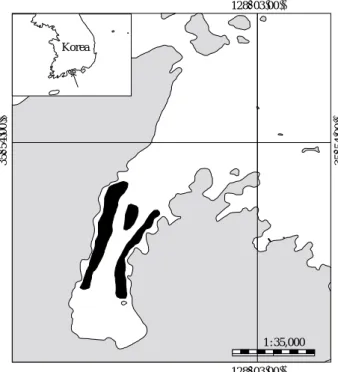
2005년 12월까지 동대만의 잘피밭 (Fig. 1)에서 매월 소형
동대만 잘피밭에 서식하는 돌팍망둑(Pseudoblennius percoides)의 식성
허성회∙곽석남1,
*
∙김하원부경대학교 해양학과, 1
(주)해양생태기술연구소
Feeding Habits of Pseudoblennius percoides (Pisces; Cottidae) in an Eelgrass (Zostera marina) Bed of Dongdae Bay by Sung-Hoi Huh, Seok Nam Kwak1,* and Ha Won Kim (Department of Oceanography, Pukyong National University, Busan 608-737, Korea, 1Marine Eco-Technology Institute Co., Ltd. 485-1 Yongdang, Namgu, Busan 608-830, Korea)
ABSTRACT Feeding habits of Pseudoblennius percoides collected from the eelgrass bed in Dongdae Bay from January to December 2005 were studied. P. percoides was a carnivore which mainly consumed fishes and caridean shrimps. Its diets included small quantities of mysids, amphipods (gammarid amphipods and caprellid amphipods), copepods, cephalopods, polychaetes, and crabs. P. percoides undergoes significant size-related changes; smaller fish (⁄3.0 cm SL) prey mainly copepods, gammarid amphipods, and mysids while the proportion of caridean shrimps and fishes increases with fish size. Fishes and caridean shrimps were major prey organisms for all seasons. Dietary breadth of P. percoides was lower with fish size and seasons.
Key words : Pseudoblennius percoides, feeding habits, eelgrass bed, fishes, caridean shrimps, amphipods,
dietary breadth*교신저자: 곽석남 Tel: 82-51-611-6200, Fax: 82-51-611-0588, E-mail: [email protected]
http://www.fishkorea.or.kr
빔 트롤을 이용하여 채집하였다. 동대만은 반폐쇄성만으로 잘피가 만 전체에 넓게 분포하고 있으며, 어업활동이 비교 적 원활하게 이루어지고 있지 않은 해역으로 잘피의 보존 상태가 양호하였다. 시료 채집에 사용된 어구의 크기는 길 이 5 m, 망폭 4 m였으며, 망목의 크기는 날개그물에서 1.9
cm, 끝자루로 갈수록 차츰 망목의 크기가 감소하여 끝자루
에서는 1 cm였다.채집된 어류는 10% 중성 포르말린으로 고정하였으며, 실 험실에서 표준체장 (standard length: SL)을 기준으로 10 mm 간격으로 크기군(size class)을 나눈 뒤, 어체에서 위를 분리 하였다. 위 내용물은 해부현미경을 이용하여 먹이 종류별로 분리하고 동정하였다. 먹이생물은 가능한 종 (species)까지 분석하였으나, 종 동정이 어려운 개체는 과(family) 혹은 목
(order) 단위까지 분류하였다. 위내용물 중 출현하는 먹이생
물의 동정은 Kim (1973), Takeda (1982), Cha et al. (2001),Yoon (2002), Kim et al. (2005) 등을 참조하였다. 먹이 생물
의 크기는 mm 단위까지 측정하였으며, 각 먹이 종류별로80� C의 건조기에서 24시간 건조시킨 뒤, 전자식 저울을 이
용하여 건조중량을 측정하였다.
위내용물의 분석 결과는 각 먹이생물에 대한 출현빈도수, 먹이생물의 개체수비, 그리고, 건조중량비로 나타내었다.
각 먹이생물의 출현빈도수 (Fi
)는 다음의 식을 이용하여
구하였다.A
iF
i==mmm×100N
여기서, N: 조사된 총 어류의 개체수
A
i: 위내용물 중 i 먹이생물이 발견된 어류의 개체
수이다.섭식된 먹이생물의 상대중요성지수 (Index of relative im-
portance, IRI)는 Pinkas et al. (1971)의 식을 이용하였다.
IRI=
=(N++W)×F
여기서, N: 위내용물에서 발견된 총 먹이 개체수 중 해당 먹이생물이 차지하는 비율
W: 위 내용물 건조중량 중 해당 먹이생물이 차지하
는 비율F: 해당 먹이생물의 출현빈도수
1:35,000 128�03′00′′
128�03′00′′
35�54′00′′
35�54′00′′
Korea
Standard length (cm SL)
Mar. n =38
0 50 100
Jan. n = 0
0 50 100
Dec. n =0 0
50 100
Fab. n = 3
0 50 100
Apr. n =33
0 50 100
May n =38
0 50 100
Jun. n =11
0 50 100
Jul. n =7
0 50 100
Agu. n =3
0 50 100
Sep. n =3
0 50 100
Oct. n =0
0 50 100
Nov. n =0
0 50 100
1 2 3 4 5 6 7 8 9 10 11 12
Relative frequency (%)
Fig. 2. Monthly variation in size distributions of Pseudoblennius percoides.
Fig. 1. Location of the study area (the black solid area) in Dongdae Bay, Korea.
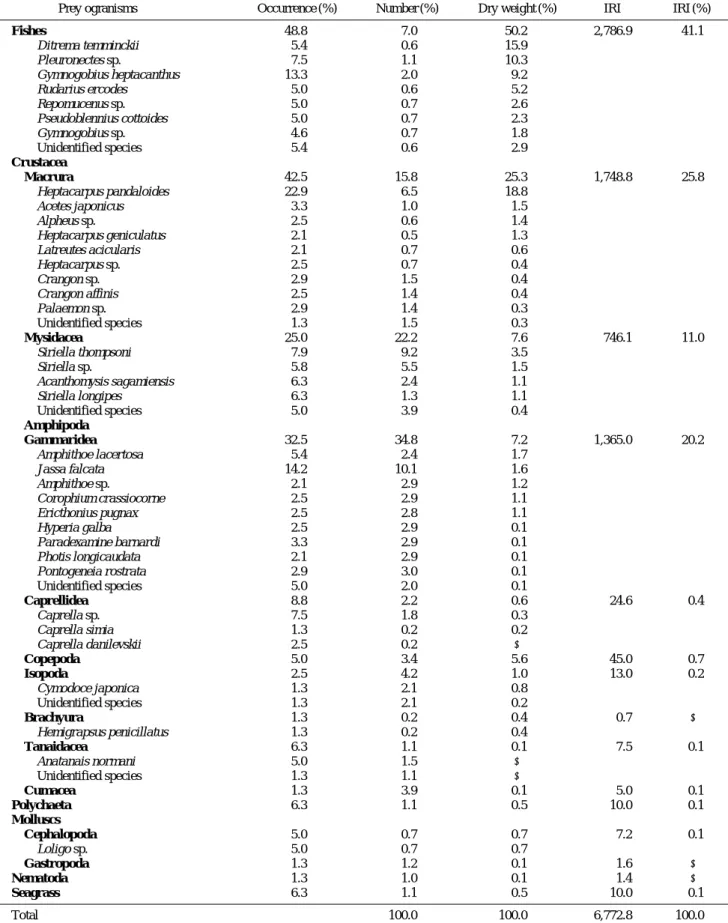
Table 1. Composition of the stomach contents of Pseudoblennius percoides by frequency of occurrence, number, dry weight and index of relative importance (IRI)
Prey ogranisms Occurrence (%) Number (%) Dry weight (%) IRI IRI (%)
Fishes 48.8 7.0 50.2 2,786.9 41.1
Ditrema temminckii 5.4 0.6 15.9
Pleuronectes sp. 7.5 1.1 10.3
Gymnogobius heptacanthus 13.3 2.0 9.2
Rudarius ercodes 5.0 0.6 5.2
Repomucenus sp. 5.0 0.7 2.6
Pseudoblennius cottoides 5.0 0.7 2.3
Gymnogobius sp. 4.6 0.7 1.8
Unidentified species 5.4 0.6 2.9 Crustacea
Macrura 42.5 15.8 25.3 1,748.8 25.8
Heptacarpus pandaloides 22.9 6.5 18.8
Acetes japonicus 3.3 1.0 1.5
Alpheus sp. 2.5 0.6 1.4
Heptacarpus geniculatus 2.1 0.5 1.3
Latreutes acicularis 2.1 0.7 0.6
Heptacarpus sp. 2.5 0.7 0.4
Crangon sp. 2.9 1.5 0.4
Crangon affinis 2.5 1.4 0.4
Palaemon sp. 2.9 1.4 0.3
Unidentified species 1.3 1.5 0.3
Mysidacea 25.0 22.2 7.6 746.1 11.0
Siriella thompsoni 7.9 9.2 3.5
Siriella sp. 5.8 5.5 1.5
Acanthomysis sagamiensis 6.3 2.4 1.1
Siriella longipes 6.3 1.3 1.1
Unidentified species 5.0 3.9 0.4 Amphipoda
Gammaridea 32.5 34.8 7.2 1,365.0 20.2
Amphithoe lacertosa 5.4 2.4 1.7
Jassa falcata 14.2 10.1 1.6
Amphithoe sp. 2.1 2.9 1.2
Corophium crassiocorne 2.5 2.9 1.1
Ericthonius pugnax 2.5 2.8 1.1
Hyperia galba 2.5 2.9 0.1
Paradexamine barnardi 3.3 2.9 0.1
Photis longicaudata 2.1 2.9 0.1
Pontogeneia rostrata 2.9 3.0 0.1
Unidentified species 5.0 2.0 0.1
Caprellidea 8.8 2.2 0.6 24.6 0.4
Caprella sp. 7.5 1.8 0.3
Caprella simia 1.3 0.2 0.2
Caprella danilevskii 2.5 0.2 ++
Copepoda 5.0 3.4 5.6 45.0 0.7
Isopoda 2.5 4.2 1.0 13.0 0.2
Cymodoce japonica 1.3 2.1 0.8
Unidentified species 1.3 2.1 0.2
Brachyura 1.3 0.2 0.4 0.7 ++
Hemigrapsus penicillatus 1.3 0.2 0.4
Tanaidacea 6.3 1.1 0.1 7.5 0.1
Anatanais normani 5.0 1.5 ++
Unidentified species 1.3 1.1 ++
Cumacea 1.3 3.9 0.1 5.0 0.1
Polychaeta 6.3 1.1 0.5 10.0 0.1
Molluscs
Cephalopoda 5.0 0.7 0.7 7.2 0.1
Loligo sp. 5.0 0.7 0.7
Gastropoda 1.3 1.2 0.1 1.6 ++
Nematoda 1.3 1.0 0.1 1.4 ++
Seagrass 6.3 1.1 0.5 10.0 0.1
Total 100.0 100.0 6,772.8 100.0 +: less than 0.1%
Heptacarpus pandaloides Pleuronectes sp.
Anatanais normani Gammarid amphipods
Caprella danievskii
Polychaetes Gymnogobius heptacanthus
Caridean shrimps
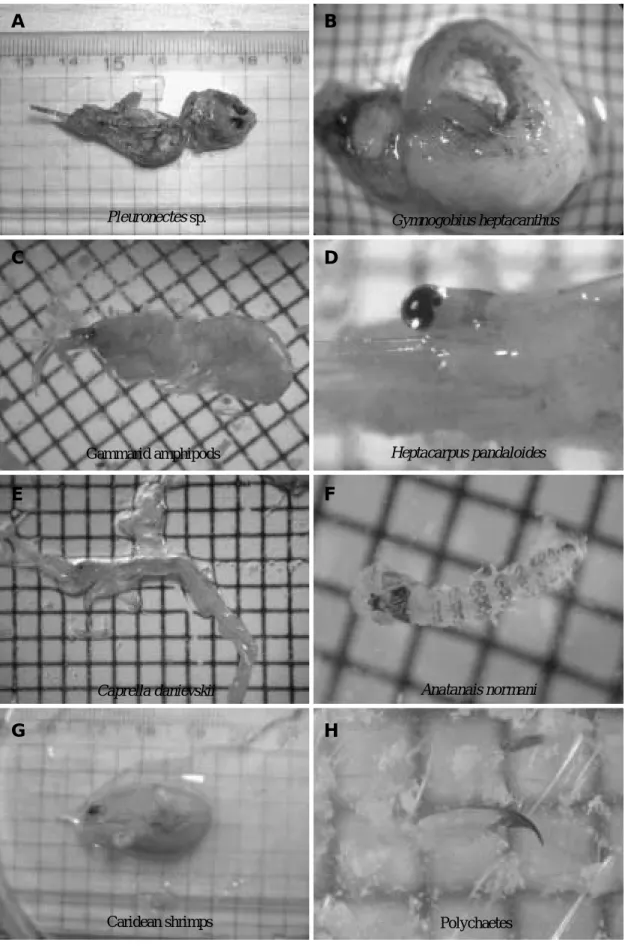
Fig. 3. Photographs of stomach contents of Pseudoblennius percoides.
A B
C D
E F
G H
Dietary breadth index는 Levins standardized index (Krebs, 1989)를 이용하여 구하였다.
1 1
B
i==mm×1n (mmmmmm -1∑ )
j
P
ij2여기서, Bi
: 포식자 i에 대한 Levins standardized index P
ij: 먹이생물 j의 포식자 i에서의 비율 n: 먹이생물 종류의 갯수
이 지수의 범위는 0~1까지이며, 수치가 높을수록 다양 한 먹이생물을 섭식하였다(Gibson and Ezzi, 1987; Krebs,
1989).
결과 및 고찰
조사기간 동안 돌팍망둑은 2005년 2월부터 9월까지 출 현하였으며, 체장분포는 1.1~11.3 m 범위를 나타내었다
(Fig. 2). 2월에는 체장 3.1~4.0 cm 크기의 개체들이 채집되
기 시작하였으며, 3월에는 체장 1.1~7.0 cm 범위의 개체들 이 채집되어 넓은 범위를 나타내었다. 시간이 지남에 따라 체장이 점차적으로 증가하여 9월에는 체장 10.1~11.8 cm 범위의 개체가 채집되었다.1. 위내용물 조성
위내용물 분석에 사용된 돌팍망둑은 총 136개체였으며, 위 속에 먹이가 전혀 없었던 돌팍망둑은 4개체로 공복율은
3.1%에 불과하였다. 위내용물 속에서 먹이생물이 발견된 132개체의 위내용물을 분석한 결과, 돌팍망둑의 주 먹이생
물은 어류 (Fishes) 및 갑각류 (Crustacea)에 속하는 새우류(Macrura)였다 (Table 1, Fig. 3). 어류는 총 먹이생물 개체수
의 7.0% 차지하였고, 48.8%의 출현빈도수를 보였으며, 위내 용물 건조중량의 50.2%의 높은 비율을 차지하였다. 상대중 요성지수비는 41.1%를 보였다. 가장 많이 섭식된 어종은 망 상어 (Ditrema temminckii), 넙치류 (Pleuronectes sp.), 살망둑(Gymnogobius heptacanthus),
그리고 그물코쥐치 (Rudarius ercodes) 순으로 나타났다.새우류는 총 먹이생물 개체수의 15.8%와 42.5%의 출현 빈도수를 보였으며, 위내용물 건조중량의 25.3%의 높은 비 율을 차지하였다. 상대중요성지수비는 25.8%를 보였다. 가 장 많이 섭식된 종은 긴좁은뿔꼬마새우 (Heptacarpus pan- daloides)였으며, 그 외 젓새우 (Acetes japonicus), 딱총새우 류(Alpeus sp.) 등이 섭식되었다.
그 다음으로 곤쟁이류 (Mysidacea), 단각류 (Amphipoda) 및 요각류 (Copepoda) 순으로 중요한 먹이생물로 나타났다.
곤쟁이류는 25.0%의 출현빈도, 22.2%의 개체수비, 7.6%의
건조중량비를 보였으며, 상대중요성 지수비는 11.0%를 나 타내었다. 가장 많이 섭식된 종은 Siriella thompsoni, Siriella
sp.였다. 단각류는 주로 옆새우류 (Gammaridea)가 차지하였
는데, 32.5%의 출현빈도, 34.8%의 개체수비, 7.2%의 건조중 량비를 보였으며, 상대중요성 지수비는 20.2%를 나타내었 다. 특히 Ampithoe lacertosa, Jassa falcata 등의 옆새우류가 주로 섭식되었다. 한편 요각류는 총 먹이생물 개체수의3.4%와 5.0%의 출현빈도수를 보였으며, 위내용물 건조중량
의 5.6%의 높은 비율을 차지하였으며, 상대중요성지수비는0.7%를 나타내었다.
그 외 5% 이상의 출현빈도수를 보인 종류는 두족류
(Cephalopoda),
갯지렁이류 (Polychaeta), 해초류 (Seagrass), 그리고 주걱벌레붙이류 (Tanaidacea) 등으로 나타났으나, 이 들 먹이생물의 총 먹이생물 개체수비와 건조중량비가 차지 하는 비율은 아주 작았다.따라서 돌팍망둑은 잘피밭에서 서식하는 어류, 새우류, 곤 쟁이류 및 단각류 등을 주로 섭식하는 육식성 어종임을 알 수 있다.
2. 성장에 따른 먹이조성의 변화
체장이 가장 작은 1.1~2.0 cm 크기군에서는 요각류의 비 율 (90.9%)이 대부분을 차지하였으나, 체장이 증가하면서
2.1~3.0 cm 크기군에서는 요각류의 점유율이 급격히 감소
한 반면, 단각류의 점유율이 약 99%까지 급격하게 증가하 며 극우점 하였다 (Fig. 4). 지금까지 보고된 잘피밭에서 서 식하는 어류 중 베도라치(Pholis nebulosa), 실고기(Syngna- thus schlegeli), 쥐치 (Stephanolepis cirrhifer)와 그물코쥐치(Rudarius ercodes)도 아주 어린시기에는 요각류를 주로 섭
식하였으나, 체장이 증가함에 따라 곧바로 단각류로 먹이생 물의 전환이 나타난다고 보고되었다(Huh and Kwak, 1997a,b; Kwak et al., 2003; Kwak and Huh, 2004).
특히 잘피와 같 은 해초지에서는 해초 잎이나 줄기에 부착하여 서식하는 많은 종류의 단각류(옆새우류 및 카프렐라류) 등이 많이 서 식하고 있어서 어류들이 다른 해역보다 단각류를 많이 먹는 것으로 보고되고 있다 (Edgar and Shaw, 1995; Hemmingaand Duarte, 2000; Kwak and Huh, 2003a, b; Kwak et al., 2004, 2005; Klumpp and Kwak, 2005). 대부분의 어류들은
치어기에는 해양 환경 중에 많은 양이 분포해 있는 요각류 를 주로 섭식하다가 성장함에 따라 큰 크기의 다른 먹이생 물로 전환하는 특징을 보인다고 보고되고 있다 (Kikuchiand Yamashita, 1992; Politoum and Papaconstantinou, 1994;
Baeck and Huh, 2003a, b; Moriniere et al., 2003; Soh and Kwak, 2005).
그러나 체장이 증가함에 따라 단각류의 점유율 역시 급 격하게 감소하였으나, 체장 4.1 cm 이상의 크기군에서는 어
류의 점유율이 증가하였고, 체장이 큰 10.1 cm 이상의 개체 에서는 어류 및 새우류의 점유율이 점점 증가하여 11.0 cm 이상의 크기군에서는 이들이 전체 점유율의 약 90% 정도 를 차지하였다. 이와 같은 결과를 국외의 다른 해역에서 보 고된 결과와 비교해 보면, 일본 Shijiki Bay에서 서식하는 돌팍망둑은 갑각류를 주로 먹다가, 체장이 증가함에 따라 어류를 주로 먹었으며, 일본 Yanagihama Beach에서 서식하 는 돌팍망둑은 조사해역에서 서식하는 작은 크기의 넙치의 치어들을 주로 먹는다고 보고하여 (Kimura et al., 1983;
Noichi et al., 1993), 조사해역에 관계없이 체장이 증가함에
따라 어류를 주로 먹은 어식성이 강하게 나타나고 있음을 알 수 있었다. 한편 광양만 잘피밭에서 우점하였던 같은 속 에 속하는 가시망둑의 경우도 아주 어린시기에는 단각류를 주로 섭식하였으나, 체장이 증가함에 따라 새우류 및 어류등을 주요 먹이생물로 섭식하고 있어서 본 조사해역에서 서식하는 돌팍망둑의 먹이습성과 아주 유사하였다.
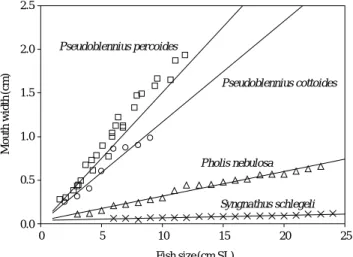
이와 같이 비교적 체장이 작은 개체들이 비교적 큰 크기 의 새우류 및 어류를 쉽게 섭식할 수 있었던 것은 몸 체장 에 비하여 아주 큰 입 (Fig. 5)을 가지고 있었기 때문으로 판단된다. 동대만 잘피밭에서 돌팍망둑과 함께 우점하고 있 는 실고기, 베도라치, 그리고 돌팍망둑과 같은 속인 가시망 둑 (Pseudoblennius cottoides)의 체장 증가에 따른 입 크기 의 변화에 비하여 돌팍망둑의 입 크기 증가율이 더 큰 것 으로 나타나, 같은 속이지만 체폭이 더 넓은 어류인 가자미 류와 망상어 같은 어류를 가시망둑보다 더 쉽게 섭식할 수 있었던 것으로 판단된다. 더불어 Pseudoblennius 속에 속하 는 어종들은 다른 어종들과 비교하여 민첩한 행동양식과 잘 발달된 양턱 및 치열을 소유한 결과라고 판단된다(Noichi et al., 1993; Huh and Kwak, 1998).
돌팍망둑은 체장이 증가함에 따라 먹이생물의 크기가 증 가하였다(Fig. 6). 체장이 작은 3.0 cm 이하의 개체들은 먹이 생물의 크기가 평균 1 mm 이하였으나, 체장이 증가함에 따
Fish size (cm SL) 0
20 40 60 80 100
Fishes Macrura Mysidacea
Amphipoda Copepoda Others
Percentage of stomach contents (by dry weight)
1 2 3 4 5 6 7 8 9 10 11 12
Fig. 4. Ontogenetic changes in feeding habits of Pseudoblennius percoides.
0.0 0.5 1.0 1.5 2.0 2.5
0 5 10 15 20 25
Mouth width (cm)
Fish size (cm SL) Pseudoblennius percoides
Pseudoblennius cottoides
Pholis nebulosa
Syngnathus schlegeli
Fig. 5. Relationships between mouth size and standard length of Pseudoblennius percoides, Pseudoblennius cottoides, Pholis nebulosa and Syngnathus schlegeli.
0 1 2 3 4
Fish size (cm SL)
Size of food organisms (mm)
1 2 3 4 5 6 7 8 9 10 11 12
Fig. 6. Ontogenetic changes in the size of food organisms consumed by Pseudoblennius percoides (Circles: mean, Bars: maximum and minimum).
0.0 0.1 0.2 0.3
Fish size (cm SL)
Dietary breadth index
1 2 3 4 5 6 7 8 9 10 11 12
Fig. 7. The size-related variations of dietary breadth index of Pseu- doblennius percoides.
라 점진적으로 섭식하는 먹이생물의 크기가 증가하였다. 특 징적인 것은 체장이 증가함에 따라 섭식하는 먹이생물의 크기의 범위 폭이 증가하였는데, 이와 같은 결과는 작은 크 기의 단각류부터 새우류, 그리고 큰 크기의 어류까지 다양 한 크기의 먹이생물을 섭식하였기 때문으로 판단된다.
한편 돌팍망둑은 체장이 증가함에 따라 dietary breadth는
0.03~0.33의 범위를 나타내어 모든 체장에서 대체적으로
다소 낮은 값을 나타내었다 (Fig. 7). 체장에 따른 dietarybreadth의 변화는 체장이 가장 작은 1.1~2.0 cm 범위에서
는 0.11의 수치를 나타내었으나, 체장이 증가하면서 체장4.0 cm까지는 단각류, 곤갱이류 및 요각류 등을 다양하게
섭식하여 가장 높은 수치를 나타내었다. 그러나 체장 4.1cm 이상부터는 다른 먹이생물보다 새우류 및 어류만의 점
유율이 증가하면서 수치가 서서히 감소하는 양상이었다.3. 계절별 먹이생물 조성의 변화
돌팍망둑은 계절에 관계없이 어류를 주로 섭식하였으나,
위내용물 중 차지하는 비율은 계절별 변화가 있었다 (Fig.
8). 돌팍망둑이 처음 출현하였던 2월에는 단각류와 곤쟁이
류, 요각류가 주 먹이생물이었으나, 계절이 변함에 따라 어 류와 새우류의 비율이 증가하였다. 새우류와 비교하여 어류 의 증가율이 더 높게 나타났으며, 4월과 5월에는 어류의 점 유율이 전체의 약 70%를 차지하여 조사기간 중 가장 높은 점유율을 나타내었다. 6월에 접어들면서 어류의 점유율이 서서히 감소한 반면, 새우류의 점유율은 증가하여, 9월에는 어류와 새우류만을 주로 섭식하는 양상이었다.돌팍망둑이 주로 섭식하였던 먹이생물의 잘피밭 환경에 서 보인 출현량 변동을 살펴보면, 어류는 3월부터 출현량이 증가하여 5월과 6월에 최대치를 보인 후, 서서히 감소하는 양상이었다. 새우류는 겨울철과 3월에 최대치를 보였으나, 봄철에도 꾸준히 잘피밭 환경에서 출현하였고, 여름철 이후 부터는 출현량이 급격히 감소하는 양상이었다. 한편 작은 크기의 단각류, 곤쟁이류 및 요각류 등은 여름에 최대 출현 량을 보인 후 가을부터는 출현량이 감소하는 양상이었다.
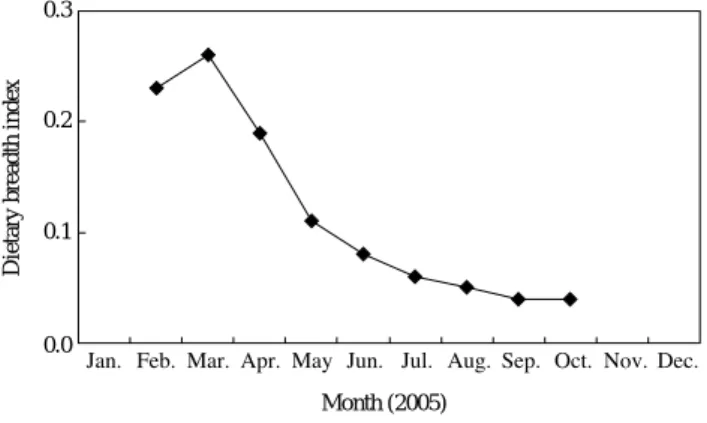
또한 돌팍망둑이 주로 섭식하였던 먹이생물인 새우류의 출 현량은 소형 갑각류인 단각류 및 요각류 등에 비하여 아주 적었으며 더우기 어류는 새우류의 출현량보다 훨씬 더 적었 다. 한편 계절에 따른 dietary breadth의 변화는 0.04~0.26 의 범위를 나타내었다(Fig. 9). Dietary breadth는 2월과 3월 에 가장 높은 수치를 나타내었으나, 4월부터 수치가 급격히 감소하여 9월과 10월에 조사기간 중 가장 낮은 수치를 나 타내었다.
따라서 계절에 따른 돌팍망둑의 먹이조성 변화는 잘피밭 에서 출현하는 환경 먹이생물의 출현량의 변동과는 크게 연관이 없는 것으로 판단된다. 특히 어류는 다른 환경 먹이 생물에 비해 잘피밭 환경에서 출현량이 많지 않았음에도 불구하고 계절에 관계없이 지속적으로 섭식되는 먹이생물 이었다. 이와 같은 결과는 돌팍망둑이 자기가 선호하는 먹 이생물인 어류 및 새우류의 출현량과는 관계없이 섭식하는 어종임을 뜻한다. 즉 돌팍망둑은 새우류 및 어류가 조사해 역에서 출현량은 적지만 크기가 크고 상대적으로 칼로리의 양이 높아서 일단 섭식하게 되면 최적섭식이론 (Optimal
foraging theory)에 의하여 에너지 효율이 높기 때문인 것으
로 판단된다. 광양만 잘피밭에서 서식하는 가시망둑 (Huhand Kwak, 1998)의 경우도 계절에 상관없이 어류만을 선호
하는 어종으로 나타나, Pseudoblennius 속에 속하는 어종들 은 어류를 주로 섭식하는 강한 어식성 어종임을 알 수 있 었다.요 약
2005년 1월부터 2005년 12월까지 동대만의 잘피밭에서
0 20 40 60 80 100
Month (2005)
. Percentage of stomach contents (by dry weight)
Jan. Feb. Mar. Apr. May Jun. Jul. Aug. Sep. Oct. Nov. Dec.
Fishes Macrura Mysidacea
Amphipoda Copepoda Others
Fig. 8. Monthly changes in feeding habits of Pseudoblennius per- coides.
0.0 0.1 0.2 0.3
Dietary breadth index
Month (2005)
Fig. 9. Monthly variations of dietary breadth index of Pseudoblennius percoides.
채집된 돌팍망둑의 식성을 조사하였다. 돌팍망둑의 주요 먹 이는 어류 및 새우류였으며, 그 외, 곤쟁이류, 단각류 (옆새 우류 및 카프렐라류), 요각류, 두족류, 갯지렁이류 및 게류 등이 소량 섭식되었다. 돌팍망둑은 초기에는 요각류와 단각 류를 많이 섭식하였으나, 성장함에 따라 어류와 새우류의 섭식율이 점차 증가하였다. 돌팍망둑은 계절에 관계없이 새 우류 및 어류를 주로 섭식하였다. 체장별 및 계절별 dietary
breadth는 전체적으로 낮게 나타났다.
사 사
시료의 채집과 자료의 분석에 많은 도움을 준 부경대학 교 해양학과 박주면, 성봉준, 황원진에게 깊은 감사를 드립 니다.
인 용 문 헌
Baeck, G.W. and S.H. Huh. 2003a. Feeding habits of juvenile Lo- phius litulon collected in the coastal waters of Kori, Korea.
J. Kor. Fish. Soc., 36: 695-699.
Baeck, G.W. and S.H. Huh. 2003b. Feeding habits of snailfish, Liparis tanakai. Korean J. Ichthyol., 9: 71-78.
Cha, H.K., J.U. Lee, C.S. Park, C.I. Baik, S.Y. Hong, J.H. Park, D.W. Lee, Y.M. Choi, K.S. Hwang, Z.G. Kim, K.H. Choi, H.S. Sohn, M.H. Sohn, D.H. Kim and J.H. Choi. 2001.
Shrimps of the Korean Waters. Hanguel Graphics Press, Pusan, 188pp.
Edgar, G.J. and C. Shaw. 1995. The production and trophic ecology of shallow-water fish assemblages in southern Australia. I.
Species richness, size-structure and production of fishes in Western Port Bay, Victoria. J. Exp. Mar. Biol. Ecol., 194:
53-82.
Gibson, R.N. and I.A. Ezzi. 1987. Feeding relationships of a demersal fish assemblage on the wet coast of Scotland. J.
Fish Biol., 31: 55-69.
Hemminga, M.A. and C.M. Duarte. 2000. Seagrass Ecology.
Cambridge Univ. Press. 231pp.
Huh, S.H. 1986. Species composition and seasonal variations in abundance of fishes in eelgrass meadows. Bull. Kor. Fish.
Soc., 19: 509-517.
Huh, S.H. and S.N. Kwak. 1997a. Species composition and sea- sonal variations of fishes in eelgrass (Zostera marina) bed in Kwangyang Bay. Korean J. Ichthyol., 9: 202-220.
Huh, S.H. and S.N. Kwak. 1997b. Feeding habits of Pholis nebulos.
Korean J. Ichthyol., 9: 22-29.
Huh, S.H. and S.N. Kwak. 1998. Feeding habits of Pseudoblennius cottoides. J. Korean Fish. Soc., 31: 37-44.
Hwang, W.J. 2007. Species composition and seasonal variation in
fishes in the eelgrass (Zostera marina) bed in Aenggang Bay, Korea. M.S.Thesis, Pukyong National University, Pusan, 63pp.
Kikuchi, T. 1966. An ecological study on animal communities of the Zostera marina belt in Tomioka Bay, Amakusa, Kyu- shu. Publ. Amakusa Mar. Biol. Lab., 1: 1-106.
Kikuchi, T. and Y. Yamashita. 1992. An ecological study on animal communities of the Zostera marina belt in Tomioka Bay, Amakusa. Publ. Amakusa Mar. Biol. Lab., 11: 73-93.
Kim, H.S. 1973. Illustrated Encyclopedia of Fauna & Flora of Korea. Vol.14 Anomura∙Brachyura. Ministry of Educa- tion. Korea, 694pp.
Kim, I.S. and C.H. Youn. 1992. Synopsis of the Family Cottidae (Pisces: Scorpaeniformes) from Korea. Korean J. Ichthyol., 4: 54-79.
Kim, I.S., Y. Choi, C.L. Lee, Y.J. Lee, B.J. Kim and J.H. Lim.
2005. Illustrated book of Korean fish. Kyo-Hak Publishing, Seoul, 615pp.
Kimura, S., Y. Nakamura, M. Aritaki, F. Kimura, K. Mori and K, Suzuki. 1983. Ecological studies on fishes of the Zostera bed at the mouth of Ago Bay Mie Prefecture. 1. Fish fauna and its seasonal change. Bull. Fac. Lab., Mie Univ., 10: 71- 93.
Klumpp, D.W. and S.N. Kwak. 2005. Composition and abundance of benthic macrofauna of a tropical seagrass bed in North Queensland, Australia. Pac. Sci., 59: 541-560.
Krebs, C.J. 1989. Ecological methodology, Harper and Row, New York, 654pp.
Kwak, S.N. and S.H. Huh. 2003a. Feeding habits of juvenile Li- paris tanakai in eelgrass (Zostera marina) beds in Kwang- yang Bay. J. Kor. Fish Soc., 36: 372-377.
Kwak, S.N. and S.H. Huh. 2003b. Feeding habits of Limanda yokohamae in the eelgrass (Zostera marina) bed in Kwang- yang Bay. J. Kor. fish. Soc., 36: 522-527.
Kwak, S.N. and S.H. Huh. 2004. Feeding habits of Rudarius ercodes in a Zostera marina bed. J. Fish. Sci. Tech., 7: 46- 50.
Kwak, S.N., G.W. Baeck and S.H. Huh. 2003. Feeding habits of Stephanolepis cirrhifer in a Zostera marina bed. Korean J.
Ichthyol., 15: 219-223.
Kwak, S.N., G.W. Baeck and D.W. Klumpp. 2005. Comparative feeding ecology of two sympatric greenling species, Hexa- grammos otakii and Hexagrammos agrammus in eelgrass Zostera marina beds. Environ. Biol. of Fishes, 74: 129-140.
Kwak, S.N., S.H. Huh and C.G. Choi. 2006. Comparisons of fish assemblages associated with eelgrass bed and adjacent unvegetated habitat in Jindong Bay. Korean J. Ichthyol., 18: 119-128.
Kwak, S.N., S.H. Huh and D.W. Klumpp. 2004. Partitioning of food resources among Sillago japonicus, Ditremma temmi- ncki, Tridentiger trigonocephalus, Hippocampus japonicus, and Petroscirtes breviceps in an eelgrass, Zostera marina,
bed. Environ, Biol. Fish., 71: 353-364.
Lee, T.W., H.T. Moon, H.B. Hwang, S.H. Huh and D.J. Kim. 2000.
Seasonal variation in species composition of fishes in the eelgrass beds in Angol Bay of the Southern Coast of Korea.
J. Kor. Fish. Soc., 33: 439-447.
Matsumiya, Y., I. Kinoshita and M. Oka. 1980. Stomach contents examination of the piscivorous demersal fishes in Shijiki Bay. Bull. Seikai Reg. Fish. Res. Lab., 54: 333-342.
Moriniere, E.C., B.J.A. Pollux, I. Nagelkerken and G.V. Velde.
2003. Diet shifts of Caribbeans grunts (Haemulidae) and snappers (Lutjanidae) and the relation with nursery-to-coral reef migrations. Estuarine, Coastal and Shelf Science, 57:
1079-1089.
Nelson, J.S. 2006. Fishes of the world. 4th ed. John Wiley & Sons.
601pp.
Noichi, T., M. Kusani, D. Ueki and T. Senta. 1993. Feeding habits of fishes eating settled larval and juvenile Japanese floun- der (Paralichthys olivaceus) at Yanagihama Beach, Naga- saki Prefecture. Bull. Fac. Fish. Nagasaki Univ./Chodai Suikenpo. 73: 1-6.
Pinkas, L., M.S. Loiphant and I.L.K. Iverson. 1971. Food habits of albacore, bluefin tuna, and bonito in California waters.
Calif. Dep. Fish Game, Fish Bull., 152: 1-105.
Politoum, C.Y. and C. Papaconstantinou. 1994. Feeding ecology of Mediterranean poor doc, Trisopterus minutus capelanus (Lapecede), from the eastern coast of Greece. Fish. Res., 19: 269-292.
Soh, H.Y. and S.N. Kwak. 2005. Feeding habits of Belted Beard Grunt, Hapalogenys mucronatus, in the coastal waters off Sori Island, Yeosu, Korea. Korean J. Ichthyol., 17: 258- 263.
Takeda, M. 1982. Keys to Japanese and Foreign Crustaceans.
Hokuryukan, Tokyo, 284pp.
Yoo, D.J., K.H. Han, S.R. Baek, K.S. Kim and S.C. Ha. 2003.
Morphological development of eggs, larvae and juvenile of the Sunrise Sculpin, Pseudoblennius cottoides (Teleostie:
Cottidae). J. Kor. Fish. Soc., 36: 263-269.
Yoon, C.H. 2002. Fishes of Korea with Pictorial Key and Syste- matic List. Academy Publ. Co. Seoul, 341pp.