Jun-Xi Li, Chi-Do Wee, and Bo-Kyoon Sohn*
Department of Bio-Environmental Science, Sunchon National University, Suncheon 540-742, Republic of Korea
The feasibility of using ammonium (NH
4+) and potassium (K
+)-loaded zeolite (NK-Z) as a slow-release fertilizer to control nitrogen and potassium supply was investigated in this study. The growth responses, which were determined in terms of shoot length, shoot fresh weight, and fresh fruit weight, were greater in plants treated with NK-Z than in those treated with chemical fertilizers (CF) after 18 weeks of transplantation.
The total fruit weight per plant in treated with NK-Z as the basal and additional fertilizer (ZBAF) was 14.89%
higher than that of CF. The nitrogen and potassium contents in NK-Z amended soils were higher than those in CF amended soils in the final stage of plant growth. The ammonium nitrogen (NH
4-N) concentration in ZBAF amended soils was 63.41% higher than that in CF amended soils.
Key words: Natural zeolite, Slow-release fertilizer, Hot pepper, Growth response
Received : July 2. 2010 Accepted : October 6. 2010
*Corresponding author : Phone: +82617503292 E-mail: [email protected]
Introduction
Zeolites are aluminosilicate minerals that have a rigid three-dimensional crystal structure with voids and channels of molecular size; furthermore, these minerals have a high cation exchange capacity (CEC) because of aluminium for silicon in silicon oxide tetrahedral units. Zeolites play many important roles, e.g., in ion exchange, filtering, chemical sieving, and water softening.
Natural zeolite is particularly useful in agriculture because of its large porosity, high CEC, and physical stability. Natural zeolites are highly selective for K
+and NH
4+rather than for sodium or divalent cations, such as calcium and magnesium, because of the location and density of the negative charge in the structure and dimensions of the interior channels (Ming and Mumpton, 1989). Applying zeolite to the soil can improve its ability to hold nutrients without affecting its drainage ability. Zeolite can also be used as a controlled-release fertilizer because it holds ammonium and other plant nutrients in the crystal structure where they are water insoluble but are accessible to the plants.
The research towards producing inexpensive slow- releasing fertilizers has drawn great attention recently.
Nitrogen leaching from irrigated croplands significantly contributes to nitrate contamination in surface and ground waters and decreases nitrogen availability to crops (lichtenberg and shapiro, 1997). Therefore, slow-release fertilizers are essential in order to decrease nitrogen leaching in these environments. Ammonium- loaded clinoptilolite (A-CP) has been suggested as a potential nitrogen fertilizer for sandy soils as this fertilizer can decrease nitrogen leaching and increase the efficiency of nitrogen utilization (Perrin et al., 1997). In this study, we used ammonium (NH
4+) and potassium (K
+)-loaded zeolite (NK-Z) as a slow-release fertilizer and investigated the growth characteristics of hot pepper as well as the changes in the nitrogen and potassium contents of experimented soil.
Materials and Methods
Zeolite The natural zeolite used in this experiment
was characterized using X-ray diffraction (XRD, D/Max-
2500V/PC, PANalytical B.V.) analysis. In the XRD
pattern, two kinds of zeolites (mordenite and clinoptilolite)
were confirmed to compose the natural zeolite of this
study (Fig. 1). A scanning electron microscopy (SEM)
image of the surface morphology of the zeolite is
presented in Fig. 2. The physicochemical property of
natural zeolite were analyzed (Table 1). The CEC value
of the natural zeolite was 68.29 cmol
ckg
-1.
Fig. 1. XRD patterns of natural zeolite (Mordenite : 33%, Muscovite : 37%, Clinoptilonite : 30%).
1-2 mm 1-2 mm 1-2 mm
Fig. 2. SEM image of natural zeolite.
Table 1. Chemical characteristics of natural zeolite used in the experiment.
SiO
2Al
2O
3Fe
2O
3CaO MgO Na
2O K
2O P
2O
5Moisture Specific gravity CEC --- % --- cmol
ckg
-170.3 13.6 1.29 2.51 0.31 1.93 3.17 0.09 6.8 2.04 68.29
Table 2. The growth characteristics of hot pepper at transplanting.
Species No. of leaves Leaf area Shoot fresh weight Shoot length
ea cm
2g cm
Capsicum annuum L. 12.0 ± 0.5 112.25 ± 4.53 8.02 ± 0.10 26.6 ± 0.4
Ammonium and potassium-loading of natural zeolite The natural zeolite rock was crushed and sieved to the size fraction of 1 ~ 2mm and loaded with ammonium and potassium by soaking in 1 M ammonium sulfate ((NH
4)
2SO
4) and 1 M Potassium chloride (KCl) for 10 days. The NH
4+and K
+loaded zeolite was rinsed with distilled water until the electrical conductivity (EC) of the supernatant was
<0.5 mSm
-1(Perrin et al., 1998). The total nitrogen content in the NH
4+-loaded zeolite (N-Z) was analyzed using the method of Kjeldahl digestion (Bremner and Mulvaney, 1982) and K of K
+-loaded zeolite (K-Z)
was analyzed by Inductive Coupled Plasma (ICP, Optima 3300DV, Perkin-Elmer, USA). The NK-Z were produced which resulted in concentrations of 2% N and 3% K.
Test crops and farming methods Seedlings of hot
pepper (Capsicumannuum L.) were cultured in a
greenhouse as test plants. The characteristics of hot
pepper were tested before transplanting (Table 2). Soil
was also analyzed before transplanting. The equivalent
of 200kg/10a lime and 1500kg/10a compost were
mixed in the soil because of low fertility for hot
Table 3. Growth responses of hot pepper 3 weeks after transplanting.
Treatment No. of leaves Shoot length Shoot weight Leaf area Chlorophyll contents
plant cm g plant
-1cm
2mg 100cm
-2CF 17.67 27.31 24.29 227.52 4.93
ZAF 21.33* 28.10 27.61 289.40* 5.28*
ZBAF 19.83 27.49 26.38 244.77 5.39*
LSD
0.052.687 0.897 3.329 41.133 0.217
CF, Chemical fertilizer as basal conventional fertilizer along with additional fertilizer; ZAF, Chemical fertilizer as basal conventional fertilizer, NK-Z as additional fertilizer; ZBAF, NK-Z as basal and additional fertilizer.
Table 4. Growth responses of hot pepper 18 weeks after transplanting.
Treatment Shoot length Shoot weight Fruit weight [A] No. of fruit [B] Fruit weight [A / B]
cm g plant
-1g plant
-1ea plant
-1g fruit
-1CF 141.0 1540.0 591.8 70.50 8.37
ZAF 146.0 1733.3 614.5 76.83 8.25
ZBAF 153.7* 1853.3 679.9 80.17 8.66
LSD
0.056.02 340.56 148.87 19.538 1.390
with the soil using cultivator.
The growth characteristics of hot pepper and changes in nitrogen and potassium concentrations in soil were investigated regularly after application of NK-Z. Three kinds of fertilizers were used in this experiment: (1) chemical fertilizer as basal conven- tional fertilizer along with additional fertilizer (CF), (2) chemical fertilizer as the basal conventional fertilizer and NK-Z as the additional fertilizer (ZAF), and (3) NK-Z as the basal and additional fertilizer (ZBAF).
The concentrations of N, P and K between chemical fertilizer and NK-Z fertilizer had no differences among every treatments. The experiment area for every treatments were 6.4 m
2, 640 g compound fertilizer (N-P-K=11-10-8 kg/10a) were added into the soil in the treatment of CF. In the treatment of ZAF, 640 g compound fertilizer (N-P-K=11-10-8 kg/10a) were added into the soil as basal conventional fertilizer, 4000 g N-Z and 1160 g K-Z were added into the soil as additional fertilizer. NK-Z as additional fertilizer were added into the soil at the same time with the application of basal fertilizer before seedling trans- planting. In the treatment of ZBAF, the NK-Z were also added into the soil before seedling transplanting.
8686 g N-Z, 2980 g K-Z, and 360 g fused super- phosphate were added into soil as basal fertilizer along with additional fertilizer. Thereafter, black color mulching film were used to cover the plot of each treatment.
Soils in different treatment fields were sampled 0, 3,
water and shake for 30 minutes at the speed of 120 rpm. The clear solution were accepted after filtering using whatman No.2 filter paper. The nitrogen content was analyzed by the Kjeldahl digestion method (Bremner and Mulvaney, 1982) and potassium was analyzed by ICP using the method of NIAST (2000).
EC and pH were analyzed using Istek Conductivity meter and Mettler Toledo 340 pH meter, respectively.
Phosphorus was also analyzed using the method of NIAST (2000).
Results and Discussion
Crop growth characteristics The leaf number, leaf area, shoot length, shoot weight, and chlorophyll content were tested 3 weeks after transplanting (Table 3). The chlorophyll contents of hot pepper plants grown in ZAF and ZBAF treated soils were 7.10% and 9.33%, respctively, which were higher than that of hot pepper plants grown in CF treated soil. Significantly higher values were also observed for leaf numbers and leaf area in the case of ZAF treatment than in the case of CF treatment. With regard to shoot length and shoot weight, no significant differences were noted between the ZAF and ZBAF treatments, but higher values were observed with these treatments than with the CF treatment.
The growth characteristics of hot pepper plants 18
Table 5. The physicochemical property changement of soil.
pH EC av-P
2O
5CF ZBF ZBAF CF ZBF ZBAF CF ZBF ZBAF
--- dS m
-1--- --- mg kg
-1---
Before 6.39 6.77 6.17 1.04 1.25 0.97 742.46 810.75 633.78
After 5.15 4.87 5.03 0.78 0.80 0.75 557.07 584.82 533.48
Before: Soils sampled before experiment; After: Soils sampled after experiment.
CF ZAF ZBAF
Fig. 3. Hot pepper growth responses 18 weeks after
transplanting. Fig. 4. The dynamics of NH
4-N concentrations in soils.
weeks after transplanting are shown in Table 4. The shoot length was 9.01% higher with ZBAF treatment than with CF treatment. The shoot weights were also 12.55% and 20.34% higher with the ZAF and ZBAF treatments, respectively, than with CF treatment. In radish, A-CP treatment produced a greater radish leaf area, dry weight, and root fresh weight compared to radishes fertilized with ammonium sulfate (Lewis et al., 1984). In this study, we also determined that ZAF and ZBAF treatment resulted in greater shoot length and fruit numbers per plant as compared to CF treatment, even though the differences in single heavy of hot pepper fruit were not observed. The ZAF and ZBAF treatments resulted in 3.83% and 14.89% higher fruit weights, respectively, than did CF treatment. The results obtained showed that NK-Z enhanced the harvest and the growth of hot pepper (Fig. 3).
The physicochemical property changement of soil The changement of soil physicochemical properties were shown in table 5. There were no significant differences between chemical fertilizer and NK-Z fertilizer on the pH, EC and P concentrations in soil.
This was probably because of the same phosphorus fertilizer were used in every treatment. In this study, in order to explore the utility of NK-Z as a slow-release fertilizer, The movement of nitrogen and potassium in
soil were tested in detail.
Nitrogen and Potassium movement in soil The concentration of exchangeable and water-soluble ammonium nitrogen (NH
4-N) in the soil rapidly decreased during the first 3 weeks (Fig. 4). During these 3 weeks, the NH
4-N concentration decreased to a greater extent with the ZAF and ZBAF treatments than with CF treatment, this was probably because of the absence of additional chemical fertilizer. Significant differences in NH
4-N concentrations were noted between the various amendments on all the sampling dates, and the NH
4-N concentrations were less than 220 mg·kg
-1, at 6 weeks after transplanting. ZAF and ZBAF amended soils appeared to maintain relatively higher NH
4-N concent- rations 18 weeks after transplanting, this was probably due to retention of ammonia on the cation-exchange sites of the zeolite. Exchangeable NH
4-N concent- rations in ZAF and ZBAF amended soils were 51.90%
and 63.41% higher than that in CF amended soils. The
water-soluble NH
4-N concentrations in ZAF and ZBAF
amended soils were 5.54% and 18.33% higher than
that in CF amended soils. The NH
4-N concentrations
were high on each of the investigation days, this
indicates that NK-Z, which is a type of slow-release
fertilizers, can maintain the high levels of NH
4-N
throughout the growth period until the final stages of
plant development.
Fig. 5. The dynamics of NO
3-N concentrations in soils.
Fig. 6. The dynamics of K concentrations in soils.
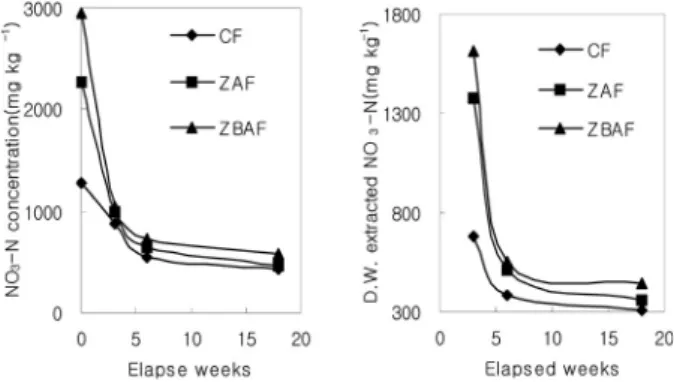
than that with CF treatment during the first 3 weeks, depending on the nitrogen sources, due to nitrification (Fig. 5). ZAF and ZBAF decreased the NO
3-N concentration probably because of the retention of NH
4+on the zeolite, which decreased the availability of NH
4+for nitrification. The NO
3-N concentration decreased slowly after 6 weeks. Exchangeable NO
3-N concent- rations in ZAF and ZBAF amended soils were 6.74%
and 35.68% higher than that in CF amended soils 18 weeks after transplanting.
Many studies have been conducted to develop best management practices for nitrogen fertilization to reduce N losses via leaching or volatilization and to increase N utilization efficiency (Alva and Parama- sivam,1998). Clinoptilolite zeolite has been used to reduce ammonia emission from farm manures (Amon et al., 1997), and as NH
4+-loaded exchange fertilizer because of its high CEC. It is well known that soil bacteria convert ammonium into readily leachable nitrate. NK-Z has been shown to be an excellent long-term, slow-release fertilizer when applied to agricultural crops. In a loamy sand (6% clay), A-CP decreased NO
3-leaching by 30% compared to chemical fertilizers (Lewis et al., 1984). Perrin hypothesized that A-CP reduced N leaching while increasing the efficiency of N utilization as compared to chemical fertilizer (Perrin et al. 1998). However, since their study was conducted only for approximately 4 weeks, they did not obtain long-term data encompassing the final stage of crop growth. In our study, the N concentrations were measured over the entire growth period of the crops, and at the late stage of crop growth, we observed stabilization in the changing trend of N concentrations as slow-release fertilizers.
Limited data obtained by comparing the potassium leaching only from potassium-saturated clinoptilolite and potassium nitrate highlighted the advantages of zeolite as a slow-release fertilizers (Hershey et al., 1980). In this study, the plots of exchangeable and water-soluble K concentrations are shown in Fig. 6.
The release patterns for K were very similar regardless of the type of treatment. K levels decrease sharply in the first 3 weeks and stabilize thereafter. Although the potassium retention capability of ZAF and ZBAF were higher, the potassium release patterns of ZAF and
ZBAF were similar to that of CF, however, at the late stage of plant growth, the exchangeable potassium concentrations of ZAF and ZBAF were 29.73% and 52.79% higher than that of CF, and the water-soluble K concentrations were 33.97% and 55.30% higher than that of CF 18 weeks after transplanting. Two kinds of K concentrations were maintained at high levels on each of the investigation days, this result shows the effect of NK-Z, a type of slow-release fertilizers, on the decrease potassium leaching.
ZAF and ZBAF provided controlled-release of available N and K as compared to chemical fertilizers, which indicates that they are suitable for application to soils as slow-release fertilizers. The slow release of N and K from NK-Z at late stages in plant growth was probably due to diffusion and cation exchange (Semmens, 1984; ming, et al., 1995), processes that control the release of N and K from NK-Z.
Conclusion
As compared to chemical fertilizer, NK-Z when added into soils can develop the N and K keeping ability of the soil in the whole stage of crop growth.
The hot pepper plants grown in soils amended with
NK-Z got significantly more fruits harvesting than that grown in soils amended with CF. NK-Z is not only useful as a slow-release fertilizer maintaining the high level nutrition that sustains plant growth, it also provide a nutrient supply that is high enough to sustain suitable plant development. Another important advantage is that NK-Z as additional fertilizer can be added into soil before seedling transplanting because of their slow-release character, which can reduce lots of labour force for the application of chemical additional fertilizer.
Studies using NK-Z have revealed a significant improvement in fertilizer efficiency with NK-Z as compared to conventional fertilizer. As a controlled- release fertilizer in agricultural application, NK-Z offers considerable economic, technical and environ- mental advantages.
Acknowledgment
This study was supported by The Technology Development Program for Agriculture and Forestry, Ministry for Food, Agriculture, Forestry and Fisheries, Republic of Korea.
References
Alva, A.K. and S. Paramasivam. 1998, Nitrogen management for high yield and quality of citrus in sandy soils. Soil Sci.
Soc. Am. J. 62:1335-1342.
Amon, M., M. Dobeic, R.W. Sneath, V.R. Philips, T.H.
Mis-selbrook, and B.E. Pain. 1997. A farm-scale study on the use of clinoptilolite zeolite and de-odorase for reducing odor and ammonia emissions from broiler houses. Bioresource Tech. 61:229-237.
Bremner, J.M. and C.S. Mulvaney. 1982. Nitrogen-total. p.
403-430. In A.L. page, R.H. Miller and D.R. Keeney (eds.) Methods of Soil Analysis. Part 2. Agronomy 9, American Society of Agronomy, Madison, WI.
Hershey, D.R., J.L. Paul, and R.M. Carlson. 1980. Evaluation of potassium-enriched clinoptilolite as a potassium source for potting media. Hort. Sci. 15:87-89.
Lewis, M.D., F.D. Moore, and K.L. Goldsberry. 1984.
Ammonium-exchanged clinoptilolite and granulated clinoptilolite with urea as nitrogen fertilizers. p. 105-111. In W.G. Pond and F.A. Mumpton (eds.), Zeo-Agriculture: Use of Natural Zeolites in Agriculture and Aquaculture. Westview Press, Boulder, CO.
Lichtenberg, E. and L.S. Shapiro. 1997. Agriculture and nitrate concentrations in Maryland community water system wells. J.
Environ. Qual. 26:145-153.
Ming, D.W. and F.A. Mumpton. 1989. Zeolites in soils. p.
874-911. In J.B. Dixon and S.B.Weed (eds.), Minerals in soil environments(2nd ed.). Soil science society of america, Madison, WI
Ming, D.W., D.J. Barta, D.C. Golden, C.Galindo, Jr., and D.L.
Henninger. 1995. Zeoponic plant-growth substrates for space applications. p. 505-513. In D.W. Ming and F.A. Mumpton (eds), Natural Zeolites '93: Occurrences, Properties, Use.
International Committee on Natural Zeolites, Brockport, NY.
Perrin, T.S., D.T. Drost, J.L. Boettinger, and J.M. Norton. 1998.
Ammonium-loaded clinoptilolite: a slow-release nitrogen fertilizer for sweet corn. Journal of Plant Nutrition. 21 :515-530.
Perrin, T.S., J.L. Boettinger, D.T. Drost, and J.M. Norton. 1997.
Decreasing nitrogen leaching from sandy soil with ammonium-loaded clinoptilolite. J. Environ. Qual. 27: 656-663.
Semmens, M.J. 1984, Cation-exchange properties of natural zeolites. p.45-54. In W.G. Pond and F.A. Mumpton (eds.), Zeo-Agriculture: Use of Natural Zeolites in Agriculture and Aquaculture. Westview Press, Boulder, CO.
NIAST. 2000. Methods of soil chemical analysis, National
Institute of Agricultural Science and Technology, RDA,
Suwon, Korea.
고추의 생육에 미치는 효과