Physico-chemical Properties of Disturbed Plastic Film House Soils under Cucumber and Grape Cultivation as Affected by
Artificial Accumulation History
Kyung-Hwa Han, Muhammad Ibrahim1, Yong-Seon Zhang, Kang-Ho Jung, Hee-Rae Cho, Seung-Oh Hur, and Yeon-Kyu Sonn*
Soil and Fertilizer Division, National Academy of Agricultural Science, RDA, Wanju, 565-851, Korea
1Department of Environmental Sciences, Government College University, Faisalabad (38000), Pakistan
(Received: February 24 2015, Revised: April 17 2015, Accepted: April 20 2015)
This study was carried out to investigate the effects of profile disturbance with different artificial accumulation history on physico-chemical properties of soil under plastic film house. The investigations included soil profile description using soil column cylinder auger F10cm x h110cm, in situ and laboratory measurements of soil properties at five sites each at the cucumber (Site Ic ~ Vc) and grape (Site Ig ~ Vg) plastic film houses with artificial soil accumulation. The sites except sites Ic, IVc, IVg and Vg, belong to ex-paddy area. The types of accumulates around root zone included sandy loam soil for 3 sites, loam soil for 1 site, saprolite for 2 sites, and multi-layer with different accumulates for 3 sites. Especially, Site IIg has mixed plow zone (Ap horizon) with original soil and saprolite, whereas disturbed soil layers of the other sites are composed of only external accumulates. The soil depth disturbed by artificial accumulation ranged from 20 cm, for Site IIg, to whole measured depth of 110 cm, for Site IVc, Vc, and Site IVg. Elapsed time from artificially accumulation to investigation time ranged from 3 months, Site IIc, to more than 20 years, Site Vg, paddy-soil covering over well-drained upland soil during land leveling in 1980s.
Disturbed top layer in all sites except Site Vg had no structure, indicating low structural stability. In situ infiltration rate had no correlation with texture or organic matter content, but highest value with highest variability in Site IIIc, the shortest elapsed time since sandy loam soil accumulation. Relatively low infiltration rate was observed in sites accumulated by saprolite with coarse texture, presumably because its low structural stability in the way of weathering process could result in relatively high compaction in agro-machine work or irrigation. In all cucumber sites, there were water-transport limited zone with very low permeable or impermeability within 50 cm under soil surface, but Site IIg, IIIg, and Vg, with relatively weak disturbance or structured soil, were the reverse. We observed the big change in texture and re-increase of organic matter content, available phosphate, and exchangeable cations between disturbed layer and original soil layer. This study, therefore, suggest that the accumulation of coarse material such as saprolite for cultivating cash crop under plastic film house might not improve soil drainage and structural stability, inversely showing weaker disturbance of original soil profile with higher drainage.
Key words: Saprolite, Artificial disturbance of soil profile, In situ vertical water transport
0.05 0.01 0.01 0.01 0.01 0.01 2.5 6.4 0.01
2.2
0 50 100 150 200 250
Site-I Site-II Site-III Site-VI Site-V Site-I Site-II Site-III Site-VI Site-V
CucumberGrape
Soil surface within 30 cm from main stem of crop Subsurface layer with minimum value within 50 cm soil depth In-situ saturated hydraulic conductivity (mm hr-1)
†Saturated hydraulic conductivities of soil surface and subsurface layer corresponds to Gardner parameter saturation hydraulic conductivity (Ks), induced from measured infiltration data with several steps of tension using tension infiltrometer and field saturated hydraulic conductivity(Kfs) from Guelph permeameter; Horizontal bars mean standard deviations of the values.
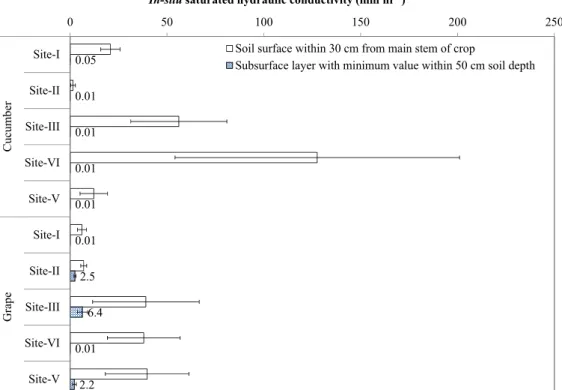
In situ saturated hydraulic conductivity† of soil surface and subsurface layer under plastic film houses with cucumber and grape cultivation as affected by artificial accumulation history.
1)
*Corresponding author : Phone: +82632382425, Fax: +82632383822, E-mail: [email protected]
§Acknowledgement: This project was supported by National Academy of Agricultural Science (PJ010936).
Introduction
Particular environmental and management conditions of soil under protected cultivation often results in continuous cropping obstacles and are characterized by deterioration in soil properties, increased incidence of diseases and soil borne pests and finally decline in crop quality and yield. According to Yu and Du (2000), the safe and sustainable production is restricted under protected cultivation demanding more attentions to the mechanism and control measures of cropping obstacles (Ma et al., 2004;
Mallik and Zhu, 1995).
The cultivated area under plastic film house has increased continually in Korea since the early 1980s, whereas paddy area has decreased due to crop change from rice to cash crop such as vegetables and fruit. This increase in area under plastic film house cultivation was due to increase in demand of fresh vegetables and fruits and the availability of polythene sheets for the film houses. The major features of soil environment under plastic film houses in Korea were reported; increased temperature, soil disease from mono-cropping, higher fertilization rates and consequential accumulation of salts in the soil profile (Kim, 2001). Recently, to overcome the adverse soil condition, materials such as soil and saprolite were artificially accumulated over original soil profile in some plastic film houses. For cultivating profitable crops in lowland with poor drainage, artificial accumulation of more than 1m depth appeared (Yoon, 2001). Besides, the accumulation materials are various including saprolite and soil with wide range of texture.
Cucumber and grape are important crops under plastic film house cultivation in Korea. The area of cucumber under plastic film house soil is 3,589 ha and for grapes is 2,242 ha (Statistics Korea, 2010). The average production is 76 Mg ha-1 and 17 Mg ha-1 for cucumber and grapes, respectively (Statistics Korea, 2010). Both these cash crops in Korea are also directly affected by the soil properties, especially the disturbed soil profile by artificial accumulation. These disturbed soils also vary greatly in space and time and the large variation made it difficult to group and categorize these soils for some purposes (Jim, 1998; Patterson et al., 1980). The soil characteristics have strong variations across any landscape, not only the disturbed but also the relatively un-disturbed soils, modified by certain environmental and management factors especially under plastic film house conditions (Pouyat et al., 2003). The complete systematic assessment of disturbed soils is required otherwise the investigation of the properties may mislead, the reason thereby, they have been recovered for the past few years (Insam and Domsch, 1988). Addition to laboratory measurement such as nutrient contents, in situ measurements including soil profile description, water permeability, and penetration resistance enable us to grasp field characteristics, including drainage and topography.
The agricultural soils are sometimes used for other aggressive
uses such as urban planning and industrial uses and sometimes the soil material is also shifted to the agricultural soils affecting the soil properties and disturbing the soil profile (Banov et al., 2010; Ibrahim et al., 2012). These changes in the soil properties make it very fragile and un-predictable for plant growth under specific conditions. Once the physical structure of soil is disturbed, the biological and physico-chemical characteristics of soils is on the process of changes with different rate, interacting natural and artificial environment conditions. The change has rarely been checked (Allen and Fanning, 1988; Smeck, 1973).
Therefore, this study was carried out to investigate the effects of profile disturbance with different artificial accumulation history including accumulate types and elapsed time since artificial accumulation on physico-chemical characteristics of plastic film house soils with cucumber and grapes grown.
Materials and Methods
Study area and location The present studies were conducted under plastic film house at five sites each under cucumber (Site Ic ~ Vc) and grape (Site Ig ~ Vg) cultivation. The studies were conducted at Cheonan city, Chungnam province of Republic of Korea. The sites had inter-valley alluvial fan topography, mainly having cultivated rice, except Site Ic and IVc with mountain-foot slope. For both cucumber and grapes crops, five plastic film houses were selected from the same province and soil physico-chemical characters were determined.
The study sites with cucumber cultivation had plastic film mulched ridges with 20 cm height, on average, whereas the grape sites did not have ridge or vinyl mulch.
Soil layers discrimination In plastic film houses with cropping, we sampled undisturbed soil profile with soil column cylinder auger (Eijkelkamp Product code 05.07, Giesbeek, Netherland) F10cm x h110cm, using gasoline driven percussion hammer. The profile using column cylinders at each site describing the soil layers are presented in Fig. 1 (cucumber plastic film house soils) and Fig. 2 (grape plastic film house soils). Minimizing soil and plant disturbance, soil column cylinders in cucumber sites were sampled in row, and the ridge soils were separately sampled. The soil profile was divided into different layers based on the similarity of the soil properties or genesis. The description of soil profile was referred from Schoeneberger et al. (2002).This layering was largely influenced by the soil texture, soil color, hardness, and organic matter content. Soil color of each layer was determined by Munsellâ soil color chart. Soil samples were taken and brought to the laboratory to determine the soil water contents by gravimetric method and other soil properties.
In-situ measurements Field saturated hydraulic conductivity were in-situ measured with Disc tension infiltrometer (Model
(a) Site-I (36°50.35′ N 127°19.04′ E)
(b) Site-II (36°44.77′ N 127°5.38′ E)
(c) Site-III (36°46.34′ N 127°20.12′ E)
(d) Site-IV (36°47.05′ N 127°18.58′ E)
(e) Site V (36°46.25′ N 127°18.20′ E)
Fig. 1. Profile pictures (a) Site-I, (b) Site-II, (c) Site-III, (d) Site-IV, and (e) Site-V showing different soil layers at investigated plastic film house soils under cucumber cultivation.
(a) Site-I (36°54.31′ N 127°12.83′ E)
(b) Site-II (36°54.27′ N 127°12.85′ E)
(c) Site-III (36°54.40′ N and 127°11.52′ E)
(d) Site-IV (36°54.48′ N 127°10.56′ E)
(e) Site-V (36°52.75′ N 127°12.04′ E)
Fig. 2. Profile pictures (a) Site-I, (b) Site-II, (c) Site-III, (d) Site-IV, and (e) Site-V showing different soil layers at investigated plastic film house soils under grape cultivation.
2826D20, Soil moisture corp., CA, USA) at soil surface and Guelph permeameter (Model 2800K1, Soil moisture corp., CA, USA) at subsurface layer, respectively. The infiltration rate under soil saturation condition (Ks) was induced by following equation after infiltration measurements with several tension steps with triplicate. In cucumber plastic film house, it was measured at surface of ridge between plants after removing vinyl mulching, whereas measured at soil surface close to grapes growing line.
exp
(1)where Q is the volume of water entering the soil per unit time (cm3 hr-1), r is radius of disc (cm), Ks (cm hr-1) is saturated hydraulic conductivity, and a is the parameter of Gardner
(1958) equation.
The Guelph Permeameter is an in-hole constant-head Per- meameter, employing the Mariotte Principle (Reynold et al., 2002). The method involves measuring the steady-state rate of water recharge into unsaturated soil from a cylindrical well hole, in which a constant depth (head) of water is maintained.
Reynold et al. (2002) was described the determination of field saturated hydraulic conductivity (Kfs, cm sec-1) as following equation.
(2)
where X is Well radius, in cm. R1, R2 is steady state rate of fall corresponding to H1 and H2, respectively, and converted to cm/sec. H1 and H2 are 5 cm and 10 cm, respectively, in this study. The determination of permeability grade was referred
Table 1. Selected soil profile description of cucumber plastic film house sites.
Depth cm
Soil layers
Colora Structureb Texturec Particle size distribution %d
Layers Elapsed time† Sand Silt Clay
Site-I Ridge(20) Disturbed soil
5-10 years
Br (10YR 4/3) St.less SL 62.8 27.2 10.0
0-22 Disturbed soil Br (10YR 4/3) St.less SL 64.3 23.7 12.0
22-43 Disturbed soil DYBr (10YR 4/6) St.less Gravelly SL 60.8 29.2 10.0
43-50 A horizon DYBr (10YR 4/4) St.less SL 74.2 19.8 6.0
50-100 C horizon Br(10YR 4/3) St.less LS 86.9 7.1 6.0
Site-II Ridge(20) Disturbed soil
5-10 years
DBr (10YR 3/3) St.less SL 61.5 24.6 14.0
0-16 Disturbed soil DBr (10YR 3/3) St.less SL 63.5 24.5 12.0
16-22 Disturbed soil LBGr (10YR 6/2) St.less SL 74.1 15.9 10.0
22-40 Disturbed soil Br (10YR 5/3) week SBK SL 73.3 18.7 8.0
40-58 Disturbed soil Br (10YR 5/3) St.less LS 77.3 16.7 6.0
58-71 A1 horizon Gr (2.5Y 5/1) week SBK SiL 15.1 58.9 26.0
71-84 A2 horizon DYBr (10YR 4/6) week PR SiCL 10.2 57.8 32.0
84-100 B horizon YBr (10YR 5/4) week PR SiCL 9.2 59.8 31.0
Site-III Ridge(20) Disturbed soil
5-10 years
Br (10YR 4/3) St.less SiL 31.7 51.1 17.2
0-18 Disturbed soil Br (10YR 4/3) St.less L 34.5 49.5 16.0
18-29 Disturbed soil DYBr (10YR 4/4) week SBK L 29.6 49.4 21.0
29-45 Disturbed soil YBr (10YR 5/4) week SBK SiL 28.2 51.8 20.0
45-72 A horizon YBr (10YR 5/4) week SBK L 46.7 43.3 10.0
72-87 C1 horizon YBr (10YR 5/4) St.less SL 69.2 20.8 10.0
87-110 C2 horizon YBr (10YR 5/4) St.less SL 77.0 15.0 8.0
from NIAST (1973). The penetration resistances of soil were measured with Penetrologger (Eijkelkamp Product code 06.15.SA, Giesbeek, Netherland) with cone base area 1cm2 and angle 60 deg with triplicate, except Site Ic with gravel layer and Site IIc with water-logged condition. It was measured at surface of ridge between plants, whereas it was measured at soil surface close to grapes growing.
Laboratory measurements For analyzing the particle size distribution and chemical properties of soils, air-dried fine earth fraction of each layer soil was used. The particle size distribution was determined by hydrometer method described by Klute et al. (1986). Soil pH was measured potentiometrically in H2O (1:5 w/v) with a pH meter (Orion, USA). Organic carbon was determined by wet digestion method as described in Tyurin (1931) and expressed as organic matter (OM) using Van Bemmelen factor 1.724. The cation exchange capacity (CEC) and the exchangeable cations were determined by the extraction using 1N NH4OAc solution buffered at pH 7 followed as Sumner and Miller (1996). The cations in 1N NH4OAc extracts were measured with ICP (GBC Integra, Braeside VIC, Australia). For determining available P2O5, the extracting
phosphate was followed with the Lancaster method described by Alban et al. (1964) and then molybdate-reactive phosphorus in the extract was measured with Kuo (1996).
Results and Discussion
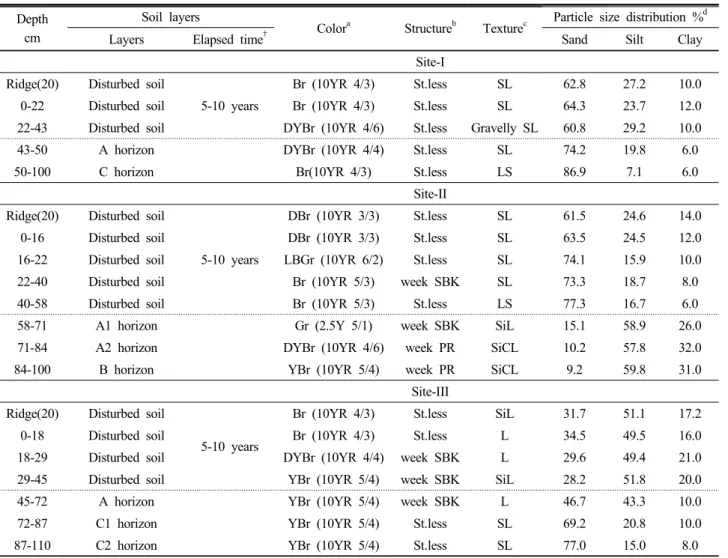
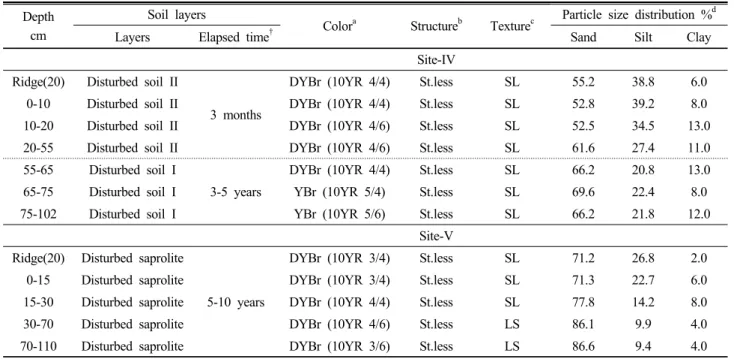
Soil profile disturbance by artificial accumulation The soil profile pictures and description are presented (Fig. 1, 2, Table 1, 2). The soil profiles were differentiated into several layers in artificially accumulated layer and original soil layer.
In particular, we distinguished the layers in case of several times accumulations were conducted in different years. Undis- turbed soil column pictures shows in Fig. 1 and 2. Ridge soil of cucumber sites does not show in the Fig. 1, but we described the ridge soil with separately observation in Table 1. The color and texture of ridge soil were similar to those of top layer of row which could result from soil mixing by tillage more than two times in a year in cucumber sites. Types of accumulates around root zone in the study sites included sandy loam soil for 3 sites, loam soil for 1 site, saprolite for 2 sites, and multi-layer with different accumulates for 3 sites. In particular, Site IIg has mixed plow zone (Ap horizon) with
Table 1. Selected soil profile description of cucumber plastic film house sites (Continue).
Depth cm
Soil layers
Colora Structureb Texturec Particle size distribution %d
Layers Elapsed time† Sand Silt Clay
Site-IV Ridge(20) Disturbed soil II
3 months
DYBr (10YR 4/4) St.less SL 55.2 38.8 6.0
0-10 Disturbed soil II DYBr (10YR 4/4) St.less SL 52.8 39.2 8.0
10-20 Disturbed soil II DYBr (10YR 4/6) St.less SL 52.5 34.5 13.0
20-55 Disturbed soil II DYBr (10YR 4/6) St.less SL 61.6 27.4 11.0
55-65 Disturbed soil I
3-5 years
DYBr (10YR 4/4) St.less SL 66.2 20.8 13.0
65-75 Disturbed soil I YBr (10YR 5/4) St.less SL 69.6 22.4 8.0
75-102 Disturbed soil I YBr (10YR 5/6) St.less SL 66.2 21.8 12.0
Site-V Ridge(20) Disturbed saprolite
5-10 years
DYBr (10YR 3/4) St.less SL 71.2 26.8 2.0
0-15 Disturbed saprolite DYBr (10YR 3/4) St.less SL 71.3 22.7 6.0
15-30 Disturbed saprolite DYBr (10YR 4/4) St.less SL 77.8 14.2 8.0
30-70 Disturbed saprolite DYBr (10YR 4/6) St.less LS 86.1 9.9 4.0
70-110 Disturbed saprolite DYBr (10YR 3/6) St.less LS 86.6 9.4 4.0
†Elapsed time from artificially accumulation to investigation time; aBr=Brown; DYBr=Dark Yellowish Brown; YBr=Yellowish Brown; LBGr=Light Brownish Gray; Gr=Gray; The parentheses mean Munsell soil color notation.; bSt.less=Structureless;
SBK=Sub-angular blocky; PR=Prismatic; cSL=Sandy Loam; LS=Loamy Sand; SiL=Silt Loam; L=Loam; SiCL= Silt Clay Loam;
dfine earth fraction.
Table 2. Selected soil profile description of different soil layers of grape plastic film house sites.
Depth cm
Soil layers
Colora Structureb Texturec Particle size distribution %d
Layers Elapsed time† Sand Silt Clay
Site-I
0-47 Disturbed saprolite 8 years RYe (10YR 4/3) St.less LS 79.9 16.2 3.9
43-50 A horizon Gr (10YR 5/1) St.less L 41.6 36.4 22.0
50-100 Bg horizon Gr (10YR 5/1) mod. SBK L 37.2 45.1 17.7
Site-II
0-20 Ap1 with saprolite 13 years DYBr (10YR 4/2) St.less SL 64.2 26.2 9.6
20-60 BA horizon DGr (10YR 4/1) week Pr SiL 24.2 50.5 25.3
60-85 B1 horizon Gr (10YR 5/1) week Pr L 27.7 46.0 26.3
85-100 B2 horizon Gr (10YR 6/1) mod Pr SiCL 15.0 54.2 30.9
Site-III 0-16 Disturbed soil
5-10 years DYBr (10YR 4/4) St.less SL 66.1 22.5 11.4
16-35 Disturbed soil LYBr (10YR 6/4) St.less LS 75.8 22.6 1.6
35-55 A horizon Gr (5Y 5/1) St.less L 31.7 47.2 21.2
55-87 C1 horizon OGr (5Y 5/2) week Pr SiL 19.4 53.7 26.9
87-104 C2 horizon DGr(5Y 4/1) week Pr SL 55.4 31.4 13.2
Site-IV
0-20 Disturbed soil 5 years BYe (10YR 6/6) St.less SL 62.4 25.3 12.4
20-40 Disturbed saprolite 8 years DYBr (10YR 3/4) St.less SL 53.5 29.3 17.2
40-100 Disturbed sediment 8 years YBr (10YR 5/6) St.less SL 60.0 27.6 12.4
Site-V
0-15 Disturbed soil 20-30 years DYBr (10YR 4/4) Granular L 35.7 45.1 19.2
15-60 Disturbed soil YBr (10YR 5/6) Week SBK CL 27.4 44.4 28.2
60-100 A DBr (10YR 3/3) Week SBK Gravelly SL 73.1 20.4 6.5
†Elapsed time from artificially accumulation to investigation time; aRYe=Redish Yellow; DYBr=Dark Yellowish Brown; YBr=
Yellowish Brown; Gr=Gray; DGr=Dark Gray; LYBr=Light Yellowish Brown; OGr=Olive Gray; BYe=Brownish Yellow; DBr=Dark Brown;
The parentheses mean Munsell soil color notation.; bSt.less=Structureless; SBK=Sub-angular blocky; PR=Prismatic; mod.= moderate.;
cSL= Sandy Loam; LS= Loamy Sand; SiL= Silt Loam; L= Loam; SiCL= Silt Clay Loam; CL= Clay Loam; dfine earth fraction.
Table 3. In situ vertical water transport characteristics in investigation sites.
Sites Infiltration rate at soil surface† Field saturated hydraulic conductivity (Kfs) of subsoil*
Gardner Ks mm hr-1 Gardnera Kfs mm hr-1 Measured depth cm
Cucumber
Site I 20.8±5.0# 0.22 2.2 -22
0.05 -43
Site II 1.5±1.2 0.06 <0.01‡ -50
Site III 56.1±24.8 0.42 <0.01 -30
0.04 -50
Site VI 127.6±73.4 0.32 0.07 -30
<0.01 -50
Site V 12.2±7.1 0.20 <0.01 -30
0.3 -50
Grape
Site I 6.1±2.3 0.12
7.8 -20
<0.01 -40
<0.01 -60
Site II 7.0±1.5 0.11 2.5 -20
3.3 -55
Site III 39.1±27.5 0.16
10.1 -30
6.4 -50
0.5 -80
Site VI 38.0±18.8 0.21 9.9 -15
<0.01 -35
Site V 39.8±21.6 0.29 2.2 -15
33.1 -35
†Gardner parameters saturation hydraulic conductivity (Ks) and ‘a’ were fitted with measured infiltration data with several steps of tension using tension infiltrometer; *the negative ‘-’of measured depth means under soil surface, especially row soil surface in cucumber cultivation sites.; #mean±standard deviation; ‡Vertical water transport was not observed with used instruments, so it could be regarded as ‘impermeable’.
original soil and saprolite, whereas disturbed soil layers of the other sites are composed of only external accumulates. The soil depth disturbed by artificial accumulation ranged from 20 cm for Site IIg to whole measured depth of 110 cm for Site IVc, Vc, and Site IVg. Elapsed time from artificially accu- mulation to investigation time ranged from 3 months for Site IIc to more than 20 years for Site Vg.
Site Ic, located at mountain-foot slope, was observed with accumulation with gravels and a little higher clay content than original soil. Its ridge and row top layer had brown color, showing typical upland soil color. Contrary to Site Ic, Site IIc shows dark color, similar to paddy soil. In fact, Site IIc belongs to ex-paddy area with poor drainage. This site has sandy loam soil accumulation from ridge to 58 cm depth under row soil surface. Nevertheless, the profile shows gray color, indicating reduced condition in redox potential, which corresponds to adverse condition to cultivate upland crop. Site IIIc also belongs to ex-paddy area, so had loam soil accumulation from ridge to 45 cm depth under row soil surface. But compared to Site IIc, Site IIIc had deeper groundwater level and less abrupt change in texture between accumulates and original
soil layer. Site IVc and Site Vc had deep accumulation depth, not observed original soils in whole measured depth. Site IVc had most recent accumulation of study sites and two times accumulation with sandy loam soil. Site Vc had deep saprolite accumulation with differences in color and texture between layers.
All sites under grape cultivation except Site IVg and Vg belong to ex-paddy area. Site IIg, however, has mixed plow zone (Ap horizon) with original soil and saprolite, unlike disturbed layer of the other sites is composed of only external accumulates. Site Ig had coarse saprolite accumulation and sub-layers with finer texture had gray color. Site IIg and Site IIIg also had coarse suface layer and in sub-layers with finer texture had gray color. Site IVg had three layers with different accumulates, sandy loam soil, saprolite, and river sediment, but their textures were similar to each other. Contrary to other gape sites, Site Vg had relatively finer textured top soil layer with coarse textured original soil layer. The profile disturbance in this site was accomplished not by cultivating grape under plastic film house but by covering adjacent finer paddy soils on coarse original upland soil in the way of arable land
Table 4. Chemical properties of plastic film house soil under cucumber cultivation.
Depth Cm
pH OM P2O5 Ca+2 K+ Mg+2 Na+
(1:5H2O) g kg–1 mg kg–1 --- cmolc kg-1 --- Site-I
Ridge(20) 7.5 27 623 10.0 3.3 5.1 0.8
0-22 6.8 27 577 10.2 2.2 3.4 0.5
22-43 6.8 17 233 5.8 1.4 2.3 0.3
43-50 6.8 10 341 3.5 1.1 1.5 0.2
50-100 6.6 3 143 1.7 0.8 0.8 0.1
Site-II
Ridge(20) 7.5 42 985 39.0 5.2 21.1 5.8
0-16 7.8 35 768 22.9 6.5 11.7 5.9
16-22 8.1 13 156 11.7 0.7 4.2 0.8
22-40 7.8 3 12 13.6 0.1 4.8 0.7
40-58 7.3 4 0 12.8 0.04 4.6 0.7
58-71 7.1 14 24 6.1 0.1 2.7 0.3
71-84 7.3 9 6 5.3 0.1 3.3 0.2
84-100 7.6 9 40 7.1 0.1 4.7 0.2
Site-III
Ridge(20) 6.3 35 1160 15.0 2.7 7.3 1.9
0-18 6.3 35 1082 17.5 3.7 7.7 1.9
18-29 6.0 21 377 5.6 1.7 2.3 0.5
29-45 6.0 9 12 4.9 0.9 2.3 0.4
45-72 6.0 6 12 5.6 0.3 2.4 0.3
72-87 6.1 3 6 4.5 0.2 1.9 0.3
87-110 6.4 5 16 5.2 0.1 2.1 0.3
Site-IV
Ridge(20) 6.5 72 1928 13.5 2.3 5.5 0.5
0-10 6.5 50 1542 12.6 1.7 4.8 0.4
10-20 6.6 39 1390 10.1 1.3 3.6 0.2
20-55 6.1 4 111 3.1 0.6 1.6 0.1
55-65 6.3 6 141 3.2 0.6 1.5 0.1
65-75 6.2 7 78 2.2 0.7 1.1 0.1
75-102 5.9 3 47 1.9 0.6 1.1 0.1
Site-V
Ridge(20) 6.9 78 1733 11.8 1.6 5.6 0.5
0-15 7.7 42 1540 10.4 2.0 5.3 0.6
15-30 7.7 10 315 4.4 0.3 2.6 0.2
30-70 7.7 5 10 7.8 0.1 2.7 0.2
70-110 7.5 6 8 8.5 0.3 2.0 0.2
OM = organic matter; P2O5 = available; Ca+2, K+, Mg+2, Na+ corresponds to exchangeable cations.
leveling in 1980s.
Artificial accumulation had differences in accumulates, depth, texture, and elapsed time between sites, as mentioned above. Disturbed top layer in all sites except Site Vg, however, had no structure, showing low structural stability. Besides, the sites in ex-paddy area still had gray color, and the gray layer even moved up to accumulated layer in Site IIc
Soil physico-chemical characteristics under cucumber cultivation as affected by artificial accumulation Different physic-chemical characteristics were determined at plastic
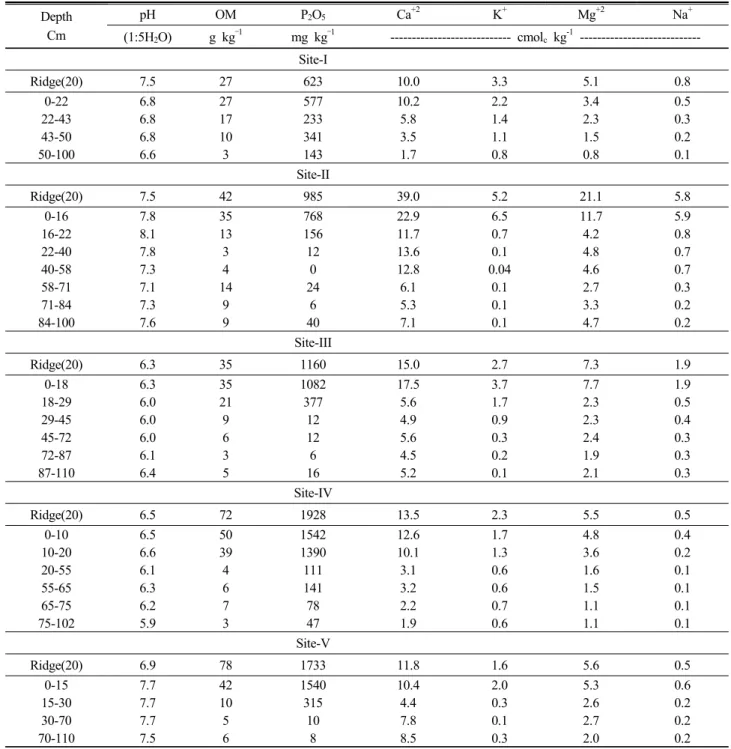
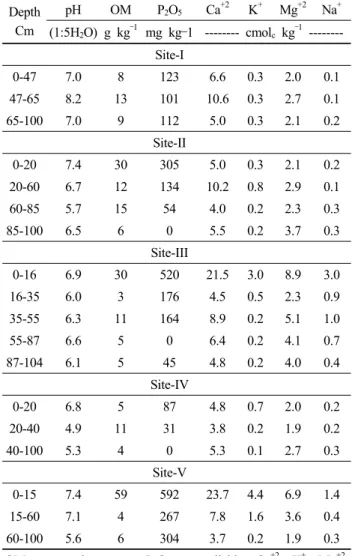
film house soils under cucumber and grape cultivation. The characteristics were determined after differentiating the soil profiles into different layers. The parameters determined are described as different plastic film houses individually (Table 3, 4, 5, Fig. 3, 4, 5).
Site Ic, having mountain-foot slope topography, had ordinary Ks (20~62.5 mm hr-1) at ridge soil surface. Second layer (0-22 cm) had slow Kfs, and third layer (22-43 cm) had very slow Ks. The values of soil reaction (pH of 1:5 soil water ratios) are around neutral, showing highest value in ridge. The decreasing trend also persisted for organic matter contents in this film house
Table 5. Chemical properties of plastic film house soil under grape cultivation.
Depth Cm
pH OM P2O5 Ca+2 K+ Mg+2 Na+ (1:5H2O) g kg–1 mg kg–1 --- cmolc kg–1 ---
Site-I
0-47 7.0 8 123 6.6 0.3 2.0 0.1
47-65 8.2 13 101 10.6 0.3 2.7 0.1
65-100 7.0 9 112 5.0 0.3 2.1 0.2
Site-II
0-20 7.4 30 305 5.0 0.3 2.1 0.2
20-60 6.7 12 134 10.2 0.8 2.9 0.1
60-85 5.7 15 54 4.0 0.2 2.3 0.3
85-100 6.5 6 0 5.5 0.2 3.7 0.3
Site-III
0-16 6.9 30 520 21.5 3.0 8.9 3.0
16-35 6.0 3 176 4.5 0.5 2.3 0.9
35-55 6.3 11 164 8.9 0.2 5.1 1.0
55-87 6.6 5 0 6.4 0.2 4.1 0.7
87-104 6.1 5 45 4.8 0.2 4.0 0.4
Site-IV
0-20 6.8 5 87 4.8 0.7 2.0 0.2
20-40 4.9 11 31 3.8 0.2 1.9 0.2
40-100 5.3 4 0 5.3 0.1 2.7 0.3
Site-V
0-15 7.4 59 592 23.7 4.4 6.9 1.4
15-60 7.1 4 267 7.8 1.6 3.6 0.4
60-100 5.6 6 304 3.7 0.2 1.9 0.3
OM = organic matter; P2O5 = available; Ca+2, K+, Mg+2, Na+ corresponds to exchangeable cations.
soil and it decreased sharply and ranged between 27 g kg–1 (at surface soil) and 3g kg–1 at a depth of 50-100 cm. There was a decrease in all the available cations down the profile with the maximum at the surface soil and the least in the lower soil layers (50-100 cm). Unlike organic matter and cations, the decreasing trend along soil depth did not persist for available phosphate and it had an increase at original soil layer 43-50 cm, compared to 22-43 cm layer. The data regarding Site-IIc shows that the profile is differentiated to different layers (Fig.
1). Infiltration rate at ridge soil surface belongs to slow permeability, showing lowest value of study sites. The vertical water movement at subsurface layer was not observed, probably due to elevated ground water level. The soil water content was closed to saturation through whole measured soil depth.
All soils layers exhibited pH values more than neutral with the maximum pH (8.12) at soil depth of 16-22 cm, indicating reduced condition of gray color (Table 4). This soil presented very high exchangeable cations at the surface soil due to the accumulation of salts in the upper profile. The profile pictures
showed that the upper layers up to 58 cm are composed of accumulated soils. In case of plant nutrients and the available cations, this plastic film house soil also exhibited a large variation.
The upper soil layer recorded the maximum available P2O5
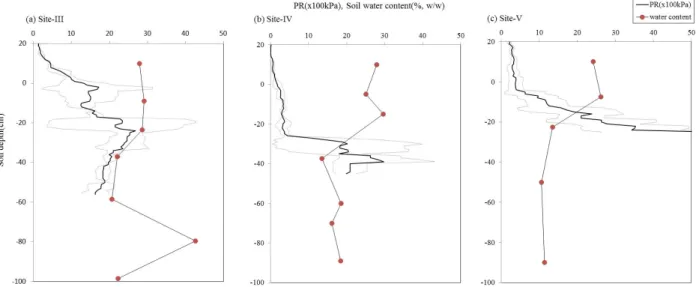
(985 mg kg–1) which decreased down to 0 mg kg–1 at soil depth of 40-58 cm but had a little increase at the soil depth of breakthrough of original soil layer similar to Site-Ic. At Site-IIIc, ridge and the upper three soil layers (0-18 cm, 18-29 cm and 29-45 cm) represented the accumulated soil. Then there was a layer of paddy soil (45-72 cm). This site has also elevated ground water table and poor drainage. Infiltration rate at ridge soil surface belongs to ordinary permeability, having variability from moderately slow to fast. The Kfs at subsurface layer was not observed or very low, corresponding to layers with high penetration resistances. For available calcium, there was a little increase at the soil depth of breakthrough of original soil layer, differently from Sites Ic and IIc. The soil properties at Site-IVc represented accumulated soil during land development and high input of organic matter on the surface soil layers (Table 3). This site had lowest penetration resistance from ridge to 20 cm under row soil surface. Besides, the Ks at ridge soil surface shows very fast permeability and highest variation from ‘ordinary’ to ‘very fast’. On the contrary, the Kfs at subsurface layer was not observed or very low, corresponding to layers with high penetration resistances. The pH of different soil layers is detected to be in the acidic range with the maximum 6.5 (0-10 cm soil layer) and decreasing down the profile. There was a sharp decrease in the organic matter contents with the maximum 72 g kg–1 (Ridge soil) followed by 50 g kg–1 (0-10 cm soil layer) and then sharp decrease to 4 g kg–1 (20-55 cm soil layer). The higher organic matter contents at the surface soil layers given rise to the concentration of available P2O5 and the maximum was recorded at the surface soil layers of Ridge, 0-10 cm and 10-20 cm. At the brea- kthrough depth of previous accumulation, organic matter and available P2O5 had a little increase compared to right upper layer. The soils at Site-Vc exhibited a unique feature of saprolite accumulated soil throughout the profile (Fig. 2). Ks at ridge soil surface shows moderately slow permeability, showing lower than other sites except Site IIc. The Kfs at subsurface layer was not observed or very low, corresponding to layers with high penetration resistances. This soil also showed the presence of higher organic matter and available contents in the surface soil layers and decreased sharply down the profile.
Like Site IVc, the surface soil of ridge recorded high values of organic matter content and available P2O5.
An overall comparison of all these five plastic film house sites under cucumber cultivation suggested a relatively higher concentration of organic matter in the upper soil layers and this may be due to high inputs for high cucumber production (Kim et al., 2003). A compact or impermeable layer within root zone usually hinder plant growth by limiting nutrients
0.05 0.01 0.01 0.01 0.01 0.01 2.5 6.4 0.01
2.2
0 50 100 150 200 250
Site-I Site-II Site-III Site-VI Site-V Site-I Site-II Site-III Site-VI Site-V
CucumberGrape
Soil surface within 30 cm from main stem of crop
Subsurface layer with minimum value within 50 cm soil depth In-situ saturated hydraulic conductivity (mm hr-1)
†Saturated hydraulic conductivities of soil surface and subsurface layer corresponds to Gardner parameter saturation hydraulic conductivity (Ks), induced from measured infiltration data with several steps of tension using tension infiltrometer and field saturated hydraulic conductivity(Kfs) from Guelph permeameter
Fig. 3. In situ saturated hydraulic conductivity† of soil surface and subsurface layer under plastic film houses with cucumber and grape cultivation as affected by artificial accumulation history; Horizontal bars indicate the standard deviation of the values.
and aeration and restricting root penetration (Taylor and Brar, 1991). In the present investigations on cucumber plastic film houses mostly this type of layer was present and causing the restriction in the movement of nutrients down the profile. In all sites, there was very slow permeability or impermeable layer with field saturated hydraulic conductivity (Kfs) less than 0.01 mm hr-1 within 50 cm under soil surface. This indicates that the root zone of cucumber could limit impermeable layer, from only ridge soil Site IIc to 40 cm depth under row soil surface, Site Ic, regardless of the depth of artificial accumulation.
On the contrary, vinyl mulched ridge soil with recently accumulated soil had high infiltration rate with high variability, which could result in lowering productivity due to non-uniform water content in root zone. This big difference of water permeability between ridge soil and subsurface soil could be one of main causes of generating waterlogged row condition, although cucumber sites usually use drip irrigation, one of representative micro-irrigation. Site IIc had waterlogged row and gray layer in accumulated soil, which means that artificial accumulation did not improve drainage.
Mostly there was accumulation of soil material on the original soil mass, the process of trafficking may also had led to the formation of layer responsible for interfering with the movements of ions and water. It was also noted that organic matter contents and the available cations are higher in the
surface soil layers than the deep soil layers. The reason may be the higher evapotranspiration in the plastic film house and causing an upward movement of water and accumulation in the surface layers (Naidu and Rengasamy, 1993). Hillel (1983) concluded that water flows spontaneously from a higher hydraulic potential to a lower one and, here, it should move upward in response to water content gradient in different soil layers and results in accumulation of salts causing higher available cations in the surface layers than the deep layers (Table 4). The cucumber crop is grown 2-3 times in a year and this has led to the higher rates of fertilizer and composts at the sowing of each cucumber crop. This would have resulted in higher organic matter contents in the upper layers of soil profile. The same is true for the concentrations of available cations and P2O5. Sarwar et al. (2008) in field studies and Ibrahim et al. (2008) in a greenhouse experiment have also showed that the application of higher organic material rates and frequency resulted in higher organic matter status and the plant nutrients.
Soil physico-chemical characteristics under grape culti- vation as affected by artificial accumulation The grape is also important fruit cash crop in Korea and is cultivated in plastic film houses throughout the country. Grape is not annual crop, so the tillage intensity of soil is lower than soil
Fig. 4. Penetration resistance (PR) and soil water content through soil profile (a) Site-III, (b) Site-IV, and (c) Site-V in plastic film houses with cucumber cultivation; 0 soil depth means the surface of row and 20cm means the surface of ridge with cucumber plant growing; Two dotted lines around PR indicate the standard deviation of PR at each depth.
under cucumber cultivation. Besides, grape cultivation sites had no vinyl mulch and no ridge unlike cucumber sites. The topography of all sites is inter-valley alluvial fan and sites except Site IVg and Vg are ex-paddy field.
Site-Ig show the division of the profile in three layers (0-47 cm, 47-65 cm and 65-100 cm). Ks at the surface of the first layer with disturbed coarse saprolite had 6.1 mm hr-1 belonging to moderately slow permeability. The Kfs also had moderately slow permeability at the depth of 20cm but was not observed at the depth of 50 cm, corresponding to layers with high penetration resistances. The pH ranged from neutral to slight alkaline down the profile. The maximum organic matter content and available calcium at this site were recorded at the middle layer of 47-65 cm, original soil layer. At the brea- kthrough depth of original soil layer, organic matterhad a little increase compared to right upper layer. The Site-IIg with Ap of dressed saprolite belongs to fine loamy, mixed, and mesic family of Fluvaquentic Endoqauents in Soil Taxonomy, typical paddy soil of Korea. The texture of top layer changed from loam to sandy loam by mixing with coarse saprolite.
Nevertheless, Ks at the soil surface had 7.0 mm hr-1 belonging to moderately slow permeability. The Kfs at subsoil (20 cm, 55 cm) had slow permeability, not very low or impermeable, showing relatively low penetration resistances compared to other sites. Soil pH decreased from 7.4 at the surface layer (0-20 cm) down the profile to the minimum (5.7) at soil depth of 60-85 cm. The decreasing trend also continued for organic matter content and the available P2O5 down the soil profile. At Site-IIIg, the profile was differentiated into five layers (Fig.
3). Ks at the soil surface had 39 mm hr-1 belonging to ordinary permeability. The Kfs at subsoil (30 cm, 50 cm) had moderately slow or slow permeability, not very low or impermeable, showing relatively low penetration resistances like Site IIg.
The pH recorded was on acidic side ranged between 6.9 at the surface soil (0-16 cm) and 6.1 at soil depth of 87-104 cm. At the breakthrough depth of original soil layer, organic matter had a little increase compared to right upper layer. This site exhibited a decrease in available P2O5 down the profile with the maximum of these at the surface layers (Table 4). The Site-IVg presented (Fig. 3) exhibited unique feature and very dark layer below the surface soil layer. Ks at the soil surface had 38 mm hr-1 belonging to ordinary permeability. The Kfs had moderately slow permeability at 15 cm soil depth, but the second layer (20-40 cm) was impermeable, showing rapid increase in penetration resistances. It represented acidic pH started from 6.8 (0-20 cm) to 4.9 at 20-40 cm soil depth and 5.3 at depth blow 40 cm. At the breakthrough depth of second soil layer, organic matterhad a little increase compared to right upper layer. The available P2O5 also decreased down the profile with the maximum 87 g kg–1 at the surface soil. The Site-V (Fig. 3) presented a shallow surface layer (0-15 cm) and relatively deep sub-surface layers (15-60 cm and 60-100 cm). Ks at the soil surface had 40 mm hr-1 belonging to ordinary permeability. At the boundary of first and second layer, the Kfs had slow permeability, showing relatively low penetration resistances as those at like Site IIg and IIIg. Better permeability was observed at 35cm soil depth of second layer with fine texture, probably due to macropores from interag- gregate or biological activity such as root channel (Han et al., 2009). The pH of the upper soil layers was alkaline (7.4 at 0-15 cm soil layer) and the deep soil layer (5.6 at soil depth
>60 cm) was acidic in nature. Sharp decrease in organic matter content was recorded down the soil profile starting from 59 g kg–1 (0-15 cm) to 4.0 g kg–1 (15-60 cm) and further to 6.0 g kg–1 (>60 cm soil depth). This site recorded the highest organic matter contents in the investigated grape
Fig. 5. Penetration resistance (PR) and soil water content through soil profile (a) Site-I, (b) Site-II, (c) Site-III, (d) Site-IV, and (e) Site-V in plastic film houses with grape cultivation Two dotted lines around PR indicate the standard deviation of PR at each depth.
plastic film house soils.
Influences of accumulate types and elaped time on physico-chemical properties of soils The water infiltration at the surface soil including saprolite was relatively low compared to other site, similarly to cucumber site with saprolite.
Coarse saprolite itself had significantly poor chemical properties such low organic matter content (Joo et al., 2004) like Site Ig and IVg. The surface layer with saprolite at Site Vc and Site IIg, however, showed an increased organic matter in the surface soil probably due to excessive use of organic materials as fertilizers. An important point to be noted is that the grape is a perennial crop and the fertilizer or compost application is generally once a year. This may have resulted in low organic matter status as compared to cucumber plastic film house where 2-3 crops are grown and the application rate is higher.
This is also supported by the earlier findings of Sarwar et al.
(2008) under field conditions. Remarkable thing about water permeability of disturbed soil in this study is that we could not find any correlation between permeability and organic matter content. Site Vc had coarse accumulate and highest
organic matter content, but its Ks at ridge soil surface was lower than that of Site IIIc with silt loam. Coarse materials such as sandy loam or saprolite generally have low aggregation due to low content of cementing agent like clay (Hillel, 1983).
Moreover, saprolite is not close to rigid material but still is on weathering process, which means its components such as quartz and mica can fragment into small pieces over time (Zhang et al., 2014; Begonha and Braga, 2002). Zhang et al.
(2014) also reported that saturated hydraulic conductivity of piled saprolite decreased over time, probably due to macropore clogging of fine particles formed by weathering of mica and feldspar in saprolite.
On the contrary, site IIIg and Vg had ordinary permeability at soil surface and no impermeable layer within 60cm soil depth. Site IIg had relatively low permeability at soil surface but relatively high permeability at sub-surface layer within 60 cm soil depth. Site Vg, not ex-paddy but paddy-soil accumulated over well-drained upland soil, had granular structure in surface layer and sub-angular blocky structure in sub-surface layers, giving better permeability compared to no structure soil (Han et al., 2007; Han et al., 2009; Paul and Clark, 1989). This site
had been used to cultivate upland crop for about 20 years before plastic film house construction since accumulation, which could develop the structure formation in according to wetting-drying, percolation, and translocation (Brady and Weil, 2008). Unlike open upland, there is no rainfall but only irrigation for growing crop under plastic film house, and thereby the structure formation of disturbed soil might be limited compared to open field. Sites IIg and IIIg, ex-paddy, had relatively weak disturbance with coarse material in the aspect of disturbed soil depth.
Bradshaw (1997) reported that most important aspect of disturbance is the severity of the disturbance in relation to the soil environment. The accumulation of disturbed soil on the original soil material has altered soil physic-chemical properties, and the change could be accelerated or mitigated by crop cultivation practices by farmer. The higher tillage intensity of the annual crop, cucumber, compared to perennial crop, grape, could cause higher compaction (Anderson, 2005; Hamza, 2005; Unger, 1996). In this study, penetration resistance of subsurface layer shows the higher in Site Vc than in Site Ig with accumulate similar to Site Vc, disturbed saprolite. Site IIIc and IIg also had similar textures in subsurface layer at about 20 cm soil depth, but the penetration resistance of Site IIIc, 2.5 MPa, had two times higher than that of Site IIg, 1.2 MPa. The higher compactness of subsurface layer had lower permeability (Fig. 3). In all cucumber sites, showing higher penetration resistance, there were water-transport limited zone with very low permeable (less than 1.25mm hr-1) or imper- meability within 50 cm under soil surface, but Site IIg, IIIg, and Vg, with relatively weak disturbance or structured soil, were the reverse. This indicate that the higher disturbances and cropping intensity could result in generating water-transport limited layer, lowering drainage and aeration. Chemical properties, organic matter, available cations, and available P2O5, of the surface soils show higher value in cucumber sites than the grape sites on the overall comparison, probably due to higher inputs including inorganic and organic fertilizers in cucumber sites. This result could be suggested that the adverse effect of disturbance like impermeable compact zone and salt accumulation might become larger in more intensive cultivation field.
In the breakthrough of original soil, there was an increase in organic matter and available nutrient compared to right upper layer. In other words, the original surface (Ap horizon) soil with relatively high fertility was buried under root zone.
The available nutrient could, therefore, rarely be used by plants but slowly efflux to a water body according to water flow. This is one of adverse effect in profile disturbance by artificial accumulation, losing nutrient and enhancing off-site mitigation potential of non-point sources such as phosphorus to a water body. To mitigate this adverse effect, the surface soil separately gathering and re-covering over accumulated materials has been recommended in artificial disturbance
deeper than surface layer (Kim, 2013). This recommendation need to be expanded to farmers and shake-holders considering artificial disturbance of soil profile.
Land use change from paddy to plastic film house has proceeded rapidly since 1960s especially in a highly populated area, achieving more profits for farmers and providing fresh vegetables and fruit to urban residents (Kim, 2013; Kim et al., 1997; Moritsukai et al., 2013). Satisfying the need of land use change, Jung et al. (2001) suggested the classification of morphological types of Korean paddy soils with a recom- mendation of land use change to 4 levels, high possible, possible, barely possible, and impossible. The classification was mainly based on texture, topography and drainage. Site IIg, fine loamy textured semi-wet local valley & fans, belongs to ‘possible’ group of land use change to plastic film house.
The soil physic-chemical properties of Site IIg with surface soil dressed with saprolite shows the higher quality for cultivating upland crop than that of other sites with accumulated layer, relatively high permeability and low compaction compared to other sites. In case of Site IIc, vulnerable to waterlogging due to the gathering of waters, tile drain could be effective because of lowering ground water level rather than the piled soil over original soil.
Conclusions
The artificial accumulation has been carried out to improve ex-paddy or problem soil for cultivating profitable crop under plastic film soil. In reality, disturbed soil mostly goes with poor structure and high sensitivity of external forces, resulting in low infiltration rate and compacted layer. After more than 20 years, there would be structure re-formation in fine loamy paddy soil over well-drained upland soil. Unlike fine-textured soil, the coarse textured materials such as sandy loam soil and saprolite generally have low structural stability because of low cementing agent like clay content. Therefore, it is necessary to find other methods or to minimize the disturbance of soil profile like tile drain and surface dressing, rather than strong disturbance of soil profile deeper than 50 cm.
References
Alban, L.A., S. Vacharotayan, and T.L. Jackson. 1964. Phosphorus availability in reddish brown Lateritic soils. I. Laboratory studies. Agron. J., 56:555-558.
Allen, B.L. and D.S. Fanning. 1988. Composition and soil genesis. In Wilding LP, Smeck NE, Hall GF (eds) Pedogenesis and Soil Taxonomy: Concepts and Interactions, Elsevier, pp.
141-192.
Banov, M., V. Tsolova, P. Ivanoa, and M. Hristova. 2010.
Anthropogenically disturbed soils and methods for their re- clamation. Agric. Sci. Technol., 2:33-39.
Begonha, A. and M.A.S. Braga. 2002. Weathering of the Oporto granite: geotechnical and physical properties. Catena 49:57-76.
Bradshaw, A.D. 1997. What do we mean by restoration? In Urbanska KM, Webb NR, Edwards PJ (eds) Restoration Ecology and Sustainable Development. Cambridge University Press, Cambridge, p. 8-14.
Brady, N.C. and R.R. Weil. 2008. The nature and properties of soils. Pearson-Prentice Hall Inc. New Jersy, USA.
Gardner, W.R. 1958. Some steady state solutions of unsaturated moisture flow equations with application to evaporation from a water table. Soil Sci. 85:228-232.
Hamza, M. and W. Anderson. 2005. Soil compaction in cropping systems: a review of the nature, causes and possible solutions.
Soil and Tillage Research 82:121-145.
Han, K.H., H.J. Cho, H.S. Lee, S.O. Hur, and S.K. Hur. 2009.
Relationship between water stable aggregate and macroporosity in upland soils calculated by fragmentation fractal dimension.
Korean J. Soil Sci. Fert. 42:58-64.
Han, K.H., H.J. Cho, H.S. Lee, D.S. Oh, and L.Y. Kim. 2007.
Stable macro-aggregate in wet sieving and soil properties.
Korean J. Soil Sci. Fert. 40:255-261.
Hillel, D. 1983. Introduction to soil physics. p. 107-113. Academic Press, New York.
Ibrahim, M., K.H. Han, S.K. Ha, Y.S. Zhang, and S.O. Hur. 2012.
Physico-chemical characteristics of disturbed soils affected by accumulate of different texture in South Korea. Sains Malaysiana 41(3):285-291.
Ibrahim, M., A. Hassan, M. Iqbal, and E.E. Valeem. 2008.
Response of wheat growth and yield to various levels of compost and organic manure. Pak. J. Bot., 40:2135-2141.
Jim, C.Y. 1998. Physical and chemical properties of a Hong Kong roadside soil in relation to urban tree growth. Urban Ecosys., 2:171-181.
Insam, H. and K.H. Domash. 1988. Relationship between soil organic carbon and mircrobial biomass on chronosequences of reclamation sites. Microb. Ecol. 15:177-188.
Joo, J.H., C.S. Park, Y.S. Jung, J.E. Yang, J.D. Choi, W.J. Lee, and S.I. Kim. 2004. Evaluation of the dressed soil applied in mountainous agricultural land. Korean J. Soil Sci. Fert.
37(4):245-250.
Jung, Y.T., S.J. Jung, G.S. Hyeon, Y.K. Son, Y.K. Cho, E.S. Yun, and G.H. Cho. 2001. Classification of morphological types of the Korean paddy soils for practical use of soil survey results.
Korean J. Soil Sci. Fert. 34:77-84.
Kim, P.J. 2001. Effects of compact layer on salt accumulation in plastic film house soils. Soil Sci. Plant Nutr., 47:67-77.
Kim, P.J., D.K. Lee, and D.Y. Chung. 1997. Vertical distribution of bulk density and salts in a plastic film house soil. J. Korean Soc. Soil Sci. Fert., 30:226-233.
Kim, S.C., Y.H. Park, Y. Lee, J.Y. Lee, C.S. Kim, and C.S. Kim.
2003. Comparison of farm based fertilizer usage in 1992 and 1999. Korean J. Soil Sci. Fert., 36:344-355.
Kim, Y.L. 2013. Soil science for practical use (revised version).
Sambumunhwa Press, Suwon, Korea.
Klute, A., G.S. Campbell, R.D. Jackson, M.M. Mortland, and D.R. Nielsen. 1986. Methods of soil analysis. Part I. 2nd ed.
Agron. Monogr. 9. ASA and SSSA, Madison, WI.
Kuo, S. 1996. Phosphorus. In Sparks DL (eds.) Methods of soil analysis, Part 3. Chemical Methods, 3nd Ed. ASA and SSSA, Madison, WI. pp. 869-920.
Ma, Y.H., M. Wei, and X.F. Wang. 2004. Variation of micro flora and enzyme activity in continuous cropping cucumber soil in solar greenhouses. J. Appl. Ecol., 15(6):1005-1008.
Mallik, A.U. and H. Zhu. 1995. Overcoming allelopathic growth inhibition by mycorrhizal inoculation. ACS Symposium Series 582:38-57.
Moritsukai, N., T. Nishikawai, S. Yamamoto, N. Matsui, H.
Inoue, L.I. Kun-Zhi, and T. Inamurai. 2013. Changes in soil physicochemical properties following land use change from paddy fields to greenhouse and upland fields in the southeastern basin of Dianchi lake, Yunnan province, China. Pedosphere 23(2):169-176.
Naidu, R. and P. Rengasamy. 1993. Ion interaction and constraints of plant nutrition in Australian sodic soils. Aust. J. Soil Res., 31-801-819.
NIAST. 1973. Soil survey manual. Part 1. Field description and soil classification. pp 70. National Institute of Agricultural Science and Technology, Suwon, Korea.
Patterson, J.C., J.J. Murray, and J.R. Short. 1980. The impact of urban soils on vegetation. In METRIA 3: Proceedings of Conference Metropolitan Tree Improve. Alliance, 3rd, Rutgers, NJ. June 18-20, 1980. North Carolina State Univ. Raleigh. pp.
33-56.
Paul, E.A. and F.E. Clark. 1989. Soil microbiology and biochemistry. Academic Press, Inc.
Pouyat, R.V., J. Russell-Anelli, I.D. Yesilonis, and P.M.
Groffman. 2003. Soil carbon in urban forest ecosystems. In Kimble, J.M., L.S. Heath, R.A. Birdsey, and R. Lal (eds) The potential of U.S. forest soils to sequester carbon and mitigate the greenhouse effect, CRC Press, Boca Raton, FL, pp.
347-362.
Reynolds, W.D., D.E. Elrick, E.G. Youngs, A. Amoozegar, H.W.G. Booltink, and J. Bouma. 2002. Ch. 3.4, Saturated and field-saturated water flow parameters, in Methods of Soil Analysis, Part 4. Physical Methods, J. Dane and C. Topp, ed.,p.
797-878. SSSA, Madison, WI.
Sarwar, M.A., M. Ibrahim, M. Tahir, K. Ahmad, Z.I. Khan, and E.E. Valeem. 2010. Appraisal of pressmud and inorganic fertilizers on soil properties, yield and sugarcane quality. Pak.
J. Bot., 42:1361-67.
Schoeneberger, P.J., D.A. Wysocki, E.C. Benham, and W.D.
Broderson (editors). 2002. Field book for describing and sampling soils, Version 2.0. Natural Resources Conservation Service, National Soil Survey Center, Lincoln, NE. USA.