• 검색 결과가 없습니다.

Effects of Localized Muscle Fatigue and Whole Body Fatigue on Postural Control during Single-Leg Stance

N/A
N/A
Protected

Academic year: 2021

Share "Effects of Localized Muscle Fatigue and Whole Body Fatigue on Postural Control during Single-Leg Stance"

Copied!
9
0
0

로드 중.... (전체 텍스트 보기)

전체 글

(1)

Effects of Localized Muscle Fatigue and Whole Body Fatigue on Postural Control during Single-Leg Stance

Chang-Hong Youm

1

· Joong-Dal Shin

1

· Joong-Sook Lee

2

· Kook-Eun Seo

3

· Jong-Jin Park

4

1

Department of Coaching, College of Sport Sciences, Dong-A University, Busan, Korea

2

Division of Physical Education, College of Medical and Life Sciences Silla University, Busan, Korea

3

Division of Sport Sciences, Pusan National University, Busan, Korea

4

School of Sports and Health, College of Arts, Kyungsung University, Busan, Korea Received 20 January 2014; Received in revised form 13 March 2014; Accepted 21 May 2014

...

ABSTRACT

The purpose of this study was to investigate the effects of localized muscle fatigue and whole body fatigue on postural control during single-leg stance after impairment induced by heel raise and the Harvard step test. Thirty-eight university students (19 men:

age, 20.1±0.2 yrs; height, 175.0±5.23 cm; weight, 66.8±5.6 kg; body mass index, 21.8±1.7 kg/m

2

, 19 women: age, 20.6±1.1 yrs;

height, 163.6±6.7 cm; weight, 58.8±4.6 kg; body mass index, 22.0±2.2 kg/m

2

) were participated in this study. Subjects performed a series of single-leg postural tasks prior to, following, and 24 hours after completing: heel raise or the Harvard step test. This study showed that the root mean squared distance and velocity in the anteroposterior and mediolateral planes of the center of pres- sure decreased significantly due to heel raise exercise-induced fatigue. Furthermore, the root mean squared distance in the antero- posterior and mediolateral planes, and the 95% confidence ellipse area of the center of pressure also decreased significantly 24 hours after completing the Harvard step test. In conclusion, this study showed that both heel raise exercise- and Harvard step exer- cise-induced fatigue affects postural control during single-leg stance in AP and ML planes. Furthermore, this study suggests that changes in the postural control strategy may have occurred after the fatigue protocols during single-leg stance. Also vision can attenuate the postural deficits associated with the fatigues. In order to clarify these results, further studies using other equipment and variables are necessary.

Keywords : Muscle Fatigue, Single-leg Stance, Center of Pressure, Heel Raise, Harvard Step Test

...

I. Introduction

Postural control is maintained by the dynamic integration of internal and external forces(Massion, 1994; Yaggie &

McGregor, 2002), which involves harmonious control of the musculoskeletal, visual, vestibular, and somatosensory systems(Hall & Brody, 1999; Shumway-Cook & Woolla- cott, 2000). For the assessment of the postural control, the force platform is primarily utilized, and the center of pres- sure (COP) is determined to quantify body sway (Winter, 1995). The COP assessments have been used to investigate changes in postural control in a variety of healthy and spe-

cial populations (Dolye, Hsiao-Wecksler, Ragan, & Rosen- gren, 2007). The single-leg stance is used as a clinical and experimental tool to assess static postural control in various groups (Bohannon & Leary, 1995; Frzovic, Morris, & Vow- els, 2000), since this stance is required to perform many everyday motor tasks, including turning, climbing stairs, and walking (Jonsson, Seiger, & Hirschfeld, 2004).

Measurement of postural control is one approach to quan- tify neuromuscular control (Gribble & Hertel, 2004b).

Fatigue has been shown to have an adverse effect on neu- romuscular control (Gribble & Hertel, 2004a). Moreover, fatigue and postural control deficits can lead to musculo- skeletal injury (Gribble & Hertel, 2004b). This increased postural sway can increase the risk of musculoskeletal inju- ries such as ankle sprain (Christina, White, & Gilchrist, 2001; Letafatkar, Alizadeh, & Kordi, 2009; Rozzi, Lephart, Gear, & Fu, 1999; Urabe et al., 2005).

Muscle fatigue relates to a decline in performance during high-intensity exercise. The fatigue-induced changes in per-

This study was supported by the Dong-A University research fund.

Corresponding Author: Chang-Hong Youm

Department of Coaching, College of Sports Sciences, Dong-A Uni- versity, 840 Hadan-dong, Saha-gu, Busan, Korea.

Tel : +82-51-200-7830 / Fax : +82-51-200-7805

E-mail: [email protected]

(2)

formance include reduced force production, decreased shortening velocity, and slowed relaxation (Allen & West- erblad, 2001). Factors contributing to muscle fatigue are divided largely into 2 groups: the central factor generates fatigue as a result of the disordering of neuromuscular trans- mission between the central nervous system and the mus- cular membrane, whereas the peripheral factor leads to alteration within the muscle (Giannesini, Cozzone, &

Bendahan, 2003). Muscle fatigue depends on the type of exercise and its various causes, and its behavior is based on the manner in which it is induced (Giannesini et al., 2003;

Letafatkar et al., 2009).

Many researchers have examined the relationship between lower leg muscle fatigue and COP sway (Adlerton

& Moritz, 1996; Cobeil, Blouin, Bégin, Nougier, & Teas- dale, 2003; Gribble & Hertel, 2004a, 2004b; Shin & Youm, 2011; Yaggie & McGregor, 2002; Youm & Kim, 2012).

Lundin, Feuerbach, and Grabiner (1993) studied how pos- tural control during single-leg stance was affected by plan- tar flexor and dorsiflexor fatigue in 8 healthy men, and found that both mediolateral and anteroposterior sway increased significantly. Similarly, Yaggie and McGregor (2002) investigated how postural control during single-leg stance was impacted by plantar flexor and dorsiflexor fatigue in 24 healthy men, and reported that mediolateral sway increased significantly. Gimmon, Riemer, Oddsson, &

Melzer (2011) reported that localized plantar flexor fatigue caused impairment to postural control in the sagittal plane.

Lin et al. (2009) investigated that acute effects of fatigue location and age on changes in postural control induced by localized muscle fatigue, and resulted that the acute effects of fatigue differed between joints. And ankle joint fatigue resulted in significant effects on postural control.

On the other hand, Adlerton and Moritz (1996) examined the effect of calf muscle fatigue on postural control during single-leg stance and found no significant reduction. Grib- ble and Hertel (2004a) studied the effects of ankle, knee, and hip joint fatigue on postural control during single-leg stance in 4 men and 10 women, and reported that localized muscle fatigue in the anteroposterior plane affected the pos- tural control of the lower limbs. In another study by Gribble and Hertel (2004b), which examined the effects of hip and ankle muscle fatigue on postural control during single-leg stance in 4 men and 9 women, they discovered that hip mus- cle fatigue affected postural control in the anteroposterior and mediolateral planes but ankle muscle fatigue did not produce any significant effect. Although most investiga- tions concluded that ankle muscle fatigue negatively affects postural control; however, some studies reported no changes in postural control after fatigue of the ankle mus- cles, which may be due to a differences of methods and pro- tocols (Adlerton & Moritz, 1996; Gribble & Hertel, 2004b).

In addition, some studies have been conducted on the

effects of peripheral localized muscle fatigue on postural control using an isokinetic dynamometer; however, studies focusing on the differences in the types of exercise-induced fatigue, such as a comparison of the effects of heel raise and the Harvard step test on functional movements, rarely have been performed. In addition, the effect of post-fatigue recovery on postural control has been poorly documented.

Therefore, the purpose of this study was to investigate the effects of localized muscle fatigue and whole body fatigue on postural control during single-leg stance after impair- ment induced by heel raise and the Harvard step test in healthy university students.

II. Methods

1. Participants

Thirty-eight university students (19 men: age, 20.1±0.2 yrs; height, 175.0±5.23 cm; weight, 66.8±5.6 kg; body mass index, 21.8±1.7 kg/m

2

, 19 women: age, 20.6±1.1 yrs;

height, 163.6±6.7 cm; weight, 58.8±4.6 kg; body mass index, 22.0±2.2 kg/m

2

) in sports-related departments par- ticipated in this study. None of the subjects presented with any history of injury of the lower limb that could affect their ability to perform the experiment. Informed consent was obtained from each participant after the purpose of the study and its procedures was explained.

2. Experimental procedures

Subjects participated in 2 experimental sessions, sepa- rated by approximately 1 week, and were asked to refrain from performing physical exercise and to maintain their regular daily activity level during the study period. During each session, subjects performed a series of single-leg pos- tural tasks prior to, following, and 24 hours after completing 1 of 2 randomly ordered conditions: heel raise or the Har- vard step test.

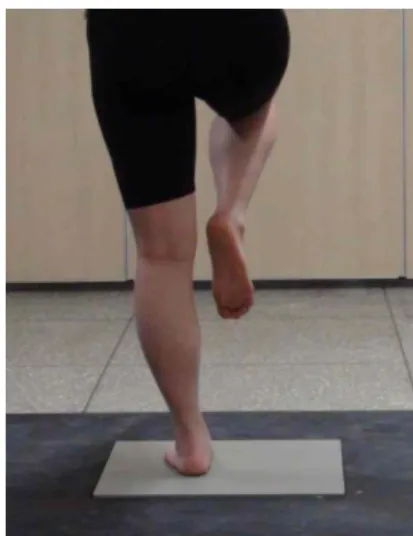
All single-leg postural trials lasted above 70 seconds immediately following each condition, with the patients’

eyes open on the platform (Figure 1). During the stance, subjects were instructed to stand barefoot with their pre- ferred leg, with arms crossed at their chest and the knee of the opposite leg in a flexed position, and to visually fixate on the target in front of them. Subjects were instructed to sway as little as possible while single-leg standing.

3. Fatigue protocol

The fatigue protocol involved a heel raise and the Har-

vard step test (Figure 2). The heel raises were performed on

a board with an approximately 10° posterior slope in order

to increase the subjects’ range of motion. Subjects were

(3)

instructed to perform the heel raises at a metronome-paced 40 repetitions·min

−1

and the Harvard step test (height, 45 cm) at a metronome-paced 30 repetitions·min

-1

. A single investigator monitored the performance of the heel raises and the Harvard step test to ensure subjects maintained con- trol during all phases.

Termination of the exercise was determined as the time when the subject was unable to perform throughout the full range of motion, to maintain the established cadence, or when the subject ceased exercise volitionally(American College of Sports Medicine [ACSM], 2006; Springer &

Pincivero, 2009; Vuillerme, Burdet, Isableu, & Demetz, 2006). Verbal encouragement was provided during all tests that provoked muscle fatigue. To investigate the exercise intensity of each subject, their heart rate was measured with a Polar heart rate monitor (Polar Electro OY, Finland).

4. Data analysis

A force platform (AMTI, USA) was used to measure the displacements of the COP during the single-leg stance trials.

The COP data were sampled at 100 Hz and filtered using a fourth-order Butterworth, zero-phase, low-pass filter, with a 10-Hz cut-off frequency. To remove any initial sway that could have occurred under the experimental conditions, the data from 10 seconds to 70 seconds after the start sign were analyzed (Dolye et al., 2007; Raymakers, Samson, & Ver- haar, 2005). The validity and reliability of force platform measurements for stance stability have been reported pre- viously (Hageman, Leibowitz, & Blanke, 1995). Intraclass correlation coefficients revealed high test-retest reliability for measurements of sway (ICCs>0.90; Hageman et al., 1995).

COP data were used to calculate 5 postural variables: the area of the 95% confidence ellipse(1)(in cm

2

), the mean velocity in the AP and ML planes(2, 3)(in cm/s), and the mean distance of the root mean square (rms) in the AP and ML planes(4, 5)(in cm). These variables have been assessed in postural control studies and have demonstrated good validity and reliability(Ruhe, Fejer, & Walker, 2010).

95% confidence ellipse area = πab (1)

(2)

(3)

(4)

(5)

5. Statistical analysis

Two-way analysis of variance for repeated measurements was used to assess the effects of the time factors (prior to, following, and 24 hours after completing heel raise or the

a [ 3 SD (

AP2

+ SD

ML2

+ D ) ]

12 ---

=

b [ 3 SD (

AP2

+ SD

ML2

– D ) ]

12 ---

=

D [ ( SD

AP2

+ SD

ML2

) 4 SD – (

AP2

SD

ML2

– SD

APML2

) ]

12 ---

=

SD

APML

1

N ---- x

AP n( )

x

ML n( )

n 1=

N

⎝ ⎠

⎜ ⎟

⎛ ⎞

=

RMS

AP

1

N ---- ( x

AP n( )

– x

AP

)

2

n 1=

N

12 ---

=

RMS

ML

1

N ---- ( x

ML n( )

– x

ML

)

2

n 1=

N

12 ---

=

V

AP

1

T --- ( x

AP n 1( + )

– x

AP n( )

)

N 1= N 1–

=

V

ML

1

T --- ( x

ML n 1( + )

– x

ML n( )

)

N 1= N 1–

= Figure 1. Single-leg stance with eyes open

Figure 2. Fatigue protocols (heel raise & harvard step)

(4)

Harvard step test) and the fatigue protocol factors (heel raise and the Harvard step test) on the postural variables. One- way analysis of variance for repeated measurements was performed to assess the effects of the time factors on the postural variables. Post-hoc tests were used, when appro- priate, using Bonferroni test and paired t-test. The level of significance was set at .05.

III. Results

1. Results of fatigue protocol

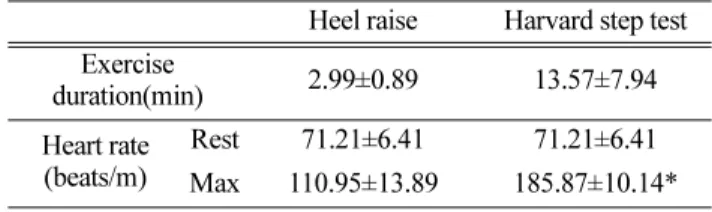
The results of fatigue protocol are provided in Table 1.

The performed heel raise and the Harvard step test demon- strated significant differences for the exercise duration and maximum heart rate. Therefore, this result showed that their’s movement characteristics were different.

2. COP 95% ellipse area

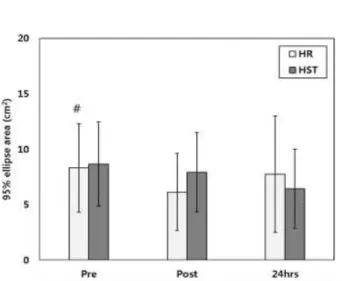
The results for all the COP measurements are provided in Table 2. The 95% ellipse area results revealed a significant main effect of fatigue (F

1,37

=3.623, p=.032) and an inter- action effect of fatigue and time (F

1,37

=4.706, p=.012; Fig- ure 3). The 95% ellipse area 24 hours after completing the fatigue protocol was smaller than that prior to performing the fatigue protocol (F

2,111

=3.677, p=.028), according to the results of the post-hoc test of the Harvard step test. The 95%

ellipse area of the Harvard step test was significantly greater than that of the heel raise (t

37

=2.320, p=.026), according to the results of the paired t-test at the post.

3. COP rms distance

The AP rms distance results showed a significant main effect of fatigue (F

1,37

=4.749, p=.011) and an interaction effect of fatigue and time (F

1,37

=4.565, p=.014; Figure 4).

The AP rms distance following the fatigue protocol was smaller than that prior to performing the fatigue protocol (F

2,111

=3.181, p=.045), according to the results of the post- hoc test of the heel raise. Furthermore, the AP rms distance 24 hours after completing the fatigue protocol was smaller than that prior to performing the fatigue protocol (F

2,111

=3.779, p=.026), based on the results of the post-hoc test of the Harvard step test. The AP rms distance of the Harvard step test was significantly greater than that of the heel raise (t

37

=2.841, p=.007), according to the results of Table 1. The results of exercise duration, heart rates and

repetitions(n=38)

Heel raise Harvard step test Exercise

duration(min) 2.99±0.89 13.57±7.94 Heart rate

(beats/m)

Rest 71.21±6.41 71.21±6.41 Max 110.95±13.89 185.87±10.14*

* is results of paired sample t-test; p<.05

Table 2 The results of center of pressure variables (n=38)

Pre Post 24 hrs F

a

Post-hoc

95% ellipse area (cm

2

)

HR 8.33 ± 4.00 6.14 ± 3.48 7.75 ± 5.26 .310(T)

HST 8.67 ± 3.78 7.93 ± 3.59 6.45 ± 3.56 3.623(F)

*

Pre > 24hrs

t 1.198 2.320

*

1.256 4.706(F×T)

*

AP rms (cm)

HR 0.88 ± 0.21 0.77 ± 0.16 0.80 ± 0.20 3.131(T) Pre > Post HST 0.90 ± 0.21 0.87 ± 0.17 0.78 ± 0.19 4.749(F)

*

Pre > 24hrs

t 1.140 2.841

*

.575 4.565(F×T)

*

ML rms (cm)

HR 0.58 ± 0.09 0.52 ± 0.09 0.60 ± 0.10 .029(T) Pre, 24hrs > Post HST 0.58 ± 0.08 0.59 ± 0.08 0.53 ± 0.08 2.368(F) Pre, Post > 24hrs

t .336 5.383

*

3.385

*

.002 22.609(F×T)

*

AP velocity (cm/s)

HR 3.30 ± 0.79 2.75 ± 0.73 3.26 ± 0.91 13.390(T)

*

Pre, 24hrs > Post HST 3.43 ± 0.85 3.45 ± 0.94 3.06 ± 0.90 4.574(F)

*

t 3.756

*

.001 6.133

*

1.716 24.081(F×T)

*

ML velocity (cm/s)

HR 3.23 ± 1.09 2.60 ± 0.72 2.98 ± 0.92 5.201(T)

*

Pre > Post HST 3.20 ± 0.88 3.23 ± 0.93 2.81 ± 0.95 4.713(F)

*

t .504 5.589

*

1.359 18.846(F×T)

*

*a is results of two-way ANOVA (fatigue×time) for repeated measures, t is results of paired sample t-test (fatigue types); T means time, F means fatigue

types; AP means anterior-posterior, ML means medial-lateral, rms means root mean squared, HR means Heel Raise, HST means Harvard Step Test, p<.05

(5)

the paired t-test at the post.

The ML rms distance results revealed a significant inter- action effect of fatigue and time (F

1,37

=22.609, p=.000;

Figure 5). The ML rms distance following the fatigue pro- tocol was smaller than that prior to and 24 hours after com- pleting the fatigue protocol (F

2,111

=6.145, p=.003), according to the results of the post-hoc test of the heel raise.

In addition, the ML rms distance 24 hours after completing the fatigue protocol was smaller than that prior to and fol- lowing the fatigue protocol(F

2,111

=6.977, p=.001), based on the results of the post-hoc test of the Harvard step test.

According to the results of the paired t-test, the ML rms dis- tance of the Harvard step test was significantly greater than that of the heel raise(t

37

=5.383, p=.000) at the Post, while the AP rms distance of the Harvard step test was signifi- cantly smaller than that of the heel raise(t

37

=3.385, p=.002) at the 24hrs.

4. COP velocity

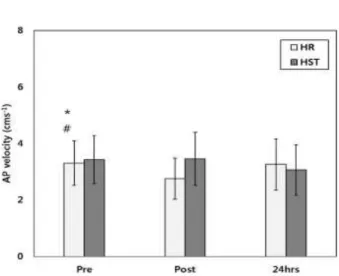
The AP velocity results showed a significant main effect of time (F

1,37

=13.390, p=.001), main effect of fatigue (F

1,37

=4.574, p=.013), and interaction effect of fatigue and time (F

1,37

=24.081, p=.000; Figure 6). The AP velocity fol- lowing the fatigue protocol was smaller than that prior to and 24 hours after completing the fatigue protocol (F

2,111

=5.476, p=.005), based on the results of the post-hoc test of the heel raise. The AP velocity of the Harvard step test was significantly greater than that of the heel raise, according to the results of the paired t-test at the Pre (t

37

=3.756, p=.001) and the Post (t

37

=6.133, p=.000).

The ML velocity results revealed a significant main effect of time (F

1,37

=5.201, p=.028), main effect of fatigue (F

1,37

=4.713, p=.012), and interaction effect of fatigue and time (F

1,37

=18.846, p=.000; Figure 7). The ML velocity

following the fatigue protocol was smaller than that prior to performing the fatigue protocol (F

2,111

=4.403, p=.014), according to the results of the post-hoc test of the heel raise.

The ML velocity of the Harvard step test was significantly greater than that of the heel raise (t

37

=5.589, p=.000), according to the results of the paired t-test at the post.

IV. Discussion

The purpose of this study was to investigate the effects of localized muscle fatigue and whole body fatigue on postural control during single-leg stance after impairment induced by heel raise and the Harvard step test in healthy university students.

The International Society for Posture and Gait Research (ISPGR) suggests using the rms distance and velocity in the AP and ML planes of the COP to evaluate postural control Figure 3. COP 95% ellipse area. # is a main effect of fatigue

(HR, HST) by two-way repeated measure ANOVA (p<.05)

Figure 4. COP rms distance in the AP. # is a main effect of fatigue (HR, HST) by two-way repeated measure ANOVA (p<.05)

Figure 5. COP rms distance in the ML. # is a main effect of

fatigue (HR, HST) by two-way repeated measure

ANOVA (p<.05)

(6)

by using the COP trajectory of the ground reaction force system (Kapteyn et al., 1983), whereas current studies investigating postural control with COP used the 95% con- fidence ellipse area more frequently than other time domain variables (Dolye et al., 2007; Prieto, Myklebust, J. B, Hoff- mann, Lovett, & Myklebust, B. N., 1996; Youm & Kim, 2012; Rocchi, Chiari, & Cappello, 2004). Therefore, the COP variables in this study were limited to AP and ML rms distance, AP and ML velocity, and 95% confidence ellipse area.

The major findings of this study were that heel raise exer- cise-induced fatigue affected the rms distance and velocity in the AP and ML planes of the COP, and that these vari- ables decreased significantly following the fatigue protocol

(Youm & Kim, 2012). Furthermore, we observed that Har- vard step exercise-induced fatigue affected the rms dis- tances in the AP and ML planes and the 95% confidence ellipse area of the COP, and that these variables decreased significantly 24 hours after completing the fatigue protocol.

Yaggie and McGregor (2002) measured postural control during single-leg stance after plantar flexor and dorsiflexor fatigue in 24 healthy men, and reported that isokinetic fatigue significantly increased the sway parameters. Gribble and Hertel (2004a) examined the effects of ankle, knee, and hip joint fatigue on postural control during single-leg stance in 4 men and 10 women, and showed that fatigue of the knee and hip muscles led to significantly greater velocity of the COP in the ML plane, whereas fatigue of the ankle mus- cle did not. They also reported that the AP factors were affected by fatigue of the ankle, knee, and hip muscles.

Gimmon et al. (2011) measured postural control during upright stance after the ankle plantar flexor contractions as possible until exhaustion, in 3 men and 7 women, reported that localized plantar flexor fatigue caused impairment to postural control in the sagittal plane. As such, a decrease in performance could be related to fatigue affecting the pro- prioceptive feedback from afferent pathways (Gimmon et al., 2011).

In addition, Gribble and Hertel (2004b) investigated the effects of hip and ankle muscle fatigue on postural control during single-leg stance in 4 men and 9 women, and found that fatigue of the hip muscle led to significantly greater velocity of the COP in the AP and ML planes, whereas fatigue of the ankle muscle did not significantly impair pos- tural control in either plane. According to Springer and Pin- civero (2009), who studied the effects of localized muscle and whole-body fatigue on balance during single-leg stance in 10 men and 10 women, both localized muscle fatigue and whole-body fatigue produced significant increases in ML and total sway. Total sway increased more significantly fol- lowing the localized muscle fatigue protocol than after the whole-body fatigue protocol. Their results were somewhat different than the results of this study.

The increased COP variables generally were interpreted as decreased stability or poor postural control (Adlerton, Moritz, & Moe-Nilssen, 2003; Cobeil et al., 2003; Ray- makers et al., 2005; Prieto et al., 1996). However, the vari- ables that were reduced significantly after heel raise (following the fatigue protocol) and the Harvard step test (24 hours after completing the fatigue protocol), unlike the previous results (Gribble & Hertel, 2004a; Gribble & Her- tel, 2004b, Shin & Youm, 2011; Springer & Pincivero, 2009; Yaggie & McGregor, 2002; Youm & Kim, 2012).

Adlerton et al. (2003) examined the effects of heel raise fatigue on postural control during single-leg stance in 23 healthy women, and found that the COP velocity and fre- quency decreased significantly. According to the results of Figure 6. COP velocity in the AP. * is a main effect of time (Pre,

Post, 24hrs) by two-way repeated measure ANOVA (p<.05); # is a main effect of fatigue (HR, HST) by two-way repeated measure ANOVA (p<.05)

Figure 7. COP velocity in the AP. * is a main effect of time(Pre,

Post, 24hrs) by two-way repeated measure ANOVA

( p<.05); # is a main effect of fatigue (HR, HST) by

two-way repeated measure ANOVA (p<.05)

(7)

this study, the reduction in most COP variables after the fatigue protocols can be interpreted as a change in the pos- tural control strategy from ankle to hip, which is similar to the conclusions determined by Adlerton et al. (2003), and Panzer, Bandinelli, and Hallett (1995). Generally, there are 2 common strategies for control of body sway during stand- ing: the ankle strategy and the hip strategy (Winter, 1995).

Under normal circumstances, the ankle strategy is effective in maintaining static standing and responding to a small sway, but, when the muscle around the ankle experiences fatigue, posture is regulated by relying on the muscle around the hip joint; this is called the hip strategy. On the other hand, if the muscle around the hip joint experiences fatigue, the opposite situation occurs, which is called the ankle strategy (Bizid et al., 2009; Gribble & Hertel, 2004a).

Therefore, single-leg stance is controlled by a combination of the ankle and hip strategies (Bisson, McEwen, Lajoie, &

Bilodeau, 2011; Riemann, Myers, & Lephart, 2003). Some have questioned whether COP measurements are valid indi- cators of postural control (Adlerton et al., 2003; Winter, 1995; Moe-Nilssen, 1998) because changes in the COP tra- jectory are not always accompanied by corresponding changes in the position of the COM. Thus, this study sug- gests that changes in the postural control strategy may have occurred after the fatigue protocols during single-leg stance.

Corrective contractions in response to small sways are occurring constantly. However, fatigue slows neural trans- mission due to the reduced ability to efficiently create com- pensatory contractions about a joint. A larger variability in joint motion due to the lack of corrective muscle actions can result in diminished postural control ability (Gribble & Her- tel, 2004a). In addition, when postural sway occurs at each joint, fatigue possibly can inhibit the ability of the sur- rounding muscles to react to small sways (Gribble & Hertel, 2004a). For example, when the ankle muscle becomes fatigued, it is possible that afferent conduction velocities still remain constant in response to perturbation. Although efferently signaled compensatory contractions are reduced due to the induced fatigue, the afferent conduction rate is not reduced by responding to the sway. A lack of compen- satory contraction at the ankle tends to reduce the rms and velocity of the COP(Gribble & Hertel, 2004a). Therefore, ankle muscle fatigue reduces COP rms and velocity, similar to the results seen in this study after completing the fatigue protocols(Youm & Kim, 2012).

Vuillerme, Burdet, Isableu, & Demetz (2001) showed that, to some extent, vision can compensate for muscle fatigue of the calf muscles. Therefore, the availability of vision allowed the subjects in this study to immediately cope with the destabilizing effect induced by muscle fatigue. Moreover, Bission et al. (2011) reported that a decrease in ankle proprioception may not be sufficient to affect sway velocity when vision is available. Consequently,

vision can attenuate the postural deficits associated with fatigue of the ankle plantar flexors. In this study, the reli- ance on vision was possible because subjects were tested with their eyes open.

Interestingly, in this study, heel raise exercise-induced fatigue reduced the COP variables; however, there was no significant increase in the variables due to Harvard step exercise-induced fatigue. In addition, Harvard step exer- cise-induced fatigue decreased 24 hours after completing the fatigue protocol. As in previous studies, the effects of heel raise exercise-induced fatigue in this study were short- lived (Adlerton et al., 2003; Bisson et al., 2011; Yaggie &

McGregor, 2002). However, Harvard step exercise–induced fatigue in this study was different; the effects not only were observed immediately following the protocol, but also were seen 24 hours later. Therefore, it is believed that there is specificity in the process of treating exercise-induced fatigue (Cairns, Knicker, Thompson, & Sjøgaard, 2005;

Enoka & Stuart, 1992; Bigland-Ritchie, Rice, Garland, &

Walsh, 1995).

V. Conclusion

The purpose of this study was to investigate the effects of fatigue and recovery on postural control during single-leg stance after impairment induced by heel raise and the Har- vard step test in healthy university students. The findings of this study indicated that heel raise exercise-induced fatigue affected the rms distance and velocity in the AP and ML planes of the COP, and that these variables decreased sig- nificantly following the fatigue protocol. We also observed that Harvard step exercise-induced fatigue affected the rms distance in the AP and ML planes, and the 95% confidence ellipse area of the COP, and that these variables decreased significantly 24 hours after completing the fatigue protocol.

In conclusion, this study showed that both heel raise exer- cise- and Harvard step exercise-induced fatigue affects pos- tural control during single-leg stance in AP and ML planes.

Furthermore, this study suggests that changes in the postural control strategy may have occurred after the fatigue proto- cols during single-leg stance. Also vision can attenuate the postural deficits associated with the fatigues. In order to clarify these results, further studies using other equipment and variables are necessary.

References

American College of Sports Medicine (2006). Guidelines for exer- cise testing and prescription. Baltimore: Lippincott Wil- liams & Wilkins.

Adlerton, A. K., & Moritz, U. (1996). Does calf-muscle fatigue

affect standing balance?. Scandinavian Journal of Science

in Sports, 6, 211-215.

(8)

Adlerton, A. K., Moritz, U., & Moe-Nilssen, R. (2003). Force plate and accelerometer measures for evaluating the effect of muscle fatigue on postural control during one-legged stance.

Physiotherapy Research International, 8, 187-199.

Allen, D. G., & Westerblad, H. (2001). Role of phosphate and cal- cium stores in muscle fatigue. The Journal of Physiology, 536, 657-665.

Bigland-Ritchie, B., Rice, C. L., Garland, S. J., & Walsh, M. L.

(1995). Task-dependent factors in fatigue of human volun- tary contractions. Advances in Experimental Medicine And Biology, 384, 361-380.

Bisson, E. J., McEwen, D., Lajoie, Y., & Bilodeau, M. (2011).

Effects of ankle and hip muscle fatigue on postural sway and attentional demands during unipedal stance. Gait and Posture, 33(1), 83-87.

Bizid, R., Margnes, E., Francois, Y., Jully, J. L., Gonzalez, G., &

Dupui, P. (2009). Effects of knee and ankle muscle fatigue on postural control in the unipedal stance. European Jour- nal of Applied Physiology, 106, 375-380.

Bohannon, R. W., & Leary, K. M. (1995). Standing balance and function over the course of acute rehabilitation. Archives of Physical Medicine and Rehabilitation, 76, 994-996.

Cairns, S. P., Knicker, A. J., Thompson, M. W., & Sjøgaard, G.

(2005). Evaluation of models used to study neuromuscular fatigue. Exercise and Sport Science Reviews, 33(1), 9-16.

Christina, K. A., White, S. C., & Gilchrist, L. A. (2001). Effect of localized muscle fatigue on vertical ground reaction forces and ankle joint motion during running. Human Movement Science, 20, 257-276.

Cobeil, P., Blouin, J. S., Bégin, F., Nougier, V., & Teasdale, N.

(2003). Pertubation of the postural control system induced by muscular fatigue. Gait and Posture, 18, 92-100.

Dolye, R. J., Hsiao-Wecksler, E. T., Ragan, B. G., & Rosengren, K.

S. (2007). Generalizability of center of pressure measures of quiet standing. Gait & Posture, 25, 166-171.

Enoka, R. M., & Stuart, D. G. (1992). Neurobiology of muscle fatigue. Journal of Applied Physiology, 72(5), 1631-1648.

Frzovic, D., Morris, M. E., & Vowels, L. (2000). Clinical tests of standing balance: performance of persons with multiple sclerosis. Archives of Physical Medicine and Rehabilitation, 81, 215-221.

Gimmon, Y., Riemer, R., Oddsson, L., & Melzer, I. (2011). The effect of plantar flexor muscle fatigue on postural control.

Journal of Electromyography and Kinesiology, 21, 922-928.

Giannesini, B., Cozzone, P. J., & Bendahan, D. (2003). Non-inva- sive investigations of muscular fatigue: metabolic and elec- tromyographic components. Biochimie, 85, 873-883.

Gribble, P. A., & Hertel, J. (2004a). Effect of lower-extremity mus- cle fatigue on postural control. Archives of Physical Medi- cine And Rehabilitation, 85(4), 589-592.

Gribble, P. A., & Hertel, J. (2004b). Effect of hip and ankle muscle fatigue on unipedal postural control. Journal of Electromy- ography and Kinesiology, 14, 641-646.

Hageman, P. A., Leibowitz, J. M., & Blanke, D. (1995). Age and gender effects on postural control measures. Archives of Physical Medicine and Rehabilitation, 76(10), 961-965.

Hall, C. M., & Brody, L. T. (1999). Therapeutic Exercise: Moving Toward Function. Baltimore: Lippincott Williams &

Wilkins.

Jonsson, E., Seiger, A., & Hirschfeld, H. (2004). One-leg stance in healthy young and elderly adults: a measure of postural steadiness?. Clinical Biomechanics, 19, 688-694.

Kapteyn, T. S., Bles, W., Njiokiktjien, C. J., Kodde, L., Massen, C.

H., & Mol, J. M. F. (1983). Standardization in platform sta- bilometry being part of posturography. Agressologie, 24, 321-326.

Letafatkar, K., Alizadeh, M. H., & Kordi, M. R. (2009). The effect of exhausting exercise induced fatigue on the double-leg balance of elite male athletes. Journal of Social Sciences, 5(4), 445-451.

Lin, D., Nussbaum, M. A., Seol, H., Singh, N. B., Madigan, M. L.,

& Wojcik, L. A. (2009). Acute effects of localized muscle fatigue on postural control and patterns of recovery during upright stance: influence of fatigue location and age. Euro- pean Journal of Applied Physiology, 106(3), 425-434.

Lundin, T. M., Feuerbach, J. W., & Grabiner, M. D. (1993). Effect of plantar flexor and dorsiflexor fatigue on unilateral postural control. Journal of Applied Biomechanics, 9(2), 191-201.

Massion, J. (1994). Postural control system. Current Opinion in Neurobiology, 4(6), 877-887.

Moe-Nilssen, R. (1998). Test-retest reliability of trunk accelerome- try during standing and walking. Archives of physical medi- cine and rehabilitation, 79(11), 1377-1385.

Panzer, V. P., Bandinelli, S., & Hallett, M. (1995). Biomechanical assessment of quiet standing and changes associated with aging. Archives of Physical Medicine and Rehabilitation, 76(2), 151-157.

Prieto, T. E., Myklebust, J. B., Hoffmann, R. G., Lovett, E. G., &

Myklebust, B. M. (1996). Measures of postural steadiness:

differences between healthy young and elderly adults. IEEE Transactions on Biomedical Engineering, 43(9), 956-966.

Raymakers, J. A., Samson, M. M., & Verhaar, H. J. J. (2005). The assessment of body sway and the choice of the stability parameter(s). Gait and Posture, 21, 48-58.

Riemann, B. L., Myers, J. B., & Lephart, S. M. (2003). Comparison of the ankle, knee, hip, and trunk corrective action shown during single-leg stance on firm, foam, and multiaxial sur- faces. Archives of Physical Medicine and Rehabilitation, 84, 90-95.

Rocchi, L., Chiari, L., & Cappello, A. (2004). Feature selection of stabilometric parameters based on principal component analysis. Medical & Biological Engineering & Computing, 42, 71-79.

Rozzi, S. L., Lephart, S. M., Gear, W. S., & Fu, F. H.(1999). Knee joint laxity and neuromuscular characteristics of male and female soccer and basketball players. The American Journal of Sports Medicine, 27(3), 312-319.

Ruhe, A., Fejer, R. & Walker, B. (2010). The test-retest reliability of centre of pressure measures in bipedal static task conditions- a systematic review of the literature. Gait and Posture, 32, 436-445.

Shin, J. D. & Youm, C. H. (2011). Effects of heel raise and harvard step exercise-induced fatigue on single-leg stance postural control. The Korean Journal of physical Education, 50(3), 581-591.

Shumway-Cook, A. & Woollacott, M. H. (2000). Motor control:

(9)

Theory and practical applications. 2nd edition. Baltimore:

Lippincott Williams & Wilkins.

Springer, B. K. & Pincivero, D. M. (2009). The effects of localized muscle and whole-body fatigue on single-leg balance between healthy men and women. Gait and Posture, 30, 50-54.

Urabe, Y., Kobayashi, R., Sumida, S., Tanaka, K., Yosida, N., Nishi- waki, G. A., Tsutsumi, E., & Ochi, N. (2005). Eletromyo- graphic analysis of the knee during jump landing in male and female athletes. Knee, 12, 129-134.

Vuillerme, N, Nougier, V., & Prieur, J. (2001). Can vision compen- sate for a lower limbs muscular fatigue for controlling pos- ture in humans?. Neuroscience Letters, 308, 103-106.

Vuillerme, N, Burdet, C., Isableu, B., & Demetz, S. (2006). The magnitude of the effect of calf muscles fatigue on postural

control during bipedal quiet standing with vision depends on the eye-visual target distance. Gait and Posture, 24, 169- 172.

Winter, D. A. (1995). Human balance and posture control during standing and walking. Gait and Posture, 3, 193-214.

Yaggie, J. A. & McGregor, S. J. (2002). Effects of isokinetic ankle fatigue on the maintenance of balance and postural limits.

Archives of Physical Medicine and Rehabilitation, 83(2), 224-228.

Youm, C. H. & Kim, T. H. (2012). Effects of induced fatigue of

ankle joint muscle on the capability and recovery of postural

control during single-leg stance. Korean Journal of Sport

Biomechanics, 22(2), 219-228.

수치

Figure 2. Fatigue protocols (heel raise &amp; harvard step)
Table 2 The results of center of pressure variables (n=38)
Figure 4. COP rms distance in the AP. # is a main effect of fatigue (HR, HST) by two-way repeated measure ANOVA (p&lt;.05)
Figure 7. COP velocity in the AP. * is a main effect of time(Pre, Post, 24hrs) by two-way repeated measure ANOVA ( p&lt;.05); # is a main effect of fatigue (HR, HST) by two-way repeated measure  ANOVA (p&lt;.05)

참조

관련 문서

Therefore, as a recovery method during exercise, it is more effective for recovery of exercise fatigue and prevention of body acidification due to high

The purpose of this study was to investigate the lower extremity muscle strength and student health of male middle school students. Twenty middle school

The purpose of this study was to investigate the change of body composition and physical fitness after 12 weeks of practice with middle-aged women centered

For each of several tests, elastic, plastic, and total strain data points are plotted versus life, and fitted lines are also

The purpose and necessity of this study was to investigate the effects of lactic acid fatigue and body oxidation through myofascial relaxation exercise using small tools

Taken together, these results suggest that the core stabilization exercise program has a positive effect on improving body composition factors, blood

The purpose of this study was to investigate the effects of sound-finding strategies based on phonological awareness on word recognition, oral reading

The purpose of this study was to investigate the effects of 8 weeks trampoline exercise on health promotion (health related fitness, blood lipid) in