Kor. J. Hort. Sci. Technol. 30(6):680-685, 2012 DOI http://dx.doi.org/10.7235/hort.2012.12078
온실 내 위치에 따른 온도 환경과 착색단고추 생육과의 관계
박수민1ㆍ김호철1ㆍ구양규1ㆍ김상욱2ㆍ배종향1*
1원광대학교 원예・애완동식물학부, 2원광대학교 환경조경학과
Relation between Temperature and Growth of Sweet Pepper by Growing Areas in Greenhouse
Su-Min Park1, Ho Cheol Kim1, Yang Gyu Ku1, Sang Wook Kim2, and Jong Hyang Bae1*
1Division of Horticulture and Pet Animal-Plant Science, Wonkwang University, Iksan 570-749, Korea
2Department of Environmental Landscape Architecture, Wonkwang University, Iksan 570-749, Korea
Abstract. The objective of the experiment was to investigate the effect of two growing areas in the greenhouse on the plant growth characteristics, physiological responses and yield attributes of the ‘Cupra’ sweet pepper.
Two growing areas of the greenhouse were as follows, central part area (CA) and north part area (NA).
Daily average temperature of the CA was 1.6℃ higher than those of NA. Plant height, number of internode, and SPAD value in the CA were significantly higher than NA both six weeks and twelve weeks after planting.
Net photosynthesis of the sweet pepper leaves of the CA was significantly higher than those of NA. The total fruit yield of the sweet pepper was 20% higher in plants grown for CA than that of NA. These results suggest that air temperature in the greenhouse influenced plant growth characteristics, net photosynthesis and total yield of sweet pepper whether pepper plants were grown as CA or as NA.
Additional key words: environmental factor, net photosynthetic rate, paprika
*Corresponding author: [email protected]
※ Received 12 April 2012; Revised 30 July 2012; Accepted 30 July 2012. 본 연구는 2011년 원광대학교 교내 연구비 지원에 의해 수행되었음.
서 언
우리나라에서 착색단고추(Capsicum annunm L.)가 처음 재배된 것은 1994년이며, 불과 10여년 만에 일본, 동북아시 아와 미국으로 수출을 확대할 만큼 급속히 재배면적이 늘어 나고 생산량이 증대되었다. 그러나 네덜란드 등 유럽 농업 선진국에 비해 재배기술이 미흡하여 단위 면적당 생산성이 크게 떨어진다(Jeong et al., 2008). 착색단고추는 낮은 온도 에 매우 민감한 작물로 온대지역에서는 온실 내로 제한되어 재배되고 있지만, 열대기후지역에서는 여러 해 동안 수확이 가능하다(Andrews, 1984). 착색단고추의 착과는 낮과 밤의 온도 차이에 의하여 좌우되며(Bakker and Uffelen, 1988), 야간온도가 16-18℃ 정도가 되어야 개화 및 착과가 정상적 으로 이루어진다(Pressman et al., 1998). 특히, 고품질 과실 생산 및 수량 증대를 위해서는 정식 후 영양생장기에 주간 온도는 25-27℃, 야간온도는 18-20℃로 관리하며, 착과 후 과실 비대가 시작되는 시점에는 일평균 온도를 21℃로 관리
해야 한다(Bakker and Uffelen, 1988). 낮은 야간온도는 건 물중 대비 엽면적을 저하시키고, 고온은 낙화 및 낙과를 조 장하여 생산량을 감소시킨다(Rylski and Spigelman,1982).
과채류의 시설재배 시 주요 환경요인들의 차이는 온실 내에 서도 나타나게 되는데 일반적으로 온실의 방향(Rosa et al., 1989)과 위치에 따라 달라지는 것으로 보고되고 있다. 특히 광량 및 온도에 영향을 주어 동일 온실에서도 위치에 따라 생육 및 생산량에서 다소 차이를 나타낸다. 그리고 온실 방 향 및 위치에 따라 광량의 차이와 이에 따른 source strength 차이를 나타내며, 저일조 환경은 낮은 착과율 및 생산성 감 소를 초래한다(Kim et al., 2005; Marcelis et al., 2004). 착색 단고추의 고품질 다수확 생산을 위해서는 온실 내 환경관리 의 최적화 및 균일화가 매우 중요하다.
따라서 본 연구는 착색단고추 재배온실 내의 위치에 따른 온도 차이가 생육에 미치는 영향을 구명하여 저온기 착색단 고추의 안정적 재배를 위한 온실 내 온도 관리의 기초자료 로 활용하고자 수행하였다.
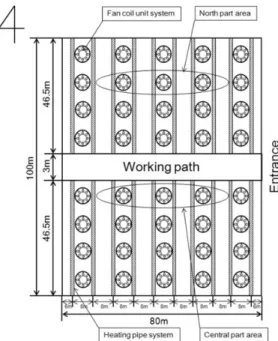
Fig. 1. Two growing areas (central part area & north part area) of the greenhouse used in this experiment.
재료 및 방법
경남 산청군 신등면 소재 벤로형 유리온실에서 재배되고 있는 착색단고추(Capsicum annuum)인 ‘Cupra’(Enza zaden, The Netherland)를 공시 품종으로 하여 2010년 10월 5일부 터 2011년 2월 28일까지 시험을 수행하였다.
2010년 10월 5일에 암면 플러그 트레이(Grodan BV, Den- mark)를 electrical conductivity(EC) 2.5-3.0dS・m-1, pH 5.5-6.0 의 양액으로 포습한 후에 종자를 1립씩 파종하였다. 파종된 암면 플러그 트레이를 PE필름으로 덮어 온도 24℃와 상대 습도 100% 조건하에서 발아시켰다. 종자 발아 후 EC 3.0dS·m-1, pH 5.5-6.0의 양액을 공급하였고, 2-3매의 본엽이 확인된 후 균일한 유묘를 표준양액(Grodan BV, Denmark) 3.0dS・m-1, pH 5.5로 포습된 암면 큐브(100 × 100 × 75mm, Grodan, Den- mark)에 뿌리부가 위쪽으로 향하도록 줄기를 U자로 절곡하 여 가식하였다.
파종 후 33일째 초장이 균일한 착색단고추 묘들을 표준 양 액에 포습된 암면 슬라브(900 × 150 × 75mm, Grodan, Den- mark) 위에 재식밀도 3.65 plants/m2로 정식하였다. 줄기의 유인 방법은 V자형으로 하였고, 착과는 세 번째 분지부부터 시켰다.
급액 관리는 자동양액기(Wizard, Daeyoung GS, Korea) 에 의해 일출 2시간 후부터 일몰 2시간 전까지 첫 관수 후 2시간 단위로 배지 내의 함수율에 따라 급액 시간을 조절하 였으며, 매 회 암면 슬라브당 150mL・m-2로 공급하였다. 공급 EC는 2.7-3.0dS・m-1, pH 5.5-6.0으로 급액하였다. 배지 내의 함수율은 함수율 측정기(WCM-control, Grodan, Denmark) 를 사용하여 측정하였고 시험기간 동안 50-70%로 유지하였다.
온도 관리를 위해 온실 내 상단에 fan coil unit system과 지상부에서 1m 높이에 heating pipe system으로 최저 18℃
로 설정하였으며(Fig. 1), 시험기간 동안 일평균 온도는 23
± 1℃로 관리하였다. 환기창과 온수난방시스템은 복합환경 조절컴퓨터시스템(Magma, Green CS, Korea)을 이용하여 외부 환경과 내부 환경의 설정값을 비교하여 환기창과 난방 시스템을 작동시켜 온실 내부의 온도 관리를 자동 조절되도 록 하였다.
온실 내 위치에 따른 온도 환경의 차이를 분석하기 위해 온 도기록장치(Thermo Recorder TR-72U, T&D Corp., Japan) 를 이용하여 온실 내 중앙 작업로 부분(central part area)과 작업로를 중심으로 북쪽의 측창 부분(north part area)의 지 상부와 근권부의 주・야간 및 일평균 온도를 기록하였다(Fig. 1).
온실 내 위치 선정에 있어 누적광량과 일사량의 차이가 없 는 두 구역을 선정하여 위치를 설정하였다. 재배기간 동
안 근권부 온도는 함수율 측정기(WCM-control, Grodan, Denmark)를 사용하여 측정하였다.
온실 내 위치에 따른 착색단고추의 생육 변화를 알아보기 위해 정식 3주 후부터 매주마다 생육조사를 실시하였다.
조사 항목으로는 초장, 절간수, 경경, 엽장, 엽폭, 그리고 엽 록소를 측정하였다. 엽록소는 chlorophyll meter(SPAD-502, Minolta, Japan)를 이용하여 착색단고추의 정단부로부터 아래로 3마디째에 위치한 엽을 3반복으로 측정하였다. 2주 마다 온실 내부 위치에 따른 착색단고추의 광합성 차이를 측정하기 위해 두 구역별로 5지점을 지정하고 식물체의 정 단부로부터 아래로 5번째 마디에 착생한 엽을 광합성측정기 (Li-6400, Li-cor, USA)를 이용하여 순광합성량, 기공전도 도, 세포 내 CO2 농도, 증산속도 등을 측정하였다. 과실의 조사항목으로는 과장, 과폭, 그리고 생산량을 조사하였다.
통계분석은 SAS(Statistical Analysis System, V. 9.1, Cary, NC, USA) 프로그램을 이용하여 95% 신뢰수준에서 t-검정 을 실시하였다.
결과 및 고찰
온실 내 위치에 따른 온도 차이
정식 후 2주부터 17주까지 15주간 온실 내부의 지상부 온도의 변화를 중앙과 북측 두 위치로 나누어 살펴보면, 온 실 내 평균 지상부 온도는 중앙에서 20.8℃로 북측은 이보 다 1.6℃가 낮은 19.2℃로 나타나 중앙이 지상부 온도가 높 게 유지되었다(Table 1). 온실 내 하루의 시간대별 평균온도
Table 1. Average daily maximum, minimum and mean air tem- perature in different growing areas in the greenhouse from November 8th to February 28th.
Source of variation Daily temperature (℃) Maximum Minimum Average Central part area of the greenhouse
Maximum 32.9 20.2 23.7
Minimum 25.8 16.8 17.4
Mean 27.1 18.9 20.8
SDz 3.86 1.24 2.57
CVy (%) 14.2 6.6 12.4
North part area of the greenhouse
Maximum 32.4 18.2 22.5
Minimum 23.5 15.6 16.9
Mean 26.5 16.7 19.2
SD 3.84 1.51 3.38
CV(%) 14.7 9.3 18.5
zStandard deviation (n = 12).
yCoefficient of variation.
Fig. 2. Daily fluctuation of air temperature of central part area and north part area of the greenhouse from November 8th to February 28th.
Table 2. Average daily maximum, minimum and mean root zone temperature in the slab medium in different growing areas in the greenhouse from November 8th to February 28th.
Source of variation Daily temperature (℃) Maximum Minimum Average Central part area of the greenhouse
Maximum 27.1 22.4 25.2
Minimum 23.6 18.9 17.8
Mean 26.1 21.2 22.3
SDz 2.09 1.44 1.76
CVy (%) 8.1 6.3 12.4
North part area of the greenhouse
Maximum 24.9 21.2 23.9
Minimum 18.6 17.7 16.5
Mean 21.6 18.6 20.1
SD 1.97 3.16 1.56
CV(%) 13.6 8.6 17.8
zStandard deviation (n = 12).
yCoefficient of variation.
Fig. 3. Daily fluctuation of root zone temperature of central part area and north part area of the greenhouse from November 8th to February 28th.
는 주간보다 야간에 중앙에서 북측보다 높게 유지되었다 (Fig. 2).
정식 후 2주부터 17주까지 15주간 암면 슬라브 내 온도의 변화를 중앙과 북측 두 위치로 나누어 살펴보면, 근권부 평 균온도는 온실의 중앙에서 22.3℃, 그리고 북측에서는 20.1℃
로 중앙이 북측보다 2.2℃ 높게 유지되었다(Table 2). 그리고 일중 18시에서 22시까지를 제외하고는 중앙이 북측보다 높 게 유지되었다(Fig. 3). 착색단고추의 온실 재배 시 착과는 24시간 동안 주야간 온도차에 의하여 좌우되며(Bakker and Uffelen, 1988), 개화와 착과에 필요한 야간온도는 16-18℃, 그리고 수량을 높이기 위한 일일 적정온도는 21℃로 보고되 었다(Pressman et al., 1998; Rylski and Spigelman, 1982).
이를 고려하면 본 시험에서 재배기간 동안 중앙과 북측의
지상부 온도가 차이를 나타내고, 이에 따라 근권부 온도도 차이를 나타내어 배지 수분함량에 영향을 주어 두 위치 간 초기 생육 차이에 영향을 주었다(Rhee et al., 2010). 또한 온실 내부의 위치별 지상부 및 근권부의 평균온도 차이는 재배기간 동안 누적된 온도에도 영향을 미쳤을 것으로 판단 된다. 15주간 측정된 온실 내 지상부의 일평균 온도의 누적 된 값은 온실 중앙에서 1,920℃, 북측에서는 1,764℃, 그리 고 근권부의 일평균 온도 누적값은 각각 1,853과, 1,767℃
로 중앙에서 높게 나타났다(자료 미제시).
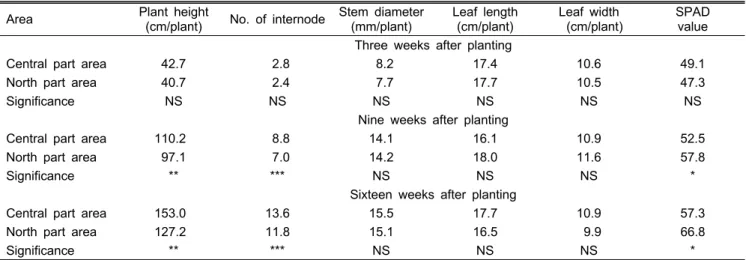
온실 내 위치에 따른 착색단고추 생육 및 수량 차이 정식 후 3주째 온실의 위치별 초기 생육을 살펴보면, 온 실 내 중앙과 북측에서 생육된 착색단고추의 초장은 각각
Table 3. Growth characteristics and SPAD value of sweet pepper grown the two growing areas in the greenhouse.
Area Plant height
(cm/plant) No. of internode Stem diameter
(mm/plant) Leaf length
(cm/plant) Leaf width
(cm/plant) SPAD value Three weeks after planting
Central part area 42.7 2.8 8.2 17.4 10.6 49.1
North part area 40.7 2.4 7.7 17.7 10.5 47.3
Significance NS NS NS NS NS NS
Nine weeks after planting
Central part area 110.2 8.8 14.1 16.1 10.9 52.5
North part area 97.1 7.0 14.2 18.0 11.6 57.8
Significance ** *** NS NS NS *
Sixteen weeks after planting
Central part area 153.0 13.6 15.5 17.7 10.9 57.3
North part area 127.2 11.8 15.1 16.5 9.9 66.8
Significance ** *** NS NS NS *
NS,*,**,***
Nonsignificant or significant at P = 0.05, 0.01 or 0.001, respectively.
Table 4. Net photosynthesis, stomatal conductivity, intercellular CO2 concentration, and transpiration rate of sweet pepper grown two growing areas in the greenhouse.
Area Net photosynthetic rate
(µmol・CO2・m-2・s-1)
Stomatal conductivity (mol・m-2・s-1)
Intercellular CO2
concentration (µmol・mol-1)
Transpiration rate (mmol・CO2・m-2・s-1) Three weeks after planting
Central part area 16.2 0.811 330 2.73
North part area 15.5 0.765 331 2.86
Significant NS NS NS NS
Nine weeks after planting
Central part area 14.9 0.713 331 2.63
North part area 13.5 0.665 321 2.56
Significant NS NS NS NS
Sixteen weeks after planting
Central part area 13.5 0.665 319 2.46
North part area 10.3 0.554 332 1.98
Significant * * NS *
NS,*Nonsignificant or significant at P = 0.05 (n = 10).
42.7cm와 40.7cm였고 통계적인 유의한 차이는 없었다. 그 리고 방아다리 분지에서의 절간수, 분지 아래의 줄기 직경, 엽장, 엽폭, 엽록소의 함량도 두 위치 간 유의한 차이는 없었 다. 정식 후 9주째에는 초장, 절간수, 엽록소 함량은 통계적 으로 유의한 차이가 있었고, 다른 생장 요소들은 두 위치 간 유의한 차이가 없었다(Table 3). 정식 후 16주째에도 9주째 의 결과와 유사하였고 두 위치 간에 초장과 절간수 차이가 9주째의 결과보다 더 컸다. 따라서 두 위치 간에 착색단고추 의 생육은 정식 후 시간이 경과함에 따라 초장, 절간수 및 엽록소 함량변화에서 현저한 차이가 있었다. 특히, 정식 16 주째의 온실 내 위치 간 생육의 차이는 내부 환경 요인의 차 이에 의한 동화산물 생성 및 이동률의 차이(Marcelis, 1991) 와 양·수분 흡수량 차이에서 나타난 것으로 사료가 된다. 근 권부 온도는 새로운 뿌리의 발육이나 양·수분흡수에 직접적 으로 관여하며 적온보다 낮게 되면 뿌리의 활성 및 무기물
의 흡수가 저하된다고 보고되어 있다(Gosselin and Trudel, 1986). 일반적으로 착색단고추 생육의 차이는 시설 종류(Kim et al., 2009), 재배 방법(Kang et al., 2007), 그리고 내부 환 경의 제어 수준(Macelis et al., 2004)에 크게 영향을 받는 것으로 알려져 있다.
정식 후 온실 내 위치에 따른 엽의 광합성 특성을 파악하 기 위하여 정단부로부터 아래로 5번째 마디의 전개된 엽에 서 광합성 특성을 조사하였다(Table 4). 정식 후 3주째와 9 주째 조사에서는 온실 내 두 위치 간 순광합성속도, 기공전 도도, 세포내부 이산화탄소의 농도 및 증산 속도에서 유의 한 차이가 없었다. 그러나 정식 후 16주째 조사에서는 온실 내 두 위치별 순광합성속도는 온실 내 중앙에서 13.5µmol・
CO2・m-2・s-1로 유지되는 반면 북측에서는 10.3µmol・CO2・ m-2・s-1로 그 차이가 3.2µmol・CO2・m-2・s-1로 북측과 비교하 여 중앙에서 약 32% 높게 나타났다. 그리고 기공전도도와
Fig. 4. Net photosynthetic rate in response to incident PPFD of sweet pepper grown two growing areas in the greenhouse.
Vertical bars represent standard error of the mean (n = 10).
B
C A
Fruit length (mm)
Fig. 5. Relationship between fruit width and fruit length of the sweet pepper grown two growing areas in the greenhouse.
Fig. 6. Effect of two growing areas of the greenhouse on yield of sweet pepper grown in the greenhouse (n = 10).
증산 속도도 북측에 비해 중앙에서 통계적으로 유의하게 높 았다. 식물의 생장과 발달은 축적된 동화산물의 이동과 분 배에 의해 나타나게 되며, 동화산물의 축적은 주간의 생육 조건하에서의 순광합성률에 의해 결정된다.
온실 내 위치에 따른 착색단고추 엽의 광포화점은 중앙에 서는 2,000µmol・m-2・s-1인 반면에 북측에서는 800µmol・m-2・s-1 이었다(Fig. 4). 생육 적온 범위에서의 광합성 특성은 동화 산물의 생성과 분배에 영향을 미치지 않는 것을 고려하면 본 시험의 결과에서 북측에서 생육된 착색단고추는 중앙보 다 지상부의 낮은 야간 온도 및 일출 직후 온도에 따라 일평 균 온도가 낮아져 생육과 광합성률이 저조하였을 것으로 생 각된다.
정식 후 12주에서 15주까지 1그룹의 착과된 과실의 생장 변화를 알아보기 위해 3회에 걸쳐 조사한 결과(Fig. 5), 첫 번째 및 두 번째 수확 조사된 과장은 모두 중앙에서 북측보 다 길었고(Figs. 5A and 5B), 세 번째 수확 조사된 과장은 온 실 내 중앙과 북측 간 차이가 없었다(Fig. 5C). 특히 첫 번째 수확 조사된 과실은 중앙에서 생육된 과에서 북측보다 뚜렷 이 긴 형태를 나타내었는데(Fig. 5A), 이는 지상부 및 근권 부 온도 차에 따른 초기 뿌리 발육과 이에 따른 양·수분 흡수 량 차이(Gosselin and Trudel, 1986)에서 온 것으로 생각된 다. Lee et al.(2008)은 착색단고추 과실의 과형지수를 통해 과실의 품질 특성을 평가하게 되는데 재배온도가 높아지면 과실의 길이가 길어지고 과육의 두께가 얇아진다고 보고하 였다. 그리고 착색단고추의 주기적인 수량 변동은 과실의 착과성향에 의존하고, 식물체의 sink-strength에 의존된다고 보고되고 있다(Lee and Cha, 2009).
정식 후 16주까지의 총 수확된 상품과의 과실 수량을 조 사한 결과(Fig. 6), 중앙에서 재배된 5주에서의 총 수량은
49.1개이며 북측에서 재배된 5주에서의 총수량은 40.5개로 중앙에서 약 9개의 상품과가 더 많은 것으로 나타났다. 본 시험의 결과에 따라, 온실 내부의 위치별 온도 차이는 착색 단고추의 착과 및 수량 차이를 나타내었으며, 온도 환경 차 이, 광합성 차이 등 상기 결과들의 영향에 의해 탄수화물의 축적의 차이에서 발생된 것으로 생각된다.
초 록
본 연구는 착색단고추 재배온실 내의 위치에 따른 온도 환경 차이가 생육에 미치는 영향을 알아보고자 수행하였다.
지상부의 온도는 중앙부가 북측부보다 일평균 온도가 1.6℃
정도 높게 측정되었으며, 근권부의 온도도 중앙부에서 2.
2℃ 높았다. 착색단고추의 초장, 절간수, 경경 등은 온실 내 중앙부에서 북측부보다 유의하게 높았다. 정식12주 후 초장 은 중앙부에서 153cm/plant로 북측 127.2cm/plant보다 길었 으며, 절간수는 2개 더 많았고, 경경 또한 1.5mm/plant 더 두꺼웠다. 또한 순광합성속도도 중앙부에서 북측부보다 높 게 나타났다. 수확된 상품과의 수량도 중앙에서 49.1개/5주 로 북측의 40.5개/5주에 비해 20% 정도가 증대되었다. 온실 내 위치에 따른 온도 환경 차이는 착색단고추의 생육 및 광 합성률에 영향을 주어 생산량에 차이를 나타내는 것으로 판 단된다.
추가 주요어 : 환경요인, 순광합성속도, 파프리카
인용문헌
Andrews, J. 1984. Peppers, the domesticates Capsicums. Uni- versity of Texas Press, Austin.
Bakker, J.C. and J.A.M. van Uffelen. 1988. The effects of diurnal temperature regimes on growth and yield of sweet pepper.
Neth. J. Agri. Sci. 36:201-208.
Gosselin, A. and M.J. Trudel. 1986. Root-zone temperature effects on pepper. J. Amer. Soc. Hort. Sci. 111:220-224.
Jeong, E.M., W.T. Kim, S.R. Kim, and S.H. Yun. 2008. The state and urgent problem of sweet pepper in Korea. Korea Rural Economy Institute, Seoul, Korea.
Kang, Y.I., S.Y. Lee, H.J. Kim, H. Chun, and B.R. Jeong. 2007.
Effects of CO2 enrichment concentration and duration on growth of bell pepper (Capsicum anuum L.). J. Bio-Environ.
Control 16:352-357.
Kim, H.C., S.G. Jeong, J.H. Lee, and J.H. Bae. 2009. Effect of house covering material on environment factors and fruit yield in protected cultivation of sweet pepper. J. Bio-Environ.
Control 18:253-257.
Kim, Y.B., S.J. Chung, and J.H. Bae. 2005. Response of the photosynthetic rate and stomatal pore opening reaction on light condition of hydroponically grown sweet paper in winter. Kor.
J. Hort. Sci. Technol. 23(Suppl. I):35. (Abstr.)
Lee, J.H. and J.C. Cha. 2009. Effects of removed flower on dry mass production and photosynthetic efficiency of sweet pepper cultivars ‘Derby’ and ‘Cupra’. Kor. J. Hort. Sci. Technol.
27:584-590.
Lee, J.N, E.H. Lee, J.S. Im, W.B. Kim, and Y.R. Yeoung. 2008.
Fruit characteristics of high temperature period and economic analysis of summer paprika (Capsicum annuum L.) grown at different altitudes. Kor. J. Hort. Sci. Technol. 26:230-233.
Marcelis, L.F.M. 1991. Effects of sink demand on photosynthesis in cucumber. J. Exp. Bot. 42:1387-1392.
Marcelis, L.F.M., E. Heuvelink, L.R. Baan Hofman-Eijer, J. Den Bakker, and L.B. Xue. 2004. Flower and fruit abortion in sweet pepper in relation to source and sink strength. J. Expt. Bot.
55:2261-2268.
Pressman, E., II. Moshkovitch, K. Rosenfeld, R. Shaked, B.
Gamliel, and B. Aloni. 1998. Influence of low night temperatures on sweet pepper flower quality and the effect of repeated pollinations, with viable pollen, on fruit setting. J. Hort. Sci.
Biotech. 73:131-136.
Rhee, H.C., T.C. Seo, G.L. Choi, M.Y. Roh, and M.W. Cho.
2010. Effect of air humidity and water content of medium on the growth and physiological disorder of paprika in summer hydroponics. J. Bio-Environ. Control 19:305-310.
Rosa, R., A.M. Silva, and A. Miguel. 1989. Solar irradiation inside a single pan greenhouse. J. Agric. Engng. Res. 43:221-229.
Rylski, I. and M. Spigelman. 1982. Effects of different diurnal temperature combinations on fruit set of sweet pepper. Sci.
Hort. 17:101-106.