Received: July 18, 2019 Revised: September 9, 2019 Accepted:September 12, 2019
OPEN ACCESS
HORTICULTURAL SCIENCE and TECHNOLOGY 37(6):678-686, 2019
URL: http://www.hst-j.org pISSN : 1226-8763 eISSN : 2465-8588
This is an Open Access article distributed under the terms of the Creative Commons Attribution Non-Commercial License which permits unrestricted non-commercial use, distribution, and reproduction in any medium, provided the original work is properly cited.
Copyrightⓒ2019 Korean Society for Horticultural Science.
This work was supported by Korea Institute of Planning and Evaluation for Technology in Food, Agriculture and Forestry (IPET) through Export Promotion Technology Development Program, funded by Ministry of Agriculture, Food and Rural Affairs (MAFRA) (No. 617070-5).
Effects of Plant Growth Regulators and Floral Cluster Thinning on Fruit Quality of ‘Shine Muscat’ Grape
Hyun Wook Shin, Gi Hoon Kim, and Cheol Choi *
College of Agriculture and Life Science, Kyungpook National University, Daegu 41566, Korea
*Corresponding author: [email protected]
Abstract
‘Shine Muscat’, recently introduced into Korea, is a seedless grape ( Vitis vinifera) with an edible skin and high sugar content. Despite the rapid increase in its cultivation area, there is no research on how to apply plant growth regulators (PGR) for seedlessness and floral cluster thinning of ‘Shine Muscat,’ which is the basis of this study. Five different PGR treatment methods were applied. Streptomycin (SM) at 200 mg·L
-1was applied 7 days before blooming in most of the treatment groups, and an untreated control was included. Primary treatments were applied 1-3 days after full bloom (DAFB) and involved the application of 12.5 or 25.0 mg·L
-1gibberellic acid (GA
3) and 2.5 or 5.0 mg·L
-1thidiazuron (TDZ) or 5 mg·L
-1forchlorfenuron (CPPU), and one treatment involved a second application of 200 mg·L
-1SM. Secondary treatments were applied 12-15 DAFB and involved the application of 12.5 or 25.0 mg·L
-1GA
3or no PGR treatment. Three different flower cluster treatments were applied. Flower clusters were thinned by hand to 3, 4, and 5 cm. Fruit quality was investigated through the measurement of the seedlessness rate, cluster weight, berry weight, berry length, berry diameter, soluble solids contents, acidity, and aroma. The results showed that the use of SM is advantageous for seedlessness when applied 7 days before blooming, and fruit quality differed between the CPPU and TDZ treatments. Floral cluster thinning to 3 and 4 cm resulted in higher quality grapes compared with thinning to 5 cm. We hope these findings will contribute to establishing standards for producing seedless ‘Shine Muscat’ grapes with high fruit quality.
Additional key words: cluster weight, cppu, electronic nose grape, grape soluble solids content, thidiazuron
Introduction
In the 1990s, South Korea’s domestic grape (Vitis spp.) production increased substantially, but it decreased after the signing of the Free Trade Agreement (FTA) in the 2000s because of increased imports and because of the government project supporting the closure of orchards. Since the FTA was signed, grapes are imported from Chile, the United States, and Peru. Consequently, consumer trends have changed. The main import varieties include ‘Thompson Seedless’, ‘Crimson Seedless’, ‘Red Globe’, and ‘Black Sapphire’. The common features of these varieties are that they are seedless grapes with edible skin and high sugar content.
‘Shine Muscat’ is a diploid table grape breed from Japan, with characteristics similar to those of
European grapes (Yamada et al., 2008). It is relatively new in Korea but gaining increasing popularity over the traditional
‘Campbell Early’ grapes because of its higher sweetness. ‘Shine Muscat’ seedless grapes can be produced commercially by applying gibberellic acid (GA
3) to flower and fruit clusters in full bloom and 10 - 15 days after full bloom (DAFB), respectively (Yamada et al., 2008). Its large yellow-green berries are juicy and crisp, and the skin is edible. Compared to 2018, the area of cultivation of ‘Shine Muscat’ grapes increased by 79% in 2019, accounting for 12.9% of the total area of grape cultivation, and it is expected to surpass the area of ‘Muscat Bailey A’ and become the third largest area after
‘Campbell Early’ and ‘Kyoho’ (Yoon et al., 2018).
In contrast to the rapid increase in the cultivation area of ‘Shine Muscat,’ farmers are finding it difficult to grow this variety due to the lack of basic cultivation techniques, which have been established for other traditional grape cultivars.
There is no specific method used to dispose of seedlessness, and the type or timing of the plant growth regulator (PGR) treatment used for seedlessness, such as using in accordance with the same method of ‘Kyoho.’
Four PGRs were used in this study, including streptomycin (SM), GA
3, forchlorfenuron (CPPU), and thidiazuron (TDZ). Streptomycin is not technically a PGR, but it is used like a PGR in grape cultivation. It plays a role in increasing the period of primary GA
3treatment by suppressing the development of the ovule (Kimura et al., 1996). GA
3is a natural plant hormone that contributes to preventing fruit cracking and is currently being used for the induction of seedlessness in several grape varieties, such as ‘Kyoho’, ‘Muscat Bailey A’, and ‘Tamnara’ (Kimura et al., 1996; Jung et al., 2017).
CPPU and TDZ are phenylurea-type cytokinins and play a role in berry enlargement (Reynolds et al., 1992).
In addition, there is also no standardized cluster thinning technique in ‘Shine Muscat’. By leaving the flower cluster longer than 5 cm during the floral cluster thinning stage, too much labor is needed for berry thinning later, and by the time of harvest, cluster weight is more than 1,000 g. It has been reported that the higher the amount of fruit in apples (Malus domestica) and peaches (Prunus persica), the lower the sugar content of the fruit (Awad et al., 2001; Garcia-Pallas et al., 2001), and in ‘Kyoho’ grapes, the greater the cluster weight, the lower the soluble solids content (SSC) of the fruit (Shim et al., 2007). In addition, it is not possible to maintain uniform fruit quality without flower cluster thinning, as the greater the cluster weight, the greater the difference is grow bigger in SSC between berries in the upper section (top) and lower section (tip) of the cluster (Kim et al., 2015).
In this study, we applied five different PGR treatment methods to examine the effect of PGR types, amounts, and timing on the induction of seedlessness, berry development, and quality at harvest time. In addition, we tested the effects of floral pruning methods on fruit quality in order to provide growers with standardized production criteria for ‘Shine Muscat’
grapes.
Materials and Methods Plant Materials
This experiment was conducted on ‘Shine Muscat’ grapes (Vitis vinifera) from farms located in Jain-myeon (Gyeongsan) and Modong-myeon (Sangju), Gyeongsangbuk-do, Korea. Grapes were grown in rainproof cultivation without heating.
The distance between the plants was 2.5 m, and the inter-row spacing was 3 m.
The floral cluster thinning treatment groups were treated in duplicate, and the PGR treatment groups were treated in
triplicate. Four fruit clusters per plant were harvested for the fruit quality evaluation.
Plant Growth Regulator (PGR) and Streptomycin Treatments
The PGR treatments consisted of five treatment methods. Streptomycin was applied 7 days before blooming in most of the treatment groups, the primary PGR treatment occurred at 1-3 DAFB, and the secondary PGR treatment occurred at 12-15 DAFB. The control group was subjected to the conventional PGR procedure, GA
3(12.5 mg·L
-1) and TDZ (2.5 mg·L
-1) as the primary treatment, and GA
3(12.5 mg·L
-1) as the secondary treatment, used same method in ‘Kyoho’ grape cultivation (Lee et al., 2003). Treatment group 1 was treated with GA
3(25 mg·L
-1) and CPPU (5 mg·L
-1) as the primary treatment, and the secondary treatment was a single treatment of GA
3(25 mg·L
-1). Treatment group 2 was treated with GA
3(25 mg·L
-1) and CPPU (5 mg·L
-1) as the primary treatment, and no secondary treatment was performed. Treatment group 3 was treated with GA
3(25 mg·L
-1) and thidiazuron (TDZ) (5 mg·L
-1) for the primary treatment, and GA
3(25 mg·L
-1) was used for the secondary treatment. Treatment group 4 did not receive a pre-treatment with SM treatment but GA
3(25 mg·L
-1), CPPU (5 mg·L
-1), and SM (200 mg·L
-1) were applied together as the primary treatment and GA
3(25 mg·L
-1) for secondary treatment.
The PGRs used in this study were 20% agricultural streptomycin hydrate (NH Chemical, Korea), 3.1% GA
3receptor (Yooill, Korea), 0.1% liquid CPPU (Arysta LifeScience Korea, Korea), and 1% thidiazuron solution (Bayer CropScience Korea, Korea). Streptomycin was sprinkled on to cluster and both the primary and secondary treatments were applied using the dipping method.
All berries in the PGR treatment groups were equally thinned to 4 cm. Except for PGR applications and floral cluster thinning, cultivation was carried out in the same manner as conventional cultivation.
Floral Cluster Thinning
Floral cluster thinning was conducted 7 days before full bloom, as was the SM treatment. The flower cluster length was adjusted to 3, 4, and 5 cm to attain expected cluster weights of 500, 700, and 1,000 g, respectively, for each treatment group. Floral cluster thinning was done by hand starting from the bottom of the flower cluster until the desired length was reached. Berry thinning was carried out at 15 DAFB, with 35 - 40 berries remaining for the 3 cm treatment group, 45 - 50 berries remaining for the 4 cm treatment group, and 60 - 65 berries remaining for the 5 cm treatment group.
The floral cluster thinning treatment groups were equally treated with SM (200 mg·L
-1) 7 days before blooming, GA
3(25 mg·L
-1) and CPPU (5 mg·L
-1) at the primary treatment, and GA
3(25 mg·L
-1) at the secondary treatment. Except for PGR applications and floral cluster thinning, cultivation was carried out in the same manner as conventional cultivation.
Fruit Quality Evaluation
Four clusters per plant of ‘Shine Muscat’ grapes grown in Gyeongsan and Sangju were randomly selected to measure cluster weight, berry weight, berry length, berry diameter, SSC, and aroma. For berry weight, berry length, and berry diameter, 10 berries were randomly selected from each cluster and measured by using an electronic scale and calipers (CD-20CP, Mitutoyo Corp., Japan). SSC was determined on 5 berries randomly selected from five different regions in the cluster (from top to tip) and the measurements were made using a digital refractometer (PR-101 α, Atago, Japan).
Aroma was analyzed using the Heracles II Flash gas chromatography-based electronic nose (Alpha MOS, USA).
Crushed samples were placed in a vial and heated, and aroma was based on the material’s retention time.
Table 1. Effects of streptomycin (SM), gibberellic acid (GA
3), thidiazuron (TDZ), and forchlorfenuron (CPPU) application on berry qualities of seedless ‘Shine Muscat’ grape at harvest time in Gyeongsan city, Korea
Time of treatment
z(mg·L
-1) Seedless rate (%)
Cluster weight (g)
Berry weight
(g)
Berry length (mm)
Berry diameter
(mm) L/D ratio
SSC
y(°Brix)
TA
BFB DFB DAFB (%)
SM 200 GA
312.5+ TDZ 2.5 GA
312.5 100.0 785.65 b
x14.12 bc 29.76 b 26.12 b 1.14 14.43 d 0.36 SM 200 GA
325+ CPPU 5 GA
325.0 100.0 797.68 b 14.53 b 31.40 a 26.20 b 1.20 17.65 b 0.29 SM 200 GA
325+ CPPU 5 - 98.3 685.06 c 13.45 c 31.82 a 25.16 c 1.26 19.22 a 0.32 SM 200 GA
325+ TDZ 5 GA
325.0 100.0 960.03 a 18.41 a 29.33 b 28.92 a 1.01 16.73 c 0.29 - SM 200+ GA
325+ CPPU 5 GA
325.0 88.3 841.69 b 14.69 b 32.20 a 25.48 bc 1.26 18.03 b 0.30
z
BFB: 7 days before full bloom, DFB: 1-3 days after full bloom, DAFB: 12-15 days after full bloom.
y
Abbreviations: soluble solids content (SSC), titratable acidity (TA)
x
Different letters within columns are significantly different by Duncan's multiple range test at p ≤ 0.05.
A B C D E
Fig. 1. Shape of ‘Shine Muscat’ clusters at harvest time. The details of plant growth regulator treatments (mg·L
-1) for each 7 days before full bloom, 1-3 days after full bloom, and 12-15 days after full bloom, respectively, are as follows: SM 200,GA 12.5+TDZ 2.5, GA 12.5 (A); SM 200, GA 25+CPPU 5, GA 25 (B); SM 200, GA 25+TDZ 5, untreated (C); SM 200, GA 25+TDZ 5, GA 25 (D); Untreated, SM 200+GA 25+TDZ 5, GA 5 (E). Abbreviations: streptomycin (SM), GA
3(GA), thidiazuron (TDZ), forchlorfenuron (CPPU).
Statistical Analysis
One way analysis of variance (ANOVA) were conducted. And statistical analysis of the experimental results was performed using the IBM SPSS Statistics 23 program (SPSS, Inc.). The inter-processing significance verification was verified at the 0.05% level through the Duncan's multiple range test.
Results
Plant Growth Regulator (PGR) and Streptomycin Treatments
The fruit quality was evaluated from grapes harvested in Gyeongsan city. The seedlessness percentage 98.3 - 100% in
four treatments treated SM before full bloom (BFB), but the seedlessness percentage was 88.3% when SM was mixed
with GA
3and CPPU at 1 - 3 days after full bloom (DFB) (Table 1) . Cluster weight and berry weight were greater in the
group 3 of doubled PGR level (SM 200 at BFB, GA 25+TDZ 5 at DFB, GA 25 at DAFB), which had 960.03 g of cluster
weight and 18.41 g of individual berry weight when compared with those of the conventional (SM 200 at BFB, GA 12.5
+ TDZ 2.5 at DFB, GA 12.5 at DAFB) group, which were 785.65 g and 14.12 g, respectively (Table 1) .
Table 2. Effects of streptomycin (SM), gibberellic acid (GA
3), thidiazuron (TDZ), and forchlorfenuron (CPPU) application on berry qualities of seedless ‘Shine Muscat’ grape at harvest time in Sangju city, Korea
Time of treatment
z(mg·L
-1) Seedless rate (%)
Cluster weight (g)
Berry weight
(g)
Berry length (mm)
Berry diameter
(mm) L/D ratio
SSC
y(°Brix)
TA
BFB DFB DAFB (%)
SM 200 GA
312.5+ TDZ 2.5 GA
312.5 100.0 713.45 c
x14.82 c 31.38 b 26.40 c 1.19 18.84 b 0.20 SM 200 GA
325+ CPPU 5 GA
325.0 100.0 711.31 c 14.17 c 32.84 a 24.74 d 1.33 18.80 b 0.21 SM 200 GA
325+ CPPU 5 - 100.0 616.00 d 12.27 d 30.23 c 23.88 e 1.27 20.35 a 0.21 SM 200 GA
325+ TDZ 5 GA
325.0 100.0 1008.43 a 19.10 a 33.12 a 28.81 a 1.15 16.17 d 0.28 - SM 200+ GA
325+ CPPU 5 GA
325.0 92.6 801.38 b 16.73 b 32.83 a 27.30 b 1.20 17.94 c 0.19
z
BFB: 7 days before full bloom, DFB: 1-3 days after full bloom, DAFB: 12-15 days after full bloom.
y
Abbreviations: soluble solids content (SSC), titratable acidity (TA).
x
Different letters within columns are significantly different by Duncan's multiple range test at p = 0.05.
A
B
C
D
E
Fig. 2. Shape of ‘Shine Muscat’ berries at harvest time. The details of plant growth regulator treatments (mg·L
-1) for each 7 days before full bloom, 1-3 days after full bloom, and 12-15 days after full bloom, respectively, are as follows: SM 200, GA 12.5+TDZ 2.5, GA 12.5 (A); SM 200, GA 25+CPPU 5, GA 25 (B); SM 200, GA 25+TDZ 5, untreated (C); SM 200, GA 25+TDZ 5, GA 25 (D); Untreated, SM 200+GA 25+TDZ 5, GA 5 (E). Abbreviations: streptomycin (SM), GA
3(GA), thidiazuron (TDZ), forchlorfenuron (CPPU).
When comparing the CPPU (group 1) and TDZ (group 3) treatment, the cluster weight and berry weight were greater
in the TDZ (960.03 and 18.41 g, respectively) treatment, than those of the CPPU (797.68 g and 14.53 g, respectively)
treatment (Table 1) . It was also shown that TDZ had a significant effect on the increase in berry diameter (Fig. 1, Table 1) .
For no secondary treatment, the SSC was the highest at 19.22°Brix, but the berry weight was 13.45 g, slightly lower than
the 14 - 16 g yield aim of the ‘Shine Muscat’ grapes. The grapes harvested in Sangju showed similar characteristics to
those harvested in Gyeongsan (Table 2) .
Fig. 3. Overlapping of sensors for volatiles of ‘Shine Muscat’ grape with CPPU and TDZ treatment as detected by the electronic nose. Hexanal had a retention time of 49.95 s, and 2-hexen-1-ol had a retention time of 56.72 s.
Fig. 4. Principal component analysis based on ‘Shine Muscat’ aroma characteristics with CPPU and TDZ treatments at harvest time. Components were separated by CPPU and TDZ.
The aroma analysis by the electronic nose showed that hexanal and 2-hexen-1-ol were higher in the TDZ treatment (group 3) than in the CPPU treatment (group 1) (Fig. 3) . Hexanal and 2-hexen-1-ol are clear, colorless liquids known to smell of freshly cut grass (Ömür-Özbek and Dietrich, 2008). Principal component analysis separated these aroma components by the CPPU and TDZ treatments (Fig. 4) .
Floral Cluster Thinning
When considering the effect of adjusting the cluster weight by floral cluster thinning, the grape clusters harvested in
Gyeongsan and Sangju weighed, respectively, 475.1 and 607.1 g for the 3 cm treatment group, 766.3 and 735.9 g for the
4 cm treatment group, and 981.4 and 958.2 g for the 5 cm treatment group (Fig. 5, Table 3) .
A B C
Fig. 5. Shape of ‘Shine Muscat’ clusters at harvest time following floral cluster thinning to 3 cm (A), 4 cm (B), and 5 cm (C).
Table 3. Effects of different lengths of floral cluster thinning by hand on berry development of ‘Shine Muscat’ grape at harvest time in Gyeongsan and Sangju city, Korea
Thinning dose
z(Tip lengths)
Cluster weight (g)
Berry weight (g)
Berry length (mm)
Berry diameter (mm ) Gyeongsan city
3 cm 475.1 c
y12.8 b 30.4 b 25.4 b
4 cm 766.3 b 15.5 a 32.7 a 26.7 a
5 cm 981.4 a 13.7 b 30.1 b 25.1 b
Sangju city
3 cm 607.1 c
y16.1 a 33.9 a 25.9 a
4 cm 735.9 b 15.2 a 32.2 b 25.9 a
5 cm 958.2 a 15.8 a 33.1 ab 26.5 a
z
Floral cluster thinning was conducted 7 days before full bloom.
y
Different letters within columns of each area are significantly different by Duncan's multiple range test at p ≤ 0.05.
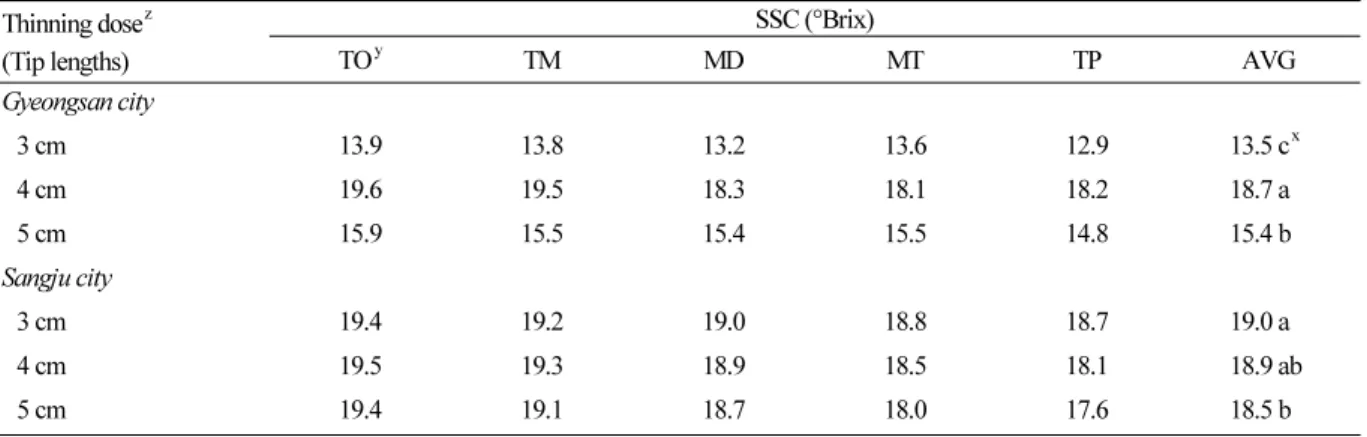
The average berry weight of fruit harvested in Sangju was 16.1, 15.2, and 15.8 g for the 3, 4, and 5 cm treatment groups, respectively, showing no significant differences between each other. There were also no significant differences in the berry diameter, and although significant results were produced in the berry length between the 4 cm treatment group and the rest of the treatments, the difference was minimal. SSC was 19.0°Brix at 3 cm, 18.9°Brix at 4 cm, and 18.5°Brix at 5 cm, and tended to decrease gradually as the cluster weight increased. The longer the remaining flower cluster, the greater the SSC of the berries of the top and tip (Figs. 5 and 6, Table 4) compared with those in the middle regions of the clusters.
The SSC of grapes harvested from Gyeongsan was the lowest in the 3 cm treatment group and highest in the 4 cm
treatment group (Table 4) . There was a noticeable effect of cluster weight on the SSC of the fruit harvested in Sangju. For
the 3 cm treatment group, the difference between the average SSC of the berries of the top and tip was approximately
0.7°Brix, whereas the difference between the SSC of the berries of the top and tip increased to 1.4°Brix (at 4 cm) and
1.8°Brix (at 5 cm) as the cluster weight increased (Table 4) .
A B C
Fig. 6. Shape of ‘Shine Muscat’ berries at harvest time following floral cluster thinning to 3 cm (A), 4 cm (B), and 5 cm (C).
Table 4. Comparison of soluble solids content (SSC) among the fruit from different lengths of floral cluster thinning by hand in ‘Shine Muscat’ grape at harvest time in Gyeongsan and Sangju city, Korea
Thinning dose
z(Tip lengths)
SSC (°Brix)
TO
yTM MD MT TP AVG
Gyeongsan city
3 cm 13.9 13.8 13.2 13.6 12.9 13.5 c
x4 cm 19.6 19.5 18.3 18.1 18.2 18.7 a
5 cm 15.9 15.5 15.4 15.5 14.8 15.4 b
Sangju city
3 cm 19.4 19.2 19.0 18.8 18.7 19.0 a
4 cm 19.5 19.3 18.9 18.5 18.1 18.9 ab
5 cm 19.4 19.1 18.7 18.0 17.6 18.5 b
z
Floral cluster thinning was conducted 7 days before full bloom.
y
Abbreviations: top (TO), top-middle (TM), middle (MD), middle-tip (MT), tip (TP), average (AVG).
x