INTRODUCTION
Inguinal hernia repair is one of the most frequently performed operations in general surgery.
1Several techniques have been introduced to treat inguinal hernias over the past 100 years. A laparoscopic procedure first described in 1990 is now widely used.
2,3Laparoscopic surgery has several advantages over conventional open methods. The
advantages include less postoperative pain, faster recovery and early return to work, and cosmetic benefit. In addition, the laparoscopic approach provides a clear view around the inguinal region, allowing detection of type and site of unexpected hernia.
4-6Among various laparoscopic techniques, laparoscopic totally preperitoneal (TEP) hernia repair is accepted to be superior to and less invasive than other methods and has become the
Laparoscopic Totally Extraperitoneal Hernia Repair after Radical Prostatectomy or Lower Abdominal Surgery Except for
Appendectomy – Experience of 35 Cases
Sung-Wook Heo, M.D., Min-Su Park, M.D., Sang-Mok Lee, M.D.
Department of Surgery, Kyung Hee University Hospital, Seoul, Korea
Purpose:
Laparoscopic totally extraperitoneal (TEP) hernia repair is known to be relatively difficult in cases with a history of lower abdominal surgery. We assess the feasibility of laparoscopic TEP hernia repair in those patients.Methods:
Thirty five patients with a previous history of radical prostatectomy or lower abdominal surgery who underwent laparoscopic TEP hernia repair for inguinal hernia were reviewed retrospectively. All operations were performed by a single experienced surgeon.Results:
Thirty three out of the 35 patients (94%) were men. Laparoscopic TEP hernia repair was performed successfully in 30 out of 35 cases. Twenty five cases (71%) were right inguinal hernia, 6 cases (17%) were left hernias, and 4 cases (11%) had an inguinal hernia on both sides. Five cases were converted to transabdominal preperitoneal (TAPP) (n=3) or open methods (n=2). Mean operation time was 111 minutes. The patient group with previous radical prostatectomy was the largest (n=22, 63%) and required a longer operation time (124 minutes). Blood loss was less than 50 cc in all cases.Average hospital stay was 1.2 days after surgery. Voiding difficulties requiring catheterization were observed in 13 cases (37%).
Conclusion:
Laparoscopic TEP hernia repair for a patient with previous history of radical prostatectomy or lower abdominal surgery except for appendectomy can be safely performed by an experienced surgeon, but is not recommended as a standard choice because of a longer operation time and higher conversion rate.Keywords:
Inguinal hernia, Laparoscopy, TEP, Lower abdominal surgeryReceived August 31, 2015 Revised 1st September 26, 2015
2nd October 19, 2015 Accepted October 20, 2015
Corresponding author Sang-Mok Lee
Department of Surgery, Kyung-Hee University Hospital, Kyungheedae- ro 23, Dongdaemun-gu, Seoul 02447, Korea
Tel: +82-2-958-8241 Fax: +82-2-966-9366 E-mail: [email protected]
This is an Open Access article distributed under the terms of the Creative Commons Attribution Non-Commercial License (http://
creativecommons.org/licenses/by-nc/4.0/) which permits unrestricted non-commercial use, distribution, and reproduction in any medium, provided the original work is properly cited.
Copyright © 2015 The Journal of Minimally Invasive Surgery. All rights reserved.
Journal of Minimally Invasive Surgery
J Minim Invasive Surg 2015;18(4):121-126
first choice of treatment for inguinal hernias in many centers.
When performed in a recurrent case after open hernia repair, it allows adhesions resulting from the previous procedure to be avoided. However, this procedure is known to be relatively difficult in cases with a history of radical prostatectomy or previous lower abdominal surgery.
7-9This is because there may be severe tissue adhesion after previous operations, which increases the risk of organ injury and bleeding during dissection.
10,11Several studies have reported the results of laparoscopic TEP hernia repair in selective patients with a previous history of various lower abdominal surgery.
6,10-13Although most studies have reported favorable results, no clear conclusion has yet been reached, and the suitability is still a matter of debate.
We have published our early experience of laparoscopic TEP repair in these patients in 2011 that the procedure is quite challengeable under operation by skilled surgeon, although longer operation time should be overcome.
Our purpose in this study was to assess the safety and feasibility of laparoscopic TEP hernia repair in patients with a previous history of radical prostatectomy or lower abdominal surgery based on our experience.
MATERIALS AND METHODS
Patients
Between July 2007 and July 2014, a total of 35 patients were enrolled in this study at Kyung Hee University Hospital.
Patients who had a previous history of radical prostatectomy or lower abdominal surgery and underwent laparoscopic TEP hernia repair for inguinal hernia were reviewed retrospectively.
Previous lower abdominal surgeries were gastrointestinal surgery, vascular surgery, gynecologic surgery, and urologic surgery.
Operation procedure
Laparoscopic procedure with three trocars was performed by a single experienced surgeon. The patient was placed in a supine position under general anesthesia. About 1.5 cm longuitudinall incision was made and dissection was done to find the preperitoneal field between the rectus abdominis muscle and posterior sheath of the muscle. A balloon dissector (Autosuture, Norwalk, USA) was inserted through the area and inflated with air. Inflation was done by balloon pump included in the trocar set. Space making was much slowly and carefully done than conventional cases to avoid peritoneal tear or bleeding. After securing the proper space, the balloon dissector was deflated and a 12-mm balloon trocar (peritoneal
distension balloon, Autosuture, Norwalk, USA) was inserted into the space. The space was inflated with CO
2and a laparoscopic videoscope was inserted. Next, a 5-mm trocar was placed above the pubic symphysis, while the last 5-mm trocar was placed between the two trocars on the midline.
Dissection was done gently to expose the space of Retzius and space of Bogros so as to identify the type of hernia. Once the hernia sac was detached, the sac returned itself into the abdominal cavity because of the inflated CO
2pressure. The sac was detached successfully in all cases. Peritoneal tear was repaired if it disturbed laparoscopic view or procedure. Most procedures were similar to conventional laparoscopic TEP hernia repair except for dissecting severe adhesion. During operation, electrocautery was frequently used when dissecting tissues resistant to blunt dissection. Blunt dissection could be more dangerous than cauterization in severely adhered condition. An anatomical mesh (Parietex
Ⓡ, Sofradim, Formans, France) was inserted through the 12-mm trocar and placed to cover the operation field evenly. CO
2was gradually deflated to check the position and fixation of the mesh. Trocars were removed after full deflation. Skin closure and dressing were done to finish the operation. The patient remained in the hospital on the operation day and was generally discharged the next day. Follow-up was planned at 5~7 days after the surgery and once a year thereafter.
RESULTS
Demographic characteristics
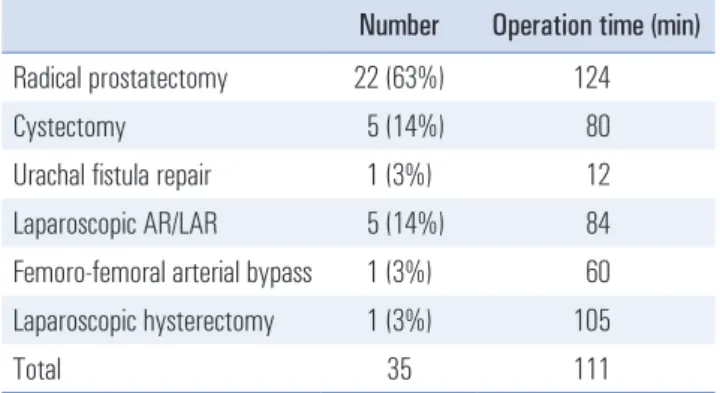
Thirty three out of the 35 patients (94%) were men. Average age was 68 years (38~88). Twenty two patients (63%) had a history of radical prostatectomy by either an open or robotic method and 6 (17%) had a history of urinary bladder or/and ureter surgery. Others were 5 (14%) laparoscopic operations for colorectal cancers, 1 (3%) femoro-femoral arterial bypass
Table 1. Type and mean operation time of previous lower abdominal surgery Number Operation time (min) Radical prostatectomy 22 (63%) 124
Cystectomy 5 (14%) 80
Urachal fistula repair 1 (3%) 12
Laparoscopic AR/LAR 5 (14%) 84
Femoro-femoral arterial bypass 1 (3%) 60 Laparoscopic hysterectomy 1 (3%) 105
Total 35 111
AR = anterior resection); LAR = low anterior resection.
surgery, and 1 (3%) laparoscopic hysterectomy (Table 1).
Operative outcomes
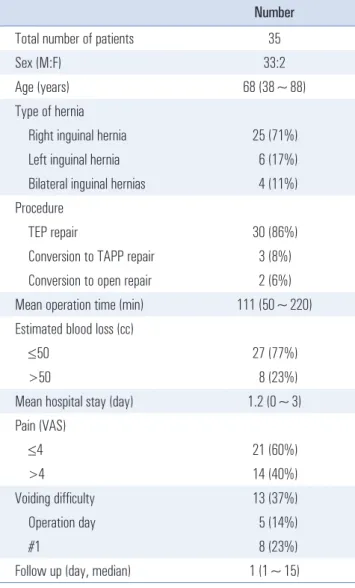
Laparoscopic TEP hernia repair was successfully done on 30 out of 35 cases (86%), but five cases (14%) had to be converted to transabdominal preperitoneal (TAPP) hernia repair (n=3) or open methods (n=2). In conversion cases, 4 cases (3 TAPP procedure and 1 open method) had previous radical prostatectomy and 1 (open method) had previous radical cystectomy. Twenty five cases (71%) were right inguinal hernias, including 1 recurrent case after previous hernia repair in other hostipal. Six cases (17%) were left hernias, and 4 cases (11%) had an inguinal hernia on both sides. Hernia repair with onlay mesh and plug method was used as the open method.
Mean operation time was 111 minutes (50~220). Operation time for patient with previous radical prostatectomy was longer than average. Blood loss was less than 50 cc in all cases.
Seroma and surgical site infection were reported in one case respectively and recovered with conservative management.
Average hospital stay was 1.2 days (0~3) after surgery. Voiding difficulties requiring catheterizations were observed in 13 cases (37%), 5 cases were resolved on the operation day and the others on the following day. There was no recurrence of urinary retention. Median follow up period was 5 years (1~15) (Table 2).
We divided patients into four groups according to operation period using a 2-year interval. Although the number of cases in each group differed, the average operation time tended to decrease over time (Table 3).
DISCUSSION
First introduced in the early 1990s, laparoscopic TEP hernia repair has gained widespread popularity.
2,3Feasibility and safety of laparoscopic TEP hernia repair have been verified and it is the treatment of choice in many centers. Laparoscopic TEP hernia repair is generally preferred to laparoscopic TAPP procedure, because the latter is associated with a higher incidence of port site hernia and visceral injuries than laparoscopic TEP hernia repair.
4However, laparoscopic TEP hernia repair is not recommended cases such as sliding or incarcerated hernias, or hernia with previous lower abdominal surgery.
10Improvements in surgical skills and results have resulted in changes in recommendation.
14The International Endohernia Society (IEHS) recommended both laparoscopic TAPP and TEP hernia repair as possible treatment options for hernias with previous history of lower abdominal surgery if it is performed by an experienced surgeon.
15In our hospital, TEP was carefully done in such cases since 2007 and once reported early experiences in 2011.
16Compared with laparoscopic TEP on patients without previous history of lower abdominal surgery, longer operation time was required.
The major factor that determines the difficulty of the pro- cedure is the presence of adhesions in the operation field.
Table 2. Patients and surgical characteristics
Number
Total number of patients 35
Sex (M:F) 33:2
Age (years) 68 (38~88)
Type of hernia
Right inguinal hernia 25 (71%) Left inguinal hernia 6 (17%) Bilateral inguinal hernias 4 (11%) Procedure
TEP repair 30 (86%)
Conversion to TAPP repair 3 (8%) Conversion to open repair 2 (6%) Mean operation time (min) 111 (50~220) Estimated blood loss (cc)
≤50 27 (77%)
>50 8 (23%)
Mean hospital stay (day) 1.2 (0~3) Pain (VAS)
≤4 21 (60%)
>4 14 (40%)
Voiding difficulty 13 (37%)
Operation day 5 (14%)
#1 8 (23%)
Follow up (day, median) 1 (1~15)
TEP = totally extraperitotoneal; TAPP = transabdominal preperitoneal;
VAS = visual analog scale.
Table 3. Mean operation time according to period
Cases Operation time (min)
2007~2008 5 150 (120~195)
2009~2010 12 118 (55~220)
2011~2012 10 107 (50~210)
2013~2014 8 82 (55~105)
The presence of some adhesions is inevitable in patients with a previous history of lower abdominal surgery because these operations and laparoscopic TEP hernia repair share same operation field. This leads to the longer operation time and higher conversion rate and contributes to the reason laparoscopic TEP has not been recommended in these complicated cases.
7,8,10,12,17The first obstacle occurs when dissecting through the preperitoneal space using a balloon dissector. The dissector can easily slip onto the wrong course or damage vessels. Careful control is required when advancing the dissector and performing ballooning to create the ideal surgical space. Separating the hernia sac from the inguinal cord is the next challenging task. Usually, the sac and surrounding tissues are strongly conglomerated. The operator should gently retract and separate the herniated sac to avoid injury to adjacent structures as well as peritoneal tears.
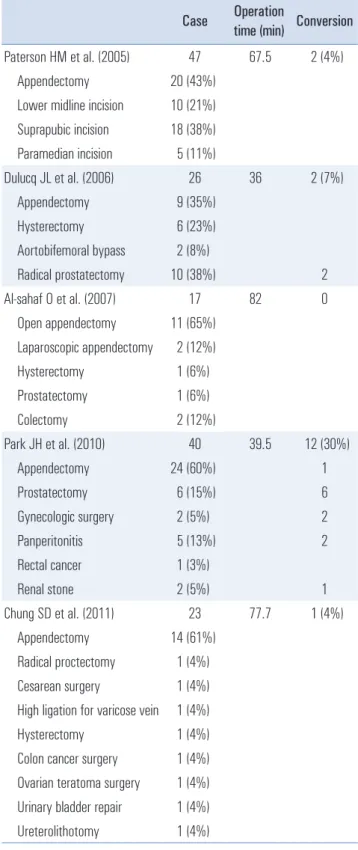
Several studies have reported the results of laparoscopic TEP hernia repair for groin hernia on patients with a prior history of lower abdominal surgery. Operation time differs widely among these studies. Relatively long operation times were reported by most studies (Table 4).
6,10-13In our study, the mean operation time was 111 min, which is longer than other studies. However, this could be due to different operational settings and patient variance among studies. Operation time is also affected by the surgeon`s method and style. One more different factor is the characteristic of previous low abdominal surgery in our study group. More than half of previous operations were radical prostatectomy and patients with previous appendectomy were not included in our study.
In same period, mean operation time of our hospital for laparoscopic TEP hernia repair in patient without such an operation history was 86 minutes.
In our study, operation time gradually decreased in our study. Improvements in laparoscopic skills as well as accumu- lation of surgical experience are likely responsible for the reduction in operation time. Considering that numerous laparoscopic TEP hernia repairs have been performed at our hospital, the result suggests that longer learning period is required in the surgery in patients with a prior history of lower abdominal surgery than regular patients. Nevertheless, operation time is still longer when compared with patient group without previous history of lower abdominal surgery in same period. This may mean that shortening of operation time is limited and not much advantageous.
Peritoneal injury occurs commonly during laparoscopic TEP hernia repair. Minimal tearing is ignorable in most cases, but bigger one may make air leakage into abdominal cavity. It disturb maintaining ideal operation field or lead to more peritoneal injury. If the tearing is irrecoverable, conversion to other operation procedure is needed. Peritoneal
injury is mostly related with conversion of procedure. There were 3 conversions to laparoscopic TAPP approach and 2 conversions to open method during laparoscopic TEP hernia
Table 4. Mean operation time and conversion rate in other studies Case Operation
time (min) Conversion Paterson HM et al. (2005) 47 67.5 2 (4%) Appendectomy 20 (43%)
Lower midline incision 10 (21%) Suprapubic incision 18 (38%) Paramedian incision 5 (11%)
Dulucq JL et al. (2006) 26 36 2 (7%)
Appendectomy 9 (35%) Hysterectomy 6 (23%) Aortobifemoral bypass 2 (8%)
Radical prostatectomy 10 (38%) 2
Al-sahaf O et al. (2007) 17 82 0
Open appendectomy 11 (65%) Laparoscopic appendectomy 2 (12%) Hysterectomy 1 (6%) Prostatectomy 1 (6%)
Colectomy 2 (12%)
Park JH et al. (2010) 40 39.5 12 (30%)
Appendectomy 24 (60%) 1
Prostatectomy 6 (15%) 6
Gynecologic surgery 2 (5%) 2
Panperitonitis 5 (13%) 2
Rectal cancer 1 (3%)
Renal stone 2 (5%) 1
Chung SD et al. (2011) 23 77.7 1 (4%)
Appendectomy 14 (61%)
Radical proctectomy 1 (4%)
Cesarean surgery 1 (4%)
High ligation for varicose vein 1 (4%)
Hysterectomy 1 (4%)
Colon cancer surgery 1 (4%)
Ovarian teratoma surgery 1 (4%)
Urinary bladder repair 1 (4%)
Ureterolithotomy 1 (4%)
repair in our study. In TAPP conversion cases, TEP procedure was discontinued due to severe adhesion and accompanied peritoneal tear. In open conversion cases, TEP was held while making operation space, due to severe adhesion. Numerous conversion cases have been reported in other reports (Table 4).
6,10-13Mainly reasons are severe adhesion on operation field or peritoneal injury. Conversion rate shown in our study is higher than other reports. Similar to difference in operation time, the rate should be considered together with patient variance and operational settings.
Generally small hernia sac could be easily dissected in most cases, but huge hernia sac is not. In a huge scrotal hernia the sac is very difficult to dissect and this can be lead to peritoneal injury and conversion to other method. It is necessary to resect the sac whenever we meet some difficulty to dissect the sac.
17In our cases, hernia sacs were successfully detached in all cases.
Pain control is not routinely administered to all patients after laparoscopic TEP hernia repair in our hospital. Intra- venous or intramuscular injection of a pain reliever is pro- vided if the patient complains of pain. There was no case of uncontrolled pain prolonged until postoperative day in our hospital. Laparoscopic TEP hernia repair is known to be less painful than other procedures for treating an inguinal hernia.
4,5Chung et al.
13reported that postoperative pain during 1 week after surgery didn`t differ among study and control groups.
Minimal complications were reported in most studies.
Paterson et al.
6reported 2 seromas, 2 urinary retention, 2 chronic groin pain and 1 transient neuropathy in 47 cases.
Dulucq et al.
10reported 1 case of trocar site bleeding in 26 cases. Chung et al.
13reported 3 hematomas and 2 seromas. In our study, 1 case of seroma and 1 case of surgical site infection occurred and well treated with conservative management.
No major complications leading to morbidity were observed.
It is difficult to measure the amount of bleeding accurately.
Usually, bleeding is minimal or limited to the regional field.
(Paragraph emerged) A total of 13 patients (37%) experienced voiding difficulties after the operation. Urinary retention is known to be a frequent complication after laparoscopic TEP hernia repairs, occurring in 2~8% of cases.
4,18,19The rate of urinary retention in our study was therefore relatively high.
However, all urinary retensions were resolved in one day without recurrence during follow up period. There was no case of hernia recurrence within 24 hours after surgery. Follow up was planned within 5~7 days after surgery and annually afterward. Median follow up period was 5 years (1~15).
There are several limitations in our study. The number of included patients is still small and the study was single-cen- tered retrospective design. Laparoscopic TEP hernia repair in
a patient with previous prostatectomy is known to be difficult than one with other previous low abdominal surgery.
10,17Although we included much cases of patients with previous prostatectomy compared with other studies (Table 4), larger volume would be necessary to establish more accurate results.
In conclusion, laparoscopic TEP hernia repair for patients with previous history of lower abdominal surgery has been reported to be a safe. Postoperative pain and rate of complication are similar between previous studies and ours.
However, longer operation time and higher conversion rate are limitations of the procedure, especially in cases with previous radical prostatectomy. Despite much learning period and experiences, it may be difficult to achieve favorable feasibility among various treatment options for inguinal hernia.
Laparoscopic TEP hernia repair for a patient with previous history of radical prostatectomy or lower abdominal surgery except for appendectomy can be performed safely by an ex- perienced surgeon, but is not recommended as a standard choice. The operation should be carefully considered among various treatment options.
REFERENCES
1) Dulucq JL, Wintringer P, Mahajna A. Laparoscopic totally extraperitoneal inguinal hernia repair: lessons learned from 3,100 hernia repairs over 15 years. Surg Endosc 2009;23:482-486.
2) Schultz L, Graber J, Pietrafitta J, Hickok D. Laser laparoscopic herniorraphy: a clinical trial preliminary results. J Laparoendosc Surg 1990;1:41-45.
3) Corbitt JD Jr. Laparoscopic herniorrhaphy. Surg Laparosc Endosc 1991;1:23-25.
4) Langeveld HR, van't Riet M, Weidema WF, et al. Total extra- peritoneal inguinal hernia repair compared with Lichtenstein (the LEVEL-Trial): a randomized controlled trial. Ann Surg 2010;251:819-824.
5) Bansal VK, Misra MC, Babu D, et al. A prospective, randomized comparison of long-term outcomes: chronic groin pain and quality of life following totally extraperitoneal (TEP) and transabdominal preperitoneal (TAPP) laparoscopic inguinal hernia repair. Surg Endosc 2013;27:2373-2382.
6) Paterson HM, Casey JJ, Nixon SJ. Totally extraperitoneal laparo- scopic hernia repair in patients with previous lower abdominal surgery. Hernia 2005;9:228-230.
7) Andersson B, Hallen M, Leveau P, Bergenfelz A, Westerdahl J.
Laparoscopic extraperitoneal inguinal hernia repair versus open mesh repair: a prospective randomized controlled trial. Surgery 2003;133:464-472.
8) Bringman S, Ramel S, Heikkinen TJ, Englund T, Westman B, Anderberg B. Tension-free inguinal hernia repair: TEP versus mesh-plug versus Lichtenstein: a prospective randomized controlled
trial. Ann Surg 2003;237:142-147.
9) Wright D, Paterson C, Scott N, Hair A, O'Dwyer PJ. Five-year follow-up of patients undergoing laparoscopic or open groin hernia repair: a randomized controlled trial. Ann Surg 2002;235:
333-337.
10) Dulucq JL, Wintringer P, Mahajna A. Totally extraperitoneal (TEP) hernia repair after radical prostatectomy or previous lower abdominal surgery: is it safe? A prospective study. Surg Endosc 2006;20:473-476.
11) Park JH, Choi YY, Hur KY. The Feasibility of Laparoscopic Total Extraperitoneal (TEP) Herniorrhaphy after Previous Lower Abdominal Surgery. J Korean Surg Soc 2010;78:405-409.
12) Al-Sahaf O, Al-Azawi D, Fauzi MZ, Cunningham FO, McGrath JP. Totally extraperitoneal laparoscopic inguinal hernia repair is a safe option in patients with previous lower abdominal surgery. J Laparoendosc Adv Surg Tech A 2008;18:353-356.
13) Chung SD, Huang CY, Chueh SC, Tsai YC, Yu HJ. Feasibility and safety of total extraperitoneal inguinal hernia repair after previous lower abdominal surgery: a case-control study. Surg Endosc 2011;25:3353-3356.
14) Cho DH, Kim BS, Choi SI, Joo SH, Lee SM. Laparoscopic Totally ExtraperitonealHernia Repair in Patients with Previous Lower
Abdominal Surgery-Early Experience. J Korean Soc Endosc Laparosc Surg 2011;14:91-95.
15) Kockerling F, Bittner R, Jacob DA, et al. TEP versus TAPP:
comparison of the perioperative outcome in 17,587 patients with a primary unilateral inguinal hernia. Surg Endosc 2015. (in press).
16) Bittner R, Arregui ME, Bisgaard T, et al. Guidelines for laparo- scopic (TAPP) and endoscopic (TEP) treatment of inguinal hernia [International Endohernia Society (IEHS)]. Surg Endosc 2011;25:
2773-2843.
17) Shpitz B, Lansberg L, Bugayev N, Tiomkin V, Klein E. Should peritoneal tears be routinely closed during laparoscopic total extraperitoneal repair of inguinal hernias? Surg Endosc 2006;18:
1771-1773.
18) Lau H, Patil NG, Yuen WK, Lee F. Urinary retention following endoscopic totally extraperitoneal inguinal hernioplasty. Surg Endosc 2002;16:1547-1550.
19) Zendejas B, Onkendi EO, Brahmbhatt RD, Lohse CM, Greenlee SM, Farley DR. Long-term outcomes of laparoscopic totally extraperitoneal inguinal hernia repairs performed by supervised surgical trainees. Am J Surg 2011;201:379-383; discussion 383- 374.