Polymorphisms of LEP, LGB and PRLR in water buffalo
Jiyeon Seong
1, Hong Sik Kong
1,2*
1
Genomic Informatics Center, Hankyong National University, Anseong 456-749, Korea
2
International Agriculture Information and Technology Center, Hankyong National University, Anseong 456-749, Korea
Received on 10 December 2012, revised on 13 December 2012, accepted on 14 December 2012
Abstract : The polymorphisms of several genes including Leptin (LEP), beta-lactoglobulin (LGB) and Prolactin receptor (PRLR) have been shown to affect milk composition traits in dairy cattle. But, the effects of these polymorphisms on the milk traits of Philippine water buffalo are still unclear. In the Philippines, buffalo are the major milk producers most of which are the Philippine carabao (PC), the American Murrah Buffalo (AMB) and Bulgarian Murrah Buffalo (BMB).
The LEP, LGB and PRLR genes are considered to be associated with milk production traits. The objective of the present study was to identify the single nucleotide polymorphisms (SNPs) in the LEP, LGB and PRLR genes of PC, AMB and BMB and to investigate the effect of the SNPs on milk production traits in these buffalo. Genetic polymorphisms were screened by DNA sequencing and 12 SNPs were detected in BMB; 5 SNPs were in LEP exon3 region (G14227A, G14343A, T14502C, C14526T, G14603A); 5 SNPs were in LGB exon 2 region (G1861C, A1900G, G1901T, T1948C, G1949A); 2 SNPs were in PRLR exon 6 (T59047C, T59109C). Also, 12 polymorphism sites between cattle and buffalo were identified. Our analysis of the association between SNPs and milk production traits should be useful in future studies of buffalo breeding to improve lactation performance.
Key words : Buffalo, Philippine carabao, LEP, LGB, PRLR, Milk production traits
*Corresponding author: Tel: +82-31-670-5334 E-mail address: [email protected]
I. Introduction
The water buffalo ( Bubalus bubalis ) are important domestic animals distributed in the tropical and sub- tropical regions (Shi et al., 2011). They are of particular importance for meat and milk production in tropical and subtropical countries because of their ability to adapt to harsh environmental conditions (Das and Khan, 2010; Yindee et al., 2011). There are two distinct types, the riverine and swamp types. Native water buffalo or Carabao that are found in the Philippines and in the South and Southeast Asian regions belong to the swamp type. American Murrah Buffalo (AMB) and the Bulgarian Murrah Buffalo (BMB) are found in India, Europe and the Americas and belong to the riverine type. Swamp buffalo have 48 chromosomes, and riverine buffalo have 50 chromosomes (Nanda et al., 2003;
Nanda et al., 2006; Lei et al., 2007; Groeneveld et al., 2010; Mingala et al., 2011).
The Korean cattle, Bos taurus , is a breed native to the Korean peninsula and the Japanese islands, and is considered to descend from a breed of European cattle (Seong et al., 2012)
In a previous study, Leptin (LEP), beta-lactoglobulin (LGB) and Prolactin receptor (PRLR) were shown to be genes that are associated with milk production traits in cattle (Ruheena, et al., 2011; Shi, et al., 2011; Heidari, et al., 2012; Tanpure, et al., 2012).
LEP, the fat derived protein hormone, has a variety of physiological functions such as regulation of feed intake, energy balance, and fertility and immune functions (Tanpure et al., 2012). Genetic polymorphisms within the bovine LEP gene were found to be associated with growth, fertility and milk production in Holstein cows (Clempson et al., 2011; Tanpure et al., 2012).
LGB is one of the major components of bovine milk.
The SNPs in the exon2 region of the LGB gene were
Table 1. Primers and length of each amplified fragment and annealing temperature.
Primer Name Primer Sequence Size (bp) Annealing Temp (℃)
LEP exon 3 F
R
GAGGAAGCACCTCTACGCTCTA
GATTCTCAGAGGGAATCTTGCTT 815 61
LGB exon 2 F
R
CTGGCCCTCAGTTCATCCT
ATCACCACCAGCCCCTTAG 243 57
PRLR exon 6 F
R
GACCTACATACTGGCTTCTCTGC
GCAGATTTCAGGCAGAATCC 280 58
shown to affect milk performance traits (i.e., milk yield, protein and fat contents) in Chinese Holstein cows (Yang et al., 2011). PRLR is one of the main proteins of bovine milk (Ganai et al., 2009). The PRLR-S18N polymorphism (Ser to Asn) is the major QTL associated with milk production traits. Holstein, Chinese Holstein and Montebeliard cows with the AG nucleotide genotype showed the highest milk yield, while GG genotype cows showed the highest fat content (Shi et al., 2011).
Genetic analysis of these genes in the Philippine buffalo is limited. In this study, we detected SNPs in the LEP, LGB and PRLR genes using DNA sequencing technology in BMB, AMB, PC and KC. This study not only provides insight into milk production of dairy cattle but it also provides helpful information that may be used to improve the milk production, in both quantity and quality, through genetic manipulation in water buffalo.
II. Materials and Methods
1. DNA samples and Genomic DNA Extraction
A total of 390 buffaloes from the Philippine Carabao Center (PCC) were used with the following distribution:
20 American Murrah Buffalo, 20 Philippine Carabao, 350 Bulgarian Murrah Buffalo and 20 Korean cattle (KC). DNA was extracted from blood using the Promega Blood and Tissue Kit and DNA concentration was quantified using a ND-2000 UV-Vis spectrophoto- meter (Nano Drop Technologies, USA).
2. PCR Amplification and Sequencing
The LEP, LGB and PRLR gene regions were amplified using five pairs of primers (Table 1). The Polymerase Chain Reaction (PCR) amplification was performed in 20 µl volume and each reaction contained 100 ng of genomic DNA, 10 pmole of each primer, 2.5 µl of 10x PCR buffer (10 mM Tris-HCl,50 mM KCl, 1.5 mM MgCl
2, pH 8.3), 2.5 µl dNTP (2.5 mM), and 0.1 µl Taq polymerase(10 unit/µl)(GENET Bio, Korea). The PCR condition was as follows: first denaturation step of 5 min at 94℃ followed by 35 cycles, each step consisting of 1 min at 94℃, 30 sec at each temperature, 30sec at 72℃ and then, a final step of 5 min at 72℃. The reactions were performed using a PTC200 Pettier thermal cycler (MJ Research, USA). DNA sequencing was performed on an ABI 3130 Genetic Analyzer (Applied Biosystems, USA) to determine each of the nucleotide sequences. Sequences were determined using the Seq Man II program (DNA Star, USA) for each SNP.
3. Statistical analysis
Allele and genotype frequencies were calculated by simple counting. Hardy-Weinberg equilibrium was tested by comparing the expected and observed genotypes of frequencies using the Chi-square test.
III. Results
1. Polymorphisms of the LEP, LGB and PRLR genes using BMB
We identified 12 single nucleotide polymorphisms
Table 2. Genotype and allele frequencies of specific gene regions in BMB.
Gene SNPs AA change Genotype freq
Allele freq
11 12 22
LEP G14227A GG (0.80) GA (0.19) AA (0.01) G (0.90) A (0.10)
G14343A R159Q GG (0.68) GA (0.29) AA (0.03) G (0.82) A (0.18)
T14502C CC (0.52) CT (0.41) TT (0.07) C (0.73) T (0.27)
C14526T CC (0.35) CT (0.45) TT (0.20) C (0.58) T (0.43)
G14603A AA (0.19) GA (0.46) GG (0.35) A (0.42) G (0.57)
LGB G1861C CC (0.79) CG (0.19) GG (0.02) C (0.89) G (0.11)
A1900G AA (0.78) AG (0.21) GG (0.01) A (0.88) G (0.12)
G1901T GG (0.78) GT (0.21) TT (0.01) G (0.88) T (0.12)
T1948C TT (0.28) TC (0.53) CC (0.18) T (0.55) C (0.45)
G1949A GG (0.29) GA (0.53) AA (0.19) G (0.55) A (0.45)
PRLR T59047C CC (0.34) CT (0.49) TT (0.17) C (0.59) T (0.41)
T59109C CC (0.90) CT (0.10) TT (0.00) C (0.95) T (0.05)
(SNPs) in the LEP, LGB, and PRLR genes. Of these SNPs, 5 were located in LEP exon 3 region (G14227A, G14343A, T14502C, C14526T, G14603A), 5 SNPs were in LGB exon 2 region and intron (G1861C, A1900G, G1901T, T1948C, G1949A), and 2 SNPs were in PRLR exon 6 and intron (T59047C, T59109C). The estimated LEP, LGB and PRLR allele and genotype frequencies are shown in Table 2.
In the LEP gene, G14343A is a synonymous mutation where amino acid 159 changes from arginine to glu- tamine. The G14343A frequency for allele G was higher than that for allele A and 0.68, 0.29 and 0.03 displayed the GG, GA and AA genotypes, respectively. Also, the C14526T mutation for the LEP gene had a frequency for allele C that was higher than allele T and 0.35, 0.45 and 0.20 displayed the CC, CT and TT genotypes, respectively.
In the LGB gene, the A1900G frequency for allele A was higher than that for allele G and 0.78, 0.21 and 0.01 displayed the GG, GA, and AA genotypes, respec- tively. For the G1901T SNP, the frequency for allele G was higher than that for allele T and 0.78, 0.21 and 0.01 displayed the GG, GT, and TT genotypes, respec- tively. Also, two haplotypes A-G and G-T, were found at the 1900
th-1901
stsite.
In the PRLR gene, the T59109C SNP had a frequency for allele C that was higher than that for allele T and 0.90 and 0.10 displayed the CC and CT genotypes, respectively.
2. Comparison of polymorphism sites between cattle and buffalo
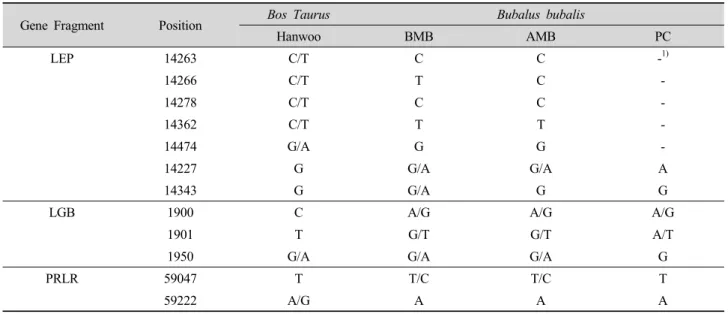
We identified 12 SNPs in the three sequenced gene fragments between buffalo and KC, including nine intra specific SNPs among the three buffalo groups (Table 3).
For the LEP gene, KC, AMB and PC species fixed the G allele genotype of the G14343A SNP and BMB had the G and A allele fixed. Thus, KC, AMB and PC species fixed the R allele genotype of R159Q and BMB have both R and Q at this same amino acid.
For the LGB gene, KC has the T allele genotype of the G1901T SNP, BMB and AMB have both the G and T alleles and PC has both the A and T alleles.
For the PRLR gene, all buffalo species fixed the A
allele genotype of the G59222A SNP, and KC fixed
both the A and G allele genotypes.
Table 3. The polymorphism sites of three gene fragments between water buffalo and cattle.
Gene Fragment Position Bos Taurus Bubalus bubalis
Hanwoo BMB AMB PC
LEP 14263 C/T C C -
1)14266 C/T T C -
14278 C/T C C -
14362 C/T T T -
14474 G/A G G -
14227 G G/A G/A A
14343 G G/A G G
LGB 1900 C A/G A/G A/G
1901 T G/T G/T A/T
1950 G/A G/A G/A G
PRLR 59047 T T/C T/C T
59222 A/G A A A
1)