INTRODUCTION
A variety of internal and external stressors, such as habitat disturbance and nutrients input, incoming to aquatic ecosystem have indirect or direct effects on the structure and components of river ecosystem such as organisms, community, and ecosystem (Adams and Tremblay, 2003). Espe- cially in case of urban stream environments, efflu-
ent water of wastewater disposal plants (WDPs) resulted in varieties of problems such as eutro- phication, organic matter pollution, and toxic or hazard pollution along with habitat degradations (Lee et al., 2006).
Previous studies on chemical water quality sur- veys in Gap-Stream (Kang et al., 2000; Bae and An, 2006; Lee et al., 2006) pointed out that the stream has a longitudinal difference of chemical water quality such as nitrogen and phosphorus
─
─ 422 ──
* Corresponding author: Tel: +82-42-821-6408, Fax: +82-42-822-9690, E-mail: [email protected]
Population Dynamics of Zacco platypus in Gap-Stream and Its Relation with Water Quality
Shin, Young-Eun, Ji-Woong Choi and Kwang-Guk An*
(Department of Biology, College of Biological Sciences and Biotechnology, Chungnam National University, Daejeon 305-764, Korea)
This study was to provide basic data for aquatic ecosystem research using fishes.
Field sampling was carried out at five selected sites of Gap Stream, and fish samples, especially for a selection of sentinel species were collected three times in June, September, and October 2007. We analyzed total length distribution of Zacco platy- pus in relation with the season and the sampling sites, and then compared with total body weight, condition factor (K), and age distribution of the fish. The fish popu- lation data were compared with physico-chemical water quality, obtained from the Ministry of Environment, Korea. Water quality analysis showed a significant nutri- ent enrichment, based on total nitrogen (TN) and total phosphorus (TP), and organic matter pollution, based on biological oxygen demand (BOD) and chemical oxygen de- mand (COD) in the Site 5, which is directly influenced by wastewater disposal plant (WDP). Population analysis of the sentinel species showed that the total number of individuals, age distribution, and the population size-structure were influenced by the effluents from the WDP, and that reproductive failure of young-age population were evident in Site 5. According to the relation analysis of total weight to K, the disturbed population was mainly attributed to combined effects of habitat modifica- tions and chemical degradations. Regression analysis of K values against water quality parameters showed significant (p⁄⁄0.05) positive relations with nutrient and organic matter contents. Our data suggest that the population structure using a sentinel fish species reflected the ambient water quality in the stream and that diagnosis of aquatic ecosystem health using Z. platypus population may be practical for water resource and ecosystem conservations.
Key words : sentinel species, condition factor, fish population, water pollution, stream diagnosis
along the main axis of upstream to the down- stream (Bae and An, 2006; Lee and An, 2007) and the difference is mainly caused by the point pollution source of the wastewater disposal plants (WDPs) near the downstream (Bae and An, 2006;
Lee et al., 2008a). For this reason, recently, water quality in the downstream is rapidly worsen as a result of point pollution source caused by indus- trial complexes and waste water disposal plant, so efficient management is required for the pur- pose of stream ecosystem conservation and protec- tion. Furthermore, some physical habitat analy- sis, based on Qualitative Habitat Evaluation Index (QHEI), showed that habitat degradation occurred within the stream depending on the sam- pling sites (An et al., 2001a; Choi et al., 2007a;
Bae et al., 2008; Kim et al., 2009) and that the plan of habitat restoration by the government is eminent in the stream.
Biological assessments, based on the bioindica- tor of fish assemblage (community), in Gap Stream during last several years indicated an impaired health condition by the criteria of index of biolo- gical integrity (IBI) (An et al., 2001b; Bae and An, 2006). Fishes are top consumers in aquatic ecosystem, have large mobility and sensitively respond to physicochemical changes of habitat (Barbour et al., 1999; Byeon et al., 2008; Choi et al., 2008). And they are affected by physical, chem- ical and biological changes that continued for a long time and have an wide range of effects on organism level to population, and community lev- els. For this reason, fishes in Gap Stream were used for diagnosis of water quality, because it is easy to predict influences by pollution source in the aquatic environment (Son et al., 1997; Seo, 2005). In this manner, study of aquatic environ- ment management or evaluation using fishes re- quires long-term data, but past researches of fresh- water fishes in Korea were almost about species distribution and community diversity (Choi et al., 2006a), so that these studies were insufficient to utilize the fish population dynamics. Recent stud- ies find out population growth, obesity and robust- ness of fishes using the indices such as length- weight relationship, or condition factor (K) for the understanding of population dynamics. And thro- ugh some previous studies tried to identify and determine the overall health of river ecosystems (Choi et al., 2006b; Choi et al., 2006c; Jang et al., 2007; Lee et al., 2008b), little is known about the fish population studies related to water quality
and stream health.
Sentinel species in this study, the pale chub (Zacco platypus) usually inhabited riffle and run of midstream region in most of Korean river (Jang et al., 2007). This species was usually feed on epilithic periphyton, aquatic insects, and organic matter so that categorized in omnivore and its spawning usually occur during May to July, before monsoon period (Kim and Park, 2002). In addition, they are one of the most wide range of distribution in Korea and more pollution resistant than many other species. Thus, Z. platypus is adequate to the purpose of this study that find out the rela- tionship between total length∙total weight∙con- dition factor values of the population and physico- chemical water quality variables depending on sampling periods and sites. Also, the sentinel species may be effectively used for a key indicator for health assessments in relation to the conven- tional chemical water quality such as biological oxygen demand (BOD), chemical oxygen demand (COD), and nutrients (Lee et al., 2008c). Still, the information of the relationship between physico- chemical water quality variables and reproduc- tion∙growth of fish population is insufficient. In this study, we analyzed some relations of total length∙total weight∙condition factor∙relative age distribution of Z. platypus collected from five sites of Gap-Stream belongs to Geum river water- shed, and compared these data with physico-chem- ical water quality data.
MATERIALS AND METHODS
1. Study sites and periods
Field sampling was carried out at five selected sites of Gap stream. Fish samples were collected three times in June (Pre monsoon, PRE), Septem- ber (Monsoon, MON), and October (Post monsoon, POS) in 2007. Site 1 (S1) is located in outside of urban area, mainly surrounded by forest and some paddies and ordinary fields beside the stre- am, and is judged as a good habitat for fishes, based on previous study (Lee and An, 2007). Two sites of S2 and S3 could regard as artificially impacted-locations by nearby human activities in urban area, nutrient and organic inputs, and alter- ation of riverbed substrate by the urban construc- tions. Site 4 (S4) is directly influenced by artifi- cial river-restoration construction and S5 had been impacted severely by sewages input from
the wastewater disposal plant so that it seems to be hardly contaminated. The sampling sites of Gap Stream are as follows:
S1: Bongoek 2nd bridge, Bongoek-dong, Seo-gu, Daejeon (3rd order)
S2: Gasuwon bridge, Jeongnim-dong, Seo-gu, Daejeon (4th order)
S3: Manyeon bridge, Wolpyeong-dong, Seo-gu, Daejeon (4th order)
S4: Daedeok bridge, Samcheon-dong, Seo-gu, Daejeon (4th order)
S5: Gapcheon bridge, Jeonmin-dong, Yuseong- gu, Daejeon (5th order)
2. Sampling methods
At the five sites, fishes were collected from all types of the habitats including riffle, run and pool according to the Wading method (Ohio EPA, 1989), modified by An et al. (2001). At each sam- pling location, stream distance sampled was 200 m and the sampling time elapsed was 50 minu- tes. For the fish capture, we used the sampling gears such as cast net (mesh 5×5 mm) and kick
net (4×4 mm). Fish species collected were identi- fied according to the methods of species identifi- cation (Nelson, 1994; Kim and Park, 2002). Z.
platypus among fish species collected were trans- ported to the laboratory with ice, and then total length and weight were measured.
3. Analysis of fish population
In this study, we analyzed condition factor (K) of sentinel species as a diagnostic measure of pop- ulation health to determine the diverse physical, chemical, biological effects on the stream ecosys- tem.
1) Condition factor (K)
The condition factor or Ponderal Index expre- sses the condition of fish, such as abundance of food, and explained by high energy accumulation (Seo, 2005). Fulton-type condition factor (K) is generally explained as follows, and compared with length-weight relationship (Jang et al., 2007). The equation by Anderson and Neumann (1996) is as follow:
K==TW(TL3
)-1×10n(n==2)
TLindicates total length (mm), and TWindicates total weight (g).
2) Relative age distribution
We analyze relative age distribution of Z. pla- typus population, was categorized using a total length (TL) of fish. The age intervals (I-XV, unit== mm) as follows.
I: 21~30, II: 31~40, III: 41~50, IV: 51~60, V:
61~70, VI: 71~80
VII: 81~90, VIII: 91~100, IX: 101~110, X:
111~120, XI: 121~130
XII: 131~140, XIII: 141~150, XIV: 151~160, XV: 161~170
4. Physico-chemical water quality analysis Total six parameters including biological oxy- gen demand (BOD), chemical oxygen demand (COD), total nitrogen (TN), total phosphorus (TP), suspended solids (SS), and electric conductivity (EC) were analyzed in this study. We analyzed one year monthly dataset from January 2007 to December 2007 or dataset of three months (June, September, and October), obtained from water quality monitoring network (http://water.nier.go.
kr/weis) of Ministry of Environment, Korea (MEK).
Fig. 1. Sampling sites in the Gap-Stream (S1: 36�16′N, 127�19′E, S2: 36�18′N, 127�21′E, S3: 36�21′N, 127�21′E, S4: 36�22′N, 127�22′E, S5: 36�24′N, 127�24′E).
N
S5 Gap Stream
WWDP
Daecheong Reservoir
Daejeon Stream
0 5 km
Yudeung Stream
Daejeon 2nd Industrial Complex S4
S3
S2
S1
The criteria of physico-chemical water quality was based on 7-rank system by the Ministry of Envi- ronment, Korea.
RESULTS AND DISCUSSION
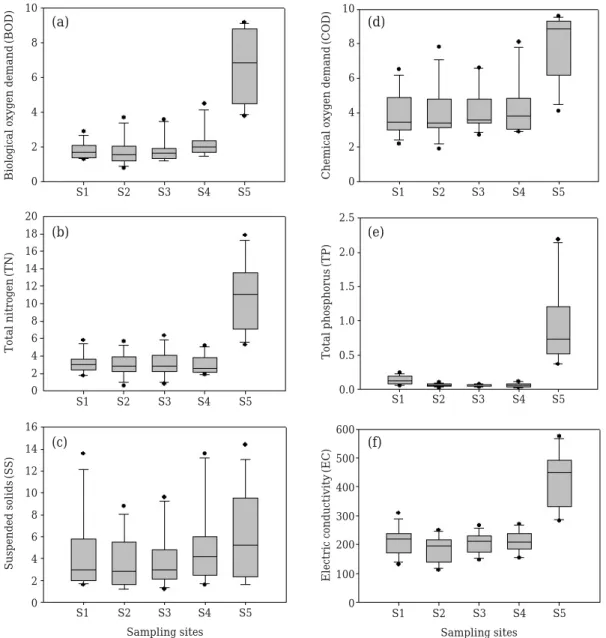
Water quality showed distinct longitudinal gra- dient of water quality along the main axis of head- water-to-the downstream in the Gap-Stream and the largest difference occurred in the downstream region. Organic matter pollutions, based on bio- logical oxygen demand (BOD) and chemical oxy- gen demand (COD), were not significant in the
upstream regions (S1~S3) but most pronounced in the downstream site (S5, Fig. 2a, d), which is influenced by the wastewater disposal plants (WDPs); mean values of BOD and COD were ⁄3 mg L-1 and 4.5 mg L-1, respectively in the up- stream regions of S1~S3, but values were reach- ed up to 6.7 mg L-1 in BOD and 7.9 mg L-1 in COD (Fig. 2a, d).
Nutrients of total nitrogen (TN) and total phos- phorus (TP) in the stream showed similar pattern with BOD and COD (Fig. 2a, b, d, e), but the dif- ference between the upstream and downstream was much greater than the differences in BOD and COD. Mean TN was 3.2 mg L-1at the Site 1,
Fig. 2. Chemical water quality in the five sampling sites.
10
8
6
4
2
0
20 18 16 14 12 10 8 6 4 2 0
16 14 12 10 8 6 4 2 0
10
8
6
4
2
0
2.5
2.0
1.5
1.0
0.5
0.0
600
500
400
300
200
100
0
Biological oxygen demand(BOD)Total nitrogen(TN)Suspended solids(SS) Chemical oxygen demand(COD)Total phosphorus(TP)Electric conductivity(EC)
S1 S2 S3 S4 S5
S1 S2 S3 S4 S5
S1 S2 S3 S4 S5
Sampling sites
S1 S2 S3 S4 S5
Sampling sites
S1 S2 S3 S4 S5
S1 S2 S3 S4 S5
(a) (d)
(b) (e)
(c) (f)
but increased up to 11.0 mg L-1in the Site 5 near the WDP (Fig. 2b), resulting in difference of 5- fold between the two sites. Similarly, mean TP was 135μg L-1at the Site 1, but increased up to 963μg L-1at the Site 5 (Fig. 2e), resulting in dif- ference of 5-fold between the two sites. This re- sult indicates that nutrient enrichment was evi- dent in the downstream location. Suspended solids (SS) averaged 4.6 mg L-1and ranged from 3.5 mg L-1to 5.9 mg L-1depending on the sampling sites (Fig. 2c), indicating low spatial gradient compared to the nutrients of TN and TP. Electrical conduc-
tivity (EC) averaged 250μS cm-1during the study and showed a large spatial variations between the upstream (213μS cm-1) and downstream site (429μS cm-1, Fig. 2f). The higher ions in the downstream are due to direct wastewater dis- charge from the WDP (Bae and An, 2006). Thus, there were significant differences (p⁄0.05) in the BOD, COD, TN, TP, and electrical conductivity (EC) between S5 and other sites (S1~S4), indicat- ing distinct influences of wastewater on the stream water from the WDP.
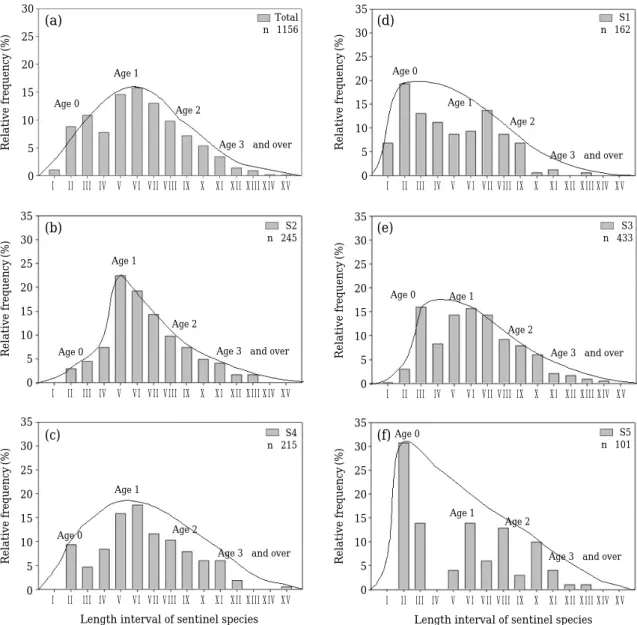
Relative age distribution of sentinel species,
Fig. 3. Relative age distribution of Z. platypus by sampling site in relation to 15 total length interval of I (21~30 mm)~XV (161~170 mm). The curve indicates the overall tendency of age distribution. (a): Total sampling sites, (b): S2, (c):
S4, (d): S1, (e): S3, (f): S5.
30 25 20 15 10 5 0
35 30 25 20 15 10 5 0
35 30 25 20 15 10 5 0
35 30 25 20 15 10 5 0
35 30 25 20 15 10 5 0
35 30 25 20 15 10 5 0
Relative frequency(%)Relative frequency(%)Relative frequency(%) Relative frequency(%)Relative frequency(%)Relative frequency(%)
I II III IV V VI VII VIII IX X XI XII XIII XIV XV
I II III IV V VI VII VIII IX X XI XII XIII XIV XV
I II III IV V VI VII VIII IX X XI XII XIII XIV XV Length interval of sentinel species
I II III IV V VI VII VIII IX X XI XII XIII XIV XV Length interval of sentinel species I II III IV V VI VII VIII IX X XI XII XIII XIV XV
I II III IV V VI VII VIII IX X XI XII XIII XIV XV
(a) (d)
(b) (e)
(c) (f)
Age 0++
Age 0++
Age 0++
Age 0++ Age 0++
Age 0++
Age 1++
Total n==1156
S1 n==162
S2 n==245
S4 n==215
S3 n==433
S5 n==101 Age 1++
Age 1++
Age 1++ Age 1++
Age 1++
Age 2++
Age 2++
Age 2++
Age 2++ Age 2++
Age 2++
Age 3++and over
Age 3++and over
Age 3++and over
Age 3++and over Age 3++and over
Age 3++and over
Zacco platypus, in the combined data of all sites (n==1156) showed a normal distribution over the length interval. As shown in the Fig. 3, age of sentinel species showed maxima (15%) in the Age 1++which is in the length interval of V~VI along with minima in the Age 0++with the length inter- val of I~III and Age 3++and over with the length interval of XI~XV (Fig. 3a). In the Site 1 (S1), to- tal number of Z. platypus sampled was 162 in the 3rd order stream and the relative frequency peaked in the Age 0++with the length interval of II (Fig. 3d). The peak frequency value declined
over the length intervals of II (Age 0++)~XV (¤Age 3++; Fig. 3d), thus, the maximum of the frequency was slightly skewed in the left side.
Total number of Z. platypus sampled in S2, S3, and S4 was 245, 433, and 215. respectively and the numbers were significantly (p⁄0.05) greater than the number of S1 (Fig. 3b, c, e). The relative frequency values of sentinel species in the S2, S3, and S4 were normal distribution over the length interval and these maxima fell into the nearly Age 1++with the length interval of V~VI (Fig. 3b, c, e). In contrast, in the Site 5, the maxi-
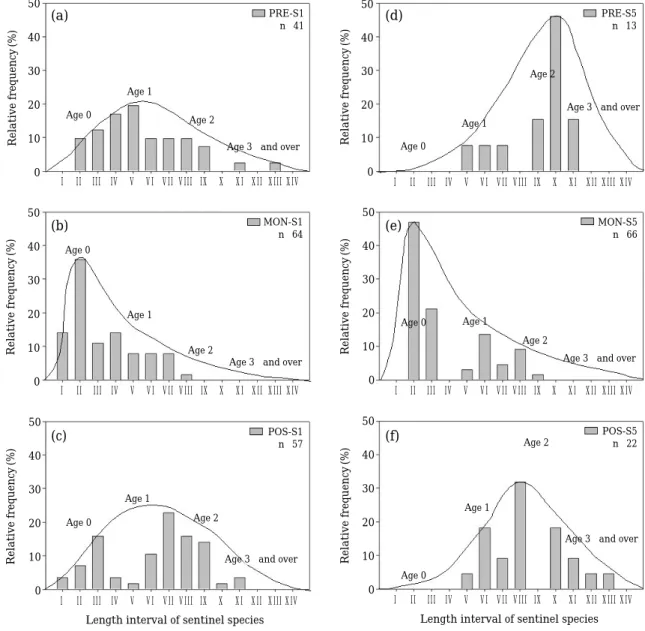
Fig. 4. Relative age distribution of Z. platypus by three seasons (PRE==premonsoon, MON==monsoon, POS==postmonsoon) in relation to 15 total length interval of I~XV in the control site (S1) and the impacted downstream (S5). (a): Pre- monsoon, S1, (b): Monsoon, S1, (c): Postmonsoon, S1, (d): Premonsoon, S5, (e): Monsoon, S5, (f): Postmonsoon, S5.
50
40
30
20
10
0
50
40
30
20
10
0
50
40
30
20
10
0
50
40
30
20
10
0
50
40
30
20
10
0
50
40
30
20
10
0
Relative frequency(%)Relative frequency(%)Relative frequency(%) Relative frequency(%)Relative frequency(%)Relative frequency(%)
I II III IV V VI VII VIII IX X XI XII XIII XIV
I II III IV V VI VII VIII IX X XI XII XIII XIV
I II III IV V VI VII VIII IX X XI XII XIII XIV Length interval of sentinel species
I II III IV V VI VII VIII IX X XI XII XIII XIV Length interval of sentinel species I II III IV V VI VII VIII IX X XI XII XIII XIV
I II III IV V VI VII VIII IX X XI XII XIII XIV
(a) (d)
(b) (e)
(c) (f)
Age 0++
Age 0++
Age 0++
Age 0++ Age 0++
Age 0++
Age 1++
PRE-S1 n==41
PRE-S5 n==13
MON-S1 n==64
POS-S1 n==57
MON-S5 n==66
POS-S5 n==22 Age 1++
Age 1++
Age 1++ Age 1++
Age 1++
Age 2++
Age 2++
Age 2++
Age 2++ Age 2++
Age 2++
Age 3++and over
Age 3++and over
Age 3++and over
Age 3++and over Age 3++and over
Age 3++and over
ma of relative frequency value in Z. platypus was Age 0++ with the length interval of II and the total number of individual (Z. platypus) sampled was 101, which is much lower than the values in the sites 1~4 (S1~S4; Fig. 3f). Thus, in the S5, the values were largely skewed in the most left side (Fig. 3f), indicating a disturbance of the popu- lation in Z. platypus. This phenomenon is de- monstrated by the chemical impacts by high BOD,
COD, and nutrients (TN, TP) from the wastewater disposal plants (WDP), as shown in Fig. 2. In fact, total number of the sentinel species and the population size-structure were influenced by the effluents from the WDP.
We also compared three seasons on the popula- tion variations of sentinel species, Z. platypus in the two sites of upstream (S1) and downstream (S5). We found that during the premonsoon, the
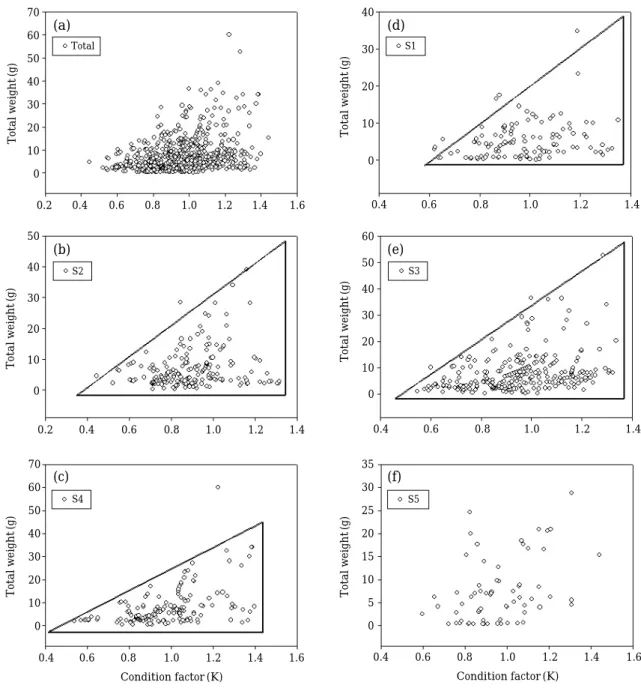
Fig. 5. The relationship between the condition factor (K) and total weight (TW) of the sentinel species. The triangle indicates that as the condition factor increase, total weight increase in the all sites except for the Site 5, impacted by the wastewater disposal plants. (a): Total sampling sites, (b): S2, (c): S4, (d): S1, (e): S3, (f): S5.
70 60 50 40 30 20 10 0
50 40 30 20 10 0
70 60 50 40 30 20 10 0
40
30
20
10
0
60 50 40 30 20 10 0
35 30 25 20 15 10 5 0
Total weight(g)Total weight(g)Total weight(g) Total weight(g)Total weight(g)Total weight(g)
0.2 0.4 0.6 0.8 1.0 1.2 1.4 1.6
0.2 0.4 0.6 0.8 1.0 1.2 1.4
0.4 0.6 0.8 1.0 1.2 1.4 1.6
Condition factor (K)
0.4 0.6 0.8 1.0 1.2 1.4 1.6
Condition factor (K)
0.4 0.6 0.8 1.0 1.2 1.4
0.4 0.6 0.8 1.0 1.2 1.4
(a) (d)
(b) (e)
(c) (f)
Total S1
S2
S4
S3
S5
maximum frequency of sentinel species occurred in Age 1++with the length interval of V in the up- stream reach and the frequency of occurance in the Age 0++ was less than 18% (Fig. 4a). During the monsoon, the maximum frequency of sentinel species in the upstream reach moved to the Age 0++with the length interval of II and the frequency of occurance in the Age 0++was greater than 35%
(Fig. 4b). During the postmonsoon, the frequency
of sentinel species with Age 0++ increased in the upstream reach along with large increases of Age 2++(VII~X) and ¤Age 3++(XI; Fig. 4c). This result indicates that the spawning of Z. platypus in the upstream during the premonsoon increased 15%
young age population during the monsoon and thereby increased older population (Age 2++~Age 3++and over) during the postmonsoon.
In contrast, in the downstream reach (S5), the
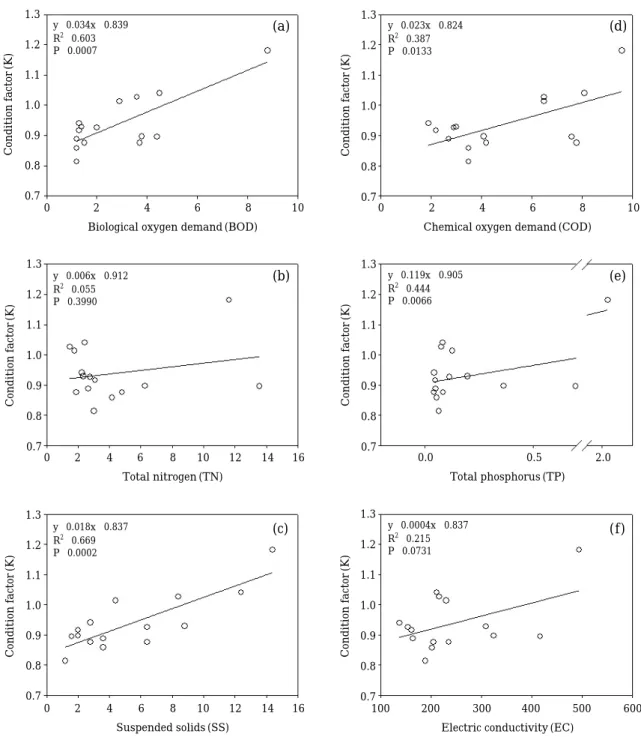
Fig. 6. The relations of the condition factor (K) to the water quality.
1.3 1.2 1.1 1.0 0.9 0.8 0.7
1.3 1.2 1.1 1.0 0.9 0.8 0.7
1.3 1.2 1.1 1.0 0.9 0.8 0.7
1.3 1.2 1.1 1.0 0.9 0.8 0.7
1.3 1.2 1.1 1.0 0.9 0.8 0.7
1.3 1.2 1.1 1.0 0.9 0.8 0.7
Condition factor(K)Condition factor(K)Condition factor(K) Condition factor(K)Condition factor(K)Condition factor(K)
0 2 4 6 8 10
Biological oxygen demand (BOD)
0 2 4 6 8 10 12 14 16
Total nitrogen (TN)
0 2 4 6 8 10 12 14 16
Suspended solids (SS)
0 2 4 6 8 10
Chemical oxygen demand (COD)
0.0 0.5 2.0
Total phosphorus (TP)
100 200 300 400 500 600
Electric conductivity (EC)
(a) (d)
(b) (e)
(c) (f)
y==0.034x++0.839 R2==0.603 P==0.0007
y==0.006x++0.912 R2==0.055 P==0.3990
y==0.018x++0.837 R2==0.669 P==0.0002
y==0.023x++0.824 R2==0.387 P==0.0133
y==0.119x++0.905 R2==0.444 P==0.0066
y==0.0004x++0.837 R2==0.215 P==0.0731
old-age population with the length interval of IX
~XI dominated in the premonsoon (Fig. 4d) and the young-age population (II~IV) abruptly incre- ased during the monsoon (Fig. 4e) but not at all in young-age population with the length interval of I~IV during the postmonsoon (Fig. 4f ). These data suggest that the young-age population in the upstream reach got a reproductive success but a failure of recruiting of young-age popula- tion in the downstream. The reproductive failure phenomenon of young-age population was evi- dently attributed to the water pollution by nutri- ent enrichment and high organic matter (BOD, COD) along with a physical habitat degradations (urban developments) in the downstream. This outcome is supported by previous studies of eco- logical health assessments (index of biological inte- grity, IBI) using fish (An et al., 2005; Bae and An, 2006; Kim et al., 2009) and qualitative habitat health assessments (qualitative habitat evaluation index, QHEI) between the two locations of Gap- Stream (An et al., 2001a).
The relations of total weight to condition factor (K) in the sentinel species showed a distinct difference between the un-polluted sites (S1~
S4) and the polluted site (S5). As the condition factor (K) increases over the range of 0.2~1.6, the variation range of total weight in the popula- tion increased in the sites 1~4, but not in Site 5 (Fig. 5). In all sites (S1~S4) except for Site 5 (S5), the overall shapes in the condition factor-total weight were triangle, but not in the S5 (Fig. 5).
In the S5, total weight values did not show any trend over the condition factor of 0.6~1.4. The population structure in S5 was modified because of the habitat degradation by the chemical pollu- tion, compared to that of the undisturbed sites.
The relations of the condition factor (K), based on an equation of Anderson and Newmann (1996), and the water quality are shown in Fig. 6. Regres- sion analysis of condition factor (K) against the water quality parameters showed significant positive relations with BOD (R2==0.603; p⁄0.001, n==15; Fig. 6a) and COD (R2==0.387; p⁄0.05, n== 15; Fig. 6d). Also, values of K had significant posi- tive linear relations with TP (R2==0.444; p⁄0.01, n==15; Fig. 6e), and total suspended solids (SS, R2==0.669; p⁄0.001, n==15; Fig. 6c), but not with TN (p¤0.05; Fig. 6c) and electrical conductivity (p¤0.05; Fig. 6f). It is evident that nitrogen seems to be enough for the system, even though the TN is much higher in the S5 than any other sites and
that phosphorus is limited due to high N : P ratios in the system. For this reason, the condition factor was directly related with TP but not with TN (Fig.
6c, f). According to previous studies (Da Costa and Araújo, 2003; Anene, 2005; Choi et al., 2007b;
Yeom et al., 2007), generally, as values of K incre- ase in a fish, the health conditions of fish popula- tion get worse. Our data suggest that the high values of K increased with the degradations of water quality or greater nutrients/organic matter input in the stream environments.
ACKNOWLEDGEMENTS
This research is supported by the grant “Assess- ment model developments of biological, chemical, and physical habitat in the level of fish individual and community in aquatic ecosystems and their optimum stressor analysis”, the Ministry of Envi- ronment, Korea in 2009.
LITERATURE CITED
Adams, S.M. and L.A. Tremblay. 2003. Integration of chemical and biological tools in environmental management and regulation. Australasian Jour- nal of Ecotoxicology 9: 157-164.
An, K.G., J.Y. Lee and H.N. Jang. 2005. Ecological health assessments and water quality patterns in Youdeung stream. Korean Journal of Limnology 38: 341-351.
An, K.G., S.H. Jung and S.S. Choi. 2001a. An evalua- tion on health conditions of Pyong-Chang river using the index of biological integrity (IBI) and qualitative habitat evaluation index (QHEI). Ko- rean Journal of Limnology 34: 153-165.
An, K.G., D.H. Yeom and S.K. Lee. 2001b. Rapid bio- assessments of Kap stream using the index of bio- logical integrity. Korean Journal of Environmen- tal Biology 19: 261-269.
Anderson, R.O. and R.M. Neumann. 1996. Length, weight, and associated structural indices. Fisheri- es techniques (2nd ed.). American Fisheries Socie- ty, Bethesda, Maryland.
Anene, A. 2005. Condition factor of four Cichlid Spe- cies of a man-made lake in Imo state, Southea- stern Nigeria. Turkish Journal of Fisheries and Aquatic Sciences 5: 43-47.
Barbour, M.T., J. Gerritsen, B.D. Snyder and J.B.
Stribling. 1999. Rapid bioassessment protocols for use in streams and wadeable rivers: periphyton, benthic macroinvertebrates and fish, 2nd Ed, EPA 841-B-99-002. US EPA Office of water, Washing-
ton, D.C., USA.
Bae, D.Y. and K.G. An. 2006. Stream ecosystem asse- ssments, based on a biological multimetric para- meter model and water chemistry analysis. Korean Journal of Limnology 39: 198-208.
Bae, D.Y., Y.P. Kim and K.G. An. 2008. Ecological health assessment of mountainous stream in Mt.
Sik-Jang using multi-metric models. Journal of Korean Society on Water Quality 24: 156-163.
Byeon, M.S., H.K. Park, W.O. Lee and D. Kong. 2008.
Fish fauna and community structure in lake Pal- dang and its inflows. Journal of Korean Society on Water Quality 24: 206-213.
Choi, E.Y., J.W. Seo and J.S. Choi. 2006c. Length- weight relation and Von Bertalanffy’s growth mo- del of Zacco koreanus population distributed in the tributaries of the Nakdong river. Korean Jour- nal of Limnology 39: 226-235.
Choi, J.K., O. Mitamura, D.J. Lee and H.S. Shin.
2008. Ichthyofauna and ecological community an- alysis in the Dong river. Korean Journal of Envi- ronment and Ecology 22: 616-624.
Choi, J.S., J.K. Kim, Y.S. Jang, K.Y. Lee and J.Y.
Lee. 2007b. Change of length-weight relationship and condition factor of Kumgang fat minnow (Rhynchocypris kumgangensis) on turbid water.
Journal of Environmental Research 4: 11-22.
Choi, J.S., S.C. Park, Y.S. Jang, K.Y. Lee and J.K.
Choi. 2006a. Population dynamics of Korean chub (Zacco koreanus, Cyprinidae) in the upstream and downstream of lake Hongseong. Korean Journal of Environment and Ecology 20: 391-399.
Choi, J.S., Y.S. Jang and K.Y. Lee. 2006b. Length- weight relation and Von Bertalanffy’s growth mo- del of Dark chub (Zacco koreanus, Cyprinidae) in the upstream and downstrem of lake Hongseong.
Journal of Environmental Research 3: 81-95.
Choi, J.W., E.H. Lee, J.H. Lee and K.G. An. 2007a.
Biological water quality assessments using fish assemblage in Nakdong river watershed. Korean Journal of Limnology 40: 254-263.
Da Costa, M.R. and F.G. Araujo. 2003. Length-weight relationship and condition factor of Micropogonias furnieri (Desmarest) (Perciformes, Sciaenidae) in the Sepetiba Bay, Rio de Janeiro State, Brazil.
Revista Brasileira de Zoologia 20: 685-690.
Jang, Y.S., J.S. Choi, K.Y. Lee, J.W. Seo and B.C.
Kim. 2007. Length-weight relationship and condi- tion factor of Zacco platypus in the lake Hoeng- seong. Korean Journal of Limnology 40: 412-418.
Kang, C.M., S.M. Lee, J.S. Um, J.H. Lee, H.W. Lee and C.P. Hong. 2000. The study on water quality and phytoplankton Flora at 3 rivers in the Taejon city. Journal of the Korean Environmental Sciences
Society 9: 275-284.
Kim, I.S. and J.Y. Park. 2002. Freshwater fishes of Korea. Kyohak Publishing Co., Ltd.
Kim, Y.P., E.H. Lee and K.G. An. 2009. Ecological health assessment of Dongjin river based on che- mical measurement and fish assemblage analysis.
Korean Journal of Limnology 42: 183-191.
Lee, E.H., H.M. Kim, J.K. Lee, M.S. Byeon and K.G.
An. 2008c. Fish fauna and guild compositions in Geum river watershed. Korean Journal of Limno- logy 41: 490-498.
Lee, E.H., S.H. Yoon, J.H. Lee and K.G. An. 2008a.
Total mercury contents in the tissues of Zacco platypus and ecological health assessments in asso- ciation with stream habitat characteristics. Ko- rean Journal of Limnology 41: 188-197.
Lee, H.S., J. Hur, S.A. Jung, S.J. Hwang and J.K.
Shin. 2006. Spatial characterization of water pol- lution in the urban stream watershed (Gap Str- eam), Korea. Journal of Korean Society on Water Quality 22: 943-951.
Lee, J.H. and K.G. An. 2007. Seasonal dynamics of fish fauna and compositions in the Gap stream along with conventional water quality. Korean Journal of Limnology 40: 503-510.
Lee, J.Y., J.S. Choi, J.K. Kim, Y.S. Jang, K.Y. Lee and B.C. Kim. 2008b. Ecological effects of Kum- gang fat minnow (Rhynchocypris kumgangensis) on turbid Water. Korean Journal of Environment and Ecology 22: 184-191.
Nelson, J.S. 1994. Fishes of the world (3th ed.). John Wiley & Sons, New York.
Ohio EPA. 1989. Biological criteria for the protection of aquatic life. Vol. III, standardized biological field assessment of Ohio surface waters. Division of water quality monitoring and assessment, surface water section, Columbus. OH.
Seo, J.W. 2005. Fish fauna and ecological characteri- stics of Dark chub (Zacco temminckii) population in the mid-upper region of Gam stream. Korean Journal of Limnology 38: 196-206.
Son, Y.M., H.B. Song, H.K. Byeon and J.S. Choi. 1997.
Study on the dynamics of fish community in the lake Paldang. Korean Journal of Ichthyology 9:
141-152.
Yeom, D.H., S.A. Lee, G.S. Kang, J.W. Seo and S.K.
Lee. 2007. Stressor identification and health asse- ssment of fish exposed to wastewater effluents in Miho stream, south Korea. Chemosphere 67: 2282- 2292.
(Manuscript received 2 November 2009, Revision accepted 30 November 2009)