Evaluation on the nutrient concentration changes along the flow path of a free surface flow constructed wetland in agricultural area
Jean Margaret R. Mercado* · Marla C. Maniquiz-Redillas** · Lee-Hyung Kim***+
Department of Civil and Environmental Engineering, Kongju National University
농업지역에 조성된 자유수면형 인공습지의 유로에 따른 영양염류의 변화 평가
Jean Margaret R. Mercado* · Marla C. Maniquiz-Redillas** · 김이형***
+공주대학교 건설환경공학부
Abstract
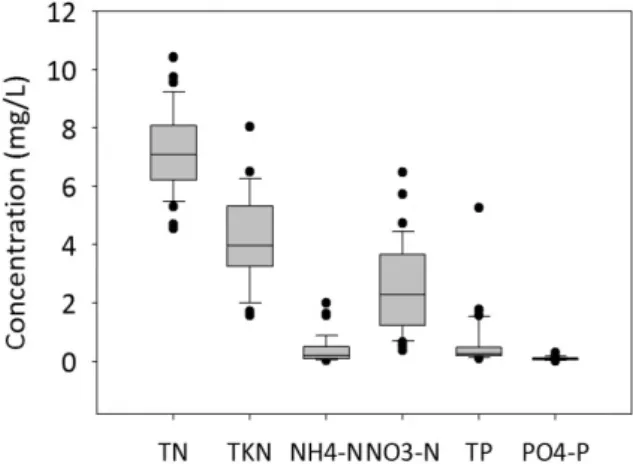
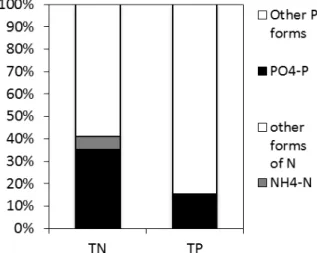
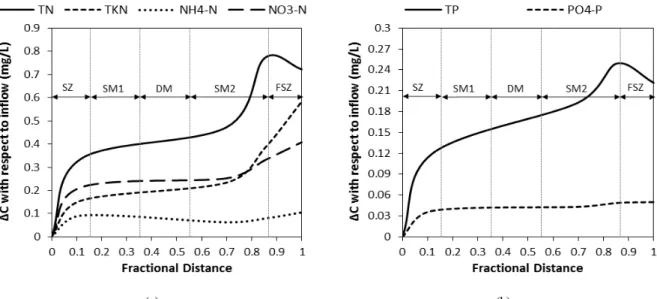
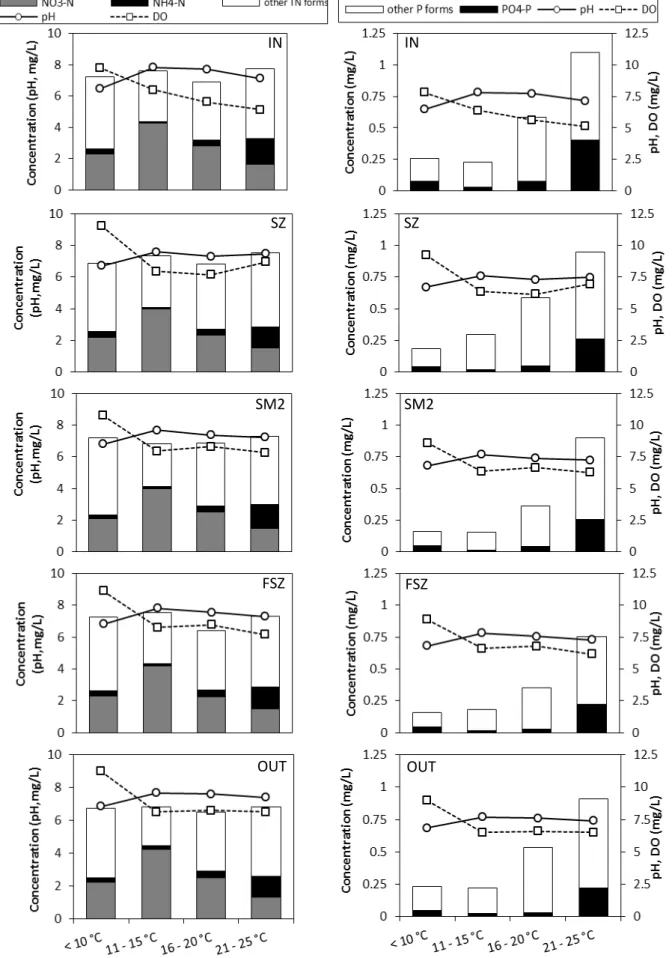
In this study, the nutrient concentration changes along the hydrologic flow path of a free water surface flow constructed wetland (CW) treating agricultural stream runoff was investigated. Dry sampling was performed from April 2009 to November 2011 at five locations representing each treatment units of the CW. Grab water samples were analyzed for nitrogen forms such as total nitrogen (TN), total Kjeldahl nitrogen, nitrate, and ammonium; and phosphorus forms including total phosphorus (TP) and phosphate. Findings revealed that the physical properties such as temperature, dissolved oxygen and pH affected the TP retention in the CW. High nutrient reduction was observed after passing the first sedimentation zone indicating the importance of settling process in the retention of nutrients. However, it was until the 85% of the length of the CW where nutrient retention was greatest indicating the deposition of nutrients at the alternating shallow and deep marshes. TN and TP concentration seemed to increase at the final sedimentation zone (FSZ) suggesting a possible nutrient source in this segment of the CW. It was therefore recommended to reduce or possibly remove the FSZ in the CW for an optimum performance, smaller spatial allocation and lesser construction expenses for similar systems.
Keywords : Constructed wetland; Wetland Design; Free water surface flow; Nutrient behavior
요 약농업지역의 소하천에 흐르는 하천수는 유역의 농업활동으로 유출된 각종 영양염류의 함량이 높아 호소 유입시 부영양화 의 원인이 된다. 본 연구에서는 농업지역의 하천수를 처리하기 위해 조성된 자유수면형 인공습지의 수문학적 유로에 따 른 영양염류의 농도를 평가하고자 수행되었다. 습지내 유로에 따른 영양염류의 농도를 평가하기 위한 모니터링은 2009년 4월부터 2011년 11월까지 습지내 유로의 5개 지점에서 수행되었다. 채취된 시료는 유로에 따른 수질변화를 분석하기 위 하여 질소와 인에 대한 집중적 분석이 수행되었다. 습지내 TP 저류의 원인을 평가한 결과 수온, DO 및 pH가 큰 영향을 끼치는 것으로 나타났다. 또한 습지내 유입수가 침강지를 통과한 직후 영양염류의 농도가 가장 크게 저감된 것으로 나타 났는데, 이는 많은 양의 영양소가 입자와 부착된 형태로 이동하기 때문인 것으로 판단되기에 향후 습지 설계시 침강지의 기능 증대 방안 도입이 중요한 인자인 것으로 평가된다. 그러나 습지내에서 가장 큰 영양염류 저감이 발생한 지점은 유 로의 85% 지점인 것으로 나타났다. 이는 습지내 미생물 및 식생흡입에 의한 영향으로 평가되기에 이를 활성화 하기 위한 얕은 습지 및 깊은 습지의 적절한 배치도 인공습지 설계에서 중요한 인자임을 보여주고 있다. 마지막 침전지 부분에서는 영양염류의 농도가 증가하는 것으로 나타났는데, 이는 길어진 체류시간에 의한 퇴적층으로부터 용출이 원인인 것으로 평 가되기에 습지설계시 침전지의 적정한 체류시간 확보가 중요한 것으로 나타났다.
핵심용어 : 농업지역, 영양염류, 자유수면형 인공 습지, 습지설계
+ Corresponding author: [email protected]
* 정회원, 공주대학교 건설환경공학부 석사과정, E-mail: jmrmercado @kongju.ac.kr
** 정회원, 공주대학교 건설환경공학부 박사후연구원, E-mail: [email protected]
*** 정회원, 공주대학교 건설환경공학부 교수, E-mail: [email protected]