Print ISSN: 2288-4637 / Online ISSN 2288-4645 doi:10.13106/jafeb.2020.vol7.no11.915
Social Media Adoption in SMEs Impacted by COVID-19: The TOE Model*
Mohamad Irhas EFFENDI 1 , Dyah SUGANDINI 2 , Yuni ISTANTO 3
Received: August 01, 2020 Revised: September 30, 2020 Accepted: October 15, 2020
Abstract
The purpose of the research is to analyze the behavioral intention to adopt social media in SMEs affected by the COVID-19 crisis, based on the TOE Model. This study uses the TOE framework as a theoretical basis. This research is important because COVID-19 has destroyed most of the SMEs, and SMEs are exposed to social media technology to market their products. The success of social media adoption has helped SMEs to be able to rise from adversity. Respondents in this study were 250 SMEs in the Special Region of Yogyakarta, Indonesia.
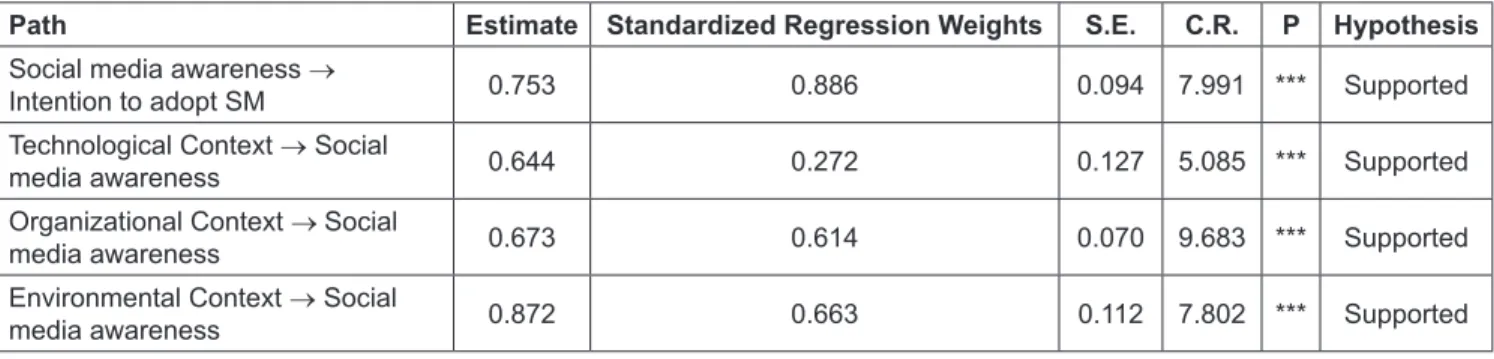
The data analysis technique used is structural equation modeling with AMOS. The results of this study indicate that SMEs affected by the COVID-19 crisis have a high awareness of social media and have a high intention to adopt social media as a way to market their products and connect with customers. The intention to adopt social media is significantly influenced by the technological context, organizational context, environmental context, and social media awareness. The findings of this study suggest that in times of crisis due to the COVID-19 pandemic, the Government support is needed. The Government needs to open services for SMEs whose businesses are affected by the pandemic.
Keywords: Behavior Intention, Technology, Organization, Environment JEL Classification Code: M31, M15, L20, O32
eventually disrupted the marketing process at a critical point.
SMEs are the most affected by the coronavirus pandemic.
The SME sector can no longer be a buffer for the economy as it was during the economic and financial crises of 1998 and 2008. When Indonesia experienced a monetary crisis in 1998, SMEs could still be a buffer for the national economy, absorbing the workforce, and moving the economy. In 2008 during the global financial crisis, SMEs remained strong in sustaining the economy. However, SMEs still could not withstand the crisis caused by COVID-19. The effects of the previous economic and financial crisis were more localized in specific sectors. COVID-19 has caused SMEs to become the most vulnerable sector of the economic crisis. The Jakarta Stock Exchange reported that the price of the Composite Stock Index (CSPI) experienced the worst decline in the last decade, reaching 5%. At the same time, the rupiah continues to weaken against the U.S. dollar.
The Ministry of Cooperatives and SMEs received complaints from 1,417 SMEs related to the COVID-19 impact since March 2020. This number will still increase in line with the personal reports of business actors, as well as based on the results of the provincial, district, and city government data collection. Of the interim figures, some constraints experienced by businesses during the pandemic accounted for 68% complaining of sales and falling demand;
1. Introduction
The Corona Virus Pandemic (COVID-19) has a significant impact on the small- and medium-sized enterprises (SME) in Indonesia. The increasingly massive corona outbreak
*Acknowledgements:
We would like to thank the Ministry of Research and Technology / Deputy of the National Research and Innovation Agency for strengthening research and development that has funded this research. This research was funded by the Higher Education Excellence Basic Research Grant / PDUPT in 2020.
1
First Author. Lecturer of Management Department, Economic and Business Faculty, Universitas Pembangunan Nasional Veteran Yogyakarta, Indonesia. Email: [email protected]
2
Corresponding Author. Lecturer of Management Department, Economic and Business Faculty, Universitas Pembangunan Nasional Veteran Yogyakarta, Indonesia [Postal Address: Jl.
SWK Jl. Ring Road Utara No.104, Ngropoh, Condongcatur, Kec.
Depok, Kabupaten Sleman, Daerah Istimewa, Yogyakarta 55283, Indonesia] Email: [email protected]
3