Vol. 23, No. 7, pp. 858-868, December 31, 2017, ISSN 1229-3431(Print) / ISSN 2287-3341(Online) https://doi.org/10.7837/kosomes.2017.23.7.858
1)
* First Author : [email protected], 051-620-5467 Corresponding Author : [email protected], 051-410-4293
A Study on the Improvement of Safety Training of Shipbuilding Industry by Analysis of Serious Accidents in Shipbuilding Industry
Jin-Woo Lee
*Cheol-Ho Han
**Young-Ho Lee
**** Offshore Training Team, Korea Institute of Maritime and Fisheries Technology, Busan 48562, Korea
** Jungbu Regional Office, Korea Occupational Safety and Health Agency, Incheon 21417, Korea
*** Department of Mechanical Engineering, Korea Maritime and Ocean University, Busan 49112, Korea
조선업 중대재해 분석을 통한 조선업 안전교육 개선에 관한 연구
이진우
*한철호
**이영호
***한국해양수산연수원 해양플랜트교육팀 한국산업안전보건공단 중부지역본부 한국해양대학교 기계공학과
* , ** , ***
Abstract : Korea’s shipbuilding industry has led the world in the technical area over the last century. Despite this commendable performance, around 2,000 workers experience accidents almost every year with 40 being killed. This raises a question of whether the safety level of our shipbuilding industry, in particular the safety of workers, is actually at the world-class level. Accordingly, this research has analyzed several types of safety training currently provided in the field through investigating statistical data of serious accidents occurring from 2006 to 2015 in the domestic shipbuilding industry, analyzing its occurrence and causes, and conducting a survey targeting employees in the shipbuilding industry. Based on this, it has investigated problems of safety training in the shipbuilding industry and suggested improvements. First, it is essential to create a standard system for safety training in the shipbuilding industry to address problems of different kinds and levels of safety training provided by each shipyard and low quality of training, and operate more organized and systemized training. Second, safety training curriculum specializing in the shipbuilding industry should continue to be developed and standardized based on a standard system for safe training to prevent serious accidents and improve safety awareness of workers. Lastly, both employers and employees should actively provide and participate in safety training to secure safety of workers through preventing serious accidents and ultimately create safety-first culture in workplace.
Key words : Serious accidents, Unsafe behavior, Unstable work environment, Objects which are direct cause of accidents, Safety training, Standard system of safety training
요 약 : 우리 조선업은 기술적인 분야에서 세계를 선도하는 역할을 수행하고 있으나 조선업에서는 매년 2,000여명의 재해자가 발생하 고 있으며 이중 약 명은 사망하고 있는 등 근로자의 안전측면에서도 과연 우리 조선업이 세계적인 수준인지는 의문이 들 수밖에 없다, 40 .
따라서 이 연구는 국내 조선업에서 2006 ~2015년 년 동안 발생한 중대재해의 통계자료를 고찰하여 조선업 중대재해의 발생현황 및 원인을
분석하고 조선업 근로자를 대상으로 설문조사를 실시하여 산업현장에서의 안전교육 형태를 분석하였으며 이를 바탕으로 조선업 안전교, ,
육의 문제점을 도출하여 개선방안을 마련하였다 첫째 조선소별로 수행하는 안전교육의 종류 및 수준이 상이하거나 교육품질이 미흡한 . ,
문제점을 해결하고 체계적으로 교육과정을 운영하기 위해서 조선업 안전훈련 표준체계의 마련이 필요하다 둘째 조선업 안전훈련 표준. ,
체계를 바탕으로 조선업에 특화된 안전교육과정을 지속적으로 개발하고 표준화하여 조선업 중대재해를 감소시키고 근로자의 안전의식을
향상시킬 필요가 있다 셋째 조선업에서의 중대재해를 예방하여 근로자의 안전을 확보하기 위해서는 사업주와 근로자 모두가 적극적으. ,
로 안전교육을 수행하고 참여하여 사업장의 안전문화를 형성할 필요가 있다.
핵심용어 : 중대재해 불안전한 행동 불안전한 상태 기인물 안전교육 안전훈련 표준체계 , , , , ,
1. Introduction
1.1 Background and objectives
Although the shipbuilding industry in Korea has recently been in a serious depression due to low international oil prices, rapid decrease of order for new ships influenced by the global economic slowdown, and order cancellation of offshore plants, the shipbuilding industry was one of the major driving forces behind the increase in foreign exchange reserve and growth of exports during the late 1990s (Kim, 2008) and is still considered as one of the leading shipbuilding market in the world. As of 2015, however, the number of accident victims and accident rates hit a record high with 1,940 (death toll of 31) out of 233,730 employees working in 8,438 workplace in the shipbuilding industry, and 0.83 % respectively, 1.7 times the entire industries (0.50 %) and 1.3 times the manufacturing industry (0.65 %). It can be translated that it is doubtful whether safety for employees is at the world class level – as much as our technology is. Accident can be defined as injury and death occurring uncontrollably and unexpectably just like injuries to humans or its possibilities by action and reaction of objects, materials and humans (Han, 2007), which seriously affects not only employees but companies (Kim, 2014). Taking a close look at estimates of domestic economic loss caused by industrial accidents, it continuously rose up to around 20 trillion KRW in 2015 from about 15 trillion KRW in 2006, which was almost equal to economic profits able to be gained from sales of 400 trillion KRW by putting net profit ratio of domestic companies as approximately 5 %. With that said, since industrial accidents can bring about a loss of life and productivity as well as properties, prevention of the accidents should be understood to raise not only safety of employees but management stability and economic profits, which means it is necessary to create an organized and scientific system for preparing for appropriate actions and measures to prevent the accidents. Accidents can occur by several reasons including technical issues, education-related problems, work control, unstable conditions and unsafe behaviors, but it has been known that 20 to 90 % of the accidents depending on characteristics of each industry are from mistakes by employees (Lee, 2010). For accident prevention, it is important to take technical measures dealing with physically or mechanically inappropriate environment, or regulatory measures to be implemented institutionally as control, supervision or management matters, but since most accidents are caused by unsafe behaviors of employees, educational measures preventing accidents through safety education and training to help the workers have appropriate knowledge or functions can be more
efficient for accident prevention, which can be helpful or considering various elements including employees, machinery, work and management. Accordingly, this research explores status of safety training provided in the shipbuilding industry based on statistical analysis and a survey of serious accidents1) in the industry, analyzes problems discovered, and ultimately suggests improvements.
1.2 Research methodology
This research has analyzed safety training in industrial sites through investigating statistical data of serious accidents occurring from 2006 to 2015 in the domestic shipbuilding industry, analyzing its status of occurrence and causes, and conducting a survey targeting employees in the shipbuilding industry, and based on this, eventually suggested improvements by drawing problems of safety training.
2. Status and analysis of serious accidents in the shipbuilding industry
In this chapter, the cases of serious accidents reported to the Korea Occupational Safety & Health Agency (KOSHA) from 2006 to 2015 were analyzed by referring to the KOSHA guide G-83-2016 (Guidance on the recording and classification of industrial accidents) to identify types, physical- and human-related causes and objects which are direct cause of accidents of serious accidents.
2.1 Status of occurrence of serious accidents by year Fig. 1 shows rates of death in industrial accidents in the shipbuilding industry by year, which has continuously decreased from 4.05 (1.9 times the entire industries of 2.10, 2.0 times the manufacturing industry of 2.02) in 2006 to 1.33 (1.3 times the entire industries of 1.01, 1.3 times in the manufacturing industry of 1.03) in 2015. Overall, accidents causing death in the shipbuilding industry has steadily fallen but as of 2015, the death toll was 31 (the 10-year average number of 44), which means many have still died in the field. The average annual number of 44 death toll in the shipbuilding industry accounts for 8.1 % out of 544, the annual 1) Serious accidents refers to industrial accidents of a serious degree such as death, and which are prescribed by Ordinance of the Ministry of Employment and Labor; 1. accidents involving loss of life, 2. accidents that caused more than two injured persons who need medical care for 3 months or more at the same time, 3. accidents that caused more than 10 people injured or occupationally ill at the same time (Occupational Safety and Health Act Article 2).
average death toll in the entire industries, which tells it is urgent to prepare for measures for securing safety for the workers.
Fig. 1. Comparison of rates of death in industrial accidents in the shipbuilding industry by year (Source : Status and analysis of overall accidents from 2006 to 2015, Statistics Korea).
2.2 Cause analysis of serious accidents in the shipbuilding industry
1) Types of serious accidents
In total, 299 serious accidents which had occurred from 2006 to 2015 can be classified into 9 types as shown in Fig. 2; fall (33.4 %), narrowness·trap (13.7 %), clash·contact (11.7 %), falling·flying objects (11.7 %), fire·explosion (11.0 %), rollover·upset (9.7 %), electric shock (2.7 %), suffocation (2.0 %), and others (4.0 %) in order. As considering features of the shipbuilding industry, since it often handles various sizes and weights of heavy cargo to manufacture large-scale vessels and structures, and performs aerial work, there are more accidents involving fall, narrowness and clash as well as fire · explosion while welding work is carried out.
Fig. 2. Causes of serious accidents in the shipbuilding industry (Source : Korea Occupational Safety & Health Agency).
2) Physical- and human-related causes Unstable work environment
Fig. 3 shows the number of occurrence of serious accidents by unstable work environment, which is in the order of frequency i.e., inappropriate protection management (29.4 %), inappropriate work process and procedure (20.1 %), faulty objects and equipment (17.4 %), danger of objects, machinery and equipment in handling (14.0 %), poor or dangerous space including working passage (14.0 %), inappropriate working environment (1.7 %), protection devices not provided (1.3 %), others (1.3 %), and other risk factors inherent in work itself (0.7 %).
Fig. 3. Status of serious accidents in the shipbuilding industry by unstable work environment (Source : Korea Occupational Safety & Health Agency).
Unsafe behaviors
Fig. 4 displays the number of occurrence of serious accidents by unsafe behavior, which is neglection or uncheck of danger such as neglected structure (24.7 %), carelessness in work performance and failure in compliance of procedure (24.1 %), inappropriate application·management of equipment·machinery (21.4 %), inadequate use of clothes and protective devices (18.7 %), negligence during performance of work (8.0 %), reckless or unnecessary behaviors and actions (2.3 %), and unstable working posture (0.3 %) in order.
Features of unstable conditions and unsafe behaviors about serious accidents in the shipbuilding industry can be explained as follows.
First, the most serious reasons causing accidents are lack of protection management including non-installation of safety handrail, non-shutdown of opening, and non-access to hazard areas except qualified operators.
Second, some accidents are caused by inappropriate work process·procedure such as non-recording of work permits while carrying out hazardous works including dealing with heavy cargo
or performing works in enclosed space mostly done for building large-scale structure like vessels·offshore plants.
Third, some cases are related to designs able to cause confusion to workers such as no accurate distinction in a connecting device of a manifold supplying oxygen and air.
Forth, despite work procedure prepared for dangerous works noncompliance with work procedure including no enough inspection of gas or ventilation before entry into enclosed space, causes accidents.
Fig. 4. Status of serious accidents in the shipbuilding industry by unsafe behavior (Source : Korea Occupational Safety &
Health Agency).
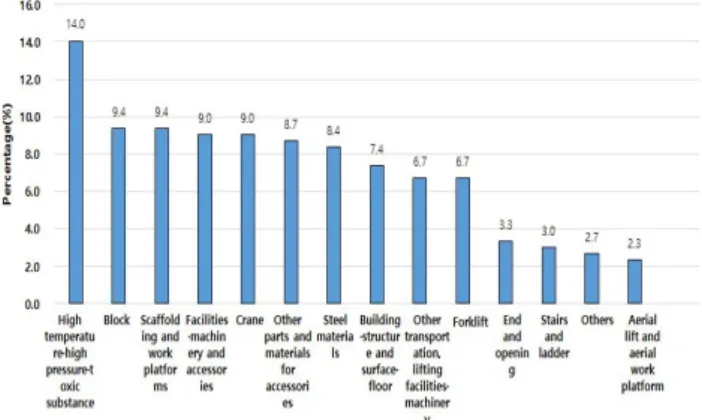
2.3 Analysis of objects which are direct cause of accidents Fig. 5 shows status of serious accidents in the shipbuilding industry by object, direct cause of accidents.
Fig. 5. Status of objects which are direct cause of accidents for serious accidents in the shipbuilding industry (Source : Korea Occupational Safety & Health Agency).
It is in the order of a high frequency, caused by high temperature·high pressure·toxic substance (14.0 %), block (9.4 %), scaffolding and work platforms (9.4 %), facilities·machinery and
accessories (9.0 %), cranes (9.0 %), other parts and materials for accessories (8.7 %), steel materials (8.4 %), building·structure and surface·floor (7.4 %), other transportation, lifting facilities·machinery (6.7 %), forklift (6.7 %), end and opening (3.3 %), stairs and ladder (3.0 %), others (2.7 %), and aerial lift and aerial work platform (2.3 %). There have been many serious accidents caused by ship block as considering the shipbuilding industry where large-scale vessels and maritime structures are manufactured and assembled in a block unit. Moreover, some are caused by a crane, equipment for transferring those heavy cargos. In addition, as aerial works progress to assemble large-scale structures, accidents have steadily occurred in scaffolding, work platforms and aerial work platforms.
2.4 Analysis of objects which are direct cause of accidents by accident type
Table 1 describes status of objects which are direct cause of accidents for accidents in the shipbuilding industry by accident type.
Major objects which are direct cause of accidents for fall accident are scaffolding and work platforms (23.0 %), building·structure and surface·floor (17 %), crane (13.0 %), block (10.0 %), end and opening (9.0 %), stairs and ladder (7.0 %), and when it comes to main original cause materials for narrowness·trap accidents, there are crane (19.5 %), other transportation, lifting facilities·machinery (19.5 %), facilities·machinery and accessories (17.1 %), block (12.2 %), steel materials (12.2 %), forklift (7.3 %), and aerial lift and aerial work platform (7.3 %). For original cause materials for falling·flying objects-involving accidents, there are other parts and materials for accessories (28.6 %), steel materials (17.1 %), facilities·machinery and accessories (14.3 %), crane (11.4 %), block (11.4 %), and other transportation, lifting facilities·machinery (5.7 %), and when it comes to original cause materials in clash·contact-involving accidents, there are forklift (37.1 %), other transportation, lifting facilities·machinery (25.7 %), equipment·machine and accessories (11.4 %), and aerial lift and aerial work platform (8.6 %). Lastly, for original cause materials in fire·explosion-involving accidents, high temperature·high pressure·toxic substance (87.9 %) and other parts and materials for accessories (9.1 %) can be mentioned, in regard of original cause materials for rollover·upset-involving accidents, there are steel materials (31.0 %), block (24.1 %) and other parts and materials for accessories (13.8 %), and in respect to objects which are direct cause of accidents for other accidents, high temperature·high pressure·toxic substance (46.2 %), scaffolding and work platforms (11.5 %), facilities·machinery and accessories (11.5 %), other parts and materials for accessories (11.5 %), and others (11.5 %) are described.
Fall Narro wness
Trap·
Falling objects
· Flying object
Clash Conta·
ct
Fire · Explo
sion Rollo ver · Upset
Others*
High temperat ure·high press ure·toxic subst ance
0 0 0 1 29 0 12
Block 10 5 4 2 0 7 0
Scaffolding &
work platforms 23 0 0 0 0 2 3
Facilities·mach inery and acce ssories
7 7 5 4 1 0 3
Crane 13 8 4 1 0 1 0
Other parts·ma terials for acc essories
5 1 10 0 3 4 3
Steel materials 3 5 6 1 0 9 1
Building·struct ure and surfac e ·floor
17 0 1 0 0 3 1
Other transport ation, lifting f acilities·machi nery
1 8 2 9 0 0 0
Forklift 2 3 0 13 0 2 0
End & opening 9 0 1 0 0 0 0
Stairs & ladder 7 1 0 0 0 1 0
Others 3 0 1 1 0 0 3
Aerial lift and aerial work pl atform
0 3 1 3 0 0 0
Sum 100 41 35 35 33 29 26
* Others: suffocation·electric shock·compound·collapse Source : Korea Occupational Safety & Health Agency
Table 1. Objects which are direct cause of accidents by accident type (Unit : Case)
3. Status and analysis of safety training in the shipbuilding industry
3.1 Purposes and objectives
The survey was conducted by visiting large-size shipyards (Hyundai Heavy Industries, Daewoo Shipbuilding & Marine Engineering, Samsung Heavy Industries) and targeting shipbuilding industry workers participating in basic offshore safety induction &
emergency training provided by Korea Institute of Maritime and Fisheries Technology to understand status of safety training being offered in the shipbuilding industry and level of safety awareness of employees, investigate related issues, and prepare for improvements.
The total of 155 valid questionnaires were used for analysis. The survey was analyzed by employing IBM SPSS Statistics 21 program. General status and actual situations were investigated through applying frequency analysis, and differences in practicing rates of safety training were analyzed by employing T-test, mean difference analysis and ANOVA test. The empirical analysis was verified with p<.05 of significance level.
3.2 Descriptive statistics
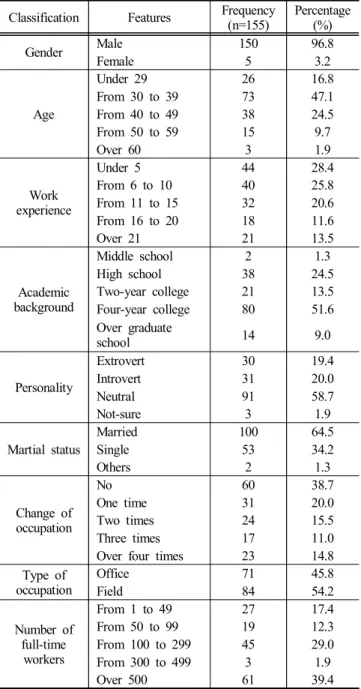
Table 2 shows descriptive statistics of employees in the shipbuilding industry who participated in the survey.
Classification Features Frequency
(n=155) Percentage (%)
Gender Male 150 96.8
Female 5 3.2
Age
Under 29 26 16.8
From 30 to 39 73 47.1
From 40 to 49 38 24.5
From 50 to 59 15 9.7
Over 60 3 1.9
Work experience
Under 5 44 28.4
From 6 to 10 40 25.8
From 11 to 15 32 20.6
From 16 to 20 18 11.6
Over 21 21 13.5
Academic background
Middle school 2 1.3
High school 38 24.5
Two-year college 21 13.5
Four-year college 80 51.6
Over graduate
school 14 9.0
Personality
Extrovert 30 19.4
Introvert 31 20.0
Neutral 91 58.7
Not-sure 3 1.9
Martial status
Married 100 64.5
Single 53 34.2
Others 2 1.3
Change of occupation
No 60 38.7
One time 31 20.0
Two times 24 15.5
Three times 17 11.0
Over four times 23 14.8
Type of occupation
Office 71 45.8
Field 84 54.2
Number of full-time
workers
From 1 to 49 27 17.4
From 50 to 99 19 12.3
From 100 to 299 45 29.0
From 300 to 499 3 1.9
Over 500 61 39.4
Table 2. Descriptive statistics including demographic analysis
Taking a look at change of occupation, 60 (38.7 %) answered the current job is their first one, 31 (20.0 %) one time, 24 (15.5 %) two times, 17 (11.0 %) three times and 23 (14.8 %) over four times.
When it comes to type of occupation, the number of participants working in office and field is 71 (45.8 %) and 84 (54.2 %) each.
Lastly, for the number of full-time workers, 27 (17.4 %) answered they are from a company whose number of full-time employees ranges from 1 to 49, 19 (12.3 %) from 50 to 99, 45 (29.0 %) from 100 to 299, 3 (1.9 %) from 300 to 499, and 61 (39.4 %) over 500.
3.3 Status of safety training provided in the shipbuilding industry
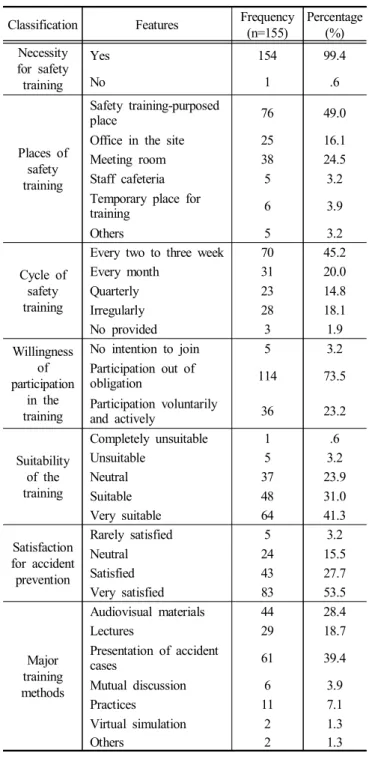
Table 3 describes status of training provided for employees in the shipbuilding industry. Taking a look at the status of training offered for employees in the shipbuilding industry, 154 (99.4 %) workers except 1 (0.6 %) mentioned it is essential to offer safety training in the field. When it comes to places of safety training, it has appeared that 76 (49.0 %) have been trained in a safety training-purposed place, 25 (16.1 %) in the site office, 38 (24.5 %) in a meeting room, 5 (3.2 %) in a staff cafeteria, 6 (3.9 %) in a temporary place for training, and 5 (3.2 %) in others. In regard of training cycle, 70 (45.2 %), 31 (20.0 %), 23 (14.8 %), 28 (18.1 %), and 3 (1.9 %) get training every two to three weeks, every month, quarterly, irregularly, and never. In willingness of joining the training, the number of workers answering participation out of obligation, voluntarily and actively, and no intention to join as much as possible accounts for 114 (73.5 %), 36 (23.2 %), and 5 (3.2 %) in order of a high frequency respectively, which means most employees seem to take the training passively. In suitability of the training to each work, 64 (41.3 %) responded very suitable, 48 (31.0 %) suitable, 37 (23.9 %) neutral, 5 (3.2 %) unsuitable, and 1 (0.6 %) completely unsuitable in order. When it comes to the satisfaction of safety training for accident prevention, 83 (53.5 %) answered very satisfied, 43 (27.7 %) satisfied, 24 (15.5 %) neutral, and 5 (3.2 %) rarely satisfied in order. For training methods usually provided in the field, 61 (39.4 %) are trained through presentation of accident cases, 44 (28.4 %) through audiovisual materials, 29 (18.7 %) through lectures, 11 (7.1 %) through practices, 6 (3.9 %) through mutual discussion, 2 (1.3 %) through virtual simulation, and 2 (1.3 %) through other materials in order, which shows presentation of accident cases, lectures and audiovisual materials take a big part of the training in the field since those can conveniently be given at the lecture room rather than practices.
Classification Features Frequency
(n=155)
Percentage (%) Necessity
for safety training
Yes 154 99.4
No 1 .6
Places of safety training
Safety training-purposed
place 76 49.0
Office in the site 25 16.1
Meeting room 38 24.5
Staff cafeteria 5 3.2
Temporary place for
training 6 3.9
Others 5 3.2
Cycle of safety training
Every two to three week 70 45.2
Every month 31 20.0
Quarterly 23 14.8
Irregularly 28 18.1
No provided 3 1.9
Willingness of participation
in the training
No intention to join 5 3.2
Participation out of
obligation 114 73.5
Participation voluntarily
and actively 36 23.2
Suitability of the training
Completely unsuitable 1 .6
Unsuitable 5 3.2
Neutral 37 23.9
Suitable 48 31.0
Very suitable 64 41.3
Satisfaction for accident prevention
Rarely satisfied 5 3.2
Neutral 24 15.5
Satisfied 43 27.7
Very satisfied 83 53.5
Major training methods
Audiovisual materials 44 28.4
Lectures 29 18.7
Presentation of accident
cases 61 39.4
Mutual discussion 6 3.9
Practices 11 7.1
Virtual simulation 2 1.3
Others 2 1.3
Table 3. Status of training provided for employees in the shipbuilding industry
Table 4 displays the results of the survey regarding how to improve the safety training. First, for the cycle to provide the safety training, 68 employees (43.9 %) have responded the most efficient cycle is once a week, 39 (25.2 %) once a month, 27 (17.4 %) twice a month, 11 (7.1 %) twice a week, 5 (3.2 %) everyday, and 5 (3.2 %) others in order. For the most efficient training methods
they would like to have, 52 (33.5 %) answered practices, 40 (25.8 %) presentation of accident cases, 23 (14.8 %) audiovisual materials, 15 (9.7 %) others, 11 (7.1 %) virtual simulation, 7 (4.5 %) mutual discussion, 6 (3.9 %) lectures, and 1 (0.6 %) role plays in order.
Lastly, to the question about what factor is important to improve effectiveness of the training, the number of 76 (49.0 %) checked introduction of training methods with a high immersion level, 22 (14.2 %) attraction of participants to join voluntarily, 16 (10. 3%) improvement of training contents, and 12 (7.7 %) offer of incentives for completion of the training in order of a high frequency.
Classification Features (n=155) Frequency Percentage (%)
Cycle of safety training
Everyday 5 3.2
Twice a week 11 7.1
Once a week 68 43.9
Twice a month 27 17.4
Once a month 39 25.2
Others 5 3.2
Efficient training methods
Audiovisual materials 23 14.8
Lectures 6 3.9
Presentation of accident cases 40 25.8
Role play 1 .6
Mutual discussion 7 4.5
practices 52 33.5
Virtual simulation 11 7.1
Others 15 9.7
The most important factor to improve effectiveness
of the training
Improvement of training
contents 16 10.3
Increase in time of training 1 .6 Increase in frequency of
training 2 1.3
Introduction of training methods with a high immersion level
76 49.0
Reduction of the number of
participants 3 1.9
Support for expense of training 5 3.2 Attraction of participants to
join voluntarily 22 14.2
Offer of incentives for
completion of the training 12 7.7 Preparation for training room
with pleasant environment 2 1.3
Securing qualified lecturers 5 3.2
Others 11 7.1
Table 4. Result of survey on how to improve the safety training
3.4 Rates of putting safety training contents into practice In order to examine differences in practicing rates of safety
training depending on features of the workers, the survey was analyzed by employing ANOVA test. Age, working experience, academic background, personality, martial status and awareness if safety were set as independent variable and rates of employees’
applying safety training into practice was set as dependent variable.
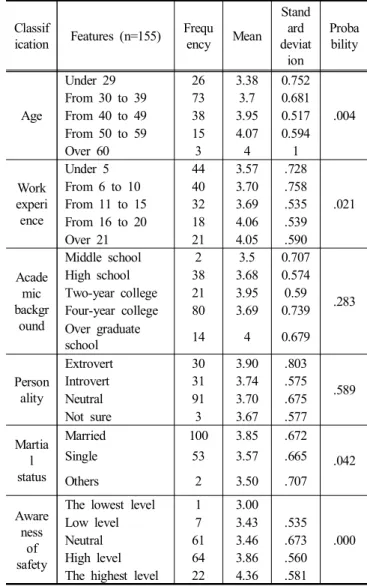
Table 5 describes rates of employees’ applying safety training into practice depending on features of the workers.
Classif
ication Features (n=155) Frequ ency Mean
Stand ard deviat
ion
Proba bility
Age
Under 29 26 3.38 0.752
.004
From 30 to 39 73 3.7 0.681
From 40 to 49 38 3.95 0.517
From 50 to 59 15 4.07 0.594
Over 60 3 4 1
Work experi ence
Under 5 44 3.57 .728
.021
From 6 to 10 40 3.70 .758
From 11 to 15 32 3.69 .535
From 16 to 20 18 4.06 .539
Over 21 21 4.05 .590
Acade mic backgr
ound
Middle school 2 3.5 0.707
.283
High school 38 3.68 0.574
Two-year college 21 3.95 0.59
Four-year college 80 3.69 0.739 Over graduate
school 14 4 0.679
Person ality
Extrovert 30 3.90 .803
Introvert 31 3.74 .575 .589
Neutral 91 3.70 .675
Not sure 3 3.67 .577
Martia l status
Married 100 3.85 .672
Single 53 3.57 .665 .042
Others 2 3.50 .707
Aware ness
of safety
The lowest level 1 3.00
.000
Low level 7 3.43 .535
Neutral 61 3.46 .673
High level 64 3.86 .560
The highest level 22 4.36 .581 Table 5. Application rate of safety training into practice
It has been revealed that there is a significant difference (p<.004) in rates of workers’ applying safety training into practice by age, and in particular, the rate has appeared higher in participants in over 40 than that between 20 and 30. When it comes to the rate depending on the period of work experience, there has been a significant difference (p<.021) as appearing the highest for the participants whose work experience is 16 to 20
years and the lowest for participants whose work experience is under 5. However, there has been no significant difference in the relation between academic background and the rate (p<.283), and with personality neither (p<.589). In addition, the rate displayed a significant difference (p<.042) depending on martial status, as appearing that the rate in the married workers was relatively higher than that in single workers. Lastly, there has been a significant difference (p<.000) in the rate depending on the level of safety awareness of workers. It can be translated that the more the employees are aware of safety, the higher the rate of their putting the safety training into practice, which means it is crucial to improve the safety consciousness for enhancing effectiveness of safety training.
4. Problems and improvements in the shipbuilding industry
4.1 Problems investigated from accident- and empirical- analysis in the shipbuilding industry
Around 2,000 accident victims and 40 deaths in the annual average are from the shipbuilding industry from 2006 to 2015.
Particularly, the accident in the industry accounts for around 2 % in entire accidents and about 8 % out of average death toll in the manufacturing industry, which means it is urgent to prepare for measures to secure safety of the employees.
According to statistical analysis of serious accidents in the shipbuilding industry, the most common accidents are fall from aerial works, narrowness·clash·falling objects caused by handling heavy cargo, and fire·explosion·suffocation from work at dangerous areas, and for unsafe behaviors of employees, there are failure in compliance of work procedure, neglection of danger, inappropriate application·management of equipment·machinery, and inadequate use of protective devices. In other words, since fall-involving accidents account for over 30 % out of entire accidents in the shipbuilding industry, it is the most urgent to prepare for actions to tackle the issue, and then for works of handling heavy cargo and works in dangerous places. Moreover, it is also necessary to come up with plans for enhancing safety awareness of employees because their unsafe behaviors causing accidents are mostly from absence of safety awareness or negligence on safety.
According to analysis of objects which are direct cause of accidents for serious accidents in the shipbuilding industry, there are many accidents arising from high temperature, high pressure, toxic substance, block, scaffolding and work platforms, and a
crane. Taking a look at major objects which are direct cause of accidents by accident type the most often occurring in the shipbuilding industry, for fall-involving accidents, scaffolding and work platforms are related to approximately 23 % of the entire fall-involving accidents, for narrowness·trap in handing heavy cargo, a crane, around 20 %, and for fire·explosion and suffocation caused by work at dangerous areas, high temperature·high pressure·toxic substance, about 87 % and 46 % respectively.
Therefore, it is crucial to take safety measures for scaffolding works, crane-applying works, works by handling heavy cargo, and works at dangerous places related to major original cause materials in each accident to lower accidents frequently occurring in the shipbuilding industry.
As a result of analysis of the survey targeting workers in the shipbuilding industry, it has been revealed that most employees have participated in the safety training obligatorily rather than voluntarily, and the training in the field is usually provided through lectures or audiovisual materials than practices workers actually want to have, which means it is hard to arouse workers’
interest in the training. Moreover, it is also essential to prepare for measures for operating the training more systematically and efficiently as considering around 20 % of workers participating the survey has answered safety training in their company or field is given irregularly or not provided at all.
4.2 Improvements
1) Preparation for a standard system of safety training of the shipbuilding industry
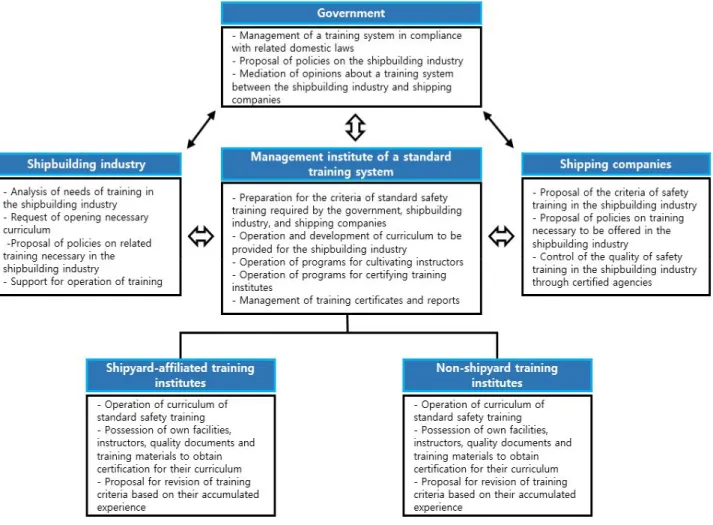
According to the results of the survey on status of training provided for employees in the shipbuilding industry, safety training currently provided as lectures or audiovisual materials in the field mostly ends up as one-off education just to meet legal requirements, which does not have practical effects for preventing accidents in the shipbuilding industry. In addition, that the training is given differently by type and level depending on shipyards and its quality is quite low is also part of problems. To address those issues and operate systematic curriculum, it is necessary to understand characteristics of the shipbuilding industry and educational contents required by the industry, establish a system for providing and evaluating the training by professionals, and manage training records and certificates of trainees by certified institutes. In other words, it is significant to create a standard system for safety training in the shipbuilding industry based on mutual cooperation between the government, the shipbuilding
industry, shipping companies and training institutes, and make the training institutes as a single system. In this sense, a management and supervision organization needs to be designated (established) to approve, operate and manage the curriculum, and it should have credibility to mediate between needs and interests of shipping companies, the shipbuilding industry, and the government as well as be qualified with specialized knowledge in the training area.
Fig. 6 describes a standard system for safety training in the shipbuilding industry.
2) Standardization of safety training curriculum of the shipbuilding industry
As mentioned earlier, the death toll of 44 on average is from serious accidents in the shipbuilding industry, including fall (34.2 %), narrowness (13.8 %), fire·explosion (13.3 %), falling·flying objects (10.8 %), crash·contact (10.4 %), rollover·upset (8.8 %), suffocation (3.3 %), electric shock (1.7 %), and others (3.8 %).
The occurrence of those serious accidents, with unstable conditions, are growing by unsafe behaviors, and the representative unstable situations in the shipbuilding industry are inappropriate protection management such as safety handrail, no recording of work reports, and poor repair (condition) of machinery·facilities, and the representative unstable behaviors of workers are noncompliance of work procedure planned, use of inappropriate equipment, cancellation of safety devices of machinery·facilities by force, and no protective devices put. These unstable conditions and unsafe behaviors can be reduced through improving awareness of safety of workers through training. Accordingly, based on the standard system for the safety training mentioned earlier, safety curriculum specializing in the shipbuilding industry needs to be continuously developed and standardized, and the curriculum to be primarily standardized based on statistics of the serious accidents in the shipbuilding industry can be suggested as follows.
First, safety training for aerial work: Fall-involving accidents
Fig. 6. Organization of a standard system for safety training in the shipbuilding industry.
account for around 34 % of the entire accidents in the shipbuilding industry and most death toll is from the accident, which means it is urgent to prepare for actions to reduce the accidents. Therefore, the safety training on aerial work needs to be standardized with matters to be required and safety measures during performance of aerial work.
Second, safety training for scaffolding work: As protection management including safety handrail is necessary to prevent fall-involving accidents, scaffold is installed to protect work places and workers in the field. However, fall accidents occur with quite high frequency because scaffold is installed·dismantled wrong.
Therefore, it is necessary to offer curriculum on how to install and dismantle the scaffold.
Third, safety training for crane-employing work: Considering heavy cargo is often dealt with in the shipbuilding industry and in most cases, a crane is used for handling the cargo, many accidents are caused by crane. Most crane-related accidents are caused by cancellation of safety devices of a crane by force, operation by unskilled workers, and noncompliance with work procedure, so curriculum on safety procedure and right operation of crane needs to be prepared.
Forth, safety training for rigging work: When heavy cargo is lifted through using lifting equipment in the shipbuilding industry, the cargo should be secured by using a rigging tool. However, there are accidents often occurring by fractured rigging tools or lifted cargo’s dropping from the tool because of wrong selection of rigging tool and methods of securing the cargo, and being narrowed to falling freight due to wrong selection of location of signals (Lee et al., 2016). Accordingly, curriculum containing selection of rigging tools, handling and operation of cargo, and signal methods and safety regulations needs to be developed.
Fifth, safety training for work at enclosed space: There are continuing accidents occurring due to human factors such as cases of explosion·fire and choking accidents, work at enclosed space without its recognition, and work at enclosed space not by following safety instructions.
Therefore, it is crucial to provide training about features and riskiness of enclosed space, safe work procedure, and response procedure in case of emergency.
Sixth, training about work permission: There are various kinds of hazardous works including aerial works, work with lifting equipment, work with fire and work in enclosed space in the shipbuilding industry, but there is no appropriate issuing procedure training of work permission required for managing those harmful
and dangerous factors, which sometimes ends up with accidents.
Thus, training containing procedure of drawing and issuing work permission for risky works should be ready.
3) Creation of safety-first culture in workplace
As mentioned beforehand, industrial accidents have a serious influence on not only employees but companies. According to the results of the survey on rates of employees’ applying safety training into practice depending on features of the workers, the more the employees are aware of safety, the higher the rate of their applying the safety training into practice. Accordingly, it is crucial to make workers have knowledge, awareness and capabilities on keeping safety through developing·providing curriculum depending on characteristics of the shipbuilding industry and types of workers, and reminding contents of safety by re-(supplement) training to prevent serious accidents in the shipbuilding industry. Moreover, employers and employees should actively participate in safety training and create safety-first culture in workplace with consciousness that safety is a divine right and basic conditions for happy life workers can deserve.
5. Conclusion
The Korea’s shipbuilding industry has led the world in technical area, but around 2,000 workers experience accidents every year, and 40 out of the number is dead. It raises a question of whether our shipbuilding industry, when it comes to safety of workers, is actually in the world-class level. Accordingly, there are preceding studies (Kim et al., 2003; Shim, 2009; Seo, 2015) emphasizing the necessity of accident prevention by proposing enhancement of occupational safety and health training as a way to prevent accidents in the shipbuilding industry and multiple types of training methodologies. However, there seem not enough studies on what the most necessary curriculum is, and how a safety training system should be organized to provide·manage training more efficiently and make the quality of training consistent in the entire shipbuilding industry.
In this sense, this research analyzed occurrence and causes of serious accidents through conducting statistical analysis and literature review about serious accidents in the domestic shipbuilding industry, and methods of safety training provided in the field through the survey targeting workers in the shipbuilding industry. Based on this, problems about the safety training have been investigated and improvements can be suggested as follows.
First, safety training provided in the field mainly through audiovisual materials and lectures mostly ends up with one-off training just to satisfy the legal requirements, which has not shown much effectiveness enough to prevent accidents. In addition, kinds and levels of the training are offered differently by shipyard, and its quality is relatively low. Therefore, it is essential to prepare for a standard system for safety training in the shipbuilding industry to address those problems and provide systematic curriculum.
Second, serious accidents in the shipbuilding industry, based on unstable conditions, have been rising as the cause of unsafe behaviors of workers are growing, which can be reduced by improving safety awareness of the employees through the training.
Accordingly, safety training curriculum specializing in the shipbuilding industry continues to be developed and standardized based on a standard system of safe training in the shipbuilding industry mentioned earlier.
Lastly, both employers and employees should actively provide and participate in safety training to secure safety of workers through preventing serious accidents, which ultimately leads to create safe-first culture in workplace.
References
[1] Han, G. W.(2007), Industrial Safety and Health Practice, p.49.
[2] Kim, C. Y., M. J. Jeon and D. H. Byun(2003), Five-year Industrial Accidents of Ship-building Workers at a Ship-Yard, Annals of Occupational and Environmental Medicine, Vol. 15, No. 4, pp. 436-445.
[3] Kim, J. H.(2008), A Study of World Championship of Korean Shipbuilding Industry, The Journal of the Korean Political Science Society, Vol. 16(1), pp. 251-252.
[4] Kim, J. G.(2014), Loss of Lives caused by Ship Accidents and Corporate Criminal Liability, Journal of the Korean Society of Marine Environment & Safety, Vol. 20, No. 6, pp.
721-729.
[5] Lee, J. W., C. H. Han, Y. J. Woo, J. H. Lee and C. H.
Lee(2016), A Study on the Development of Rigging and Slinging Course for Seafarers, The Journal of Fisheries and Marine Sciences Education, Vol. 28(6), pp. 1561-1572.
[6] Lee, Y. H.(2010), A Revisit to the Human Errors in the Industrial Accidents : Is it Cause or Consequence?, The Spring Conference of the Ergonomics Society of Korea, p. 7.
[7] Seo, S. J.(2015), An Analysis of Safety Consciousness of Shipyard Subcontractors for Improving Safety & Health
Education, Pukyoung National University Graduate School, pp. 22-39.
[8] Shim, J. H.(2009), The Effects of Simulative Safety Training for Novice Employees, Mokpo National University Graduate School, pp. 80-82.
Received : 2017. 09. 18.
Revised : 2017. 11. 13. (1st) : 2017. 12. 07. (2nd) Accepted : 2017. 12. 28.