• 검색 결과가 없습니다.

Research on Disney's 3D Animation <Wreck-It Ralph>'s Style, Layout Pipeline, and Camer a Capture System

N/A
N/A
Protected

Academic year: 2021

Share "Research on Disney's 3D Animation <Wreck-It Ralph>'s Style, Layout Pipeline, and Camer a Capture System"

Copied!
9
0
0

로드 중.... (전체 텍스트 보기)

전체 글

(1)

Research on Disney's 3D Animation <Wreck-It Ralph>'s Style, Layout Pipeline, and Camera Capture System

Jiwon Paik

, Cheeyong Kim

††

ABSTRACT

Disney Animation has showed not only artistic excellence but also technological innovations through a lot of animation films that they released. Especially with the unique concept that free-willed game characters dive into different worlds of games in animation film, <Wreck-It Ralph> received both critical and commercial acclaim for its stunning visuals and outstanding CG (computer graphics) effects. The purpose of this study is to analyze different styles of game worlds, Disney's layout pipeline, and in-house camera capture system used in <Wreck-It Ralph>. This paper analyzes that three game worlds in this film such as Fix-It Felix Jr., Sugar Rush, and Hero's Duty express different styles by using appropriate character animation and camera movements. Especially Hero's Duty game which new in-house camera capture system is extensively used maximizes unseen visuals by perfectly making realistic and believable game world. Disney's newly developed in-house camera capture system, which is used in this film for the first time, allows real camera's motion and shake and real-time camera's movement and correction within animation set. Result of this study proves that this system improves directing of feature animation and enhance efficiency of the layout department's production process. Therefore, it contributes to a great extent to development of animation films‘ business.

Key words: Disney, Camera Capture, Layout

※ Corresponding Author : Cheeyong Kim, Address : (614- 714) 176 Eomgwang-no, Jin-gu, Busan S. Korea, TEL : +82-051-890-2270, FAX : +82-51-890-2265, E-mail : [email protected]

Receipt date : Sep. 16, 2013, Revision date : Oct. 15, 2013 Approval date : Oct. 30, 2013

††

Dept. of Animation & Motion Graphics, Division of Design & Animation, Daejeon Univ.

(E-mail: [email protected] )

††
Dept. of Visual Information Engineering, Dong-Eui Univ.

1. INTRODUCTION

Disney Animation has marked new history by showing its artistic excellence as well as techno- logical innovations through a lot of feature anima- tion films that they released. Especially, <Wreck-It Ralph>(2012) which has unique concept that free- willed game characters go across different worlds of games inside animation film. This film was nominated for the Academy Award (2013) for 'Best Animated Feature' and won the Annie Award

(2013) for 'Best Animated Feature' and it received both critical and commercial acclaim for its stun- ning and outstanding visuals.

The purpose of this study is to analyze different styles of game worlds, Disney's layout pipeline, and in-house camera capture system used in

<Wreck-It Ralph>. This film uses camera move- ments and character animation appropriately to express unique styles of three different worlds;

simplified style in Fix-It Felix Jr., classical Disney style in Sugar Rush, and futuristic shooting game style in Hero’s Duty.

Disney Animation developed new in-house cam-

era capture system, which is similar to live-action

film's one, and made a great use of the system in

first person point-of-view shooting game, Hero’s

Duty. This camera capture system not only makes

realistic camera movements and shake possible,

but also enhances efficiency of layout production

process to a great extent.

(2)

This study is not the first paper to analyze styles of animation film or camera system at Disney.

Jae-Yoon Park's paper "Disney Feature-length Drawn Animation Since Using Digital Technology"

[1] analyzes development of Disney’s camera sys- tems such as multi-plane camera, CAPS, and Deep Canvas. This study differs from the former study in that the former one focuses mainly on camera technology that Disney developed before year 2000 and applied to 2D animations, whereas this paper focuses on the camera system used from 3D ani- mation <Bolt> (2008) to the latest <Wreck-It Ralph> (2012).

Jong-Hyeok Ahn's paper "Analysis of Anima- tion <How To Train Your Dragon>[2]", also gives in-depth analysis on the contents and format-lay- out, camera technique-of Dreamworks' feature animation <How to Train Your Dragon>. This study differs from the former one in that, based on the researcher’s work experiences at Disney Animation, this study analyzes the style of

<Wreck-It Ralph>, Disney's layout production pipeline, and new in-house camera capture system.

In following chapters, this paper will analyze styles of the game worlds featured in this film, character animation and camera movement used, Disney’s layout production process, and newly de- veloped camera capture system.

2. STYLES OF GAME WORLDS IN

<WRECK-IT RALPH>

It is very common that after feature animation film is released, game related to its content is released. However, in <Wreck-It Ralph>, the com- plex and unique game worlds exists in 3D anima- tion and free-willed characters in each world dive into different worlds of games inside animation.

This kind of unique attempt was never tried before.

This film features three different game worlds which are Fix-It Felix Jr., a 8-bit arcade game, Sugar Rush, a racing game, and Hero’s Duty, a re-

alistic shooting game. First of all, Fix-It Felix Jr.

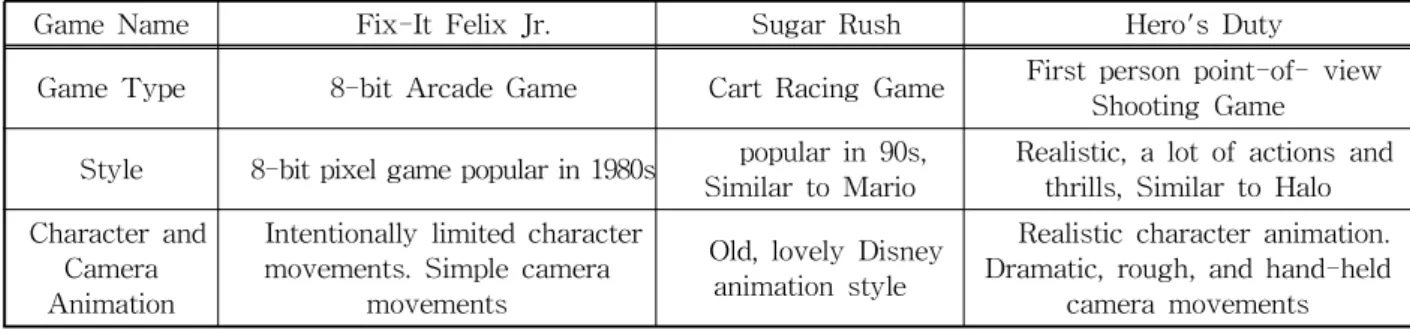
is a 8-bit pixel game where characters can only move in either vertical or diagonal way like most of the games in 1980s. On the other hand, Sugar Rush is similar to Nintendo’s Mario Kart, very popular game of the 1990s. It's like classical Disney Animation and world consists of vivid and deli- cious-looking desserts. In order to express cute and lovely atmosphere, the world is pastel-tone colored, bright, and rounded. Whereas two games listed above are close to cartoon styles, Hero’s Duty, first person point-of-view shooting game is much closer to realism. This game has an atmos- phere which is similar to Microsoft’s popular game, Halo's, and has lots of exciting action scenes.

<Wreck-It Ralph> features more than 180 char- acters and this number is three times more than the average number of typical Disney feature ani- mation's characters[3]. Such characters and cam- era movements were all expressed carefully in or- der to show styles of different game worlds. First of all, in Fix-It Felix Jr., characters' movements is limited intentionally so that movement looks overly simplified while in classical cartoon type Sugar Rush, characters animation style is similar to traditional, classical, and lovely Disney anima- tion style. In a shooting game, Hero’s Duty, se- quences seem to be filmed by a hand-held camera, with lots of dramatic and rough camera move- ments, to add realism to the film. The fast move- ments of the crowd and diverse action scenes seen in Hero’s Duty makes Disney’s new camera cap- ture system more prominent.

So far, this paper analyzed three different game world styles of <Wreck-It Ralph>. In order to fully create different characteristics and visuals of these worlds, Disney developed a couple of new tech- nologies such as camera capture system, dRig[4]

character technology, and new lighting technology.

Among these, this paper will focus on the camera

capture system and layout department’s production

pipeline related to it.

(3)

(a) (b)

(c)

(d)

Fig. 1. (a) Ralph and Felix, the game heroes of Fix-It Felix Jr. Game[5] (b) Character and camera's movement, intentionally limited in 8 bit game world[5] (c) Lovely styles in Sugar Rush Game[6]

(d) Fast and rough camera movement in chasing scene of Hero’s Duty Game[7]

3. DISNEY LAYOUT DEPARTMENT'S PIPELINE

In 3D animation, layout department is similar to cinematography team of live-action film. It is first department in production which does pre-visual- ization[8] and creates 3D shots from 2D storyboard.

Disney's layout department consists of two groups: first group is 'Layout'. It arranges each element and background, locates the camera and its movement, and animate character roughly (a.k.a

blocking). The second group is ‘Layout Finaling’.

It re-checks camera animation after animation de- partment publishes[9] its work, checks whether all elements of a scene through a camera look fine, and exchanges layout models with actual pro- duction models to make a set.

Director has to make a plan for every single shot

and give directions of his or her expectation to lay-

out artists[10]. Since diverse experiments are re-

quired in layout stage to save downstream de-

partments' time, layout artist sometimes show a

(4)

Table 1. Styles of Game Worlds in <Wreck-It Ralph>

Game Name Fix-It Felix Jr. Sugar Rush Hero's Duty

Game Type 8-bit Arcade Game Cart Racing Game First person point-of- view Shooting Game Style 8-bit pixel game popular in 1980s popular in 90s,

Similar to Mario Realistic, a lot of actions and thrills, Similar to Halo Character and

Camera Animation

Intentionally limited character movements. Simple camera

movements

Old, lovely Disney animation style

Realistic character animation.

Dramatic, rough, and hand-held camera movements

(a) (b)

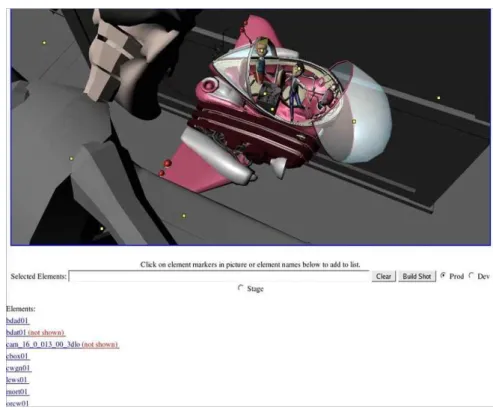
Fig. 2. (a) ‘Layout’ and ‘Layout Finaling’ dept. in Disney Animation's Production Pipeline (b) Disney Tool to add or remove characters and props. ex) <Bolt>'s 13.0/040.00

couple of shots using different camera animation so that director can choose the best shot among them[11]. In some cases, elements in a scene are added or removed after director reviews works from layout department which influences down- stream departments' works. (Figure. 2(b))

In conclusion, layout department creates 3D ani- matic which not only include precise camera direc- tion, audio, length of a shot, timing, staging[12]

which has locations of character and props and scene composition, but also cover the overall con- trol of the tone, and character’s eye contacts and even moods.

As seen in production pipeline in [Figure 2](a),

finished work from layout department is handed

down in consideration with importance of shot's

effects. If the effects leads and influences an entire

shot (for example, a space shuttle in a scene catch-

es on fire and falls), work is then handed down

to the ruff effect department first. If not, work is

passed to animation department. After animation

department publishes its work, then it is passed to

layout finaling department. Since director manages

overall flow of the work by reviewing movie files

from layout department first, and since he or she

might try new ideas or makes modifications to the

works, layout department's work efficiency and

production time are pivotal in the whole process

(5)

Fig. 3. Disney's tool to show production date of each dept.'s work.

Fig. 4. Disney’s program letting users select elements needed to create new Maya shots.

of animation pipeline.

Through in-house web-based database tool, Disney lets all the artists to see on-going and fin- ished shots from each department's. [Figure 3]

shows production records from different depart- ments of <Meet the Robinsons> (2007)'s shot 70.0/605.00. As we see production dates of each de- partment, if works from layout and layout finaling department are delayed, then it affects shot start dates of all the downstream departments such as effects, animation, character finaling, and shot finaling.

When layout artist finishes a shot, it goes through publish process and are saved onto Disney's database, and follow-up departments use a program, as seen in [Figure 4], to download pre- vious department's work in order to create new shot. The reason for not using existing Maya scene file from previous department, but creating new file, is to prevent passing along useless elements, garbages, possible problems in a scene which may cause Maya crashes, unusual lateness, and file corruption.

In order to enhance efficiency of layout de- partment's pipeline and express shots more effec- tively, Disney developed in-house camera capture system. Next chapter analyzes camera system used prior to <Wreck-It Ralph> and newly devel- oped camera capture system.

4. DISNEY'S CAMERA SYSTEM

4.1 Camera System prior to <Wreck-It Ralph>

As Jae-Yoon Park's paper "A Study on Disney

(6)

Fig. 5. Camera System developed by Disney prior to <Wreck-It Ralph>.

Feature-length Drawn Animation Since Using Digital Technology" mentions, Disney has devel- oped multiplane camera technology which gave a visual depth in film in 1930s films such as <The Snow White> and <Bambi>. In 1990s, Disney in- troduced CAPS (Computer Animation Production System) to digitally systemize not only camera but 2D animation, releasing The Little Mermaid (1989), Beauty and the Beast (1991), Aladdin (1992), and Lion King (1994) and then in making Tarzan (1999), Disney introduced Deep Canvas system so that cameras could hover between different layers of digital paintings[1].

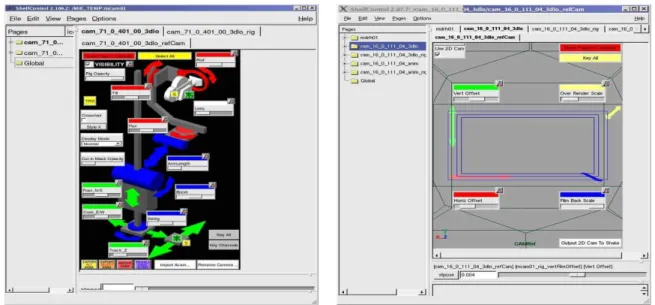
In 3D animation <Bolt> (2008), Disney used a program which not only has Maya's camera's fea- tures but extra features are added as seen in [Figure 5]. This system is developed using anima- tion toolkit called QT and program uses actual movements of camera rig such as roll, pan, tilt, boom, swing, shake, and has 2D camera features inside 3D camera. However, there is still limitation that artists can use this system only inside Maya.

4.2 Camera Capture System in <Wreck-It Ralph>

In contrast to the previous method, in which camera movements could only be controlled within

Maya, new method used in <Wreck-It Ralph> first introduces camera capture system, in which an ar- tist can handle real camera with a marker or steer the camera on a tripod in capture studio. Since this system is linked to Disney's production process which is based on Maya, when user changes real camera, camera in Maya scene is changed instantly. Users can see result of Maya scenes from changed camera view in various screens mounted in camera capture studio's walls as seen in [Figure 6].

As in live-action filming, where director changes camera movements by changing characters, back- grounds, or props' location first, this camera cap- ture studio allows its users to do the same, with much ease and speed. In the world of animation, it's 24 frames per second. Expressing real and de- tailed movements of camera requires an experi- enced layout artist to insert numerous keys in proper place appropriately in 3D computer program such as Maya. By using new system, however, the user can use real camera, conveying the real and vivid details of movement at ease.

Furthermore, even artists who are not familiar

with Maya, such as storywriters, 2D animators, or

artists from live-action film can use this system

at ease and show result. Especially directors can

(7)

Fig. 6. A layout artist at Disney is using new Camera Capture System [13].

Table 2. Steps using Camera Capture System

Steps using Camera Capture System

1 Review a scene that artist worked on. Or start from process No. 2 2 Use real camera in camera capture studio, or modify its movements.

Re-arrange the elements in a scene, if necessary.

3 Camera animation is copied into camera in Maya.

4 Review modified scene in screens in the studio. If rework is needed, go to process No. 2.

Fig. 7. Shots of game world "Hero's duty" created from camera capture system[15].

<Top> Warriors' battle scene which shows radical camera movement.

<Bottom> Cy-bugs' attack scene where camera movement is similar to real, hand- held camera's one.

do numerous tests and suggest a guideline for shots. Before this system is developed, after a di- rector give orders, he or she has to wait for weeks to actually see works done by layout department.

With new system, director and layout artists can control camera movements even together and modify locations of characters, backgrounds, and props at ease, discussing modification decisions on the spot[13]. Director can show shot plans in his or her mind using real camera in camera capture studio and also suggest scene structure or compo- sition in front. These all boil down into a significant decrease in layout department's work time and communication time between director and artists as well.

This system was adequately used in all of the game worlds, but was most prominently used in the world of Hero’s Duty, the world with numerous battle action scenes and thrilling chasing scenes.

Detailed movements from cameraman’s waist, shoulders, or even feet movement can be conveyed to the audience. As Disney presented in FMX (Film and Media Exchange) 2012 Conference[14], Disney is willing to improve this system further to let

users make use of the system with convenience,

and also to be able to express even the subtle

movements of simulation particles.

(8)

This research proves that camera capture sys- tem has advantages of live-action filming method and let pre-visualization possible inside camera capture studio. By letting director and artists col- laborate in the studio to change camera movements and staging in a virtual set even in real time, it increases efficiency layout department’s production process to a great extent. When compared to the traditional animation studio where layout depart- ments work with cameras within a computer pro- gram only such as Maya, development of new sys- tem is fundamental change and noteworthy innovation.

5. CONCLUSION

This study analyzes unique styles of game worlds from <Wreck-It Ralph>, layout pipeline of Disney to fully express these worlds, and new camera capture system developed for this film.

<Wreck-It Ralph> is the most complex 3D feature animation film ever made by Disney. It is a mas- terpiece that makes excellent use of character ani- mation and camera movements to show unique characteristics of each game world. Even with more than 180 characters, there is hardly a fault in the overall structure and visuals.

John Lasseter, the CCO of Disney and Pixar Studios, says ‘The art challenges the technology, and the technology inspires the art’. This film is combination of Disney's indispensable know-hows from long time experience and revolutionary in- novation to create outstanding visuals. Especially Hero's duty which new in-house camera capture system is extensively used maximizes unseen vis- uals by perfectly making the realistic and believ- able game worlds. This study shows that this sys- tem allows real camera's motion and shake and make real-time camera's movement and correction within animation set possible. After analysis, we can conclude that new camera capture system im- proves directing of feature animation and enhances

efficiency of the layout department's pipeline.

Comparing to the way that how layout is done in traditional animation pipeline where artists work with cameras within a computer program only such as Maya, new system is fundamental change and innovation. Therefore, this system contributes to a great extent to animation films business as a whole.

Future research will focus on analyzing pro- duction pipeline studios in South Korea and major studios in other countries such as US and find in- novative system such as camera capture system.

Domestic studios need a better system and pipeline as Sung-Kyu Choi's paper "A Study on Technology Trends of CG in Visual Effects and Suggestion[16]" also points it out since domestic studios have less budget, limited number of artists, and shorter time period comparing to major studios in foreign countries. Therefore, the goal of future study is to adjust new system to domestic industry field and propose it to provide a stepping stone for the progress of the animation films’ business in South Korea.

REFERENCES

[ 1 ] Jae-Yoon Park, "A Study on Disney Feature- length Drawn Animation Since Using Digital Technology," Cartoon & Animation Studies , Vol. 26, pp. 57-78, 2012.

[ 2 ] Jong-Hyeok Ahn, "Analysis of Animation

<How To Train Your Dragon>", Journal of Korea Contents Association , Vol. 11, No. 12, pp. 162-170, 2011.

[ 3] Wreck-It Ralph Production Notes, http://www.

visualhollywood.com/movies_2012/wreck-it_

ralph/notes.pdf, 2013.

[ 4 ] Greg Smith, Mark McLaughlin, Andy Lin, Even Goldberg, and Frank Hanner, "dRig: An Artist-Friendly, Object-Oriented Approach to Rig Building," Siggraph 2012 , 2012.

[ 5 ] Walt Disney Animation Studio's "Wreck-It

(9)

Ralph" Trailer Page, http://www.disneyani- mation. com/projects/wreckitralph, 2012.

[ 6] Wreck-It Ralph' Inspires Technological Inno- vations at Walt Disney Animation Studios, https://thewaltdisneycompany.com/blog/wre ck-it-ralph-inspires-technological-innov- ations-walt-disney-animation-studios, 2012.

[ 7] Maggie Malone and Jennifer Lee, The Art of Wreck-It Ralph , Chronicle Books, San Fran- cisco, pp. 50-51, 2012.

[ 8] Charles Finance and Susan Zwerman, The Visual Effects Producer , Focal Press, Boston, 2010.

[ 9] Mayur Patel, The Digital Visual Effects Studio , Clock and Flame Studios, Toronto, 2009.

[10] Catherine Winder, Producing Animation , Focal Press, Boston, 2011.

[11] Jeremy Bern, Digital Lighting and Rendering , New Riders Press, Indianapolis, 2006.

[12] Jeremy Cantor and Pepe Valencia, Inspired 3D Short Film Production , Thomson, Boston, 2005.

[13] All The World's a Virtual Stage in Disney's New Camera Capture System, AWN, http://

www.awn.com/articles/technology/all-the- world-a-virtual-stage-in-disneys-new- camera-capture-system, 2013.

[14] Evan Goldberg, "Camera Capture for “Wreck- it Ralph”: Introducing Capture Technology in- to a Feature Animation Pipeline", FMX 2012 , 2012.

[15] Walt Disney Animation Studio's "Wreck-It Ralph" Trailer Page, http://www. disneyani- mation.com/projects/wreckitralph, 2012.

[16] Sung-Kyu Choi, "A Study on Technology Trends of CG in Visual Effects and Sugges- tion", Journal of Korea Multimedia Society , Vol. 12, No. 4, pp. 591-598, 2009.

Jiwon Paik

Prof. Jiwon Paik received her bachelor's degree in Computer Science, Boston College. Then she received her master's de- gree in Computer and Informa- tion Science, University of Pennsylvania. She worked at Walt Disney Animation Studio as a software engineer (2000~2003). She also worked at Sony Pictures Imageworks as a technical director (2003~2004) and then moved back to Walt Disney Animation Studio and worked as a technical director (2004~2007). From 2008 to Jan. 2010, She worked as a visiting professor at KAIST, Graduate School of Culture Technology.

Currently she is an assistant professor at Deajeon University, Dept. of Animation & Motion Graphics since 2010, March. Her research interest is 3D Animation, Visual Effects, and Digital Contents.

Cheeyong Kim

Associate Professor Kim

Cheeyong acquired a bachelor’s

degree in Physics and a master’s

degree in Computational Physics

from Inje University. He worked

as a researcher at the Institute

of Computer Design Education

of Inje University from 1991 to 1999, full time lecturer

of Department of Information and Communications at

Busan Info-Tech College from 2000 to 2002, assistant

professor of Department of Digital design at Dongseo

University from 2003 to 2005, visiting professor at

Oxford University in 2007, and visiting professor of

the Digital Clothing Center at Seoul National Universi-

ty in 2012. Currently, he is an associate professor of

Department of Visual Information Engineering at

Dong-Eui University. Prof. Kim held private ex-

hibitions four times both in Seoul and China and joined

over 200 international group exhibitions. With his deep

interest in 3D Animation, Fractal & Chaos Design,

Computational Simulation, and 3D virtual fashion fit-

ting, Kim passionately researches and gives pre-

sentations on the convergence of film and engineering.

수치

Table 1. Styles of Game Worlds in &lt;Wreck-It Ralph&gt;
Fig. 4. Disney’s program letting users select elements needed to create new Maya shots.
Fig. 5. Camera System developed by Disney prior to &lt;Wreck-It Ralph&gt;.
Fig. 6. A layout artist at Disney is using new Camera Capture System [13].

참조

관련 문서

The purpose of this study is to examine the service quality of a tennis court which is one of public sport facilities and analyze a difference in

The purpose of this study is to analyze the effects of sports marketing strategy fit on organizational attitude and organizational citizenship behavior

S., An Experimental Study on the Cooling and Heating Performance of a Residential Ground Source Heat Pump System, Korean Journal of Air-Conditioning

The purpose of this study is to analyze the situations of violating the right to learn and violence in student-athletes from an ethnographic view and

The purpose of this study is to analyze the interest and self-confidence of middle school students in learning English grammar and to examine the

In the past year, it is obvious that this cooperation development has also promoted in Vietnam the formation and development of a Korean studies training

The purpose of this study is to analyze the causes of the income inequality and to find the improvement schemes of tax system for the elimination of

This study observes the fictional realism used in The Magus and discusses how it is deployed in the short stories of The Ebony Tower differently.. Through this analysis,