Comparison of Environmental Conditions and Insulation Effect between Air Inflated and Conventional Double Layer Greenhouse
Shanika N. Jayasekara
1, Wook H. Na
2, Abdulhameed B. Owolabi
1, Jong W. Lee
2, Adnan Rasheed
1, Hyeon T. Kim
3, and Hyun W. Lee
1,2*
1Department of Agricultural Engg. Institute of Agricultural Science & Technology, Kyungpook National Univ., Daegu, 702-701, Korea
2Institute of Agricultural Science & Technology, Kyungpook National Univ., Daegu, 702-701, Republic of Korea
3Dept. of Bio-Industrial Machinery Eng., Gyeongsang National Univ. (Insti. of Agric. & Life Sci.), Jinju 660-701, Korea
Abstract. This study was conducted to determine which greenhouse provided good environmental conditions for strawberry production, and performed better at conserving energy. Temperature, RH, VPD, CO2, solar radiation, yield, and fuel consumption were the parameters analyzed. The temperatures of both greenhouses were well con- trolled in order to provide optimal day and night temperatures for strawberry production. The air inflated double layer greenhouse had higher RH values (more than 90% at night), which led to higher disease occurrence, in compar- ison to the conventional double layer greenhouse. Furthermore, the air inflated double layer greenhouse had lower VPD values than the conventional double layer greenhouse. Therefore, better RH and VPD were observed in the conventional double layer greenhouse. Higher CO2 concentration was observed in the air inflated double layer green- house while the conventional double layer greenhouse ventilated better than the air inflated greenhouse, because of its side ventilators. Moreover, higher solar radiation in the conventional double layer greenhouse resulted in higher yield, in comparison to the air inflated double layer greenhouse. Thus, we can conclude that the conventional double layer greenhouse provided a better environment for crop growth, in comparison to the air inflated double layer green- house. Regarding fuel consumption, the air inflated double layer greenhouse had lower fuel consumption than the conventional double layer greenhouse. Therefore, from an energy consumption point of view, we can conclude that the air inflated double layer greenhouse performed better than the conventional double layer greenhouse.
Additional key words : fuel consumption, strawberry, vapor pressure deficit, yield
Introduction
In cold climate regions, low temperatures can cause many adverse effects on crop growth. As crops are not cul- tivated in fields during cold months, a greenhouse tech- nique has emerged as an alternative method. This was a crucial step in the evolution of modern agriculture with low cost and higher energy efficiency structures, which provide optimum growing conditions throughout the year. A green- house is a building in which plants are grown while being protected from adverse weather conditions. Furthermore, a greenhouse is useful for growing plants as it prevents heat from escaping while allowing sunlight to enter. There are many advantages of using greenhouse techniques such as protection from heavy rainfall and frost/snow, protection
from heavy sunlight (supply optimum temperatures, nutri- ents, and light for growth and development), and pest and disease elimination. Thereby, the quality of the harvest is enhanced.
Different types of greenhouses exist in the world and their operating expenses vary according to structure, design, and size. Covering is the most important aspect of a greenhouse facility as sunlight is generally the limiting fac- tor during winter season greenhouse production. A cover- ing which facilitates the transmission of maximum sunlight for plant growth is very important. Presently, several types of covering materials are available and most covering materials inhibit rapid degradation by ultraviolet radiation.
The covering can be flexible or rigid, corrugated or smooth, and single wall or double wall. Most people use polyethylene as covering because it is inexpensive, flexi- ble and easy to work with.
The conventional double layer greenhouse is very popu- lar in Korea. The purpose of using a conventional double
*Corresponding author: [email protected]
*Received October 31, 2017; Revised November 20, 2017;
*Accepted November 27, 2017
sumption, while providing a good environment for crop growth.
In 1964, Professor William J. Roberts developed the first air inflated double layer polyethylene greenhouse covering system at Cook College, in Rutgers University (ASABE, 2004). Air inflated greenhouses use air to separate the two layers. The air gap between two layers plays an important role in energy conservation, as it maintains coolness or heat inside the greenhouse; thus, it reduces the cooling/heating cost. The use of air for keeping the films rigid, increases the life of the film and enhances the visual appeal of the structure. As the film does not have to be fastened to the framework, simpler and less expensive structures can be designed. Additionally, recovering is simpler and requires very little labor (Roberts, 1973). The air inflated double layer greenhouses have the advantage of losing internal heat at a slower rate than the normal double layer green- houses. Two layers of plastic, with a layer of air in between, can reduce heat loss by 50 percent (Wilbur, 1976). The air inflated double layer greenhouses reduce heat loss by separating two coverings by air pressure, which is maintained by a small continuously running fan.
This is supposed to have a positive effect on plant growth, as it is possible to maintain higher internal average tem- peratures. Furthermore, the air inflated double layer poly- ethylene greenhouse covering systems were quickly and widely adopted throughout the United States and across the world, primarily due to their relatively low installation cost, adequate light transmission, and significant insulation prop- erties. Today, more than half of all greenhouses worldwide use the air inflated double layer polyethylene covering sys- tem (ASABE, 2004). With the increase of energy costs, the need to reduce operational costs has become more pro- nounced; therefore, it is important to investigate which method (air inflated double layer greenhouse or the con-
gate which greenhouse type (air inflated double layer or conventional double layer) provides good environmental conditions for strawberry production, and performs better in terms of energy conservation.
Materials and Methods
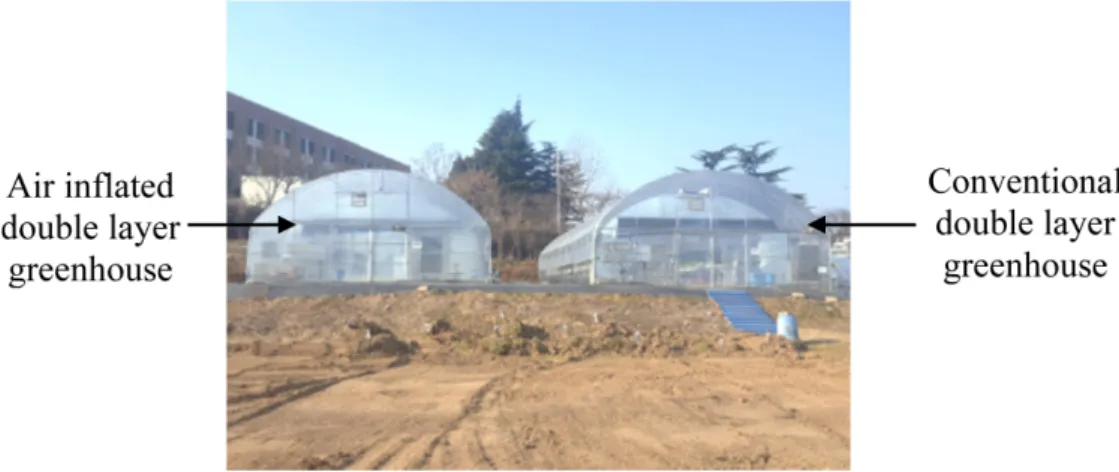
The study was conducted from December 1st, 2015, to February 29th, 2016, at Kyungpook National University, in South Korea, using two greenhouses (air inflated double layer greenhouse and conventional double layer green- house) with a height of 4m and length of 25m, respec- tively. The both covers of air inflated double layer greenhouse were polyolefin (PO) films (0.15mm of thick- ness), in contrast, the outer cover of conventional double layer greenhouse was PO and inner covering was polyeth- ylene (PE) film (0.1mm of thickness) with function of rol- lup and roll down. Both greenhouses had two layers, which guaranteed the tightness of the structure. A ground source heating system of 7m width, 20m length, and 0.8m height was used for both greenhouses. PE double wall perforated pipes were used to build the inlet and outlet pipes. After installing the pipes, the pits were filled with crushed stones (75mm). Spiral galvanized iron sheets were used to build the air duct; 3 ventilation fans (380V, 440 CFM, 285Pa) were installed in each greenhouse. An air blower was installed in the air inflated double layer greenhouse to fill the air between the two layers. The roll-up side ventilator was set up for the double layer greenhouse. The outside view of the greenhouses is shown in Fig. 1. For planting, six crates were built in each greenhouse and were filled with coconut coir. Strawberries were planted, and water with nutrients was supplied using the drip irrigation method (Fig. 2). Boilers had been installed in both greenhouses; the night temperature and day temperature were set at 10oC
and 25oC, respectively. The daily fuel consumption for the boiler was measured in both greenhouses. Data were col-
lected by the sensors listed in Table 1.
Environmental factors can influence each other, for example, the increase of solar radiation will result to high greenhouse temperature. Therefore, it is important to clar- ify the mutual effects and priority of each factor to provide a better environment for crop cultivation. In winter, the greenhouse temperature is lower than the optimal tempera- ture; therefore, a heating system (boiler) is required. When the temperature becomes optimal, the boiler switches off automatically. Like temperature, RH is also lower in the winter, and due to the irrigation system, an optimum RH can be obtained. For a higher CO2 concentration, the venti- lation fans should be put in operation and the side ventila- tors should be opened. In addition to maintaining the temperature in the greenhouse, this also helps to maintain Fig. 1. Outside view of greenhouses.
Fig. 2. Inside the greenhouses.
Table 1. Measured data.
Measured data Unit Time interval Sensor
Temperature oC 10 min TR-76Ui-H,
TECPEL Relative humidity % 10 min TR-76Ui-H,
TECPEL Carbon dioxide ppm 10 min TR-76Ui-H,
TECPEL Solar radiation W/m2 10 min CMP3,
Kipp & Zonen
Yield kg Weekly -
Fuel consumption L Daily -
saturation vapor pressure and VPD are given below (Tetens, 1930).
(1)
Here, Ps is the saturation vapor pressure in Pa and t is temperature in oC.
(2)
Here, VPD and Ps are measured in Pa and RH is a per- centage.
To calculate transmissivity, the following equation was used:
(3)
Here, T is the transmissivity expressed as a percentage, Si is the interior total solar radiation in W/m2,and So is the outside total solar radiation in W/m2.
Results and Discussion
1. Temperature
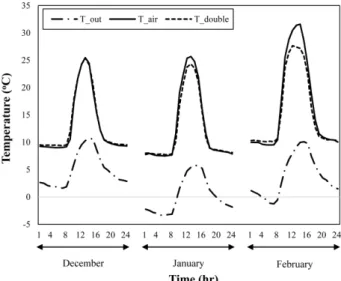
In the winter season, owing to the cold weather, auxil- iary heat was required to keep plants growing at an opti- mal rate. The outside temperature varied from -5oC to 23oC. The optimal temperature for strawberry cultivation is 15oC to 25oC, in the daytime, and 5oC to 10oC in the night- time (Park et al., 2011). Therefore, supplementary heating to control the temperature of the two greenhouses was required. Hence, by using a good heating system, both greenhouses were well maintained at the required tempera- tures during both day and night time. During the night, the
temperature was controlled at approximately 10oC, and when there was sun light (daytime) the temperature was controlled at approximately 15oC to 25oC. When the out- side air was colder, the greenhouses lost heat through con- duction across the covering material. The outside air in contact with the warmer covering material was continu- ously mixed to remove heat through convection. As shown in Fig. 3, the highest daytime temperature values were observed in February and the lowest daytime temperature was recorded in December. Furthermore, the lowest night time temperature was recorded in January, rather than in December and February. The air inflated double layer greenhouse showed slightly higher temperature values than the conventional double layer greenhouse. In February, the air inflated double layer greenhouse had a temperature of more than 25oC, while the conventional double layer green- house was maintained at 25oC. Therefore, both green- houses were well controlled to provide optimum day and night time temperatures for strawberry production.
2. Relative humidity
The results of RH variations are shown in the Fig. 4. For good growth and strawberry yield in the greenhouse, an RH level of 65% to 75% during the day is considered opti- mal (Lieten, 2000). In December, the outside environment had low RH values, while both greenhouses reached 100%
at night, and both reduced their RH up to 65%, while out- side RH reached up to 40% during day time. In January, the outside RH was low (reduced up to 30% during day- Ps=610.78 exp t t 238.3× ( ⁄( + )×17.2694)
VPD=(1–((RH) 100⁄ ) P× s)
T Si SO --- 100×
=
Fig. 3. Greenhouse and external temperature variations.
time) and the air inflated double layer greenhouse had nearly 100% RH, while the conventional double layer greenhouse had 95% at night and was reduced up to 60%
in the day. Furthermore, the air inflated double layer green- house had higher RH than the conventional double layer greenhouse. In February, the external environment had 60% to 30% variation throughout the day. The air inflated double layer greenhouse had nearly 100% RH, while the conventional double layer greenhouse had 85% saturation at night. In the day time, the air inflated double layer greenhouse had 50% RH, while the conventional double layer greenhouse had 40%. In February, neither green- house could reach the optimal RH. However, having more than 40% RH can also be considered as a good value, in comparison to the external environment. At any time of the day, the air inflated double layer greenhouse had higher RH values than the conventional double layer greenhouse, and at night it had nearly 100% RH. The increase of RH in the strawberry growing greenhouses enhanced the vegetative growth and long-term exposure to high humidity signifi- cantly increased the leaf area and the length of petioles (Lieten, 2000). Hence, fruit growth would be low. Further, high humidity can cause moisture condensation on cool surfaces and tends to increase the occurrence of diseases.
Additionally, it can also condense on the greenhouse struc- ture where it may reduce light transmission and encourage rust and/or rotting of the structure itself. Therefore, the air inflated double layer greenhouse had unfavorable condi-
tions for strawberry production, in comparison to the con- ventional double layer greenhouse. The conventional double layer greenhouse showed 40% to 70% RH during day time, and 85% to 98% RH during night time. This con- dition had lower values than the air inflated double layer greenhouse and nearly satisfied the optimal RH condition compared to the air inflated double layer greenhouse. Fur- thermore, the conventional double layer greenhouse had lower disease occurrence than the air inflated double layer greenhouse. Therefore, by having less humidity and by supplying nearly optimal levels, the conventional double layer greenhouse, was a better environment for strawberry production, in comparison to the air inflated double layer greenhouse. These were good conditions for a larger har- vest in the conventional double layer greenhouse.
3. Vapor pressure deficit
A comparison of the VPD values in both greenhouses and outside is shown in Fig. 5. At night, the air inflated double layer greenhouse had a VPD value of nearly 0, which increased during the day time. The conventional double layer greenhouse also had low VPD values at night and higher VPD during day time. Having low VPD values means that the air has higher water content, which leads to providing an environment conducive to the occurrence of disease. Fungal pathogens survive best below 430 Pa and disease infection is most damaging below 200 Pa. Thus, the greenhouse climate should be kept above 200 Pa to pre- Fig. 4. Relative humidity variations inside and outside of the
greenhouses.
Fig. 5. Vapor pressure deficit variations inside and outside of the greenhouses.
unable to maintain more than 200 Pa at night. However, the conventional double layer greenhouse had more VPD than the air inflated double layer greenhouse; therefore, the con- ventional double layer greenhouse was better than the air inflated double layer greenhouse.
4. CO2 concentration
In a closed greenhouse, CO2 depletion can slow down plant growth. As shown in Fig. 6, both greenhouses had higher CO2 values than the outside environment during night and day time. The CO2 enrichment of the greenhouse atmosphere markedly increased the strawberry yield. More- over, the air inflated double layer greenhouse had higher CO2 concentration than the conventional double layer greenhouse. The outside CO2 varied between 450 ppm and 500 ppm, while the conventional double layer greenhouse showed variation between 450 ppm and 600 ppm. The air inflated double layer greenhouse had CO2 between 460 ppm and 650 ppm, and higher CO2 concentration com- pared to the external environment and the other green- house. At night, both greenhouses had a CO2 concentration of 550 ppm to 650 ppm, while during the day this was reduced between 450 ppm and 500 ppm, due to photosyn- thesis. The air inflated double layer greenhouse had only fans for ventilation while the conventional double layer greenhouse had side ventilators. It had been opened at day- time and eventually, leads to have better ventilation and obtained outdoor CO2 concentration in December and Feb- ruary. In January, outside was very cold (coldest month compared to December and February shows in Fig. 3) and did not open the side ventilators. This was lead to have nearly same CO2 concentration as the air inflated double layer greenhouse. Considering this situation, the conven- tional double layer greenhouse had better ventilation than the air inflated double layer greenhouse.
5. Solar radiation
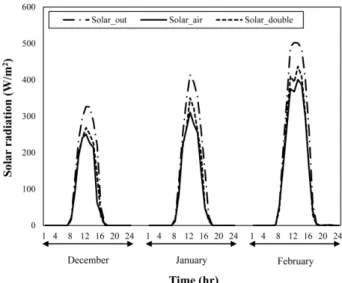
Fig. 7. shows solar radiation variations and implicates slightly higher solar radiation values in the conventional double layer greenhouse (variation between 0W/m2 to 420W/m2), in comparison to the air inflated double layer greenhouse (variation between 0W/m2 to 400W/m2). Feb- ruary had higher solar radiation than December and Janu- ary. Solar radiation plays an important role as a regulator and controller of crop growth and development. It pro- vides the necessary energy for all phenomena concerning biomass production. Therefore, higher solar radiation val- ues in the conventional double layer greenhouse, as com- Fig. 6. CO2 variations in the greenhouses and outside.
Fig. 7. Solar radiation variations in the greenhouses and outside.
pared to the air inflated double layer greenhouse, caused the yield in the conventional double layer greenhouse to increase. Furthermore, high transmissivity is an import- ant factor for an efficient greenhouse, as it promotes higher yield. The conventional double layer greenhouse had 77% transmissivity, while the air inflated double layer greenhouse had 72%. The conventional double layer greenhouse had higher transmissivity than the air inflated double layer greenhouse; therefore, the conventional dou- ble layer greenhouse was a better environment for the plants.
5. Yield
The conventional double layer greenhouse yielded a total production 170kg, while the air inflated double layer greenhouse yielded only 112kg (Fig. 8). This means that favorable environmental conditions for strawberry culti- vation existed in the conventional double layer green- house. The fruit set can be reduced by high humidity, as pollen tends to remain inside the anthers and is less eas- ily transported by insects (Van Koot and Van Ravestijn, 1962). Higher humidity stimulated vegetative develop- ment, but reduced fruit firmness and shelf life (Lieten, 2000). According to the results, the conventional double layer greenhouse had more favorable RH for strawberry growth, in comparison to the air inflated double layer greenhouse. Furthermore, the air inflated double layer greenhouse had very low VPD values at night, which caused diseases to occur with higher frequency, in com-
parison to the conventional double layer greenhouse.
Therefore, better VPD values could also be seen in the conventional double layer greenhouse. Furthermore, the conventional double layer greenhouse had higher solar radiation and transmissivity than the air inflated double layer greenhouse and this led to higher yield, in compari- son to the air inflated double layer greenhouse. These favorable environmental conditions cause the increase of strawberry yield in the conventional double layer green- house, in comparison to the air inflated double layer greenhouse.
6. Fuel consumption
Regarding fuel consumption, the conventional double layer greenhouse consumed 584.5L of fuel, while the air inflated double layer greenhouse consumed 517L. As shown in Fig. 9, more fuel was consumed in January than in December and February, by both greenhouses. The air inflated double layer greenhouse consumed 143.7L, 213.7L, and 159.6L, in each month, respectively, while the conventional double layer greenhouse consumed 167.7L, 227.7L, and 189.1L, respectively. Regardless, the conven- tional double layer greenhouse had higher solar radiation values than the air inflated double layer greenhouse, and higher fuel consumption was observed in the conventional double layer greenhouse. Higher heat loss in the conven- tional double layer greenhouse caused the consumption of more fuel, in comparison to the air inflated double layer greenhouse.
Fig. 8. Greenhouse yield comparison. Fig. 9. Greenhouse fuel consumption.
(ASABE). 2004. Air-inflated double-layer polyethylene greenhouse. Retrieved from http://www.asabe.org/awards- landmarks/asabe-historic-landmarks/air-inflated-double- layer-polyethylene-greenhouse-44.aspx.
Iwasaki, Y., C. Yoshida, and Y. Shishido. 2011. Effect of changing the environmental factors in a greenhouse cov- ered with double-layered air inflated plastic film on the growth and fruit of cucumber grown under semi-forcing cul- ture. Horticulture Research, 10(1), 49-54 (in Japanese).
Lee, H. W., S. Y. Sim, and Y. S. Kim. 2010. Characteristics of PPF transmittance and heat flow by double covering meth- ods of plastic film in tomato greenhouse. Journal of the Korean Society of Agricultural Engineers 52(5):11-17 (in Korean).
Lee, H. W., S. Y. Sim, H.S. Nam, S.W., Nam, and Y. S. Kim.
2009. Development of design technology of Korean style air-inflated double-layer plastic greenhouse. Journal of Bio-
Prenger, J. J., and P. P. Ling. 2001. Greenhouse condensation control understanding and using vapor pressure deficit (VPD). Extension Factsheet, Ohio State Univ., Ohio, USA.
Roberts, W. J., and D. R. Mears. 1969. Double covering a film greenhouse using air to separate film layers. Transactions of the ASAE, 12(1):32-33.
Roberts, W. J. 1973. Air-inflated and air-supported green- houses. In Symposium on Greenhouse Design and Environ- ment 46:163-172.
Tetens, O. 1930. Uber einige meteorologische Begriffe. Z.
Geophys., 6:207-309 (in German).
Van Koot, I. J., and W. Van Ravestijn. 1962. The germination of tomato pollen on the stigma (as an aid to the study of fruit setting problems) 95:452-461.
Wilbur, B. 1976. Energy conservation – greenhouses. Orna- mentals Northwest Archives 1(9):7.
공기주입 및 관행 이중피복온실의 재배환경 및 단열성능 비교
메쓰캄카남즈사니카닐란가니자야세카라
1· 나욱호
2· 오우라비압둘하메드바바툰데
1· 이종원
2라쉬드아드난
1· 김현태
3· 이현우
1,2*
1경북대학교 농업토목공학과, 2경북대학교 농업과학기술연구소, 3경상대학교 지역기반환경공학과(농업생명과학연구원)
적 요. 본 연구는 공기주입 이중피복온실과 관행 이중피복온실의 생육환경과 단열성능을 비교하기 위하여 수
행하였다. 두 온실의 온도, 상대습도, 포차, 이산화탄소농도, 일사량, 딸기 생산량 및 난방연료소비량을 비교하 였다. 공기주입온실이 관행온실보다 야간에 상대습도가 더 높고 포차는 더 낮게 나타나 딸기의 생육에 좋지 않은 환경을 보여주었다. 이산화탄소농도는 공기주입온실이 관행온실보다 더 높게 나타났으며, 이는 공기주입 온실이 더 밀폐되어 있어 환기량이 적기 때문인 것으로 판단된다. 관행온실의 광투과율이 77%로 공기주입온실 의 72%보다 더 높아 관행온실의 광환경이 더 우수한 것으로 나타났다. 관행온실의 딸기 생산량이 더 높게 나 타났으며, 이는 관행온실의 생육환경이 공기주입온실보다 더 우수한 결과로 판단된다. 난방연료는 공기주입온 실에서 더 적게 소모되어 공기주입온실의 단열성능이 더 우수한 것으로 나타났다.
추가 주제어 : 딸기, 수확량, 연료소모량, 포화수증기압차