• 검색 결과가 없습니다.

Recognition of Car Manufacturers using Faster R-CNN and Perspective Transformation

N/A
N/A
Protected

Academic year: 2021

Share "Recognition of Car Manufacturers using Faster R-CNN and Perspective Transformation"

Copied!
9
0
0

로드 중.... (전체 텍스트 보기)

전체 글

(1)

1. INTRODUCTION

In recent years, much deep learning based ve- hicle detection or recognition algorithms are being proposed. Vehicle logo is one of the essential ve- hicle highlight descriptors, which can furnish the astute activity framework with valuable data to distinctive vehicles. Therefore, vehicle logo recog- nition can be applied in the highway toll system and vehicle identification for public security and so on. To respond rising demand from the reasonable circumstance, it is increasingly important to find and perceive vehicle logo clearly. There are princi- pal challenge to expand acknowledgment precision and productivity. Vehicle type classification is al-

ready addressed in previous work [1, 2]. The pri- mary purpose of this paper is to locate and identify the vehicle brand to monitor the traffic better along with vehicle detection. In paper [3], reported algo- rithm for vehicle logo detection using day data but the same algorithm was unable to detect vehicle logos in some images. Whereas, here we report the extension of the proposed algorithm[3] by includ- ing night data during training the model. Along with night data we also propose selective trans- formation of the images according to their logo area. In previous work[3], the parameter of per- spective transformation was same for all the im- ages, in upward direction. Therefore, the logos on the top were moved more upward after trans-

Recognition of Car Manufacturers using Faster R-CNN and Perspective Transformation

Israfil Ansari

, Yeunghak Lee

††

, Yunju Jeong

†††

, Jaechang Shim

††††

ABSTRACT

*In this paper, we report detection and recognition of vehicle logo from images captured from street CCTV. Image data includes both the front and rear view of the vehicles. The proposed method is a two-step process which combines image preprocessing and faster region-based convolutional neural network (R-CNN) for logo recognition. Without preprocessing, faster R-CNN accuracy is high only if the image quality is good. The proposed system is focusing on street CCTV camera where image quality is different from a front facing camera. Using perspective transformation the top view images are transformed into front view images. In this system, the detection and accuracy are much higher as compared to the existing algorithm. As a result of the experiment, on day data the detection and recognition rate is improved by 2% and night data, detection rate improved by 14%.

Key words: Car Logo Detection, Faster R-CNN, Perspective Transformation, Vehicle Manufacturer Detection

※ Corresponding Author : Jaechang Shim, Address:

(36729) 1375 Gyeongdong-ro, Andongsi, Gyenongsang- buk-do, Korea, TEL : +82-54-820-5645, FAX : +82-54- 820-6164, E-mail : [email protected]

Receipt date : Jul. 13, 2017, Revision date : Aug. 9. 2018 Approval date : Aug. 21, 2018

††

Department of Computer Eng., Andong National University (E-mail : [email protected])

††

Department of Computer Eng., Andong National University (E-mail : [email protected])

††††

School of Computer Science and Eng., Kyungpook National University

(E-mail : [email protected])

††††
Department of Computer Eng., Andong National University

※ This work was supported by "Cooperative Research

Program for Agriculture Science and Technology Devel-

opment" Rural Development Administration, Republic of

Korea (Project No. PJ01384901).

(2)

formation, so the detection rate went down. In this paper we propose both upward and downward per- spective transformation. The logos on the top area in the images are passed through downward per- spective transformation and the logos in the lower area are passed through upward perspective trans- formation.

The main difficulty to detect vehicle models is due to a rapid change of vehicle brands designs based on their appearance for a competitive market.

In today’s competitive market some of the brands have almost the same front view with slight changes, so the only logo of the manufacturer is the option to differentiate vehicles. A vehicle man- ufacturer logo is a small object that should be unique to represent their brand and model. In most of the cases the logo is found especially in the front middle area and lays between the lights and above the number plate of the vehicle. The vehicle logo is mostly made with some unique features or geo- metries using different colors and textures to be distinguished as soon as it is seen.

Image matching or feature matching is tradi- tionally used by researchers for logo detection from vehicle images. However, these methods fail if the quality of images is not good enough or the images are taken from street CCTV cameras. In paper [2]

authors propose SIFT-based vehicle logo detection and recognition method. Here, multiple images were merged to enhance the detection rate. Fur- thermore, hough transform was used for feature clustering, and geometric verification was applied for the affine transformation. In paper [4] authors propose a two-layer CNN method with a concept of pre-training model. During the pre-training step principal component analysis is used to improve the accuracy and speed of the system. In paper [5], authors propose the CNN and SVM combination method. In the initial stage, CNN is applied to select candidate areas that are likely to be the manu- facturer logo. After the first stage, the pyramid of the histogram of orientation for smooth changes

between two points to improve detection rate of vehicle logo, leads to improvement of overall per- formance of the system. It is then applied to check the truth of the candidate area and eliminate the false areas that do not contain logo. The methods of using SVM as the classifier to manually se- lection of the feature. To select a feature with clear effect on the classification result, lighting up a weak feature, noise and other harsh surrounding conditions can cause extreme ineffective. At the same time, CNN classification does not need to se- lect feature manually. In paper [6] the authors pro- pose vehicle detection and recognition models us- ing modest Adaboost algorithm and radial Tchebi- chef moments. The system can recognize vehicle logos regardless of variation in viewpoints such as rotation, scaling, translation, and skewing. To de- tect the vehicle logo, Haar-like features are ex- tracted to represent parts of the image and modest Adaboost algorithm is used to classify them. When the logo has been detected, the system normalizes and shifts the logo back to the normal front viewpoint. Then, the image pattern is represented by radial Tchebichef moments and is recognized with k-Nearest-Neighbor (k-NN) classifier.

This paper proposes R-CNN based pre-trained model to train our custom data. For training data, we have used 1000 images from the different brand of vehicles and level them before training data.

After training, the trained file used to detect and recognize vehicle logo.

2. PROPOSED WORK

In this study the data for testing were taken

from top view street CCTV cameras. It was then

passed through image preprocessing part to in-

crease the detection rate of the vehicles logo. In

the front facing camera the logos of the vehicles

are clearly visible but when the images are taken

from top view, the quality of the image and the

logo area are not clearly visible. To overcome this

problem propose a perspective transformation

(3)

method [7]. Perspective is called when human eyes see near things they look bigger as compared to far away and transformation is known as the transfer of an object from one state to another. For perspective transformation, a 3×3 transformation matrix is required for processing. To find this transformation matrix, 4 points are required from the input image and corresponding points on the output image. Among these 4 points, 3 of them should not be collinear. During perspective trans- formation, it does not change the image content but deform the pixel grid and map this deformed grid to the destination image. To avoid sampling arti- facts, the mapping is done in the reverse order, from destination to the source. That is, for each pixel (x, y) of the destination image, the functions compute coordinates of the corresponding “donor”

pixel in the source image and copy the pixel value.

Direct linear transformation algorithm used to transform

 

 

 to

′  

′ 

′ with pro- jection matrix M.

 

(1)











(2)

where t is the weight of the feature points.

Equation (1) is the scalable variable. We can derive equation (3) from equation (2)

′   



 



 



 



 



 

′   



 



 



 



 



(3) In projection matrix M, we have to find 8 elements. If we know 4 pairs of source and desti- nation point, then we can find projection matrix M.

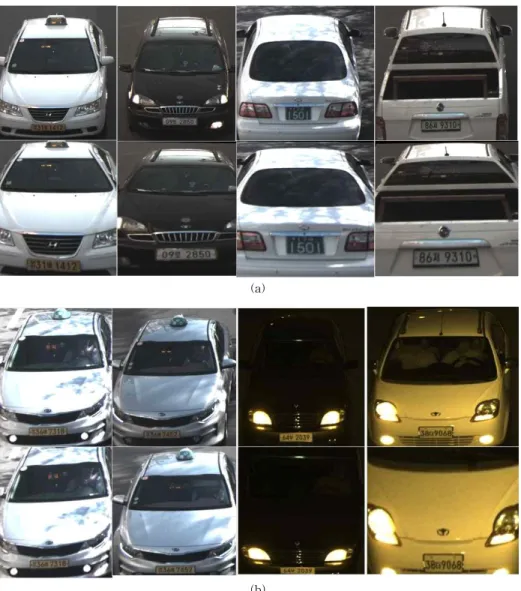
Fig. 1(a) depicts the upward perspective trans- formation of images, where vehicle logos are in downward position. As seen in the figure, after transformation the logos are clearly visible. Fig.

1(b) depicts the downward perspective transfor- mation of the vehicle images. This transformation helps to increase the detection rate of the vehicle

logos. In case of recognition of logo types, with the normal dataset, there was some wrong and miss recognition which was solved by the perspective transformation.

3. CONVOLUTIONAL NEURAL NETWORK

CNN for training data is divided into 3 parts. Fig.

3 depicts the full flow of the proposed system.

Initially, the dataset is level with their correspond- ing classes. After leveling all the dataset, it is then forwarded for training with the faster R-CNN model. After training an inference graph is saved, the graph used to localize and identify the logo.

However, before detecting the logos from the cap- tured data, all the data are pass-through image processing for the better result.

3.1 Labeling dataset

For labeling dataset, there are two things to be considered. First, RGB images are required which are encoded as jpeg or png. Second, a list of bound- ing boxes (Xmin, Ymin, Xmax, Ymax) is neces- sary for the image and the class of the object in the bounding box. Here 1000 images are taken to label them with their respective classes. Fig. 3 shows some of the labeling datasets. As shown in the figure 3 the red bounding box in the vehicle image labeled as brand Hyundai, the blue bounding box represents the brand Daewoo, and the yellow bounding box represents the brand Ssangyong.

3.2 Training data with faster R-CNN model A faster R-CNN is a complex network, and the training with this model is not an easy task. Fig.

4 depicts the architecture of faster R-CNN. Faster

R-CNN [8] has two networks: (a) region proposal

network (RPN) for generating region proposals

and (b) a network using these proposals to detect

objects. An RPN takes an image of any size as in-

put and outputs as set of rectangular object pro-

posals, each with an object score. This method en-

(4)

ables a unified, deep-learning-based object de- tection system to run at near real-time frame rates.

The learned RPN also improves region proposal quality and thus improves the overall object de-

tection accuracy. The main difference between faster R-CNN with fast R-CNN is that the later uses selective search to generate region proposals.

The time cost of generating region proposals is (a)

(b)

Fig. 1. The perspective transformation (a) Upward perspective transformation, (b) Downward perspective trans- formation.

Fig. 2. Training Data Sequence.

(5)

much smaller in RPN than selective search, when RPN shares the most computation with the object detection network. Similar to Fast R-CNN, a faster R-CNN network may be built on a existing networks. Mainly, RPN ranks region boxes also known as anchors and proposes the ones most likely containing the object. To make a robust sys-

tem in translation and scale, the RPN uses an algo- rithm based on anchors. For each position of the sliding window on the feature map, 9 anchors are placed. Then all the anchors are centered on a slid- ing window with the changes of their scale and ratio to generate 9 anchors. Each anchor is proc- essed through the convolutional layers of the RPN, and the networks give an output probability that this anchor represents an object which is trained in the mode and potentially an offset to correct the anchor dimensions.

3.3 Creating inference graph

Inference graph is also known as a freezing model which is saved for further process. This will help to save time and also helps in real-time object detection. While training dataset with the model, each pair at different time steps, one is holding the weights “.data”, and another is holding the graph

“.meta”. All together, we call it as meta-data. After training all the frozen files are saved as the trained model which is supportable to TensorFlow. This file is used further to detect logo area and recognize them.

Fig. 3. Labeling dataset.

Fig. 4. Architecture of Faster R-CNN.

(6)

4. EXPERIMENTAL RESULTS

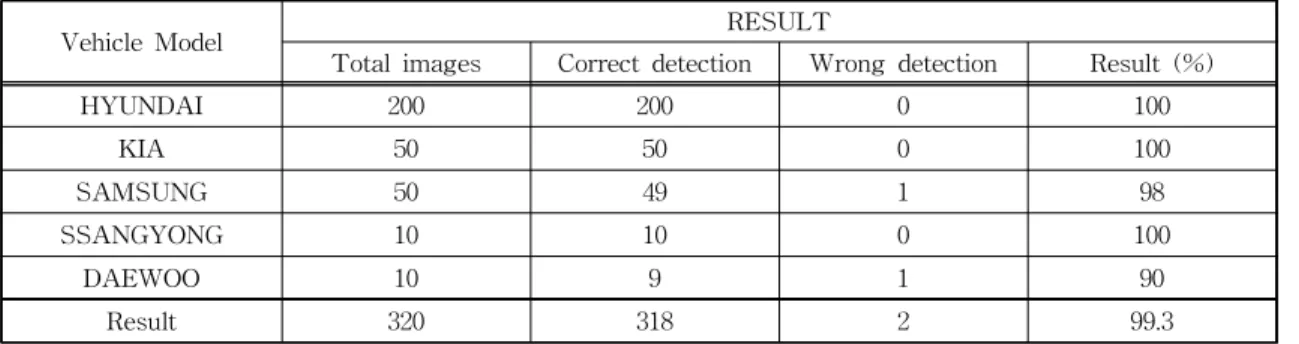
This proposed system was successfully tested with the street live CCTV. After the training data- set, the frozen file was used to detect the logos of vehicle of newly received data. All the above ex- periments were performed using NVidia GeForce GTX 1070 with 8GB memory, Tensorflow frame- work and Windows OS with Intel Core i7 with 32GB RAM. The experiment mainly focused on vehicles available in S. Korea. In table 1 and table 2 we have shown the difference between the nor- mal images and the preprocessed images. In both cases, we have used the same data. Initially, the original data was tested and then all the data were preprocessed using perspective transformation and tested with our trained model. Looking at table 1 and, 2 there is a significant difference in all the brands. However, when the images passes through perspective transformation, the wrong detection

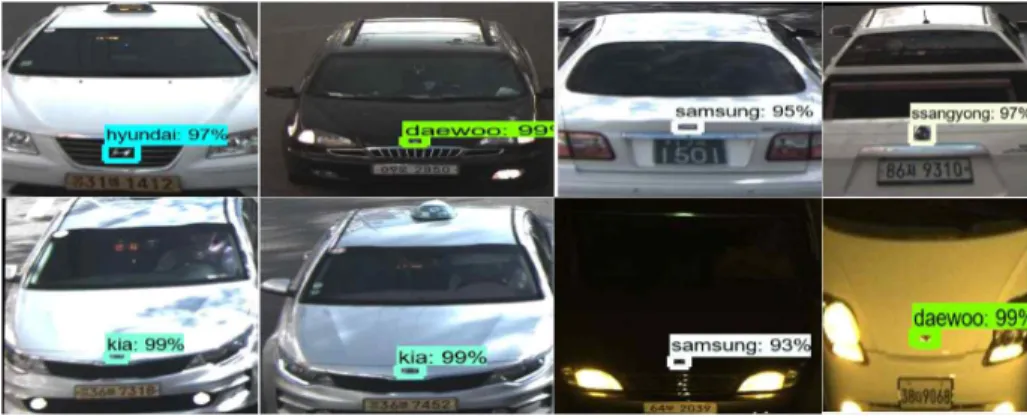
went to zero. Fig. 5 shows the final visualize output after preprocessing. It clearly shows the prediction percentage. The prediction percentage also differs from the processed data. In normal image when the prediction is 97 percentage after detection while, it is 99 percent in preprocessed data.

In Table 1 and 2 only day data were used. In Table 2 we can see the difference between the re- sult of paper [3] and this algorithm. Furthermore, the average result of day data is increased from 97.5 [3] to 99.3. In this paper we have extended out algorithm by training model with night dataset. In Table 3 and 4 shows the result of night data taken from street camera. As shown on the table 2 and 4 perspective transformation helps to increase the detection rate as compared to unprocessed image.

5. CONCLUSION

Several methods are used to detect and recog-

Fig. 5. Result after perspective transformation.

Table 1. Result of day image

Vehicle Model RESULT

Total images Correct detection Wrong detection Result (%)

HYUNDAI 200 196 4 98

KIA 50 46 4 92

SAMSUNG 50 48 2 96

SSANGYONG 10 10 0 100

DAEWOO 10 6 4 60

Result 320 306 14 95.6

(7)

nize vehicle logo by extracting a specific pattern.

However, most of them are very complicated and has low detection. The rate goes even more lower while detecting it from street top view cameras.

This proposed system provides a practical ap- proach for vehicle logo detection and recognition system using faster R-CNN model and perspective transformation. In case of perspective transforma- tion both upward and downward direction trans- formation is proposed. By using this system, we can label all the required vehicle type logo with

their respective classes and recognize them ac- cordingly. This approach can help the traffic mon- itoring system to become smarter in classifying the vehicle data. As shown in the result, the per- spective transformation in image preprocessing gives a better result as compared to the normal im- age which received from CCTV. We have success- fully tested the proposed system on both day and night data.

There are some issues with night data as the image quality is very low. In the future, we plan Table 2. Result of day preprocessed image

Vehicle Model RESULT

Total images Correct detection Wrong detection Result (%)

HYUNDAI 200 200 0 100

KIA 50 50 0 100

SAMSUNG 50 49 1 98

SSANGYONG 10 10 0 100

DAEWOO 10 9 1 90

Result 320 318 2 99.3

Table 3. Result of night image

Vehicle Model RESULT

Total images Correct detection Wrong detection Result (%)

HYUNDAI 186 156 30 83.8

KIA 19 14 5 73.6

SAMSUNG 14 9 5 64.2

SSANGYONG 2 2 0 100

DAEWOO 3 2 1 66.6

Result 224 183 41 81.6

Table 4. Result of night preprocessed image

Vehicle Model RESULT

Total images Correct detection Wrong detection Result (%)

HYUNDAI 186 184 2 98.9

KIA 19 18 1 94.7

SAMSUNG 14 12 2 85.7

SSANGYONG 2 2 0 100

DAEWOO 3 3 0 100

Result 224 219 5 97.7

(8)

to increase the image quality of the night images to detect and recognize vehicle logos.

REFERENCE

[ 1 ] T. Kato, Y. Ninomiya, and I. Masaki, “Preced- ing Vehicle Recognition Based on Learning from Sample Images,” IEEE Transactions on Intelligent Transportation Systems, Vol. 3, No. 4, pp. 252-260, 2002.

[ 2 ] A. Psyllos, C.N. Anagnostopoulos, and E.

Kayafas, “M-SIFT: A New Method for Vehicle Logo Recognition,” Proceeding of IEEE International Conference on Vehicular Electronics and Safety, pp. 261-266, 2012.

[ 3 ] I. Ansari, W. Shin, Y. Lee, Y. Jeong, and J.

Shim “Vehicle Logo Detection and Recogni- tion using Neural Network and Perspective transformation,” Proceeding of International Conference on Multimedia Information Tech- nology and Application, Vol. 12, pp. 12-15, 2018.

[ 4 ] Y. Huang, R. Wu, Y. Sun, W. Wang, and X.

Ding, “Vehicle Logo Recognition System Based on Convolutional Neural Networks With a Pretraining Strategy, “IEEE Transactions on

Intelligent Transportation Systems, Vol. 16, pp. 1951-1960, 2015.

[ 5 ] W. Thubsaeng, A. Kawewong, and K. Pata- nukhom, “Vehicle Logo Detection Using Convolutional Neural Network and Pyramid of Histogram of Oriented Gradients,“ Pro- ceeding of International Joint Conference on Computer Science and Software Engineering, pp. 34-39, 2014.

[ 6 ] S. Kam-Tong and X. Lin Tian, “Vehicle Logo Recognition Using Modest AdaBoost and Radial Tchebichef Moments,” Proceeding o f International Conference on Machine Learn- ing and Computing, Vol. 25, pp. 91-95, 2012.

[ 7 ] S.H. Heo and S.G. Kwon, “OMR Sheet Recognition Algorithm Using QR Code Re- cognition and Perspective Transform,” Journal of Korea Multimedia Society, Vol. 21, No. 4, pp. 464-470, 2018.

[ 8 ] S. Ren, K. He, R. Girshick, and J. Sun, “Faster

r-cnn: Towards Real-time Object Detection

with Region Proposal Networks,” IEEE

Trainsactions on Pattern Analysis and Machine

Intelligence, Vol. 39, No. 6, pp. 1137-1149,

2017.

(9)

Md Israfil Ansari

received his BCA degree in Com- puter Application from Punjab Technical University, Jalandhar, India in 2011 and the MCA de- gree in Computer Application from Visvesvaraya Technologi- cal University, Bangalore, India in 2015. His previous position was a Software Developer as an Intern at Xcelvations Consultancy Pvt Ltd, Hyderabad, India. Currently studies for Ph.D. at Department of Computer Engineering, Andong Natio- nal University, Korea. He has interests in the areas of computer vision, pattern recognition, Deep Learning.

Yeunghak Lee

received his Ph.D degree from Yeungnam University, Korea, in 2003. He had one year experi- ence at University of Cardiff as postdoc research fellow. He was a professor of department of avionic electronic engineering at Kyungwoon University. He is currently working as a senior researcher in the Department of Computer Science at Andong National University. He contributes as a management editor for the Journal of Multimedia and Information Systems. His research interests in- clude pattern recognition, embedded system and com- puter vision.

Yunju Jeong

received her BS in Comput- ational Statistics from Andong National University in 1991 and Master of Computer Engineer- ing from Department of Computer Engineering, Andong National University in 2000.

Currently, she studies for Ph.D. at Department of Computer Engineering of Kyungpook National University and also an Education Instructor at Department of Computer Engineering, Department of Electronic Engineering, Andong National University, Korea. Her research interests include computer vision, Deep Learning, and VR.

Jaechang Shim

received his B. S. degree in 1987 and Ph.D. degree from Kyung- pook National University, Korea, in 1997. From 1997 to 1999, he worked as a researcher in IBM T. J. Watson Research Center.

From 2005 to 2006, he was a visiting Fellow Professor at Princeton University.

Since 1994, he has been a Professor of the Andong

National University, Korea. He received the best

Industrial-Related Paper Award form International

Association for pattern Recognition in 1998. His re-

search interests include computer vision, image proc-

essing, pattern recognition, and AI.

수치

Fig. 1. The perspective transformation (a) Upward perspective transformation, (b) Downward perspective trans- trans-formation.
Fig. 4. Architecture of Faster R-CNN.
Fig. 5. Result after perspective transformation.
Table 3. Result of night image

참조

관련 문서