J Intell Inform Syst 2018 December: 24(4): 85~110 http://dx.doi.org/10.13088/jiis.2018.24.4.085
Identifying Social Relationships using Text Analysis for Social Chatbots*
Jeonghun Kim
School of Management, Kyung Hee University ([email protected])
Ohbyung Kwon
School of Management, Kyung Hee University ([email protected])
․․․․․․․․․․․․․․․․․․․․․․․․․․․․․․․․․․․․․․․․․․․․․․․․․․․․․․․․․․․․․․․․․․․․․․․․․․․․․․․․․․․․․
A chatbot is an interactive assistant that utilizes many communication modes: voice, images, video, or text.
It is an artificial intelligence-based application that responds to users’ needs or solves problems during user-friendly conversation. However, the current version of the chatbot is focused on understanding and performing tasks requested by the user; its ability to generate personalized conversation suitable for relationship-building is limited.
Recognizing the need to build a relationship and making suitable conversation is more important for social chatbots who require social skills similar to those of problem-solving chatbots like the intelligent personal assistant. The purpose of this study is to propose a text analysis method that evaluates relationships between chatbots and users based on content input by the user and adapted to the communication situation, enabling the chatbot to conduct suitable conversations. To evaluate the performance of this method, we examined learning and verified the results using actual SNS conversation records. The results of the analysis will aid in implementation of the social chatbot, as this method yields excellent results even when the private profile information of the user is excluded for privacy reasons.
Key Words : Social Chatbot; Relationship Awareness; Text Analysis; Privacy Protection
․․․․․․․․․․․․․․․․․․․․․․․․․․․․․․․․․․․․․․․․․․․․․․․․․․․․․․․․․․․․․․․․․․․․․․․․․․․․․․․․․․․․․
Received : August 24, 2018 Revised : December 10, 2018 Accepted : December 16, 2018 Publication Type : Regular Paper Corresponding Author : Ohbyung Kwon
* This work was supported by Institute for Information & communications Technology Promotion(IITP) grant funded by the Korea government(MSIP) (No.2017-0-01122, Development of personal profiling and personalized chatbot technology based on language usage pattern analysis for intelligent It's My Story service)
1. Introduction
A chatbot is a computer-based program that allows a device to have an intelligent conversation with a user in the form of voice, images, video, or text over SNS. Chatbots are used in education, games, and many other settings. iPhone’s Siri,
Google's Assistant, Amazon's Alexa, and Galaxy S8's Bixby are recent representative examples.
With the rapid development of natural language processing and speech recognition technologies, companies are considering adoption of chatbots in customer service applications and employee training.
When chatbots are used as social agents, users may feel like chatting with them at the beginning of a conversation, but they may also feel that the conversation gradually becomes a struggle. For a social chatbot, it is difficult to learn from past conversational records to improve the quality of the current conversation (Hill et al., 2015).
Collection of customer information and improving customer satisfaction may also be difficult. To alleviate this problem, chatbots need the ability to probe users’ backgrounds and form a rapport with them. Doing so is not only important in successful human-to-human communication, but can also play an important role in human–agent communication (Cerekovic et al., 2017) with agents such as chatbots. Positivity, attentiveness, and coordination are also necessary to form a rapport, as is knowledge of the human circumstances of the conversation, especially the nature of the relationship (e.g., secretary, friend, relative, etc.).
Context-aware technology automatically collects environmental data about people, time, and location related to interactions between applications (Dey, 2001). One of the contextual perceptions is the ability to recognize the relationships between people or between people and machines, which will foster sustainable and natural personalized communication (Koerner, 2006). In this study, we estimate these relationships between users and objects, hoping to provide users with convenient, timely, high-quality services from social chatbots.
Relationships are also evident in important situational information. However, there is almost
no existing research that has investigated this aspect of the relationship between users and chatbots. Developers of social chatbots assume a conversational style chosen by the developer, which may be provider-oriented or obtrusive, thereby decreasing user satisfaction and acceptance.
The purpose of this study is to propose a method which automatically infers how a user interacts with a chatbot during a conversation, assuming a relationship based on written unstructured sentences. We utilize the text analysis function, analyzing sentences provided by the conversant, and the inference function, inferring the relationship. Relationships are classified into four types of social collectives according to the research of Kirkpatrick and Ellis (2001):
instrumental coalitions, mating relationships, kin relationships, and friendships. In addition, the user profile, which aids in recognizing the relationship during context recognition, may cause privacy problems; therefore, we herein describe how to avoid these problems.
This paper is organized as follows. In Section 2, we review existing research on relationship recognition with chatbots. In Section 3, we describe the proposed methodology. Validation of the results to verify the feasibility and superiority of our research method is performed in Section 4.
Finally, a discussion and description of possible future research directions are provided in Section 5.
2. Literature Review
2.1 Chatbots
Chatbots, also called "conversational agents"
and "conversational systems", analyze natural language processing of text or voice data entered by the user and analyze the contents of the text, answering via software (Griol et al., 2013). In recent years, chatbots have been used in increasingly diverse business areas in addition to customer service (Sandbank et al., 2017).
There are three types of chatbots:
scenario-based, rule-based, and artificial intelligence-based, depending on how users select responses to queries. First, the scenario-based chatbot is a type in which queries and responses are made according to a predetermined order and content. Second, the rule-based chatbot recognizes the user's answers as a condition and then responds with a conclusion matching the condition type.
However, these two types of chatbots have the disadvantage that they cannot respond to exceptional user queries. On the other hand, the artificial intelligence approach can provide the most suitable answer to a new type of query, or if a new conversation is created, its contents may be learned. This method has the advantage of excellence in terms of flexibility and expandability.
A chatting service based on the artificial intelligence approach is more sustainable than one based on the other two methods. Early versions of chatbots such as Eliza, for example, were very difficult to understand and respond to in a
conversational context because of the pattern matching inherent in conversations. However, the development of natural language processing techniques and artificial intelligence has improved interactive performance, resulting in the birth of intelligent chatbots like Alexa, Apple’s Siri, and Samsung’s Bixby (Hirschberg & Manning, 2015).
Chatbots can also be categorized according to function. There is the IPA (intelligent personal assistant) type, which is a kind of electronic secretary that solves problems, and the social chatbot, which carries on a conversation while establishing and maintaining a relationship with the user. With the IPA, the chatbot uses situational and personal information to perform tasks requested by the user in conjunction with music, movies, calendars, and emails to provide convenience to users (Shum et al., 2018).
Representative examples of IPAs include Google’s Assistant, Amazon’s Alexa, Apple’s Siri, and Samsung’s Bixby. Siri, developed by Apple and embedded in the smartphone, can notify the user about events on his or her schedule stored in the calendar and execute requested applications. Siri also provides relevant information about sports, movies, and restaurants as well as smartphone features. Similarly, Bixby works on Samsung's Android phone, and, like Siri, its voice can be changed according to individual preferences. Alexa is an IPA that has the ability to notify users of weather forecasts, news, calendar events, and shopping It can access Wikipedia and provide users with desired information. In addition, Alexa is a cross-platform chatbot that is compatible with
various devices.
IPA-type chatbots have minimal difficulty in performing tasks requested by users. However, in order to use chatbots effectively, users must understand and respond to the chatbot’s questions (Shum et al., 2018). For effective communication with chatbots, conversational quality must be high and emotional exchanges must occur (Oliver, 2014). For example, Microsoft's XiaoIce has the skills to understand the user’s emotional state and conduct the conversation accordingly, but empathy is still lacking.
Social chatbots, on the other hand, communicate freely with users and perform requested tasks using acquired human social skills. As a social chatbot, Microsoft's XiaoIce is representative.
When interacting with this device, the device can input conversational content, analyze the emotional state of the user, and respond to changes in emotional state. One essential technology for social chatbots is the ability to grasp current human perceptions about the relationship and respond accordingly. Depending on how it is perceived, the relationship between the chatbot and the user will differ and responses to the chatbot’s speech will vary. In this study, we present a method for automatically recognizing this relationship, a function not currently available in the social chatbot.
2.2 Relationship Inferencing
A relationship is formed when a social connection is made for its own sake, for the
benefit of each person from a sustained association with the other (Jamieson, 1999). Establishing relationships is essential to constructing a network.
People use both verbal and nonverbal means to form relationships. In everyday conversation, gestures can be used as a nonverbal form of communication, but this is difficult in non-face-to-face situations. In some cases, people often use emoticons or images in order to express their feelings and form relationships with others. In addition, as the amount of unstructured data acquired in the non-face-to-face channel increases, more research is being conducted to grasp opinions and understand emotional states through written articles (Choi et.al, 2015; Choi et.al, 2016; Cui et.al, 2016; Seo and Kwon, 2018).
Relationships between humans and machines have been extensively studied (Kwon & Lee, 2011). Experiments have been conducted to examine how machines interact with humans to form a specific relationship (Reeves & Nass, 1996;
Cassell et al., 2000; Breazeal, 2002). Specific mathematical functions have been developed to infer relationships with friends (Yu et al., 2017), colleagues (Zhuang et al., 2012; Diehl et al., 2007), co-authors (Zhuang et al., 2012; Wang et al., 2010), and others.
Many researchers have attempted to infer relationships using network analysis of traffic (Yu et al., 2013; Yu et al., 2017; Zhuang et al., 2012;
Wang et al., 2010; Diehl et al., 2007), as shown in Table 1. Although social network reasoning based on traffic data estimates intimacy according to volume and temporal patterns of contact,
Researchers Content Data for Learning Input Feature Class Algorithm
Yu et al.
(2013)
- real-world sensing data using Bluetooth technique
- classified friends or non-friends (simple problem)
- inadequate detail about social relationships (family, formal relationship, or lover)
- MIT Reality Mining project data
- Outgoing calls - Outgoing text
messages - Incoming calls - Incoming text
messages - proximity
(time, location)
- Friend, non-friend SVM
Yu et al.
(2017)
- performance comparison using ensemble technique and PCA (principal component analysis) - improved performance using
semi-supervised learning - no inference of detailed social
relationships with unstructured data such as text messages
- MIT Reality Mining project data
- Outgoing calls - Outgoing text
messages - Incoming calls - Incoming text
messages - proximity
(time, location)
- Friend, non-friend SVM + Naïve Bayes
Zhuang et al.
(2012)
- compared with the previous studies, proposed an improved algorithm
- inference based on network analysis, requires continuous data collection
- proposed a relationship inference method using various domains, but no inferences about social relationships
- Publication:
Wang et al.
(2010) - Email: Diehl
et al. (2007) - Mobile: Eagle
et al. (2009)
- Publication: paper count/paper ratio/
co-author ratio/
conference coverage/first- paper-year-diff - Email: Traffic - Mobile: Voice
calls/messages/
proximity (time)
- Publication:
co-advisor/
co-advisee - Email: co-recipient/
co-manager/
co-subordinate - Mobile:
co-location/
related-call
SVM TPFG PLP-FGM-S
PLP-FGM
Wang et al.
(2010, July)
- potential publishing networks identified by applying time-series elements not previously considered in network research
- difficult to apply to relationships that change in real time like Web or SNS
- DBLP computer science bibliography database
- Sent, received
Colleague/Ph.D./
teacher/advisor/
advisee
SVM Ind Max
TPFG
Diehl et al.
(2007)
- content-based reasoning is superior to traffic-based method
- inference using unstructured data with no consideration of proximity
- Enron email
dataset - Traffic/content Manager/subordinate
Supervised ranking approach
<Table 1> Related Studies on Relationship Inferencing accuracy in reasoning of correct relationships is
problematic. For example, traffic data may indicate numerous business contacts in formal relationships, but individual connections are difficult to establish.
Various studies have clarified the situation by further analyzing factors related to proximity (time, location) (Yu et al., 2013; Yu et al., 2017). For example, during work hours, people often interact
with their colleagues; for those with closer relationships, they may meet outside of work hours. Diehl et al. (2007) found that the results were better when traffic-based analysis and inference and comparison of content-based relationships were combined.
Traffic-based network reasoning has the advantage of verifying relationships between users and machines, but grasping the detailed nuances of relationships remains difficult. In addition, various dynamic factors affect human relationships; thus, constant observation of the network is required.
On the other hand, with relational reasoning using irregular data, relationships can be instantly deduced. This method is also suitable for deducing individual relationships and can be changed according to the dynamics among various factors.
The secret is the vocabulary used, which depends on the type of relationship. For example, emails in the workplace involve words like "please",
"report", "project", "termination", and "executed"
(Diehl et al., 2007). In more casual relationships, words like "hey", "game", and "music" are used.
3. Methods
3.1 Process
The proposed method of recognizing relationships in this study is shown in Figure 1.
First, actual messages were collected from users of KakaoTalk. Data was collected using the chat export function in KakaoTalk, and the profile of
each user was input by the data provider. Note that the user profile data are not used in the proposed method. Second, message information was classified in preprocessing the text after constructing the corpus. The preprocessing stage involved extraction of idiomatic words, the number of words, morphemes, polarity, and nouns, from which metrics were constructed. The data set was then randomly divided using the 10-fold method to generate a prediction model based on the training data set. Lastly, test data was applied to the generated prediction model, and the final evaluation was performed.
The process of preparing data to be used for relationship inferencing is shown in Figure 2. First, inferences about the user's profile data were based on content obtained from the existing learning data. Therefore, at the stage of actually recognizing the relationship, only the inferred profile can be estimated irrespective of the exact profile of the user. The profile information is not included based on the assumption that obtaining the user's profile data or utilizing it for service enhancement causes privacy concerns. Next, unstructured data corresponding to the dialogue is formulated and aggregated according to sessions composed of various conversational contents in combination with contextual information (e.g., time zone during conversation). Finally, the collected, inferred profile data and the data aggregated in session units are combined and used in learning and verification processes to deduce the relationship.
<Figure 1> Research Framework
<Figure 2> Data Preparation Procedure
3.2 Preprocessing
In this study, formalized data to be used as input features for classification was extracted from
unstructured text through the following process.
The first input feature is the number of words, which represents the length of the sentence. By treating the number as a spacing unit, we can
determine the word length more objectively by counting how many sentences are used regardless of the length of each word. Second, the number of morphemes is calculated. Since there can be more than one morpheme in a given word, it is desirable to know the number of morphemes in order to determine the length of the text more objectively.
However, since morphemes only indicate auxiliary meaning, not the central meaning, the length of the text is also used as an indicator of meaning in addition to the number of words and morphemes.
Various kinds of analyses were made possible by including these grammar units.
Emoticons are another means of expressing emotions in addition to pictures, special symbols, and other elements which cannot be conveyed through text. Using emoticons, the speaker can express his or her emotions both more directly and indirectly. Emoticons convey meaning that is difficult to express in words and can convey intimacy while keeping communication appropriate. Because of this feature of emoticons, the same sentence can convey feelings differently.
The frequency of their use is expected to be high between friends because they are relatively easy to use and freely available in private conversations;
however, because it is not a traditional method of expression, its use in public interactions is expected to be low. In addition to the emoticons provided by Messenger, we also examine "!", "...", and "~". In this study, emoticons were extracted and categorized using the Mild symbol and the Tough symbol. The Mild symbol is a function that softens expressions and is difficult to express
directly. They enable the speaker to convey his/her direct attitude for easy interpretation by the listener, so that communication is successful. On the other hand, symbols such as the exclamation point are represented by the Tough symbol, which is a more direct sign used for more emphatic expression. The ability to amplify and express feelings without inhibition indicates that the listener is not a difficult person or some kind of opponent. Using this system, it is possible to determine users' class and level of intimacy.
Lastly, emotional analysis was performed to extract values related to the emotional elements of the conversation. Positive or negative words in the conversation provide information about the emotional value of the conversation. Using SentiWordNet, emotional words were extracted by three coders who are graduate students specializing in data analytics. Emotional values were calculated by assigning a value of +1 to affirmative words and a value of -1 to negative adverbial/adjectival words, aggregating the overall value for all affirmative words and subtracting the overall value for all adverbial/adjectival words, and dividing the result by the total number of vocabulary words related to emotion in the conversation. This study used the stringr package of R, an open source statistical program, and the RHINO 2.5.4 morphological analyzer was used. RHINO 2.5.4 can be downloaded from "https://github.com/
SukjaeChoi/RHINO". RHINO 2.5.4 supports R, Java and Python languages. Table 2 shows the input features in the content category obtained through the above process.
Category Features Definitions Data Type
Class Perceived relationship Human perceptions of the relationship between humans and chatbots
Categorical
(1=family/2=public/3=non-public/
4= lover/5=friend)
Content (Session)
Average number of words The average number of words in the
message written by the speaker Real
Average number of morphemes The average number of morphemes in the
message written by the speaker Real
Average respect level The average level of respect in the message written by the speaker
Real (0~4)
Average number of emoticons Number of times emoticons were used in messages created by the speaker
Real (1=false/2=true)
Average number of mild symbols The number of times the mild symbol is
used in the message written by the speaker Real
Average number of tough symbols The number of times the tough symbol is
used in the message written by the speaker Real
Average polarity The polarity value of the message created by the speaker
Real (1=positive/ 2=negative)
<Table 2> Class and Input Features
3.3 Profile Inferencing
In this study, we utilized inferred personal profiles rather than actual personal profiles because use of real profiles can cause privacy concerns, which may be a barrier to chatbot system acceptance. However, doing the opposite increases the possibility of inferior performance of our proposed method. Therefore, we profiled the user as much as possible using the proposed method of reasoning without securing personal information that is sensitive to disclosure. Of course, in this study, deducing the user's identity is not allowed.
To infer the personal profiles, we first divided
the corpus into training data and test data. Second, each dialogue unit was separated into text and classification categories. Third, a DTM (document term matrix) was generated for each conversation including content and keyword lists. Fourth, each DTM was divided into categories. Last, the frequency of each column of the DTM was determined for each conversation unit.
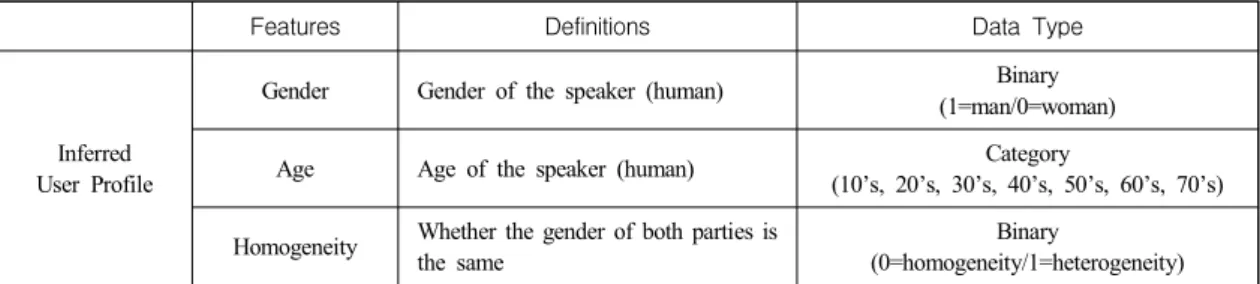
Conversations with column sums of zero were excluded. By repeating the above procedure, we deduced each personal profile with its cumulative DTM. The resulting inferred user profile is shown in Table 3.
Features Definitions Data Type
Inferred User Profile
Gender Gender of the speaker (human) Binary
(1=man/0=woman)
Age Age of the speaker (human) Category
(10’s, 20’s, 30’s, 40’s, 50’s, 60’s, 70’s) Homogeneity Whether the gender of both parties is
the same
Binary
(0=homogeneity/1=heterogeneity)
<Table 3> Input Features in Inferred User Profile
Features Definitions Data Type
User Context
Conversation time Time of day at which conversation
occurs Time
Conversation at night Whether or not message is sent after 21:00
Real
[0,1] (0=daytime/1=evening or midnight) Date of conversation Date when the speaker sent the
message/made the call
Real
[0,1] (0=weekday,1=weekend)
<Table 4> Input Features in Inferred User Context 3.4 Contextual information
Even for the same content, relationships may differ depending on the context of the conversation. For example, in a formal relationship, conversations may not often occur on weekends. Also, the later the time of a conversation, the more informal it is likely to be.
Therefore, in this study, contextual information (e.g., location) was obtained automatically without any direct input from the user to avoid privacy concerns.
First, we determined the time of the conversation. In close personal relationships, communications are frequently and easily exchanged regardless of time. However, in other relationships, it is common to avoid texts or phone calls in the evening and after a certain time of
night. Therefore, it is safe to assume high intimacy in cases where communication occurred frequently and at night time. In the same vein, we also considered the day of the week. Frequent communication on both weekdays and weekends indicates a high level of intimacy. In most public, formal relationships, weekends are considered a private time in which people must refrain from attempting to communicate.
Second, the presence of nighttime conversation is a powerful factor with which to gauge the intimacy of a relationship. Night time was designated as from 21:00 to 08:59, which is the time of day when most people are sleeping, and day time was designated as from 09:00 to 20:59.
Table 4 summarizes the three variables described above.
4. Experiment
4.1 Prototype System
We implemented a prototype system to show the feasibility of the relationship-aware social chatbot system proposed in this study. This system was programmed in R3.5.0 running on 64-bit computers. When the system is started, contextual data (time, day, and time domain) at the time of use is automatically received. Then, when the user's input message is received, a morphological analysis is carried out to determine the number of morphemes, special characters, etc. included in the text, after which the user's age and gender are deduced. Next, when collection of necessary data is completed, the relation-inferred result is shown in parentheses through the model, which has already been learned. This process is designed to stop the system when the user indicates that it is not in use. A sample screen shot for the prototype system is shown in Figure 3 and the pseudo code for the drive operation process is shown in Appendix A. Figure 3 shows an example of Chatbot communicating with humans using the method proposed in this study. Figure 3 (a) is an example of public dialogue, and Figure 3 (b) is an example of a dialogue with family. When chatting with a long sentence, Chatbot recognizes it as a public conversation and responds accordingly.
Figure 3 (b) shows a relatively short conversation in which the conversation partner is inferred as a family member . The prototype proposed in this study combines characteristics of the text input by
the opponent, profile information, and context information so that the user can communicate according to the social relation assumed by the user. In this study, the relationship consists of friends, family, public, private, and lover relationships.
4.2 Experimental Methodology
In this study, we combined and compared three things: personal profile information (inferred or not), features extracted from content, and features extracted from context. We considered two possible methods as options: combining the three features using factors from actual user profiles which do not present privacy concerns – gender and age (Method 7) and combining these three features using inferred user profiles – inferred gender and inferred age (Method 8). We did not compare our methods with previous methods because of the lack of research into relationship inferencing. Overall accuracy was selected as the variable of interest. The following is a list of the methods examined:
Method 1: Personal profile only Method 2: Content data only Method 3: Content only
Method 4: Combining Method 1 and Method 2 Method 5: Combining Method 1 and Method 3 Method 6: Combining Method 2 and Method 3 Method 7: Combining Method 1, Method 2,
and Method 3 (Proposed 1)
Method 8: Combining inferred personal profile, Method 2 and Method 3 (Proposed 2)
(a) Formal conversation
(b) Informal conversation
<Figure 3> Examples of Relationship Inferencing during Conversation
<Figure 4> Aggregated Data by Session 4.3 Data Collection
The data used in this study involved users of KakaoTalk, a smartphone messenger application used by more than 50 million users around the world. Actual conversational content was collected over a period of 30 days from data shared by the sponsored participants. In total, 33,160 conversations were collected and saved as the .txt file by KakaoTalk application program. To make the raw data suitable for analysis, a data set is reconstructed, as shown in Figure 4. Personal information such as name, dialogue relations, age, gender, personality, etc. was declared by the participants, and raw data about the time, day, and date of the conversation was transferred to a spreadsheet. In addition, we used RHINO 2.5.4 as
the morphological analyzer to compute the number of morphemes, number of emoticons, number of mild and tough symbols, and polarity. The relationships are distributed as shown in Table 5, and Table 6 is an example of the dialogue contents of the collected data.
<Table 5> Relation Frequency Frequency
Family 5,159
Friend 11,155
Public Relations 4,691
Non-Public Relations 7,922
Lover 4,233
Total 33,160
Relation Sample Text
Family - Are you tired? I loved it. Come on.
- Have a bowl of seaweed soup. ^^
Public
- Manager Hi ^^ I sent you the list last time. I think the image was sent by the manager last time.
I have not received it yet. Please send it once when you have time ^^ I did not have the file then
;;; And I asked you if you have OO. If you have two, I would like to ask for confirmation.
- Hi? Can not you see the details of others yet? I do not have a contact for Professor OO yet ... Please complete this and send it to me ^^
Non Public - How are you? I hope to see you sometime ... Happy Christmas evening!
- Seeing you soon.
Lover - Baby, I like to look at anything!
- Honey, I like that look. (heart) Friend - Buddy, doing something?
- Where are you playing?
<Table 6> Sample text by Relation
4.4 Causal Analysis
In this study, multinominal logistic regression was used to investigate the factors affecting relationship inference. Normal logistic regression is analyzed as two separate dependent variables, y = 0 and y = 1, while multinominal logistic regression is based on y = 0 and y = 1, y = 2, y = 3, y = 4. Multinominal logistic regression was performed because the dependent variable in this study consists of five categories. We evaluated the influence of three input feature categories: content, user context, and user profile, in predicting the user–chatbot relationship. Logistic regression analysis was performed for each model by using the full model (relationship ~ content + user context + user profile), reduced Model #1 (relationship ~ content), and reduced Model #2 (relationship ~ content + user context).
As shown in Table 7, the number of
morphemes, the total number of honorifics, and the degree of honorification in the three models were statistically significant. Thus, these are important variables in predicting relationships. The use and strength of honorifics can be an important basis for speculating about relationships. For intimate relationships with friends or lovers, it is seldom used; however, this important variable enables us to appreciate fine distinctions in relationships because it is used in relationships with parents or grandparents or in public relationships. Comparing the -Mcfadden 2 of each model, we see that the full model proposed in this study had the highest value at 0.331. Values for reduced Models
#1 and #2 were 0.165 and 0.167, respectively; #2 is slightly higher, but the difference is not significant. Therefore, we can conclude that the contextual information of reduced Model #2 is more influential than the elements extracted from
Variables Reduced Model #1 Reduced Model #2 Full Model
(Intercept) -0.2056 0.7028 -16.7649
Contents
words -0.0887 -0.0873 -0.2661***
morph 0.2522*** 0.2462*** 0.2627***
respect 0.1944* 0.2076* 0.2728***
respect_strength 2.1752*** 2.1286*** 1.7022***
imo_strength -0.1008 -0.088 0.2177
mild_num 0.266 0.2837 0.201
tough_num -0.5364 -0.5114 -0.0234
polarity 0.2848 0.2426 0.3293
Context
hour -0.042*** -0.0436***
night -0.3156 -0.4053
weekend -0.0677 -0.0635
Personal Profile
gender 0.6923***
age20's 17.4678
age30's 19.0744
age40's 19.1183
age50's 17.7969
age60's 16.3698
age70's 35.3985
homogeneity -1.9209***
adj−Mcfadden R2 = 0.165
adj−Mcfadden R2 = 0.167
adj−Mcfadden R2 = 0.331
<Table 7> Results of Logistic Regression Analysis unstructured data. In addition, the R2 value of the
full model including profile information, which was excluded from reduced Models #1 and #2, was 0.331, which was twice as high as that of both models. This difference can be explained by the amount of profile information.
One interesting point in the results of the logistic regression analysis is that the magnitude of the quasi-linearity has a positive effect, but the age-dummy variables have no effect. This seems to be due to the fact that the boundaries of social
relations are ambiguous. For example, among lovers, regardless of their age, there will be cases in which they do not show respect in their conversations; this is also true in public relationships. However, age may be a very important factor in predicting detailed relationships other than those proposed in this study.
As a result, the variables which are significantly associated with the user–chatbot relationship used in the proposed method for developing relationship aware social chatbot.
Methods Random Forest KNN Naïve Bayes Logistic Regression
Method 1 0.5439 0.4279 0.5122 0.4943
Method 2 0.4630 0.4423 0.4383 0.4428
Method 3 0.6497 0.6023 0.4294 0.5942
Method 4 0.6480 0.6105 0.5561 0.5596
Method 5 0.7544 0.7162 0.4479 0.6606
Method 6 0.6676 0.5931 0.4473 0.5930
Method 7 0.8156 0.7746 0.4739 0.6832
Method 8 0.7340 0.6716 0.4583 0.6220
<Table 8> Performance Comparison (Overall Accuracy) 4.5 Performance Evaluation
A performance comparison was conducted by comparing the accuracy of the relationship between the proposed method with functions of other chatbots. First, we compared the performance of the proposed methodologies. We used the 10-fold method as the input feature to obtain all or part of the unstructured data, contextual information, and personal profile details and to predict the perceived relationship (family, public relations, friends, lovers, and private relations).
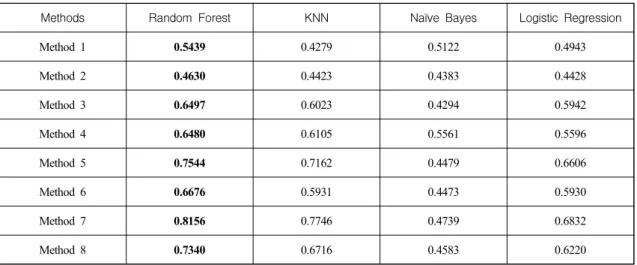
Table 8 shows the relationship prediction accuracy obtained by training and test data.
According to the results presented in Table 8 and Figure 5, Method 7 yielded the best inference accuracy (81.56%). On the other hand, Method 2 showed the lowest inference accuracy (46.3%).
Also, when considering the economic feasibility of the model, we see that Method 3 exceeds other methods. Method 2 has the lowest accuracy
because SNS enables users to communicate anytime and anywhere without restriction of time and space. Since Methods 4, 6, 7, and 8 show higher reasoning accuracy than Method 2, we may conclude that contextual information appears to be effective when combined with other information.
In addition, the accuracy of Methods 4 and 6 is almost the same at 64.86% and 64.23%, respectively. Based on the accuracy of Method 5, we posit that there is a lower causality relation between profile information and information extracted from unstructured data.
Of Methods 4, 5, 7, and 8, which included profile information and unstructured data, Method 7 had the highest accuracy at 81.51%. Therefore, if profile information is available in the inferencing process, more inferential reasoning is possible, but it may cause privacy issues (Kwon, 2009; Faratin et al., 1998). To overcome this problem, Method 5, which does not use profile information, and Method 8, which uses profile
<Figure 5> Performance Comparison
information through inference, can be suitable alternatives. Consequently, we conclude that if profile information is obtainable, Method 7 is superior. If profile information is unobtainable, Method 8 is superior.
Next, we compare the proposed system with other major chatbot systems. The evaluation items for chatbots include speech recognition and synthesis, rules built into the knowledge base, provision of help functions, presence of back buttons, connectivity with external databases (Kuligowska, 2015), user interface, and system aspects such as elapsed time. We also see the performance of chatbots resulting from human
success. We did not consider features related to system commercialization and user interface, as they are not the focus of this paper. We compared systems from the viewpoint of personalization of conversation among functional viewpoints. In total, we evaluated items in five categories: personal information protection, use of context-awareness information, personalization of conversation, individual profile inferencing, and relationship recognition.
First, protecting personal information involves asking the user for personal information about things such as gender or age during a conversation, or taking user information from a third source and
constructing a dialogue based on this information.
Although accuracy of the conversation will increase, there is concern about privacy.
Situational or context awareness concerns the current location or time. Personalization of a conversation involves changing its content (e.g., honorification, etc.) according to the characteristics of the user. Personal profile inferencing is the ability to attain profile information about things such as gender or age by various means safely without the user providing personal information, and to communicate based on that. Using all these tools, we assessed the chatbots’ ability to recognize relationships between users during conversation.
5. Discussion
5.1 contributions
In this study, we proposed a method to deduce the relationship between chatbot users and a social chatbot system automatically. We combined a text analysis method and classification methods such as random forest, naïve Bayes, logistic regression, and KNN. The results reveal that using the formalized variable extracted from a text analysis, the proposed method showed very high performance in terms of accuracy for contextual information and the user profile. Moreover, since no personal profile information is provided by the user, and information about gender and age is obtained indirectly through text analysis, privacy
problems are averted. Except for profile information, no factors caused a threat to privacy.
Although Diehl et al. (2007) proposed a model to infer relationships by direct analysis of the content of emails, infringement upon the user’s privacy is probable. In the case of a public for more formal relationship, it is highly possible that information will be leaked. On the other hand, since the method proposed in this study involves extraction and use of the characteristics of sentences such as the number of words, number of morphemes, the length of the text, and use of emoticons, the threat of personal information leakage and privacy infringement can be avoided.
Even without direct access to profile information, excellent results were obtained using our profile inferencing method that infers gender and age. The method proposed in this study is successful in extracting formal information needed for relationship recognition.
5.2 Future Research Issues
The relationship inferencing method proposed in this study can be used with social chatbots.
Current use of chatbots focuses on the user's intention only. However, as Lindgaard (2003) pointed out, we must consider the issues of efficiency and effectiveness. Developing viable systems for use in business is much more complex than developing prototype systems aimed at demonstrating technical ability. Creating a technology-driven system for real users would undoubtedly be more attractive, but would require
more time and money (Nielsen, 1994). For this reason, future researchers should focus more on business-driven concepts and profitability. In applying the relationship inferencing system proposed in this study, practitioners can provide a high-quality, business- and technology-oriented service.
A limitation of this study is that the data is used in a model constructed assuming a one-to-one dialogue. Although our proposed method solves the privacy problem that was often mentioned in previous big data and IoT studies, it may be difficult to use for inferring relationships in other contexts. In the context of personal terminals such as a smartphone or chatbot service, the proposed model can be applied because it is a one-to-one situation, but it may be difficult to apply it to artificially intelligent speakers or robots that provide services in open places. Second, this study focuses on proposing a method of inferring relationships. However, actual implementation remains at the development stage with a simple prototype system. Full implementation of the method in a sustainable dialogue with more than one user generating appropriate sentences should be conducted in future research.
6. Conclusion
For a social chatbot, one of the most important features in realizing a natural interface is to understand how the person is communicating, to do so accurately and unobtrusively, and then to
create a conversation accordingly. In this study, we proposed a method to deduce perceived relationships with chatbots without using personal information submitted at the time of user registration. In this method, information is extracted from user-written messages and the number of words, number of morphemes, number of messages, and general contextual information (e.g., time, day of the week) are determined. In addition, we aggregated digitized and contextual information extracted from content to construct a data set for relationship inferencing. Our system automatically recognizes relationships and predicts chatbot performance without using personal information directly. Avoiding using personal data is important because if information is leaked while an individual is using IT services or devices, not only existing users, but also potential new customers may feel vulnerable and reject the service. Therefore, the method proposed in this study is expected to contribute to the enhancement of social chatbot performance. In the near future, this method may improve interaction between machines and users in fields such as the IoT (internet of things), AI (artificial intelligence), and enabled application systems, which make use of natural man–machine interaction. Most existing chatbot services are focused on improving accuracy with consideration of usage intentions rather than the factors that affect continuous use.
However, chatbots with the features proposed in this study will increase satisfaction with the interaction.