자생지에 따른 꼬리진달래의 광합성 특성 및 엽록소 함량
김남영1·이경철1·한상섭1·이희봉2·박완근1*
1강원대학교 산림과학대학 산림자원학과, 2(주)한국나무종합병원
Photosynthetic Characteristics and Chlorophyll Content of Rhododendron micranthum by the Natural Habitat
Nam Young Kim1, Kyeong Cheol Lee1, Sang Sub Han1, Hee-Bong Lee2, and Wan Geun Park1*
1Department of Forest Resources, College of Forest and Environmental Sciences, Kangwon National University, Chuncheon 200-701, Korea
2Korea General Tree Hospital Ogeum-dong 89-1, Songpa-gu, Seoul 133-858, Korea
Abstract. This study was conducted to investigate the photosynthetic R. micranthum by natural habitats.
In the results, natural habitats didn’t affect values of light saturated point, light compensation point and pho- tosynthetic capacity of R. micranthum. We investigated light response curve and chlorophyll content at each habitat. Light compensation points were 11.8µmol m−2 s−1, 11.5µmol m−2 s−1 and 10.4µmol m−2 s−1 in Seokpo-ri, Yeonha-ri, and Mt. Worak. Light saturation points showed that R. micranthum is shade tolerant specie which has the light saturation point approximately 500~600µmol m−2 s−1. Photosynthetic rates of R.
micranthum leaves were 5.5µmol m−2 s−1, 5.4µmol m−2 s−1 and 5.6µmol m−2 s−1 in Seokpo-ri, Yeonha-ri and Mt. Worak. On the other hand, since between 20oC and 30oC, it appeared that the values of net photo- synthetic rates of R. micranthum leaves in all sites were high. Especially, the rates were highest at 25oC.
Because of low stomatal transpiration rate in saturation radiance, the moisture utilization efficiency in Yeo- nha-ri was lower than other habitats. Rates of chlorophyll a, chlorophyll b, and total chlorophyll content in Mt. Worak were no significant difference. Therefore R. micranthum has characteristic of shade tolerant spe- cies. The moderate temperature for R. micranthum is between 20oC and 30oC.
Key words : Chlorophyll Content, Photosynthetic Characteristic, Rhododendron micranthum
서 론
꼬리진달래(Rhododendron micranthum TURCZ.)는 진달래과(Ericaceae)의 진달래속(Rhododendron)으로 경 북, 강원도, 충북의 일부지역에서 자라는 상록관목의 식물이다.
꼬리진달래는 참꽃나무겨우살이라고도 불리며, 높이 는 1~2m이고 가지가 한 마디에서 2~3개씩 나오며 2 년지는 갈색이 돌며 털이 있고 골속은 갈색이다. 잎은 호생하며 가지 윗부분에서 3~4개씩 달리며, 길이는 2~3.5cm로 톱니가 없으며, 표면은 녹색이다. 꽃은
6~7월에 총상화서로 피며, 20개 정도의 꽃이 달린다.
열매는 긴 타원형이고 길이 5~8mm로서 9월에 익는다 (Lee, 1980).
산림생태계에서 임지에 생육하는 식물은 토양, 기온, 광, 수분과 같은 주위 환경과의 상호작용을 통해 다른 생리적 반응양상을 보이고, 생육에 적합한 지역에서 군 락을 이루어 서식하게 된다. 따라서 식물의 적지환경 진단에 가장 많이 사용되는 방법인 광, 온도, 수분 등 의 환경인자 변화가 광합성, 호흡, 증산, 기공전도도, 수분특성 등에 미치는 영향을 상세히 구명한다는 것은 그 수종의 생리적 특성을 진단할 수 있는 가장 좋은 방법이라 할 수 있다.
최근 국가 간 식물유전자원의 확보경쟁이 심화되고 있으며, 각종 국제협약단체는 식물자원의 이용 및 개발
*Corresponding author: [email protected]
*Received March 22, 2012; Revised March 28, 2012;
*Accepted April 1, 2012
에 대한 상업적 권리를 제도화 하고 있으며, 우리나라 역시 고유의 산림자원식물에 대한 보존에 많은 노력을 기울이고 있다.
원예적으로 관상가치가 높아 조경용 또는 원예용으 로 많이 이용되고 있는 진달래속의 식물인 꼬리진달래 는 산림청에서 희귀멸종위기 식물로 지정한 우리나라 고유의 식물자원이다. 꼬리진달래에 대한 생리학적 연 구는 Lee 등(1990)에 의해 광합성특성에 대하여 조사 가 이루어졌으나, 자생지내에서 조사가 이루어진 것이 아닌 화분에 옮겨 조경용 식물로서 광합성 특성이 이 루어졌다. 또한, 꼬리진달래의 수분특성에 대하여 Kim 등(2009)에 의해 연구되어졌다.
이 연구는 자생지 환경에 따른 꼬리진달래의 순광합 성속도, 기공증산속도, 기공전도도, 수분이용효율, 엽록 소 함량 등을 조사하여 희귀멸종위기 식물인 꼬리진달 래의 보호 및 자생지 보전 전략을 위한 기초자료를 제공하고자 하였다.
재료 및 방법
1. 공시재료
본 연구의 실험재료는 2009년 5월에 충청북도 월악 산, 강원도 영월군 연하리, 경상북도 봉화군 석포리에 서 생육이 양호한 개체를 실험재료로 사용 하였으며 월악산, 영월군 연하리, 봉화군 석포리의 자생지는 꼬 리진달래 분포지역을 포함하며 개체수가 많고, 생태적 으로 안정된 곳을 선정하였다. 자생지별로 광합성 측정 엽은 완전히 성숙된 전년지 가지의 잎을 사용하였다.
꼬리진달래가 자생하고 있는 지역의 해발고는 월악산
575m, 영월군 연하리 385m, 봉화군 석포리 510m로
월악산의 해발고가 가장 높았으며, 경사도는 봉화 석포 리가 높은 것으로 나타났다. 방위는 북서, 남서 방향에 자생하고 있었다. 이 지역의 기온과 강수량은 본 조사 지에 인접한 충주, 제천, 봉화 측후소의 30년간
(1981~2010)의 기상자료에 의하면 평균기온은 충주가
11.2로 가장 높았으며, 봉화가 9.9로 낮게 나타났다.
강수량은 제천이 1,387mm로 가장 많았으며, 충주가 1,212mm로 적게 나타났다(Table 1).
2. 광합성 특성 및 엽록소 함량
꼬리진달래의 잎에 대한 광합성 반응은 자생지내에 서 3개체를 선발한 후 각 개체별로 3~5개의 잎에 대 하여 실시하였으며, 휴대용 광합성 측정장치(Ultra Compact Programmable Photosynthesis System, LCpro+, ADC, UK)를 이용하여 단위 엽면적당 순광 합성속도(net photosynthetic rate; Pn), 기공증산속도 (stomatal transpiration rate; E), 기공전도도(stomatal conductance; gH2O) 등을 측정하였다.
측정시 휴대용 광합성 측정장치에 부착된 LED light source를 이용하여 PPFD(Photosynthetic Photon Flux Density)를 0, 50, 100, 200, 400, 800, 1000, 1200, 1400µmol m−2 s−1로 조절하였다. 또한 온도 변화에 따른 광합성 속도를 비교하기 위해 PPFD 1200µmol m−2 s−1에서 온도를 15oC, 20oC, 25oC, 30oC, 35oC로 조절하여 측정하였다. 측정시 4m 높이 의 공기유입안테나를 사용하여 대기로부터 CO2를 공급 받은 후 챔버안의 CO2 농도가 대기의 CO2 농도와 비슷해지면, 엽챔버로 잎을 집은 다음 5분 정도 경과
후 CO2 농도의 변화가 안정될 때 측정을 시작하였다.
측정된 모든 자료는 Data Logger에 자동 저장이 되며, 단위 잎표면적당 순광합성속도, 기공증산속도는 Caemmerer and Farquhar(1981)의 식으로 자동 계산 했으며, 수분이용효율은 순광합성속도를 증산속도로 나 눈 값, 즉 µmol · CO2· mmol · H2O−1로 나타내었다.
광-광합성곡선은 다음의 Kume and Ino(1993)식에 의 해 나타냈다.
Pn = Pn max [1− exp(− ΦP/Pn max)] − R Table 1. Meteorological date of R. micranthum habitat (1981~2010).
Natural habitat
Altitude (m)
Slope (o)
Direction (o)
Mean temperature (oC) Precipitation (mm)
Relative humidity (%)
Warmth index
Min. Mean Max.
Mt. Worak 575 10 285 5.9 11.2 17.7 1,212 71.9 97.1
Yeonha-ri 385 23 202 4.4 10.2 16.8 1,387 69.8 89.1
Bonghwa 510 35 330 3.6 09.9 17.2 1,217 69.3 65.8
여기서 Pn = 순광합성속도, Φ = 순양자수율, P = 광 도, Pn max = 최대광합성속도, R = 호흡속도를 의미 한다.
약광 조건에서 광합성능력의 지표가 되는 순양자수 율(apparent quantum yield)은 광도 0~100µmol m−2 s−1 영역에서의 직선회귀식 y = ax + b에 의해 구하였다.
여기서 a는 순양자수율, y절편인 b는 암호흡속도, x절 편인 −b/a는 광보상점, 광포화점은 상대광합성속도가 80% 이상을 보인 광도를 광포화점으로 하였다.
엽록소 함량 분석을 위해 Hiscox와 Israelstam (1978)의 방법에 따라 DMSO(dimethylsulfoxide)를 추 출 용매로 하여 엽록소를 추출하였다. 추출액은 UV- Visible spectrophotometer(UV/VIS Spectrophotometer, HP 8453, Hewlett-Packard, U.S.A)를 이용하여 663nm 와 645nm의 파장에서 흡광도를 측정하고, 아래와 같 은 식으로 엽록소 a와 b 그리고 총 엽록소 함량을 구 하였다(Arnon, 1949).
Chlorophyll a = 12.7 A663− 2.69 A645
Chloyophyll b = 22.9 A645− 4.68 A663
Total Chlorophyll(a + b) = 20.21 A645+ 8.02 A663
위 식에서 A663, A645는 각각 663nm와 645nm에서의 흡광도이다.
결과 및 고찰
1. 광합성 특성
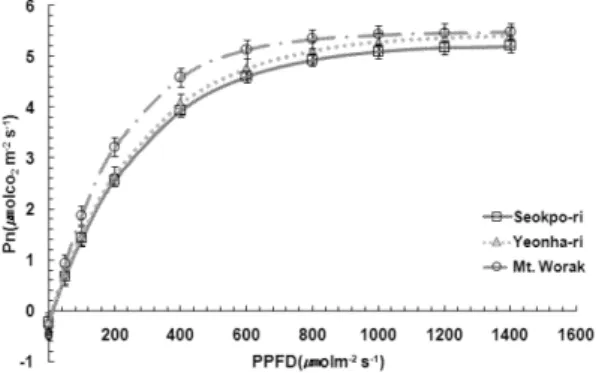
꼬리진달래 잎의 광특성을 알기 위하여 광-광합성 곡선을 Fig. 1에 나타냈다. 산지별 광보상점은 석포리 11.8µmol m−2 s−1, 연하리 11.5 µmol m−2 s−1, 월악 산 10.4 µmol m−2 s−1로 유의적인 차이가 나타나지 않았다. Larcher(1995)에 의하면 온대지방 낙엽활엽수
의 광보상점은 양엽의 경우 20~50 µmol m−2 s−1에 음엽이 10~15 µmol m−2 s−1의 범위를 나타낸다고 보 고하였는데, 꼬리진달래는 음엽의 특성을 가지며 약광 에서도 플러스 CO2수치를 유지하므로 매우 약한 광 량에서도 생육할 수 있는 생리적 특성을 갖고 있다는 것을 알 수 있다.
또한, 꼬리진달래의 광포화점은 500~600 µmol m−2 s−1로 Lee 등(1990)이 보고한 조경수로 이용하기 위한 화분이식 꼬리진달래와 같은 범위를 보였으며(Table 2), 약한 음수성으로 보고된 음나무의 광포화점 800~
1,200µmol m−2 s−1과 비교해 보면 꼬리진달래는 음수 의 생리적 특성을 나타냈다(Han et al., 2005).
광포화이후 최대순광합성속도를 평균으로 하는 광합 성 능력(Kim and Lee, 2001a; 2001b)은 석포리 5.5 µmol · CO2 m−2 s−1, 연하리 5.4 µmol · CO2 m−2 s−1, 월악산 5.6 µmol · CO2 m−2 s−1로 유의적인 차이가 나 타나지 않았다(Table 2).
온도 변화에 따른 자생지별 꼬리진달래의 순광합성 속도를 알아보기 위해 포화광도 1,200 µmol m−2 s−1 을 유지한 후 온도를 변화시켜 순광합성속도를 산출하 Fig. 1. Light response curves of R. micranthum by the natu- ral habitat. Measurements were made at 25oC chamber temperature, values are mean ± S.D. (n = 20).
Table 2. Values of light saturation point, light compensation point and Photosynthetic capacity of R. micranthum by the natu- ral habitat.
Natural habitat Light saturation point (µmol m−2 s−1)
Light compensation point (µmol m−2 s−1)
Photosynthetic capacity (µmol m−2 s−1)
Seokpo-ri 600 *11.8 ± 1.72* 5.5 ± 0.18
Mt. Worak 500 10.4 ± 1.56 5.6 ± 0.20
Yeonha-ri 600 11.5 ± 1.64 5.4 ± 0.13
*Values are mean ± S.D. (n = 6).
였다(Fig. 2). 꼬리진달래의 온도별 평균 광합성 속도 를 보면, 20~30oC 온도역에서 높은 광합성 속도를 유 지하는 것으로 나타났으며, 그 중 25oC에서 가장 활 발한 광합성을 하는 것으로 나타나 Lee 등(1990)에 의한 종자 발아시 최적의 온도와 같은 값을 나타냈다.
20oC 이하의 온도역에서는 월악산이 가장 높은 광합성
속도를 보였고, 35oC의 고온에서는 연하리가 비교적 높은 광합성 속도를 유지하는 것으로 나타났다(Fig. 2).
포화광도 1,200 µmol m−2 s−1일때의 기공전도도, 기 공증산속도, 수분이용효율을 Fig. 3에 나타냈다. 기공닫 힘은 순광합성속도를 제한하는 중요한 인자이며(Faria et al., 1996), 기공전도와 기공증산속도는 광에 대한 기공닫힘 반응을 알 수 있는 중요한 인자이다.
Koerner(1994)에 따르면 일반적인 목본식물의 기공 전도도는 190~280 mmol m−2 s−1의 범위라고 보고하 였는데, 꼬리진달래의 경우에도 이 범위에 속하는 것을 알 수 있었다. 자생지별로는 연하리의 기공전도도가 137 mmol m−2 s−1을 나타내어, 약 250 mmol m−2 s−1 의 범위를 나타낸 석포리와 월악산에 비해 낮았으며, 기공증산속도 역시 연하리가 더 낮게 나타났다. 3지역 의 꼬리진달래 모두 광합성 능력은 거의 비슷한 것으 로 보아 연하리의 수분이용효율이 석포리와 월악산에 비해 더 높은 것은 포화광도에서 낮은 기공증산속도로 나타난 결과임을 알 수 있었다.
Fig. 2. Change of temparture on net photosynthetic rate of R. micranthum by the natural habitat. Values are mean ± S.D. (n = 20). Means with different letters on bar are sig- nificantly different at P < 0.05, which are testified with one ANOVA test and Duncan’s multiple range test.
Fig. 3. Effects of PPFD 1,000µmol m−2 s−1 on stomatal conductance (gH2O), stomatal transpiration rate (E) and water use efficience (WUE) of R. micranthum by the natural habitat. Values are mean ± S.D. (n = 10). Means with different letters on bar are significantly different at P < 0.05, which are testified with one ANOVA test and Duncan’s multiple range test.
Table 3. Contents of chlorophyll a, b, a + b and a/b ratio in R. micranthum by the natural habitat.
Natural habitat Chlorophyll content Chlorophyll a/b
(mg/g) Chlorophyll a (mg/g) Chlorophyll b (mg/g) Chlorophyll a + b (mg/g)
Seokpo-ri *2.53 ± 0.65a* 1.28 ± 0.30a 3.81 ± 0.95a 1.97 ± 0.06a
Yeonha-ri 2.66 ± 0.17a 1.46 ± 0.14a 4.12 ± 0.32a 1.82 ± 0.06a
Mt. Worak 2.48 ± 0.22a 1.32 ± 0.27a 3.80 ± 0.26a 1.87 ± 0.44a
*Values are mean ± S.D. (n = 6).
Means with different letters are significantly different at P < 0.05, which are testified with one ANOVA test and Duncan’s multiple range test.
2. 엽록소 함량
꼬리진달래의 자생지별 엽록소 a, b 및 총 엽록소 함량 모두 연하리가 다른 두 지역보다 높게 나타났다 (Table 3). 자생지별로 함량의 차이를 보였으나 통계적 인 차이는 나타나지 않았으며, 자생지별 엽록소 함량의 일정한 경향이 나타나지 않았다. Lee 등(1990)이 보고 한 화분에 이식한 꼬리진달래의 개화 전, 후의 꼬리진 달래 엽록소 함량보다 비교적 높은 경향을 나타냈으며 (Fig. 4), 엽록소 a/b는 자생지별로 유의적인 차이가 없었다.
적 요
자생지별 꼬리진달래의 생리반응을 측정한 결과 광 보상점은 석포리 11.8 µmol m−2 s−1, 연하리 11.5 µmol m−2 s−1, 월악산 10.4 µmol m−2 s−1로 나타났으며, 광 포화점은 500~600 µmol m−2 s−1 범위로 나타나 음수 의 생리적 특성을 갖고 있었다. 광포화시의 광합성 능 력은 석포리 5.5 µmol m−2 s−1, 연하리 5.4 µmol m−2 s−1, 월악산 5.6 µmol m−2 s−1로 나타나 광보상점과 광포화점, 광합성 능력은 자생지별로 유의적인 차이가 나타나지 않았다.
온도 변화에 따른 자생지별 꼬리진달래의 순광합성 속도는 3지역 모두 20~30oC 온도역에서 높은 광합성 속도를 유지하는 것으로 나타났으며, 그 중 25oC에서 가장 활발한 광합성을 하는 것으로 나타났다.
연하리의 수분이용효율이 석포리와 월악산에 비해 더 높은 것은 포화광도에서 낮은 기공증산속도로 인한 결 과였으며, 꼬리진달래의 자생지별 엽록소 a, b 및 총
엽록소 함량은 유의적 차이가 없는 것으로 나타났다.
위의 결과를 통해 꼬리진달래는 음수의 특성을 가지 며, 생육에 적합한 온도는 20~30oC인 것을 알 수 있 었다.
주제어 : 광합성, 엽록소, 꼬리진달래
사 사
본 연구는 산림청 ‘산림과학기술개발사업(과제번호:
S211011L020100)’의 지원과 2007년도 강원대학교 학 술연구조성비로 수행된 연구임(120070809). 이에 감사 드립니다.
인 용 문 헌
1. Arnon, D.I. 1949. Copper enzymes in isolated chloro- plasts polyphenoloxidase in Beta Vulgaris. Plant Phys- iology 24(1):1-15.
2. Caemmerer, S. and G.D. Farquhar. 1981. Some rela- tionships between the biochemistry of photosynthesis and the gas exchange of leaves. Planta. 353:376-387.
3. Faria, T., J.I. Garcia-Plazaola, A, Abadia, S. Cerasoli, J.S. Pereira, and M.M. Chaves. 1996. Diurnal changes in photoprotective mechanisms in leaves of cork oak (Quercus suber) during summer. Tree Physiology 16:
115-123
4. Han, S.S., D.S. Jeon, and J.S. Sim. 2005. Effect of light, temperature, water changes on physiological responses of Kalopanax pictus leaves(1)- characteris- tics of photosynthesis and respiration of leaves by the light intensity-. Journal of Forest Science 21:83-91 (in Korean).
5. Hiscox, J.D. and G.F. lsraelstam. 1978. A method for the extraction of chlorophyll from leaf tissue without maceration. Canadian Journal of Botany. 57(12):1332- 1334.
6. Kim, N.Y., K.C. Lee, S.S. Han, and W.G. Park. 2010.
Water relations parameters of Rhododendron micran- thum from P-V curves. Korean Journal of Plant Resource 23(4):374-378.
7. Kim, P.G. and E.J. Lee. 2001a. Ecophysiology of pho- tosynthesis 1: Effects of light intensity and intercellu- lar CO2 pressure on photosynthesis. Korean Journal of Agricultural and Forest Meteorology 3(2):126-133 (in Korean).
8. Kim, P.G. and E.J. Lee. 2001b. Ecophysiology of pho- tosynthesis 2: Adaptation of the photosynthetic appara- tus to changing environment. Korean Journal of Fig. 4. Contents of Chlorophyll a, b, a + b of R. micran-
thum by the natural habitat. Values are mean ± S.D. (n = 6). Means with different letters on bar are significantly different at P < 0.05, which are testified with one ANOVA test and Duncan’s multiple range test.
Agricultural and Forest Meteorology 3(3):171-176 (in Korean).
9. Kume, A. and Y. Ino. 1993. Comparison of ecolphysi- ological response to heavy snow in two varieties of Acuba japonica with different areas of distribution.
Ecological Reserch 8:111-121.
10. Koerner, C.H. 1994. Lear diffusive conductances in the major vegetation types of the globe In: Schulze E- D, Caldwell M.M. (eds.) Ecophysiology of Photosyn- thesis (Eco-logical Studies, vol. 100). Springer. Berlin.
pp. 463-490.
11. Larcher, W. 1995. Physiological Plant Ecology. Springer- Verlag. Berlin. 506pp.
12. Lee, T.B. 1980. Illustrated Flora of Korea. Hyang- munsa. 990pp (in Korean).
13. Lee, B.R., K.E. Lee, and K.C. Yoo. 1990. A study on the wild Rhododendron micranthum for landscape use - With special reference to photosynthesis -. The Korean Institute of Landscape Architecture. 31(4):400- 404 (in Korean).