488
©The Korean Society of Food Science and Technology
제2형 당뇨 모델 KK-A
y마우스에 대한 발효 녹차의 항당뇨 효과
이소영·박소림·남영도·이성훈·임성일*
한국식품연구원 발효기능연구단Anti-diabetic Effects of Fermented Green Tea in KK-A
yDiabetic Mice
So-Young Lee, So-Lim Park, Young-Do Nam, Sung-Hun Yi, and Seong-Il Lim* Fermentation and Functionality Research Group, Korea Food Research Institute
Abstract The anti-diabetic effect of green tea fermented by cheonggukjang was evaluated using KK-Ay mice, an animal model of type 2 diabetes mellitus. Over a 90 day testing period, food and water intake decreased significantly in the group fed fermented green tea (FGT) and a group fed commercially available health functional food (PC), when compared with a diabetic control group (DC). The blood glucose levels of FGT mice were lower than in DC mice throughout the test period and were similar to the levels in PC after 60 days. Levels of Hemoglobin A1c (HbA1c) levels and insulin resistance were lower in mice of the FGT group than in mice of the DC group. DNA microarray analysis showed that administration of FGT increased the abundance of 12 mRNA transcripts related to diabetes. Whereas FGT increased hexokinase transcripts related to glycolysis more than 37 fold, levels of Pdx1 (pancreatic and duodenal homeobox1) and Cacna1e (calcium channel) transcripts increased more than 1.8 fold.
Keywords: KK-Ay, type 2 diabetes mellitus, solid fermented material, green tea, DNA microarray
서
론
대한당뇨병학회와 건강보험심사평가원에서 공동으로 실시한 한 국인 당뇨병 역학조사 결과에 따르면 2005년 국내 당뇨병으로 고 통받는 환자는 270만명(전체 인구의 7.7%)이며, 2020년에는 455 만명(전체 인구의 8.97%), 2030년에는 545만명(전체 인구의 10.85%)에 이를 것으로 추정되고 있다(1). 당뇨병은 발병 원인에 따라 제1형 당뇨와 제2형 당뇨로 구분되는데, 전체 당뇨병의 90% 에 해당하는 제2형 당뇨병은 근육, 간, 지방조직에서 인슐린 저 항성으로 인해 인슐린 작용이 충분하지 못하거나 췌장의 베타세 포가 인슐린 저항성을 극복할 수 있을 만큼 인슐린을 분비하지 못하여 혈중 포도당 농도가 높게 지속될 때 유발된다. 지속적인 고혈당은 당질뿐만 아니라 지질 및 단백질 대사에도 이상을 초 래하여 신장 기능의 저하, 동맥경화, 망막 출혈로 인해 시력 저 하, 족부 궤양, 말초신경병증 등 다양한 합병증을 유발하는데, 2007년 당뇨 합병증인 말초순환장애 및 당뇨병성 망막증 환자의 경우 전년 대비 각각 60% 및 36% 가량 증가한 것으로 나타났 다(1). 이처럼 당뇨병은 그 자체의 발병률이 점차 증가하고 있을 뿐만 아니라, 수반되는 합병증 발병률이 높다는 특성을 가지고 있어 의료비용(건강보험 총 진료비의 5분의 1이 당뇨병 환자 총 진료비) 및 인력손실 등 막대한 사회적 손실이 발생하고 있다(1). 따라서 최근에는 이러한 손실을 막기 위해 당뇨병으로 진행되기 전인 내당능 장애(공복혈당 100-126 mg/dL)를 가진 사람을 대상 으로 한 당뇨예방 소재 발굴연구가 활발히 이루어 지고 있다. 현 재 사용되고 있는 경구혈당강하제로는 베타세포에서 인슐린 분 비를 직접 자극하는 sulfonylurea와 non-sulfonylurea계(2), 간에서 포도당 합성을 억제하는 biguanide계(3), 장에서 포도당 흡수를 억 제하는 α-glucosidase 저해제(4), 말초조직에서의 인슐린 저항성을 개선시키는 thiaxolinedione(5) 등이 있다. 그러나 이들 혈당 강하 제는 젖산 축적의 위험성, 신부전 증상의 악화, 간독성, 복부팽만 등의 부작용(3,4,6-8)을 나타내는 위험요소를 포함하고 있어 장기 복용에 따른 위와 같은 부작용의 위험성을 해소할 수 있는 혈당 강하 소재의 개발이 절실한 실정이다. 이러한 현실과 더불어 대 체의료 개념이 부각되면서, 엉겅퀴(9), 흑삼(10) 과 같은 천연물 의 항당뇨 활성에 대한 연구가 진행되고 있으며, 국내 뿐 아니라 일본 및 미국을 중심으로 Mori folium(11) 및 Psidiium guajava (12) 등 당뇨병 환자를 위한 기능성 식품이 다양하게 개발되고 있다. 한편, 최근 들어 천연물의 생리활성을 증진시키는 주요한 기술 로 발효가 각광받고 있는데, 발효를 통한 홍삼의 유효성분 증진 (13), 천연물의 항산화 활성 증대(14) 및 항염증 활성 증대(15) 등 의 연구가 보고 되고 있어 발효가 천연물의 생리활성을 증진시 키는 효과적인 방법임이 입증되고 있다. EGCG, EGC 및 EC 등 의 chatechins과 gallic acid를 다량 함유하고 있는 녹차(16)는 항 산화(17), 항균(18), 항당뇨(19), 항비만(20), 콜레스테롤 저하 효과 (21) 등의 다양한 기능성을 가지는 대표적인 생리활성 천연물로 서, 발효를 통한 녹차의 기능성 증진에 관한 연구도 다수 보고되 고 있다(22-29). 그러나 이들 연구는 oxidative enzyme의 작용에 의해 발효된 산화발효차(22-24)에 대한 연구가 대부분이며, 미생 물을 이용하여 발효한 녹차의 기능성에 관한 연구는 Monascus *Corresponding author: Seong-Il Lim, Fermentation andFunctional-ity Research Group, Korea Food Research Institute, Seongnam, Gyeonggi 463-746, Korea
Tel: 82-31-780-9277 Fax: 82-31-709-9876 E-mail: [email protected]
Received February 25, 2013; revised April 22, 2013; accepted April 24, 2013
spp.(25), Penisillium spp. 및 Aspergillus spp.(26-28) 등의 곰팡이 나 Lactobacillus sp.(29)를 이용하여 제조한 발효녹차에 관한 연 구가 보고된 바 있으나, Bacillus spp. 균주를 이용하여 발효한 녹 차의 항당뇨 활성에 대한 연구는 보고된 바 없다. 이에 본 연구에서는 항당뇨 관련 건강기능식품소재를 개발하 기 위해 Bacillus spp. 균주들이 포함된 청국장 분말을 이용하여 발효녹차를 제조하고, 발효녹차의 제2형 당뇨모델 마우스 KK-Ay 에 대한 혈당강하 효과를 확인하고 기전 구명을 통해 건강기능 식품으로서의 이용 가능성을 조사하였다.
재료 및 방법
녹차 발효물 제조 시중에 판매되고 있는 청국장 중 주요 균총이 Bacillus sp. KCTC 11351BP, Bacillus subtilis KCTC 11352BP, Bacillus sono-lensis KCTC 11354BP 및 Bacillus circulans KCTC 11355B인 청국장을 동결 건조한 후, hot kneader (300-500 L, Daehan Food Machine, Inc., Gyeonggi, Korea)를 이용하여 82.5±2.5oC에서 4시 간 동안 열처리한 녹차분말에(Ingreen, Seoul, Korea) 1% 비율(w/ w)로 첨가하였다. 총 중량의 40%에 해당하는 수분을 공급한 후 시료를 발효통에 충진시키고 온도 25oC, 습도 60% 조건에서 30 일 동안 고체발효를 진행하였다. 82.5±2.5oC에서 2시간 1차 건조 한 후, 82.5±2.5oC에서 2시간 열풍 건조하여 수분 3% 이하의 녹 차 발효물을 제조하였다. 실험동물 및 식이제2형 당뇨모델인 KK-Ay (5주령, 수컷)를 Clea (Tokyo, Japan) 에서 구입하여 1주일간 순화시킨 후, 체중에 따라 난괴법에 의해 7마리씩 4군으로 분류하였다. 대조군은 AIN-93G 일반사료를 공 급하였으며, 양성대조군, 녹차 원료, 녹차 발효물 첨가군은 일반 사료에 각 시료를 0.4% 첨가한 사료를 제조하여 식이로 공급하 였다. 이때 양성대조군으로는 시판되고 있는 항당뇨 관련 건강기 능식품인 바나바 주정추출물을 사용하였다. 사육실 온도는 23±2oC, 습도는 50±5%, 명암주기는 12시간 간격으로 설정하고 물과 사 료를 자율 급식시켰다. 동물실험은 한국식품연구원 동물실험위원 회에서 승인(KFRI-M-10020)한 절차에 따라 수행하였다. 체중 및 식이섭취량 매 10일 마다 일정한 시간에 체중을 측정하였으며, 식이섭취량 및 수분 섭취량을 급여량과 잔여량의 차이로 측정하였으며 식이 효율(feed efficiency ratio: FER)은 체중 증가량을 식이 섭취량으 로 나누어 계산하였다.
혈당 및 당화혈색소 측정
혈당은 공복시간 없이 매 10일 마다 90일 동안 일정한 시간에 꼬리정맥으로부터 전혈을 채취하여 혈당스트립(ACCU-CHEK Sensor, Roche, Basel, Switzerland)을 이용하여 측정하였다. 당화혈 색소(HbA1c)는 실험식이 종료 후 16시간 절식 시킨 마우스의 안 와 정맥에서 전혈을 취하여 A1c 측정용 카트리지에 주입한 후, 당화혈색소 측정기(Easy A1c, Asan pharmaceutical, Seoul, Korea) 이용하여 측정하였다. 혈청 glucose 및 insulin 함량 측정 16시간 절식 시킨 후 마우스의 안와 정맥을 통해 채혈한 혈액 을 3000 rpm에서 10분간 원심분리하여 혈청을 분리하였다. 상등 액 4 µL를 취해 tinder 시약 1 mL을 첨가한 후 상온에서 18분 방 치한 후 505 nm에서 흡광도를 측정하고 glucose 표준곡선을 이용 하여 혈중 포도당 농도를 산출하였으며, insulin 함량은 SHIBAY-AGI사의 mouse insulin ELISA kit (TMB type, Shibukawa, Japan)를 이용하여 측정하였다. 측정된 혈청 glucose 및 insulin 함 량으로부터 HOMA-IR을 구하였다.
HOMA-IR=(fasting insulin (IU/mL)×fasting glucose (mg/dL))/405 혈청 Triglyceride, total cholesterol, HDL-cholesterol, LDL-cholesterol
분석을 위한 혈청은 glucose 및 insulin 함량 측정 시 사용한 혈 청과 동일한 조건으로 준비하였다. Triglyceride, total cholesterol, HDL-cholesterol, LDL-cholesterol은 ADVIA automated hematol-ogy analyzer (Bayer ADVIA 1650, Tarrytown, NY, USA)를 이 용하여 측정하였다.
DNA microarray 분석
대조군, 녹차 식이군 및 발효녹차 식이군의 간 조직에서 RNA 를 추출한 후 Agilent’s Low RNA input amplication kit (Agilnet tech., Wilmington, DE, USA) 프로토콜에 따라 cy3 또는 cy5가 결합된 aminoallyl-UTP로 RNA를 증폭시켜 cy3/cy5가 표지된 cDNA를 합성하고 이를 정량 및 정성 분석하여 assembled Agi-lent’s Mouse Oligo Microarray (44K)와 65oC에서 17시간 동안 hybridization 시켰다. Hybridization 된 이미지는 Agilent’s DNA microarray scanner로 분석하였으며, Feature Extraction Software (Agilent Technology, Palo Alto, CA, USA)를 이용하여 각 유전자 의 발현 정도를 정량적으로 측정하였다. 모든 데이터의 normal-ization과 fold-changed genes의 선별은 GeneSpringGX 7.3 (Agi-lent Technology)를 이용하여 분석하였으며, 발현된 유전자의 기 능분석을 위해 Gene Ontology TM Consortium (http://www.gene-ontology.org/index.shtml)을 이용하였다. 유전자 classification은 Bio-Carta (http://www.biocarta.com/), GenMAPP (http://www.genmapp. org/), DAVID (http://david.abcc.ncifcrf.gov/), 및 Medline databases (http://www.ncbi. nlm.nih.gov/)를 이용하였다.
통계처리
실험결과는 SAS 9.1 (SAS Institute Inc., Carry, NC, USA)을 이 용해 평균값(mean)±표준편차(standard deviation)으로 표시하였고, 분산분석법(ANOVA)으로 분석하였다. 각 실험군 사이의 평균값들 에 대한 통계적 유의성 검증은 p<0.05 수준에서 Duncan’s multiple range test에 의해 검정하였다.
결과 및 고찰
체중, 식이효율 및 음수량 측정 체중변화 및 식이효율(FER)은 모든 실험구에서 유의적인 차이 는 없는 것으로 나타났다(Table 1). 그러나 음용수 섭취량의 경우 모든 실험구가 대조군에 비해 낮은 음용수 섭취량을 보였는데, 특 히 발효녹차 섭취군의 경우 음용수 섭취량이 시판 항당뇨 관련 건강기능식품을 섭취한 양성대조군과 유의적인 차이가 나지 않 을 정도로 감소하여 당뇨의 기본 증상 중 하나인 다음 증상 완 화에 도움이 되는 것으로 사료된다.혈당변화측정 녹차 및 발효녹차를 0.4% 첨가한 사료를 90일간 식이한 KK-Ay 마우스의 혈당변화는 Fig. 1과 같다. 나타냈다. 식이 공급 첫날 혈당은 모든 실험구에서 250-270 mg/dL 수준으로 각 군간의 차 이가 없었으나 실험 20일 이후 혈당 변화가 나타나기 시작하였 다. 대조군의 경우 20일차부터 혈당이 급격히 증가하기 시작하여 30일 이후에는 400 mg/dL 이상의 고혈당이 유지되었으나, 양성대 조군의 경우 90일간의 실험기간 동안 260-300 mg/dL 수준으로 혈 당 변화가 거의 없는 것으로 나타났다. 발효녹차 섭취군은 30일 까지 혈당이 380 mg/dL 정도로 증가한 후 50일까지 이 수준을 유지하다 60일부터는 실험종료일까지는 시판 건강기능식품인 양 성대조군과 유사한 수준으로 혈당이 감소되어 항당뇨 관련 건강 기능식품으로의 개발 가능성을 보였다. 녹차 투여 시 KK-Ay mouse(30), OLETF rat(31) 및 streptozotocin으로 당뇨를 유발한 wistar albino rat의 혈당을 효과적으로 강하시켰다는 연구결과(32) 와 마찬가지로 본 연구의 녹차 섭취군도 실험 후기에 혈당이 감 소하는 경향을 보였으나 발효녹차 섭취군 보다는 혈당조절 능력 이 떨어지는 것으로 미루어 보아 고체발효를 통해 녹차의 항당 뇨 활성이 증진된 것으로 판단된다. 녹차의 항당뇨 활성은 epi-catechin, epicatechin-3-gallate 및 epigallocatechin을 비롯한 cat-echin류의 α-glucosidase 저해 활성(33) 및 인슐린 민감성 향상(34) 에 의한 것으로 보고된 바 있다. 녹차에 풍부하게 존재하는 catechins류는 발효가 진행되는 과정에서 theaflavins, thearubigins, bisflavanol 및 gallic acid등의 물질로 전환되는데(16), 이들의 항 당뇨 활성은 FOXO1a phosphorylation, PEPCK repression(35) 및 Akt 활성화와 관련 있는 것으로 보고되었다(36). 본 연구에서 관 찰된 발효녹차의 항당뇨 활성도 이러한 theaflavin류의 작용에 일 부 기인한 것으로 생각되는데, 실험 후반에 두드러진 혈당강하효 과를 나타낸 점과 본 연구의 insulin 함량 측정결과 및 DNA microarray 실험 결과로 미루어 볼 때 식후혈당강하나 인슐린 유 사활성 보다는 인슐린 저항성 개선이나 베타세포의 기능조절을 통해 혈당을 감소시켰을 가능성이 높을 것으로 생각된다. 당화혈색소 HbA1c는 적혈구 생존기간인 약 3개월 동안에 일어나는 당화 반응의 변화에 따른 것이므로 약 3개월간의 혈당조절 상태를 나 타내며 정상인 내지 비당뇨인은 7% 이하 당뇨병 환자의 경우 10% 이상으로 나타나는 경우가 많다. 뿐만 아니라 당뇨병 진행 을 나타내는 의미 있는 지표로 HbA1c가 1% 감소할 때 마다 당 뇨 합병증인 심근경색 발생위험이 14%, 망막병증 등의 미세혈관 질환 발생 위험이 37% 감소하는 것으로 알려져 있다(37). 당화 혈색소를 분석한 결과(Fig. 2), 녹차 섭취군은 대조군과 유사한 수 준의 당화혈색소값을 보여 혈당 조절 능력이 거의 없는 것으로 나타났으나 발효녹차 섭취군의 당화혈색소값은 8.08±0.95%로 9.72 ±0.95%인 대조군 보다 유의적으로 낮게 측정되었으며, 8.96±0.83 인 양성대조군 보다도 낮은 수치를 보여 발효녹차 섭취를 통해 장기간 혈당조절이 가능하며, 당뇨로 인한 합병증 발병 위험도 감소시킬 수 있을 것으로 판단된다. 혈청 glucose 및 insulin 함량 일반적으로 혈당은 인슐린에 의해 조절되기 때문에 인슐린 분 비가 많으면 혈당이 떨어지게 되는데, 인슐린 저항성이 생기게 되면 인슐린 분비량이 많아져도 혈당은 잘 떨어지지 않아 정상 보다 높은 농도의 인슐린이 분비되는 보상성 고인슐린혈증 상태 Table 1. The weight gain and food/water consumption of KK-Ay
Intial body weight (g) Final body weight (g) Change of body weight (g) Food intake (g/day) FER(%) Water intake (g/day) Control 27.29±1.32 45.58±2.35 0.20±0.02 7.11±0.26b 2.53±0.24 22.28±2.61a Positive control 26.61±1.51 42.49±9.16 0.20±0.01 6.57±0.27c 2.94±0.25 16.54±3.50b Green tea 26.19±0.79 44.97±2.46 0.21±0.02 7.56±0.26a 2.78±0.33 b20.22±2.90ab Fermented Green tea 26.31±0.61 44.35±2.51 0.20±0.02 7.17±0.17b 2.72±0.25 19.59±1.15b
Each value represent the mean±SD (n=7).
a-cMeans with different superscripts in the same column are significantly different at the p<0.05 by Duncan’s multiple range test.
Fig. 2. Effect of fermented green tea on HbA1c (%) in KK-Ay after 90 days. Each value and bar represent the mean±SD (n=7). Different letters indicate a significantly different base on one-way ANOVA and the Duncan’s multiple range test (p<0.05).
Fig. 1. Effect of fermented green tea on blood glucose level in KK-Ay for 90 days. Each value and bar represent the mean±SD (n=7).
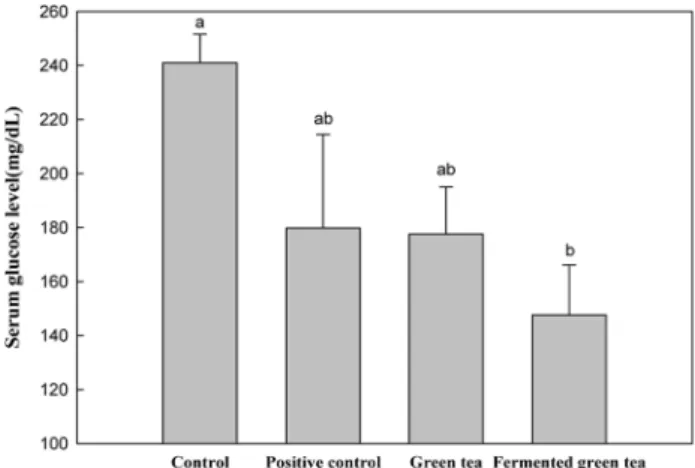
가 유발된다(38). KK-Ay mouse는 KK mouse에 yollow obese Ay 유전자를 도입한 genetically diabetic mouse로 생후 8 주령 이후 심각한 비만, 고혈당, 내당능, 인슐린 저항성과 함께 고인슐린혈 증이 유발된다고 알려져 있다(39). 본 실험에서도 대조군의 경우, 혈중 glucose 농도가 양성대조군, 녹차 및 발효녹차 섭취군에 비 해 유의적으로 높게 측정되었으며 혈청 인슐린 함량도 236.33 µΙU/ mL로 가장 높게 검출되어 insulin 함량이 높음에도 불구하고 혈 중 glucose 농도가 높은 고인슐린혈증 상태임을 알 수 있었다. 그 러나 나머지 실험군들은 대조군에 비해 고인슐린혈증이 개선되 었음을 알 수 있었는데, 특히 발효녹차 섭취군의 경우 insulin 농 도는 146.67 µΙU/mL로 대조군에 비해 약 48% 낮게 나타났음에 도 불구하고 glucose 농도는 154 mg/dL로 대조군보다 약 20% 감 소하여 고인슐린혈증 개선 효과가 큰 것으로 나타났다(Fig. 3, Fig. 4). 또한, 공복 혈당과 인슐린 농도를 바탕으로 인슐린 저항성 지 표인 HOMA-IR(40)을 계측한 결과(Fig. 5), 양성대조군, 녹차 섭 취군, 발효녹차 섭취군 모두 대조군 보다 HOMA-IR은 감소하였 으며, 특히 발효녹차 섭취군에서 이러한 현상이 두드러지게 나타 났다. 이와 같은 결과로부터 발효녹차는 인슐린 저항성 개선을 통해 고인슐린혈증 개선 및 혈당강하효과를 나타낸 것으로 판단된다. 혈중 지질 농도 제2형 당뇨병 환자에서 가장 흔히 나타나는 지질대사 이상은 고지혈증, 특히 유리지방산 저장 및 산화 장애로 간 내 유리지방 산의 유입 증가로 인한 간에서의 지방합성 및 very low density lipoprotein (VLDL)의 생성 증가와 lipoprotein lipase의 활성 감소 로 인해 유도되는 고중성지방혈증으로 20-60%의 빈도로 나타나 며, 이는 당뇨병 환자의 주된 사망요인인 죽상경화성 질환 발생 에 중요한 영향을 미친다(41-43). 실험결과(Table 2), 대조군의 중 성지방은 235.60±46.73 mg/dL으로 높은 수치를 보였으며 양성대 조군도 221.5±31.05 mg/dL로 대조군과 유사한 수준의 중성지방 수치를 보였으나, 녹차 및 발효녹차 섭취군은 각각 166.60± 12.69 mg/dL 및 184.67±16.82 mg/dL로 대조군에 비해 중성지방이 22-30% 가량 감소한 것으로 나타났다. 한편, 당뇨환자에서 발생 하는 또 다른 혈청지질 대사 이상으로 혈청 내 VLDL과 LDL 함 Fig. 4. Effect of fermented green tea on serum insulin level in
KK-Ay after 90 days. Each value and bar represent the mean±SD (n=7). Different letters indicate a significantly different base on one-way ANOVA and the Duncan’s multiple range test (p<0.05). Fig. 3. Effect of fermented green tea on serum glucose level in KK-Ay after 90 days. Each value and bar represent the mean±SD (n=7). Different letters indicate a significantly different base on one-way ANOVA and the Duncan’s multiple range test (p<0.05).
Fig. 5. Effect of fermented green tea on insulin resistance index HOMA score after 90 days. Each value and bar represent the mean ±SD (n=7). Different letters indicate a significantly different base on one-way ANOVA and the Duncan’s multiple range test (p<0.05).
Table 2. Effet of fermented green tea on serum total cholesterol, HDL-cholesterol, LDL-cholesterol, triglyceride level in KK-Ay (unit: mg/dL) Total cholesterol HDL-cholesterol LDL-cholesterol Triglyceride
Control 141.25±16.69 116.00±6.12b 9.60±2.06 235.60±46.73a
Positive control 144.80±12.54 0119.33±22.48b 9.75±3.90 221.50±31.05a Green tea 144.40±8.520 00120.00±25.82ab 9.67±1.70 166.60±12.69b Fermented Green tea 145.33±3.860 136.33±5.25b 9.00±1.00 184.67±16.82b
Each value represent the mean±SD (n=7).
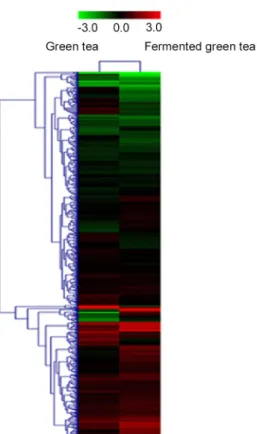
량 증가 및 HDL 콜레스테롤 감소가 흔히 나타나는데, 이는 동 맥경화성 관상동맥질환 또는 뇌혈관 질환의 발생율을 높일 수 있 다(44). 혈청지질 중 HDL 콜레스테롤은 LDL 콜레스테롤의 생성 을 억제하거나 혈관에 축적된 콜레스테롤을 감소시킴으로서 동 맥경화의 발생을 억제하는 작용을 한다(45). 본 실험결과(Table 2), total cholesterol과 LDL-cholesterol은 실험구간의 유의적인 차이가 없었으나, HDL-chlosterol은 녹차와 발효녹차 섭취군이 대조군에 비해 높게 검출되어 녹차 및 발효녹차 섭취가 당뇨로 인해 발생 하는 이상지질대사 개선에도 효과가 있는 것으로 생각된다. 녹차 의 이상지질혈증에 대한 녹차의 개선 활성에 관한 연구는 다수 보고된 바 있는데(46,47), 본 연구의 발효공정을 통해 제조한 발 효 녹차의 경우 녹차가 가진 이상지질혈증 개선활성은 유지하면 서 혈당조절활성만 증가된 것으로 판단된다. DNA-microarrrays 분석 발효녹차와 비발효녹차를 급여한 마우스의 간 조직에서의 유 전자 발현 변화를 분석하기 위해 간 조직에서 총 36,910개의 유 전자를 분석하였다. 이들 유전자가 up/down regulation되는 pattern 을 이용하여 Hierarchical clustering (HCL)을 수행하였다. HCL은 전체 유전자의 발현양상을 분석하여 그 패턴이 비슷한 유전자 또 는 투여군으로 묶어가는 방법으로 발현이 증가된 것은 붉은색, 발현이 감소한 것은 녹색으로 나타내었는데, 분석 결과, 녹차 및 발효녹차 급여 시 유전자의 발현량에 차이가 있음을 확인할 수 있다(Fig. 6). 유전자 데이터베이스는 NCBI gene과 KEGG path-way database의 PPAR signaling pathway, insulin signaling path-way, type I diabetes mellitus, type II diabetes mellitus와 관련한 Fig. 6. Hierarchical clustering analysis of gene expression data.
Expression profile data was derived from pooled RNA of the livers of KK-Ay treated with fermented green tea
Table 3. Differentially expressed genes in the liver of fermented green tea treated KK-Ay
Accession No Gene name Gene symbol Fold Function
NM-013820 Hexokinase 2 Hk2 34.70 Glycolysis
Glucose metabolic process
NM-013474 Apolipoprotein A-II Apoa2 3.68 PPAR signaling
NM-133360 Acetyl-Coenzyme A carboxylase alpha Acaca 2.56 Insulin signaling
NM-013963 Tumor necrosis factor Tnf 2.40 Insulin signaling
Glucose metabolic process NM-080464 Protein phosphatase 1, regulatory (inhibitor) subunit 3A Ppp1r3a 2.36 Insulin signaling
Glycogen metabolic process NM-008814 Pancreatic and duodenal homeobox 1 Pdx1 2.08 Insulin signaling
Protein amino acid phsphorylation NM-016979 Protein kinase, X-linked Prkx 1.93 Insulin signaling NM-009782 Calcium channel, voltage-dependent, R type,
alpha 1E subunit Cacna1e 1.89
Insulin signaling Glucose homeostasis Calcium ion transport NM-207692 Mitogen-activated protein kinase 9 Mapk9 1.87 Insulin signaling NM-009512 Solute carrier family 27 (fatty acid transporter), member 5 Slc27a5 1.86 PPAR signaling NM-028259 Ribosomal protein S6 kinase, polypeptide 1 Rps6kb1 1.86 PPAR signaling NM-010011 Cytochrom P450, Family 4, sunfamily a, polypeptide 10 Cyp4a10 1.84 PPAR signaling NM-001033599 Acyl-CoA synthetase long-chain family member 6 Acsl6 0.48 PPAR signaling
NM-010554 Interleukin 1 alpha Il1a 0.48 Type 1 diabetes mellitus NM-008839 Phosphatidylinositol 3-kinase, catalytic, alpha polypeptide Pik3ca 0.45 Insulin signaling NM-009231 Son of sevenless homolog 1 (Drosophila) Sos1 0.45 Insulin signaling NM-153679 Carnitine palmitoyltransferase 1c Cpt1c 0.42 PPAR signaling AK-052374 Phosphodiesterase 3A, cGMP inhibited Pde3a 0.39 Insulin signaling NM-133656 v-crk sarcoma virus CT10 oncogene homolog (avian) Crk 0.38 Insulin signaling
NM-019388 CD86 antigen Cd86 0.34 Type 1 diabetes mellitus
NM-028817 Acyl-CoA synthetase long-chain family member 3 Acsl3 0.34 PPAR signaling Fatty acid metabolic process
유전자를 이용하였으며, 총 924개 유전자를 대상으로 조사하였 다. 발효녹차 식이 마우스에서 발현량이 증가한 유전자는 161개 였으며, 반대로 발현량이 감소한 유전자는 91개로 나타났다. 이 중에서 제2형 당뇨와 연관성이 있고 대조군에 비해 1.8 fold 이 상 up-regulation된 유전자 12개와 제2형 당뇨와 연관성이 있으면 서 0.5 fold 이하 down-regulation된 유전자 9개를 선별하였다 (Table 3). 발효녹차 식이에 의해 up-regulation된 유전자 중 hexokinase 2 (HK2) gene은 glucose(48)와 insulin(49)에 의해 조절되는 gene으 로 glucose의 glucose-6-phosphate (G-6-P)로의 전환에 작용하여 glycolysis에 관여하는 주요 효소이며, diabetic rat(50), mice(51) 그 리고 인슐린 비의존성 당뇨병 환자(52)에서 그 발현이 감소되었 다고 보고된바 있는데, 본 연구에서 glycolysis 관련 gene인 HK2 는 발현이 34.70배 증가하였다. 또한 발효녹차 식이에 의해 베타 세포의 성숙에 관여하는 pdx의 발현(53)이 2.08배 증가하였으며, 베타세포 function과 관련된 gene으로 이 유전자가 결손된 mouse 에서 고혈당 및 내당능 장애가 보고된바 있는 CACNA1e gene(54, 55)이 1.89배 증가하는 것으로 나타났다. 이로 미루어 보아 발효 녹차의 항당뇨 효과에는 glycolysis 활성화를 통한 glucose 이용율 증가 및 베타세포 function 증진이 관여하였음을 추론할 수 있다.
요
약
제2형 당뇨질환모델인 KK-Ay를 이용하여 녹차와 발효녹차의 항당뇨 활성을 측정한 결과, 발효 녹차는 비발효녹차에 비해 높 은 항당뇨 활성이 있는 것으로 분석되었다. 발효녹차 섭취군의 혈당은 당뇨 대조군보다 낮게 유지되었으며, 60일 이후에는 시판 건강기능식품 섭취군(양성대조군)과 유사한 수준으로 유지되었을 뿐만 아니라 당화혈색소값도 8.08%로 대조군 및 양성대조군 군 보다 낮게 나타났다. 간 조직의 DNA microarray 분석결과, 이러 한 발효녹차의 항당뇨 활성은 glycolysis 활성화를 통한 glucose 이용율 및 베타세포 function 증가에 의한 것으로 사료된다. 또한 발효녹차는 혈중 triglyceride 수치를 낮추고 HDL-cholesterol 수치 를 높이는 등 당뇨로 인해 발생할 수 있는 지질대사이상 개선에 도 효과가 있음을 알 수 있었다. 이로 미루어 보아 발효녹차는 항당뇨 관련 건강기능식품으로의 상업적 이용가능성이 높을 것 으로 생각된다.감사의 글
본 연구는 농림수산식품부 고부가식품기술개발사업에 의해 수 행된 것으로 이에 감사드립니다.References
1. Korean Diabetes Association, Health Insurance Review & Assess-ment Service. Report of Task Force Team For Basic Statistical Study of Korean Diabetes Mellitus: Diabetes in Korea 2007. 1st ed. Goldfishery, Seoul, Korea (2008)
2. Levetan C. Oral antidiabetic agents in type 2 diabetes. Curr. Med. Res. Opin. 23: 945-952 (2007)
3. Krentz AJ, Bailey CJ. Oral antidiabetic agents: current role in type 2 diabetes mellitus. Drugs 63: 385-411 (2005)
4. Clissold SP. Edwards C. Acarbose: a preliminary review its phar-macodynamic and pharmacokinetic properties and therapeutic potential. Drugs 35: 214-243 (1988)
5. Diamant M, Heine RJ. Thiazolidinediones in type 2 diabetes mel-litus: current clinical evidence. Drugs 63: 1373-1405 (2003)
6. Stumvoll M, Nurjhan N, Perriello G, Dailey G, Gerich JEN. Met-abolic effects of metformin in non-insulin-dependent diabetes mellitus. New Engl. J. Med. 333: 550-554 (1995)
7. Barnett D, Craig JG, Robinson DS, Rogers MP. Effect of clofi-brate on glucose tolerance in maturity onset diabetes. Brit. J. Clin. Pharmaco. 4: 455-458 (1977)
8. Murphy EJ, Davern TJ, Shakil AO, Shick L, Masharani U, Chow H, Freise C. Lee WM, Bass NM. Troglitazone-induced fulminant hepatic failure. Acute Liver Failure Study Group. Digest. Dis. Sci. 45: 549-553 (2000)
9. Han HK, Je HS, Kim GH. Effect of Cirsium japonicum powder on plasma glucose and lipid level in streptozotocin induced dia-betic rats. Korean J. Food Sci. Technol. 42: 343-349 (2010) 10. Kun SN, Kang SJ. Effect of black ginseng (9 times steaming
gin-seng) on hypoglycemic action and changes in the composition of ginsenosides on the steaming process. Korean J. Food Sci. Tech-nol. 41: 77-81 (2009)
11. Iizuka Y, Sakurai E, Tanaka Y. Antidiabetic effect of folium mori in GK rats. Yakugaku zasshi 121: 365-369 (2001)
12. Oh WK, Lee CH, Lee MS, Bae EY, Sohn CB, Oh H, Kim BY, Ahn JS. Antidiabetic effects of extracts from Psidium guajava. J. Ethnopharmacol. 96: 411-415 (2005)
13. Bae EA, Kim NY, Han MJ, Choo MK, Kim DH. Transformation of ginsenosides to compounds K (IH-901) by lactic acid bacteria of human intestine. J. Microbiol. Biotechnol. 13: 9-14 (2003) 14. Kusznierewicz B, Smiechowska A, Bartoszek A, Namiesnik J.
The effect of heating and fermenting on antioxidant properties of white cabbage. Food Chem. 108: 853-861 (2008)
15. Han CC, Wei H, Guo J.Anti-inflammatory effects of fermented and non-fermented sophora flavescens: a comparative study. BMC Complem. Altern. M. 11: 100-106 (2011)
16. Cabrera C, Artacho R, Gimenez R. Beneficial effects of green tea-a review. J. Am. Coll. Nutr. 25: 79-99 (2006)
17. Xu J, Zhu SG, Yang FM, Cheg LC, Hu Y, Pan GX, Hu QH. The influence of selenium on the antioxidant activity of green tea. J. Sci. Food Agr. 83: 451–455 (2003)
18. Yee YK. Koo MW. Anti-helicobacter pylori activity of Chinese tea: in vitro study. Aliment. Pharm. Ther. 14: 635-638 (2000) 19. Sabu MC, Smitha K, Kuttan R. Anti-diabetic activity of green tea
polyphenols and their role in reducing oxidative stress in experi-mental diabetes. J. Ethnopharmacol. 83: 109-116 (2002)
20. Zheng G, Sayama K, Okubo T, Juneja LR, Oguni I. Anti-obesity effects of three major components of green tea, catechins, caf-feine and theanine in mice. In Vivo 18:55-62 (2004)
21. Yang TT, Koo MW. Chinese green tea lowers cholesterol level through an increase in fecal lipid excretion. Life Sci. 66: 411-423 (2000)
22. Feng Q, Torii Y, Uchida K, Nakamura Y, Hara Y, Osawa T. Black tea polyphenols, theaflavins, prevent cellular DNA damage by inhibiting oxidative stress and suppressing cytochrome P450 IAI in cell culture. J. Agr. Food Chem. 50: 213-220 (2002) 23. Kuo KL, Weng MS, Chiang CT, Tsai YJ, Lin-Shiau SY, Lin JK.
Comparative studies on the hypolipidemic and growth effects of oolong, black, pu-erh, and green tea leaves in rats. J. Agr. Food Chem. 53: 480-489 (2005)
24. Gomes A, Vedasiromoni JR, Das M, Sharma RM, Ganguly DK. Anti-hyperglycemic effect of black tea (Camellia sinensis) in rat. J. Ethnopharmacol. 45: 223-226 (1995)
25. Lee SI, Lee YK, Kim SD, Yang SH, Suh JW. Dietary effects of post-fermented green tea by Monascus pilosus on the body weight serum lipid profiles and the activities of hepatic antioxida-tive enzymes in mouse fed a high fat diet. J. Appl. Biol. Chem. 55: 85-94 (2012)
26. Chen YS, Liu BL, Chang YN. Bioactivities and sensory evalua-tion of pu-erh teas made from three tea leaves in an improved pile fermentation process. J. Biosci. Bioeng. 109: 557-563 (2010) 27. Huang HC, Lin JK. Pu-erh tea, green tea, and black tea
sup-presses hyperlipidemia, hyperleptinemia and fatty acid synthase through activating AMPK in rats fed a high-fructose diet. Food Funct. 3: 170-177 (2012)
28. Huang Q, Chen S, Chen H, Wang Y, Wang Y, Hochstetter D, Xu P. Studies on the bioactivity of aqueous extract of pu-erh tea and
its fraction: in vitro antioxidant activity and α-glycosidase inhibi-tory property, and their effect on postprandial hyperglycemia in diabetic mice. Food Chem. Toxicol. 53: 75-83 (2013)
29. Park JH, Kim Y, Kim SH. Green tea extract (Camellia sinensis) Fermented by Lactobacillus fermentum attenuated alcohol-induced liver damage. Biosci. Biotech. Bioch. 76: 2294-2230 (2012) 30. Miura T, Koike T, Ishida T. Antidiabetic activity of green tea
(Thea sinensis L). in genetically type 2 diabetic mice. J. Health Sci. 51: 708-710 (2005)
31. Lee BR, Koh KO, Park PS. Anti-hyperglycemic effects of green tea extract on alloxan-induced diabetic and OLETF rats. J. Korean Soc. Food Sci. Nutr. 36: 696-702 (2007)
32. Kumar B, Gupta SK, Nag TC, Srivastava S, Saxena R. Green tea prevents hyperglycemia-induced retinal oxidative stress and inflammation in streptozotocin-induced diabetic rats. Ophthalmic Res. 47: 103-108 (2012)
33. Kamiyama O, Sanae F, Ikeda K, Higashi Y, Minami Y, Asano N, Adachi I, Kato A. In vitro inhibition of α-glucosidases and gly-cogen phosphorylase by catechin gallates in green tea. Food Chem. 122: 1061-1066 (2010)
34. Anderson RA, Polansky MM. Tea enhances insulin activity. J. Agr. Food Chem. 50:7182-7186 (2002)
35. Cameron AR, Anton S, Melville L, Houston NP, Dayal S, McDougall GJ, Stewart D, Rena G. Black tea polyphenols mimic insulin/insulin-like growth factor-1 signalling to the longevity fac-tor FOXO1a. Aging Cell 7: 69-77 (2008)
36. Ma X, Tsuda S, Yang X, Gu N, Tanabe H, Oshima R, Matsuch-ita T, Egawa T, Dong AJ, Zhu BW, Hayashi T. Pu-erh tea hot-water extract activates Akt and induced insulin-independent glu-cose transport in rat skeletal muscle. J. Med. Food 16: 259-262 (2013)
37. Stratton IM, Adler AI, Neil HAW, Matthews DR, Manley SE, Cull CA, Hadden D, Turner RC, Holman RR. Association of gly-caemia with macrovascular and microvascular complications of type 2 diabetes (UKPDS 35): prospective observational study. Brit. Med. J. 321: 405-412 (2000)
38. Shanik MH, Xu Y, Skrha J, Dankner R, Zick Y, Roth J. Insulin resistance and hyperinsulinemia. Diabetes Care 31: S262-S268 (2008)
39. Srinivasan K, Ramarao P. Animal models in type 2 diabetes research: An overview. Indian J. Med. Res. 125: 451-472 (2007) 40. Mattews DR, Hosker JP, Rudenski AS, Naylor BA, Treacher DF,
Turner RC. Homeostasis model assessment: insulin resistance and beta-cell function from fasting plasma glucose and insulin con-centration in man. Diabetologia 28: 412-419 (1985)
41. Krauss RM. Lipids and lipoproteins in patients with type 2 diabe-tes. Diabetes Care 27: 1496-1504 (2004)
42. Avramoglu RK, Basciano H, Adeli K. Lipid and lipoprotein dys-regulation in insulin resistant states. Clin. Chim. Acta 368: 1-19
(2006)
43. Kolovou GD, Anagnostopoulou KK, Cokkinos DV. Pathophysiol-ogy of dyslipidaemia in the metabolic syndrome. Postgrad. Med. J. 81: 358-366 (2005)
44. Hirano T. Lipoprotein abnormalities in diabetic nephropathy. Kid-ney Int. 56 (suppl.) 71: S22-S24 (1999)
45. Castelli WP, Garrison RJ, Wilson PW, Abbott RD, Kalousdian S, Kannel WB. Incidence of coronary heart disease and lipoprotein cholesterol levels. The Framingham study. J. Am. Med. Assoc. 256: 2835-2838 (1986)
46. de Santana MB, Madarino MG, Cardoso JR, Dichi I, Dichi JB, Camargo AEI, Fabris BA, Rodrigues RJ, Fatel ECS, Nixdorf SL, Simao ANC, Cecchini R, Barbosa DS. Association between soy and green tea (Camellia sinensis) diminishes hypercholesterolemia and increases total plasma antioxidant potential in dyslipidemic subjects. Nutrition 24: 562-568 (2008)
47. Unno T, Tago M, Suzuki Y, Nozawa A, Sagesaka YM, Kakuda T, Egawa K, Kondo K. Effect of tea cathechins on postprandial plasma lipid responses in human subjects. Brit. J. Nutr. 27: 363-370 (2008)
48. Tsao TS, Burcelin R, Charron MJ. Regulation of hexokinase II gene expression by glucose flux in skeletal muscle. J. Biol. Chem. 271: 14959-14963 (1996)
49. Postic C, Leturque A, Rencurel F, Printz RL, Forest C, Granner DK, Girard J. The effects of hyperinsulinemia and hyperglycemia on GLUT4 and hexokinase II mRNA and protein in rat skeletal muscle and adipose tissue. Diabetes 42: 922–929 (1993)
50. Frank SK, Fromm HJ. Effect of streptozotocin-induced diabetes and insulin treatment on the synthesis of hexokinase II in the skeletal muscle of the rat. Arch. Biochem. Biophys. 249: 61-69 (1986)
51. Braithwaite SS, Palazuk B, Colca JR, Edwards CW, Hofmann C. Reduced expression of hexokinase II in insulin-resistant diabetes. Diabetes 44: 43-48 (1995)
52. Vestergaard H, Bjorbaek C, Hansen T, Larsen FS. Granner DK, Pedersen O. Impaired activity and gene expression of hexokinase II in muscle from non-insulin-dependent diabetes mellitus patients. J. Clin. Invest. 96: 2639-2645 (1995)
53. Hart AW, Baeza N, Apelqvist A, Edlund H. Attenuation of FGF signalling in mouse beta-cells leads to diabetes. Nature 408: 864-868 (2000)
54. Matsuda Y, Saegusa H, Zong S, Noda T, Tanabe T. Mice lacking Ca(v)2.3 (alpha1E) calcium channel exhibit hyperglycemia. Bio-chem. Bioph. Res. Co. 289: 791-795 (2001)
55. Pereverzev A, Mikhna M, Vajna R, Gissel C, Henry M, Weier-graber M, Hescheler J, Smyth N, Schneider T. Disturbances in glucose-tolerance, insulin-release, and stress-induced hyperglyce-mia upon disruption of the Ca(v)2.3 (alpha 1E) subunit of volt-age-gated Ca(2+) channels. Mol. Endocrinol. 16: 884-895 (2002)