수첨 레시틴으로 안정화된 오일/물 나노에멀젼에서의 Ostwald Ripening
조 완 구*⋅양 희 정⋅박 수 남✝
서울산업대학교 자연생명과학대학 정밀화학과, *전주대학교 대체의학대학 건강자원학부 (2007년 12월 20일 접수, 2008년 1월 30일 채택)
Ostwald Ripening in Hydrogenated Lecithin-stabilized Oil-in-Water Nano-emulsions
Wan Goo Cho*, Hee Jung Yang, and Soo Nam Park✝
Department of Fine Chemistry, College of Nature & Life Science, Seoul National University of Technology, 172, Gongneung 2-dong, Nowon-gu, Seoul 139-743, Korea
*Health Resources Department, College of Alternative Medicine, Jeonju University (Received December 20, 2007; Accepted January 30, 2008)
요 약: 오일/수첨 레시틴/물 계에서 전단력이 다른 두 혼합기로 제조된 나노에멀젼의 안정성에 대하여 연구하였으며, 계면활성제의 농도에 따른 나노에멀젼의 입자 크기와 안정성을 조사하였다. 입자의 크기는 광산란법에 의하여 측정하였 으며 입자크기의 시간에 따른 변화를 관찰하였다. 실험 결과 나노 에멀젼 불안정화 과정은 Ostwald ripening에 의해 지배되었다. 입자 크기가 100 ∼ 200 nm 범위에서는 오일에 대한 계면활성제의 비율이 증가함에 따라 안정성이 감소하 였으나 입자 크기가 300 ∼ 400 nm의 범위에서는 반대의 경향을 보였다.
Abstract: Formation of oil-in-water nano-emulsions has been studied in oil/hydrogenated lecithin/water systems by two shear different instrument. The influence of surfactant concentration on nano-emulsion droplet size and stability has been studied. Droplet size was determined by dynamic light scattering, and nano-emulsion stability was evaluated by measuring the variation of droplet size as a function of time. The results obtained showed that the breakdown process of nano-emulsions studied could be attributed to Ostwald ripening. An increase of nano-emulsion instability with increase in surfactant concentration was found in the droplet size in the range of 100 ∼ 200 nm, however, an decrease of instability was found in the droplet size in the range of 300 ∼ 400 nm.
Keywords: hydrogenated lecithin, nano-emulsion, microfluidizer, Ostwald ripening, dynamic light scattering
1. Introduction
1)
Lecithin is natural biocompatible surfactants that are used in cosmetic, food and medicine industry as emul- sion stabilizers[1]. Thus, hydrogenated lecithin emul- sions are commercially important, and their rheological data, phase behaviour and emulsion stability becomes necessary[2-4]. Nano-emulsions have uniform and ex-
† 주 저자 (e-mail: [email protected])
tremely small droplet sizes, typically in the range of 20
∼ 200 nm. The attraction of nano-emulsions for appli- cation in personal care and cosmetics as well as in health care is due to the many advantages. Firstly, the very small droplet size causes a large reduction in the gravity force and the Brownian motion may be suffi- cient for overcoming gravity. This means that no creaming or sedimentation occurs on storage. Secondly, the small droplet size prevents any flocculation of the droplets. Thirdly, the small droplet prevents their coa-
lescence, since these droplets are non-deformable and hence surface fluctuations are prevented. Finally, nano- emulsions are suitable for skin delivery and the trans- parent nature may give a pleasant character and skin feel.
In spite of the above advantages, nano-emulsions re- quires in many cases special application techniques, such as microfluidizer. It means that nano-emulsions are expensive to produce. Moreover, lack of knowledge on the mechanism of Ostwald ripening, which is per- haps the most serious instability problem with nano- emulsions[5-8].
The theory of Ostwald ripening process in one com- ponent dispersion system is well developed. Lifshitz, Slezov[9], and Wagner[10] independently produced theory, LSW theory, of Ostwald ripening of particles.
They applied steady dynamics to the transfer of mate- rials between particles by molecular diffusion and ar- rived at the following equation for the rate of Ostwald ripening, ω:
ω = dac3/dt = 8γCeqVmDζ(ϕ)/9RT (1)
where γ is the interfacial tension, Vm is the molar vol- ume of the substance of the dispersed phase (m3/ mol), ac is the critical radius of a droplet which at a given time is neither growing nor dissolving. Droplets with radius an > ac will grow at the expense of the small ones. In most cases, the critical radius may be approxi- mated by the number average radius, an. The quantity Ceq is the dimensionless solubility of the bulk dispersed phase in the medium (m3/m3), reduced to the density of the solute and D is the diffusion coefficient of the dissolved oil in the aqueous phase (m2/s). R is the uni- versal gas constant and T is the absolute temperature.
The coefficient ζ(ϕ) reflects the dependance of the Ostwald ripening rate on the volume fraction (ϕ) of the particles. It takes values from the 1 as ϕ tends to 0 to
∼ 2.5 when ϕ = 0.3. The main results of the LSW theory can be summarized as;
(1) The cube of the critical radius increases linearly with time. Since the number of the unit volume of the system (n) is linked to the volume fraction (ϕ) and the
critical radius by n = 3ϕ/4πac3
, above equation corre- spond to the following change in the number of the particles in the unit volume
-dn/dt = 4πωn2/3ϕ (2)
i.e. dn/dt is the second order with respect to drop con- centration n.
(2) The size distribution of the drops assumes a time-independent form, g(u), given by
g(u) = cu2(3 + u)-7/3(1.5 - u)-11/3exp(- u/1.5 - u) 0 < u ≤ 1.5 and g(u) = 0 u > 1.5 (3) where u is the normalized drop radius, u = an/ac.
The present investigation describes a comparative formulation study for the production of nano-emulsion suitable for skin application. The nano-emulsions in- cluding hydrogenated lecithin as a surfactant were pre- pared using normal homogenizer and microfluidizer. We will discuss the stability mechanisms.
2. Materials and Methods
2.1. Materials
The hydrogenated lecithin and glycerin were pur- chased from Nikko (Lecinol® S-10, Tokyo, Japan) and Unichema (Pricerine® 9081, Netherlands), respectively and were used as received. The oil phase, caprylic/cap- ric triglyceride (Lexol® GT-865, Inolex, USA), was used as received. Water was double-distilled deionized with Milli-Q system (Millipore, USA).
2.2. Tension Measurement
Surface tension was measured at room temperature on a tensiometer (DCAT 11, Dataphysics, Germany) based on the Lecomte de Noüy method using a rigid platinum ring. Water and oil phases were the compo- nents used for the nano-emulsion preparation. Surface tension of the purified water was 71.9 mN/m at 20 ℃.
2.3. Nano-emulsion Preparation
The nano-emulsions were prepared by mixing the oil
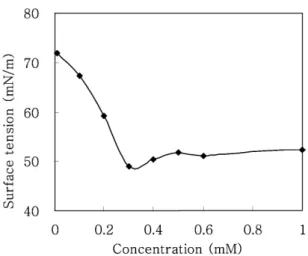
Figure 1. Surface tension as a function of hydrogenated lec- ithin concentration (25 ℃).
with hydrogenated lecithin and then water phase was added slowly with high-speed mixer (X1030D, Ingen- ieurburo CAT, Germany) for 25 min at 40 ℃. The speed of adding water phase was 1 mL for 1 min.
In another set of experiments, a stock emulsion of triglyceride was prepared using above procedure. There were further homogenized by passing them through a microfluidizer (M-110EH-30, MFIC Corp, USA) for 5,000 psi.
2.4. Droplet Size Measurement
The mean droplet size and distribution of the nano-emulsions were determined by dynamic light scattering (DLS, ESLZ, Photal, Japan).
3. Results & Discussion
3.1. Tension Measurement
The surface tensions of hydrogenated lecithin were measured as a function of concentration at constant temperature (20 ℃). The results (Figure 1) shows that the CMC of hydrogenated lecithin aqueous solution is 0.32 mM.
3.2. Ostwald Ripening Rates of Nano-emulsions Pro- duced with Microfluidizer
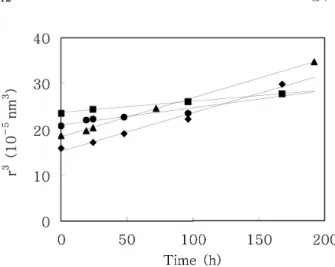
According to LSW theory, the cube of average radi- us should vary linearly with time. Figure 2 shows the
plot of cube of average radius as a function of time at various ratio of surfactant and oil for nano-emulsions prepared with homomixer. As can be seen from Figure 2, the plots at different ratio of surfactant and oil are linear within experimental error, suggesting the applic- ability of LSW theory to nano-emulsions. To verify that the observed variations in size with time were not due to coalescence, there were no oil resolution with time (∼ 7 days).
Table 1 shows the experimental ripening rates at var- ious ratio of surfactant and oil. Ostwald ripening rates were obtained from the slope of lines from Figure 2.
The CMC of hydrogenated lecithin was obtained from Figure 1. Above the CMC, the rates were found to increase in the ratio of surfactant and oil (Figure 3).
The rates were increased from 0.68 × 10⁻²⁷ to 2.32 × 10⁻²⁷. Similar results were obtained by Soma[6]. This is contrast to the results obtained by Kabalnov[11], who did not found any difference in the rates above the CMC. LSW theory does not take into consideration the presence of micelles, however, the results obtained in the experiment clearly indicate that the presence of micelles affects the Ostwald ripening rate. Similar re- sults were found in the results of Binks[5]. From the system of AOT-heptane emulsions, the theoretical rates were larger than the experimental ones, the ratio of the two varying from 2.5 to 14. Due to using the mi- cellar solubility of heptane not the molecular one. This also suggests that micelles transport oil in these emulsions.
Micelles have long been known to facilitate transport in liquid-liquid extractions[12]. That such a facilitated transfer can also occur between emulsion droplets via evidence from the study of McClements and Dungan [13], who have shown that oil can be exchanged be- tween droplets stabilized by a nonionic surfactant, even though the droplet size remains unchanged. Solubiliza- tion and transport of oil by surfactant micelles were considered to be the major mechanism for the exchange of oil. Lee and Tadros[13] also observed that mass transfer through Ostwald ripening was enhanced in the presence of micelles.
Kabalnov[11] considered three mechanism by which
Figure 2. Nano-emulsion r3 as a function of time at 20 ℃ in the system oil/hydrogenated lecithin/water phase for various surfactant/oil ratio (surfactant + oil, 3 %; glycerin 12 %;
water, 85 %) and prepared with microfluidizer. [surfactant]
and [oil]: ■, 1.8 wt% + 1.2 wt%; ●, 2.0 wt% + 1.0 wt%;
▲, 2.2 wt% + 0.8 wt%; ◆, 2.4 wt% + 0.6 wt%.
micelles can mediates mass transfer between oil drop- lets: firstly, micelles take up oil directly from the oil droplets and exchange it with other droplets through Brownian motion and fusion-fission processes. Second- ly, micelles were in a local equilibrium with the con- tinuous medium, they can take up oil only from the continuous medium and not directly from the droplets.
Finally, micelles are not in a local equilibrium with the dissolved oil and cannot solubilize the oil fast enough so as to affect the rate. Another possible mechanism for the increased ripening rates in the presence of micelles can be through depletion flocculation. Aronson[14,15]
has found that the presence of surfactants at a critical concentration above the CMC causes the oil-in-water emulsions to flocculate rapidly. This flocculation process was suggested to be induced by the exclusion of the surfactant micelles between approaching droplets.
Binks et al.[16] also found that oil-in-water emulsions stabilized by a nonionic surfactant had a maximum stability at the CMC. Above the CMC, the main desta- bilization mechanism of Ostwald ripening, depletion flocculation has an effect similar to that of increased volume fraction, as the diffusion fields of the neighbor droplets start interacting with each other. Even though emulsions with droplet sizes less than 200 nm are less sensitive to micelle depletion than emulsions with larger
Table 1. Ostwald Ripening Rates, ω, at 20 ℃ of Nano-emul- sions in the System Oil/Hydrogenated Lecithin/Water Phase for Various Surfactant/Oil Ratio (Surfactant + Oil, 3 %;
Glycerin 12 %; Water, 85 %) and Prepared with Microfluidizer [Surfactant]/[Oil] r (nm) ω (m3s-1)
0.6/2.4 133 0.68 × 10⁻²⁷
0.8/2.2 127 0.93 × 10⁻²⁷
1.0/2.0 122 2.37 × 10⁻²⁷
1.2/1.8 116 2.32 × 10⁻²⁷
Table 2. Ostwald Ripening Rates, ω, at 20 ℃ of Nano-emul- sions in the System Oil/Hydrogenated Lecithin/Water Phase for Various Surfactant/Oil Ratio (Surfactant+ Oil, 3 %;
Glycerin 12 %; Water, 85 %) and Prepared with Homomixer [Surfactant]/[Oil] r (nm) ω (m3s-1)
0.4/2.6 362 23.83 × 10⁻²⁶
0.8/2.2 326 17.84 × 10⁻²⁶
1.0/2.0 268 3.41 × 10⁻²⁶
droplets[17], high surfactant concentration above the CMC used in this study is enough to enhance the de- pletion flocculation.
3.3. Ostwald Ripening Rates of Nano-emulsions Pro- duced with Homomixer
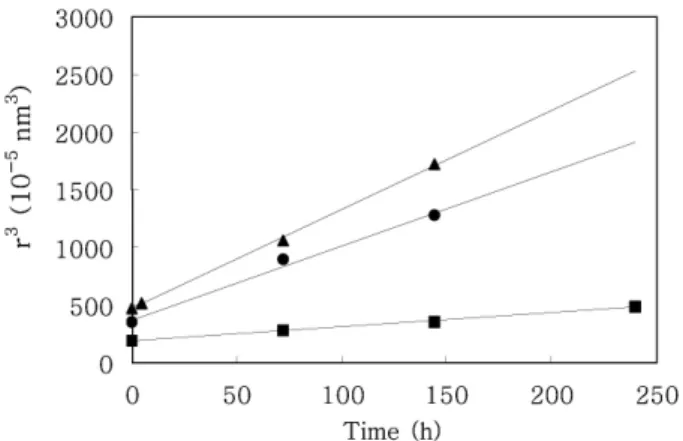
Equation (1) predicts a linear relationship between cube of the radius, r3, and time. As an illustration, Figure 3 shows several plots for various ratio of surfac- tant and oil for the same emulsions described above section except preparation method. These linear plots mean that the main driving force for instability is Ostwald ripening. The Ostwald ripening rate, ω, can be calculated from the slope of the linear plots. Table 2 gives a summary of the initial droplet radii and Ostwald ripening rate constants at various ration of surfactant and oil. The droplet radius decreases with the increase in ratio of surfactant and oil. This might be due to decrease of interfacial tension, g.
Concerning Ostwald ripening rates, it is clear from Figure 3 and Table 2 that ω decreases with the in- crease in ratio of surfactant and oil. It is shown that the slope declines with the in creasing ratio of the surfac- tant and oil, which means the more stable nano-emul-
Figure 3. Nano-emulsion r3 as a function of time at 20 ℃ in the system oil/hydrogenated lecithin/water phase for various surfactant/oil ratio (surfactant + oil, 3 %; glycerin 12 %;
water, 85 %) and prepared with homomixer. [surfactant] and [oil]: ■, 1.0 wt% + 2.0 wt%; ●, 0.8 wt% + 2.2 wt%; ▲, 0.4 wt% + 2.6 wt%.
sions are obtained with higher surfactant concentration.
This phenomenon is consistent with the results reported else where[18-20]. It was suggested that excess mi- celles formed in the aqueous phase, which act a solubi- lization sites for added oil. The oil solubilized in the mi- celles was not dispersed at the molecular level in the continuous phase. As a results, the increase of the amount of micelles actually lowers the solubility of oil in the bulk phase, via, the term Ceq in equation (1) and hence the ripening rate.
These results are opposite with the results shown in case of small size droplet nano-emulsions prepared with microfluidizer. This means that Ostwald ripening is the key instabilizing mechanism of nano-emulsions and the rate is mainly due to solubility of the oil. However, the solubility of oil in equation (1), which is in bulk phase or in the micelles is not clear.
4. Conclusions
Nano-emulsions with a droplet size in the range 100
∼ 400 nm have been obtained in the system cap- rylic/capric triglyceride/hydrogenated lecithin/water with two different mixing system. Investigations of the nano-emulsions showed that the stability decreases with increase in surfactant ratio in case of using micro-
fluidizer, however, stability increase with in surfactant ratio in case of using homomixer.
Acknowledgments
This research was partially supported by the research fund of Seoul Technopark (R&BD-2008-001).
References
1. S. S. Davis, J. Hadgraft, and K. Palin, Encyclopedia of emulsion technology, eds. P. Becher, 2, 159, Dekker, New York and Basel (1983).
2. S. Bhattacharya, M. H. Shylaja, M. S. Manjunath, and U. Sanker, Rheology of lecithin dispersions, J.
Am. Oil Chem. Soc., 75, 871 (1998).
3. R. Angelico, A. Ceglie, U. Olssen, and G. Palazzo, Phase diagram and phase properties of the system lecithin-water-cyclohexane, Langmuir, 16, 2124 (2000).
4. F. Ishii, Phospholipids in emulsion and dispersion systems, Abura Kagaku, 41, 101 (1992).
5. B. P. Binks, W. G. Cho, P. D. I. Fletcher, and D. N.
Petsev, Stability of oil-in-water emulsions in a low interfacial tension system, Langmuir, 16, 1025 (2000).
6. J. Soma and K. D. Papadopoulos, Ostwald ripening in sodium dodecyl sulfate-stabilized decane-in-wa- ter emulsions, J. Colloid and Interface Sci., 181, 220 (1996).
7. V. M. Sadtler, P. Imbert, and E. Dellacherie, Ostwald ripening of oil-in-water emulsions stabi- lized by phenoxy-substituted dextrans, J. Colloid and Interface Sci., 254, 355 (2002).
8. L. Wang, X. Li, Gaoyong, J. Dong, and J. Eastoe, Oil-in-water nanoemulsions for pesticide for- mulations, J. Colloid and Interface Sci., 314, 230 (2007).
9. I. M. Lifshitz and V. V. Slezov, The kinetics of precipitation from supersaturated solid solutions, J.
Phys. Chem. Solids, 19, 35 (1961).
10. C. Wagner, Theorie der alterrung von nieders- chlagen durch umlosen, Zeit. Electrochem., 65, 581
(1961).
11. A. S. Kabalnov, Can micelles mediate a mass transfer between oil droplets, Langmuir, 10, 680 (1994).
12. J. Otsuki and M. Seno, Kinetics of liquld-liquid extraction by micelles of hexadecyltrimethyla- mmonium bromide: Theory of simultaneous diffu- sion and solubilization-desolubilization, J. Phys.
Chem., 95, 5234 (1991).
13. D. J. McClements and S. R. Dungan, Factors that affect the rate of oil exchange between oil-in-water emulsion droplets stabilized by a nonionic surfac- tant; droplet size, surfactant concentration, and ionic strength, J. Phys. Chem., 97, 7304 (1993).
14. G. W. Lee and T. F. Tadros, Formation and stabil- ity of emulsions produced by dilution of emulsify- able 11 concentrates. Part II. The influence of sur- factant concentration on the stability of oil-in-wa- ter emulsions., Colloids Surf., 5, 117 (1982).
15. M. P. Aronson, The role of free surfactant in desta- bilizing oil-in-water emulsions, Langmuir, 5, 494
(1989).
16. M. P. Aronson, Flocculation of emulsions by free surfactant in purified systems, Colloids Surf., 58, 195 (1991).
17. B. P. Binks, P. D. I. Fletcher, and D. I. Horsup, Effect of microemulsified surfactant in destabilising water-in-oil emulsions containing, Colloids Surf., 61, 291 (1991).
18. W. R. Liu, D. J. Sun, C. F. Li, Q. Liu, and J. Xu, Formation and stability of paraffin oil-in-water nano-emulsions prepared by the emulsion inversion point method, J. Colloid Interface Sci., 303(2), 557 (2006).
19. Y. D. Smet, L. Deriemaeker, and R. Finsy, Ostwald ripening of alkane emulsions in the presence of sur- factant micelles, Langmuir, 15, 6745 (1999).
20. K. N. Hoang, V. B. La, L. Deriemaeker, and R.
Finsy, Ostwald ripening of alkane emulsions stabi- lized by polyethylene glycol monolaurate, Langmuir, 17, 5166 (2001).