Nondestructive Bending Strength Evaluation of Ceramics Made from Miscanthus sinensis var. purpurascens Particle Boards
1- Effect of Resin Impregnation Ratio -
Hee-Seop Byeon
2⋅Kyung-Rok Won
3⋅Seung-Won Oh
4†ABSTRACT
Nondestructive evaluation (NDE) method by using a resonance frequency mode was carried out for ceramics made from particle boards with different phenol resin impregnation ratios (30, 40, 50, 60%) at carbonizing temperature of 800℃. The material for ceramics was Miscanthus sinensis var. purpurascens board. Dynamic modulus of elasticity in- creased with increasing impregnation ratio. There was a close relationship of dynamic modulus of elasticity and static bending modulus of elasticity to modulus of rupture (MOR). However, the result indicated that correlation coefficient is higher in dynamic modulus of elasticity to MOR than that in static modulus of elasticity to MOR. Therefore, the dynamic modulus of elasticity using resonance frequency by free vibration mode is more useful as a nondestructive evaluation method for predicting the MOR of ceramics made from Miscanthus sinensis var. purpurascens particle boards by different phenol resin impregnation ratios.
Keywords : Nondestructive evaluation (NDE), ㅊarbonizing temperature, Miscanthus sinensis var. purpurascens, Resonance frequency, MOR
1. INTRODUCTION
1)These days, low-carbon, clean fuels and en- ergy-efficient technologies have been discussed worldwide. Miscanthus sinensis var. purpur- ascens particle boards have been considered as one of the viable strategies for achieving sus- tainable development for low-carbon green growth.
Woodceramics are new porous carbon materials
obtained by carbonizing wood or woody materi- al impregnated with thermosetting resin such as phenol resin in a vacuum furnace. During the carbonizing process, thermosetting resin changes into glassy carbon, which has superior corrosion resistance and mechanical strength (Okabe et al.
1996).
Nondestructive evaluation (NDE) techniques have been extensively used for sorting or grad-
1 Received January 8, 2014; accepted February 12, 2014
2 College of Agriculture & Life Science, IALS, Gyeongsang National University, Jinju 660-701, Korea.
3 College of Agriculture and Life Science, Gyeongsang National University, Jinju 660-701, Korea.
4 Dept. of Wood Science and Technology, Chonbuk National University, Chonju 561-756, Korea.
† Corresponding author : Seung-Won Oh (e-mail: [email protected])
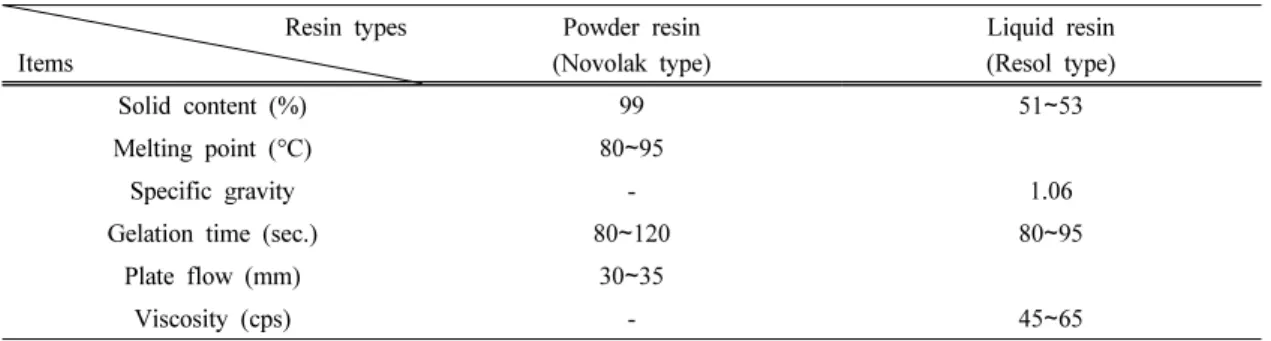
Resin types Items
Powder resin (Novolak type)
Liquid resin (Resol type)
Solid content (%) 99 51∼53
Melting point (°C) 80∼95
Specific gravity - 1.06
Gelation time (sec.) 80∼120 80∼95
Plate flow (mm) 30∼35
Viscosity (cps) - 45∼65
Table 1. Characteristics of phenol-formaldehyde resin used in this study
ing of wood products. Examples include visual grading and machine stress rated (MSR) of lumber. Dynamic modulus of elasticity (MOE
d) and ultrasonic techniques also have been used for the same purpose. There are two methods to measure dynamic MOE
dusing a resonance fre- quency and the velocity of acoustic propaga- tion. The resonance frequency can be achieved by a free vibration and/or the fast Fourier trans- form (FFT) analyzer of impact hammer signals.
The dynamic MOE
dmethod using the resonan- ce frequency has been extensively used for the characterization of wood for musical instru- ments (Sobue et al., 1984; Hong, 1985; Byeon
& Hong, 1997). Park and Byeon (2006) reported that dynamic MOE by resonance frequency us- ing flexural vibration and comparison with ben- ding strength and creep performances of 3-ply woods had a high correlation coefficient of 0.811∼0.947. Basic relationship between ultra- sonic transmission and wood property was stud- ied (Kang & Lee, 2000; Lee et al., 2003; Son
& Lee, 2008). The NDE of wood using the ul- trasonic has been used to detect non-visible de- fects such as honeycomb or closed surface checks (Anderson et al., 1997; Fuller, 1995).
Therefore, NDE technique using the resonance frequency by free vibration mode was applied to ceramics made by different phenol resin im-
pregnation ratios (30, 40, 50, 60%) and the re- lationship between the resonance frequency pa- rameter and static bending strength properties were analysed.
2. MATERIALS and METHODS
2.1. Material
The raw material of Miscanthus sinensis var.
purpurascens for ceramic board was provided from Rural Development Administration Natio- nal Institute of Crop Science Bio-energy Crop Center in Muan county, Jeollanam province, Korea. The height and stem diameter of this materials were approximately 400 cm and 9.6 mm Respectively. Growth characteristics such as height and stem diameter of this materials were two times greater than those of normal Miscanthus.
2.2. Board Manufacture
Particles from part of Miscanthus sinensis var.
purpurascens were made by a mill. The par-
ticles were screened with 10~20 mesh sieve
and dried to below 7 percent moisture content
and then mixed 10 percent PF resin powder
(KNB-100PL, Kolon Chemical Co., Ltd). Table
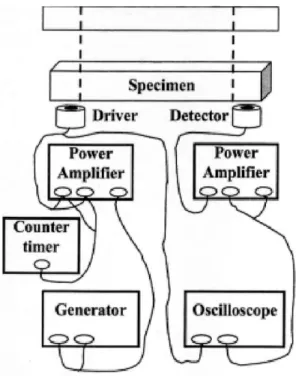
Fig. 1. Schematic diagram of magnetic driver vi- bration mode.
1 shows the characteristics of phenol-form- aldehyde resin used in this test.
A board 260 × 260 × 11 mm and density of 0.6 g/cm
3was made by hot-pressing and mold- ing at temperature of 190°C. The pressing pres- sure was 50 kgf/cm
2→ 30 kgf/cm
2→ 20 kgf/
cm
2and pressing time was 3 min → 2 min → 1 min.
2.3. Resin Impregnation and Carbonization The board was cut into sample measuring 120 × 120 × 14 mm which were then impreg- nated at controlled resin impregnation ratios of 30 ± 2%, 40 ± 2%, 50 ± 2%, and 60 ± 2% in a decompression impregnation apparatus filled with liquified PF resin (KPD-L777, Kolon Che- mical Co., Ltd) at 1 atmosphere. The thickness
of resin impregnated board increased from 11 mm to 14 mm after impregnation of PF resin.
The impregnated specimens were dried and cured at 60°C for 1 hours, then at 100°C and 135°C for 8 hours, respectively. Ceramics boards were made in a vacuum carbonization furnace (KOVAC KSF-200V). Samples from the board were treated with various resin impregnation ra- tios while a carbonizing temperature of 800°C, heating rate of 4°C/min, and duration of 2 hours remained constant.
2.4. Resonance Mode and Bending Test The resonance frequency was first measured by a free transverse vibration at both ends sys- tem apparatus which was composed of sine ge- nerator (B&K, 1023), universal counter timer (GSP, 5001), and oscilloscope (HP, 1740A).
The value at frequency counter timer was meas- ured when the relative amplitude value was highest in oscilloscope. Dynamic modulus of elasticity (MOE
d) was calculated by the follow- ing equations:
f = f
0(1 + αh
2/l
2) (1) where f
0:value at frequency counter timer, α
:value according to vibration type-8.2, h
:thick- ness of specimen (cm), l
:length of specimen (cm).
MOE
d= 48 π
2ρl
4f
2/ m
4h
2(2) where ρ
:density (g/cm
2), m
:value according to basic vibration-4.73, h
:thickness of specimen (cm), l
: llength of specimen (cm).
After resonance frequency measurement, ben-
ding strength property test for the same speci-
men was performed by a three point loading
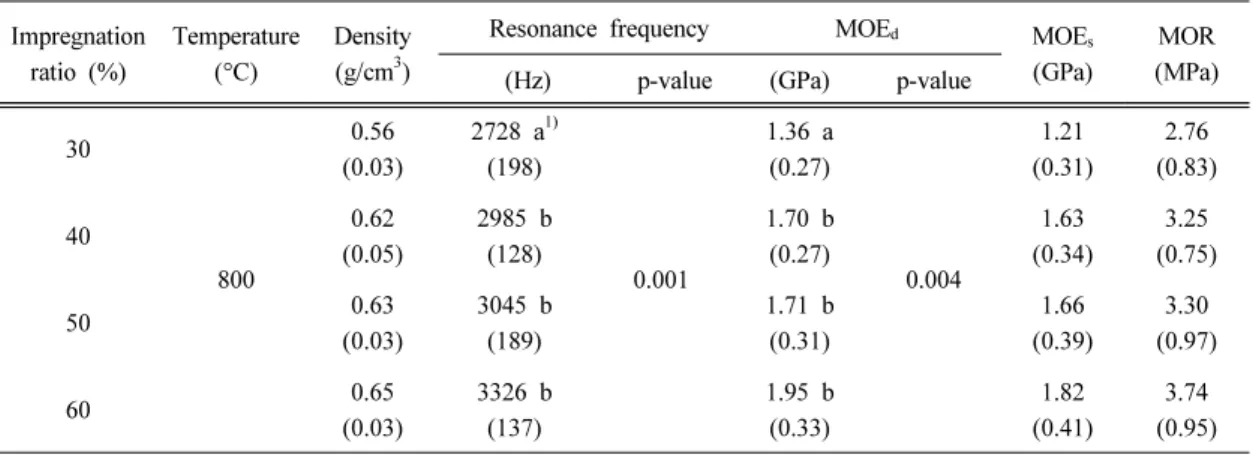
Impregnation ratio (%)
Temperature (°C)
Density (g/cm3)
Resonance frequency MOEd MOEs
(GPa)
MOR (MPa)
(Hz) p-value (GPa) p-value
30
800
0.56 (0.03)
2728 a1) (198)
0.001
1.36 a (0.27)
0.004
1.21 (0.31)
2.76 (0.83)
40 0.62
(0.05)
2985 b (128)
1.70 b (0.27)
1.63 (0.34)
3.25 (0.75)
50 0.63
(0.03)
3045 b (189)
1.71 b (0.31)
1.66 (0.39)
3.30 (0.97)
60 0.65
(0.03)
3326 b (137)
1.95 b (0.33)
1.82 (0.41)
3.74 (0.95) Notes ; MOE: modulus of elasticity, MOR: modulus of rupture, Mean value from 10 replications.
1) Mean followed by the same letter within the same column are not significantly different (P < 0.05) according to Duncan’s new multi- ple range test (n = 2)
Table 2. The physical and mechanical properties of ceramics made at different resin impregnation ratios at carbonizing temperature of 800°C
method (concentrated load at midspan and sup- ported at its ends) in a universal testing ma- chine (UTM, Taeshin accuracy machine, TSU-2).
The span was 80 mm, and the cross-head speed was set at 0.6 mm/min. The static modulus of elasticity (MOE
s) and modulus of rupture (MOR) were calculated from the test result.
3. RESULTS AND DISCUSSION
3.1. Dynamic Elastic roperties ccording to esin mpregnation atio
Table 2 shows the average values of density, resonance frequency, modulus of rupture (MOR), static modulus of elasticity (MOE
s) and the dy- namic modulus of elasticity (MOE
d) for ce- ramics made from Miscanthus sinensis var. pur- purascen board by different phenol resin im- pregnation ratios (30, 40, 50, 60%) at carboniz- ing temperature of 800°C.
3.1.1. Resonance Frequency
The mean values of resonance frequency ac- cording to different resin impregnation ratios were shown in Table 2 and Fig. 2. The mean values of resonance frequency were 2,728, 2,985, 3,045, 3,326 Hz for 30%, 40%, 50%, 60% of resin impregnation ratio, respectively.
Resonance frequency increased with increasing resin impregnation ratio. The density also in- creased with increasing resin impregnation ratio.
Hong (1995) reported that resonance frequency of normal wood in Pinus densiflora increased, whereas that of compression wood decreased, with increasing density.
3.1.2. Dynamic Modulus of Elasticity
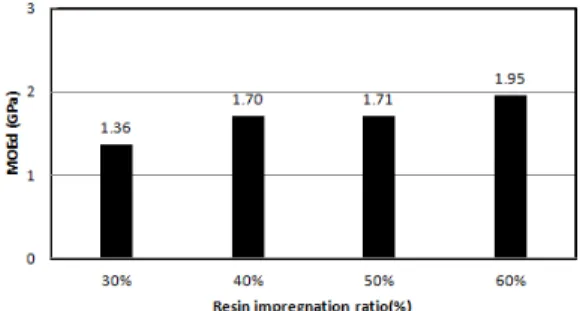
The mean values of MOE
daccording to resin impregnation ratio ere shown in Table 2 and Fig. 3. The mean values of dynamic MOE were 1.36, 1.70, 1.71, 1.95 GPa for 30%, 40%, 50%, 60% of resin impregnation ratio, respectively.
Both density and dynamic modulus of elasticity
also increased with increasing resin impre-
Fig. 2. Resonance frequency according to different resin impregnation ratios at carbonizing temperature of 800°C.
Fig. 3. Dynamic modulus of elasticity according to different resin impregnation ratios at carbonizing temperature of 800°C.
Fig. 4. Relationship between MOR and density ac- cording to resin impregnation ratios at carbonizing temperature of 800°C.
gnation ratio. Byeon (2004) reported that wood- ccearaics had been made from particle board of impregnated with phenol resin from three kinds of species, Pinus densifora, Pinus koraiensis and Larixleptolepis had a similar tendency. Byeon (2011) also reported that MOE
sto ceramics made by Broussonetia Kazinoki increased with increasing resin impregnation ratio.
3.2. Relationship between Density and Mechanical Properties
Least squares regression analysis method has been used in the field of wood properties, be- cause mechanical properties of wood are line- arly related (Bodig & Jayne, 1982; Bucur, 1995).
Regression parameters are presented in Table 3 show relationships between density, static MOE
s, dynamic MOE
dand MOR.
The correlation coefficients for density-static MOE, density-resonance frequency, density-dy- namic MOE
d, density-MOR (Fig. 4) for ceramics produced by different resin impregnation ratios were 0.808, 0.765, 0.898 and 0.860, respec- tively. The correlation coefficient of density versus dynamic MOE
din the ceramics made by different impregnation ratio was much higher than the others. Hong (1995) reported that the
correlation coefficient values of density versus dynamic MOE
drelationship for normal wood and compression wood in Pinus densiflora were very high values of 0.896 and 0.688
3.3. Relationship between Static MOEs and Mechanical Properties
Relationship between static MOE and MOR
for ceramics were analyzed. The regression co-
efficient shows that correlation coefficient be-
tween bending MOE
sand MOR for ceramics
produced by different impregnation ratio was
high value of 0.757 (Table 3 and Fig. 5). It is
considered to be caused by the uniform quality
of ceramics inner or outer. Whereas, wood-
Parameter Regression model Correlation
coefficient r p-value
Density vs. MOEs y = 6.2277x – 2.2406 0.808** 0.000
Density vs. RF y = 3175.9x + 1011.2 0.765** 0.000
Density vs. MOEd y = 5.8705x – 1.927 0.898** 0.000
Density vs. MOR y = 9.4539x – 2.5508 0.860** 0.000
MOEs vs. MOEd y = 0.9535x – 0.02 0.808** 0.000
MOEs vs. MOR y = 1.2416x + 1.2777 0.870** 0.000
RF vs. MOEd y = 0.0014x – 2.3626 0.863** 0.000
RF vs. MOR y = 0.0019x - 224898 0.723** 0.000
RF vs. MOEs y = 0.0013x – 2.3078 0.688** 0.000
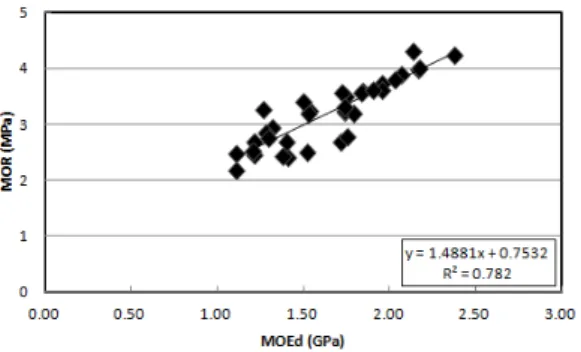
MOEd vs. MOR y = 1.4881x + 0.7532 0.884** 0.000
Parenthesis is standard deviation, MOE: modulus of elasticity, MOR: modulus of rupture, RF: resonance frequency, Mean value from 10 replications.
Table 3. Summary of regression parameters for relationships between density, MOR, MOE, RF and MOEd for Ceramics produced at different resin impregnation ratios
Fig. 5. Relationship between MOR and MOEs ac- cording to resin impregnation ratios at carbonizing temperature of 800°C.
ceramics produced from different carbonizing temperatures with three kinds of species (Pinus densifora, Pinus koraiensis, Larix leptolepis) had a higher density in outside than those in in- side, had a low correlation coefficient between static MOE and MOR (Byeon, 2004).
3.4. Relationship between MOEd and Mechanical Properties
Relationships between MOE
dand MOE
s, MOR for ceramics were analyzed (Table 3 and Fig.
6). The correlation coefficient between dynamic MOE
dto MOR and static MOE
sto MOR for ceramics were high values of 0.884 and 0.870.
And close correlations were found in MOE
dand MOE
sfor ceramics produced by different impregnation ratios. Generally, close correlation MOE
dand MOE
sfor clear solid wood was re- ported by stress wave mode (Ross & Pellerin, 1991). However, Byeon (2004) reported that the correlation coefficient of static MOE and MOR
for the woodceramics produced by different car- bonizing temperatures was lower value of 0.425.
3.5. Predicting MOR of Ceramics
The correlation coefficient was higher in dy-
namic modulus of elasticity to MOR than those
in static modulus of elasticity to MOR and den-
sity to MOR. Therefore, the dynamic modulus
Fig. 6. Relationship between MOR and MOEd ac- cording to resin impregnation ratios at carbonizing temperature of 800°C.
of elasticity using resonance frequency by free vibration mode is more useful as a nondestruc- tive evaluation method for predicting the MOR.
4. CONCLUSIONS
Nondestructive evaluation method by using a resonance frequency mode was carried out for ceramics made from particle boards with differ- ent phenol resin impregnation ratios (30, 40, 50, 60%) at carbonizing temperature of 800°C.
The material for ceramics was Miscanthus si- nensis var. purpurascens board.
The resonance frequency and dynamic mod- ulus of elasticity increased with increasing phe- nol resin impregnation ratio. There were close relationships among density vs modulus of rup- ture (MOR) and static modulus of elasticity vs MOR and dynamic modulus of elasticity vs MOR. However, the result indicated that corre- lation coefficient is highest in dynamic modulus of elasticity to MOR. Therefore, the dynamic modulus of elasticity using resonance frequency by free vibration mode is most useful as a non- destructive evaluation method for predicting the MOR of ceramics made from Miscanthus si- nensis var. purpurascens particle boards by dif-
ferent phenol resin impregnation ratios.
REFERENCES
1. Anderson, R.B,, J.K. Wiedenbeck, and R.J. Ross.
1997. Nondestructive evaluation for detection of honeycomb in the sawmill: An economic analy- sis. Forest Prod. J. 47(6): 53∼59.
2. Bodig, J. and B.A. Jayne. 1982. Mechanics of Wood and Wood Composites. Van Nostrand Reinhold company, New York. pp. 247∼269, 645∼650.
3. Bucur, V. 1995. Acoustics of Wood. CRC Press, Boca Ration, Fla. pp. 105∼106.
4. Byeon, H.S. and B.H. Hong. 1997. The dynamic mechanical properties of Agathis Alba used for piano soundboards. J. of Korean Society of fur- niture technology 8(1/2): 9∼16.
5. Byeon, H.-S., S.Y. Ahn, S.W. Oh, and J.-J. Piao.
2004. Nondestructive bending strength evaluation of woodceramics using resonance Frequency Mode. Mokchae Konghak 32: 8∼14.
6. Byeon, H.-S., J.M. Kim, K.R. Won, and Oh, S-W. 2011. Nondestructive Bending Strength Evaluation of Woodceramics Made from Woody Part of Broussonetia kazinoki Sieb. -Effect of Resin Impregnation Ratio-. Mokchae Konghak 39: 398∼405.
7. Fuller, J.J. 1995. Nondestructive evaluation of honeycomb and surface checks in red oak lum- ber. Forest Prod. J. 45(5): 42∼44.
8. Hong, B.H. 1985. The dynamic mechanical properties of Paulownia coreana used for sound- ing boards. Mokchae Konghak 13(3): 34∼40.
9. Hong, B.H. and H.S. Byeon. 1995. Dynamic MOE and internal friction of compression woods in Piuns densiflore. Mokuzai gakkaishi. 23(2):
32∼36.
10. Kang, H.Y. and K.-Y. Lee. 2000. Effects of cross-sectional dimension and moisture profile of small specimens on characteristics of ultrasonic wave propagation. Mokchae Konghak 28(2): 19
∼24.
11. Lee, J.J., K.M. Kim., and Mun, S.B. 2003.
Investigation of transmission process for ultra- sonic wave in wood. Mokchae Konghak 31(2):
31-37.
12. Okabe. T., T. Saito, and K. Hokkirigawa. 1996.
New porous carbon materials, woodeeramics:
Development and fundamental properties. Journal of porous materials. 2: 207∼213.
13. Park, H.M. and H.S. Byeon. 2006. Measurement of dynamic MOE of 3-ply woods by flexural vi- bration and comparison with bending strength and creep performances. Mokchae Konghak 34(2):
46∼57.
14. Ross, R.J., and R.F. Pellerin. 1991. NDE of green material with stress waves: Preliminary re- sults using dimension lumber. Forest Prod. J. 41:
57∼59.
15. Sobue, N., H. Nakano, and I. Asano. 1984.
Vibrational properties of spruce plywood for mu- sical instruments. Mokuzai gakkaishi. 31(1): 93
∼97.
16. Son, D.W. and D.H. Lee. 2008. Evaluation on termite damage of the traditional wooden build- ing by nondestructive methods. Mokchae Kong- hak 36(1): 21∼29.