JESK http://jesk.or.kr eISSN:2093-8462
Comparison of Systemic Accident Investigation Techniques Based on the Sewol Ferry Capsizing
Dohyung Kee
Department of Industrial and Management Engineering, Keimyung University, Daegu, 42601
Corresponding Author Dohyung Kee
Department of Industrial and Management Engineering, Keimyung University, Daegu, 42601
Mobile : +82-10-5656-1260 Email : [email protected]
Received : August 22, 2017 Revised : September 01, 2017 Accepted : September 16, 2017
Objective: This study aims to survey and compare three systemic accident investigation techniques of Accimap, STAMP and FRAM, based on the application studies of the Sewol ferry accident.
Background: Traditional accident investigation methods such as domino models, FTA, etc. work well for losses caused by physical component failures or actions of human in relatively simple systems, but are unable to depict mechanisms generating errors and violations in the current complex socio-technical systems. For better understanding the structure and behavior of the socio-technical systems, systemic techniques have been developed and used.
Method: This study was mainly based on survey of literatures through surfing webpages of ScienceDirect and Google, and ergonomics relevant journals. The key words of Sewol, Sewol ferry, Sewol ferry accident, etc. were used in the survey.
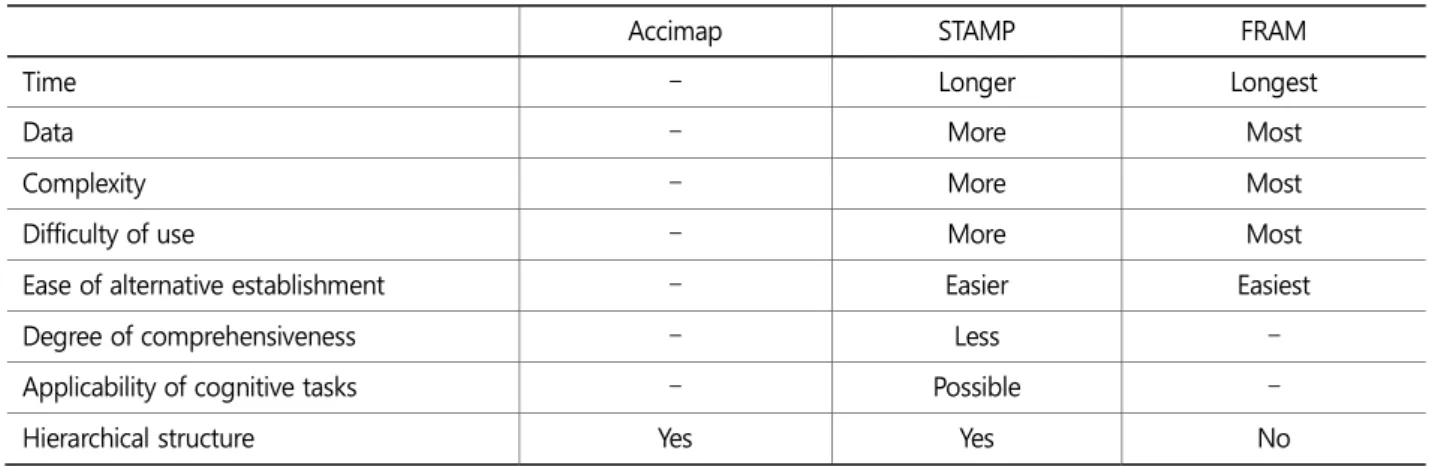
Results: Three systemic accident investigation methods included similar actors in the Sewol ferry accident including government, Ministry of Ocean and Fisheries, Korean Coast Guard, Korean Register of Shipping, Korea Shipping Association, Chonghaejin Marine Company, crew members. The methods graphically represented each level's failures or performance variabilities of relevant functions and relationships between them. It was shown that the systemic methods consider the entire system, ranging from the environment in which the accident occurred, to the role of government in shaping the system of work. Each method has its own comparative pros and cons, but the Accimap has advantages in terms of time of analysis, data required, model complexity and degree of comprehensiveness.
Conclusion: This study reviewed and compared three systemic accident investigation methods, which showed that there are systemic characteristics and pros and cons in the methods.
Application: The results would be used as a guideline when selecting accident investigation methods.
Keywords: Accident investigation method, Accimap, STAMP, FRAM, Sewol ferry accident
Copyright@2017 by Ergonomics Society of Korea. All right reserved.
○
ccThis is an open-access article distributed under the terms of the Creative Commons Attribution Non-Commercial License (http://creativecommons.org/licenses/by-nc/3.0/), which permits unrestricted non-commercial use, distribution, and reproduction in any medium, provided the original work is properly cited.