ISSN 1225-6552, eISSN 2287-7630 http://dx.doi.org/10.7853/kjvs.2016.39.3.175
< Original Article >
Veterinary Service
Available online at http://kjves.org
*Corresponding author: Jae-Keun Cho, Tel. +82-53-760-1300, Fax. +82-53-760-1302, E-mail. [email protected]
개와 고양이에서 분리한 methicillin 내성 및 감수성 Staphylococcus pseudintermedius
조재근 * ㆍ이미리ㆍ김정미ㆍ김환득
대구광역시보건환경연구원
Methicillin-resistant or susceptible Staphylococcus pseudintermedius isolates from dogs and cats
Jae-Keun Cho*, Mi-Ree Lee, Jeong-Mi Kim, Hwan-Deuk Kim
Metropolitan Health & Enviornmental Research Institute, Daegu 42183, Korea (Received 6 September 2016; accepted 27 September 2016)
Abstract
Staphylococcus pseudintermedius is an important opportunistic pathogen of dog and cats. Since 2006 there has been a significant emergence of methicillin-resistant S. pseudintermedius (MRSP) mainly due to clonal spread. The aim of this study was to investigated the prevalence of antibiotic resistance and presence of mecA and femA gene in 91 S. pseudintermedius isolates isolated from dogs and cats asso- ciated with various clinic infections. Methicillin resistance was confirmed by oxacillin disc diffusion method. MRSP isolate was detected 19 isolates (20.9%). MRSP and methicillin-resistant S. pseudinter- medius (MSSP) isolates were highly resistant to penicillin, kanamycin, tetracycline, erythromycin, trime- thoprim-sulfamethoxazole, clindamycin, ciprofloxacin, enrofloxacin and choloramphenicol (100∼47.3%
and 90.3∼33.3%, respectively). About 90% of MRSP isolates were multi-drug resistance (resistance to at least five or more antimicrobials), and MSSP isolates was ca 74%. Among the 91 isolates, mecA gene was detected in 25 isolates (27.5%, 19 in MRSP isolates and 6 in MSSP isolates), but none carried the femA gene. Our results indicated MRSA isolates show a strong resistance to antimicrobials com- monly used in veterinary medicine. A continuous surveillance and monitoring should be called for to prevent the contamination and spread of MRSP in dogs and cats.
Key words : S. pseudintermedius, MRSP, MSSP, mecA gene, Antimicrobial resistance
서 론
Staphylococcus (S) pseudintermedius는 개와 고양이 의 피부와 점막의 정상세균인 동시에 기회감염균으 로, 2005년에 S. intermedius에서 재분류되었다(Devriese 등, 2005). 특히 개에서 농피증 감염의 80% 이상이 S.
pseudintermedius가 원인체로 알려져 있다(Pellerin 등, 1998).
이전 S. pseudintermedius는 사용된 대부분 항생제에
감수성이었다(Pellerin 등, 1998). 그러나 1999년 미국 과 2005년 유럽에서 methicillin-resistant S. pseudinter- medius (MRSP)가 최초로 보고된 이후, 2006년부터 MRSP의 출현은 증가하고 있어 수의 임상에서 중요 한 문제로 대두되고 있다(Gortel 등, 1999; Loeffler 등, 2007; Weese와 van Duijkeren, 2010).
Methicillin 내성 S. aureus와 마찬가지로 S. pseu-
dintermedius에서 methicillin 내성은 penicillin- binding
protein (PBP)의 생산을 암호화하는 mecA 유전자에
의해 결정된다. 정상적으로 -lactam 항생제는 세균으
로부터 세포벽 구조를 보호하기 위해 S. pseudinterme-
Table 2. Primer Sequence for PCR analysis
Primer Sequence (′5 to ′3) Annealing (
oC) PCR product bp Reference
mecA-F TGGCTATCGTGTCACAATCG 58 310 Dziva et al (2015)
mecA-R CTGGAACTTGTTGAGCAGAG
femA-F CTTACTTACTGGCTGTACCTG 53 686 Dziva et al (2015)
femA-R ATGTCGCTTGTTATGTGC
SInuc-F TAGGCAGTAGGATTCGTTAA 56 926 Dziva et al (2015)
SInuc-R CTTTTGTGCTTCCTTTTGG
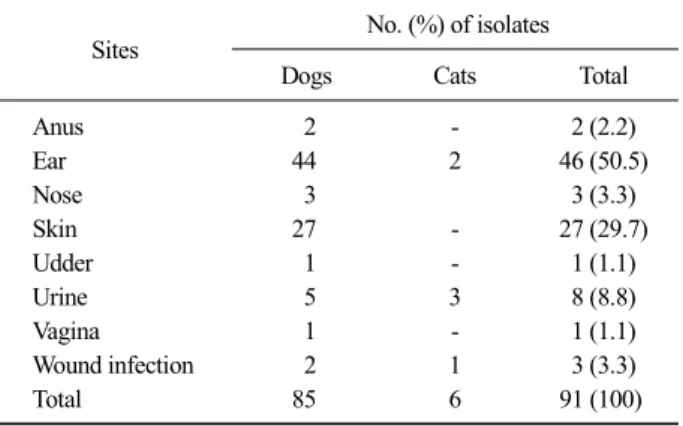
Table 1. Distribution of 91 S. pseudintermedius isolates in this study
Sites No. (%) of isolates
Dogs Cats Total
Anus 2 - 2 (2.2)
Ear 44 2 46 (50.5)
Nose 3 3 (3.3)
Skin 27 - 27 (29.7)
Udder 1 - 1 (1.1)
Urine 5 3 8 (8.8)
Vagina 1 - 1 (1.1)
Wound infection 2 1 3 (3.3)
Total 85 6 91 (100)
dius의 BPB에 결합한다. 반면 MRSP의 변형된 PBP는
-lactam 항생제에 낮은 친화성을 가지므로 세포벽 구조는 이들 항생제로부터 보호되지 않는다(Weese와 van Duijkeren, 2010). 한편 mecA 유전자는 Staphylococcal cassette chromosome mec (SCCmec)이라는 이동성 유 전자의 염색체 내 존재한다(Wielders 등, 2001).
S. pseudintermedius는 수술 후 상처 감염, 눈, 피부, 요로, 호흡기관 및 신체 여러 조직의 감염의 중요한 원인체로(van Duijkeren 등, 2011), MRSP에 의한 감염 은 고양이에서 보다 개에서 흔히 일어난다(Kadlec 등, 2010). MRSP는 -lactam 계열 항생제 뿐만 아니라 몇 몇 다른 계열의 항생제에도 내성을 나타내고 있어 다 약제 내성과도 관련이 있다(Perreten 등, 2010; Ruscher 등, 2010; Dziva 등, 2015). 이로 인해 MRSP 감염은 치료 약제 선택의 어려움 때문에 수의 임상에서 문제 가 될 수 있다(Wettstein 등, 2008). 최근까지 국내에서 MRSP에 대한 연구는 주로 대학의 동물병원에 의뢰 된 가검물에 국한되어서 이루어지고 있는 실정이다 (Yoo 등, 2010; Yoon 등, 2010; Kang 등, 2014).
이번 연구의 목적은 대구지역 개와 고양이의 임상 병변 부위로부터 분리된 S. pseudintermedius 91주에 대하여 MRSP의 출현 빈도를 조사하고, MRSP와 MRSS 균주들에 대한 항생제 내성 양상을 비교하는 것이다. 또한 PCR을 이용하여 methicillin 내성 유전 자인 mecA와 femA 유전자의 검출을 시도하였다.
재료 및 방법
공시재료
2013년 1월부터 2015년 12월까지 대구지역 동물병 원에서 보건환경연구원으로 병성감정 의뢰된 개와 고양이의 가검물 422건(개 382건, 고양이 40건)에서 S. pseudintermedius 91주(개 85주, 고양이 6주)를 분리
하여 실험에 공시하였다(Table 1). 의뢰된 가검물은 tryptic soy broth (Oxoid, UK)에 37
oC에서 18∼24시간 배양한 다음 egg yolk-terullite emulsion (Oxoid, UK)이 첨가된 Baired-Parker agar (Oxoid, UK) 배지 상에 도 말한 후 37
oC에서 18∼24시간 배양하였다. 의심되는 집락에 대하여는 그람 염색, 용혈성, catalase 및 coag- ulase 시험을 실시하였다. S. pseudintermedius 특이 primer인 nuclease (nuc) gene (Table 2)과 Vitek GPI card (BioMerieux, France)를 이용하여 최종 동정하였다.
항균제 감수성 시험
항균제 감수성시험은 Clinical and Laboratory Standards Institute의 기준(2008)에 따라 디스크 확산 법으로 실시하였다. 항생제 디스크는 Oxoid사(UK)의 amoxacillin/clavulanic acid (20/10 g), chloramphenicol (30 g), ciprofloxacin (5 g), clindamycin (2 g), enro- floxacin (10 g), erythromycin (15 g), kanamycin (30
g), linezolid (30 g), nitrofurantoin (300 g), oxacillin (1 g, OX), penicillin (10 UI), quinuprestin- daltopristin (15 g), rifampin (5 g), trimethoprim/sulfamethoxazole (1.25/23.75 g), teicoplanin (30 g) 및 tetracycline (30
g) 등 16종을 공시하였다. 항균제 감수성 시험의 표
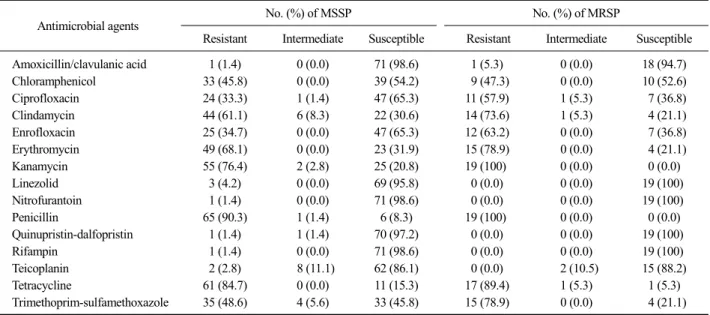
Table 3. Antimicrobial susceptibility of 72 methicillin-susceptible Staphylococcus pseudintermedius (MSSP) and 19 methicillin-resistant S.
pseudintermedius (MRSP) isolates
Antimicrobial agents No. (%) of MSSP No. (%) of MRSP
Resistant Intermediate Susceptible Resistant Intermediate Susceptible
Amoxicillin/clavulanic acid 1 (1.4) 0 (0.0) 71 (98.6) 1 (5.3) 0 (0.0) 18 (94.7)
Chloramphenicol 33 (45.8) 0 (0.0) 39 (54.2) 9 (47.3) 0 (0.0) 10 (52.6)
Ciprofloxacin 24 (33.3) 1 (1.4) 47 (65.3) 11 (57.9) 1 (5.3) 7 (36.8)
Clindamycin 44 (61.1) 6 (8.3) 22 (30.6) 14 (73.6) 1 (5.3) 4 (21.1)
Enrofloxacin 25 (34.7) 0 (0.0) 47 (65.3) 12 (63.2) 0 (0.0) 7 (36.8)
Erythromycin 49 (68.1) 0 (0.0) 23 (31.9) 15 (78.9) 0 (0.0) 4 (21.1)
Kanamycin 55 (76.4) 2 (2.8) 25 (20.8) 19 (100) 0 (0.0) 0 (0.0)
Linezolid 3 (4.2) 0 (0.0) 69 (95.8) 0 (0.0) 0 (0.0) 19 (100)
Nitrofurantoin 1 (1.4) 0 (0.0) 71 (98.6) 0 (0.0) 0 (0.0) 19 (100)
Penicillin 65 (90.3) 1 (1.4) 6 (8.3) 19 (100) 0 (0.0) 0 (0.0)
Quinupristin-dalfopristin 1 (1.4) 1 (1.4) 70 (97.2) 0 (0.0) 0 (0.0) 19 (100)
Rifampin 1 (1.4) 0 (0.0) 71 (98.6) 0 (0.0) 0 (0.0) 19 (100)
Teicoplanin 2 (2.8) 8 (11.1) 62 (86.1) 0 (0.0) 2 (10.5) 15 (88.2)
Tetracycline 61 (84.7) 0 (0.0) 11 (15.3) 17 (89.4) 1 (5.3) 1 (5.3)
Trimethoprim-sulfamethoxazole 35 (48.6) 4 (5.6) 33 (45.8) 15 (78.9) 0 (0.0) 4 (21.1)
준균주로는 S. aureus ATCC 25923을 사용하였다. 이 번 연구에서 oxacillin에 내성(≤10 mm)을 나타낸 S.
pseudintermedius는 MRSP로 판정하였다.
DNA 분리 및 methicillin 내성 유전자(mecA 및 femA) 검출
Genomic DNA 분리는 0.5 mg/mL lysostaphin (Sigma, USA)을 사용하여 Wizard
ⓇGenomic DNA Putrification Kit (Promega, USA)를 이용하여 제조사의 방법에 따라 추출하였다. mecA와 femA 유전자의 검 출은 Dziva 등(2015)의 방법에 따라 실시하였다. PCR 반응은 Maxime PCR PreMix (i-Star Taq, intron Biotech, Korea)에 각각의 10 pmol primer 1 L와 tem- plate DNA 2 L를 넣은 후 멸균된 증류수를 첨가하 여 최종 반응량이 20 L가 되게 하여 TProfessional Thermal Cycler (Biometra, Germany)를 이용하여 수행 하였다. PCR 조건은 94
oC에서 5분간 초기 denatura- tion시킨 후, 94
oC에서 30초간 denaturation, 각각의 온 도(Table 2)에서 annealing, 72
oC에서 90초간 extension 과정을 총 25회 반복하였으며, 마지막으로 72
oC에서 5분간 final extension을 하였다. PCR 산물은 1.2%
agarose gel에서 전기영동을 실시한 후 증폭산물의 크 기를 확인하였다.
결 과
2013년부터 2015년까지 대구시 보건환경연구원에 의뢰된 개와 고양이의 가검물로부터 S. pseudinterme- dius 91주(개 85주, 고양이 6주)를 분리하여 실험에 사용하였다(Table 1).
공시한 S. pseudintermedius 91주에 대하여 MRSP를 확인하기 위해 디스크 확산법으로 oxacillin에 대한 항생제 감수성 시험을 실시한 결과, oxacillin에 내성 인 MRSP는 개의 피부(8주), 귀(6주), 코(2주) 및 개와 고양이의 수술 후 감염(각각 2주 및 1주) 부위 등에서 총 19주(20.9%)가 분리되었다. oxacillin에 감수성인 MSSP는 72주(79.1%)가 분리되었다.
MRSP 19주와 MSSP 72주에 대한 항생제 감수성 시험 결과는 Table 3과 같다. MRSP는 kanamycin과 penicillin (각각 100%), tetracycline (89.4%), eryth- romycin과 trimethoprim-sulfamethoxazole (각각 78.9%), clindamycin (73.6%), enrofloxacin (63.2%), cipro- floxacin (57.9%), chloramphenicol (47.3%) 및 amox- icillin/clavulanic acid (5.3%)에 내성을 나타내었다.
Linezolid, nitrofurantoin, quinupristin-dalfopristin, ri- fampin, teicoplanin에 대하여 내성인 균주는 없었다.
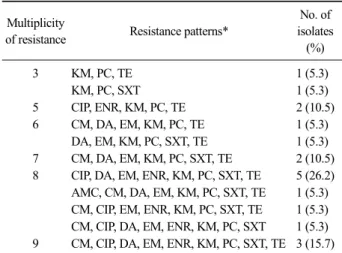
한편 이들 MRSP의 89.5% (17/19)가 5제 이상의 약제
에 내성을 보인 다약제 내성균으로, 이증 8제 내성균
이 8주(42.1%)로 가장 많았고, 다음은 9제 내성균이 3
주(15.8%)이었다(Table 4). MSSP는 penicillin (90.3%),
Table 5. Phenotypes of antimicrobial resistance in 72 MSSP isolates
Multiplicity
of resistance Resistance patterns*
No. of isolates (%)
0 2 (2.8)
1 PC 2 (2.8)
TE 1 (1.4)
2 PC, TE 6 (8.3)
LZD, TE 1 (1.4)
EM, TE 1 (1.4)
3 KM, PC, TE 2 (2.8)
AMC, PC, TE 1 (1.4)
PC, TE, SXT 1 (1.4)
CIP, PC, TE 1 (1.4)
CIP, ENR, PC 1 (1.4)
5 DA, EM, KM, PC, TE 2 (2.8)
CIP, ENR, KM, PC, TE 1 (1.4)
EM, KM, LZD, PC, TE 1 (1.4)
CM, EM, KM, PC, TE 2 (2.8)
CM, DA, KM, PC, TE 1 (1.4)
CM, DA, EM, KM, PC 2 (2.8)
6 CM, CIP, ENR, KM, PC, SXT 1 (1.4)
CM, DA, EM, KM, PC, TE 7 (9.7)
CM, DA, EM, KM, PC, SXT 2 (2.8)
DA, EM, KM, PC, SXT, TE 2 (2.8)
DA, EM, KM, NF, PC, TE 1 (1.4)
CIP, ENR, KM, PC, SXT, TE 1 (1.4) 7 CIP, DA, ENR, EM, KM, SXT, TE** 2 (2.8) CIP, ENR, EM, KM, PC, SXT, TE 1 (1.4) DA, ENR, EM, KM, PC, RD, TE 1 (1.4) CM, CIP, ENR, EM, KM, PC, SXT** 1 (2.1) CM, DA, EM, KM, PC, SXT, TE 7 (9.7) CM, DA, EM, KM, PC, TEC, TE 1 (1.4) 8 CM, DA, ENR, EM, KM, PC, SXT, TE 1 (1.4) CIP, DA, ENR, EM, KM, PC, SXT, TE** 6 (8.3) CM, CIP, ENR, EM, KMPC, TE, SXT, TE 1 (1.4) CM, DA, EM, KM, LZD, PC, SXT, TE 1 (1.4) CM, CIP, DA, ENR, KM, PC, SXT, TE 1 (1.4) 9 CM, CIP, DA, ENR, EM, KM, PC, SXT, TE** 5 (6.9) CIP, DA, ENR, EM, KM, PC, QD, SXT, TE 1 (1.4) CIP, DA, ENR, EM, KM, PC, SXT, TEC, TE** 1 (1.4)
*AMC, amoxacillin/clavulanic acid; CM, chloramphenicol; CIP, ciprofloxacin; DA, clindamycin; ENR, enrofloxacin; EM, erythro- mycin; KM, kanamycin; LZD, linezolid; NF, nitrofurantoin; PC, penicillin; RD, rifampin; QD, quinupristin-dalfopristin; SXT, sulfa- methoxazole/trimethoprim; TEC, teicoplanin; TE, tetracycline.
**6 MSSP isolates contained mecA gene.
Table 4. Phenotypes of antimicrobial resistance in 19 MRSP isolates
Multiplicity
of resistance Resistance patterns*
No. of isolates (%)
3 KM, PC, TE 1 (5.3)
KM, PC, SXT 1 (5.3)
5 CIP, ENR, KM, PC, TE 2 (10.5)
6 CM, DA, EM, KM, PC, TE 1 (5.3)
DA, EM, KM, PC, SXT, TE 1 (5.3) 7 CM, DA, EM, KM, PC, SXT, TE 2 (10.5) 8 CIP, DA, EM, ENR, KM, PC, SXT, TE 5 (26.2) AMC, CM, DA, EM, KM, PC, SXT, TE 1 (5.3) CM, CIP, EM, ENR, KM, PC, SXT, TE 1 (5.3) CM, CIP, DA, EM, ENR, KM, PC, SXT 1 (5.3) 9 CM, CIP, DA, EM, ENR, KM, PC, SXT, TE 3 (15.7)
*AMC, amoxacillin/clavulanic acid; CM, chloramphenicol; CIP, ciprofloxacin; DA, clindamycin; ENR, enrofloxacin; EM, erythro- mycin; KM, kanamycin; PC, penicillin; SXT, trimethoprim/sulfa- methoxazole; TE, tetracycline.
tetracycline (84.7%), kanamycin (76.4%), erythromycin (68.1%), clindamycin (561.1%), trimethoprim-sulfame- thoxazole (48.6%), chloramphenicol (45.8%), enro- floxacin (34.7%), ciprofloxacin (33.3%), linezolid (4.2%), teicoplanin (2.81%), amoxicillin/clavulanic acid, nitrofurantoin, Quinupristin-dalfopristin 및 rifampin (각 각 1.4%)에 내성을 나타내었다. MSSP의 경우 73.6%
(53/72)가 5제 이상의 약제에 내성을 보인 다약제 내 성균으로, 이중 6제 내성균이 10주(19.4%)로 가장 많 았고, 다음은 7제 13주(18.1%), 8제 10주(13.9%) 및 5 제 10주(12.5%) 순이었다(Table 5).
공시한 S. pseudintermedius 전주를 대상으로 methi- cillin 내성과 관련이 있는 mecA와 femA 유전자의 검 출을 실시한 결과는 Table 6과 같다. mecA 유전자는 91주 중 25주(27.5%)에서 검출되었다. 이중 MRSP에 서 19주(100%), oxacillin에 감수성인 MSSP에서 6주 (8.3%)가 검출되었다. 반면 femA 유전자는 공시균 모 두에서 검출되지 않았다. 한편 mecA 유전자를 보유하 면서 oxacillin에 감수성을 보인 MSSP 6주는 모두 7제 이상의 약제에 내성을 나타내었다.
고 찰
최근 개와 고양이에서 MRSP의 발생은 점차 증가 하는 추세로, 이들 동물에서 MRSP 감염은 질병 치료
를 위한 항생제의 부적절한 투여, 장기간 입원, 외과 적 수술 및 MRSP를 보유하고 있는 사람과의 접촉 같 은 여러 가지 위험요인과 관련이 있다(van Duijkeren 등, 2011).
이번 연구에 공시된 91주의 S. pseudintermedius 중
Table 6. Detection of methicillin-resistance gene in 72 MSSP and 19 MRSP isolates
Resistance gene Total No of MSSP (%) No of MRSP (%) mecA 25 (27.5) 6 (8.3) 19 (100)
femA 0 (0.0) 0 (0.0) 0 (0.0)
MRSP는 19주(20.9%)에서 분리되었다. MRSP는 개에 서 94.7% (18/19). 고양이에서 5.3% (1/19)가 분리되었 으며, 부위별로는 피부에서 8주(42.1%), 귀에서 6주 (31.6%)로 많이 분리되었다. 이는 MRSP의 출현은 개 보다 고양이에서 더욱 흔하며, 귀와 피부는 MRSP의 가장 흔한 감염부위라고 보고한 이전 연구자들의 보 고와 일치하였다(Ruscher, 2009; Kadlec 등, 2010; van Duijkeren 등, 2011).
MRSP의 유행에 관한 연구는 주로 피부질환과 외 이도염의 증상을 보인 개에서 이루어지고 있다. 이번 연구의 결과는 북미와 캐나다의 개에서 0%∼4.5%
(van Duijkeren 등, 2011), 독일의 개에서 7.4%
(Nienhoff 등, 2011), 중국의 개에서 12.7% (Wang 등, 2012), 일본의 개와 고양이에서 13.8% (Bardiau 등, 2013) 및 국내에서 개에서 17.6% (Yoon 등, 2010) 성 적 보다 높았다. 그러나 일본의 개에서 30% (Sasaki 등, 2007), 국내 개에서 33.8%와 36% (Yoo 등, 2010;
Kang 등, 2014), 중국의 개에서 47% (Feng 등, 2012) 보다는 낮았다. 이와 같은 MRSP 출현 빈도의 차이는 지역적 분포, 질병의 유무, 시료채취 부위 및 검사 방 법 등의 차이에 기인할 것으로 생각된다(Wang 등, 2012).
MRSP는 kanamycin, penicillin, tetracycline, eryth- romycin, clindamycin, trimethoprim-sulfamethoxazole, ciprofloxacin, enrofloxacin 및 chloramphenicol에 대하 여 100∼47.3%의 높은 내성률을 나타내었다. 이러한 결과는 사용된 약제의 수는 다소 차이가 있었지만, 이전 연구자들의 결과와 비교 시 내성률은 다소 낮았 다(Yoon 등, 2010; Haenni 등, 2014). MSSP의 경우 MRSP와 비교 시 내성 양상은 유사하였지만 이들 약 제에 대한 내성률은 90.3∼33.3%로 다소 낮았다 (Haenni 등, 2014). 한편 amoxicillin/ clavulanic acid, linezolid, nitrofurantoin, rifampin, teicoplanin 및 quinu- pristin-dalfopristin에 대하여는 MRSP 및 MSSP 균주의 대부분이 감수성을 나타내어, 이전 연구자들의 결과 와 유사하였다(Haenni 등, 2014; Priyantha 등, 2016).
이번 연구에서 MRSP는 일반적으로 MSSP 보다 상대 적으로 높은 내성을 나타내었고, penicillin 같은 -lac-
tam 계열의 항생제 뿐 만 아니라, 다수의 non--lac- tam 계열의 항생제에 대하여도 내성을 가지는 것으 로 알 수 있었다(Perreten 등, 2010; Ruscher 등, 2010;
Moodley 등, 2014).
MRSP의 89.5%, MRSS의 73.6%가 MDR로 질병의 치료뿐만 아니라 사람으로의 전파 가능성 때문에 개 와 고양이에서 MDR의 유행은 공중보건상 위해를 초 래할 수 있다(Wettstein 등, 2008; Weese와 van Duijkeren, 2010). 항생제 내성률과 마찬가지로 MDR의 출현은 MRSS보다 MRSP에서 더 높았다. 반면 Detwiler 등 (2013)은 MDR의 출현은 MRSP보다 MRSS에서 더 높 았다고 보고 하였다. Perreten 등(2010)은 MDR의 높 은 유행은 주로 sequence type (ST) 71에 의한 clone 전파와 관련이 있으며, MRSP의 74%가 ST71에 속하 며, 이들 중 87%가 적어도 6종류 이상의 항생제에 내 성을 가진다고 하였다.
이번 조사에서 sequence type은 실시하지 않았다.
향후 추가적인 연구가 수행되어져야 할 것으로 생각된 다.
Zubeir 등(2007)은 S. aureus에서 PCR에 의한 mecA 유전자의 검출과 디스크 확산법에 의한 methicillin 내 성과는 상관성이 있다고 하였다. 그러나 이번 연구에 서 mecA 유전자는 가지고 있었으나, oxacillin에 감수 성을 나타낸 S. pseudintermedius는 6주가 확인되었다.
Berger-Bachi 등(2002)은 이들 균주를 pre-MRSP로 분 류하였다. pre-MRSP 균주는 mecA 발현을 강하게 억 제시키며, 항생제 선택압하에서 PBP를 생산하고 me- thicillin에 내성을 획득하는 것으로 알려져 있다.
이번 연구 결과 S. pseudintermedius는 대부분의 사 용된 항생제에 높은 내성률을 나타내었으며, 더욱이 MDR과 MRSP의 높은 출현은 수의 임상분야에서 치 료약제의 부재라는 심각한 문제를 초래할 수 있다.
MDR과 MRSP의 예방을 위해 항생제의 신중한 사용 과 더불어 지속적인 감독과 모니터링이 필요할 것으 로 생각된다.
결 론
개와 고양이로부터 분리된 S. pseudintermedius 91주 에 대한 항생제 내성, MRSP의 출현 빈도 및 mecA 및 femA 유전자의 검출을 조사한 결과는 다음과 같다.
공시된 S. pseudintermedius는 피부, 귀, 뇨, 코, 항문
등에서 분리되었다. 총 91주의 S. pseudintermedius 중
MRSP는 19주(20.9%), MSSP는 72주(79.1%)가 분리되 었다. MRSP와 MSSP 균주들은 PC, KM, TC, EM, SXT, DA, CIP, ENR 및 CM에 높은 내성을 나타내었 다(각각 100∼47.3%와 90.3∼33.3%). MRSP 균주의 89.5% (17/19)와 MSSP 균주의 73.6% (53/72)가 MDR 이었다. mecA 유전자는 MRSP 균주에서 19주(100%) 가 검출되었고, MSSP에서도 6주(8.3%)가 검출되었 다. 반면 femA 유전자는 검출되지 않았다. S. pseu- dintermedius에서 MRSP와 MDR의 높은 출현은 수의 임상에서 질병 치료에 어려움을 줄 수 있다. 따라서 항생제의 신중한 선택과 사용이 요구된다.
REFERENCES
Bardiau M, Yamazaki K, Ote I, Misawa N, Mainil JG. 2013.
Characterization of methicillin-resistant Staphylococcus
pseudintermedius isolated from dogs and cats. Microbiol
Immunol 57: 496-501.Berger-Bächi B, Rohrer S. 2002. Factors influencing methicillin resistance in staphylococci. Arch Microbiol 178: 165- 171.
Clinical Laboratory Standards Institute (CLSI). 2008. Perfor- mance standards for antimicrobial discs and dilution sus- ceptibility for bacteria isolated from animals, Approved Standards. Wayne, PA: National Committee for Clinical Laboratory Standards.
Detwiler A, Bloom P, Petersen A, Rosser EJ. 2006-2011.
Multi-drug and methicillin resistance of staphylococci from canine patients at a veterinary teaching hospital.
Vet Q 33: 60-77.
Devriese LA, Vancanneyt M, Baele M, Vaneechoutte M, De Graef E, Snauwaert C, Cleenwerck I, Dawyndt P, Swings J, Decostere A, Haesebrouck F. 2005. Staphylo-
coccus pseudintermedius sp. nov., a coagulase-positive
species from animals. Int J Syst Evol Microbiol 55:1569-1573.
Dziva F, Wint C, Auguste T, Heeraman C, Dacon C, Yu P, Koma LM. 2015. First identification of methicillin-re- sistant Staphylococcus pseudintermedius strains among coagulase-positive staphylococci isolated from dogs with otitis externa in Trinidad, West Indies. Infect Ecol Epidemiol 28: 29170-http://dx.doi.org/10.3402/iee.v5.29170.
Feng Y, Tian W, Lin D, Luo Q, Zhou Y, Yang T, Deng Y, Liu YH, Liu JH. 2012. Prevalence and characterization of methicillin-resistant Staphylococcus pseudintermedius in pets from South China. Vet Microbiol 160: 517-524.
Gortel K, Campbell KL, Kakoma I, Whittem T, Schaeffer DJ, Weisiger RM. 1999. Methicillin resistance among staph- ylococci isolated from dogs. Am J Vet Res. 60:
1526-1530.
Haenni M, de Moraes NA, Châtre P, Médaille C. 2014.
Characterisation of clinical canine meticillin-resistant and meticillin-susceptible Staphylococcus pseudinterme-
dius in France. J Global Antimicrobial Resistance 2:
119-123.
Kadlec K, Schwarz S, Perreten V, Andersson UG, Finn M, Greko C, Moodley A, Kania SA, Frank LA, Bemis DA, Franco A, Iurescia M, Battisti A, Duim B, Wagenaar JA, van Duijkeren E, Weese JS, Fitzgerald JR, Rossano A, Guardabassi L. 2010. Molecular analysis of methi- cillin-resistant Staphylococcus pseudintermedius of feline origin from different European countries and North America. J Antimicrob Chemother 65: 1826-1828.
Kang MH, Chae MJ, Yoon JW, Kim SG, Lee SY, Yoo JH, Park HM. 2014. Antibiotic resistance and molecular character- ization of ophthalmic Staphylococcus pseudintermedius isolates from dogs. J Vet Sci 15: 409-415.
Loeffler A, Linek M, Moodley A, Guardabassi L, Sung JM, Winkler M, Weiss R, Lloyd DH. 2007. First report of multiresistant, mecA-positive Staphylococcus intermedius in Europe: 12 cases from a veterinary dermatology re- ferral clinic in Germany. Vet Dermatol 18: 412-421.
Moodley A, Damborg P, Nielsen SS. 2014. Antimicrobial resist- ance in methicillin susceptible and methicillin resistant
Staphylococcus pseudintermedius of canine origin: liter-
ature review from 1980 to 2013. Vet Microbiol 171:337-341.
Nienhoff U, Kadlec K, Chaberny IF, Verspohl J, Gerlach GF, Kreienbrock L, Schwarz S, Simon D, Nolte I. 2011.
Methicillin-resistant Staphylococcus pseudintermedius among dogs admitted to a small animal hospital. Vet Microbiol 150: 191-197.
Pellerin JL, Bourdeau P, Sebbag H, Person JM. 1998. Epidemio- surveillance of antimicrobial compound resistance of
Staphylococcus intermedium clinical isolates from canine
pyodermas. Comp Immunol Microbiol Infect Dis 21:115-133.
Perreten V, Kadlec K, Schwarz S, Grönlund Andersson U, Finn M, Greko C, Moodley A, Kania SA, Frank LA, Bemis DA, Franco A, Iurescia M, Battisti A, Duim B, Wagenaar JA, van Duijkeren E, Weese JS, Fitzgerald JR, Rossano A, Guardabassi L. 2010. Clonal spread of methicillin-resistant Staphylococcus pseudintermedius in Europe and North America: an international multicentre study. J Antimicrob Chemother 65: 1145-1154.
Priyantha R, Gaunt MC, Rubin JE. 2016. Antimicrobial suscepti- bility of Staphylococcus pseudintermedius colonizing healthy dogs in Saskatoon, Canada.Can Vet J 57: 65-69.
Ruscher C, Lübke-Becker A, Wleklinski CG, Soba A, Wieler LH, Walther B. 2009. Prevalence of Methicillin-resistant
Staphylococcus pseudintermedius isolated from clinical
samples of companion animals and equidaes. Vet Microbiol 136: 197-201.Ruscher C, Lübke-Becker A, Semmler T, Wleklinski CG, Paasch A, Soba A, Stamm I, Kopp P, Wieler LH, Walther B.
2010. Widespread rapid emergence of a distinct methi- cillin- and multidrug-resistant Staphylococcus pseu-
dintermedius (MRSP) genetic lineage in Europe. Vet
Microbiol 144: 340-346.Sasaki T, Kikuchi K, Tanaka Y, Takahashi N, Kamata S, Hiramatsu K. 2007. Methicillin-resistant Staphylococcus
pseudintermedius in a veterinary teaching hospital. J
Clin Microbiol 45: 1118-1125.van Duijkeren E, Catry B, Greko C, Moreno MA, Pomba MC, Pyörälä S, Ruzauskas M, Sanders P, Threlfall EJ, Torren-Edo J, Törneke K; Scientific Advisory Group on Antimicrobials (SAGAM). 2011. Review on methi- cillin-resistant Staphylococcus pseudintermedius. J Anti- microb Chemother. 66: 2705-2714.
Wang Y, Yang J, Logue CM, Liu K, Cao X, Zhang W, Shen J, Wu C. 2012. Methicillin-resistant Staphylococcus pseu-
dintermedius isolated from canine pyoderma in North
China. J Appl Microbiol 112: 623-630.Weese JS, van Duijkeren E. 2010. Methicillin-resistant Staphylo-
coccus aureus and Staphylococcus pseudintermedius in
veterinary medicine. Vet Microbiol 140: 418-429.Wettstein K, Descloux S, Rossano A, Perreten V. 2008.
Emergence of methicillin-resistant Staphylococcus pseu-
dintermedius in Switzerland: three cases of urinary tract
infections in cats. Schweiz Arch Tierheilkd 150:339-343.
Wielders CL, Vriens MR, Brisse S, de Graaf-Miltenburg LA, Troelstra A, Fleer A, Schmitz FJ, Verhoef J, Fluit AC.
2001. In-vivo transfer of mecA DNA to Staphylococcus
aureus [corrected]. Lancet 357: 1674-1675.
Yoo JH, Yoon JW, Lee SY, Park HM. 2010. High prevalence of Fluoroquinolone- and Methicillin- resistant Staphylococcus
pseudintermedius isolates from canine pyoderma and oti-
tis externa in veterinary teaching hospital. J Microbiol Biotechnol 20: 798-802.Yoon JW, Lee KJ, Lee SY, Chae MJ, Park JK, Yoo JH, Park HM. 2010. Antibiotic resistance profiles of Staphylococcus
pseudintermedius isolates from canine patients in Korea.
J Microbiol Biotechnol 20: 1764-1768.
Zubeir IE, Kanbar T, Alber J, Lämmler C, Akineden O, Weiss R, Zschöck M. 2007. Phenotypic and genotypic charac- teristics of methicillin/oxacillin-resistant Staphylococcus