• 검색 결과가 없습니다.

A Study on Information Consumption Behavior Structure of Rural Residents in Changchun, China

N/A
N/A
Protected

Academic year: 2021

Share "A Study on Information Consumption Behavior Structure of Rural Residents in Changchun, China"

Copied!
8
0
0

로드 중.... (전체 텍스트 보기)

전체 글

(1)

A Study on Information Consumption Behavior Structure of Rural Residents in Changchun, China

Hui-Shu Liu 1 , Gi-Young Jung 2 , Hyung-Ho Kim 3*

1

Professor, Dept. of Business Administration, Jilin Engineering Normal University

2

Professor, Dept. of Business Management, Sehan University

3

Professor, Dept. of Air Transport and Logistics, Sehan University

중국 장춘시 농촌주민의 정보소비 행동구조에 관한 연구

유혜주 1 , 정기영 2 , 김형호 3*

1

길림공정기술사범학원 경영학부 교수,

2

세한대학교 경영학과 교수,

3

세한대학교 항공교통물류학과 교수

Abstract This study aims to deeply analyze the information consumption behavior structure of rural residents in Changchun, China. and further improve the information consumption level of rural residents. Questionnaire survey and statistical analysis were used in this study. First, Through in-depth interview and open questionnaire collection and compilation of measurement questions. Secondly, residents in 15 rural areas around Changchun were selected for the survey, Finally, SPSS23.0 was used for exploratory factor analysis of recovered data, and Mplus7.4 was used for confirmatory factor analysis. The results show that the structure of information consumption behavior of rural residents in Changchun includes three dimensions of information demand, information literacy and payment ability, which is corresponding to the previous studies on information consumption behavior structure's demand power, purchasing power and information quality. This study has certain empirical validity.

Key Words : Rural residents, Information consumption, Exploratory factor analysis, Confirmatory factor analysis, Structural model

요 약 본 연구의 목적은 중국 장춘시 농촌 주민의 정보 소비행위 구조를 심층 분석하고, 농촌 주민의 정보 소비 수준을 높이는 것이다. 본 연구에서는 농촌 주민의 정보 소비행위에 관한 설문 조사 및 면담조사를 실시하였고 통계 분석 방법 을 사용하여 정보 소비행위 구조를 분석하였다. 설문 조사는 장춘시 주변 15개 농촌지역 주민들을 대상으로 심층 면접 과 개방형 설문지를 배포하고 면접내용과 설문지를 취합하여, 조사 데이터를 SPSS23.0으로 탐색적 요인분석을 실시하 였고, Mplus 7.4를 사용하여 확증적 요인분석을 실시하였다. 연구결과, 장춘시 농촌 주민의 정보소비 행위구조는 정보 수요, 정보이용능력, 결제능력 등의 3가지 차원과 높은 관련성을 갖는 것으로 분석되었다. 이는 정보소비 행동구조의 수요력, 구매력, 정보품질 등에 관한 선행연구들과 일치한 결과가 나온 것으로 확인되었다. 본 논문은 정보 소비자의 정보 소비 행동구조에 관한 연구에서 실증분석의 효과를 입증한 연구로써 그 의의가 있다.

주제어 : 농촌주민, 정보소비, 탐색적 요인분석, 확증적 요인분석, 구조모형

*Corresponding Author : Hyung-Ho Kim([email protected]) Received October 16, 2019

Accepted January 20, 2020 Revised November 8, 2019

Published January 28, 2020

(2)

1. Introduction

In a general way, information consumption has exploded, and its strong pulling effect on domestic demand has been shown[1]. The increasing popularity of intelligent terminals and broadband networks has further stimulated residents' demand for information services.

However, the characteristics of information consumption, such as high level of structure, green and pollution-free, and strong driving effect, have become emerging consumption hot spots that countries have focused on cultivating in recent years, and are also important focus points for China to effectively expand domestic demand and promote stable and rapid economic development[2].

The information consumption of rural residents has been increasing with the movement of rural residents to cities in recent years[3].

Rural residents can conveniently choose the most favorable information consumption mode based on their own economic conditions and preferences. Rural residents use information products to meet their spiritual needs, obtain valuable information, improve their own quality, improve their production capacity and increase their income. They will also spend more money to buy information products or other products[4].

That is to say, after making farmers rich through information, it can also improve the agricultural production capacity and the consumer demand of rural residents.

In China, jilin province is the main grain producing area. Changchun, the provincial capital, has a population of 7.489 million in 2018, with 4.1723 million in rural areas, accounting for 55.7% of the total population, 1.476 million in rural areas and 2.238 million in rural labor resources. The 13th Five-Year Plan period is the decisive stage for Jilin Province to build a well-off society in an all-round way and the sprint stage to win the battle against

poverty[5]. The development status of rural residents in changchun is generally representative.

The key to expanding the consumption demand in changchun is to cultivate the living consumption demand of rural residents in Changchun, expand the rural consumption market and enhance the consumption ability of rural residents[6].

2. Previous Researches 2.1 Definition and Characteristics of

Information Consumption

Information consumption is a direct or indirect way to trust Information products and information services for the consumer object of consumption activities[7]. The main objects are various products and services with information attributes. Users purchase and use all kinds of information products and services and all activities related to information in consumption activities are information consumption.

Y.H.Zou pointed out that information consumption has strong sharing, participation and value-added[8]. L.M.Chao due to the shareability of information resources, in the process of information consumption, the consumer can share it with other subjects for free, which leads to the coexistence of paid consumption and free consumption in the information consumption chain. Sometimes, there will be a phenomenon that many people use it for free after one person pays[9]. X.Y.Liu etl. conducted research on emerging information consumption, pointing out that information consumption has the characteristics of sharing, relevance, invisibility, increasing marginal effect and coupling[10].

2.2 Summary of Research on Information Consumption Structure

On the basis of empirical research in Anhui

(3)

Province, X.T.Wang put forward an evaluation system of three elements of rural information consumption: subject, object and environment.

Among them, the index system of information consumption subject-consumer purchase level includes six major aspects: income, consumption coefficient, education level, age coefficient, consumer spending on mobile phones and computers, and time on the Internet[11]. C.Yang constructs a structural model of rural information consumption subject and environment from the perspectives of information consumption demand power and information consumption purchasing power. The demand power considers the information payment ability, information consumption literacy and information acceptance ability of information consumers from the perspective of information consumption subject.

Purchasing power is related to the information environment of the area under investigation, including information infrastructure capability and information service capability[12]. The resources to create goods are realized through mutual forces[13]. Based on social cognitive theory, there is also a study that analyzes the cognitive and interesting factors of university students on the target factors and the behavior structure[14]. Most of the previous studies have analyzed the development level of information consumption from a macro perspective based on the three major factors of information consumption subject, object and environment, while few studies have been conducted on the construction of the information consumption behavior structure of information consumption subject, especially on the information consumption behavior of rural information users.

Therefore, this study will conduct an empirical study on the information demand, information literacy and payment ability of the information consumption behavior of rural residents and deeply analyze the information consumption behavior structure system of rural residents.

3. Research design

Data statistics were conducted by means of questionnaire survey. Preliminary survey was formed by means of open questionnaire and in-depth interview. The preliminary survey was conducted. The specific operation process is as follows:

3.1 Questionnaire design

Questionnaire design is divided into two stages:

The first stage-the formation of a preliminary questionnaire. Using open questionnaire and in-depth interview. Among them, the open questionnaire is mainly used for the development of information consumption behavior information needs and the ability to pay two dimensions of the subject. According to the definition and connotation of information demand dimension, the open question "what information needs do you have" is used to extract the key words from the open answers of the subjects. after merging the same and similar answers, a total of 44 questions are developed.

According to the definition and connotation of the capacity to pay dimension, use the open question "did you originally pay for information consumption, if so, why? If you don't want to, then why? "Key words are coded and extracted from the open answers. After combining the same and similar answers, a total of 31 questions are developed. In-depth interviews are mainly used to develop information literacy dimensions of information consumption behavior. According to the definition and connotation of information literacy dimension, an in-depth interview outline for a total of 8 topics was developed. Key words were coded and extracted from the tested answers. After the same and similar answers were combined, a total of 46 topics were developed.

According to the answers collected by the

open questionnaire and in-depth interviews, the

keywords of each answer are extracted, and the

(4)

answers are screened according to the principles such as the frequency of nominated keywords, typicality of the content, standardization scoring, etc., and the topics with vague, atypical, difficult to quantify and operate contents are eliminated.

After three management experts, marketing experts and one psychology expert review the topics, 121 topics are finally formed to form the information consumption preliminary test questionnaire. Each topic uses Likert's 5-point scoring to set the answers, ranging from completely inconsistent to completely consistent.

The higher the score, the higher the information consumption level.

The second stage-formal testing. After the prediction test confirmed that there were no problems with the layout, text and topic statement of the questionnaire, the formal test was started. The official samples were taken from 15 villages and towns residents and factory workers around Changchun city, including xiaochengzi township and binhe township in Nongan county of Changchun city, Hu hometown and Zhao jiatun in Jiutai district, dongzhou village and zhong jiagou in jingyue development zone, Guo jiadian and Huoshi village in lianhuashan resort district. through on-site distribution and online distribution, 1113 questionnaires were distributed, 77 invalid questionnaires were put forward, and 1036 valid questionnaires were obtained, with an effective rate of 93.1%. And 1036 questionnaires were randomly divided into two parts of the same questionnaire, each part of the questionnaire is 518, one part for exploratory factor analysis, the other part for validation analysis.

3.2 Demographic Description

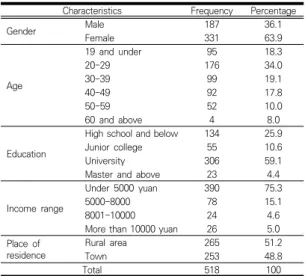
In the first part of 518 valid samples, population demographic description. See Table 1.

Characteristics Frequency Percentage

Gender Male 187 36.1

Female 331 63.9

Age

19 and under 95 18.3

20-29 176 34.0

30-39 99 19.1

40-49 92 17.8

50-59 52 10.0

60 and above 4 8.0

Education

High school and below 134 25.9

Junior college 55 10.6

University 306 59.1

Master and above 23 4.4

Income range

Under 5000 yuan 390 75.3

5000-8000 78 15.1

8001-10000 24 4.6

More than 10000 yuan 26 5.0

Place of

residence Rural area 265 51.2

Town 253 48.8

Total 518 100

Table 1. Demographic characteristics

4. Empirical analysis

Exploratory factor analysis and confirmatory factor analysis were carried out on the information consumption behavior structure.

4.1 Information Consumption Behavior Structure Exploration

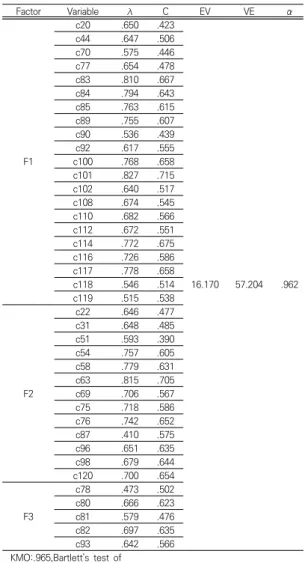
SPSS23.0 was used to analyze the discrimination degree of 121 questions on the structure of information consumption behavior,

39 questions with high division and conforming to the information consumption behavior were selected. The KMO value of exploratory factor test was 0.965, Bartlett spherical test X2=13481.072 (df=741), P <0.001, which indicated that the correlation degree between the questions was high and was suitable for factor ana lysis. Principal component analysis was carried out by using maximum variance rotation.

Three factors with feature roots greater than 1

were extracted. The cumulative variance

interpretation rate of the three factors was

57.204%, and the common degree of topics was

between 0.390 and 0.715. The discrimination

(5)

degree of 39 topics is between 0.407 and 0.827, all of which are greater than 0.4. The reliability of the questionnaire Kehlenbach α coefficient

=0.962. As shown in Table 2.

Factor Variable λ C EV VE α

F1

c20 .650 .423

16.170 57.204 .962

c44 .647 .506

c70 .575 .446

c77 .654 .478

c83 .810 .667

c84 .794 .643

c85 .763 .615

c89 .755 .607

c90 .536 .439

c92 .617 .555

c100 .768 .658

c101 .827 .715

c102 .640 .517

c108 .674 .545

c110 .682 .566

c112 .672 .551

c114 .772 .675

c116 .726 .586

c117 .778 .658

c118 .546 .514

c119 .515 .538

F2

c22 .646 .477

c31 .648 .485

c51 .593 .390

c54 .757 .605

c58 .779 .631

c63 .815 .705

c69 .706 .567

c75 .718 .586

c76 .742 .652

c87 .410 .575

c96 .651 .635

c98 .679 .644

c120 .700 .654

F3

c78 .473 .502

c80 .666 .623

c81 .579 .476

c82 .697 .635

c93 .642 .566

KMO:.965,Bartlett’s test of

sphericity:

  ≺  ,df=741, Total variance explained:57.204

Table 2. Results of exploratory factor analysis

According to the existing measurement structure theory of information consumption behavior, among the three factors of information consumption measured in this study, the topic content of F1 measurement involves the information consciousness, information morality and information ability of information consumers,

which reflects the ability of consumers to use a large number of information tools and information resources to solve problems[15].

Therefore, F1 is named information literacy.

The topic measured by F2 relates to the willingness to pay and the level of payment of information consumers and is therefore named as the ability to pay. The topic of F3 measurement is about what kind of information consumers want to obtain, why, and what is the purpose, so it is named information requirements[16]. The three factors measured in this study are relatively consistent with the theoretical conception and reasonable in structure.

4.2 Information Consumption Behavior Structure Verification

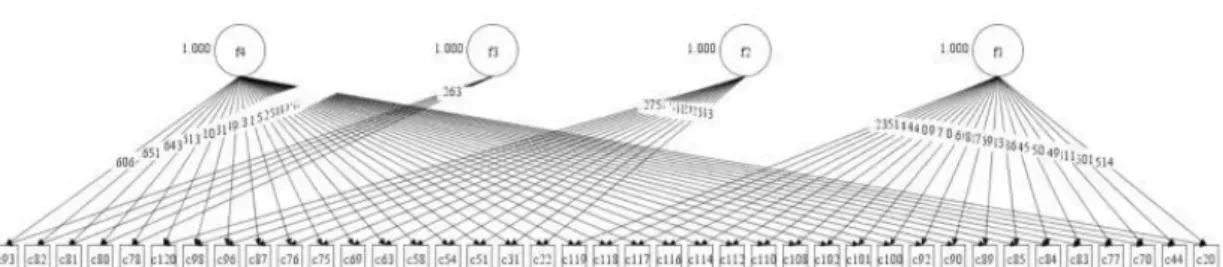
Mplus7.4 is used to cross-verify the three-factor structure of information consumption behavior obtained from exploratory factor analysis in the second part of data, and a two-factor model is obtained. Two-factor model is a kind of model with both global and local factors[17]. The discrimination of 39 topics in the second part of the data is between 0.423 and 0.812, all of which are greater than 0.4. The reliability of the questionnaire Kehlenbach α coefficient = 0.962.

On this basis, a confirmatory factor analysis of the three-factor structure of rural residents' information consumption behavior is carried out.

f1, f2 and f3 are three local factors, f1 contains 21 questions for information literacy, f2 contains 13 questions for ability to pay, f3 contains 5 questions for information demand, f4 is a global factor, and the fitting index shows X2

=13688.268, df = 741, CFI= 0.897, TLI=0.885. Both

are close to 0.9, RMSEA=0.063, less than 0.08,

SRMR=0.042, close to 0, the fitting index is ideal,

indicating the relative strength of global factor

and local factor.This shows that the information

consumption behavior structure of rural residents

has been verified. As shown in Fig 1.

(6)

Fig. 1. Verification of Two-factor Model

5. Conclusion

Through exploratory factor analysis and verification analysis of the two samples, this study fully proves the empirical validity of the information consumption behavior structure of rural residents. The following conclusions are drawn:

The first In the study of information consumption behavior structure of rural residents in Changchun, the Angle is relatively single.

Moreover, limited by geographical conditions, the questionnaire was not sent to remote rural areas, especially mountainous areas, which happened to be areas with relatively backward information infrastructure and relatively low literacy and quality of rural residents. Therefore, this study cannot represent the structural model of information consumption behavior of all rural residents in China.

The Second, the value provided by information products is the value provided by the products and services most valued by rural residents at present, and is the biggest driving force of information consumption for rural residents.

Information products such as TV and mobile phones have become the basic needs of people's life.

The third, Changchun rural residents' information consumption behavior structure includes at least three parts: information literacy, payment ability and information demand.

Moreover, these three parts correspond to the

information literacy, information consumption demand and purchasing power put forward by previous scholars.

Information literacy of rural residents has a significant correlation with information consumption behavior. To strengthen information literacy education for rural residents, the higher the level of knowledge and skills of rural residents, the more they can enjoy the effectiveness of information products and services, and the higher their willingness and enthusiasm for information consumption. Rural residents' ability to pay has a significant correlation with information consumption behavior. Information consumption can bring incomparable advantages to consumers such as pleasure, convenience and high efficiency. Rural residents are willing to pay for information products and services when money, time and energy are sufficient. Information demand of rural residents has a significant correlation with information consumption behavior. According to Cohen's information demand hierarchy theory, there are three levels: potential demand, awakened or recognized demand and expressed demand. Therefore, in order to further explore the information needs of rural residents, the more satisfied their information needs are, the more they will devote themselves to obtaining higher-level information.

In conclusion, based on the influential factors

of information consumption behavior proposed

by other scholars, this study used SPSS and Mplus

(7)

statistical analysis software to explore and verify the structure of rural residents' information consumption behavior, providing reference for improving rural residents' information consumption ability.

REFERENCES

[1] X. Q. Liu & Q. Han. (2016). Dynamic Change of Rural Information Consumption Differences in Different Areas of China. Journal of Beijing University of Aeronautics and Astronautics( Social Sciences Edition), 32(2), 114-121.

DOI:10.13766/j.bhsk.1008-2204.2016.0427

[2] L. Da. (2013). Information consumption will become a new hot spot of consumption. Macroeconomic management, 11(101), 24-28.

DOI:10.19709/j.cnki.11-3199/f.2013.11.010

[3] L. Ma, Y. Gao, Y. M. Wu, S. T. Wang. & R. Hua. (2018).

Research on information consumption gap between urban and rural residents in anhui province.. YinShan Academic Journal, 32(2), 5-8.

DOI:10.13388/j.cnki.ysajs.20180116.048

[4] C. J. Li, Z. M. Wang & W. L. Ma. (2017). Determinants and Contributions of Provincial Differences of Rural Residents’Information Consumption:An Empirical Study by the Method of Shapley Value Decomposition.

Information science, 35(8) , 146-152.

DOI:10.13833/j.cnki.is.2017.08.058

[5] X. Y. Wang. (201601.21). Comprehensively Push Forward and Take the Lead in Realizing Agricultural Modernization. New Culture Newspaper [Online].

https://news.sina.com.cn/c/2016-01-21/doc-ifxnuvxc 1500990.shtml

[6] Q. XUE. (2018.5.1). Influencing factors of rural residents' consumption in Changchun. Jilin agricultural university.

[7] M. H. Chen & Y. N. Wei. (2015). Expanding information consumption to promote the transformation of China's economic development mode. Journal of liaoning administrative institute,4(12 ),54-58.

DOI : 10.13945/j.cnki.jlac.2015.04.012

[8] Y. H. Zou. (2017). Information Consumption:

Concepts, Characteristics and Problems. Financial circles, 7(12), 1-3.

DOI:10.16266/j.cnki.cn11-4098/f.2017.12.001 [9] L. M. Chao. (2015). Characteristics analysis of

information consumption. Information theory and practice, 12(4) , 15-19.

DOI:10.16353/j.cnki.1000-7490.2015.12.004

[10] X. Y. Liu, J. Qi & Z. Y. Wang. (2016). Connotation

Definition and Characteristic Analysis of Emerging Information Consumption. Information studies : theory &Application, 39(11), 62-67.

DOI:10.16353/j.cnki.1000-7490.2016.11.012

[11] X. T. Wang. (2011). Evaluation model of rural information consumption level. Agricultural network information, 8(11) , 96-99.

DOI:10.3969/j.issn.1672-6251.2011.11.030

[12] C. Yang. (2010). Current Situation and Countermeasures of Farmers' Information Consumption Power in China.

Anhui agricultural sciences, 38(8), 4266-4269.

DOI:10.13989/j.cnki.0517-6611.2010.08.185

[13] Y. T. Jeon & J. E. Lee. (2017). The structural relationship between the Relationship conflict and Organizational Citizenship & Employee Behavior Intention of Hotel Employees. Journal of Digital Convergence, 15(8) , 95-102.

DOI:10.14400/JDC.2017.15.8.95

[14] Y. J. Yu & J. S. Park. (2018). A Study on the Structure Model of Social Welfare Students' Career Preparation Behavior based on Social-cognitive Career Theory.

Journal of Digital Convergence, 16(1) , 85-92.

DOI:10.14400/JDC.2018.16.1.085

[15] X. J. Wang. (2007). Research on the concept of information literacy at home and abroad. Library and Information Sciences in Agriculture, 19(5), 131-134.

DOI:10.13998/j.cnki.issn1002-1248.2007.05.041 [16] M. Riesener, C. Dölle, J. Koch & G. Schuh. (2019).

Information requirements for a data-based analysis of product and service complexity. Procedia CIRP, 7(22), 279-284.

DOI:10.1016/j.procir.2019.04.079

[17] H. L. Gu & Z. L. Wen. (2014). Two-factor model: a new perspective of multidimensional construct measurement. Psychological, 37(4) . 973-979.

DOI:10.16719/j.cnki.1671-6981.2014.04.030

유 혜 주(Hui-Shu Liu) [정회원]

․ 2005년 7월 : 지린재경대학교 정보관 리학과(관리학학사)

․ 2010년 7월 : 장춘이공대학교 사회주 의경제학과(법학석사)

․ 2018년 5월 ~ 현재 : 세한대학교 경영 학과 박사과정

․ 2005년 9월 ~ 현재 : 길림공정기술사 범학원 관광관리학부 교수

․ 관심분야 : 정보 관리

․ E-Mail : [email protected]

(8)

정 기 영(Gi-Young Jung) [정회원]

․ 1984년 2월 : 조선대학교 공과대학 (공학사)

․ 1986년 8월 : 명지대학교 대학원 무 역학과(경영학석사)

․ 1990년 5월 : University of Bridgeport (경영학석사)

․ 1993년 5월 : Golden Gate University (경영학박사)

․ 1997년 3월 ~ 현재 : 세한대학교 경영학과 교수

․ 관심분야 : 고객관계관리, 장소마케팅

․ E-Mail : [email protected]

김 형 호(Hyung-Ho Kim) [정회원]

․ 1989년 2월 : 경희대학교 전자계산공 학과(공학사)

․ 1992년 8월 : 경희대학교 전자계산공 학과(공학석사)

․ 2018년 2월 : 인천대학교 동북아물류 대학원(물류학박사)

․ 1998년 3월 ~ 현재 : 세한대학교 항공 교통물류학과 교수

․ 관심분야 : 신경회로망, 항공운송, System Dynamics

․ E-Mail : [email protected]

수치

Table  1.  Demographic  characteristics
Table  2.  Results  of  exploratory  factor  analysis
Fig.  1.  Verification  of  Two-factor  Model

참조

관련 문서