• 검색 결과가 없습니다.

A Study on the Different Characteristics for Information Consumption in Urban and Rural Residents -Focusing on China's Jilin Province-

N/A
N/A
Protected

Academic year: 2021

Share "A Study on the Different Characteristics for Information Consumption in Urban and Rural Residents -Focusing on China's Jilin Province-"

Copied!
11
0
0

로드 중.... (전체 텍스트 보기)

전체 글

(1)

A Study on the Different Characteristics for Information Consumption in Urban and Rural Residents

-Focusing on China's Jilin Province- Hui-Shu Liu

1

, Gi-Young Chung

2

, Hyung-Ho Kim

3*

1

Professor, Dept. of Business Administration, Jilin Engineering Normal University

2

Professor, Dept. of Business Management, Sehan University

3

Professor, Dept. of Air Transport and Logistics, Sehan University

중국 도시·농촌 거주자의 정보소비 특성에 관한 연구

-중국 길림성을 중심으로-

유혜주

1

, 정기영

2

, 김형호

3*

1

길림공정기술사범학원 경영학부 교수,

2

세한대학교 경영학과 교수,

3

세한대학교 항공교통물류학과 교수

Abstract The purpose of this study is to investigate and evaluate the characteristics of information consumption between rural and urban residents. In this study, the data were collected through a survey and in-depth interview consisting of 121 information consumption questions for the residents of 15 cities and rural areas located in Jilin Province, China, and 985 effective responses were analyzed using SPSS 23.0. Analysis of information consumption characteristics by age, type of household and gender for urban and rural residents showed that there was a large interaction between age and gender, age and type of household, type of household and gender. This study can contribute to narrowing the information service gap between urban and rural residents and utilizing the potential of information consumption. The study is limited to analyzing only residents of Jilin Province in China and needs to expand the scope of future investigations.

Key Words : Information consumption, Analysis of variance, Rural residents, Urban residents, characteristics of information consumption

요 약 본 연구의 목적은 농촌 주민과 도시 주민 간의 정보 소비의 특성을 조사하고 평가하는 것이다. 본 연구에서는 중국 길림성에 위치한 15개 도시와 농촌 지역 거주자에 대해 121개의 정보소비 문항으로 구성된 설문과 심층 인터뷰 를 통해 데이터를 수집했으며, 985개의 유효 응답을 SPSS 23.0을 이용하여 분석하였다. 도시와 농촌 거주자를 대상으 로 연령별, 가구형태 및 성별에 따른 정보소비 특성을 분석한 결과, 연령과 성별, 연령과 가구형태, 가족형태와 성별 사이에 상호작용이 큰 것을 알 수 있었다. 본 연구는 도시와 시골 주민들 사이의 정보 서비스 격차를 줄이고 정보 소비 의 잠재력을 활용하는 데 기여할 수 있다. 이번 연구는 중국 길림성 주민만을 대상으로 분석했다는 한계가 있으며 향후 조사 범위를 확대할 필요가 있다.

주제어 : 정보소비, 방차 분석, 농촌 주민, 도시 주민, 정보 소비특성

*Corresponding Author : Hyung-Ho Kim([email protected]) Received March 25, 2020

Accepted July 20, 2020 Revised June 11, 2020

Published July 28, 2020

(2)

1. Introduction

Internet, E-mail, SNS, mobile communications, artificial intelligence, 5G and other technologies are developing at a rapid pace[1]. China Internet Network Information Center(CNNIC) issued the 43rd statistical report on the development of China's Internet network on February 28, 2019.

As of December 2018, China had 829 million Internet users, 56.53 million new Internet users and 59.6% Internet penetration rate, up 3.8%

from the end of 2017. China's rural Internet users totaled 222 million, accounting for 26.7 percent of the total Internet users, an increase of 12.91 million from the end of 2017, with an annual growth the development and application of digital technology. The size of urban Internet users was 607 million, accounting for 73.3 percent, an increase of 43.62 million over the end of 2017, with an annual growth rate of 7.7 percent. Although the number of rural Internet users is less than that of urban Internet users, the number of rural Internet users increases year by year, the promotion effect that rural Internet users information consumption brings to national economy cannot ignore. Jilin Province is an old industrial zone and major grain-producing area.

The total population of Jilin Province is 27.04 million, of which 11.48 million are rural, accounting for 42.47 percent of the total population of Jilin Province in 2019. Chinese rural population is about 600 million, with a total population of 1.4 billion. The rural population accounts for 42.86 percent. The proportion of rural population in Jilin Province is similar to that of China. In addition, the per capita net income of rural residents in Jilin Province is 13748 yuan, and the per capita living consumption expenditure is 10826 yuan in 2019.

The per capita income of rural residents is 15,422 yuan and the per capita living expenditure is 12,934 yuan in China. Jilin Province is close to China's average. The income

and expenditure of rural residents in Jilin Province are close to the average in China. The population structure of rural and urban residents in Jilin Province is representative.

Through the development of digital technology and the use of technology, various devices have been developed that benefit the life of consumption[2]. In view of the research on the characteristics for subjects of information consumption, many scholars[3,4] had expounded it from the perspective of income, believed that the higher the income, the stronger the ability to pay, and the more information consumption expenditure. Other scholars[5-7] believed that different lifestyles and consumption habits would also lead to different characteristics for subjects of information consumption. However, there are few studies on the characteristics of information consumption subjects of different household types. There are two types of household registration in China. First is the rural household registration, which refers to people born in rural areas. Second is the urban household registration, refers to the people born in the town[8]. The theoretical value of this study is the comparative analysis of the characteristics of information consumption subjects reflected by different household registration types, different ages and different genders. The practical value of this study is to explore the differences between rural residents and urban residents in information consumption in Jilin Province, which is helpful to improve the information consumption domestic demands of these two groups respectively, and further improve the national information consumption ability

2. Theoretical review

2.1 A review of the concept of information

consumption

(3)

The definition of information consumption was put forward later in China. Information consumption refers to per capita information consumption expenditure, including entertainment and culture, medical care, transportation and communication expenditure[9]. R. N. Geng(2018) believed that information consumer products intelligent content diversity, information consumption, information consumption scope of infiltration, information consumption new terminal, the health, education, transportation, family, culture, and a series of the wisdom of the people's livelihood public information consumption services applications, provide the public with pratt & Whitney, fast and efficient service, promotes the rapid growth of information consumption[10]. L. L. Fu(2014)believed that information consumers take consumption activities to meet their own information needs in a specific information consumption environment[11]. Y. L. Jiang (2018) believed that the object of information consumption in this study includes not only information products and services, but also information paid for with money or obtained for free. Information consumption also plays an important role in improving economic quality and efficiency[12].

Information consumption includes three major factors: subject, object and environment. Subject factor refers to information consumers, object factor refers to information products or services, and environmental factors include information network construction, information industry and information consumption policy[13]. Information consumption emphasizes the ultimate information consumer goods and services, including the transactions that consumers directly pay for to meet their information demands and the activities that consumers do not directly pay for but meet their information demands through the information platform built by enterprises or government agencies[14].

Information consumption begins with

information demand. Information demand is the driving force of information consumption and the essential element of information consumers[15]. Education level, household type and per capita income characteristics not only directly affect the level of information consumption, but also can affect residents' information consumption tendency through cross-level interactive effects[16].

Foreign scholars on the representative of information consumption: Marko J. van Leeuwen (2002) believed that, the information of consumers was analyzed from the perspective of receiving distance online education, and information consumption behaviors of consumers of different genders, ages and occupations were analyzed, so as to classify and compare the purpose, process and duration of various consumer information consumption behaviors[17]. Anne Hoag (2016) analyzed the factors affecting user cognition, and analyzed the process and consideration factors of consumers' choice in the face of new technologies, concepts or information. The evaluation system and satisfaction index system proposed have certain guiding significance and great application value in the field of information consumption[18].

Mark Lee Hunter(2018) proposed that online community comments have an important impact on consumption behavior of consumers, especially in the initial understanding of products, among which the consumer behavior of electronic products has the greatest impact[19].

2.2 A review of the characteristics for subjects of information consumption Different scholars[3-7] have different research methods and contents on the characteristics for subjects of information consumption. The literature review is shown in Table 1.

Many scholars used the analysis of variance to

(4)

Author

(Year) Name of document Object of study Research

method Research content

D.R.Zheng (2015)

Study on the characteristics and influence factors of online video information

consumption in China

Information

consumers Analysis of variance

Information consumers are more male than female, the proportion of 10-39 years old is as high as 80%,the monthly income above 3000 yuan accounts for 40%.

Z.L.Xu

(2019) Research on consumer psychology and

behavior in network marketing Online

consumers Analysis of

variance The higher the income, the higher the network consumption and the higher the network dependence L.M.Chao

(2015) Analysis of the characteristics of information

consumption Information

consumers Literature

research Information consumers are willing to share information X.Y.Li

(2017)

Study on characteristics of tourism information consumption of self-service tourists--based

on content analysis

Self-service tourists

Social Network Analysis

Information consumers consume a wide range of types, and information processing ability is strong X.M.Jiang

(2018) Information consumption characteristics of

urban aging group urban aging

group Analysis of

variance Information consumers mainly obtain life information and cultural information

Table 1. Literature review on the characteristics for subjects of information consumption

do empirical research and analyzed the information consumption characteristics of different groups. However, among many research objects, there were very few researches on the comparison characteristics for subjects of information consumption behavior between urban residents and rural residents. This study makes up for this deficiency.

2.3 A review of the theory of analysis of variance

Analysis of Variance, also known as "Variance Analysis", invented by R. A. Fisher for the significance test of differences in the mean of two or more samples. Due to the influence of various factors, the data obtained in the study presented a fluctuation. The causes of the fluctuation can be divided into two categories:

one is the uncontrollable random factors, and the other is the controllable factors exerted by the study to influence the results. Analysis of variance is one of the most important methods in scientific experiments and statistical analysis of data[20]. It is mainly used to analyze the changes of test result data and understand which factors have significant influence on indicators. Analysis of variance is divided into one-way analysis of variance and multi-factor analysis of variance[21]. One-way analysis of variance is used to compare the average values of multiple samples in a completely random design. Its

statistical inference is to infer whether the mean values of each population represented by each sample are equal. One-way analysis of variance is completed through examples[22]. The difference between the two is that not only each factor plays a role in the test indicators, but also the different horizontal collocation of each factor plays a role in the test indicators[23]. The structural equation model uses multi-factor analysis of variance as potential variables to control the measurement error, so the coefficient values estimated as bar bath using the structural equation model are more accurate than those obtained based on a specific variable[24].

Multi-factor analysis of variance can not only analyze the independent influence of multiple factors on the observed variables, but also analyze whether the interaction of multiple control factors has a significant impact on the distribution of observed variables, and finally find the optimal combination that is beneficial to the observed variables. In SPSS, the function of multi-factor analysis of variance can also be used to compare whether there is a significant difference in the mean value of the observed variables at different levels of the control variables. There are two ways to achieve this, namely, multiple comparison test and contrast test. The method of multiple comparison test is similar to that of one-way analysis of variance.

The contrast test adopts the method of

(5)

Factors Questions Design basis

Information consumption

demand

c83 I shop online.

W. L. Kuang.(2014). Analysis of users' weak information demand and service

strategy in digital library.

Y. Xie.(2013). Observation on the level of network information consumption of

college students.

c84 When shopping online, I look at the rate of good reviews.

c85 I move payment.

c89 When I shop online, I compare prices.

c92 Choosing an information product or service depends not only on price, but also on quality.

c94 I need startup information.

c100 I use baidu to look up information.

c101 When I shopping online, I read the product reviews.

c102 I use the online bank to pay for living expenses.

c114 When I shopping online, I look at the credibility of the goods.

Information consumption

ability to pay

c54 Paid information expands my knowledge.

Z. C. Yin & J. Wang. (2011). A grey system analysis of information payment

ability of farmers in Hebei province.

c58 Paid information can enrich my mind and improve my ability.

c63 Paid information can enrich my life.

c69 Paid information enables me to better communicate with others and promote interpersonal relationships.

c75 Paid information gives me access to healthy food information.

c76 Paid information allows me to know more about society.

c93 I pay with my mobile wallet.

c96 Paid information has improved the quality of my life.

c120 Paid information helps to let technology guide my future.

Information consumption

literacy

c6 I resist pirated software.

X. J. Wang. (2007). An Overview of Conceptual Inform ation Literacy Both at

Hom e and Abroad.

D. Y. Sang. (2008). Review on Forelgn Information Literacy Research.

c10 Pirated software is of poor quality.

c27 Pirated software will make me lose a lot of information.

c37 Pirated software has viruses.

c45 Pirated software is not safe.

c47 I don't buy pirated software.

c61 I don't use pirated software for lack of quality assurance.

Table 2. Questionnaire contents and design basis one-sample t-test, which regards the values of the observed variables at different levels of the control variables as samples from different populations, and checks whether the mean of these populations is significantly different from a specified test value in turn.

Multi-factor analysis of variance is adopted in this study. Different levels of fixed age were used to explore the interaction between the household type and gender of urban residents and rural residents to obtain the mean value and standard deviation. The Levine test of homogeneity of variance was used to test whether the variances of two groups and more than two groups of independent samples were equal. SNK (Student-Newman-Keuls) test is used to verify

that the number of horizontal observations is equal[4].

3. Empirical analysis 3.1 Questionnaire design and basis

This paper adopts questionnaire survey method to collect the data of empirical analysis.

By consulting a large number of domestic and

foreign literatures[2-7] related to information

consumption, and by combining open

questionnaire and in-depth interview, 121

questions of information consumption were

finally formed to form the preliminary survey

(6)

questionnaire. Likert 5 points were used to set the answers for each question, ranging from completely inconsistent to completely consistent.

The samples formally tested came from 15 rural and urban areas of Jilin Province. A total of 1079 questionnaires were distributed through the two methods of on-site distribution and online distribution. 94 invalid questionnaires were deleted, and a total of 985 valid questionnaires were acquired, the effective rate was 91.3%.

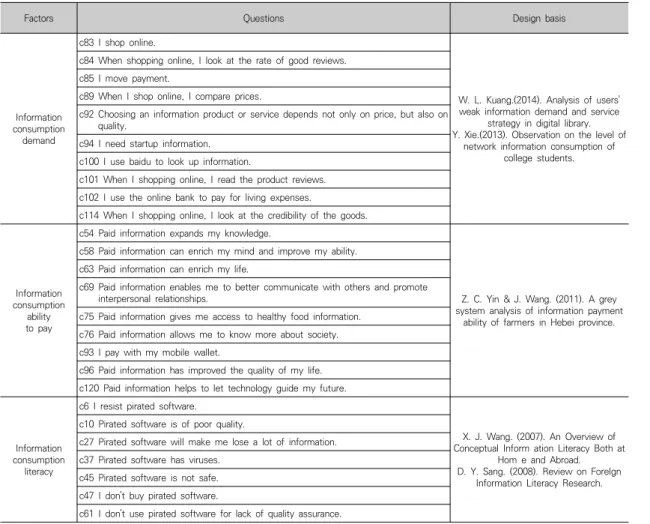
Dimensionality reduction was carried out on the data, and factors with low correlation degree were deleted to obtain the final component matrix of information consumption demand, payment ability and information literacy in three dimensions, a total of 26 factors. The questionnaire contents and design basis[25-29]

are shown in Table 2.

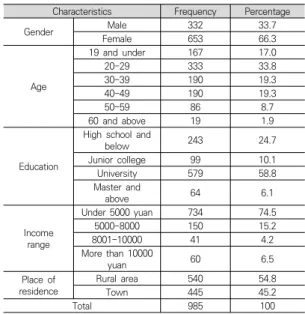
Among the 985 valid samples,332 were males, accounting for 33.7%, and 653 were females, accounting for 66.3%. In terms of age distribution, 167 people aged 19 and below (17.0%), 333 people aged 20-29 (33.8%), 190 people aged 30-39 (19.3%),190 people aged 40-49 (19.3%), 86 people aged 50-59 (8.7%), and 19 people aged 60 or above (1.9%). In terms of educational background distribution, 243 people below senior high school, accounting for 24.7%.

99 people in junior college, accounting for 10.1%.

579 people with bachelor's degree, accounting for 58.8%, 64 people with master's degree or above, accounting for 6.5%. In terms of income range distribution, 734 people below 5000 yuan, accounting for 74.5%; 150 people between 5000 yuan and 8000 yuan, accounting for 15.2%; 41 people between 8001-10000 yuan, accounting for 4.2; 60 people above 10000 yuan, accounting for 6.1%. In terms of household type distribution, there are 540 people in rural areas, accounting for 54.8%, and 445 people in urban areas, accounting for 45.2%. See Table 3.

Characteristics Frequency Percentage

Gender Male 332 33.7

Female 653 66.3

Age

19 and under 167 17.0

20-29 333 33.8

30-39 190 19.3

40-49 190 19.3

50-59 86 8.7

60 and above 19 1.9

Education

High school and

below 243 24.7

Junior college 99 10.1

University 579 58.8

Master and

above 64 6.1

Income range

Under 5000 yuan 734 74.5

5000-8000 150 15.2

8001-10000 41 4.2

More than 10000

yuan 60 6.5

Place of

residence Rural area 540 54.8

Town 445 45.2

Total 985 100

Table 3. Demographic characteristics

Levene Statistic Information consumption Based on

Mean df1 df2 Sig

Information consumption

Based on

Median 2.101 23 961 .002

Based on Median and with adjusted

df

1.554 23 961 .002

Based on

trimmed mean 1.554 23 733.91 6 .002 Table 4. Levene's Test of Equality of Error Variances

3.2 Analysis of variance

SPSS23.0 was used for reliability and validity test, and it was found that KMO=0.938, greater than 0.7, and Bartlett sphericity test was less than significance level, and the Alpha coefficient was 0.915, also greater than 0.7. According to the relevant criteria of KMO value and Bartlett sphericity test, as well as the criteria of factor load and the selection of explanatory ariants, the scale indexes reached the corresponding criteria.

Therefore, this study can be judged to be reliable.

In this study, SPSS 23.0 was used to conduct

multi-factor analysis of variance on 985 effective

samples. Through the homogeneity of variance

(7)

Dependent Variable: Information consumption

Source Type III Sum of Squares df Mean Square F Sig.

Corrected Model 5020.531 23 218.284 4.245 .000

Intercept 543191.857 1 543191.857 10562.570 .000

Age 1441.727 5 288.345 5.607 .000

Household type 121.813 1 121.813 2.369 .124

Gender 326.058 1 326.058 6.340 .012

Age*Household type 441.971 5 88.394 1.719 .128

Age*Gender 393.281 5 78.656 1.529 .178

Household type *Gender 86.634 1 86.634 1.685 .195

Age* Household type * Gender 488.812 5 97.762 1.901 .092

Error 49420.488 961 51.426

Total 1606453.000 985

Corrected Total 54441.019 984

a. R Squared = .092 (Adjusted R Squared = .070) Table 5. Tests of Between-Subjects Effects

Information consumption Student-Newman-Keulsa,b,c

Age N Subset

1 2

60 and above 19 35.0526

50-59 86 36.1279

40-49 190 39.2263

30-39 190 39.4368

19 and under 167 40.4551

20-29 333 40.9129

Sig. .370 .495

Table 6. Student-Newman-Keuls

Fig. 1. The Interaction between Age and Gender

test, it can be seen that the values of df1 and df2 are both greater than 0.05 and the P value is less than 0.05, so the homogeneity of variance is shown in Table 4.

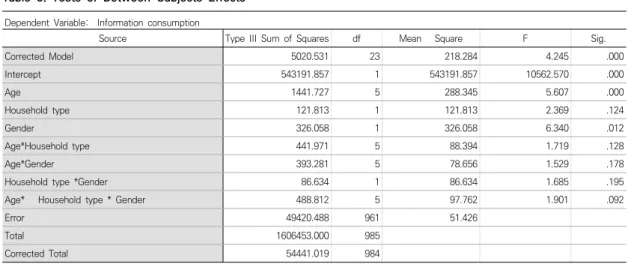
The grouping of age, gender and household type reflects the difference between different group data and the difference in their interaction. The modified model P value is less than 0.05, and the P value of age and gender is less than 0.05, indicating that there is a significant difference in information consumption demand between age and gender. See Table 5.

The SNK (student-newman-Keuls) method was used to group the ages, and it can be seen that, at the significant level of alpha =0.05, there was no difference between the age group aged 60 and above and the age group aged 50-59, and significant difference between 40-39, 30-39, 20-29 and the age group aged 19 and under. See Table 6.

Means for groups in homogeneous subsets are displayed. Based on observed means. Alpha = .05.

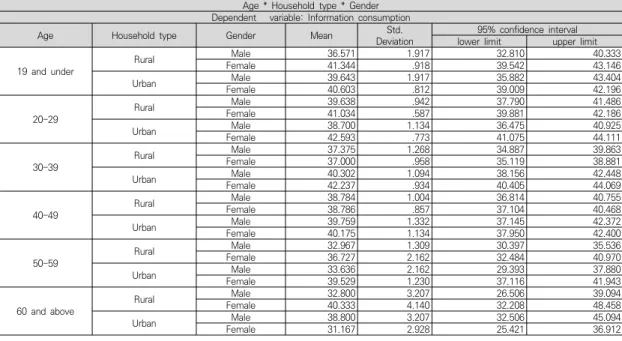
SPSS 23.0 analysis was used to obtain the

estimated marginal mean, as shown in Table 7.

(8)

Age * Household type * Gender Dependent variable: Information consumption

Age Household type Gender Mean Std.

Deviation 95% confidence interval lower limit upper limit

19 and under Rural Male 36.571 1.917 32.810 40.333

Female 41.344 .918 39.542 43.146

Urban Male 39.643 1.917 35.882 43.404

Female 40.603 .812 39.009 42.196

20-29 Rural Male 39.638 .942 37.790 41.486

Female 41.034 .587 39.881 42.186

Urban Male 38.700 1.134 36.475 40.925

Female 42.593 .773 41.075 44.111

30-39 Rural Male 37.375 1.268 34.887 39.863

Female 37.000 .958 35.119 38.881

Urban Male 40.302 1.094 38.156 42.448

Female 42.237 .934 40.405 44.069

40-49 Rural Male 38.784 1.004 36.814 40.755

Female 38.786 .857 37.104 40.468

Urban Male 39.759 1.332 37.145 42.372

Female 40.175 1.134 37.950 42.400

50-59 Rural Male 32.967 1.309 30.397 35.536

Female 36.727 2.162 32.484 40.970

Urban Male 33.636 2.162 29.393 37.880

Female 39.529 1.230 37.116 41.943

60 and above Rural Male 32.800 3.207 26.506 39.094

Female 40.333 4.140 32.208 48.458

Urban Male 38.800 3.207 32.506 45.094

Female 31.167 2.928 25.421 36.912

Table 7. Estimated marginal mean

Fig. 2. The Interaction between Age and Household Type

Fig. 3. The Interaction between Gender and Household Type

4. Research results

Through the above empirical analysis, it can

be seen that different age, household type and

gender reflect different characteristics for

subjects of information consumption. As shown

in Fig. 1, it can be seen that at different age

levels, with the growth of age, the information

consumption behavior shows a downward trend,

and the information consumption level of female

is higher than that of male. Female aged 20-29

had the highest level of information

consumption. The information consumption level

of male aged 20-29 and 40-49 is high, while that

of male aged 50-59 is very low. The information

consumption level of male and female over 60 is

basically the same. At different ages, the

information consumption behavior shows a

downward trend, and the information

consumption level of urban residents is higher

than that of rural residents. Among urban

residents, 30-39 years old is the highest level of

information consumption, and below 60 years

old is the lowest level of information

consumption. Among rural residents, 20-29 years

(9)

old is the highest level of information consumption, and 50-59 years old is the lowest level of information consumption. Below the age of 60, the information consumption level of urban residents is lower than that of rural residents, as shown in Fig. 2. At different gender levels, the information consumption level of female is higher than that of male. The information consumption level of urban residents is higher than that of rural residents, as shown in Fig. 3.

5. Conclusion

According to the above research, this study summarizes the different characteristics of information consumption behavior subjects in rural and urban residents in terms of age, gender and household type by using multi-factor analysis of variance, which has a great theoretical innovation for the characteristics of age and gender proposed by the previous scholars using one-way analysis of variance.

According to these characteristics, the government of Jilin Province and the providers for information goods and service can provide corresponding information products and services for different characteristics of consumer groups, which has an important guiding significance for the construction and improvement of information infrastructure in Jilin Province, improving the awareness of information consumption, establishing the subsidy policy system of agricultural information service, improving the popularization rate of information facilities, improving the efficiency of rural information supply and narrowing the gap between urban and rural areas.

However, there are some limitations in this study. Firstly, due to the late rise of information consumption in rural areas, there is a lot of lack of relevant statistical data in the annals.

Therefore, it is difficult to obtain the macro data

of information consumption, which makes the difficulty to analysis of this paper in depth at the macro level. Secondly, the data samples in this paper are all from Jilin Province, which have distinct characteristics of Jilin Province residents and are significantly affected by the regional economic level, so that these samples can not fully represent the overall information consumption level of China.

With the popularization and apply of the Internet, the use of information technology and information consumption behavior have gradually become a means of production and production, and information resources will become an important factor of production long into the future. As a result, it will be a new research direction in the future by using various research methods comprehensively, which can deepen the utilization and breadth of data, enrich and improve the original data, increase the scientific analysis,and then analyze the impact of information consumption on the production, life and welfare of rural and urban residents in depth.

REFERENCES

[1] H. J. Park. (2018). The Analysis on Customer Behavior of Tourism Omnichannel based upon ICT. Journal of Digital Convergence, 16(6), 95-104.

DOI:10.14400/JDC.2018.16.6.095

[2] Y. J. Kim. (2016). An analysis of consumption behavior and consumption problem according to the digital convergence. Journal of Digital Convergence, 14(2), 149-156.

DOI:10.14400/JDC.2016.14.2.149

[3] D. R. Zheng. (2015). Study on the characteristics and influence factors of online video information consumption in China. University of Science and Technology of China, 2015-05-30 (009).

https://kns.cnki.net/KCMS/detail/detail.aspx?dbcode=

CMFD&dbname=CMFD201701&filename=1016107744.

nh&uid=WEEvRE.

[4] Z. L. Xu. (2019). Research on consumer psychology

and behavior in network marketing. Journal of

Enterprise Reform and Management, 19(2), 110-111.

(10)

DOI:10.13768/j.cnki.cn11-3793/f.2019.0337

[5] L. M. Chao. (2015). Analysis of the characteristics of information consumption. Journal of Information Studies:Theory & Application, 38(12), 15-19.

DOI:10.16353/j.cnki.1000-7490.2015.12.004

[6] X. Y. Li. (2017). Study on characteristics of tourism information consumption of self-service tourists--based on content analysis. Henan university of finance and law, 2017-05-01 (003).

https://kns.cnki.net/KCMS/detail/detail.aspx?dbcode=

CMFD&dbname=CMFD201801&filename=1017725968.

nh&uid=WEEvRE.

[7] X. M. Jiang. (2018). Information consumption characterics of urban aging group. Journal of zhoukou normal university, 35(4), 142-147.

DOI:10.13450/j.cnki.jzknu.2018.04.29

[8] X. Q. Liu & Q. Han. (2016). Dynamic Change of Rural Information Consumption Differences in Different Areas of China. Journal of Beijing University of Aeronautics and Astronautics( Social Sciences Edition), 32(2), 114-121.

DOI:10.13766/j.bhsk.1008-2204.2016.0427

[9] Y. C. Pan & Y. C. Huo. (2018). Analysis of rural information consumption demand in henan province.

Journal of Modern Business, 02(06), 34-35.

DOI:10.14097/j.cnki.5392/20180206.004

[10] R. N. Geng. (2018). The Information Consumption Behavior and the Improvement of Information Consumption Ability of the Retirees under the Background of Smart City. Information science, 37(7), 106-111.

DOI:10.13833/j.issn.1007-7634.2019.07.018

[11] L. L. Fu. (2014). Information consumption: fashion consumption on fingertips. Science and technology daily , 2014-06-04 (006).

https://kns.cnki.net/kcms/detail/detail.aspx?filename=

KJRB201406040060&dbcode=CCND&dbname=CCND2 014.

[12] Y. L. Jiang. (2018). Information consumption jumped 2.0 "fast horse" still need to "whip". Journal of Communications World,09(15), 22.

DOI:10.13571/j.cnki.cww.2018.25.014

[13] L. Liu. (2015). Research on soft measurement model of information consumption level--a case study of tangshan city. Journal of Human Resource Development Quarterly, 2015-11-25 (006).

DOI:CNKI:CDMD:2.1016.784411

[14] J. G. Xin, Z. M. Wu & C. Fang. (2018). An Empirical Study on Industrial Structure Up grading in China Driven by Information Consumption. Jouranal of Hangzhou Dianzi University, 14(5), 11-18.

DOI:10.13954/j.cnki.hduss.2018.05.002

[15] L. Da. (2013). Information consumption will become a new hot spot of consumption. Jouranal of Macroeconomic management., 11(101), 24-28.

DOI:10.19709/j.cnki.11-3199/f.2013.11.010

[16] J. T. Wang & H. X. Li. (2019). Family Characteristics, Regional Differences and Information Consumption:

A Study Based on Hierarchical Linear Model. Journal of Xi'an Jiaotong University, 6(14), 9-18.

DOI:10.15896/j.xjtuskxb.201904002

[17] Marko J. van Leeuwen (2002), The Costs Benefits of Lifelong Re-search Report. Journal of Human Resource Development Quarterly, 13(2), 151-168.

DOI:10.1002/hrdq.1021

[18] Anne Hoag (1998). Measuring Usage and Satisfaction of Cablb Modem and the Internet. Corporation for National Research Initiatives,1998 .

https://dl.acm.org/doi/book/10.5555/865384

[19] Mark Lee Hunter (2010). Measuring and Explaining the Impact of Online Communities on Consumer Markets. Journal of Corporate Reputation Review, 24(12), 225-247.

DOI:10.1057/crr.2010.25

[20] P. J. Potvin & R. W. Schutz. (2000). Statistical power for the two-factor repeated measures ANOVA.

PubMed, 32(02), 347-356.

DOI:https://doi.org/10.3758/BF03207805

[21] J. H. Dai & C. Han. (2018). A Comparative Study on Two-way ANOVA. Jouranal of Statistics&Decision, 496(04), 30-33.

DOI:10.13546/j.cnki.tjyjc.2018.04.006

[22] Z. Gao. (2014). An Empirical Study on the Application of One-way ANOVA. Journal of Chifeng University, 3(25), 4-6.

DOI:10.13398/j.cnki.issn1673-260x.2014.06.002 [23] P. Guo. (2019). There are interactive influence of the

application of three-factor analysis of variance and MATLAB implementation. Journal of Shenyang University, 39(11), 252-256.

DOI:10.16103/j.cnki.21-1583/n.2019.03.014

[24] J. H. Han & H. S. Yang. (2016). Structural Relationships between the Variables of Person-Environment Fit, Positive Psychological Capital and Innovative Work Behavior. Journal of Digital Convergence, 14(10), 225-240.

DOI:10.14400/JDC.2016.14.10.225

[25] W. L. Kuang. (2014). Analysis of users' weak information demand and service strategy in digital library. Journal of Research on Library Science, 14(10), 95-97.

DOI:10.15941/j.cnki.issn1001-0424.2014.16.017 [26] Y. Xie. (2013). Observation on the level of network

information consumption of college students. Journal of Northern Economy, 28(04), 31-32.53.

DOI:CNKI:SUN:BFJJ.0.2013-08-014

[27] Z. C. Yin & J. Wang. (2011). A grey system analysis of

information payment ability of farmers in Hebei

province. Journal of Tianjin Agricultural Science,

17(01), 134-137.

(11)

https://kns.cnki.net/KCMS/detail/detail.aspx?dbcode=

CJFQ&dbname=CJFD2011.

[28] X. J. Wang. (2007). An Overview of Conceptual Inform ation Literacy Both at Hom e and Abroad. Journal of Agricultural Library and Information, 19(05), 131-133.

DOI:10.13998/j.cnki.issn1002-1248.2007.05.04 [29] D. Y. Sang. (2008). Review on Forelgn Information

Literacy Research. Journal of Research on Library Science, 13(02), 9-11.

DOI:10.15941/j.cnki.issn1001-0424.2008.10.004

유 혜 주(Hui-Shu Liu) [정회원]

․ 2005년 7월 : 지린재경대학교 정보관 리학과(관리학학사)

ㆍ2010년 7월 : 장춘이공대학교 사회 주의경제학과(법학석사)

ㆍ2018년 5월 ∼ 현재 : 세한대학교 경 영학과 박사과정

ㆍ2005년 9월 ∼ 현재 : 길림공정기술 사범학원 관광관리학부 교수

ㆍ관심분야 : 정보 관리 ㆍE-Mail : [email protected]

정 기 영(Gi-Young Chung) [정회원]

․ 1984년 2월 : 조선대학교 공과대학(공 학사)

․ 1986년 8월 : 명지대학교 대학원 무역 학과(경영학석사)

․ 1990년 5월 : University of Bridgeport (경영학석사)

․ 1993년 5월 : Golden Gate University (경영학박사)

․ 1997년 3월 ~ 현재 : 세한대학교 경영학과 교수

․ 관심분야 : 고객관계관리, 장소마케팅

․ E-Mail : [email protected]

김 형 호(Hyung-Ho Kim) [정회원]

․ 1989년 2월 : 경희대학교 전자계산공 학과(공학사)

․ 1992년 8월 : 경희대학교 전자계산공 학과(공학석사)

․ 2018년 2월 : 인천대학교 동북아물류 대학원(물류학박사)

․ 1998년 3월 ~ 현재 : 세한대학교 항공 교통물류학과 교수

․ 관심분야 : 신경회로망, 물류경영

․ E-Mail : [email protected]

수치

Table  1.  Literature  review  on  the  characteristics  for  subjects  of  information  consumption
Table  2.  Questionnaire  contents  and  design  basis  one-sample  t-test,  which  regards  the  values  of the  observed  variables  at  different  levels  of  the control  variables  as  samples  from  different populations,  and  checks  whether  the
Table  3.  Demographic  characteristics
Fig.  1.  The  Interaction  between  Age  and  Gender
+2

참조

관련 문서

In this regard, this study analyzes the effect of the job characteristics and work environment of workers with physical disabilities on job satisfaction

This study the changes in structure and mechanical characteristics by the analysis on mechanical characteristics of the welding part and the post weld

This study aims to explore the concepts of wayfinding and choice architecture in the information book and to find a connection for the proper provision

The purpose of this study is to examine the relationship among marketing mix factors, motivation for watching, relationship quality, and consumption

The study conducted a study of literature and research, and in literature, the study of cosmetic behavior, nail behavior, self esteem, and

- The final announcement of personal research will be made by the students to select research themes on urban form and spatial structure and present them in PPT in small

In this paper, we study characteristics of chromatic number which is the minimum number of colors when coloring adjacent vertices in different colors in graph coloring

In addition, it is the purpose of this study to analyze social and historical background and the characteristics on the establishment of the varied