3D Object Recognition Using SOFM
Cho, Hyunchul*․Shon, Howoong**
*Dept.of Digital Broadcasting & Image, Kyungbuk College
**Dept.of Civil, Env. & Geotechnical Eng., Paichai University
ABSTRACT 3D object recognition independent of translation and rotation using an ultrasonic sensor array, invariant moment vectors and SOFM(Self Organizing Feature Map) neural networks is presented. Using invariant moment vectors of the acquired 16×8 pixel data of square, rectangular, cylindric and regular triangular blocks, 3D objects could be classified by SOFM neural networks. Invariant moment vectors are constant independent of translation and rotation. The recognition rates for the training and testing data were 95.91% and 92.13%, respectively.
Key words Neural Network, Invariant moment vectors, SOFM(Self Orgnizing Feature Map)
1. Introduction
3 Dimensional (3D) object recognition is considered one of the important technologies in the field of computer vision. As the efficiency of industrial robots, such as speed, precision and adaptation, depends on the con- ditions of the working environment, such as 3D object rec- ognitions, under various conditions and its processing time must be short.
Generally 3D object recognitions use the distance in- formation from sensor to object. For extracting the dis- tance information, stereo vision, laser distance sensor, ra- dar and ultrasonic sensor may be used.
But efficiencies of them can be varied by the conditions of working environment.
As 3D image information is recognized to be 2 Dimension information with them for 3D object recog- nition, the distance information is heavily distorted.
Therefore to analyze the obtained image with camera, the complex algorithm and iteration processing are needed.
Also camera is under the influence of light, so that it don't recognize the object in the dark environments or the transparent object.
Using the flying time of ultrasound from sensor to ob- ject, the ultrasonic sensor can extract not only the object information regardless of kinds of object in the dark envi- ronments but having simple data processing in compar-
ison with that of camera.
With these advantages, the ultrasonic system can be used for the object recognition in robotic system.
For the object recognition in the field of robotic system, it is required to recognize independent of the translation and/or the rotation. But the researched papers for 3D object recognition were so those of the fixed object at a position that their algorithm were difficult to apply the intelligent robotic system and also had long time of iteration.
In this paper, a method for 3D object recognition will be presented. It can recognize the object independent of the translation and the rotation with ultrasonic sensor ar- ray, invariant moment vectors and SOFM. To show the ef- fectiveness of the proposed method, the experiment re- sults will be presented.
2. Invariant Moment vectors
For recognizing the object independent of translation and rotation, the features of object must be extracted. In order to extract the features, the invariant moment vectors of computer vision method are used.
M.K.Hu showed how to obtain the moments that are in- variant with translation and rotation. A set of seven in- variant moment vectors can be obtained.
ψ1= η20+ η02
(1)
ψ2= ( η20- η02)2+ 4η211(2)
Fig. 1 Experimental setup.
ψ3= (η3 0- 3η12)2+ ( 3η21- η0 3)2
(3)
ψ4= ( η30+ η12)2+ ( η21+ η03)2(4)
ψ5= ( η30-3η12)․ (η30+η12)․[ ( η30+ η1 2)2- 3(η21+ η03)2] + ( 3η21- η03)(η21+ η03)
․[ 3 ( η30+η12)2- ( η21+ η03)2]
(5)
ψ6= ( η2 0- η02)․[ ( η3 0+ η12)2- ( η2 1+ η03)2]+ 4η1 1(η3 0+ η12)
․( η21+ η03)
(6)
ψ7= 3( η21- η30)․( η30+ η12)․
[ ( η30+ η12)2-3( η21+ η03)2] + ( 3η21- η30)․( η21+ η03)
․[ 3 ( η30+ η1 2)2- (η21+ η03)2]
(7)
3. SOFM neural networks
This neural network is a typical unsupervised learning algorithm. The SOFM neural network that is used to classi- fy and recognize the objects is modelled as a human brain structure.
The learning algorithm of the neural network updates not only the weight vector of the winning neuron but also the weight vector of some neurons in the winning neuron's neighborhood. The learning rule is shown in Eqs. (8) and (9).
wij(t +1)= wij( t) +α( t)․ Nj( t) ․[xi( t) -wij(t)]
,
j∈Nj ( c )(t)(8)
α ( t) = 0.9 ( 1 - t
Νumber of Ιterations )
(9)
where
are the weight vector between input neuron i and output neuron j, the input vector and learning rate that has ranges 0 to 1, respectively. And
represents the collection of neighbor neuron for winning neuron j(c) in time t.
4. Experimental Setup and Method 4.1 Experimental Setup
The experimental setup is composed of ultrasonic sen- sor array, sensor driving part and control part. The ultra- sonic sensor array is composed of 8 ultrasonic sensors that are located in the straight line with the interval of 5 cm.
Using stepping motor and motor driver, 16×8 pixel in- formation can be obtained by moving the ultrasonic sensor array by 16steps. The sensor array is moving by 2.5 cm each step.
Specifications of the used sensor are that the diameter is 3.5 cm, the input peak to peak voltage is 380V and the sending and receiving frequency is 50Hz.
The sensor driving part performs the following func- tions: 1) sends the ultrasound, 2) receives the echo signal and 3) measures the distance by amplifying the echo sig- nal, eliminating the noise and converting into the digital signal.
The control part with 8751 microprocessor performs
the following functions: 1) independently controls the
sensor to reduce the multiple reflection and interference
between the sensors and 2) controls the sending and receiv-
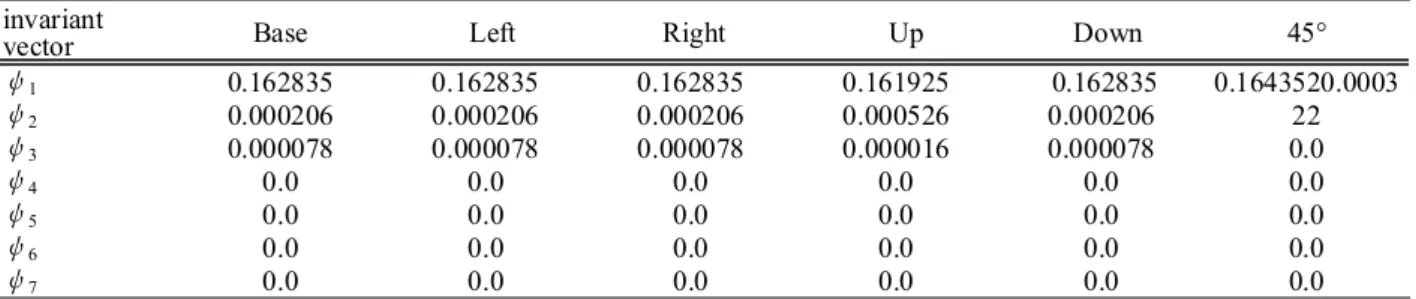
Table 2 Invariant moment vectors forsquare block.
invariant
vector Base Left Right Up Down 45°
ψ1
ψ2 ψ3
ψ4 ψ5
ψ6 ψ7
0.162835 0.000206 0.000078
0.0 0.0 0.0 0.0
0.162835 0.000206 0.000078
0.0 0.0 0.0 0.0
0.162835 0.000206 0.000078
0.0 0.0 0.0 0.0
0.161925 0.000526 0.000016
0.0 0.0 0.0 0.0
0.162835 0.000206 0.000078
0.0 0.0 0.0 0.0
0.1643520.0003 22 0.0 0.0 0.0 0.0 0.0 Table 1 patterns of the experimentalobjects.
Displacement
Object Base
Translation Rotation(°)
Left 2㎝
Right
㎝
Up 2㎝
Down
2㎝ 45 90 135
Square ◦ ◦ ◦ ◦ ◦ ◦ × ×
Rectangular ◦ ◦ ◦ ◦ ◦ ◦ ◦ ◦
Cylindric ◦ ◦ ◦ ◦ ◦ × × ×
Regular riangular ◦ ◦ ◦ ◦ ◦ ◦ ◦ ×
(○: Pattern exist, ×: Pattern don't exist)
ing time of the sensors. Compensating the disturbances from the change of base height and temperature, the dis- tance information is sent to the PC. The experimental setup is shown in figure 1, where the distance sensor and object is 1m.
4.2 Experiment Method
It is assumed that ultrasound propagates to the straight direction only. As the extracted distance information with ultrasonic sensors contain the noise by virtue of the chang- ing temperature and so on, control part compensate them.
Object information being preprocessed by the constant pixel, object features independent of the translation and the rotation are extracted by a set of seven invariant mo- ment vectors. And SOFM neural network learns to recog- nize the objects with the invariant moment vectors.
Table 1 shows the translation and the rotation patterns of the experimental object.
For the experiment, the 26 patterns like table 1 are used:
6 square(W6.3 × L6.3 × H1.5), 8 rectangle(W7 × L11 × H1.5), 5 cylindric((D7.5 × H1.5) and 7 regular triangle block(L7 × H1.5) patterns. Extracting total 130 in- formation data of objects 30 square, 40 rectangle, 25 cylin-
dric and 35 regular triangle block data, a set of seven in- variant moment vectors for them are obtained by Eq. (1)∼
(7).
The 78 data out of 130 data are used for the training data and 52 data are used for the test data. And SOFM neural network consists of the 7 input vectors and N×N output neuron space. To observe relation the size of output neuron space and number of iterartion experimentally, the size of output neuron space and the number of iterartion change from 2×2 to 10×10, from 10 to 50 turns, respectiively.
Also in order to proof the utility of invariant moment vectors experimentally, experiments of object recog- nition are performed without using invariant moment vectors. In this case, the size of input vectors in SOFM neu- ral network is 128.
5. Experimental result
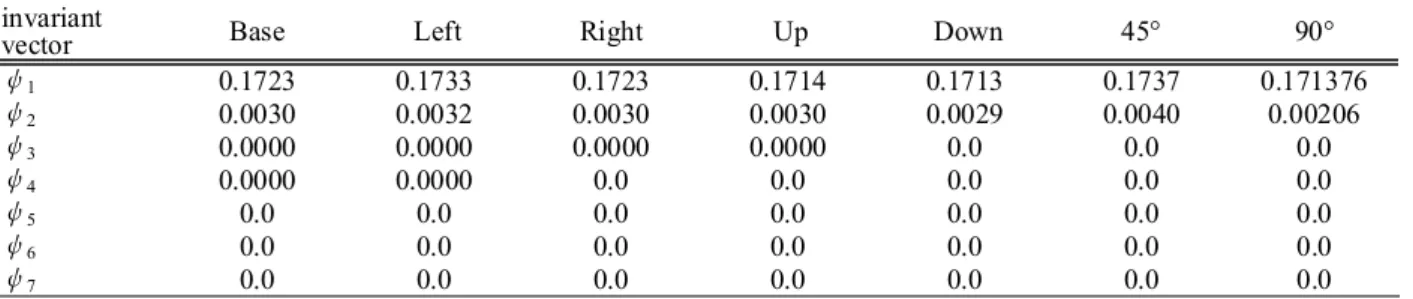
A set of seven invariant moment vectors for square, rec-
tangular, regular triangle and cylindric blocks are shown
in table 2~5, respectively. Because the invariant moment
vectors are maintained within certain range of values, the
invariant moment vectors have the features of object for
recognizing the object.
Table 6 Recognition rate.
Recognition rate Object
training
data Test
data
Square 94.45% 91.7%
Rectangular 95.84% 93.8%
Cylindric 93.35% 90.0%
Regular triangular 100% 93%
Table 5 Invariant moment vectors for cylindric block.
invariant
vector Base Left Right Up Down
ψ1 ψ2
ψ3 ψ4
ψ5 ψ6
ψ7
0.157544 0.0 0.0 0.0 0.0 0.0 0.0
0.159568 0.000265 0.000009
0.0 0.0 0.0 0.0
0.158923 0.000260 0.000011
0.0 0.0 0.0 0.0
0.158668 0.000108
0.0 0.0 0.0 0.0 0.0
0.159246 0.000265 0.000076
0.0 0.0 0.0 0.0 Table 4 Invariant moment vectors for regular triangular block.
invariant
vector Base Left Right Up Down 45° 90°
ψ1
ψ2 ψ3
ψ4 ψ5
ψ6 ψ7
0.2490 0.0404 0.0015 0.0001 0.0 0.0000
0.0
0.2250 0.0306 0.0 0.0 0.0 0.00.0
0.3125 0.0976 0.0 0.0 0.0 0.00.0
0.2730 0.0529 0.0028 0.0013 0.0000 0.0002 0.0000
0.2490 0.0401 0.0015 0.0001 0.0 0.0000
0.0
0.2106 0.0184 0.0008 0.0002 0.0 0.00.0
0.2490 0.0404 0.0015 0.0001 0.0 0.0002
0.0 invariant
vector Base Left Right Up Down 45° 90°
ψ1
ψ2 ψ3
ψ4 ψ5
ψ6 ψ7
0.1723 0.0030 0.0000 0.0000 0.0 0.0 0.0
0.1733 0.0032 0.0000 0.0000 0.0 0.0 0.0
0.1723 0.0030 0.0000 0.0 0.0 0.0 0.0
0.1714 0.0030 0.0000 0.0 0.0 0.0 0.0
0.1713 0.0029 0.0 0.0 0.0 0.0 0.0
0.1737 0.0040 0.0 0.0 0.0 0.0 0.0
0.171376 0.00206
0.0 0.0 0.0 0.0 0.0
Table 6 shows the recognition rates with invariant mo- ment vectors at the 10 iterations and 10x10 output neuron space of SOFM neural network.
When invariant moment vectors are not used, the recog- nition rates for the training data and the testing data is 57%
and 20.6% respectively.
But when the invariant moment vectors are used, the recognition rates for the training data and testing data are 95.91% and 92.13%, respectively. it is shown that the method with the invariant moment vectors is an effective method for object recognition.
Even though the output neuron space of SOFM neural network is changed from 4x4 to 10x10 and the number of iteration is changed from 10 to 50, the recognition rates are same as table 6 except when 2x2 neruon space is used, The recognition rate for the testing data is 92.13%. For 2×2
output neuron space, the same experiment was performed.
But the recognition result is not acceptable.
6. Conclusion
An object recognition technique using ultrasonic sen-
sor array is proposed. To recognize the object independent
of the translation and the rotation, the invariant moment vectors are used. A set of seven invariant moment vectors are used for input of the SOFM neural network. With sim- ple processing of input data and short training time, the rec- ognition rate using ultrasonic sensors is 92.13% even though there are translation and rotation. And when the output neuron space of the SOFM neural network is varied from 2x2 to 10x10, the recognition rate is same for all the case except 2x2 case. Also, when the number of iteration is varied from 10 to 50, the recognition rates are same for all cases. For the case without the invariant moment vec- tors, the recognition rate is only 57%. lt shows that the pro- posed recognition method must be used to recognize the object for ultrasonic sensors. Because the ultrasonic sen- sor array have several advantages such as low price, the simple driving circuit and simple mathematical model, ob- ject recognition in the dark environments and recognition transparent object, It can be used in the area of 3D object
recognition with the neural networks and invariant mo- ment vectors.
References
V. Gabbani, S. Rocchi and V. Vignoli. 1995. Multielement Ultrasonic System for Robotic Navigation, IEEE Interna- tional Conference on Robotics and Automation, pp. 3009- 3014.
H.M. Li and L. Kleeman. 1995. A Low Sample Rate 3 D Sonar Sensor for Mobile Robots, IEEE International Conference on Robotics and Automation, pp. 3015-3020.
Ultrasonic Ranging System Handbook, Polaroid Corporation.
C. H. Teh and R.T. Chin. 1986. On Digital Approximation of Moment Invariants, Computer Vision, raphics, and Image Processing 33, pp. 318-326. M.K. Hu (1962),Visual Pattern Recognitionby Moment Invariants, IRE Trans. Information Theory, Vol. 8, pp.179-187.
T.K Kohonen. 1994. Self-Organization and Associative Memory, Springer Verlag.
![Fig. 1 Experimental setup.ψ3= (η3 0- 3η12)2+ ( 3η21- η0 3)2 (3)ψ4= ( η30+ η12)2+ ( η21+ η03)2 (4)ψ5= ( η30-3η12)․ (η30+η12)․[ ( η30+ η1 2)2- 3(η21+ η03)2]+ ( 3η21- η03)(η21+ η03)․[ 3 ( η30+η12)2- ( η21+ η](https://thumb-ap.123doks.com/thumbv2/123dokinfo/4957346.542630/2.892.469.784.775.1078/fig-experimental-setup-ψ-η-η-η-η.webp)