• 검색 결과가 없습니다.

EFFECT OF EMD ON HUMAN PERIODONTAL LIGAMENT-DERIVED CELLS AND OSTEOBLAST-LIKE CELLS (MC3T3-E1) IN HIGH GLUCOSE CONDITION

N/A
N/A
Protected

Academic year: 2021

Share "EFFECT OF EMD ON HUMAN PERIODONTAL LIGAMENT-DERIVED CELLS AND OSTEOBLAST-LIKE CELLS (MC3T3-E1) IN HIGH GLUCOSE CONDITION"

Copied!
5
0
0

로드 중.... (전체 텍스트 보기)

전체 글

(1)

Ⅰ. 서 론

당뇨병은 현대사회에서 가장 흔한 내분비계 질환이다.

1)

인구 의 10%가 당뇨의 유병률을 보이며 심각한 치주질환을 보이는 이는 인구의 15%에 이른다.

2)

당뇨병 환자 중에 심각한 치주질 환자는 40%이상으로 보고되고 있다.

1)

따라서, 치주질환은 당 뇨병의 주된 합병증 중의 하나로 여겨지고 있다. 또한 실제로 치주질환은 당뇨병의 6번째 합병증으로 여겨진다.

3)

당뇨병은 사회가 현대화, 고령화되어 감에 따라 더욱 그 수가 늘어나는

추세이다.

당뇨환자의 고농도의 포도당 상태가 세포의 기능에 부정적 영향을 끼친다는 것은 잘 알려져 있다.

4-7)

하지만, 당뇨병이 어 떠한 기전으로 구강건강을 저해하는지에 대해선 명확히 밝혀 진 바가 없다.

8-9)

치주인대(PDL) 세포는 치주조직의 재생과 상처치유에 있어 서 가장 중요한 세포이다. 인간 치주인대 세포는 항상 미생물 에 노출되어지고 이에 수반되는 숙주 면역 반응을 일으키므 로, 당뇨 환자의 치주적 붕괴에 있어 인간 치주인대 세포의 재 생 능력을 고농도의 포도당 상태가 저해시킬 수 있다고 보여 진다.

10-11)

1997년 스웨덴의 Hammarstro ¨m

12)

은 enamel matrix를 실험적으 로 노출된 dental follicle에 작용시켜 무세포성 시멘질트질의 형 성을 보고 하였으며 그 후에는 원숭이와 사람의 치근에서 무 세포성 시멘트질의 형성을 보였다. 이후 EMD는 치주조직의

권 용 대

서울특별시 동대문구 회기동

1

번지

경희대학교 치의학전문대학원 구강악안면외과학교실 Yong-Dae Kwon
Dept. of OMFS, School of Dentistry, Kyung Hee University 1 Hoegidong, Dongdaemungu, Seoul, 130-702, Korea Tel: +82 2 958 9440, Fax: +82 2 966 4572

Abstract (J. Kor. Oral Maxillofac. Surg. 2008;34:532-536)

고농도 포도당 환경에서 EMD(Enamel Matrix Derivatives)가 인간 치주인대 세포와 뼈모세포양 세포(MC3T3-E1)에 미치는 영향

이백수∙김선욱∙주성숙*∙권용대

경희대학교 치과대학 구강악안면외과학교실, *구강생물학교실, 구강생물학연구소

EFFECT OF EMD ON HUMAN PERIODONTAL LIGAMENT-DERIVED CELLS AND OSTEOBLAST-LIKE CELLS (MC3T3-E1) IN HIGH GLUCOSE CONDITION

Baek-soo Lee, Sun-Wook Kim, Sung-Sook Jue * , Yong-Dae Kwon

Department of Oral and Maxillofacial Surgery, *Oral Anantomy, and Institute of Oral Biology School of Dentistry, Kyung Hee University, Seoul, Korea

Purpose: This study was designed to evaluate effect of EMD on proliferation of HPDLCs and MC3T3-E1 cells in high glucose condition in vitro.

Material and method: The Human PDL fibroblasts(HPDLCs) were obtained through typical way and the cells used in this experiment were divid- ed in 4 groups. 1x10

4

/ml HPDLCs suspension was cultured in typical DMEM and assigned to group 1. The cells cultured in DMEM which included 400mg/dl glucose are allocated to group 3. Group 2 and 4 are established by adding EMD to group 1 and 3 respectively. These control and experimen- tal groups had been cultured for 24 and 48 hours, and MTT assay was conducted. The differences of each group in cellular proliferation was evaluated.

The same experiment was conducted for preosteoblast (MC3T3-E1) with adding 25㎍/ml EMD.

Results: EMD had the same effect on both PDL cells and MCT3T3-E1 cells. The experimental group had more meaningful differences and active cellular proliferation than the control group did. The EMD accelerated cellular proliferation not only in normal glucose condition but also in high glu- cose condition. The same results were observed via MTT assay; EMD-added experimental group had more meaningful differences and showed higher cellular activity than control group did. Each experimental and control group was inspected for statistical significance through Kruskal-Wallis Test.

Statistical significances were observed among these groups. (SPSS 12.0 Chicago, IL, USA, p=0.008, p=0.011)

Conclusion: EMD is considered to accelerate proliferation of PDL cells and MC3T3-E1 cells in high glucose condition as well as normal glucose condition.

Key words: EMD, PDL, MC3T3-E1, Glucose

(2)

재생에 있어 근거있는 하나의 치료 물질로써 선택 가능해졌으 며 현재 상업적으로 돼지의 enamel organ에서 추출되어지고 있다.

EMD(enamel matrix derivatives)는 enamel matrix protein으로 1997년에 상용화되었으며, 치주조직의 재생을 자극하는데 임 상적으로 널리 쓰여왔다. EMD를 이용한 골하 결손 치료는 치 조골의 재생을 가능하게 하였고, probing depth의 향상과 부착 정도의 임상적 향상을 가져왔다. 또 EMD는 연조직의 초기 창 상 치유에도 긍정적 영향을 준다. 최근에는 EMD가 동물 모델 실험상에서 수복 상아질의 형성을 유도하였으며, 치근 흡수를 방해하였고, 유착의 재발을 방지하였다는 보고들도 나와 근관 치료학 분야에도 적용이 제안되어지고 있다.

13-16)

많은 문헌에서 EMD가 치주조직에 있는 섬유모세포와 뼈모 세포양 세포의 분화와 증식에 효과적인 작용을 한다고 보고해 왔다. EMD가 골모세포와 인간 치주인대 섬유모세포등의 증 식에 도움을 준다는 사실은 이미 여러 실험에서 밝혀진 바 있 으며

17)

Keila 등

18)

은 쥐의 BMSC (bone marrow stromal cell)의 분화 능력에 EMD가 긍정적인 효과를 나타냄을 실험적으로 보여주 었다. 임상적으로도 치주조직 재생에 있어서 그동안 많은 연 구가 있어왔으며 양호한 성적을 보이고 있다.

이러한 여러 연구와 문헌에 의하면, 인간 치주인대 세포와 뼈모세포양 세포(MC3T3-E1)의 증식에 있어 EMD가 긍정적 영 향을 준다는 것을 보고해 왔지만, 당뇨환자의 상태를 재현한 고농도의 포도당 상태에서의 연구는 없었다. 이에 고농도의 포도당 상태에서 EMD가 세포의 증식에 어떠한 영향을 주는 지를 실험적으로 평가하고자 하였다.

Ⅱ. 연구재료 및 방법 1. 세포의 분리와 배양

교정치료를 위한 건전한 상태의 소구치 발치를 주소로 내원 한 환자들로부터 사전 동의하에 소구치를 발치한 뒤, 치아를 500U/ml 페니실린과 500㎍/ml 스트랩토마이신을 포함한 DMEM(Dulbecco’s Modified Eagle Medium; Wellgene, Seoul, Korea)에 놓고 씻어낸다. 씻어낸 치아 치근의 중간 1/3부분을 클린벤치 내에서 멸균상태의 치주 큐렛 또는 외과용 수술도 등을 이용하여 치주인대를 긁어내고 배양접시에서 초대배양 을 실시하였다. 배양조건은 통상의 환경인 37℃, 95% 대기와 5% 이산화탄소의 환경으로 배양 인큐베이터를 조절하였다.

배양액으로는 DMEM에 10% 우태아혈청 (Fetal Bovine Serum;

Wellgene, Seoul, Korea)과 100U/ml 페니실린 및 100㎍/ml 스트렙

2. 세포의 증식

배양된 인간 치주인대 세포를 1x 10

4

cells/ml 의 농도로 96-well plate에 분산 시키고 (n=28), MC3T3-E1 세포는 24-well plate에 분 산시켰다 (n=26). 배지에는 DMEM에 2% FBS와 항생제를 첨가 하여 사용하였다. 각 대조군 및 실험군은 serum free medium 상 태로 24시간 배양을 시행했다. Jiang 등

17)

에 의해 인간 치주인대 세포에는 100㎍/ml의 EMD를, Keila 등

18)

에 의해 MC3T3-E1 세포 에는 25㎍/ml의 EMD를 첨가하였다. 즉, 그룹 1,2는 정상적 포도 당 농도, 그룹 3,4는 고농도 포도당 환경하 에서 실험이 이루어 졌다.

1) 인간 치주인대 세포

Group 1: 110mg/dl glucose DMEM + 2% FBS + 1% Penicillin Streptomycin.

Group 2: 110mg/dl glucose DMEM + 2% FBS + 1% Penicillin Streptomycin. + EMD(100㎍/ml)

Group 3: 450mg/dl glucose DMEM + 2% FBS + 1% Penicillin Streptomycin

Group 4: 450mg/dl glucose DMEM + 2% FBS + 1% Penicillin Streptomycin + EMD(100㎍/ml)

2) MC3T3-E1 세포

Group 1: 110mg/dl glucose DMEM + 2% FBS + 1% Penicillin Streptomycin.

Group 2: 110mg/dl glucose DMEM + 2% FBS + 1% Penicillin Streptomycin. + EMD(25㎍/ml)

Group 3: 450mg/dl glucose DMEM + 2% FBS + 1% Penicillin Streptomycin

Group 4: 450mg/dl glucose DMEM + 2% FBS + 1% Penicillin Streptomycin + EMD(25㎍/ml)

3. MTT 분석

MTT(3-(4,5-Dimethylithiazol-2-yl)-2,5-diphenyl tetrazolium bro-

mide) 분석은 탈수소 효소작용에 의하여 노란색의 수용성 기

질인 MTT tetrazolium을 청자색의 비수용성 MTT formazan(3-

(4,5-dimethylthiazol-2-yl)-2,5-diphenyl-tetrazolium bromide) 으로 환

원시키는 미토콘드리아의 능력을 이용하는 검사법이다. 이 검

사법은 세포의 증식과 성장을 알아보는 대표적인 실험방법 중

하나로 살아있는 세포수에 비례해서 흡광도(optical density)를

나타낸다. 5mg/ml로 MTT 용액을 제조하여 각 그룹별의 샘플

(3)

4. 통계분석

각각의 결과를 SPSS(SPSS 12.0 for windows, Chicago, IL, USA) 로 Kruskal-Wallis Test를 이용하여 통계적 유의성을 검정하였 다. EMD 첨가 여부에 따른 정상 포도당 그룹과 고농도 포도당 그룹 간의 차이를 확인하기 위해서는 Mann-Whitney Test를 이 용하였다.

Ⅲ. 실험결과

EMD는 인간 치주인대 세포와 MC3T3-E1 세포 모두에 세포 증식을 증가시키는 효과를 나타내었다. EMD가 두 경우 모두 실험군이 대조군에 비해 유의성 있는 차이를 나타내며 세포의 증식이 더 활발했다. 이러한 결과는 48시간이 지났을 때도 마 찬가지였다.

각각의 실험군과 대조군 그룹을 Kruskal-Wallis Test를 통해 통 계적 유의성을 검정하였으며 각 그룹간 통계적 유의성을 보였 다. (24hrs; p=0.011, 48hrs; p=0.008)

고농도 포도당의 영향에 관하여서는 Mann-Whitney Test를 시

행하여 통계적 유의성을 검증하였으며 인간 치주인대 세포 및 MC3T3-E1 세포 모두에서 고농도 포도당에서 낮은 활성을 보 였으며 통계적으로 유의하였다(p<0.05).

1) 인간 치주인대 세포

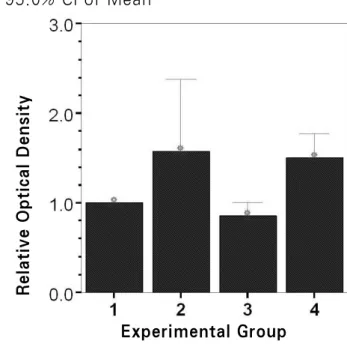
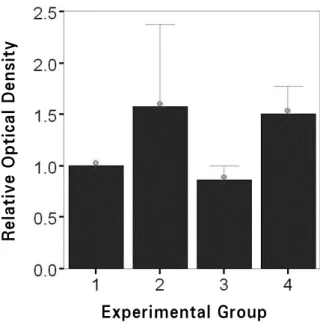
포도당 농도의 영향을 평가하면, EMD가 첨가되지 않은 상 황에서 정상 포도당 그룹 1이 고농도 포도당 환경하의 그룹 3 보다 인간 치주인대 세포활성이 높았다 (p<0.05). EMD가 첨가 된 그룹 2와 그룹 4가 EMD가 첨가 되지 않은 대조군인 그룹 1 과 3에 비해 각각 세포활성이 더 높은 경향을 보여 EMD이 세 포 활성을 높였다 (p<0.05). (Fig. 1, 2).

2) MC3T3-E1 세포

MC3T3-E1 세포에서도 EMD가 첨가되지 않은 상황에서 정

상 포도당 그룹 1이 고농도 포도당 그룹 3보다 MC3T3-E1 세포 활성이 높았다 (p<0.05). EMD가 첨가된 그룹 2와 그룹 4가 대조 군인 그룹 1과 3에 비해 세포활성이 더 높게 나타났다 (Fig.3, 4).

또한 이들 결과 역시 통계적 유의성을 보였다 (p<0.05).

Fig. 1. Cellular viability of human PDLCs after 24hrs Fig. 2. Cellular viability of human PDLCs after 48hrs

Error Bars show 95.0% CI of Mean

Relative Optical Density Relative Optical Density

Experimental Group Experimental Group

(4)

Ⅳ. 총괄 및 고찰

근래에 세포 분화와 회복, 성장인자의 진행, 능력에 대한 관 심이 커져가고 있고, 외과적 수술이나 임플란트 수술 혹은 치 주 수술 후 회복 시간이 감소하고 있지만 당뇨와 같은 전신질 환을 가진 고령의 환자가 증가하고 있어 이러한 환자를 외과 적으로 치료할 때 합병증이 발병하는 경우가 종종 있다. EMD 의 임플란트 임상에서의 사용가능성이 높아지면서 임플란트 주위골의 재생에 대한 연구와 자연치 주위의 손상된 치주조직 의 긍정적인 조직 재생효과에 대해서는 이미 여러 임상연구에 서 이루어진 바 있으며 현재까지도 많은 연구가 진행되고 있 다. 하지만 당뇨와 같은 소모성, 노인성 질환자의 경우에는 아 직도 임플란트를 비롯하여 치주조직 재생의 예후가 불확실한 것이 현실이다.

김 등

19)

의 연구에 의하면 고농도의 포도당 상태에서 인간 치 주인대 세포의 증식능이 현저히 감소함을 알 수 있다. 또한 시 간의 경과에 따라 고농도와 정상 포도당 상태에서 세포의 수 가 차이가 남을 알 수 있다. MTT 분석에 의한 흡광도 조사에서 인간 치주인대 세포는 감소된 세포활성을 나타내었다. 본 실 험에서 역시 이들의 연구 결과와 같은 내용을 확인할 수 있 었다.

가 인간 치주인대 세포의 증식을 촉진한다고 여겨진다.

MT3T3-E1 세포의 경우도 같은 결과를 나타내었다.

포도당은 세포 증식에 있어서 중요하다. 279�324mg/dl의 포 도당 농도에서는 섬유모세포의 증식이 증가한다. 반면 그 이 상의 농도에서는 증식을 방해한다. 조절되지 않는 당뇨 환자 의 혈액에서 보통 360�540mg/dl 정도의 포도당이 검출되므로 인간 치주인대 세포의 증식이 조절되지 않는 당뇨 환자에게 있어서 방해가 될 것으로 여겨진다.

20-22)

다른 많은 연구에 의하면 고농도의 포도당이 proximal tubule cell, fetal mesangial cell, umbilical endothelial cell의 증식에 방해가 됨을 보여주었다. 고농도의 포도당 또는 당뇨 환경에 감소되 는 증식률은 자세히 연구되어져 왔다.

23-24)

Hansson 등

25)

은 279mg/dl 이상의 포도당 농도가 섬유모세포의 증식을 방해한 다고 했고, 이러한 증식은 정상 섬유모세포를 추출한 것보다 당뇨환자의 상처에서부터 추출한 섬유모세포일수록 더 방해 를 받았다. 창상의 치유와 치주조직의 재생에 있어 증식과 분 화 같은 세포의 활성은 필수적이다. 고농도 포도당으로 인한 인간 치주인대 세포의 감소된 세포활성은 당뇨환자에게 있어 치유와 치주조직의 재생에 불리한 요소로 작용한다.

본 세포증식 연구에서 얻어진 결과들은 EMD의 적용시간과 용량에 따라 인간 치주인대 세포의 증식을 향상시킨다는

Fig. 3. Cellular viability of MC3T3-E1 cells after 24hrs. Fig. 4. Cellular viability of MC3T3-E1 cells after 48hrs.

Error Bars show 95.0% CI of Mean

Relative Optical Density Relative Optical Density

Experimental Group Experimental Group

(5)

의한 반응을 한다고 보고하였고, 본 연구결과와 일치한다. 인 간 치주인대 세포에 EMD가 유익한 영향을 끼친다는 Hasse와 Bartold

29)

의 최근 발표는 본 연구결과를 또한 뒷받침한다. 그들 은 EMD가 조직재생과 일치하여 hyalaruonan과 proteoglycan의 합성을 조절함으로써 세포를 자극한다고 결론지었다.

본 실험을 통해, EMD가 고농도의 포도당 상태에서 인간 치 주인대 세포와 MC3T3-E1 세포의 증식을 촉진함을 알 수 있었 다. 하지만, in vitro 상에서 얻어진 실험 결과이므로, in vivo 내에 서의 복잡한 많은 상호작용들을 모두 다 재현할 수 없으므로 in vivo모델에서 체계적인 동물실험을 통해 본 연구의 결과를 확 인 할 필요가 있다. 또한 이들 인간 치주인대 세포와 MC3T3-E1 세포에 대해서 EMD가 세포의 분화 시 미치는 영향에 관한 연 구도 이루어져야 할 것이며, 그 밖의 메카니즘에 대한 연구와 노력이 필요하다 하겠다.

참고문헌

1. Glavind L, Lund B, Loe H: The relationship between periodontal state and diabetes duration, insulin dosage and retinal changes. J.

Perio. Res. 1969;4:164-165.

2. Oliver RC, Brown LJ, Loe H: Periodontal diseases in the United States population. J. Periodontol. 1998;69:269-278.

3. Loe H: Periodontal disease: The sixth complication of diabetes mellitus. Diabetes Care 1993;16:329-334.

4. Shlossman M, Knowler WC, Pettitt DJ, Genco RJ: Type 2 dia- betes mellitus and periodontal disease. J. Am. Dent. Assoc.

1990;21:532-536.

5. Seppala B, Seppala M, Ainamo J: A longitudinal study on in- sulin-dependent diabetes mellitus and periodontal disease, J.

Clin. Periodontol. 1993;20:161-165.

6. Tervonen T, Oliver RC: Long-term control of diabetes mellitus and periodontitis, J. Clin. Periodontol. 1993;20:431-435.

7. Taylor GW, Burt BA, Becker MP , Genco RJ, Shlossman M, Knowler WC: Non-insulin dependent diabetes mellitus and alve- olar bone loss progression over 2 years, J. Periodontol.

1998;69:76-83.

8. Nishimura F, Terranova V, Foo H, Kurihara M, Kurihara H, Murayama Y: Glucose-mediated alteration of cellular function in human periodontal ligament cells, J. Dent. Res. 1996;75:1664- 1671.

9. Nishimura F, Naruishi K, Yamada H, Kono T, Takashiba S, Murayama Y: High glucose suppresses cathepsin activity in peri- odontal ligament-derived fibroblastic cells, J. Dent. Res.

2000;79:1614-1617.

10. Beertsen W, McCulloch CA, Sodek J: The periodontal ligament:

a unique, multifunctional connective tissue, J. Periodontol.

2000;13:20-40.

11. Wikesjo UM , Selvig KA: Periodontal wound healing and regen- eration, J. Periodontol. 2000;19:21-39.

12. Hammarstrom L, Heijl L, Gestrelius S: Periodontal regeneration in a buccal dehiscence model in monkeys after application of

enamel matrix proteins. J. Clin. Periodontol. 1997;24:669-77.

13. Heiji L, Heden G, Svardstrom G, Ostgren A: Enamel matrix de- rivative (EMDOGAIN) in the treatment of intrabony periodontal defects. J. Clin. Periodontol. 1997;24:705-714.

14. Kalpidis CD, Ruben MP: Treatment of intrabony periodontal de- fects with enamel matrix derivative: a literature review. J.

Periodontol. 2002;73:1360-1376.

15. Heden G, Wennestrom J, Lindhe J: Periodontal tissue alterations following Emdogain treatment of periodontal sites with angular bone defects. A series of case reports. J. Clin. Periodontol.

1999;26:855-860.

16. Wennestrom JL, Lindhe J: Some effects of enamel matrix pro- teins on wound healing in the dento-gingival region. J. Clin.

Periodontol. 2002;29:9-14.

17. Jiang J, Goodarzi G, He J, Li H, Safavi KE, Spangberg LSW, et al: Emdogain-gel stimulates proliferation of odontoblasts and os- teoblasts. Oral Surg. Oral Med. Oral Pathol. Oral Radiol. Endod.

2006;102:698-702.

18. Keila S, Nemcovsky CE, Moses O, Artzi Z, Weinreb M: In vitro Effects of Enamel Matrix Proteins on Rat Bone Marrow Cells and Gingival Fibroblasts. J. Dent. Res. 2004;83(2):134-138.

19. Kim HS, Park JW, Yeo SI, Choi BJ, Suh JY: Effects of high glu- cose on cellular activity of periodontal ligament cells in vitro.

Diabetes Res. and Clin. Practice. 2006;74:41-47.

20. Turner JL, Bierman EL: Effects of glucose and sorbitol on prolif- eration of cultured human skin fibroblasts and arterial smooth- muscle cells, Diabetes. 1978;27: 583-588.

21. Hehenberger K, Hansson A: High glucose-induced growth factor resistance in human fibroblasts can be reversed by antioxidants and protein kinase C-inhibitors, Cell Biochem. Funct.

1997;15:197-201.

22. Parker RC, Rapley JW, Isley W, Spencer P, Killoy WJ: Gingival crevicular blood for assessment of blood glucose in diabetic pa- tients. J. Periodontol. 1993;64:666-672.

23. Ziyadeh FN, Simmons DA, Snipes ER, Goldfarb S: Effect of myo-inositol on cell proliferation and collagen transcription and secretion in proximal tubule cells cultured in elevated glucose, J.

Am. Soc. Nephrol. 1991;1:1220-1229.

24. Moran A, Brown DM, Kim Y, Klein DJ: Effects of IGF-I and glucose on protein and proteoglycan synthesis by human fetal mesangial cells in culture, Diabetes. 1991;40:1346-1354.

25. Hehenberger K, Hansson A: High glucose-induced growth factor resistance in human fibroblasts can be reversed by antioxidants and protein kinase C-inhibitors, Cell Biochem. Funct.

1997;15:197-201.

26. Gestrelius S, Andersson C, Lidstrom D, Hammarstrom L, Somerman M: In vitro studies on periodontal ligament cells and enamel matrix derivative. J. Clin. Periodontol. 1997;24:685-692.

27. Lyngstadaas S, Lundberg E, Ekdahl H, Andersson C, Gestrelius S: Autocrine growth factors in human periodontal ligament cells cultured on enamel matrix derivative. J. Clin. Periodontol.

2001;28:181-188.

28. Hoang A, Oates T, Cochran D: In vitro wound healing responses to enamel matrix derivative. J. Periodontol. 2000;71:1270-1277.

29. Hasse H, Bartold P: Enamel matrix derivative induces matrix synthesis by cultured human periodontal fibroblast cells. J.

Periodontol. 2001;72:341-348.

수치

Fig. 1. Cellular viability of human PDLCs after 24hrs Fig. 2. Cellular viability of human PDLCs after 48hrs
Fig. 3. Cellular viability of MC3T3-E1 cells after 24hrs. Fig. 4. Cellular viability of MC3T3-E1 cells after 48hrs.

참조

관련 문서

In this study, we investigated the effects of low-power CO 2 laser on proliferation on human gingival fibroblast cells so that determine laser

newly formed periodontal ligament like tissue(PDL/NPDLT); green arrow, replacement resorption(RR); blue arrow, Cementum/ newly formed cementum-like tissue(C/NCeT).

Periodontal ligament cells were embedded in acellular dermal matrix(Alloderm Ⓡ ). Roots of unextracted teeth were classified into the positive control group, in

Determining optimal surface roughness of TiO₂blasted titanium implant material for attachment, proliferation and differentiation of cells derived from

 Often found connected to other molecules on the outsides of cells --- cellular recognition, cell signaling, cell

• Generation of different specialized kinds of cells from zygote (fertilized egg) or other precursor cells.. – Generate blood cells, muscle

▪ When we control the potential of the working electrode with respect to the reference, it is equivalent to controlling the energy of the electrons within the

4 &gt; Effects of Taro on COX-2 expression and iNOS expression(hot water) in human thyroid cancer cells. The cells were pretreated for 48hours with either