• 검색 결과가 없습니다.

Hispidulin alleviates 2,4-dinitrochlorobenzene and house dust mite extract-induced atopic dermatitis-like skin inflammation

N/A
N/A
Protected

Academic year: 2021

Share "Hispidulin alleviates 2,4-dinitrochlorobenzene and house dust mite extract-induced atopic dermatitis-like skin inflammation"

Copied!
8
0
0

로드 중.... (전체 텍스트 보기)

전체 글

(1)

Biomedicine & Pharmacotherapy 137 (2021) 111359

Available online 16 February 2021

0753-3322/© 2021 The Authors. Published by Elsevier Masson SAS. This is an open access article under the CC BY license

(http://creativecommons.org/licenses/by/4.0/).

Original article

Hispidulin alleviates 2,4-dinitrochlorobenzene and house dust mite extract-induced atopic dermatitis-like skin inflammation

Jinjoo Kang a , Soyoung Lee b , Namkyung Kim a , Hima Dhakal a , Young-Ae Choi a , Taeg Kyu Kwon c , Dongwoo Khang d , * , Sang-Hyun Kim a , *

a

Cell & Matrix Research Institute, Department of Pharmacology, School of Medicine, Kyungpook National University, Daegu, Republic of Korea

b

Immunoregulatory Materials Research Center, Korea Research Institute of Bioscience and Biotechnology, Jeongeup, Republic of Korea

c

Department of Immunology, School of Medicine, Keimyung University, Daegu, Republic of Korea

d
Department of Physiology, School of Medicine, Gachon University, Incheon, Republic of Korea

A R T I C L E I N F O Keywords:

Atopic dermatitis Hispidulin House dust mite Keratinocytes

A B S T R A C T

Atopic dermatitis (AD) is a chronic inflammatory skin disorder that affects 10–20% of the world’s population.

Therefore, the discovery of drugs for the treatment of AD is important for human health. Hispidulin (HPD; also known as scutellarein 6-methyl ether or dinatin) is a natural flavone that exerts anti-inflammatory effects. In the present study, the effectiveness of HPD on AD-like skin inflammation was investigated. We used a mouse AD model through repeated exposure of mice to 2,4-dinitrochlorobenzene and house dust mite extract (Dermato- phagoides farinae extract, DFE) to the ears. In addition, tumor necrosis factor- α and interferon-γ-activated ker- atinocytes (HaCaT cells) were used to investigate the underlying mechanism of HPD action. Oral administration of HPD alleviated AD-like skin inflammations: it reduced ear thickness; serum immunoglobulin (Ig)E, DFE- specific IgE, and IgG2a levels; and inflammatory cell infiltration. HPD reduced the expression of pro- inflammatory cytokines and chemokines through inhibition of signal transducer and activator of transcription 1 nuclear factor-κB in HaCaT cells. Taken together, these results suggest that HPD could be a potential drug candidate for the treatment of AD.

1. Introduction

Atopic dermatitis (AD) has a complex etiology that includes envi- ronmental and genetic factors. Chronic AD skin disorder shows a variety of symptoms including erythema, dryness, edema, and cracked and itchy skin [1–4]. The predominant histopathological features of AD are distinct thickening, swelling, parakeratosis, and infiltration of immune cells into the dermis [3]. In general, the underlying pathological mechanism of AD is T cell-driven skin inflammation. The skin lesions of AD patients are predominately characterized by T helper (Th) 2 signals in the acute condition, with a switch from Th2 to Th1 signals in the chronic condition [5].

To defend against inflammation, resident cells such as keratinocytes and macrophages as well as recruited cells such as neutrophils, eosino- phils, and lymphocytes, produce a diverse cytokines and chemokines [6]. Activated keratinocytes are one of the pathogenic characteristics of acute and chronic AD. Specifically, keratinocytes of AD patients tend to

show exaggerated expression of cytokines, such as interleukin (IL)− 1β, IL-6, and interferon (IFN)-γ, and chemokines, such as CCL17, CCL20, and CCL22, which maintains inflammation [7,8]. Thereby, an effective therapeutic approach for AD involves inhibiting the abnormal activation of keratinocytes in AD skin lesions [9].

Hispidulin (Scutellarein 6-methyl ether or dinatin, HPD) is found in many natural sources such as Grindelia argentina, Arrabidaea chica, Saussurea involucrate, Crossostephium chinense, Artemisia and Salvia species. HPD is a flavone that acts as a potent benzodiazepine receptor ligand and thereby inhibits [ 3 H]flumazenil from binding to these re- ceptors [10]. Previous studies on the pharmacological benefits of HPD have shown it to have anti-oxidant, -cancer, -epileptic, -inflammatory effects as well as hepatoprotective properties [10,11]. Previous studies have reported that HPD suppresses inflammation in mouse models of ultraviolet A radiation-induced skin damage and passive cutaneous anaphylaxis [12,13]. Although HPD has been widely studied, its immunosuppressive effects against AD are currently unknown.

* Corresponding author.

* Correspondence to: Department of Dermatology, School of Medicine, Kyungpook National University, Daegu, Republic of Korea.

E-mail addresses: [email protected] (D. Khang), [email protected] (S.-H. Kim).

Contents lists available at ScienceDirect

Biomedicine & Pharmacotherapy

journal homepage: www.elsevier.com/locate/biopha

https://doi.org/10.1016/j.biopha.2021.111359

Received 14 June 2020; Received in revised form 1 February 2021; Accepted 2 February 2021

(2)

Therefore, in this study, we investigated the therapeutic effects of HPD for the symptomatic relief of AD-like skin inflammation and elucidated the underlying mechanisms of its action.

2. Materials and methods

2.1. Procurement and preparation of reagents and cell culture

All the reagents were purchased from Sigma-Aldrich (St. Louis, MO) unless otherwise stated. HPD (Santa Cruz Biotechnology, Dallas, TX) was dissolved in 0.5% sodium carboxymethyl cellulose with phosphate buffered saline (PBS) for animal experiments and in dimethyl sulfoxide (DMSO) for cellular experiments. Dermatophagoides farinae extract (DFE) solution was purchased from Prolagen (Seoul, Republic of Korea) and added to 0.5% Tween 20. Before experimental use, 2,4-dinitrochloro- benzene (DNCB) was dissolved in a 3:1 vol solution of acetone and olive oil.

Keratinocytes (HaCaT) were maintained in Dulbecco’s modified Eagle medium (Gibco, Grand Island, NY) supplemented with 10% fetal bovine serum (Gibco) and antibiotics (100 U/mL penicillin G, 100 μ g/

mL streptomycin) at 37 C in 5% CO 2 . Passages 3–6 were used throughout the study. Recombinant human tumor necrosis factor- α (TNF- α ) and IFN-γ were purchased from R&D Systems (Minneapolis, MN) for stimulation of HaCaT cells.

2.2. Animals and ethics statement

Five-week-old female BALB/c mice (n = 24) were purchased from Dae-Han Experimental Animal Center (Daejeon, Republic of Korea). The animals were housed with four mice per cage in a laminar airflow room maintained at 22 C ± 2 C with a relative humidity of 55% ± 5% and a

12:12 h light:dark cycle throughout the study. The care and treatment of the mice were in accordance with the guidelines established by the Public Health Service Policy on the Humane Care and Use of Laboratory Animals; the study was approved by the Institutional Animal Care and Use Committee of Kyungpook National University (IRB# 2019–0011).

2.3. Induction of experimental AD on the ears of mice

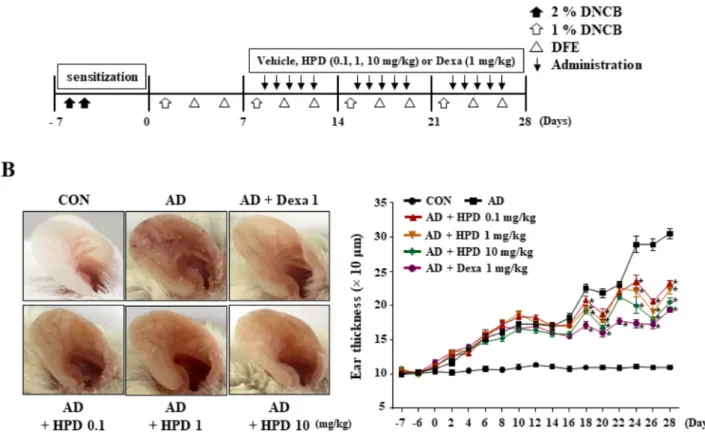
For the induction of experimental AD painted DNCB and DFE in ear of BALB/c mice. After sensitization with 20 μ L of 2% DNCB per mouse ear twice in one week, we applied 20 μ L of 1% DNCB per ear once only and 20 μ L of DFE (1 mg/mL) per ear twice a week to both ears of experimental mice for a total duration of four weeks. After two weeks into the five weeks, HPD or dexamethasone (Dexa, 1 mg/kg) were orally administered for five consecutive days per week for three weeks (Fig. 1A). According to their treatment, the mice were divided into six groups: vehicle, DNCB/DFE plus vehicle, DNCB/DFE plus HPD (0.1, 1, or 10 mg/kg), and DNCB/DFE plus Dexa (1 mg/kg). Ear thicknesses were measured 24 h after DNCB or DFE application with a 7301 dial thickness gauge (Mitutoyo Co., Tokyo, Japan).

On day 28, the mice were euthanized with carbon dioxide. Whole blood samples were collected through the celiac artery and centrifuged (Gyrozen Co., Ltd., Incheon, Republic of Korea) at 400 g for and 4 C for 15 min. The mouse ears were also used for RNA extraction and histo- pathological analysis.

2.4. Histological observation

For histological assessment, the mouse ears were fixed in 10%

formaldehyde and embedded. Subsequently, the paraffin block was cut into 6-µm sections. The tissue sections were stained with hematoxylin

Fig. 1. Experimental schematic design, and effects of HPD on AD-like skin inflammation. (A) Experimental schematic diagram of the study protocol. Mice were

divided into six groups (n = 4 per group). To induce AD-like skin inflammation lesions, DNCB and DFE were applied to the ears as described in the Materials and

methods. (B) Representative photographs (left panel) of the ear site and ear thickness, which was measured 24 h after DNCB or DFE exposure with a dial thickness

gauge. Data are presented as the means ± SEM (n = 4). * p < 0.05 compared with the DNCB/DFE-stimulated group. Dexa: dexamethasone.

(3)

and eosin (H&E) and toluidine blue (TB) prior to observation. Epidermal and dermal thickening, tissue eosinophils, and mast cells were then observed using a microscope (Leica Microsystems, Wetzlar, Germany).

At 200 × magnification, the epidermal and dermal thicknesses on the H&E-stained tissue slides were measured using a Zeiss micrometer 10:100 (Carl Zeiss, Oberkochen, Germany). At 400 × magnification, infiltration of tissue eosinophils and mast cells on the H&E- and TB- stained tissues were counted at the same site in a high-power field;

images were acquired using LAS X software (Leica Microsystems).

2.5. Quantitative polymerase chain reaction

Total RNA was isolated from the HaCaT and mouse ear tissues using the RNAiso Plus kit (Takara Bio, Shiga, Japan) and the preparations were quantified using a NanoDrop 2000 spectrophotometer (Thermo Fisher, Wilmington, MA). HaCaT cells (2 × 10 5 cells/24-well plate) were treated with HPD (0.1, 1 or 10 μ M) or Dexa (10 μ M) for 1 h and then stimulated with TNF- α (10 ng/mL) and IFN-γ (10 ng/mL) for 6 h.

From these samples, complementary DNA (cDNA) was synthesized using a RevertAid RT Kit (Thermo Fisher) at 65 C for 5 min, 42 C for 60 min, and 70 C for 5 min. Finally, quantitative polymerase chain reaction (qPCR) was conducted using a Thermal Cycler Dice TP850 (Takara Bio) according to the manufacturer’s protocol. Each PCR reaction tube con- tained 25 μ L of mixture sample comprising 1 μ L of cDNA (200 ng), 1 μ L of forward and reverse primer solution (0.4 μ M), 12.5 μ L of TB Green Premix Ex Taq (Takara Bio), and 9.5 μ L of dH 2 O. The conditions for qPCR are shown in Table S1. The mRNA expression was normalized with β -actin for tissues and GAPDH for cells. Quantification analysis was performed using the Thermal Cycler Dice TP850 manufacturer’s software.

2.6. Enzyme-linked immunosorbent assay

The serum levels of IgG2a, IgE, DFE-specific IgE, IL-4, and IL-6 were measured using an ELISA kit (BD Biosciences, Oxford, UK) according to the manufacturer’s instructions. For the detection of DFE-specific IgE, each well was coated with 30 μ g/mL of DFE in PBS. To measure the protein levels of IL-4, IL-6, and TSLP, ear tissue were homogenized in extraction buffer (100 mM Tris, 150 mM NaCl, 1 mM EGTA, 1 mM EDTA, 1% Triton X-100, 0.5% sodium deoxycholate, pH 7.4) containing phosphatase/protease inhibitor cocktail (Roche, Mannheim, Germany), and phenyl methyl sulfonyl fluoride. Debris was removed by centrifu- gation at 20,000 g for 15 min, and supernatants were collected. Protein concentration was measured using a colorimetric assay dye (Bio-Rad, Hercules, CA) [14]. The absorbance was determined at 450 nm using a spectrophotometer (VersaMax™ Microplate Reader, Biocompare, Bill- erica, MA). The data were calculated and analyzed using SoftMax® Pro software version 6.

2.7. Western blot

HaCaT cells (1 × 10 6 cells/6-well plate) were treated with HPD (0.1, 1 or 10 μ M) or Dexa (10 μ M) for 1 h, and then stimulated with TNF- α /IFN-γ (10 ng/mL) before being incubated for 15 min. The cells were washed with 1 mL of ice-cold PBS and then scraped with a lysis buffer (0.5 M Tris, 5 M NaCl, 0.5 M EDTA, 10% glycerol, 1% Triton X-100, 0.1 M DTT, 1 mM Na 3 VO 4 , and pH 7.5) containing a protease/phos- phatase inhibitor cocktail (Roche). The total cell lysate was obtained as a supernatant by sonication of the collected cells for 30 s, and then by centrifugation at 16,000 g and 4 C for 20 min. To obtain cytosolic proteins, cells were centrifuged at 2500 g and 4 C for 5 min, and then the supernatant was used as the cytosolic protein extraction. The pellet was washed with 1 mL of PBS, resuspended in 30 μ L of ice-cold RIPA buffer (Biosesang, Seongnam, Republic of Korea) containing a protease/

phosphatase inhibitor cocktail (Roche), and then vortexed before being left on ice for 20 min. Subsequently, this mixture was centrifuged at

16,000 g and 4 C for 20 min, and the resultant supernatant was used for nuclear protein extraction. Ear tissues were homogenized in ice-cold RIPA buffer (Biosesang) containing a protease/phosphatase inhibitor cocktail (Roche). Proteins were quantified using a colorimetric assay dye (Bio-Rad). Samples were electrophoresed into 8% or 10% sodium dodecyl sulfate-polyacrylamide gel and then transferred onto Bio- Trace™ NT nitrocellulose membranes (Pall Corporation, Ann Arbor, MI). These membranes were blocked with 3% bovine serum albumin in Tris-buffered saline plus Tween 20, and then incubated with appropriate antibodies (Table S1). The membranes were visualized by using G:BOX Chemi XRQ (Syngene, Cambridge, UK) through a SuperSignal West Pico PLUS chemiluminescent substrate (Thermo Fisher).

2.8. Statistical analysis

One-way analysis of variance (nonparametric) and Dunnett’s mul- tiple comparison test was used to compare the mean of each group with the means of AD or stimulated groups. Differences were considered to be statistically significant differences where p < 0.05.

3. Results

3.1. Effects of HPD on AD-like skin inflammation

The experimental scheme, in which a DNCB/DFE-stimulated AD-like mouse model was used to assess the effectiveness of HPD on AD-like skin inflammation, is described in Fig. 1A. During the induction period, the ear swelling of mice was measured after 24 h of DNCB or DFE induction.

In each group, the ear swelling of mice was similar until after 2 weeks.

After 24 days of AD induction, oral administration of HPD significantly reduced ear thickness. DNCB/DFE treatment during the induction period (5 weeks) caused severe AD-like skin lesions (Fig. 1B); mouse ears became red and swollen after DNCB/DFE stimulation. However, compared to the AD mice, these symptoms were relieved in mice treated orally with HPD. Furthermore, oral administration of HPD for five consecutive days a week for three weeks did not change the body weight of mice (Fig. S1A), indicating that HPD did not produce toxic effects.

3.2. Effects of HPD on infiltration of mast cells and eosinophils

Histological observations of HPD-treated mouse samples revealed significantly suppressed swollen and infiltration of inflammatory cells relative to samples from AD mice. HPD considerably reduced DNCB/

DFE-stimulated epidermal and dermal thickness (Fig. 2A, B). Inflam- matory mediators and histamine derived from mast cells are known to contribute to itching and inflammation in AD [15]. Thus, infiltration of mast cells into the AD lesions was assessed through TB-staining. We found that HPD attenuated mast cell infiltration (Fig. 2A, C). Because the Th2-mediated immune response involves activation of eosinophils [5], we used H&E staining to assess eosinophil infiltration into the AD site.

We found that HPD also attenuated eosinophil infiltration (Fig. 2D).

Finally, the DNCB/DFE-stimulated group showed increased expression levels of CCL11, a representative molecule responsible for eosinophil recruitment [16–18], and CCR3, a specific receptor for CCL11; however, treatment with HPD decreased CCL11 and CCR3 expression in a dose-dependent manner (Fig. 2E).

3.3. Effects of HPD on inflammatory reaction and immunoglobulin levels

The common symptoms of AD are naturally regulated through the

release cytokines and chemokines, such as IL-3, − 4, − 5, − 12a, − 31,

epithelial cell-derived cytokine (TSLP), and CCL17, which initiate

inflammation [6]. DNCB/DFE-induced Th2- and Th1-mediated inflam-

matory responses were measured by qPCR and ELISA to assess the effects

of HPD. Moreover, gene expression of Th2 cell-mediated cytokines (IL-4,

IL-5, and IL-31), Th1 cell-mediated cytokines (IL-12a, and INF-γ), a

(4)

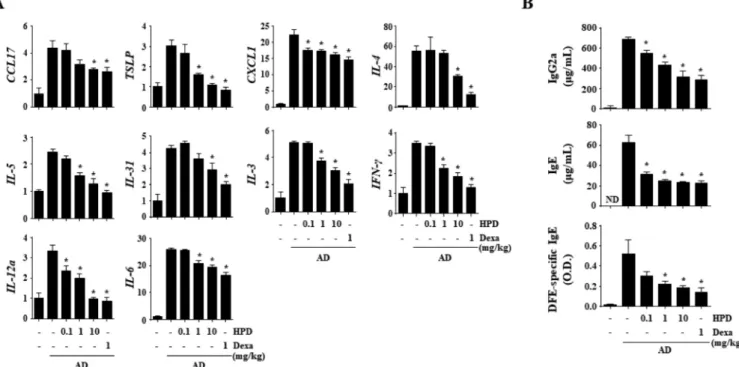
pro-inflammatory cytokine (IL-6), Th2 cell-attracting chemokine (CCL17), epithelial cell-derived cytokine (TSLP), activated T cell-derived cytokine (IL-3), and neutrophil-attracting chemokine (CXCL1) were analyzed in lesional tissues. The expression of these genes was remarkably increased in DNCB/DFE-stimulated mice. However, oral administration of HPD reduced the expression of all genes in a dose-dependent manner (Fig. 3A). To distinguish the role of HPD on the Th1 and Th2 immune response, we examined the serum levels of IgG2a and IgE (total and DFE-specific). Compared with serum levels from AD mice, the levels of IgG2a, IgE, and DFE-specific IgE were significantly reduced in the serum of mice treated with HPD (Fig. 3B).

To confirm the role of HPD on the various secreted proteins, the productions of cytokines were measured in ear tissue and serum. Oral administration of HPD reduced DNCB/DFE-stimulated production of IL- 4, IL-6, and TSLP in ear tissue (Fig. 4A), and IL-4 and IL-6 in serum

(Fig. 4B). To determine the mechanism responsible for the inhibitory effect of HPD, we assessed activation of signal transducer and activator of transcription 1 (STAT1), and nuclear factor (NF)-κB in ear tissue. Oral administration of HPD inhibited phosphorylation of STAT1, and NF-κB p65 in ear tissue of DNCB/DFE-stimulated AD mice (Fig. 4C).

3.4. Effects of HPD on keratinocyte activation

After identifying the pharmacological inhibitory effect of HPD on AD mice, keratinocytes which are commonly used to imitate the AD envi- ronment in vitro [19] were used to determine the molecular mechanism and biological function of HPD as they exhibit a similar immune response during the development of skin inflammation, especially in AD [20]. At first, HaCaT cells were treated with various concentrations of HPD for 24 h to rule out cytotoxicity. In an MTT assay, hispidulin up to Fig. 2. Effects of HPD on infiltration of immune cells and chemokine expression. Paraffin-embedded sections of ear tissues from mice affected by DNCB/DFE-induced AD-like skin inflammation were stained with (A) hematoxylin and eosin (H&E, upper panel) for thickness and count of tissue eosinophils or toluidine blue (TB, lower panel) for count of mast cells (thickness: at 200× magnification, scale bar = 25 µm; count: at 400× magnification, scale bar = 50 µm). (B) Epidermal and dermal thickness. (C and D) The number of cells is expressed as the mean number of cells at five random sites for each mouse. (E) Gene expression was analyzed by qPCR.

Data are presented as the means ± SEM (n = 4). * p < 0.05 compared with the DNCB/DFE-stimulated group. Dexa: dexamethasone.

(5)

Fig. 3. Effects of HPD on gene expressions in ear tissue and serum immunoglobulin levels. The ear tissue and serum were obtained from experimental mice as described in the Materials and methods. (A) The mRNA expression levels were measured by qPCR and normalized with β-actin. (B) Serum IgG2a, IgE, and DFE- specific IgE were measured by ELISA. Data are presented as the means ± SEM (n = 4). * p < 0.05 compared with the DNCB/DFE-stimulated group. Dexa:

dexamethasone.

Fig. 4. Effects of HPD on the release cytokines in ear tissue and serum, and production of protein in ear tissue. The cytokines levels were measured by ELISA using IL- 4, IL-6, and TSLP in ear tissue (A), and IL-4, and IL-6 in serum (B). Data are presented as the means ± SEM (n = 4). (C) The phosphorylation of STAT1 and NF-κB p65 was measured by Western blot. * p < 0.05 compared with the DNCB/DFE-stimulated group. Dexa: dexamethasone. The band of β-actin was used as a loading control.

The band is the representative of three independent experiments. The band intensity was quantified using Image J software.

(6)

100 μ M did not show cytotoxicity in keratinocytes (Fig. S1B). To investigate the effect of HPD on pro-inflammatory cytokines and che- mokines, HaCaT cells were pretreated with HPD for 1 h and then stim- ulated with TNF- α /IFN-γ for 6 h. The results of qPCR showed that HPD decreased TNF- α /IFN-γ-induced gene expression of IL-1β, IL-6, IL-8, CCL17, and CCL22 in the HaCaT cells (Fig. 5A). To determine the mechanism responsible for the inhibitory effect of HPD, we assessed its effects on TNF- α /IFN-γ-induced activation of STAT1 and NF-κB. Previ- ous studies have reported that the STAT and NF-κB signaling pathways contribute to the expression of pro-inflammatory cytokines (IL-1β, IL-6, and IL-8) and chemokines (CCL17 and CCL22) in TNF- α /IFN-γ-induced HaCaT cells [21,22]. As shown in Fig. 5B, activation of STAT1 and NF-κB was inhibited by HPD.

4. Discussion

Due to the increased diversity of associated environmental elements, there has been a 2–3-fold increase in AD incidence over the past several decades [23–25]. Therefore, it remains necessary to develop an effective drug, with fewer side effects, for AD treatment. Indeed, the current treatments for AD, predominantly corticosteroids or steroids, cause various side effects, such as thinning of skin, abnormal skin color, and diverse metabolic symptoms, if used long-term [26,27].

HPD has been shown to produce diverse pharmacological effects such as anti-oxidant, anti-cancer and anti-inflammation effects [11,28, 29]. HPD has been reported to have good penetrating activity following topical application due to its structural and physicochemical properties [30,31]. Additionally, oral administration of HPD (10 mg/kg) five consecutive days per week for three weeks did not alter the organ and body weight of mice, which indicating no toxicity of HPD (Fig. S2).

Based on the known pharmacological activity of HPD, we investigated the effects of HPD on AD-like skin inflammation using a DNCB/DFE-stimulated mouse model and TNF- α /IFN-γ-stimulated kera- tinocytes. An AD mouse model was used because it provides reproduc- ibility and AD-like characteristics involving Th1 and Th2 responses, similar to those of human AD patients exposed to DFE [19,32], an aer- oallergen with a role in the Th2 to Th1 shift [33]. Thus, our experimental

method involved pre-sensitization of mice with DNCB and alternation of DNCB and DFE application to induce AD-like skin inflammation.

In the present study, we confirmed that sensitization with DNCB/

DFE caused skin inflammation, such as redness, hyperplasia, thicker skin, and infiltration of immune cells, in the ears of mice. However, we found that oral administration of HPD ameliorated the typical pheno- type and histopathological symptom changes such as intense ear thick- ness, color change, and infiltration of immune cells. Typically, the infiltration of T cells, mast cells, and eosinophils, as well as the upre- gulation of Th2 cytokines, are features of AD lesions [34]. Our results showed that HPD suppressed the infiltration of mast cells and eosino- phils (Fig. 2), and CD3 + T cells (Fig. S3). In addition, HPD reduced chemokine (CCL11 and CCR3) levels in a similar manner to that observed for eosinophils. This may have been due to the decline in in- flammatory cells. Th2 cytokines have unique functions that involve increased epidermal thickening, sensitization, inflammation, and pru- ritus. Th2 cytokines, which can be released by basophils, eosinophils, and mast cells [5], include IL-4, IL-5, IL-13, and IL-31, whereas IL-12 is considered to be a Th1 cytokine. IL-12 is also a potent inducer of IFN-γ production [35]. In the skin, IL-5 is responsible for the recruitment of eosinophils to allergen-exposure sites and is correlated with IgE [36,37].

In addition, activated keratinocytes secrete TSLP, IL-25, and IL-33, and then cytokines act on immune cells. TSLP, as well as IL-31, also stimu- lates sensory skin neurons involved in the pathomechanism of pruritus [38]. The results of the present study indicated that HPD suppressed the expression of cytokines (TSLP, IL-3, − 4, − 5, − 6, − 12a, − 31, and IFN-γ) and chemokines (CCL17 and CXCL1) in AD tissue even in serum. In general, these cytokines and chemokines were regulated by responses of biphasic T cells and various immune cells in the AD lesions. Therefore, based on our results, we assume that HPD attenuated both Th1 and Th2 responses in various cell types.

Mast cells and eosinophils are key effector cells in IgE receptor (Fc ε RI)-bearing in atopic subjects [39]. In general, levels of IgG2a in- crease in the latter stages, while IgE levels increase in the early stages [40]. Here, we showed that oral administration of HPD reduced serum levels of IgG2a, IgE, and DFE-specific IgE. These results suggest that HPD alleviates both chronic and acute states of AD.

Fig. 5. Effects of HPD on keratinocyte activation. (A) Expression of cytokines and chemokines in TNF- α /IFN-γ-stimulated HaCaT cells. Cells were pretreated with

HPD (0.1, 1, and 10 µM) or Dexa (10 µM) for 1 h and then stimulated with TNF- α (10 ng/mL) and IFN-γ (10 ng/mL) for 6 h. The expression levels of cytokines and

chemokines were determined by qPCR. Data are presented as the means ± SEM (n = 3). * p < 0.05 compared with the TNF- α /IFN-γ-stimulated group. (B) Effects of

HPD on STAT1 and NF-κB. Cells were pretreated with HPD (10 µM) or Dexa (10 µM) for 1 h and then stimulated with TNF- α (10 ng/mL) and IFN-γ (10 ng/mL) for

15 min for the activation of STAT1 and NF-κB. The phosphorylation of STAT1, degradation of IκB α , and nuclear translocation of NF-κB were analyzed by Western

blot. The bands of β-actin, lamin B1, and total form were used as loading controls. The band is the representative of three independent experiments. The band

intensity was quantified using Image J software.

(7)

The activation of keratinocytes in the skin of AD patients plays a critical role in the pathogenesis of this inflammatory skin disease via the regulation of the innate immune response [41]. Through mechanical stimulation, keratinocytes in AD skin lesions produce a unique profile of cytokines and chemokines [20]. Our results indicate that gene expres- sion of IL-1β, IL-6, IL-8, CCL17, and CCL22 was suppressed by HPD. Of these genes, CCL17 and CCL22 promoters contain STAT1 and NF-κB binding sequences, and TNF- α /IFN-γ-stimulated expression of CCL17 and CCL22 can be reduced by specific STAT1 and NF-κB inhibitors [21].

Thus, our results indicate that HPD exerts suppressive effects on CCL17 and CCL22 through the inhibition of STAT1 and NF-κB. Therefore, we postulate that HPD mitigates gene expression of cytokines and chemo- kines through the reduction of STAT1 and NF-κB in keratinocytes.

5. Conclusions

We observed that HPD decreased the development of AD-like skin inflammation in the DNCB/DFE-induced mouse model and TNF- α /IFN- γ-induced HaCaT cells. Consequently, this study demonstrated that HPD relieves the symptoms of AD and suppresses Th1 and Th2 immune response. Specifically, HPD reduced the production of cytokines and chemokines involved in AD by blocking the STAT1 and NF-κB signal pathways in keratinocytes. Therefore, HPD could be a potential phar- macological agent for AD treatment.

Declaration of conflicting interests None.

Acknowledgements

This study was supported by the National Research Foundation of Korea grant funded by the Korean Government (2019R1A2B5B01069444, 2019M3A9H1103690, 2017M3A9G8083382, 2020M3A9D3038894 and 2014R1A5A2009242).

Appendix A. Supporting information

Supplementary data associated with this article can be found in the online version at doi:10.1016/j.biopha.2021.111359.

References

[1] S. Nutten, Atopic dermatitis: global epidemiology and risk factors, Ann. Nutr.

Metab. 66 (Suppl 1) (2015) 8–16.

[2] S. Weidinger, L.A. Beck, T. Bieber, K. Kabashima, A.D. Irvine, Atopic dermatitis, Nat. Rev. Dis. Prim. 4 (1) (2018), 1.

[3] J. Gutermuth, M. Ollert, J. Ring, H. Behrendt, T. Jakob, Mouse models of atopic eczema critically evaluated, Int Arch. Allergy Immunol. 135 (3) (2004) 262–276.

[4] V. Soumelis, P.A. Reche, H. Kanzler, W. Yuan, G. Edward, B. Homey, M. Gilliet, S. Ho, S. Antonenko, A. Lauerma, K. Smith, D. Gorman, S. Zurawski, J. Abrams, S. Menon, T. McClanahan, R. de Waal-Malefyt Rd, F. Bazan, R.A. Kastelein, Y.

J. Liu, Human epithelial cells trigger dendritic cell mediated allergic inflammation by producing TSLP, Nat. Immunol. 3 (7) (2002) 673–680.

[5] E.B. Brandt, U. Sivaprasad, Th2 Cytokines and Atopic Dermatitis, J. Clin. Cell Immunol. 02 (3) (2011), 110.

[6] B. Nedoszytko, M. Sokolowska-Wojdylo, K. Ruckemann-Dziurdzinska, J. Roszkiewicz, R.J. Nowicki, Chemokines and cytokines network in the pathogenesis of the inflammatory skin diseases: atopic dermatitis, psoriasis and skin mastocytosis, Post. Derm. Alergol. 31 (2) (2014) 84–91.

[7] A. Pivarcsi, B. Homey, Chemokine networks in atopic dermatitis: traffic signals of disease, Curr. Allergy Asthma Rep. 5 (4) (2005) 284–290.

[8] K.H. H¨anel, C. Cornelissen, B. Lüscher, J.M. Baron, Cytokines and the skin barrier, Int J. Mol. Sci. 14 (4) (2013) 6720–6745.

[9] A. Trautmann, M. Akdis, P. Schmid-Grendelmeier, R. Disch, E.-B. Br¨ocker, K. Blaser, C.A. Akdis, Targeting keratinocyte apoptosis in the treatment of atopic dermatitis and allergic contact dermatitis, J. Allergy Clin. Immunol. 108 (5) (2001) 839–846.

[10] M. Atif, I. Ali, A. Hussain, S.V. Hyder, B. Niaz, F.A. Khan, A. Maalik, U. Farooq, Pharmacological assessment of hispidulin-a natural bioactive flavone, Acta Pol.

Pharm. 72 (5) (2015) 829–842.

[11] K. Patel, D.K. Patel, Medicinal importance, pharmacological activities, and analytical aspects of hispidulin: a concise report, J. Tradit. Complement Med. 7 (3) (2017) 360–366.

[12] A. Chaiprasongsuk, J. Lohakul, K. Soontrapa, S. Sampattavanich,

P. Akarasereenont, U. Panich, Activation of Nrf2 reduces UVA-mediated MMP-1 upregulation via MAPK/AP-1 signaling cascades: the photoprotective effects of sulforaphane and hispidulin, J. Pharm. Exp. Ther. 360 (3) (2017) 388–398.

[13] D.E. Kim, K.-j Min, M.-J. Kim, S.-H. Kim, T.K. Kwon, Hispidulin inhibits mast cell- mediated allergic inflammation through down-regulation of histamine release and inflammatory cytokines, Molecules 24 (11) (2019), 2131.

[14] M.M. Bradford, A rapid and sensitive method for the quantitation of microgram quantities of protein utilizing the principle of protein-dye binding, Anal. Biochem.

72 (1976) 248–254.

[15] M.K. Oyoshi, R. He, L. Kumar, J. Yoon, R.S. Geha, Cellular and molecular mechanisms in atopic dermatitis, Adv. Immunol. 102 (2009) 135–226.

[16] M.M. Teixeira, T.N. Wells, N.W. Lukacs, A.E. Proudfoot, S.L. Kunkel, T.J. Williams, P.G. Hellewell, Chemokine-induced eosinophil recruitment. evidence of a role for endogenous eotaxin in an in vivo allergy model in mouse skin, J. Clin. Invest 100 (7) (1997) 1657–1666.

[17] M.E. Rothenberg, S.P. Hogan, The eosinophil, Ann. Rev. Immunol. 24 (2006) 147–174.

[18] A. Menzies-Gow, S. Ying, I. Sabroe, V.L. Stubbs, D. Soler, T.J. Williams, A.B. Kay, Eotaxin (CCL11) and eotaxin-2 (CCL24) induce recruitment of eosinophils, basophils, neutrophils, and macrophages as well as features of early- and late- phase allergic reactions following cutaneous injection in human atopic and nonatopic volunteers, J. Immunol. 169 (5) (2002) 2712–2718.

[19] N. Novak, New insights into the mechanism and management of allergic diseases:

atopic dermatitis, Allergy 64 (2) (2009) 265–275.

[20] E. Guttman-Yassky, K.E. Nograles, J.G. Krueger, Contrasting pathogenesis of atopic dermatitis and psoriasis—part I: clinical and pathologic concepts, J. Allergy Clin.

Immunol. 127 (5) (2011) 1110–1118.

[21] D.-J. Kwon, Y.-S. Bae, S.M. Ju, A.R. Goh, G.S. Youn, S.Y. Choi, J. Park, Casuarinin suppresses TARC/CCL17 and MDC/CCL22 production via blockade of NF-κB and STAT1 activation in HaCaT cells, Biochem Biophys. Res Commun. 417 (4) (2012) 1254–1259.

[22] S.Y. Kim, E.J. Sohn, D.W. Kim, H.J. Jeong, M.J. Kim, H.W. Kang, M.J. Shin, E.

H. Ahn, S.W. Kwon, Y.N. Kim, H.J. Kwon, T.Y. Kim, K.S. Lee, J. Park, W.S. Eum, S.

Y. Choi, Transduced PEP-1-FK506BP ameliorates atopic dermatitis in NC/Nga mice, J. Invest Dermatol. 131 (7) (2011) 1477–1485.

[23] C. Avena-Woods, Overview of atopic dermatitis, Am. J. Manag. Care 23 (8 Suppl) (2017) S115–S123.

[24] T. Werfel, A. Heratizadeh, M. Niebuhr, A. Kapp, L.M. Roesner, A. Karch, V.

J. Erpenbeck, C. Losche, T. Jung, N. Krug, P. Badorrek, J.M. Hohlfeld, Exacerbation of atopic dermatitis on grass pollen exposure in an environmental challenge chamber, J. Allergy Clin. Immunol. 136 (1) (2015) 96–103, e9.

[25] K. Yamamura, T. Uruno, A. Shiraishi, Y. Tanaka, M. Ushijima, T. Nakahara, M. Watanabe, M. Kido-Nakahara, I. Tsuge, M. Furue, Y. Fukui, The transcription factor EPAS1 links DOCK8 deficiency to atopic skin inflammation via IL-31 induction, Nat. Commun. 8 (2017), 13946.

[26] M. Chong, L. Fonacier, Treatment of Eczema: corticosteroids and Beyond, Clin.

Rev. Allergy Immunol. 51 (3) (2016) 249–262.

[27] E. Guttman-Yassky, B. Ungar, K. Malik, D. Dickstein, M. Suprun, Y.D. Estrada, H. Xu, X. Peng, M. Oliva, D. Todd, T. Labuda, M. Suarez-Farinas, R. Bissonnette, Molecular signatures order the potency of topically applied anti-inflammatory drugs in patients with atopic dermatitis, J. Allergy Clin. Immunol. 140 (4) (2017) 1032–1042.

[28] D. Kavvadias, P. Sand, K.A. Youdim, M.Z. Qaiser, C. Rice-Evans, R. Baur, E. Sigel, W.D. Rausch, P. Riederer, P. Schreier, The flavone hispidulin, a benzodiazepine receptor ligand with positive allosteric properties, traverses the blood-brain barrier and exhibits anticonvulsive effects, Br. J. Pharm. 142 (5) (2004) 811–820.

[29] Y.C. Lin, C.M. Hung, J.C. Tsai, J.C. Lee, Y.L. Chen, C.W. Wei, J.Y. Kao, T.D. Way, Hispidulin potently inhibits human glioblastoma multiforme cells through activation of AMP-activated protein kinase (AMPK), J. Agric. Food Chem. 58 (17) (2010) 9511–9517.

[30] P. Thitilertdecha, R.H. Guy, M.G. Rowan, Characterisation of polyphenolic compounds in Clerodendrum petasites S. Moore and their potential for topical delivery through the skin, J. Ethnopharmacol. 154 (2) (2014) 400–407.

[31] P. Thitilertdecha, M.G. Rowan, R.H. Guy, Topical formulation and dermal delivery of active phenolic compounds in the Thai medicinal plant-Clerodendrum petasites S. Moore, Int. J. Pharm. 478 (1) (2015) 39–45.

[32] T. Bieber, Atopic dermatitis, Ann. Dermatol. 22 (2) (2010) 125–137.

[33] T. Thepen, E.G. Langeveld-Wildschut, I.C. Bihari, D.F. van Wichen, F.C. van Reijsen, G.C. Mudde, C.A. Bruijnzeel-Koomen, Biphasic response against aeroallergen in atopic dermatitis showing a switch from an initial TH2 response to a TH1 response in situ: an immunocytochemical study, J. Allergy Clin. Immunol.

97 (3) (1996) 828–837.

[34] P.F. Weller, L.A. Spencer, Functions of tissue-resident eosinophils, Nat. Rev.

Immunol. 17 (12) (2017) 746–760.

[35] S.H. Chan, B. Perussia, J.W. Gupta, M. Kobayashi, M. Pospisil, H.A. Young, S.

F. Wolf, D. Young, S.C. Clark, G. Trinchieri, Induction of interferon gamma production by natural killer cell stimulatory factor: characterization of the responder cells and synergy with other inducers, J. Exp. Med. 173 (4) (1991) 869–879.

[36] S. Yi, J. Zhai, R. Niu, G. Zhu, M. Wang, J. Liu, H. Huang, Y. Wang, X. Jing, L. Kang,

W. Song, Y. Shi, H. Tang, Eosinophil recruitment is dynamically regulated by

(8)

interplay among lung dendritic cell subsets after allergen challenge, Nat. Commun.

9 (1) (2018) 1–14.

[37] D.M. Davis, A. Waldman, S. Jacob, J. LeBovidge, J. Ahluwalia, M. Tollefson, N. Jetter, J. Spergel, Diagnosis, comorbidity, and psychosocial impact of atopic dermatitis, Semin. Cutan. Med. Surg. 36 (3) (2017) 95–99.

[38] U. Darsow, U. Raap, S. Stander, Mechanisms and Treatment: Chapter 3, Atopic Dermatitis, CRC Press, 2014, pp. 19–31.

[39] S. Ying, L.T. Barata, Q. Meng, J.A. Grant, J. Barkans, S.R. Durham, A.B. Kay, High- affinity immunoglobulin E receptor (Fc epsilon RI)-bearing eosinophils, mast cells,

macrophages and Langerhans’ cells in allergen-induced late-phase cutaneous reactions in atopic subjects, Immunology 93 (2) (1998) 281–288.

[40] K. Adel-Patient, C. Creminon, H. Bernard, G. Clement, L. Negroni, Y. Frobert, J. Grassi, J.M. Wal, J.M. Chatel, Evaluation of a high IgE-responder mouse model of allergy to bovine beta-lactoglobulin (BLG): development of sandwich immunoassays for total and allergen-specific IgE, IgG1 and IgG2a in BLG-sensitized mice, J. Immunol. Methods 235 (1–2) (2000) 21–32.

[41] L.Y. McGirt, L.A. Beck, Innate immune defects in atopic dermatitis, J. Allergy Clin.

Immunol. 118 (1) (2006) 202–208.

수치

Fig. 1. Experimental schematic design, and effects of HPD on AD-like skin inflammation
Fig. 3. Effects of HPD on gene expressions in ear tissue and serum immunoglobulin levels
Fig. 5. Effects of HPD on keratinocyte activation. (A) Expression of cytokines and chemokines in TNF- α /IFN-γ-stimulated HaCaT cells

참조

관련 문서

Study of Thermal Effects and Structural Deformation Induced by Pulsed Laser Absorption in Human Skin.. By Jae-Young Kim Advisor

co-treatment with hispidulin and TGF-β up-regulated the protein of expression E-cadherin and occludin against TGF-β-induced in MCF-7 and HCC38 cells.. The

Skin transcriptomes analysis from atopic dermatitis group showed 14 keratinocyte differentiation related genes, 10 negative regulation of peptidase related

1) It could be lengthened defected columella without additional surgical procedure. 2) It could be avoided a complication as like meganostril and delaying

Indeed, he exacerbates it: first he quotes specific modernist styles (like cubism and constructivism), and then he simulates entire codes of historical

Mean Value and Skin Improvement Effect that Prepare of 50 year-old Korean by Black Soybean Powder E xtract Applied to the Human Skin ……… 32 Fig.. Correlation

tricuspidata on the production of proinflammatory cytokines in TNFα+IFNγ-stimulated HaCaT cells ...15 Fig.5: The cell viability of sub-fractions from 70% EtOH

Herb Extract which exhibit several bene ficial effects including acne(pimple) and skin diseases was tested for antimicrobial activity and antiinflammation