한국지역사회생활과학회지
Korean J Community Living Sci
26(3) : 489~498, 2015 26(3) : 489~498, 2015 http://dx.doi.org/10.7856/kjcls.2015.26.3.489
토복령 추출물을 첨가한 소스의 항산화 활성 및 저장 중 품질 특성
김 현 수ㆍ황 태 영ㆍ안 정 좌
†중원대학교 식품공학과
Antioxidant Activity and Quality Characteristics of Stew Sauce Mixed with Smilax china L. Extract During Storage
Hyun-Soo KimㆍTae-Young HwangㆍJoungjwa Ahn
†Dept. of Food Science and Technology, Jungwon University, Goesan, Korea 1)
ABSTRACT
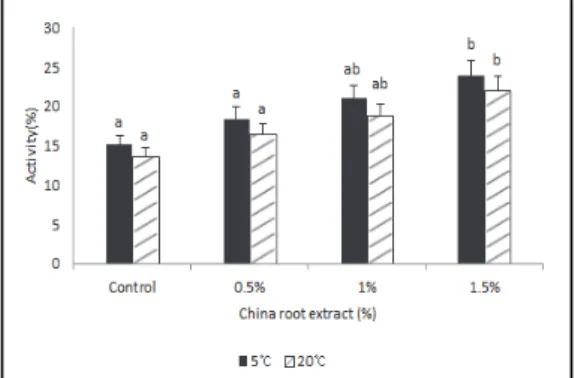
This study investigates the effects of a China root ( Smilax china L.) extract on the chemical and microbiological characteristics and antioxidant activity of the sausage stew sauce and the soft-tofu stew sauce over a 5-week storage period. Commercial sauces were obtained from the market, and samples were prepared using four different concentrations of the China root extract (0% (control), 0.5%, 1.0%, and 1.5%) and stored at 5
oC and 20
oC. Over the 5-week storage period, pH and salinity showed slight changes in both the sausage and soft-tofu stew sauces, but there was no significant difference (p<0.05) regardless of the extract amount and temperature. At 5 weeks, there were significant decreases in the total microbial count in groups with the China root extract (p<0.05) for both the sausage and soft-tofu stew sauces at 5
oC.
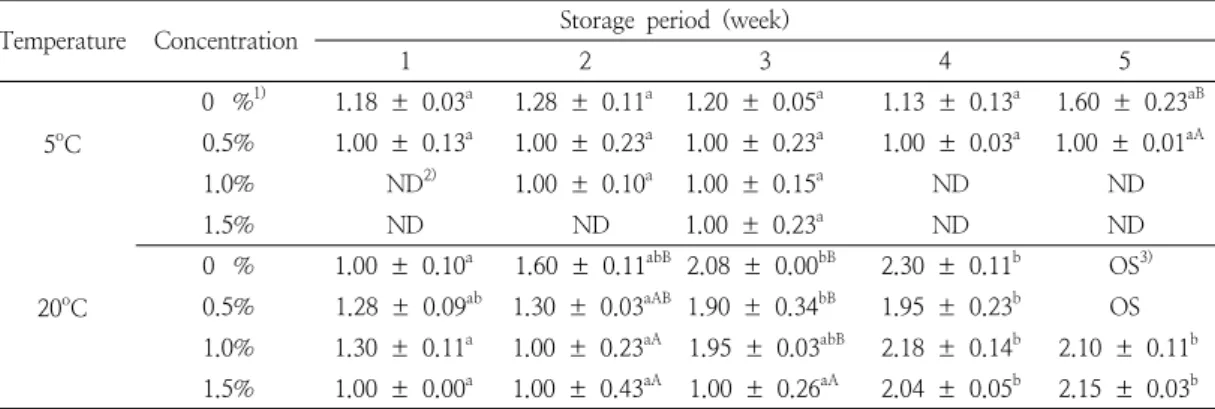
Over the whole storage period, no coliform, yeast, and mold were detected in any sample.
S. aureus counts were not detected in 1.0% and 1.5% China root groups at 5
oC, but 1.00-1.60 log CFU/g was found in the control and 0.5% groups. DPPH radical scavenging activity at 5 weeks showed an increase with an increase in the amount of the China root extract in both sauces. These results indicate that the China root extract inhibited microbial growth during storage as well as scavenging activity and thus that it can be considered to prolong the shelf life of commercial sauces.
Key words: china root extract, commercial sauce, antioxidant activity
This research was financially supported by the Ministry of Trade, Industry and Energy(MOTIE) and Korea Institute for Advancement of Technology(KIAT) through the Promoting Reginal Specialized Industry (R-0002327, 2014).
접수일: 2015년 4월 9일 심사일: 2015년 5월 11일 게재확정일: 2015년 6월 3일
†
Corresponding Author: Joungjwa Ahn Tel: 82-43-830-8611 E-mail: [email protected]
This is an Open-Access article distributed under the terms of the Creative Commons Attribution Non-Commercial
License (http://creativecommons.org/licenses/by-nc/3.0) which permits unrestricted non-commercial use, distribution,
and reproduction in any medium, provided the original work is properly cited.
I. 서론
최근 국민 생활수준 향상으로 인한 서구식 식생활 의 보편화와 편의성 및 시간 절약형을 추구하는 식품 의 소비 패턴 변화로 인해 각종 인스턴트 식품의 판 매 및 섭취가 늘어나고 있다. 이에 따라 소스류의 소 비가 점차 증대되고 다양한 양식용과 한식용 소스 제 품이 개발되고 있어 국내 시장 규모의 증가 추세도 지속될 것으로 예상된다(Han et al. 2005).
가공식품의 보편화로 식품의 보존성을 향상시키기 위해 안식향산, 소르빈산 및 프로피온산과 같은 합성 첨가물과 초산, 젖산, 구연산 등의 유기산들이 주로 사용되고 있다. 화학적 합성 보존료의 경우, 방부력 은 뛰어나지만 소재 특성 상 제한적으로 사용되고 있 으며(Kim et al. 2014), 유기산의 경우, 방부효과를 나타내기 위해서는 다량 사용해야 하기 때문에 가공 식품의 고유한 맛과 품질에 영향을 주어 사용이 용이 하지 않은 단점이 있다 .
웰빙 시대와 맞물려 화학적 합성 식품첨가물에 대 한 부정적인 소비자 인식으로 인해 천연 첨가물에 대 한 관심이 증대되고 있다. 이에 따라 천연물 유래 항 산화제 개발에 대한 연구가 활발히 진행되고 있다(Ko
& Kim 2010). 식품의 특성 상 변질 및 부패로 인한 막대한 비용 손실이 유발되므로 유통기한 확보가 매 우 중요한 요소이다. 특히, 소스류의 경우, 복합적인 원재료 사용으로 인해 유통 기한 확보가 매우 어려워, 이에 대한 천연 보존료 개발이 필요하다 하겠다.
각종 소스류에 대한 저장 중 품질 연구 및 미생물 적 안정성에 대한 연구가 진행되었다. 다양한 기능성 소재가 소스의 품질에 미치는 영향에 대한 연구(Lee et al. 2009a; Lee et al 2009b; Yim et al. 2012; Choi et al. 2013; Kim 2013), 가열 증기와 초고압처리를 적용한 간장소스의 품질 변화(Kim et al. 2011) 및 카 레소스의 가열살균조건 설정(Choi et al. 2013) 등이 보고된 바 있다.
토복령은 청미래 덩굴( Smilax china L.)의 근경을 지칭하는 생약제로, 한국을 비롯하여 중국, 일본에 널리 분포하는 백합과(Liliacea)의 덩굴성 낙엽관목이
다. 고뇨산혈증의 치유 및 신장보호 작용이 있어 주로 통풍의 치료제로 쓰이나 해독 (Cheng & Hua 2006), 항염, 항암, 항균(Ko & Yang 2011) 및 항산화 효과 (Shu et al. 2006)가 알려져 있다. 뿌리에는 다종의 사 포닌을 함유하고 있으며(Cha et al. 2005; Lee et al.
2014), 한방에서는 위암, 식도염, 만성 피부질환 등의 치료에 사용되고 있다. 토복령의 항염 및 항산화 작용 이 보고(Shu et al. 2006; Ko & Kim 2010)된 바 있으 나, 이를 첨가한 소스류의 이화학적 및 미생물학적 품 질 특성 변화에 대한 연구는 미흡한 실정이다. 따라서 본 연구는 토복령 추출물을 첨가한 부대찌개 및 순두 부찌개 소스의 저장 기간 동안의 품질 변화에 대해 조 사하고자 하였다.
II. 연구방법
1. 실험재료
본 실험에 사용한 토복령 추출물은 ㈜에스엔택에 서 제공받았다. 분쇄기에 간 토복령에 토복령 무게의 6-9배의 40% 에탄올을 첨가하고 5시간 이상 추출하 였다. 추출물을 감압농축한 후 추출물과 물을 일정 비율로 혼합하고 가열 교반 후 냉각하여 사용하였다.
시판 소스로는 ㈜백설 다담 부대찌개 소스와 ㈜ 풀무원 정통 순두부찌개를 구입하여 사용하였다.
2. 시료의 제조
두 가지 소스 시료에 토복령 추출물을 소스 양에 대해 각각 0, 0.5, 1.0 그리고 1.5% 첨가하여 밀봉 용 기에 넣은 후 5
oC와 20
oC에서 5주간 저장하면서 매 주 이화학적 및 미생물학적 특성을 측정하였다.
3. pH 및 염도 측정
pH 측정은 양념 시료 10g를 증류수 90 mL와 함께
10초간 균질화시켜 pH meter(Docu-pH meter,
Sartorius, Goettinggen, Germany)로 3번 측정하였
다. 염도 실험은 멸균백(BagFilter, Interscience
Bagsystem, St-Nom, France)에 시료 원액 5 g을 넣
고 멸균수 45 mL를 가하여 10배 희석한 후 염도계
Temperature Concentration Storage period (week)
1 2 3 4 5
5
oC
0.0%
1)5.48 ± 0.03
ns,2)5.52 ± 0.01
ns5.60 ± 0.02
ns5.61 ± 0.01
ns5.62 ± 0.01
ns0.5% 5.47 ± 0.02
ns5.53 ± 0.02
ns5.57 ± 0.03
ns5.61 ± 0.01
ns5.58 ± 0.01
ns1.0% 5.48 ± 0.02
ns5.47 ± 0.02
ns5.53 ± 0.05
ns5.60 ± 0.01
ns5.53 ± 0.01
ns1.5% 5.40 ± 0.02
ns5.49 ± 0.01
ns5.54 ± 0.02
ns5.58 ± 0.01
ns5.53 ± 0.01
ns0.0% 5.62 ± 0.02
ns5.58 ± 0.01
ns5.60 ± 0.02
ns5.56 ± 0.01
ns5.49 ± 0.01
ns20
oC 0.5% 5.60 ± 0.02
ns5.55 ± 0.01
ns5.56 ± 0.01
ns5.53 ± 0.01
ns5.47 ± 0.01
ns1.0% 5.59 ± 0.03
ns5.57 ± 0.03
ns5.58 ± 0.01
ns5.53 ± 0.01
ns5.52 ± 0.01
ns1.5% 5.58 ± 0.02
ns5.54 ± 0.03
ns5.60 ± 0.01
ns5.52 ± 0.01
ns5.49 ± 0.01
nsValues are in mean ± SD (n=3). Means within the same column with different letters show significant differences at
*p<0.05 based on Duncan’s multiple range test.
1)
0%: Control,
2)ns: not significant
Table 1. Changes of pH in china root extract added sausage stew sauce stored for 5 weeks at different temperature
(Seawater Refractometer, HANNA, Seoul, Korea)를 사용하여 난괴법 3반복으로 측정하였다.
4. 미생물 측정
시료 5 mL에 멸균된 95 mL의 0.1% 펩톤수를 혼 합하고 10초간 균질한 후, 0.1% 펩톤수를 사용하여 각각의 시료를 적정 희석하였다. 총균수는 Plate count agar(Difco Laboratories, Detroit, MI, USA), 효모와 곰팡이균수는 YM count agar(Petrifilm plate, 3M Co., St. Paul, MN, USA) 그리고 포도상구균은 Staph express count agar(Petrifilm plate, 3M Co., St. Paul, MN, USA)를 사용하여 30
oC에서 48시간 배 양한 후 나타난 콜로니 수를 계측하였다. 대장균수는 Coliform count agar(Petrifilm plate, 3M Co., St.
Paul, MN, USA)를 사용하여 37
oC에서 48시간 배양 한 후 나타난 콜로니 수를 계측하였다.
5. DPPH 라디컬 소거활성 측정
토복령 추출물을 첨가한 후 저장 5주째에 시료의 DPPH 라디컬 소거활성을 Blois(1958) 방법으로 측정 하였다. 각 시료 0.5 mL에 1 mM DPPH 용액 0.5 mL 를 가한 후 vortex mixer로 10초간 혼합하고 37
oC에 서 30분간 진탕한 후, 516 nm에서 흡광도를 측정하 였다. DPPH 라디컬 소거능(%)은 (1-시료첨가구의
흡광도/무첨가구의 흡광도 x 100)에 의하여 산출하 였다.
6. 통계 분석
통계분석은 SPSS 통계프로그램(Statistical Package for the Social Science, Ver. 12.0 SPSS Inc., USA)을 이용하여 각 측정치의 평균과 표준편차를 산출하였 고 처리간의 차이 유무를 ANOVA로 분석한 뒤 Duncan’s multiple range test를 이용하여 p<0.05 수 준에서 유의성을 검정하였다.
III. 결과 및 고찰
1. 저장 기간 중 소스의 pH 변화
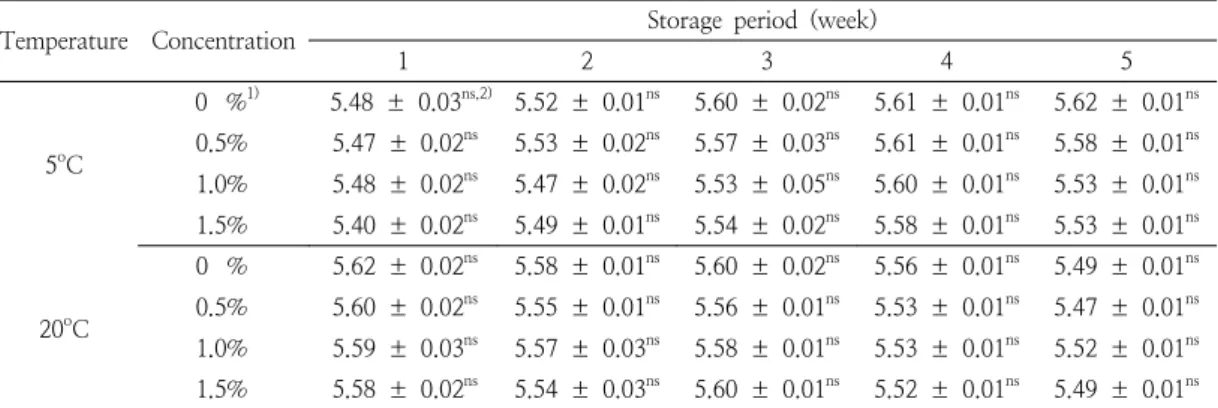
토복령 추출물을 첨가한 부대찌개와 순두부찌개의 저장기간 및 저장온도에 따른 pH 변화는 Table 1과 2에 나타내었다. 부대찌개 소스를 5
oC에서 저장한 경 우, 저장 1주째에는 대조구를 제외한 모든 첨가구에서 5.40-5.48로 큰 차이를 나타내지 않았으며 저장기간 동안 첨가구 간에 유의적인 차이를 나타내지 않았다 (Table 1). 저장 온도 20
oC의 경우에도 5주간 유의적 차이는 없었으나, 모든 첨가구에서 3주째부터 서서히 감소하여 5주째에 5.47-5.52를 나타내었다(Table 1).
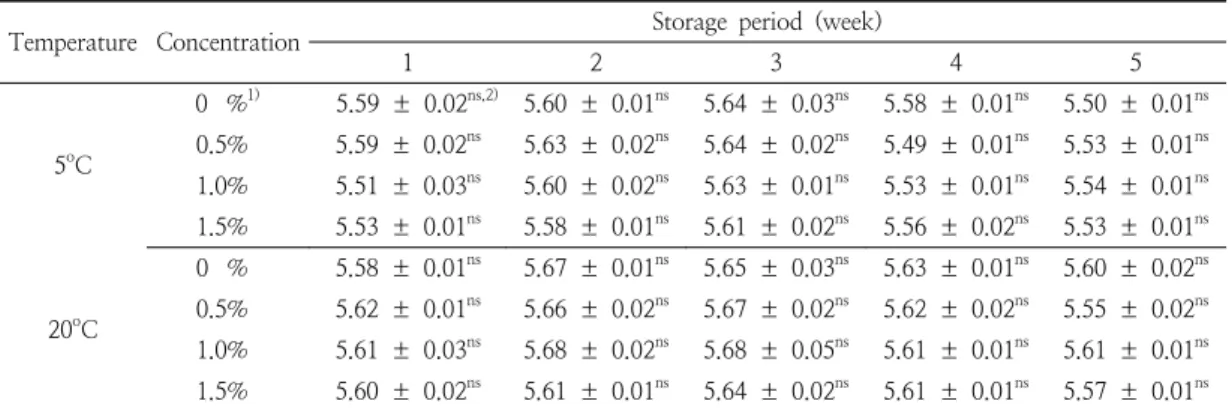
순두부 찌개를 5주간 저장한 결과, pH는 유의적
Temperature Concentration Storage period (week)
1 2 3 4 5
5
oC
0.0%
1)24.3 ± 0.7
ns2)24.7 ± 0.3
ns25.0 ± 1.0
ns25.3 ± 0.3
ns24.7 ± 0.7
ns0.5% 25.0 ± 0.0
ns25.0 ± 0.0
ns24.3 ± 0.3
ns25.0 ± 0.0
ns25.0 ± 0.0
ns1.0% 25.0 ± 0.0
ns25.7 ± 0.3
ns25.0 ± 1.0
ns25.3 ± 0.3
ns24.7 ± 0.7
ns1.5% 25.7 ± 0.3
ns25.0 ± 0.0
ns24.3 ± 0.0
ns25.0 ± 0.0
ns24.0 ± 0.7
ns0.0% 24.7 ± 0.3
ns24.7 ± 0.3
ns25.3 ± 0.3
ns25.7 ± 0.7
ns24.0 ± 1.0
ns20
oC 0.5% 25.3 ± 0.3
ns25.3 ± 0.7
ns24.3 ± 0.3
ns25.3 ± 0.3
ns23.7 ± 0.7
ns1.0% 25.3 ± 0.3
ns25.7 ± 0.3
ns24.7 ± 0.7
ns26.0 ± 0.0
ns23.7 ± 0.7
ns1.5% 25.0 ± 0.3
ns25.0 ± 0.0
ns25.7 ± 0.7
ns26.0 ± 0.0
ns24.0 ± 0.0
nsValues are in mean ± SD (n=3). Means within the same column with different letters show significant differences at
*p<0.05 based on Duncan’s multiple range test.
1)
0%: Control,
2)ns: not significant
Table 3. Changes of salinity in china root extract added sausage stew sauce stored for 5 weeks at different temperature (PSU)
Temperature Concentration Storage period (week)
1 2 3 4 5
5
oC
0.0%
1)5.59 ± 0.02
ns,2)5.60 ± 0.01
ns5.64 ± 0.03
ns5.58 ± 0.01
ns5.50 ± 0.01
ns0.5% 5.59 ± 0.02
ns5.63 ± 0.02
ns5.64 ± 0.02
ns5.49 ± 0.01
ns5.53 ± 0.01
ns1.0% 5.51 ± 0.03
ns5.60 ± 0.02
ns5.63 ± 0.01
ns5.53 ± 0.01
ns5.54 ± 0.01
ns1.5% 5.53 ± 0.01
ns5.58 ± 0.01
ns5.61 ± 0.02
ns5.56 ± 0.02
ns5.53 ± 0.01
ns20
oC
0.0% 5.58 ± 0.01
ns5.67 ± 0.01
ns5.65 ± 0.03
ns5.63 ± 0.01
ns5.60 ± 0.02
ns0.5% 5.62 ± 0.01
ns5.66 ± 0.02
ns5.67 ± 0.02
ns5.62 ± 0.02
ns5.55 ± 0.02
ns1.0% 5.61 ± 0.03
ns5.68 ± 0.02
ns5.68 ± 0.05
ns5.61 ± 0.01
ns5.61 ± 0.01
ns1.5% 5.60 ± 0.02
ns5.61 ± 0.01
ns5.64 ± 0.02
ns5.61 ± 0.01
ns5.57 ± 0.01
nsValues are in mean ± SD (n=3). Means within the same column with different letters show significant differences at
*p<0.05 based on Duncan’s multiple range test.
1)
0%: Control,
2)ns: not significant
Table 2. Changes of pH in china root extract added soft-tofu stew sauce stored for 5 weeks at different temperature
차이가 없었으나 5
oC와 20
oC 모두에서 저장 1주부터 3주째까지 pH는 완만한 증가경향을, 그 이후로는 감 소하는 경향을 보였다(Table 2). 토복령 첨가량에 따 른 차이는 나타나지 않았으며, 이는 추출물을 첨가한 여러 소스의 냉장 저장 연구 결과(Jin et al. 2006)와 유사하였다.
일반적으로 식물 추출물을 첨가할 시 pH가 낮아 지는 원인은 페놀화합물 중 방향족 산성분자가 다량 함유되어 있기 때문으로 알려져 있다(Sung 2004). 솔
잎 추출물(Kim et al. 2012)이나 매실, 오미자 추출액 등 유기산이 다량 함유되어 있는 물질의 첨가량이 증 가함에 따라 pH가 낮아지는 원인이 되나 토복령 추 출물의 경우에는 방향족 산성 분자의 함량도 적고 추 출물 첨가량이 적어 전체 pH 미치는 영향은 적은 것 으로 판단된다.
2. 저장 기간 중 소스의 염도 변화
토복령 추출물을 첨가한 소스의 저장기간 및 저장
Temperature Concentration Storage period (week)
1 2 3 4 5
5
oC
0.0%
1)20.3 ± 0.32
ns2)20.3 ± 0.3
ns20.7 ± 0.3
ns21.0 ± 0.0
ns22.0 ± 0.0
ns0.5% 21.0 ± 0.0
ns20.7 ± 0.7
ns21.0 ± 0.0
ns21.3 ± 0.3
ns22.7 ± 0.3
ns1.0% 21.7 ± 0.7
ns21.3 ± 0.3
ns21.3 ± 0.0
ns21.7 ± 0.7
ns21.3 ± 0.7
ns1.5% 22.0 ± 0.0
ns22.0 ± 0.0
ns21.0 ± 0.0
ns21.3 ± 0.3
ns21.3 ± 0.3
ns20
oC
0.0% 23.0 ± 0.0
ns21.3 ± 0.3
ns21.3 ± 0.3
ns22.3 ± 0.3
ns20.3 ± 0.3
ns0.5% 22.3 ± 0.3
ns22.3 ± 0.3
ns21.7 ± 0.7
ns22.7 ± 0.7
ns22.3 ± 0.3
ns1.0% 21.3 ± 0.3
ns22.0 ± 0.0
ns22.0 ± 0.0
ns22.7 ± 0.7
ns22.7 ± 0.3
ns1.5% 22.7 ± 0.7
ns21.3 ± 0.3
ns22.7 ± 0.7
ns22.3 ± 0.3
ns23.3 ± 0.3
nsValues are in mean ± SD (n=3). Means within the same column with different letters show significant differences at
*p<0.05 based on Duncan’s multiple range test.
1)
0%: Control,
2)ns: not significant
Table 4. Changes of salinity in china root extract added soft-tofu stew sauce stored for 5 weeks at different temperature (PSU)
Temperature Concentration Storage period (week)
1 2 3 4 5
5
oC
0.0%
1)3.38 ± 0.12
a3.81 ± 0.18
ab3.88 ± 0.21
ab4.15 ± 0.12
ab5.74 ± 0.27
bB0.5% 3.40 ± 0.27
a3.51 ± 0.15
a3.63 ± 0.12
a3.92 ± 0.27
ab4.85 ± 0.12
aA1.0% 3.38 ± 0.13
a3.48 ± 0.29
a3.58 ± 0.19
a3.90 ± 0.06
ab4.85 ± 0.16
bA1.5% 3.23 ± 0.39
a3.38 ± 0.11
a3.60 ± 0.14
ab3.85 ± 0.11
ab4.90 ± 0.21
bA20
oC
0.0% 3.83 ± 0.07
a3.83 ± 0.12
a3.90 ± 0.11
a4.28 ± 0.22
aOS
2)0.5% 3.51 ± 0.15
a3.48 ± 0.20
a3.87 ± 0.12
a4.11 ± 0.12
aOS 1.0% 3.45 ± 0.11
a3.45 ± 0.21
a3.62 ± 0.29
a3.93 ± 0.07
ab6.18 ± 0.27
b1.5% 3.82 ± 0.32
a3.79 ± 0.09
a3.86 ± 0.31
a3.93 ± 0.22
a5.78 ± 0.12
bMeans within the same column (a-b) and the same row (A-B) with different letters show significant differences at
*p<0.05 based on Duncan’s multiple range test.
1)
0%: Control,
2)OS: over shelf life
Table 5. Total microbial counts in china root extract added sausage stew sauce stored for 5 weeks at different temperature (log CFU/g)
온도에 따른 염도의 변화는 Table 3과 4에 나타내었 다. 염도가 높은 소스류이기 때문에 원액의 10배 희 석액으로 측정하였다. 부대찌개 소스의 염도는 5
oC 1 주째에 대조구 24.3, 0.5% 25.0, 1.0% 25.0, 1.5%
25.7로 저장기간 동안 1.4% 내외의 미미한 변화를 보였다. 대조군과 모든 첨가군 사이에 유의적인 차이 는 나타나지 않았다(Table 3). 순두부찌개 소스를 5
oC에서 저장한 경우에 1주째에 대조구 20.3, 0.5%
21.0, 1.0% 21.7, 1.5% 22.0였으며, 5주째에는 21.3-
22.7의 범위로 저장 기간에 따른 유의적인 차이를 나 타나지 않았다(Table 4). 이는 토복령 추출물 자체가 소스 염의 농도 변화에는 별 영향을 끼치지 않아 첨 가물로 적합함을 나타낸다고 할 수 있다.
3. 저장 기간 중 소스의 총균수 변화
부대찌개 소스의 총균수 변화는 Table 5에 나타내
었다. 부대찌개 소스를 5
oC에서 저장한 결과, 1주째
에 대조구와 첨가군 사이에 3.23-3.40 log CFU/g로
Temperature Concentration Storage period (week)
1 2 3 4 5
5
oC
0.0%
1)1.18 ± 0.03
a1.28 ± 0.11
a1.20 ± 0.05
a1.13 ± 0.13
a1.60 ± 0.23
aB0.5% 1.00 ± 0.13
a1.00 ± 0.23
a1.00 ± 0.23
a1.00 ± 0.03
a1.00 ± 0.01
aA1.0% ND
2)1.00 ± 0.10
a1.00 ± 0.15
aND ND
1.5% ND ND 1.00 ± 0.23
aND ND
20
oC
0.0% 1.00 ± 0.10
a1.60 ± 0.11
abB2.08 ± 0.00
bB2.30 ± 0.11
bOS
3)0.5% 1.28 ± 0.09
ab1.30 ± 0.03
aAB1.90 ± 0.34
bB1.95 ± 0.23
bOS 1.0% 1.30 ± 0.11
a1.00 ± 0.23
aA1.95 ± 0.03
abB2.18 ± 0.14
b2.10 ± 0.11
b1.5% 1.00 ± 0.00
a1.00 ± 0.43
aA1.00 ± 0.26
aA2.04 ± 0.05
b2.15 ± 0.03
bMeans within the same column (a-b) and the same row (A-B) with different letters show significant differences at
*p<0.05 based on Duncan’s multiple range test.
1)
0%: Control,
2)ND: not detected, 3)OS: over shelf life
Table 7. S. aureus counts in china root extract added sausage stew sauce stored for 5 weeks at different temperature (log CFU/g)
Temperature Concentration Storage period (week)
1 2 3 4 5
5
oC
0.0%
1)4.15 ± 0.21
a4.60 ± 0.21
ab4.70 ± 0.07
ab4.90 ± 0.11
ab6.48 ± 0.17
bB0.5% 3.95 ± 0.12
a4.30 ± 0.15
a4.60 ± 0.19
ab4.78 ± 0.19
ab6.13 ± 0.23
bB1.0% 4.15 ± 0.21
a4.28 ± 0.19
a4.36 ± 0.11
a4.45 ± 0.14
a4.89 ± 0.11
bA1.5% 4.11 ± 0.19
a4.08 ± 0.13
a4.26 ± 0.09
a4.45 ± 0.22
a5.10 ± 0.07
bA20
oC
0.0% 4.28 ± 0.14
a4.70 ± 0.21
ab4.85 ± 0.13
ab5.75 ± 0.21
bOS
2)0.5% 4.18 ± 0.18
a4.60 ± 0.19
ab4.90 ± 0.16
b5.00 ± 0.18
bOS 1.0% 3.99 ± 0.21
a4.20 ± 0.18
a4.70 ± 0.21
ab4.90 ± 0.31
ab6.41 ± 0.21
a1.5% 4.00 ± 0.07
a4.23 ± 0.21
a4.36 ± 0.09
a5.00 ± 0.23
ab6.00 ± 0.11
bMeans within the same column (a-b) and the same row (A-B) with different letters show significant differences at
*p<0.05 based on Duncan’s multiple range test.
1)
0%: Control,
2)OS: over shelf life
Table 6. Total microbial counts in china root extract added soft-tofu stew sauce stored for 5 weeks at different temperature (log CFU/g)
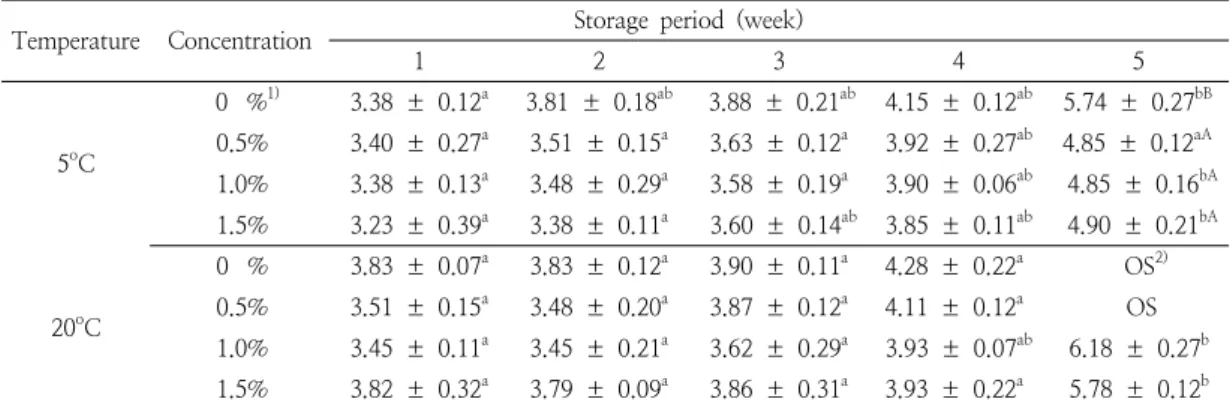
유의적 차이를 나타내지 않았으나, 5주째에 대조구의 5.74 log CFU/g에 비해 0.5%, 1.0%, 1.5% 첨가구에 서는 4.85-4.90 log CFU/g으로 유의적인 차이를 나 타내었다(p<0.05) (Table 5). 저장온도 20
oC에서 1주 째에는 대조구와 첨가구 사이에 유의적 차이가 없었 으며 저장 4주째까지 완만한 증가를 나타내었다. 저 장 5주째에 총세균수가 급격히 증가하여 토복령 추 출물 1.0%와 1.5% 첨가구에서는 5.78과 6.18 log CFU/g이었으나, 대조구와 0.5% 첨가구에서는 부패
로 인하여 측정 가능 한도를 벗어났다(Table 5). 저 장온도 5
oC와 20
oC 모두에서 5주째부터 총세균수가 급격히 증가하여, 5주째에 토복령 추출물의 총균수 억제 효과를 확인할 수 있었다. 또한, 5주째 냉장보 관한 시료들 중 토복령 추출물 0.5% 첨가 시 총균수 가 4.89 log CFU/g로, 부패 초기로 판정되는 6 log CFU/g을 넘지 않아 소스 시료가 부패되지 않았음을 알 수 있었다.
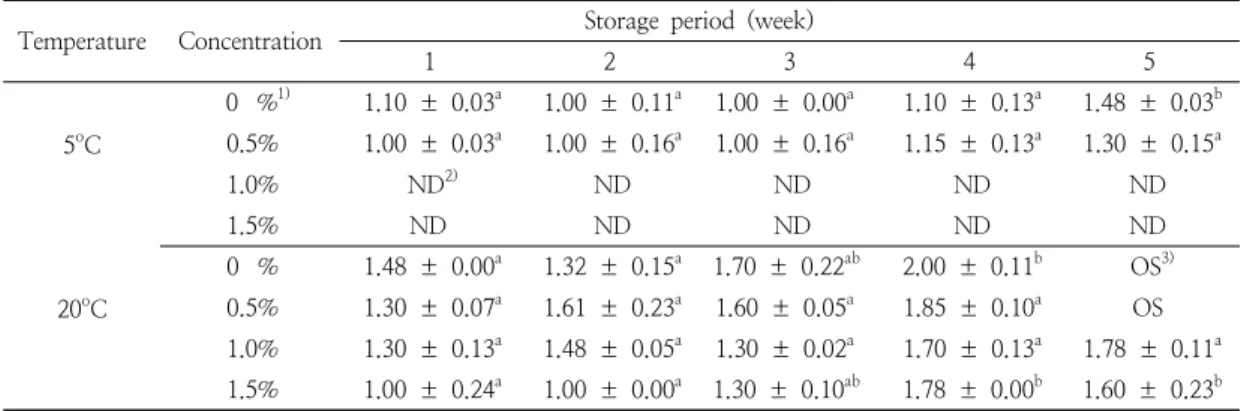
순두부찌개 소스의 경우도 부대찌개와 유사한 경
Temperature Concentration Storage period (week)
1 2 3 4 5
5
oC
0.0%
1)1.10 ± 0.03
a1.00 ± 0.11
a1.00 ± 0.00
a1.10 ± 0.13
a1.48 ± 0.03
b0.5% 1.00 ± 0.03
a1.00 ± 0.16
a1.00 ± 0.16
a1.15 ± 0.13
a1.30 ± 0.15
a1.0% ND
2)ND ND ND ND
1.5% ND ND ND ND ND
20
oC
0.0% 1.48 ± 0.00
a1.32 ± 0.15
a1.70 ± 0.22
ab2.00 ± 0.11
bOS
3)0.5% 1.30 ± 0.07
a1.61 ± 0.23
a1.60 ± 0.05
a1.85 ± 0.10
aOS 1.0% 1.30 ± 0.13
a1.48 ± 0.05
a1.30 ± 0.02
a1.70 ± 0.13
a1.78 ± 0.11
a1.5% 1.00 ± 0.24
a1.00 ± 0.00
a1.30 ± 0.10
ab1.78 ± 0.00
b1.60 ± 0.23
bMeans within the same column (a-b) and the same row (A-B) with different letters show significant differences at
*p<0.05 based on Duncan’s multiple range test.
1)