Vol. 21, No. 6, pp. 79-85, December 2017
전자식 팽창밸브를 적용한 3RT급 히트펌프 시스템의 냉방 성능 특성 Cooling Performance Characteristics of 3RT Heat Pump
System applied Electronic Expansion Valve
손창효*․윤정인*․최광환*․하수정*․전민주*․박성현**․이상봉***†
Chang-Hyo Son*, Jung-In Yoon*, Kwang-Hwan Choi*, Soo-Jung Ha*, Min-Ju Jeon*, Sung-Hyeon Park** and Sang-Bong Lee***†
(Received 26 October 2017, Revision received 05 December 2017, Accepted 05 December 2017)
Abstract: A heat pump system is a highly efficient, eco-friendly device which consumes a small amount of energy and supply a lot of energy for heat formation. In addition, it is a single device system that has low generation effect about carbon dioxide. There are many researches related to the electronic expansion valve and the heat pump, but the detailed data analysis of each influence is insufficient. In this study, the cooling capacity and COP of the heat pump system were investigated by varying frequency of the inverter connected to compressor, inlet temperature of chilled water into evaporator and inlet temperature of cooling water into condenser. The results are as follows : (1) The cooling capacity increased as the inverter frequency, inlet temperature of chilled water into evaporator increased, and inlet temperature of cooling water into condenser decreased. (2) The COP increased as the frequency of inverter, inlet temperature of cooling water into condenser decreased and the inlet temperature of chilled water into evaporator increased.
Key Words:Heat Pump System, Electronic Expansion Valve, Cooling Capacity, COP
***†이상봉(교신저자) : (주)기하정밀
E-mail : [email protected], Tel : 051-989-8042
*손창효, 윤정인, 최광환, 하수정, 전민주 : 부경대학교 냉 동공조공학과
**박성현 : 부경대학교 대학원 냉동공조공학과
***†Sang-Bong Lee(corresponding author) : Keeha Precision Co., Ltd.
E-mail : [email protected], Tel : 051-989-8042
*Chang-Hyo Son, Jung-In Yoon, Kwang-Hwan Choi, Soo-Jung Ha, Min-Ju Jeon : Department of Refrigeration and Air -Conditioning Engineering, Pukyong National University.
**Sung-Hyeon Park : Graduate School, Department of Refrigeration and Air-Conditioning Engineering, Pukyong National University.
1. 서 론
히트펌프 시스템은 4방 밸브로 냉매의 흐름 방 향을 바꾸어 동일한 장치를 냉방 운전 또는 난방 운전으로 전환하여 사용할 수 있는 장치를 뜻한 다. 히트펌프 시스템은 적은 구동에너지를 이용하
여 보다 많은 에너지를 열의 형태로 공급하는 고 효율 친환경기기이며, 단일기기로는 CO 발생 저 감 효과가 매우 큰 시스템이다.1,2)
이러한 히트펌프 시스템은 열원에 의해 분류할 수 있는데, 외부 유체의 종류에 따라 (증발기 측/
응축기 측) 공기/공기, 공기/물, 물/공기, 물/물 히
트펌프 시스템으로 나뉜다. 특히, 지열원 히트펌 프 시스템과 같은 물/물 히트펌프 시스템은 열원 의 안정성 및 효율성 측면에서 좋기 때문에 이에 대한 연구가 활발히 진행되고 있다. 또한 히트펌 프 시스템의 효율을 좀 더 높이기 위해서 냉매의 압력 및 온도 변화에 대한 반응속도가 빠른 전자 식 팽창밸브를 많이 적용하고 있는 실정이다.
지금까지의 전자식 팽창밸브 및 히트펌프 관련 연구를 살펴보면, Son 등3)은 전자식 팽창밸브를 적용한 CO용 수냉식 히트펌프의 2차 유체의 온 도와 유량에 따른 축동력, 난방능력, 성능계수 등 을 실험을 통해 제시하였고, Cha 등4)은 전자식 팽 창밸브의 개도 변화와 열교환 방식에 따른 히트 펌프의 COP와 냉·난방 능력의 영향을 분석하였다.
또한 Beak 등5)은 압축기와 연결된 인버터의 주파 수 변화가 냉동기에 미치는 영향에 대해 분석하 였으며, Lee 등6)은 압축기에 연결된 인버터의 주 파수와 전자식 팽창밸브의 개도 변화에 따른 히 트펌프의 과도 특성을 실험을 통해 알아보았다.
하지만 전자식 팽창밸브와 히트펌프 관련 연구들 은 많지만 각각의 영향에 대한 세부적인 원인 분 석이 부족하다.
이에 따라 본 논문에서는 압축기의 인버터 주 파수, 증발기 측 냉수, 응축기 측 냉각수 등의 다 양한 조건하에서 전자식 팽창밸브가 적용된 히트 펌프 시스템의 성능 특성을 파악하고 그 원인 규 명을 좀 더 명확히 하고자 한다.
2. 실험 장치 및 실험 방법
2.1 실험 장치
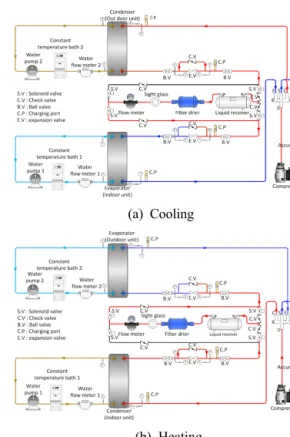
Fig. 1은 전자식 팽창밸브를 적용한 히트펌프 시스템의 개략도이며, 실제 장치는 Photo. 1과 같 다. 본 연구에 사용된 시스템은 압축기, 사방밸브, 판형 응축기, 체크밸브, 수액기, 전자식 팽창밸브, 판형 증발기, 액분리기 등으로 구성된다.
인버터를 압축기에 연결하여 압축기의 주파수 를 제어할 수 있도록 했고 압축 일량을 측정하기 위해 파워미터(WT230)를 설치하였다. 전자식 팽 창밸브를 이용해 과열도를 일정하게 제어하는 동
(a) Cooling
(b) Heating
Fig. 1 Schematic diagram of heat pump system applied electronic expansion valve
Photo. 1 Photograph of experimental apparatus 시에 액압축을 방지할 수 있도록 하였으며, 히트 펌프 시스템 내의 냉매의 온도 및 압력을 측정하 기 위해 T-type 열전대와 절대 압력계를 주요기기 의 입·출구 측에 설치하였다. 냉매의 유량은 질량 유량계, 냉수 및 냉각수의 유량은 수유량계로 측 정하였다. 또한 냉수 및 냉각수의 온도 유지를 위 해 증발기 측과 응축기 측에 각각 항온조를 설치
Table 1 Specification of main instruments Unit Specification
Compressor
Emerson copeland scroll ZP50K3E-TFD-522 380V, 3φ, 50Hz, 3.24kW
4-way valve
Saginomiya
STF-0401G, 17.58kW
Discharge : 1/2'', Suction : 3/4'' Liquid receiver Kyungan thermotec
KRT-500V, 6.5L Expansion
valve
Dotech
DPF(o)-3.2C, 17.58kW Condenser Swep, plate heat exchanger
B25TH, 9 m³/h
Evaporator Swep, plate heat exchanger B25TH, 9 m³/h
Accumulator Kyungan thermotec 5HP, 3.4L
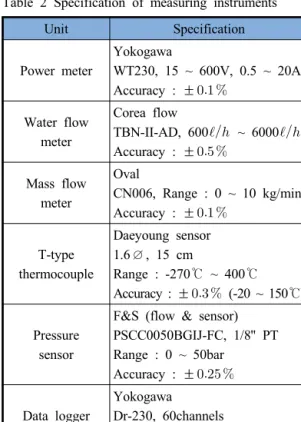
Table 2 Specification of measuring instruments Unit Specification
Power meter
Yokogawa
WT230, 15 ~ 600V, 0.5 ~ 20A Accuracy : ±
Water flow meter
Corea flow
TBN-II-AD, 600 ~ 6000
Accuracy : ± Mass flow
meter
Oval
CN006, Range : 0 ~ 10 kg/min Accuracy : ±
T-type thermocouple
Daeyoung sensor 1.6∅, 15 cm
Range : -270℃ ~ 400℃
Accuracy : ± (-20 ~ 150℃)
Pressure sensor
F&S (flow & sensor) PSCC0050BGIJ-FC, 1/8'' PT Range : 0 ~ 50bar
Accuracy : ±
Data logger
Yokogawa Dr-230, 60channels Accuracy : ±
하였고, 데이터로거(YOKOGAWA, DR230)를 사용 하여 실시간으로 데이터를 측정 및 기록이 되도록 하였다. Table 1은 주요 기기의 사양을 나타낸것이 며, Table 2는 측정기기의 사양을 나타낸 것이다.
2.2 실험 조건 및 방법
실험의 조건은 KSB ISO 13256-2의 물순환식 히트펌프에 근거하여 정하였으며, 세부 실험 조건 은 다음의 Table 3과 같다.
Table 3 Experimental conditions
Parameter Value Unit Inlet temperature of chilled
water into evaporator : Te w in
7, 12*, 17 ℃
Inlet temperature of cooling water into condenser : Tc w in
25, 30*, 35 ℃
Chilled water flow rate in
evaporator : Ge w 1950* kgh Cooling water flow rate in
condenser : Gc w 1950* kgh Inverter frequency : f 40, 50, 60* Hz Superheating degree : Tsup 5* ℃ Subcooling degree : Tsub 2* ℃
Refrigerant R410A* -
* Standard condition
과열도(Tsup)는 압축기가 안정적으로 작동될 수 있는 과열도인 5 ℃로 유지하였으며, 과냉도(Tsub) 는 2 ℃로 유지시켰다. 냉매는 R410A, 증발기 측 냉수 유량(Ge w) 및 응축기 측 냉각수 유량(Gc w) 은 모두 1950 kgh으로 고정시켰다. 실험은 이러 한 일정한 조건에서 인버터의 주파수( f), 증발기 측 냉수 입구 온도(Te w in), 응축기 측 냉각수 입 구 온도(Tc w in)를 각각 변화시켜가며 실시하였고, 본 실험은 히트펌프 시스템의 전반적인 성능 특 성을 파악하고 그 때의 원인을 규명하기 위한 것 이므로 냉방 조건에 대해서만 실시하였다.
시스템은 30분 동안의 온도 측정 변이가 ±0.5℃
이내, 압력 측정 변이가 ± bar 이내, 질량 유량 의 변화가 ± kgmin 이내일 때 정상상태로 간주하였다. 또한 정상상태에 도달한 이후 냉매의 온도와 압력 및 질량 유량, 냉수와 냉각수의 입·출 구 온도 및 수유량, 압축 일량 등을 30분 동안 측 정하였다.
2.3 데이터 해석
본 실험에서 사용한 R410A의 열물성치값 계산 은 NIST에서 개발한 냉매 물성치 계산 프로그램 인 REFPROP(version 8.01)를 이용하였다. 히트펌 프 시스템의 냉방 능력 및 COP(Coefficient of performance)는 식 (1), (2)를 통해 각각 계산할 수 있다.
Qe Ge w⋅cpw⋅T
e w out
Te w in
dt⋅
(1)
식 (1)에서 Qe는 냉방 능력 [kW], Ge w는 증발 기 측 냉수 유량 [kgh], cp w는 냉수의 정압 비열 [kJkg ∙ ℃와 Te w in와 Te w out는 각각 증발 기 측 냉수의 입·출구 온도 [ ℃]를 나타낸다.
COP
WcomQe
(2)식 (2)에서
W
com은 파워미터를 통해 측정한 압축 일량 [kW]을 나타내며, 식 (1)에서 구한 Qe 를 이용하여 COP를 구할 수 있다.3. 실험 결과 및 고찰
본 논문에서는 전자식 팽창밸브를 적용한 히트 펌프 시스템의 성능 특성을 분석하였다. 이를 통 해 여러 가지 영향에 따른 히트펌프 시스템의 냉 방 능력 및 COP를 확인하고 그 원인을 분석하고 자 한다.
3.1 인버터 주파수에 따른 영향
Table 3의 일정한 조건[증발기 측 냉수 입구 온
Fig. 2 Influence of condensing & evaporating pressure and refrigerant mass flow rate according to inverter frequency
Fig. 3 Influence of cooling capacity & compressor power and COP according to inverter frequency
도(Te in) 12 ℃, 응축기 측 냉각수 입구 온도
(Tc in) 30℃, 양측의 수유량 1950 kgh, 과열도
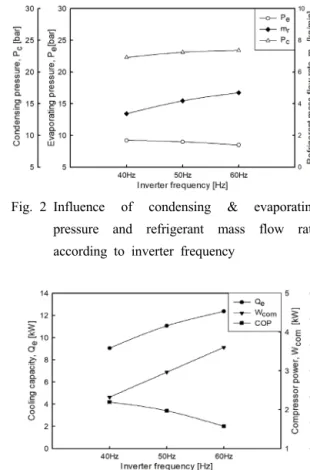
(Tsup) 5℃, 과냉도(Tsub) 2℃]에서 인버터 주파수 (40 Hz, 50 Hz, 60 Hz)가 히트펌프 시스템의 냉방 성능 특성에 미치는 영향을 살펴보았다. Fig. 2에 인버터 주파수 변화에 따른 증발, 응축 압력 및 질량 유량을 나타내었다. 인버터 주파수가 40~60 Hz로 증가함에 따라 증발 압력은 9.21~8.48 bar로 감소, 응축 압력과 질량 유량은 각각 22.28~23.44 bar, 3.365~4.696 kg/min으로 증가하는 경향을 보 였다. 이는 인버터의 주파수가 증가함에 따라 압 축기의 회전수 증가하고 냉매 흡입량과 토출량이 많아짐에 따른 결과로 생각된다.
Fig. 3은 동일한 조건에서 압축 일량, 냉방 능력
및 COP를 나타낸 그래프이다. 압축 일량은 2.320
~ 3.613 kW로 56.5%, 냉방 능력은 9.06~12.56 kW 로 38.7% 증가하였다. 이는 앞서 설명한 질량유량 의 증가로 그 이유를 설명할 수 있다. 또한, 압축 일량의 증가 비율에 비해 냉방 능력의 증가 비율 이 적어서 COP는 11% 감소하였다.
3.2 증발기 측 냉수 입구 온도에 따른 영향 일정한 조건에서 증발기 입구 측 냉수 온도가 7℃, 12℃, 17℃로 증가함에 따른 히트펌프 시스 템의 냉방 성능 특성에 대해 알아보았다.
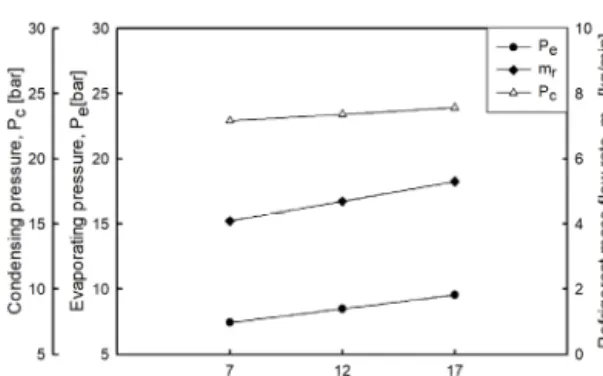
Fig. 4에 증발, 응축 압력, 질량 유량을 나타내 었다. 증발기 입구 측 냉수온도가 7~17℃로 증가
Fig. 4 Influence of condensing & evaporating pressure and refrigerant mass flow rate according to inlet temperature of chilled water into evaporator
Fig. 5 Influence of cooling capacity & compressor power and COP according to inlet temperature of chilled water into evaporator
함에 따라 증발 압력과 응축 압력은 각각 7.44 ~ 9.55 bar, 22.93~23.90 bar로 증가, 질량 유량도 4.098~5.299 kg/min으로 증가하는 경향을 보였다.
이는 증발기 입구 측 냉수 온도가 증가함에 따라 압축기 흡입 측 냉매의 비체적은 감소하며 압축 기 흡입 측 냉매의 온도는 증가함에 따른 결과로 생각된다. 압축기 흡입 측 냉매의 비체적이 감소 했다는 뜻은 동일 체적에 더 많은 질량을 내포하 고 있다는 뜻이며, 압축기 흡입 측 냉매의 온도가 증가하면, 팽창밸브에서 과열도를 자동적으로 맞 추기 위해 개도를 늘리게 된다. 이에 따라, 질량 유량은 증가한 것으로 생각된다.
Fig. 5는 동일한 조건에서 압축 일량, 냉방 능력 및 COP를 나타낸 그래프이다. 압축 일량은 3.590
~3.682 kW로 2.6%, 냉방 능력은 34.4% 증가하였 다. 또한 압축 일량의 증가 비율에 비해 냉방 능 력의 증가 비율이 커서 COP는 31% 증가하였다.
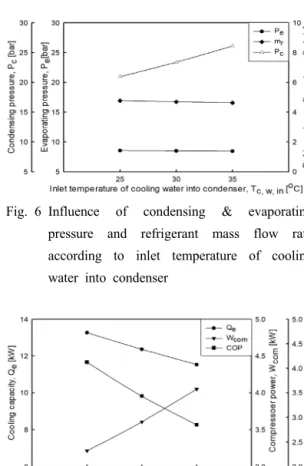
3.3 응축기 측 냉각수 입구 온도에 따른 영향 일정한 조건에서 응축기 입구 측 냉각수 온도 가 25℃, 30℃, 35℃로 증가함에 따른 히트펌프 시 스템의 냉방 성능 특성에 대해 알아보았다. Fig. 6 에 응축기 입구 측 냉각수 온도의 변화에 따른 증 발, 응축 압력 및 질량 유량을 나타내었다. 응축기 측 냉각수 입구 온도가 25~35℃로 변화함에 따라 질량 유량은 20.98~26.11 bar로 증가, 증발 압력과 질량 유량은 각각 8.54~8.44 bar, 4.772~4.631 kg/min으로 소폭 감소하였다. 이는 응축기 입구 측 냉각수 온도가 증가함에 따라 압축기 토출 측 냉매의 온도는 증가하며 압축기 흡입 측 냉매의 온도가 소폭 감소함에 따른 결과로 생각된다.
압축기 토출 측 냉매의 온도가 증가하게 되면 응축 압력이 증가하게 되고 체적 효율은 감소하 게 된다. 하지만 압축기 흡입 측 냉매의 온도가 소폭 감소한 반면, 응축압력은 큰 폭으로 증가했 기 때문에 팽창밸브에서 과열도를 자동으로 맞추 기 위해 개도를 줄여서 증발 압력을 맞추게 된다.
이에 따라, 질량 유량은 소폭 감소한 것으로 생각 된다.
Fig. 7은 동일한 조건에서 압축 일량, 냉방 능력
및 COP를 나타낸 그래프이다. 압축 일량은 3.218
~4.048 kW로 25.8% 증가한 반면, 냉방 능력은 13.27~11.54 kW로 13.8% 감소하였다. 압축 일량의 증가 이유는 체적 효율의 감소, 냉방 능력의 감소 이유는 질량 유량의 감소로 생각된다. 또한, 압축 일량은 증가하였고, 냉방 능력은 감소했으므로 COP는 31.5% 감소하였다.
Fig. 6 Influence of condensing & evaporating pressure and refrigerant mass flow rate according to inlet temperature of cooling water into condenser
Fig. 7 Cooling capacity, compressor power and COP according to inlet temperature of cooling water into condenser
4. 결 론
실험을 통해 인버터의 주파수(40 Hz, 50 Hz, 60 Hz), 증발기 측 냉수 입구 온도(7℃, 12℃, 17℃), 응축기 측 냉각수 입구 온도(25℃, 30℃, 35℃)에 따른 히트펌프 시스템의 냉방 능력 및 COP를 살
펴보았고 결론은 다음과 같다.
1) 냉방 능력을 증가시키기 위해서는 인버터의 주파수와 증발기 측 냉수 입구 온도는 증가시키 는 반면에 응축기 측 냉각수 입구 온도는 감소시 켜야 할 것으로 판단된다.
2) COP를 증가시키기 위해서는 증발기 측 냉수 입구 온도를 증가시키고, 인버터의 주파수와 응축 기 측 냉각수 입구 온도를 감소시키는 것이 좋을 것으로 판단된다.
후 기
본 연구는 산업통상자원부(MOTIE)와 한국에너 지기술평가원(KETEP)의 지원을 받아 수행한 연구 과제입니다. (No. 20162020107620)
References
1. T. Nishimura, 2002, "Heat pumps - status and trends in Asia and the Pacific", International Journal of Refrigeration, Vol. 25, No. 4, pp.
405-413.
2. S. S. Bertsch and E. A. Groll, 2008, "Two-stage air-source heat pump for residential heating and cooling applications in northern US climates", International Journal of Refrigeration, Vol. 31, No. 7, pp. 1282-1292.
3. C. H. Son and H. K. Oh, 2007, "Performance Characteristics of Water-Chilling Heat Pump Using CO₂ on the Variation of Secondary Fluid Conditions", Journal of the Korean Society of Marine Engineering, Vol. 31, No. 5, pp. 543-551.
4. D. A. Cha, O. K. Kwon and S. G. Park, 2012,
"Cooling and Heating Characteristics of Ground Source Heat Pump for Heat Exchange Methods using EEV", Proceedings of the Korean Society of Mechanical Engineers Spring Conference, pp.
232-235.
5. S. M. Baek, C. G. Moon, J. I. Yoon, S. K.
Jeong and E. Kim, 2011, "The characteristics of
capacity control using a variable speed compressor in an industrial cooler", Journal of the Korean Society for Power System Engineering, Vol. 15, No. 2, pp. 37-41.
6. S. H. Lee and J. M. Choi, 2013, "Transient
Performance of a System Heat Pump with the Variation of Compressor Speed and EEV Openings", Transactions of the Korea society of Geothermal Energy Engineers, Vol. 9, No. 3, pp.
11-18.