Korean J ournal of S oil S cience and F ertilizer
Short communication https://doi.org/10.7745/KJSSF.2018.51.4.445 pISSN : 0367-6315 eISSN : 2288-2162
Optimum Range on Soil Physical Indicators Under Plastic Film House
Yongseon Zhang, Heerae Cho*, Kyunghwa Han, Junghun Ok, Seonah Hwang, and Kangho Jung Soil and Fertilizer Division, National Institute of Agricultural Sciences, Wanju 55365, Korea
*Corresponding author: [email protected]
A B S T R A C T
Received: September 4, 2018 Revised: October 11, 2018 Accepted: October 17, 2018
The water and nutrients in the soil can be absorbed by the crop root. The soil physical properties affect the growth and penetration of crop root. The objectives of this study were to determine soil physical indicators that could inhibit the crop growth under plastic film house, and to establish the appropriate soil physical criterion depending on crop types. The soil physical (including effective rhizosphere, soil three phase, and bulk density) and chemical (including pH, EC, organic matter content, and available phosphate) properties were investigated in the mainly cultivated area for greenhouse crops including lettuce, strawberry, cucumber, tomato, oriental melon, and water melon from 2015 to 2017. For plastic film house, soil physical indicators were commonly chosen as bulk density, air porosity, and effective root depth. The optimum ranges for plastic film house soil were as follows; deeper than 50 cm for effective root depth, less than 1.5 Mg m-3 for bulk density and more than 10% gas phase.
Keywords: Plastic film house, Effective soil depth, Gas phase, Bulk density
The optimum range of soil physical indicators for crops cultivated greenhouse.
Greenhouse crops Effective root depth (cm)
Bulk density (Mg m-3)
Gas phase (%) Lettuce, Strawberry, Cucumber,
Tomato, Oriental melon, Watermelon above 50 below 1.5 above 10
Ⓒ The Korean Society of Soil Science and Fertilizer. This is an Open Access article distributed under the terms of the Creative Commons Attribution Non- Commercial License (http://creativecommons.org/licenses/by-nc/4.0) which permits unrestricted non-commercial use, distribution, and reproduction in any medium, provided the original work is properly cited.
Introduction
식물 (근권)은 토양 수분과 양분을 흡수하여, 지상부의 탄소동화 및 증산작용으로 농업생태계 물질순환에 기여한 다. 근권 발달은 관개와 비료시용 (Russel, 1997), 토양수분 (Reicosky, 1972)에 우선 영향을 받는다. 그러나 작물 근 권은 뿌리 량, 뿌리 침투력, 수평적 뿌리분포 및 최대 뿌리 깊이가 다르므로 (Canel and Jackson, 1981; Liu et al., 2011), 안정적인 작물생육에 필요한 적정 근권 깊이가 중요하다 (Allen et al., 1998; Raes et al., 2002).
농경지 작물별 근권 깊이에 대한 연구가 진행되어 왔다. 예를 들어 관개 벼의 적정 유효근권 깊이는 30 cm (HAES, 1986), 밭작물 중 콩은 60 cm, 상추, 배추 및 감자는 50 cm, 옥수수와 고추는 75 cm 이상이었다 (Zhang et. al., 2017).
이 외에도 표토의 용적밀도 및 지하수위도 근권의 발달에 영향을 미치는 요인이 될 수 있다. 즉 밭토양의 물리성 기준 은 표토 토성에 관계없이 용적밀도는 1.3 Mg m-3미만, 지하수위는 100 cm 이상 이었고, 특히 심토의 용적밀도는 사양 질에서 1.6 Mg m-3미만, 식양질에서 1.5 Mg m-3미만이었다 (NIAS, 2014).
한편, 시설재배지 면적은 95년까지 지속적으로 증가하였으며, 이후 증감을 보였고 최근 밭을 시설재배지로 활용하 는 비율이 증가하는 추세이었다. 작물별 분포면적을 살펴보면, 상추는 경기, 충남과 전북에서, 딸기는 충남과 경남에 서, 오이는 충남과 경기, 토마토는 충남, 강원과 전남, 수박은 충남, 경남과 전북, 참외는 경북에서 넓은 분포를 보였다 (Statistics Korea. 2015). 시설재배지 등을 신규로 조성할 때, 석비레 및 사양질 토양으로 성토하여 토양단면을 바꾸는 사례가 나타나고 있으며 (NAAS, 2008), 이러한 토양교란 시에 기계적 답압 (Raper, 2005)뿐만 아니라 원토양과 성토 토양의 토성 차이에 의한 투수저하가 발생한다 (NAAS, 2012). NAAS (2008)는 우리나라 대표 밭토양 64 지점에 대 해서 대형농기계 사용연수와 토양 물리성의 상관관계를 분석한 결과, 대형농기계 사용연수의 증가에 따라 토양 물리 성이 악화된다고 보고하였다.
시설재배지는 양분과 수분의 이동이 아래에서 위로 향하는 경우가 대부분이지만 노지재배는 대체로 강우에 따라 하부로 용탈되는 흐름을 가지므로 노지작물과는 상이한 뿌리 분포를 보일 것으로 예상되어 시설재배지 작물의 적정 물리성 기준이 필요한 실정이다.
농경지를 새로이 조성하거나 논을 밭이나 시설로 전환해 활용할 때 작물이 뿌리 뻗기 좋은 토양을 조성할 수 있도록 토양의 물리적 조건 중 핵심 요인을 선정해 적정 기준을 설정하는 것이 매우 필요하다. 따라서 본 연구에서는 1990년 대 이후 논과 밭의 시설재배지화 등과 같은 토지이용의 급속한 변화, 논이나 밭을 시설재배지로 전환하면서 성토, 적 토, 절토 등 인위토의 생성, 시설재배지 조성과정에서 대형 농기계의 사용이 늘면서 영농활동에 의한 토양 물리적 특 성을 고려하여 시설작물 종류별 적정 토양 물리성 기준을 설정하고자 수행하였다.
Materials and Methods
시설재배지의 적정 물리성 기준을 설정하기 위하여 재배면적이 많은 상추, 딸기, 오이, 토마토, 수박, 참외를 대상으 로 2015년 시설 상추와 딸기, 2016년 시설 오이와 토마토, 2017년 시설 수박과 참외 주산단지에서 조사하였다. 대상 토양은 토심 50 cm 이상으로 토심이 깊은 토양으로 하였으며, 조사 시기는 시설재배 토양특성에 영향을 줄 수 있는 생 육단계와 농가별 물 관리 방법을 고려하여 수확기에 실시하였다.
토양 유효토심과 작물 뿌리신장을 분석하기 위해 토성, 지하수위, 용적밀도, 작물 최장근심 등을 조사하였다. 작물 의 뿌리분포와 지하수위를 관찰하기 작물의 관부를 중심점으로 토양 깊이 75 cm까지 반원형의 칼날로 구성되어 비교
란 시료채취가 가능한 gouge auger (내경 4 cm × 길이 75 cm)로 굴착하여 뿌리 뻗음과 지하수위 높이를 포함한 토양 단면 특성을 관찰하였다(Fig. 1). 표토와 심토의 토양 다짐을 분석하기 위하여 표토는 경운 깊이를 고려하여 5-10 cm 깊이에서 삼상분석용 100 cm3 core 시료와 토양화학성 분석용 시료를 채취하였고, 심토는 75 cm 이내에 원추형 관입 저항계로 측정시 관입저항이 가장 높게 나타나는 깊이에서 삼상분석용 100 cm3 core 시료를 채취하여 분석하였다 (Fig. 1).
토양 이화학성 분석은 토양 및 식물체 분석법 (NIAST, 2000)에 준하였다. 토양삼상은 100 cm3코어로 토양을 채취 하여 건토중량법 (105°C)으로 수분함량을 조사하였다. 토양 반응 (pH)과 전기전도도 (EC)는 토양과 증류수를 1:5 (w:v)로 하여 초자전극법으로 분석하였고 유기물 함량은 Walkey-Black법, 유효인산은 Lancaster법, 치환성 Ca, Mg, K, Na는 1N-NH4OAc (pH 7.0)용액으로 침출하여 유도 결합 플라즈마 분광계 (CINTRA6, GBC, AU)로 분석하였다.
Results and Discussion
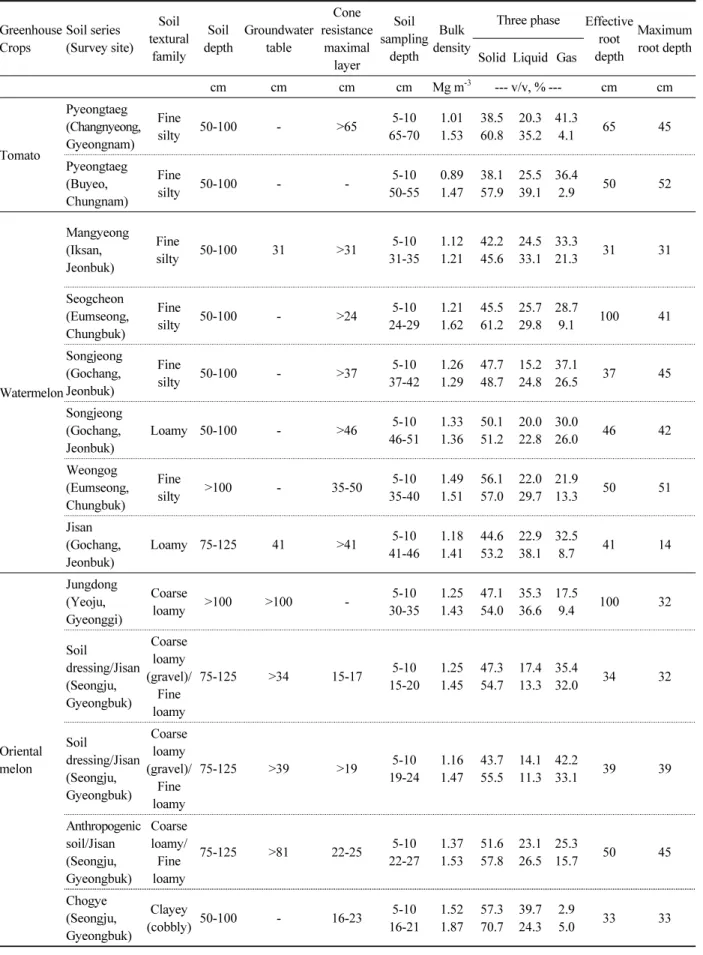
작물 수확기에 조사한 시설작물별 대상지는 41개소로, 토성속은 대부분 사양질, 미사식양질과 식양질이었고, 토심 은 50 cm 이상이 대부분이었다 (Table 1). 시설 상추와 딸기는 대부분 논을 시설로 전환한 토양으로 지하수위가 50 cm 전후인 곳이 많았으며, 시설 참외와 시설상추재배지 중 중부지역의 남양주는 적토형 인위토가 많았다. 시설재배 지의 지하수위가 50-20 cm이었던 조사대상지는 12개소, 30%이었으며, 원추형 관입저항 최대 출현 토층의 깊이가 20 cm 이하 17%, 20-50 cm 이하 63%, 50-100 cm 이하 14%, 100 cm 이상인 곳은 1%이하로 대부분 토양깊이 20-50 cm 에서 다짐층이 나타났다. 한편 교란된 시설재배지에서의 물 이동이 표면에서는 0.1-14.8 cm hr-1로 변이가 크며, 50 cm 이하에서는 대체로 불투수층이 나타났다 (NAAS, 2012).
(a) (b)
Fig. 1. Investigation of soil profile with gouge auger (a) and hardness measurement with three iterations using cone penetration resistor (b).
Table 1. Soil condition and top-soil physical properties in the plastic film house. (Continued)
Greenhouse Crops
Soil series (Survey site)
Soil textural
family Soil depth
Groundwater table
Cone resistance
maximal layer
Soil sampling
depth Bulk density
Three phase Effective root depth
Maximum root depth Solid Liquid Gas
cm cm cm cm Mg m-3 --- v/v, % --- cm cm
Lettuce
Gyuam (Chungju, Chungbuk)
Coarse silty /Fine
silty
>100 - >40 5-10
40-45 1.32 1.47
49.7 55.6
14.9 13.8
35.4
30.6 40 13
Sachon (Yangpyeong, Gyeonggi)
Coarse
loamy 50-100 >49 >17 5-10 17-22
1.08 1.39
41.7 52.4
40.3 33.3
18.0
14.4 50 38
Sinheung (Suwon, Gyeonggi)
Fine
loamy 50-100 >41 28-32 5-10 28-33
1.17 1.78
45.2 68.5
28.2 21.9
26.7
9.7 28 20
Asan (Hwaseong, Gyeonggi)
Fine
loamy 50-100 - 18-32 5-10
23-27 0.98 1.22
37.1 46.2
12.6 19.3
50.2
34.6 18 12
Weongog (Hwaseong, Gyeonggi)
Fine
loamy >100 - >27 5-10
27-32 0.96 1.31
36.1 49.3
23.8 32.0
40.2
18.8 27 17
Weongog (Hwaseong, Gyeonggi)
Fine
loamy >100 - >16 5-10
16-21 1.18 1.60
45.4 61.6
14.3 33.7
40.3
4.7 16 16
Jungdong (Gwangju, Gyeonggi)
Coarse
loamy >100 >100 40-47 5-10 41-46
1.02 1.08
39.3 41.7
30.8 40.3
30.0
18.0 100 52
Cheongweon (Chungju, Chungbuk)
Fine silty 50-100 - >37 5-10 37-42
1.22 1.31
46.0 49.4
11.9 20.3
42.2
30.3 37 17
Strawberry
Gangseo (Hadong, Gyeongnam)
Coarse
loamy 50-100 >50 23-42 5-10 23-28
1.29 1.37
48.5 51.8
37.7 38.8
13.7
9.3 50 24
Sachon (Nonsan, Chungnam)
Coarse
loamy 50-100 >51 17-39 5-10 17-22
1.31 1.44
49.5 54.2
26.0 33.8
24.5
12.0 50 39
Seogcheon (Cheongju, Chungbuk)
Coarse
loamy 50-100 >50 >35 5-10 35-39
1.11 1.52
42.6 58.6
13.7 23.7
43.7
17.7 35 34
Jungdong (Jinju, Gyeongnam)
Coarse
loamy >100 >100 18-40 5-10 18-23
1.35 1.47
51.1 55.6
26.1 31.4
22.8
13.0 60 21
Jungdong (Namyangju, Gyeonggi)
Coarse
loamy >100 >100 21-33 5-10 21-26
1.31 1.41
49.3 53.1
29.2 33.6
21.5
13.3 100 52
Cheongweon (Buyeo, Chungnam)
Fine
silty 50-100 >37 21-33 5-10 21-25
1.31 1.43
49.4 54.0
38.0 44.2
12.6
1.8 37 32
Table 1. Soil condition and top-soil physical properties in the plastic film house. (Continued)
Greenhouse Crops
Soil series (Survey site)
Soil textural
family Soil depth
Groundwater table
Cone resistance
maximal layer
Soil sampling
depth Bulk density
Three phase Effective root depth
Maximum root depth Solid Liquid Gas
cm cm cm cm Mg m-3 --- v/v, % --- cm cm
Strawberry
Pyeongtaeg (Miryang, Gyeongnam)
Fine
silty >100 >50 22-38 5-10 22-27
1.09 1.30
41.0 52.2
43.1 45.3
16.0
2.5 50 24
Pyeongtaeg (Damyang, Jeonnam)
Fine
silty >100 >50 30-39 5-10 30-35
1.21 1.34
45.7 50.6
43.4 46.5
10.9
2.9 50 37
Cucumber
Gangseo (Gurye, Jeonnam)
Coarse
loamy 50-100 - >70 5-10
70-75 0.92 1.42
34.7 53.6
28.4 39.8
36.9
6.6 70 49
Gocheon (Sangju, Gyeongbuk)
Coarse
loamy 50-100 - >35 5-10
35-40 1.12 1.61
42.3 60.7
20.8 21.3
36.9
18.0 35 22
Deogpyeong (Nonsan, Chungnam)
Clayey >100 - 47-60 5-10
47-52 0.98 1.52
37.0 57.3
33.1 40.5
29.9
2.3 47 47
Sinheung (Cheonan, Chungnam)
Fine
loamy 50-100 14-27 >42 5-10 42-47
0.90 1.01
34.1 38.0
41.7 58.1
24.2
3.9 14 16
Sinheung (Cheonan, Chungnam)
Fine
loamy 50-100 31-42 >45 5-10 45-50
0.93 0.96
35.0 36.4
39.1 44.2
25.9
19.5 30 23
Pyeongtaeg (Nonsan, Chungnam)
Fine
silty 50-100 45 >45 5-10
45-50 1.14 1.52
42.9 57.3
31.1 38.5
26.0
4.2 45 48
Tomato
Gopyeong (Goseong, Gyeongnam)
Clayey >100 - 60-70 5-10
60-65 0.97 1.16
39.4 49.9
14.5 19.5
46.2
30.6 60 47
Gopyeong (Goseong, Gyeongnam)
Clayey >100 - >60 5-10
60-65 0.92 1.39
36.4 43.8
28.0 48.3
35.6
7.8 60 47
Dalcheon (Buyeo, Chungnam)
Fine
loamy 50-100 - >46 5-10
46-61 1.21 1.72
33.7 55.3
23.5 38.4
42.9
6.3 46 46
Sindab (Cheongju, Chungbuk)
Coarse loamy/
Sandy
>100 41 39-42 5-10
39-44 1.14 1.52
42.9 57.3
31.1 38.5
26.0
4.2 39 35
Sindab (Cheongju, Chungbuk)
Coarse loamy/
Sandy
>100 43 >60 5-10
60-64 1.02 1.61
42.9 57.2
17.2 32.9
39.9
9.9 60 43
Yongji (Buyeo, Chungnam)
Fine
loamy >100 - >40 5-10
40-47 1.04 1.32
45.8 64.7
25.0 28.8
29.2
6.5 70 49
Table 1. Soil condition and top-soil physical properties in the plastic film house.
Greenhouse Crops
Soil series (Survey site)
Soil textural
family Soil depth
Groundwater table
Cone resistance
maximal layer
Soil sampling
depth Bulk density
Three phase Effective root depth
Maximum root depth Solid Liquid Gas
cm cm cm cm Mg m-3 --- v/v, % --- cm cm
Tomato
Pyeongtaeg (Changnyeong, Gyeongnam)
Fine
silty 50-100 - >65 5-10
65-70 1.01 1.53
38.5 60.8
20.3 35.2
41.3
4.1 65 45
Pyeongtaeg (Buyeo, Chungnam)
Fine
silty 50-100 - - 5-10
50-55 0.89 1.47
38.1 57.9
25.5 39.1
36.4
2.9 50 52
Watermelon
Mangyeong (Iksan, Jeonbuk)
Fine
silty 50-100 31 >31 5-10
31-35 1.12 1.21
42.2 45.6
24.5 33.1
33.3
21.3 31 31
Seogcheon (Eumseong, Chungbuk)
Fine
silty 50-100 - >24 5-10
24-29 1.21 1.62
45.5 61.2
25.7 29.8
28.7
9.1 100 41
Songjeong (Gochang, Jeonbuk)
Fine
silty 50-100 - >37 5-10
37-42 1.26 1.29
47.7 48.7
15.2 24.8
37.1
26.5 37 45
Songjeong (Gochang, Jeonbuk)
Loamy 50-100 - >46 5-10
46-51 1.33 1.36
50.1 51.2
20.0 22.8
30.0
26.0 46 42
Weongog (Eumseong, Chungbuk)
Fine
silty >100 - 35-50 5-10
35-40 1.49 1.51
56.1 57.0
22.0 29.7
21.9
13.3 50 51
Jisan (Gochang, Jeonbuk)
Loamy 75-125 41 >41 5-10
41-46 1.18 1.41
44.6 53.2
22.9 38.1
32.5
8.7 41 14
Oriental melon
Jungdong (Yeoju, Gyeonggi)
Coarse
loamy >100 >100 - 5-10
30-35 1.25 1.43
47.1 54.0
35.3 36.6
17.5
9.4 100 32
Soil dressing/Jisan (Seongju, Gyeongbuk)
Coarse loamy (gravel)/
Fine loamy
75-125 >34 15-17 5-10 15-20
1.25 1.45
47.3 54.7
17.4 13.3
35.4
32.0 34 32
Soil dressing/Jisan (Seongju, Gyeongbuk)
Coarse loamy (gravel)/
Fine loamy
75-125 >39 >19 5-10 19-24
1.16 1.47
43.7 55.5
14.1 11.3
42.2
33.1 39 39
Anthropogenic soil/Jisan (Seongju, Gyeongbuk)
Coarse loamy/
Fine loamy
75-125 >81 22-25 5-10 22-27
1.37 1.53
51.6 57.8
23.1 26.5
25.3
15.7 50 45
Chogye (Seongju, Gyeongbuk)
Clayey
(cobbly) 50-100 - 16-23 5-10
16-21 1.52 1.87
57.3 70.7
39.7 24.3
2.9
5.0 33 33
시설재배지 용적밀도는 표토에서 평균 1.14 Mg m-3, 심토에서 평균 1.42 Mg m-3이었는데 이는 2016년도 시설재배 지에 대한 농업환경변동조사사업 보고서 (NIAS, 2016)에 의하면 표토는 1.0-1.2 Mg m-3, 심토는 1.2-1.4 Mg m-3로 유 사한 경향을 보였다. 작물별로는 표토에서 오이 1.00 > 토마토 1.03 > 상추 1.12 > 딸기 1.24 > 수박 1.27 > 참외 1.31 Mg m-3순이었고, 심토에서 상추와 수박 1.40 > 딸기 1.41 > 토마토 1.47 > 오이 1.52 > 참외 1.55 Mg m-3의 순으로 참 외에서 높게 나타났다. 2016년 시설재배지 토양물리성 조사 결과 (NIAS, 2016), 작물별로는 참외가 표토 용적밀도 1.24 Mg m-3, 심토 용적밀도 1.47 Mg m-3로 가장 높은 값을 보였고 오이가 표토에서 0.98 Mg m-3, 심토에서 1.27 Mg m-3로 가장 낮은 값을 보였다. 이는 최근 시설참외 및 수박 정식 후 뿌리의 활착을 높이고 지온을 상승시키기 위하여 경운 후 이랑 다지기를 실시하는 재배법의 영향이 큰 것으로 추측된다 (Seong et al., 2012).
노지 밭토양에서 작물 근신장을 위한 물리성 적정기준으로 용적밀도는 토성에 따라 사양질 1.6 Mg m-3이하, 식양 질 1.5 Mg m-3이하이었고 기상율은 10%이었다 (NAAS, 2008). 그러나 시설재배지에서는 토성과 상관없이 원추형 관입저항 최대 출현 토층의 용적밀도가 1.5 Mg m-3이상에서는 뿌리신장 제한되는 것으로 나타났으며, 상추에서는 2개, 딸기 1개, 오이 2개, 토마토 4개, 수박 2개, 참외 2개 지점이었다. Schaffer (2007)는 콤바인 10번 주행시험에서 대 공극률과 공극연결성이 감소되므로 토양의 구조와 토양 내 공극의 양, 분포 및 공극연결성에 영향을 주어 토양이 단단 해지거나 물 빠짐이 느려지는 등 문제가 발생할 수 있다고 한바 있으며, 농기계 사용에 따른 대공극률과 공극연결성 감소는 포화수리전도도 감소 등을 비롯한 물의 이동 및 순환에 영향이 클 것으로 보인다. 특히 심토의 다짐은 일단 한 번 발생하면 구조가 회복되기 어렵고 영구적이라는 점에서 심각한 문제가 된다 (Akker and Canarache, 2001; Horn, 2009).
지하수위가 14-27 cm인 신흥통 (오이, 충남 천안)에서는 과습에 의한 환원장애가 나타나 최장근심이 16 cm 로 뿌 리 신장이 제한되었으며, 지하수에 의한 환원 장애가 청원통 (딸기, 충남 부여), 신답통 (토마토, 충북 청주), 만경통 (수박, 전북 익산)과 지산통 (참외 경북 성주) 등에서 나타났다. 특히 오이는 생육후기 높은 관수량이 요구되기 때문에 과습에 의한 환원장애의 피해가 나타나기 쉽고 이것이 생육제한의 주요한 요인으로 나타났다.
원추형 관입저항 최대 출현 토층의 기상율이 10%이하인 지점은 시설 상추 중 신흥통 (경기 수원)과 원곡통(경기 화 성), 시설 딸기 중 청원통 (충남 부여)과 평택통 (경남 밀양, 전남 담양), 시설 오이 중 덕평 (충남 논산)과 평택통 (충남 논산), 시설 수박 중 지산통 (전북 고창), 시설 참외 중 중동통 (경기 여주)와 초계통 (경북 성주)에서 나타났으며, 사양 질의 중동통 (경기 여주)을 제외한 모든 토양은 점토 함량 18% 이상인 지점에서 관찰되었다. 작물 근권에서 산소 부족 은 토양환원에 의한 유해 물질의 발생 등으로 미생물의 활동이 제한되어 작물에 스트레스를 주게 되고 (Hiler, 1976;
Plamenac, 1988). 습해는 과습에 의해 토양 중에 포장용수량 이상의 수분이 존재할 때 통기 불량으로 산소결핍이 일 차적 원인이 되어 종종 작물에 습해를 유발하게 되며 이에 의해 식물체가 2차적으로 대사과정에서 독성을 나나내거나 양분결핍 현상이 나타나게 된다 (Levitt, 1980).
시설 작물별 최장근심은 상추 52 cm (중동통, 경기 광주), 딸기 52 cm (중동통, 경기 남양주), 오이 49 cm (강서통, 전남 구례), 토마토 52 cm (평택통, 충남 부여), 수박 51 cm (원곡통, 충북 음성)과 참외 45 cm (지산통, 경북 성주)로 50 cm 전후이었다. 작물의 최장근심과 토성속간의 관계를 살펴보면, 사양질에서는 평균 최장근심이 36 cm이었고, 식 양질에서는 평균 34 cm로 토성속과 최장근심과는 차이가 없었다. 조사 대상지 중 유효토심의 깊이가 50 cm 이하는 54%, 50 cm 이상은 46%로 나타났다. 작물의 최장근심과 유효토심 관계를 살펴보면, 유효토심의 깊이가 50 cm 이하 인 토양에서 최장근심은 평균 29 cm이었고, 유효토심 50 cm 이상인 토양에서는 평균 42 cm이어서 유효토심이 깊어 질수록 작물의 뿌리 신장이 증가하는 것으로 나타났다.
Table 2. Top-soil chemical properties in the plastic film house. (Continued)
Greenhouse crops
Soil series (Survey site)
pH EC OM Avail. P2O5 Exch. Cation
K Ca Mg Na
1:5 H2O dS m-1 g kg-1 mg kg-1 --- cmolc kg-1 ---
Lettuce
Gyuam
(Chungju, Chungbuk) 7.2 3.1 63 1728 2.1 13.9 5.9 0.6
Sachon (Yangpyeong, Gyeonggi)
6.5 6.0 39 840 1.0 4.7 3.4 0.2
Sinheung
(Suwon, Gyeonggi) 6.3 6.0 70 2132 1.8 15.8 4.6 0.7
Asan
(Hwaseong, Gyeonggi) 7.3 2.7 58 2479 0.9 16.3 7.1 0.7
Weongog
(Hwaseong, Gyeonggi) 6.6 3.0 40 1396 1.6 7.9 3.9 0.4
Weongog
(Hwaseong, Gyeonggi) 6.7 6.9 30 542 0.5 11.3 4.9 0.7
Jungdong
(Gwangju, Gyeonggi) 6.8 4.0 58 1527 2.4 12.8 3.9 0.5
Cheongweon
(Chungju, Chungbuk) 7.8 1.0 48 944 1.6 10.3 4.6 0.3
Strawberry
Gangseo
(Hadong, Gyeongnam) 6.0 0.6 29 727 0.3 6.4 0.9 0.1
Sachon
(Nonsan, Chungnam) 6.3 1.1 18 599 0.4 0.6 2.0 0.2
Seogcheon
(Cheongju, Chungbuk) 6.9 1.4 15 244 0.1 8.4 2.0 0.7
Jungdong
(Jinju, Gyeongnam) 6.8 0.1 15 212 0.2 3.9 0.7 0.1
Jungdong
(Namyangju, Gyeonggi) 7.3 0.7 35 1179 1.2 4.4 1.4 0.1
Cheongweon
(Buyeo, Chungnam) 6.8 0.8 27 818 0.7 8.7 2.6 0.2
Pyeongtaeg
(Miryang, Gyeongnam) 4.8 0.7 32 129 0.1 4.0 0.5 0.2
Pyeongtaeg
(Damyang, Jeonnam) 5.8 0.4 26 128 0.1 4.0 1.0 0.2
Cucumber
Gangseo
(Gurye, Jeonnam) 6.4 3.0 46 1031 1.9 10.1 2.3 0.3
Gocheon
(Sangju, Gyeongbuk) 6.5 5.7 36 490 1.1 12.1 2.5 0.8
Deogpyeong
(Nonsan, Chungnam) 6.1 7.2 54 1244 4.3 13.1 5.5 0.7
Sinheung
(Cheonan, Chungnam) 7.6 11.1 50 1479 9.4 18.2 7.0 1.7
Sinheung
(Cheonan, Chungnam) 7.4 10.7 46 177 7.8 19.1 6.7 1.4
Pyeongtaeg
(Nonsan, Chungnam) 5.0 3.9 35 973 0.8 7.2 3.1 0.3
Table 2. Top-soil chemical properties in the plastic film house.
Greenhouse crops
Soil series (Survey site)
pH EC OM Avail. P2O5 Exch. Cation
K Ca Mg Na
1:5 H2O dS m-1 g kg-1 mg kg-1 --- cmolc kg-1 ---
Tomato
Gopyeong
(Goseong, Gyeongnam) 7.0 4.0 59 1385 3.4 17.8 6.8 0.6
Gopyeong
(Goseong, Gyeongnam) 6.9 7.2 75 1679 4.5 16.5 6.6 1.3
Dalcheon
(Buyeo, Chungnam) 6.5 0.6 17 460 0.3 5.7 2.4 0.4
Sindab
(Cheongju, Chungbuk) 6.9 7.2 50 1494 2.1 11.7 5.9 1.3
Sindab
(Cheongju, Chungbuk) 6.6 9.3 54 1422 4.9 10.0 5.7 1.1
Yongji
(Buyeo, Chungnam) 7.3 5.7 29 873 1.3 7.9 4.3 1.6
Pyeongtaeg (Changnyeong, Gyeongnam)
7.0 5.3 44 1016 2.0 13.3 4.5 1.1
Pyeongtaeg
(Buyeo, Chungnam) 5.3 2.3 31 188 0.2 6.2 1.8 0.7
Watermelon
Mangyeong
(Iksan, Jeonbuk) 6.1 1.1 20 90 0.1 4.5 1.7 0.8
Seogcheon
(Eumseong, Chungbuk) 5.2 1.3 23 437 1.2 4.7 2.0 0.9
Songjeong
(Gochang, Jeonbuk) 6.4 3.1 22 446 1.3 5.8 3.8 0.6
Songjeong
(Gochang, Jeonbuk) 6.7 0.6 24 493 0.5 6.9 2.5 0.3
Weongog
(Eumseong, Chungbuk) 6.1 0.8 17 479 0.6 1.1 2.0 0.3
Jisan
(Gochang, Jeonbuk) 7.3 3.1 22 446 1.2 6.9 3.6 0.3
Oriental melon
Jungdong
(Yeoju, Gyeonggi) 7.0 1.0 31 466 0.4 7.3 1.9 0.2
Jisan
(Seongju, Gyeongbuk) 7.6 8.3 23 1114 4.0 13.7 5.3 1.1
Jisan
(Seongju, Gyeongbuk) 8.1 3.0 22 868 2.5 10.0 3.7 0.4
Jisan
(Seongju, Gyeongbuk) 7.9 2.7 13 837 0.6 14.3 4.6 0.3
Chogye
(Seongju, Gyeongbuk) 8.0 1.1 18 1305 0.8 11.9 3.9 0.3
Optimal range 6.5-7.0 <2.0 20-30 250-400 0.4-0.6 6.0-7.0 2.0-2.5 -
시설재배지 표토 토양의 작물별 토양화학성은 Table 2와 같았다. EC는 딸기와 수박에서 2 dS m-1이하의 수준이었 으나 오이 6.9 dS m-1, 토마토 5.2 dS m-1로 높았다. 유기물은 상추, 오이, 토마토에서 40 g kg-1을 초과하였으며, 유효 인산은 상추와 토마토가 가장 높았고 수박이 가장 낮았다. 치환성 양이온은 딸기를 제외한 모든 시설작물에서 높게 나타났으며, 특히 연중 10회 이상 수확하는 상추와 시설오이에서 높게 나타났다. 지산통 (경북 성주)의 참외재배지는 동일 하우스 내에서 생육이 양호한 위치와 불량한 위치에 따라 토양 화학성에 차이가 있었는데, 단면 조사를 통해 34-39 cm 깊이에서 한 곳은 배수가 불량, 다른 한 곳은 배수가 약간불량인 것이 확인되었다. 또한 생육이 불량한 곳은 EC 8.2 dS m-1, 유효인산 1,114 mg kg-1, 치환성 K 4.0 cmolc kg-1로, 생육이 양호한 지점의 EC 3.0 dS m-1, 유효인산 868 mg kg-1, 치환성 K 2.5 cmolc kg-1과 비교하여 양분함량도 높아 배수상태에 따라 양분 이용효율이 떨어지며 생육 이 불량해짐을 볼 수 있었다.
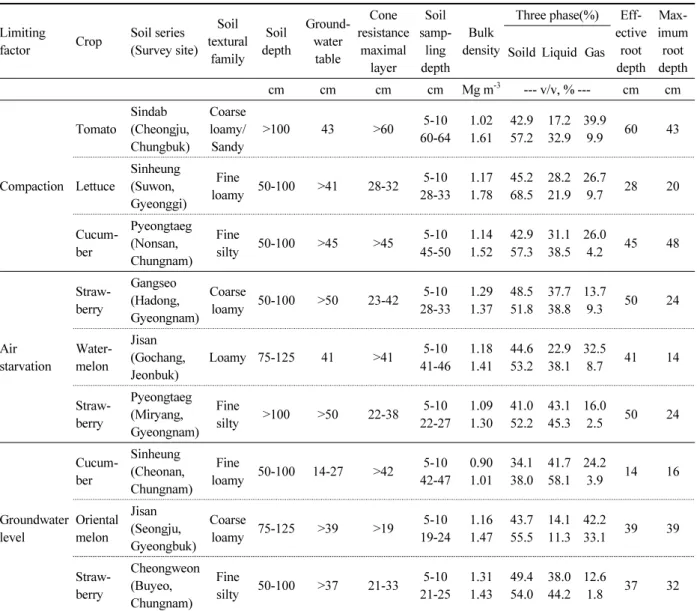
토양물리성을 저해하는 요인을 중심으로 작물별로 실태조사를 한 결과 다음과 같이 뿌리뻗음 제한요인을 3가지로 정리할 수 있었다 (Table 3). 첫 번째 요인으로 다짐이었는데, 용적밀도 1.5 Mg m-3이상의 다짐층 존재시 뿌리뻗음이
Table 3. Soil physical properties and limiting factors of crop root growth in the plastic film house.
Limiting
factor Crop Soil series (Survey site)
Soil textural
family Soil depth
Ground- water
table
Cone resistance
maximal layer
Soil samp- ling depth
Bulk density
Three phase(%) Eff- ective
root depth
Max- imum
root depth Soild Liquid Gas
cm cm cm cm Mg m-3 --- v/v, % --- cm cm
Compaction
Tomato
Sindab (Cheongju, Chungbuk)
Coarse loamy/
Sandy
>100 43 >60 5-10 60-64
1.02 1.61
42.9 57.2
17.2 32.9
39.9
9.9 60 43
Lettuce
Sinheung (Suwon, Gyeonggi)
Fine
loamy 50-100 >41 28-32 5-10 28-33
1.17 1.78
45.2 68.5
28.2 21.9
26.7
9.7 28 20
Cucum- ber
Pyeongtaeg (Nonsan, Chungnam)
Fine
silty 50-100 >45 >45 5-10 45-50
1.14 1.52
42.9 57.3
31.1 38.5
26.0
4.2 45 48
Air starvation
Straw- berry
Gangseo (Hadong, Gyeongnam)
Coarse
loamy 50-100 >50 23-42 5-10 28-33
1.29 1.37
48.5 51.8
37.7 38.8
13.7
9.3 50 24
Water- melon
Jisan (Gochang, Jeonbuk)
Loamy 75-125 41 >41 5-10 41-46
1.18 1.41
44.6 53.2
22.9 38.1
32.5
8.7 41 14
Straw- berry
Pyeongtaeg (Miryang, Gyeongnam)
Fine
silty >100 >50 22-38 5-10 22-27
1.09 1.30
41.0 52.2
43.1 45.3
16.0
2.5 50 24
Groundwater level
Cucum- ber
Sinheung (Cheonan, Chungnam)
Fine
loamy 50-100 14-27 >42 5-10 42-47
0.90 1.01
34.1 38.0
41.7 58.1
24.2
3.9 14 16
Oriental melon
Jisan (Seongju, Gyeongbuk)
Coarse
loamy 75-125 >39 >19 5-10 19-24
1.16 1.47
43.7 55.5
14.1 11.3
42.2
33.1 39 39
Straw- berry
Cheongweon (Buyeo, Chungnam)
Fine
silty 50-100 >37 21-33 5-10 21-25
1.31 1.43
49.4 54.0
38.0 44.2
12.6
1.8 37 32
제한되었다. 두 번째 요인은 과다관수 또는 배수불량에 의한 공기부족이었다. 시설재배지 조성은 논에 30-100 cm 정 도 객토 및 성토하는 경우 단면 내 불투수층이 형성되거나 배수가 불리한 조건이 된다. 또한 일반 밭과 달리 과다 관수 시 그 영향이 누적되어 공기부족이 나타나기 쉽고 뿌리 활성이 떨어지게 된다. 따라서 다짐층의 용적밀도가 밭 토양의 적정 물리성 기준이 되는 용적밀도 임계치 (1.5 Mg m-3) 이하가 되어도 근권의 통기성이 10% 이하이면 뿌리뻗음 제 한요인으로 작용하였다. 세 번째 제한요인은 지하수층의 깊이 50 cm 이내에 존재유무이다. 50 cm 이내에 지하수층이 존재하였을 때 뿌리뻗음이 제한적이었는데, 지하수위가 이 깊이 이하일 때 기상률이 작아지고 뿌리 호흡에 영향을 미 치기 때문이었다.
Conclusion
본 연구는 시설재배지에 대해서 작물생육을 저해하는 요인을 진단할 수 있는 물리성 지표를 선발하고 시설작물에 따라 적정 토양물리성 기준을 설정하고자 연구를 수행하였다.
시설작물로 상추, 딸기, 오이, 토마토, 수박, 참외 등을 대상으로 2015-2017년에 작물별 주산지에서 유효 근권심, 토성, 용적밀도, 경도 등 토양물리성, pH, EC, 유기물 함량, 유효인산 등 토양화학성을 조사하였다.
시설작물의 뿌리 뻗음 깊이는 작물의 종류나 토성에 상관없이 50 cm 이내이었으나 뿌리 신장을 저해하는 주요 요 인은 용적밀도 1.5 Mg m-3이상의 다짐층, 과다관수에 의한 10% 이하로 공기부족, 50 cm 이내에 지하수층이 존재하 였을 때 뿌리 뻗음이 제한적이었다.
따라서 시설재배지의 토양 물리성 기준은 지하수위 및 최소 유효근권심은 이랑 상부로부터 50 cm 이상이어야 하 며, 유효근권의 조건은 용적밀도 1.5 Mg m-3미만, 기상률 10% 이상이어야 한다.
Acknowledgement
This study was financially supported by a grant from the research project (No.PJ01089903) of National Institute of Agricultural Sciences, Rural Development Administration, Republic of Korea.
References
Akker, J.J.H. and A. Canarache. 2001. Two European concerted actions on subsoil compaction. Landnutzung Landentwicklung 42:15-22.
Allen, R., L.S. Pereira, D. Raes, and M. Smith. 1998. Crop evapotranspiration - Guidelines for computing crop water requirements. FAO Irrigation and Drainage Paper No. 56. Rome, Italy.
Cannell, R.Q. and M.B. Jackson. 1981. Alleviating aeration stress. p. 141-192. In G.f. Arkin and H.M. Talors (ed) Modifying the root environment to reduce crop stress. ASAE. St. Joseph. MI.
HAES. 1986. The effects of soil conditioners on root’s development of rice. Honam Agricultural Environment Station Report. RDA, Iiri, Korea. 1986:566-571.
Hiler, E.A. 1976. Drainage requirements of crops Proc. ASEA, Third national Drainage Symposium. ASAE. p.
127-129.
Horn, R. 2009. Introduction to the special issue about soil management for sustainability. Soil Tillage Res. 102:
165-167.
Levitt, J. 1980. Response of plants to environmental stresses. Academic press. Vol. Ⅱ. 213-224.
Liu, L., Y. Gan, R. Bueckert, and K. Van Rees. 2011. Rooting systems of oilseed and pulse crops. II: vertical distribution patterns across the soil profile. Field Crop Res. 122:248-255.
NAAS. 2008. Study on soil physical properties of soil compaction. Agricultural Environment research Report. RDA, Jeonju, Korea.
NAAS. 2012. Development of water management technique for water saving. Agricultural Environment research Report. RDA, Jeonju, Korea. 2011(2):1138-1215.
NIAS. 2014. Overall Management of Korean Farmland for Green Country Formation. Agricultural Environment Research Report. RDA, Jeonju, Korea. 2013:165-182.
NIAS. 2016. Annual Report 2016 Monitoring Project on Agro-environmental Quality. RDA, Jeonju, Korea.
NIAST. 2000. Methods of soil chemical analysis. National Institute of Agricultural Science and Technology, RDA, Suwon, Korea.
Plamenac, N. 1988. Effects of subsurface drainage on heavy hydromorphic soil in the Nelindvor area, Yugoslavia.
AWM. 14: 19-27.
Raes, D. 2002. BUDGET, a soil water and salt balance model, version 5.0. K.U. Leuven, Faculty of Agricultural and Applied Biological Sciences, Institute for Land and Water Management, LEUVEN, Belgium.
Raper, R.L. 2005. Agricultural traffic impacts on soil. J. Terramech. 42:259-280.
Reicosky, D.C., R.J. Millington, A. Klute, and D.B. Reters. 1972. Patterns of water uptake and root distribution of soyabeans (Glycine max) in presence of a water table. Agron. J. 64:292-297.
Russel, R.S. 1977. Plan root systems: their functions and interaction with the soil. New York, Mc GrawHill.
Schaffer, B., M. Stauber, R. Muller and R. Schulin. 2007. Changes in he macro-pore structure of restored soil caused by compaction beneath heavy agricultural machinery: a morphometric study. Eur. J. Soil Sci. 58:1062-1073.
Seong, M.H., J.H. Lim, J.J. Nor, T.B. Kim, G.T. Jung, H.G. Chon, and J.M. Kim. 2012. Effect of furrow compaction on the watermelon quality in green house in the early spring. Hortic. Sci. Technol. 30:66-66.
Statistics Korea. 2015. Agricultural area Statistics. Gangmun. Daejeon. Korea.
Zhang, Y.S., K.H. Han, K.H. Jung, H.R. Cho, M.J. Seo, and Y.K. Sonn. 2017. Study on the standards of proper effective rooting depth for upland crops. Korean J. Soil Sci. Fert. 50(1):21-30.