http://dx.doi.org/10.5468/ogs.2015.58.6.481 pISSN 2287-8572 · eISSN 2287-8580
Introduction
Endometriosis is a chronic inflammatory gynecologic disease associated with chronic pelvic pain and infertility. The current treatment of endometriosis includes both medical and surgical methods. For women with moderate to severe endometriosis who hope to preserve fertility and conceive, conservative sur- gery is commonly chosen as a primary treatment. However, conservative surgery cannot often eradicate the disease and recurrence of endometriosis is common. Recurrence rate of
Effect of second-line surgery on in vitro fertilization
outcome in infertile women with ovarian endometrioma recurrence after primary conservative surgery for
moderate to severe endometriosis
Hana Park, Chung-Hoon Kim, Eun-Young Kim, Jei-Won Moon, Sung-Hoon Kim, Hee-Dong Chae, Byung-Moon Kang
Division of Reproductive Endocrinology and Infertility, Department of Obstetrics and Gynecology, University of Ulsan College of Medicine, Asan Medical Center, Seoul, Korea
Objective
To evaluate the effect of second-line conservative surgery on in vitro fertilization (IVF) outcome in comparison with IVF without second-line surgery in infertile women with ovarian endometrioma recurrence after primary conservative surgery.
Methods
In this retrospective cohort study, 121 consecutive IVF/intracytoplasmic sperm injection cycles that were performed after second-line surgery (n=53) or without second-line surgery (control group, n=68) between January 2006 and December 2011 in 121 infertile women with ovarian endometrioma(s) recurrence after primary conservative surgery for moderate to severe endometriosis were included. The two groups were compared in terms of controlled ovarian stimulation and IVF outcomes.
Results
There were no differences in patients’ characteristics between the two groups. Total dose and days of gonadotropins administered were significantly higher in the second-line surgery group than in the control group (P<0.001, P=0.008). The numbers of oocytes retrieved, mature oocytes and grade 1 or 2 embryos were significantly lower in the second-line surgery group (P=0.007, P=0.001, P<0.001, respectively). Clinical pregnancy rate per cycle and embryo implantation rate were also significantly lower in the second-line surgery group of 24.5% and 11.8% compared with 48.5% and 25.3% in the control group (P=0.008, P=0.005, respectively).
Conclusion
Ovarian response to controlled ovarian stimulation and IVF outcome after second-line surgery is worse than those in IVF cycles without second-line surgery in infertile women with ovarian endometrioma recurrence after primary surgery for moderate or severe endometriosis.
Keywords: Endometrioma recurrence; Endometriosis; Fertilization in vitro; Second-line surgery
Received: 2015.6.3. Revised: 2015.6.25. Accepted: 2015.6.25.
Corresponding author: Chung-Hoon Kim
Division of Reproductive Endocrinology and Infertility, Department of Obstetrics and Gynecology, University of Ulsan College of Medicine, Asan Medical Center, 88 Olympic-ro 43-gil, Songpa-gu, Seoul 05505, Korea
Tel: +82-2-3010-3639 Fax: +82-2-3010-6944 E-mail: [email protected]
Articles published in Obstet Gynecol Sci are open-access, distributed under the terms of the Creative Commons Attribution Non-Commercial License (http://creativecommons.
org/licenses/by-nc/3.0/) which permits unrestricted non-commercial use, distribution, and reproduction in any medium, provided the original work is properly cited.
Copyright © 2015 Korean Society of Obstetrics and Gynecology
endometriosis after primary surgery has been reported as high as 30% to 50% within 5 years after surgery [1,2]. In women seeking pregnancy, management of recurrent ovarian en- dometrioma is particularly one of clinical dilemmas, because surgical intervention can cause further damage to the already devastated ovarian tissue, thereby decreasing the ovarian re- serve and reproductive performance significantly. Actually the pregnancy rate after second-line surgery for endometriosis has been reported to be almost half that after primary surgery [3,4].
The European Society of Human Reproduction and Embryol- ogy (ESHRE) guidelines in 2014 reported that cystectomy of ovarian endometrioma larger than 3 cm prior to treatment with assisted reproductive technology in infertile women does not improve pregnancy rates [5]. Nevertheless, the effect of ovarian endometrioma and previous surgical treatment for that before in vitro fertilization (IVF) treatment is still contro- versial. Moreover, the effect of second-line surgery prior to IVF treatment in infertile women with ovarian endometrioma recurrence remains open for debate. The ESHRE guidelines also recommended that the decision to proceed with surgery should be considered carefully if the woman has had previ- ous ovarian surgery [5]. However, there are no well-designed controlled studies if second-line surgery for recurrent ovarian endometrioma before IVF has a beneficial or deleterious effect on ovarian response to controlled ovarian stimulation (COS) and IVF outcome. Therefore, we performed this study to in- vestigate the effect of second-line conservative surgery on IVF outcome as compared with IVF without second-line surgery in infertile women with ovarian endometrioma recurrence after primary surgery.
Materials and methods
1. Patients
The present retrospective cohort study included 121 con- secutive IVF/intracytoplasmic sperm injection (ICSI) cycles that were performed in 121 infertile women with ovarian endometrioma(s) recurrence after primary conservative surgery for moderate to severe endometriosis between January 2005 and December 2011. Of 121 subjects, 53 patients underwent second-line surgery before IVF (second-line surgery group) and 68 patients underwent IVF treatment without second-line sur- gery (control group).
This study was approved by the institutional review board of the University of Ulsan College of Medicine, Asan Medical Center (IRB no. 2013-1090). The clinical information was ob- tained by chart review. If patients underwent two or more IVF/
ICSI cycles after endometrioma recurrence during the study period, only the charts corresponding to the 1st IVF/ICSI cycle after endometrioma recurrence were reviewed and analyzed.
All subjects were between 28 and 41 years of age at the time of IVF treatment included in this study, and they had reg- ular ovulatory cycles of 24 to 35 days in length and body mass index between 18 and 25 kg/m². In addition, they underwent primary conservative surgery for infertility with moderate to severe endometriosis within 5 years prior to IVF treatment in- cluded in this study and endometrioma was confirmed patho- logically at the time of primary surgery. After primary surgery, all patients included in this study failed to be pregnant and had recurrent ovarian endometriomas with a mean diameter of >3 cm that were diagnosed by transvaginal ultrasonogra- phy. Twenty-six of 53 women in the second-line surgery group and 35 of 68 women in the control group had undergone IVF treatment before ovarian endometrioma recurrence. Infertile women who had received more than 2 cycles of IVF before ovarian endometrioma recurrence were excluded from this study. Patients who had current endocrine abnormalities such as polycystic ovary syndrome and diabetes mellitus, history of previous hospitalization due to severe ovarian hyperstimula- tion syndrome, or history of previous (within 12 months) or current abuse of alcohol or drugs were also excluded from the present study.
Patients who did not achieve spontaneous pregnancy within 12 months from second-line surgery and/or had recurrent ovarian endometrioma >3 cm after second-line surgery under- went IVF/ICSI and they were included in the second-line sur- gery group. During the study period, 80 infertile women who met the inclusion and exclusion criteria underwent second- line surgery for recurrent ovarian endometrioma(s) and only five (6.3%) of them were spontaneously pregnant within 12 months after second-line surgery. Of 75 patients who failed to achieve spontaneous pregnancy within 12 months after second-line surgery, 53 infertile women received IVF treatment in our hospital and they were followed up and therefore in- cluded in the second-line surgery group of the present study.
Twenty-three patients (43.4%) of 53 included in the second-
line surgery group had recurrent ovarian endometriomas >3
cm in a mean diameter after follow-up of 24 months follow-
ing second-line surgery. Patients included in the control group underwent IVF without any surgical intervention for ovarian endometrioma recurred after primary surgery.
2. COS and IVF treatment
Gonadotropin releasing hormone (GnRH) agonist long pro- tocol or GnRH antagonist protocol was used for COS in all subjects. In the GnRH agonist long protocol, daily injection of a GnRH agonist 1 mg (leuprorelin acetate; Lorelin, Dong- kook, Seoul, Korea) was initiated from the midluteal phase of the preceding menstrual cycle and was continued at least for 14 days, followed by a dose reduction to 0.5 mg daily.
GnRH agonist 0.5 mg was continued daily up to day of hu- man chorionic gonadotropin (hCG) injection. Ovarian stimula- tion was started with 150 to 300 IU of recombinant human follicle-stimulating hormone (rhFSH; Gonal-F, Merck Serono SA, Geneva, Switzerland) after establishing ovarian and uter- ine quiescence using vaginal ultrasound. The rhFSH dose was adjusted every 3 to 4 days according to the ovarian response.
A recombinant hCG (rhCG; Ovidrel, Merck Serono SA) of 250 μg was injected to induce follicular maturation when one or more follicles reached a mean diameter of ≥18 mm. Oocyte retrieval was performed 35 to 36 hours after hCG injection, and one to three embryos were transferred into the uterus on the third day after oocyte retrieval. Vaginal progesterone gel (Crinone 8% 90 mg, Merck Serono SA) once daily was admin- istrated from the day of oocyte retrieval for luteal support.
In the GnRH antagonist protocol, ovarian stimulation was commenced with 150 to 300 IU of rhFSH, from the third day of menstruation after establishing ovarian and uterine quies- cence by using transvaginal ultrasound. The rhFSH dose was adjusted every 3 to 4 days according to the ovarian response.
When the lead follicle reached a mean diameter of 13 to 14 mm, GnRH antagonist cetrorelix (Cetrotide, Merck Serono SA) at a dose of 0.25 mg/day was started and continued daily up to the day of hCG administration. When one or more follicles reached 18 mm or more in a mean diameter, a single subcuta- neous bolus of 250 µg rhCG (Ovidrel, Merck Serono SA) was administered simultaneously with GnRH agonist 0.1 mg (De- capeptyl, Ferring, Malm ö, Sweden). Oocyte retrieval and luteal support were performed in same manner with GnRH agonist long protocol.
After IVF or ICSI, one to three embryos were transferred into the uterus on the third day after oocyte retrieval. All patients received 90 mg of vaginal progesterone gel (Crinone gel 8%,
Merck Serono SA) once daily from the day of oocyte retrieval for luteal phase support. The β-hCG serum levels were mea- sured 11 days after embryo transfer. The β-hCG serum levels were measured by radioimmunoassay using a hCG MAIA clone kit (Serono Diagnostics, Woking, UK) with interassay and intraassay variances of <10% and 5%, respectively. Clini- cal pregnancy was defined as the presence of a gestational sac by ultrasonography, while miscarriage rate per clinical pregnancy was defined as the proportion of patients who failed to continue development before 20 weeks of gestation in all clinical pregnancies.
3. Statistical analysis
Mean values were expressed as mean±standard deviation.
Student’s t-test was used to compare mean values. Chi-square test and Fisher’s exact test were used to compare fraction.
Statistical significance was defined as P<0.05. All analyses were performed by using SPSS ver. 11.0 (SPSS Inc., Chicago, IL, USA).
Results
The second-line surgery and control groups were comparable with respect to patients’ characteristics such as the age of patients, infertility duration, body mass index and the pro- portions of nullipara and patients who have undergone IVF before endometrioma recurrence was found after primary sur- gery (Table 1). However, total antral follicle count and serum anti-M üllerian hormone levels were significantly lower in the second-line surgery group than in the control group (P=0.002, P<0.001, respectively). The period from primary surgery to IVF treatment analyzed for this study was significantly longer in the second-line surgery group of 34.1±9.6 months compared with 24.2±8.5 months of the control group (P<0.001). The size of endometrioma on the day of oocyte retrieval was sig- nificantly smaller in the second-line surgery group (P<0.001) (Table 1).
Total dose and days of gonadotropins administered were
significantly higher in the second-line surgery group than in
the control group (P<0.001, P=0.008, respectively). The num-
bers of oocytes retrieved, mature oocytes, fertilized oocytes,
grade 1 or 2 embryos and frozen 2 pronucleus embryos were
significantly lower in the second-line surgery group (P=0.007,
P=0.001, P=0.001, P<0.001, P=0.003, respectively). Clinical
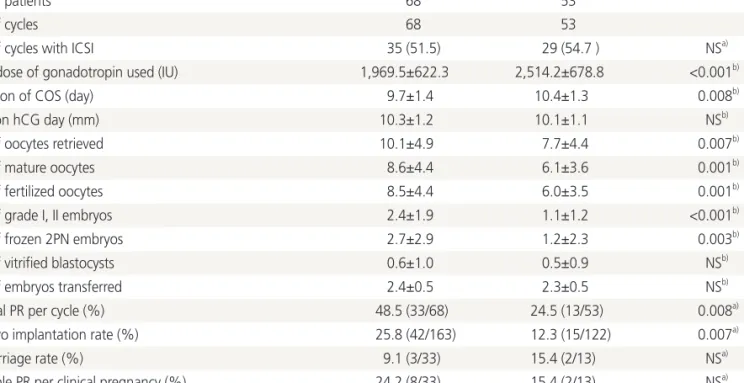
pregnancy rate per cycle and embryo implantation rate were also significantly lower in the second-line surgery group of 24.5% and 12.3% compared with 48.5% and 25.8% in the control group (P=0.008, P=0.007, respectively) (Table 2).
Discussion
Endometriosis is a troublesome disease that seriously compro- mises the female fertility and has high likelihood of recurrence after surgical treatment. The cumulative recurrence rate of endometriosis after conservative surgery has been recognized to be high and increase as the follow-up period gets longer [1-3]. The recurrence rates of pain and endometrioma after second-line surgery have been reported to be also comparable with those after primary surgery [6]. Ovarian endometrioma resection may be deleterious to residual oocyte and hormone function [7,8] and the overall pregnancy rate observed after a conservative surgery has been reported to be decreased [9].
Moreover, second-line surgery for endometrioma recurrence
can worsen the reproductive performance [10,11]. It has been reported that cumulative pregnancy rate after second- line surgery for recurrent endometriosis is significantly lower than those obtained after primary surgery [3,4]. Also the present study showed that 12-month cumulative spontane- ous pregnancy rate after second-line surgery for recurrent endometrioma is only 6.3%. These results suggest that infer- tile women who undergo second-line surgery for recurrent ovarian endometrioma are very likely to receive IVF treatment for pregnancy. Therefore the effect of second-line surgery on IVF outcome is one of our great concerns. However, it is hard to find the well-controlled studies that investigated the impact of second-line surgery for recurrent ovarian endometrioma on IVF outcome.
In our study, ovarian response to COS after second-line surgery was significantly worse than that after primary sur- gery alone, although the size of endometrioma on the day of oocyte retrieval was significantly smaller in the second-line surgery group. Clinical pregnancy rate per cycle and embryo implantation rate were also significantly lower in the secon-
Table 1. Characteristics of patientsControl Second-line surgery P-value
No. of patients 68 53
Age of patients (yr) 36.0±3.4 36.9±3.0 NSa)
Age of husbands (yr) 40.1±4.8 41.3±5.1 NSa)
Infertility duration (mo) 48.4±18.5 46.1±15.1 NSa)
Body mass index (kg/m2) 21.7±1.5 21.9±1.7 NSa)
No. of nullipara 38 (55.9) 30 (56.6) NSb)
Patients who have undergone IVF
before endometrioma recurrence 35 (51.5) 26 (49.1) NSb)
Period from primary surgery to IVF after
endometrioma recurrence (mo) 24.2±8.5 34.1±9.6 <0.001a)
Mean diameter of endometrioma on the day of oocyte
retrieval (mm) 63.4±20.8 36.4±16.5 <0.001a)
Antral follicle count 8.6±4.3 6.0±3.4 0.002a)
Basal serum FSH (IU/L) 7.6±1.8 7.9±1.6 NSa)
Serum AMH (pg/mL) 2.3±1.4 1.5±0.9 <0.001a)
COS protocol
GnRH agonist long protocol 52 (76.5) 38 (71.7) NSb)
GnRH antagonist protocol 16 (23.5) 15 (28.3) NSb)
Values are mean±standard devition or number (%).
NS, not significant; IVF, in vitro fertilization; FSH, follicle stimulating hormone; AMH, anti-Müllerian hormone; COS, controlled ovarian stimula- tion; GnRH, gonadotropin releasing hormone.
a)Student’s t-test; b)Chi-square test.
d-line surgery group. It is thought that primary cause of these results is a serious reduction of ovarian reserve by further detriment to already damaged ovarian tissue. Significantly lower antral follicle count and serum anti-Müllerian hormone levels in the second-line surgery group that were shown in this study support our hypothesis. In addition, recurrent endome- triosis after primary surgery may exhibit particularly aggressive charactericstics and therefore, repeated surgery is more likely to damage the surrounding tissue of ovarian endometrioma, thereby leading to more severe and extensive adhesion arou- nd ovaries. These changes can result in the decrease of blood perfusion to the ovary, thereby worsening the ovarian respon- se to COS. Another reason for deterioration of ovarian res- ponse to COS in the second-line surgery group can be further decrease of ovarian reserve by delayed trial of IVF. Actually, the period from primary surgery to 1st IVF cycle after endometrio- ma recurrence in this study was significantly longer in the se- cond-line surgery group. For these reasons, many women who underwent second-line surgery for recurrent endometrioma appears to be finally need IVF treatment for getting pregnant.
In conclusion, our study demonstrated that ovarian re- sponse to COS and IVF outcome after second-line surgery is substantially worse than those in IVF cycles without second- line surgery in infertile women with ovarian endometrioma recurrence after primary surgery for moderate or severe endo- metriosis. Second-line surgery for recurrent ovarian endome- triomas may give an adverse effect rather than any beneficial effect on IVF outcome. Therefore, second-line surgery should be determined carefully in infertile women with recurrent en- dometrioma after primary surgery and IVF treatment should be considered as an alternative to second-line surgery.
However, our study has a limitation to evaluate the effect of second-line surgery for recurrent endometrioma due to a small number of subjects available and their heterogenous characteristics due to its retrospective nature. Therefore, well- designed controlled trials are required to confirm the results of our present study.
Table 2. Comparison of COS results and IVF/ICSI outcome
Control Second-line surgery P-value
No. of patients 68 53
No. of cycles 68 53
No. of cycles with ICSI 35 (51.5) 29 (54.7 ) NSa)
Total dose of gonadotropin used (IU) 1,969.5±622.3 2,514.2±678.8 <0.001b)
Duration of COS (day) 9.7±1.4 10.4±1.3 0.008b)
EMT on hCG day (mm) 10.3±1.2 10.1±1.1 NSb)
No. of oocytes retrieved 10.1±4.9 7.7±4.4 0.007b)
No. of mature oocytes 8.6±4.4 6.1±3.6 0.001b)
No. of fertilized oocytes 8.5±4.4 6.0±3.5 0.001b)
No. of grade I, II embryos 2.4±1.9 1.1±1.2 <0.001b)
No. of frozen 2PN embryos 2.7±2.9 1.2±2.3 0.003b)
No. of vitrified blastocysts 0.6±1.0 0.5±0.9 NSb)
No. of embryos transferred 2.4±0.5 2.3±0.5 NSb)
Clinical PR per cycle (%) 48.5 (33/68) 24.5 (13/53) 0.008a)
Embryo implantation rate (%) 25.8 (42/163) 12.3 (15/122) 0.007a)
Miscarriage rate (%) 9.1 (3/33) 15.4 (2/13) NSa)
Multiple PR per clinical pregnancy (%) 24.2 (8/33) 15.4 (2/13) NSa)
Values are mean±standard devition unless otherwise indicated.
COS, controlled ovarian stimulation; IVF, in vitro fertilization; ICSI, intracytoplasmic sperm injection; NS, not significant; EMT, endometrial thick- ness; hCG, human chorionic gonadotropin; PN, pronucleus; PR, pregnancy rate.
a)Chi-square test or Fisher’s exact test; b)Student’s t-test.