https://doi.org/10.5468/ogs.2017.60.1.87 pISSN 2287-8572 · eISSN 2287-8580
Introduction
The loop electrosurgical excisional procedure (LEEP) is the preferred excisional procedure for higher-grade cervical in- traepithelial neoplasia (CIN) and is used to simultaneously diagnose and treat patients [1]. Among conization modalities, there is no superior surgical technique for eradicating CIN and residual disease after the procedure [2]. However, because LEEP produces less hindered pathologic specimens and causes fewer complications, it has become more popular compared
Delayed hemorrhage effect of local anesthesia with epinephrine in the loop electrosurgical excisional procedure
Yong Jae Lee, Yunjin Park, In Ok Lee, Jung Won Yoon, Jung Yoon Lee, Sang Wun Kim, Sunghoon Kim, Young Tae Kim, Eun Ji Nam
Institute of Women's Life Medical Science, Women’s Cancer Clinic, Department of Obstetrics and Gynecology, Yonsei University College of Medicine, Seoul, Korea
Objective
The aim of this study was to investigate factors preventing delayed hemorrhage after the loop electrosurgical excisional procedure (LEEP).
Methods
Medical records of patients who underwent LEEP at one university affiliated hospital from October 2013 to January 2015 were reviewed. Patients with or without delayed hemorrhage were classified. LEEP was performed either in an operating room under general anesthesia or in a procedure room with local anesthesia in the outpatient clinic. Delayed hemorrhage was defined as excisional site bleeding occurring between 1 and 30 days after the LEEP requiring intervention such as electro-cauterization, gauze packing, or application of another hemostatic agent.
Results
During the study period, 369 patients underwent LEEP. Twenty-three (6.2%) patients with delayed hemorrhage returned to our hospital either to the outpatient clinic or to the emergency unit. A third of the population (103, 27.9%) underwent LEEP in the operating room under general anesthesia without injection of local anesthesia. The remaining patients (266, 72.1%) underwent LEEP with local anesthesia (lidocaine HCl 2% with epinephrine 1:100,000) in the office procedure room. Patients given local anesthesia including epinephrine had significantly lower delayed hemorrhage compared to patients with general anesthesia without injection of local anesthesia (P=0.001). Hemostats, such as fibrin glue or patch, were used for the majority of patients (346, 93.8%) during the procedure. However, using hemostats was not statistically associated with delayed hemorrhage (P=0.163).
Conclusion
Local anesthesia with the powerful vasoconstrictor epinephrine is effective not only to control perioperative bleeding, but also to prevent delayed hemorrhage after LEEP.
Keywords: Anesthesia, local; Delayed hemorrhage; Loop electrosurgical excisional procedure
Articles published in Obstet Gynecol Sci are open-access, distributed under the terms of the Creative Commons Attribution Non-Commercial License (http://creativecommons.
org/licenses/by-nc/3.0/) which permits unrestricted non-commercial use, distribution, and reproduction in any medium, provided the original work is properly cited.
Copyright © 2017 Korean Society of Obstetrics and Gynecology Received: 2016.5.23. Revised: 2016.7.31. Accepted: 2016.9.8.
Corresponding author: Eun Ji Nam
Department of Obstetrics and Gynecology, Yonsei University College of Medicine, 250 Seongsan-ro, Seodaemun-gu, CPO Box 8044, Seoul 03722, Korea
Tel: +82-2-2228-2230 Fax: +82-2-313-8357 E-mail: [email protected]
http://orcid.org/0000-0003-0189-3560
to cold knife or laser conization since the 1990s [1]. The most important advantage of LEEP compared to other modalities is that it can be performed in an ambulatory setting [1,2]. LEEP could ultimately lower the medical cost of treating CINs.
Delayed hemorrhage is the complication of most concern after LEEP not only for the patient but also for the physician, since it results in an unscheduled return to the clinic or some- times to an emergency room. Of course, additional medical costs and efforts would thus be necessary. Oyesanya et al.
[3] reported less intraoperative bleeding resulting from LEEP compared to cold knife conization (3.3±2.8 vs. 79.1±74.6 mL) (P<0.01). Even though immediate procedural bleeding decreases, a number of patients still return to the clinic after LEEP to control delayed excisional site bleeding.
In several studies, general complications after conization have been discussed such as perioperative bleeding, delayed hemorrhage, infection, vaginal discharge, cervical stenosis, and consequent obstetric outcomes [4-6]. Regarding hemor- rhagic complications after cold knife conization, a meta-analy- sis identified that injection of vasopressin or using tranexamic acid may decrease perioperative bleeding [7]. However, there is limited data demonstrating delayed hemorrhage after LEEP.
Thus, in this study, we attempted to investigate factors pre- venting delayed hemorrhage after LEEP.
Materials and methods
This is a retrospective cohort study of a population of patients
diagnosed with CIN who underwent LEEP at the Severance Hospital, Yonsei University, from October 2013 to January 2015. LEEP was performed by five different gynecologic oncologists. The procedure sometimes was performed in an operation room under general anesthesia for various reasons such as the extent of cervical lesions, difficulty in exposure of the cervix in an ambulatory setting, patient preference, and so on. For procedures performed in the operating room, the in- jection of local anesthesia was omitted, since the patient was under general anesthesia. In the ambulatory setting, LEEPs were performed under local anesthesia in the outpatient clinic procedure room (Fig. 1). Ball tip electrocauterization was rou- tinely performed to prevent both bleeding and to destroy any possible residual lesions. Suturing hemostasis has not been done in order to avoid any long-term complications, especially cervical stenosis, in any of the patients. Different hemostats were used depending on the amount of perioperative hemor- rhage. Irrespective of whether the procedure was performed in the operation room or in outpatient procedure room, all patients were discharged after recovering from pain and be- ing checked for post-operative hemorrhage. All patients were prescribed antibiotics after the procedure to prevent excisional site infection.
Age, parity, medical history related to hemorrhagic tendency of the patients, and indications for conization were collected from the medical records. Hemostats used and final patho- logic diagnoses were also reviewed. Delayed hemorrhage was defined as hemorrhage which occurred between 1 and 30 days after the LEEP and required interventions such as electro- cauterization, gauze packing, or application of another he- mostatic agent. Multivariate analysis was performed with variables that considered significant in univariate analysis. A P- value of <0.05 was considered statistically significant.
Results
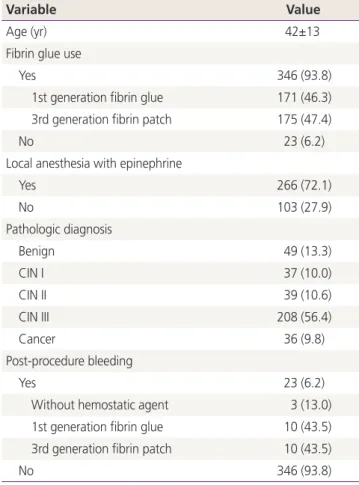
A total of 369 patients underwent LEEP during the study period. Overall 23 (6.2%) patients returned to the clinic or the emergency room because of delayed hemorrhage. The clinicopathological characteristics of the patients included in this study are listed in Table 1. A third of the population (103, 27.9%) underwent LEEP in the operation room under general anesthesia without injection of local anesthesia, the remaining patients (266, 72.1%) underwent LEEP with local anesthesia Fig. 1. Local anesthesia injection site of cervix.
(lidocaine HCl 2% with epinephrine 1:100,000) in the office procedure room. Among the delayed hemorrhage patients, 13 patients underwent LEEP in the operation room, and 10 patients underwent LEEP in the office. Hemostats, such as
fibrin glue or patch, were used for the majority of patients (346, 93.8%) for the procedure. Patients treated with the first generation fibrin glue were 171, while 175 patients were treated with the third generation fibrin sealant. The number of patients with delayed hemorrhage in each hemostatic group or without hemostat were as follows: 3 (13%) for the no hemostatic agent group; 10 (5.8%) for the first generation fibrin glue group; and 10 (5.8%) patients treated with the third generation fibrin sealant group.
Univariate and multivariate analyses of delayed hemorrhage in all patients are shown in Table 2. The multivariated analysis of delayed hemorrhage identified an injection of local anes- thesia including epinephrine resulted in significantly lower de- layed hemorrhage compared to LEEP without local anesthesia injection (P=0.02). However, using hemostats, regardless of types, did not have statistically significant effect on delayed hemorrhage but may be considered as a tendency toward significance. (P=0.061). Furthermore, age and the pathologic diagnosis did not differ significantly between the groups (P=0.256 and 0.228, respectively).
Discussion
From this study, epinephrine, a powerful vasoconstrictor, com- bined with local anesthesia reduced the incidence of delayed hemorrhage after LEEP. Vasoconstrictors such as vasopressin have been known to lower perioperative hemorrhage from knife cone biopsy. The major complication of the procedure is postoperative bleeding for which 5% to 20% of patients will require secondary procedures. A variety of technics and
Table 2. Univariate and multivariate analysis of various factors for delayed hemorrhage
No. of patients Univariate analysis (P) Multivariate analysis (P)
Age (yr, continuous) 369 0.256 -
Hemostatic agent
Yes 346 0.041 0.061
No 23 - -
Local anesthesia with epinephrine
Yes 266 0.02 0.02
No 103 - -
Pathologic diagnosis
Benign/CIN I 125 0.228 -
CIN II-III/cancer 244 - -
CIN, cervical intraepithelial neoplasia.
Table 1. Clinicopathological characteristics
Variable Value
Age (yr) 42±13
Fibrin glue use
Yes 346 (93.8)
1st generation fibrin glue 171 (46.3) 3rd generation fibrin patch 175 (47.4)
No 23 (6.2)
Local anesthesia with epinephrine
Yes 266 (72.1)
No 103 (27.9)
Pathologic diagnosis
Benign 49 (13.3)
CIN I 37 (10.0)
CIN II 39 (10.6)
CIN III 208 (56.4)
Cancer 36 (9.8)
Post-procedure bleeding
Yes 23 (6.2)
Without hemostatic agent 3 (13.0)
1st generation fibrin glue 10 (43.5)
3rd generation fibrin patch 10 (43.5)
No 346 (93.8)
V alues are presented as mean±standard deviation or number (%).
CIN, cervical intraepithelial neoplasia.
instruments have been introduced to reduce operative blood loss and prevent hemorrhage. One method is to inject vaso- pressin into the cervix before conization. In this study, vaso- pressin was injected circumferentially using a 18- to 20-gauge needle into the cervical stroma. The use of vasopressin before conization reduces the average blood loss by 100 mL [7].
However, there have been few studies examining factors that lower hemorrhage after LEEP. Furthermore, there are almost no reports describing the use of vasoconstrictors to prevent hemorrhage after LEEP.
Thanks to effective screening tools and the natural progres- sion of uterine cervical cancer that although it is the second most common gynecologic cancer in the world, it is diag- nosed at a relatively early stage [8]. However, progressive intraepithelial dysplasia occurring within the transformation zone of the cervix will result in invasive cervical squamous cell carcinoma in the absence of any intervention [9]. After Richart [10] defined the cervical intraepithelial dysplastic lesion as CIN, it has since been graded into three classes and managed ac- cording to its pathological classification. However, due to the subjectivity and poor reproducibility of the pathologic diagno- sis of CIN, the two tiered-low and high-system was defined in 2012 [11]. Regardless of the classifying systems, higher-grade lesions are considered highly premalignant. Thus, excisional therapy for a highly squamous intraepithelial lesion is the treatment of choice to prevent its malignant progression.
LEEP is the most popular excisional therapy for cervical dys- plasia [1]. Excisional therapy of the cervical transformation zone, so called cone biopsy or conization, can be performed using a scalpel, laser, or by electosurgery. Knife conization was generally performed before the introduction of colposcopy [2]. However, knife conization almost always required general anesthesia and was accompanied by various morbidities in- cluding perioperative or delayed hemorrhage, perioperative severe pain, cervical stenosis at follow-up, vaginal discharge, performing site infection, and consequent adverse pregnancy outcomes[5]. Laser conization is usually performed under general anesthesia and produces more artifacts at the exci- sional margin than other excisional procedures. LEEP has been popular since the 1990s, because it could be easily completed with successful treatment outcome and less complications [12-14]. The procedure can be performed under local anes- thesia in an office setting.
Delayed hemorrhage, defined as procedure site bleeding occurring several days after the operation, might be consid-
ered the most troubling complication of LEEP for physicians in outpatient settings. Delayed hemorrhage after LEEP, which usually requires medical assistance, requires both the patient and physician to invest more time and effort for its manage- ment. Thus, even if incidence of delayed hemorrhage after LEEP is relatively lower than that of other conization modali- ties [14], preventing delayed hemorrhage during the proce- dure would help not only physicians during practice, but also patients to improve their recovery. Therefore, we considered that investigating factors preventing delayed hemorrhage af- ter LEEP would provide practical information to physicians in their practice.
To prevent perioperative hemorrhage or delayed hemor- rhage, hemostasis must occur. This can be facilitated by applying hemostatic agents. In our institution, hemostatic agents, such as Beriplast (fibrin sealant containing fibrinogen, factor XIII, and thrombin), TachoComb (aprotinin, collagen, fibrinogen, and thrombin), or TachoSil (collagen, fibrinogen, and thrombin) were applied to the majority patients on the LEEP region during the procedure and used prophylactically against delayed hemorrhage. The prophylactic application of hemostatic agent to the cervical wound after LEEP did not significantly reduce delayed hemorrhage compared with not using hemostats.
Our findings also provide useful information for the gyneco- logic oncologist who often treats microinvasive cervical cancer with LEEP. Local anesthesia could be overlooked and omitted in an operation room using general anesthesia, because the patient would not complain of pain perioperatively and LEEP, itself, could prevent perioperative hemorrhage. However, ac- cording to our findings, local anesthesia with epinephrine could reduce not only perioperative hemorrhage or pain, but also the most concerning long-term complication: delayed hemorrhage.
A limitation of this article is the retrospective nature of the study which precludes the possibility to adjusted parameters such as extent of excision, degree of cauterization for control- ling bleeding during the procedure, inflammation status, and others.
In conclusion, local anesthesia with the addition of a power- ful vasoconstrictor, epinephrine, is effective not only to control perioperative bleeding, but also to prevent delayed hemor- rhage after LEEP.
Conflict of interest
No potential conflict of interest relevant to this article was reported.
Acknowledgements
This research was supported by Basic Science Research Pro- gram through the National Research Foundation of Korea (NRF) funded by the Ministry of Science, ICT & Future Plan- ning (2014R1A1A1A05002926).
References
1. Guntupalli SR, Mutch DG. Abnormal cervical cytology and human papillomavirus. In: Glass RH, Curtis MG, Linares ST, Antoniewicz L. Glass office gynecology. 7th ed. Phila- delphia (PA): Lippincott Williams & Wilkins; 2014. p.83-4.
2. Martin-Hirsch PP, Paraskevaidis E, Bryant A, Dickinson HO. Surgery for cervical intraepithelial neoplasia. Co- chrane Database Syst Rev 2013;(12):CD001318.
3. Oyesanya OA, Amerasinghe C, Manning EA. A compari- son between loop diathermy conization and cold-knife conization for management of cervical dysplasia asso- ciated with unsatisfactory colposcopy. Gynecol Oncol 1993;50:84-8.
4. Luesley DM, McCrum A, Terry PB, Wade-Evans T, Nichol- son HO, Mylotte MJ, et al. Complications of cone biopsy related to the dimensions of the cone and the influence of prior colposcopic assessment. Br J Obstet Gynaecol 1985;92:158-64.
5. Leiman G, Harrison NA, Rubin A. Pregnancy following conization of the cervix: complications related to cone
size. Am J Obstet Gynecol 1980;136:14-8.
6. Luesley D, Shafi M, Finn C, Buxton J. Haemorrhagic morbidity after diathermy loop excision: effect of mul- tiple pre-treatment variables including time of treat- ment in relation to menstruation. Br J Obstet Gynaecol 1992;99:82-3.
7. Martin-Hirsch PP, Bryant A. Interventions for prevent- ing blood loss during the treatment of cervical in- traepithelial neoplasia. Cochrane Database Syst Rev 2013;(12):CD001421.
8. Ferlay J, Bray F, Pisani P, Parkin DM. GLOBOCAN 2009:
cancer incidence, mortality, and prevalence worldwide.
Lyon: IARC Press; 2009.
9. Richart RM, Barron BA. A follow-up study of pa- tients with cervical dysplasia. Am J Obstet Gynecol 1969;105:386-93.
10. Richart RM. Cervical intraepithelial neoplasia. Pathol Annu 1973;8:301-28.
11. Waxman AG, Chelmow D, Darragh TM, Lawson H, Moscicki AB. Revised terminology for cervical histopa- thology and its implications for management of high- grade squamous intraepithelial lesions of the cervix.
Obstet Gynecol 2012;120:1465-71.
12. Prendiville W, Cullimore J, Norman S. Large loop exci- sion of the transformation zone (LLETZ): a new method of management for women with cervical intraepithelial neoplasia. Br J Obstet Gynaecol 1989;96:1054-60.
13. Murdoch JB, Grimshaw RN, Morgan PR, Monaghan JM. The impact of loop diathermy on management of early invasive cervical cancer. Int J Gynecol Cancer 1992;2:129-33.
14. Wright TC Jr, Gagnon S, Richart RM, Ferenczy A. Treat- ment of cervical intraepithelial neoplasia using the loop electrosurgical excision procedure. Obstet Gynecol 1992;79:173-8.