https://doi.org/10.5468/ogs.2020.63.2.195 pISSN 2287-8572 · eISSN 2287-8580
Introduction
Premenstrual syndrome (PMS) affects millions of women in a cyclical fashion, primarily 1 week before menstruation and can last from 1 to 10 days with each menstrual cycle. The ef- fects can be segregated into physical effects, such as cramps, fatigue, acne and fluid retainage, emotional effects such as depression, anxiety, perceived stress, aggression, tension,
Oxaloacetate reduces emotional symptoms in
premenstrual syndrome (PMS): results of a placebo- controlled, cross-over clinical trial
Lisa Tully, PhD
1, John Humiston, MD
2, Alan Cash, MS
31
Nutritional Supplements Division, Energy Medicine Research Institute, Boulder, CO;
2The Center for Health and Wellbeing;
3Terra Biological LLC, San Diego, CA, USA
Objective
Premenstrual syndrome (PMS) affects millions of women. While over-the-counter products have helped with the physical symptoms of PMS, emotional symptoms have been less well supported. The objective of this trial was to measure the effect of an oxaloacetate/vitamin C combination on the major emotional symptoms of PMS, including depression, anxiety, perceived stress, aggression, and suicidal ideation.
Methods
Forty-eight women experiencing PMS completed a baseline survey comprising the Beck’s Depression Inventory, Cohen Perceived Stress Scale, Generalized Anxiety Disorder Test, and Buss-Perry Aggression Questionnaire. After baseline measurements, participants were randomly assigned to take either 2 capsules of 100 mg oxaloacetate/150 mg ascorbic acid, or 2 capsules of rice flour (placebo) for their entire menstrual cycle. At menstruation, the women completed the 4 surveys again. The women then switched capsules in a cross-over design and continued the study for an additional menstrual cycle. The final assessment was repeated at menstruation. Statistical analysis of the 4 surveys was performed to examine efficacy.
Results
Oxaloacetate/vitamin C supplementation during PMS significantly improved depression, perceived stress, anxiety, aggression, and suicidal ideation. The mean improvement in depression was 54.1%, 35.8% for perceived stress, 51.43% for generalized anxiety, and 17.8% for aggression. Suicidal ideation was reduced by 47.9%. All results were highly significant.
Conclusion
A combination of oxaloacetate and vitamin C supplementation helped to alleviate depression, anxiety, perceived stress, aggression, and suicidal ideation symptoms associated with PMS.
Trial Registration
Clinical Research Information Service Identifier: NCT03509714
Keywords: Oxaloacetate; Premenstrual syndrome; Depression; Anxiety; Suicidal ideation
Received: 2019.05.09. Revised: 2019.07.07. Accepted: 2019.11.04.
Corresponding author: Alan Cash, MS
Terra Biological LLC, 3830 Valley Centre Drive, Suite 705 PMB 561, San Diego, CA 92130, USA
E-mail: [email protected] https://orcid.org/0000-0003-1916-960X
Articles published in Obstet Gynecol Sci are open-access, distributed under the terms of the Creative Commons Attribution Non-Commercial License (http://creativecommons.
org/licenses/by-nc/3.0/) which permits unrestricted non-commercial use, distribution, and reproduction in any medium, provided the original work is properly cited.
Copyright © 2020 Korean Society of Obstetrics and Gynecology
lethargy, insomnia, and poor coordination in concentration, and mental disorders, such as the feeling of being reluctant toward oneself and being suppressed [1,2]. While there are many existing products for the physical effects of PMS, devel- opment of over-the-counter options for emotional symptoms has received less attention. Common complaints among those experiencing PMS include mood changes, depression, anxiety, perceived stress, and aggression.
The objective of this study was to examine emotional is- sues in PMS, and how they can be potentially improved with oral supplementation with a mix of the metabolite, “oxalo- acetate” and vitamin C (ascorbic acid). Of particular inter- est was the treatment of the depression, anxiety, perceived stress, and aggression in PMS. These emotional states were selected due to the availability of validated measurement tools that could be used in a self-administered survey [3-8].
These validated measurement tools were modified for the subjects to only consider the 7 days before menstruation, to capture their effect on PMS in an on-line format that mirrors the Beck’s Depression Inventory, Cohen’s Perceived Stress, Generalized Anxiety Disorder, and Buss-Perry Aggression Scale surveys.
Oxaloacetate is an energy metabolite found in every cell of the human body. It holds a key place in the Krebs cycle with- in the mitochondria, is a critical early metabolite in gluco- neogenesis, amino acid and fatty acid synthesis, and is found in the urea cycle. It is critical to human metabolism, proper cellular function, and is central to energy production and use in the body. In addition, oxaloacetate may affect emotional symptoms through multiple mechanisms. During PMS, there is a large increase in glucose utilization in the cerebellum of women who are affected by emotional mood swings [9]. The cerebellum plays key roles in motor control, attention, and regulating fear and pleasure responses [10]. Individuals with bipolar depression have been shown to exhibit an increased demand for glucose in the cerebellum, similar to patients with severe emotional PMS symptoms [11-14]. Shortages of glucose in the cerebellum during PMS, therefore, may be a causal factor in emotional issues. Women with emotional symptoms during PMS exhibit an increased desire for sug- ary/fatty foods such as chocolate [15]. While binge eating of sugar and fats brings some relief to the emotional symptoms of PMS [16,17], it can also cause worsening of these PMS- related symptoms after glucose levels in the body fall.
Oxaloacetate supplementation has been shown to sup-
port adequate glucose levels in the body [18,19]. In addition, oxaloacetate is a key metabolite in gluconeogenesis—the production of glucose when needed by the body [20]. An excess of oxaloacetate enables gluconeogenesis to occur on demand, thereby fueling the brain, and potentially meeting glucose needs in the cerebellum.
In addition to the ability of oxaloacetate to support proper glucose regulation, oxaloacetate affects 2 chemicals in the brain, gamma-amino butyric acid (GABA) and glutamate.
Altering the GABA/glutamate ratio has been shown to be as- sociated with other emotional conditions such as autism and schizophrenia spectra [21]. Clinical work has also tied GABA and glutamate concentrations to emotional processing [22].
The GABA/glutamate ratio may also play a major role in the emotional symptoms of PMS. Oxaloacetate supplementation can reduce glutamate levels in the brain via a process known as “glutamate scavenging” [23,24]. In addition, oxaloacetate supplementation has been shown to increase GABA levels in animal models [25]. By both lowering glutamate and increas- ing GABA levels, the GABA/glutamate ratio is altered, which may also help to alleviate emotional symptoms experienced by women during PMS.
Before the clinical trial, we noted multiple cases in which a mix of oxaloacetate/vitamin C supplementation resulted in a marked reduction in PMS-related aggression, depression, anxiety, and stress in women who attended our private prac- tice. The combination of these individual clinical cases, and the functional ability of oxaloacetate to support proper glu- cose function and influence the GABA/glutamate ratio in the brain, which may exacerbate PMS, prompted us to conduct a formalized clinical trial to investigate the use of oxaloacetate supplementation to treat emotional symptoms during PMS.
Due to the unstable nature of oxaloacetate, it was combined with ascorbic acid (vitamin C) to increase its stability at room temperature [26].
To our knowledge, this is the first report to describe the use of the metabolite oxaloacetate and vitamin C to significantly reduce emotional symptoms of depression, anxiety, perceived stress, and aggression in women experiencing PMS.
Materials and methods
Institutional review board approval was obtained for this
study. All subjects were recruited and participated in the trial
via the Internet. Subjects between 18 and 50 years of age, who believed they experienced emotional symptoms related to PMS (i.e., depression, perceived stress, general anxiety, or aggression), were selected for the trial. Women with diag- noses of premenstrual dysphoric disorder (PMDD) or general depression were specifically excluded because the United States Food & Drug Administration (US FDA) classifies these conditions as “diseases,” which are beyond the scope of nutritional supplement treatment. A total of 48 women were tested in 2 similar clinical trials.
Subjects completed the human consent form and subse- quently participated in an on-line PMS Symptoms Question- naire—a survey comprising the Beck’s Depression Inventory, Cohen’s Perceived Stress, Generalized Anxiety Disorder and Buss-Perry Aggression Scale—focused on the time that they were experiencing PMS symptoms, usually approximately one week before their period as a baseline measure. For part A of the study (26 women), subjects were randomly assigned in a double-blind manner: neither the subject nor the individ- ual conducting the trial knew which product they received.
Thirteen women received a one-month supply of the placebo first, and 13 received the active oxaloacetate/vitamin C com- bination first. They then switched treatments at their next menstruation, in a “cross-over” design. Participants were randomized as follows: they were assigned to either group, alternating to each group in the order in which they joined the study.
After the first 26 women completed the cross-over trial, the carry-over effect of the cross-over was evaluated. Statisti- cal analysis suggested that the effect from the oxaloacetate/
vitamin C mix, when administered first, carried over to the placebo period in the following month (P<0.05). Thus, a sec- ond trial was conducted (part B) using the same protocol as part A, with the only exception that in all subjects in whom the placebo was administered first to avoid a carryover ef- fect. Twenty-two new women were tested in this fashion, bringing the total number of participants to 48.
The placebo consisted of 250 mg of encapsulated rice flour, and the active ingredients were 100 mg of oxaloace- tate and 150 mg vitamin C (ascorbic acid). The oxaloacetate/
vitamin C combination is a commercial dietary supplement mix that has been available for >10 years (Terra Biological LLC, San Diego, CA, USA). Vitamin C is added to oxaloac- etate to increase its stability, which can quickly decarboxylate at room temperature [26]. Subjects were instructed to take 2
capsules daily with breakfast (or lunch if they forgot to take it with breakfast). They began taking the provided supple- ment at the end of their first menstrual cycle of the study.
Subjects continued taking the supplement until their second menstrual cycle of the study began. Women in the study repeated the on-line questionnaire reflecting their emotional PMS symptoms before the next menstrual cycle. When men- struation ended, subjects began taking the supplement they were not provided before, in a cross-over clinical design. At the start of their next menstrual cycle, they completed the final PMS survey. Subjects were given a bonus of 12 bottles of active product for completing the entire study.
All outcome measures are expressed as mean and standard deviation. Graphical representations illustrate means, stan- dard error bars, and statistical significance in all participants.
Changes between assessment time points were calculated as percentage changes. A linear mixed effects model with subject specific random effects was used to analyze changes within and between treatment groups for the cross-over study. The carry over effect was assessed by evaluating the interaction between group and sequence order. All P-values were 2-sided and differences with P<0.05 were considered to be statistically significant. Excel (Microsoft Corporation, Redmond, WA, USA) was used to calculate P-values.
Results
A total of 48 women completed parts A and B of the study.
Women who experienced mood issues in PMS but had not received a formal diagnosis of clinical depression nor PMDD were recruited. On joining the clinical trial, the women in the study were administered a series of surveys to assess depres- sion, anxiety, perceived stress, and aggression. The average baseline results are presented in Table 1. The mean of all participants indicated that, as a group, the women had mod- erate depression and anxiety, with above average perceived stress and aggression [27-30].
Initially, a clinical examination was conducted as a random-
ized cross-over study of oxaloacetate/vitamin C mix versus
placebo in 26 subjects, in which subjects were double-
blinded, randomized to receive the oxaloacetate/vitamin
C mix first, followed by placebo, or vice-versa (they were
randomized by the order in which they were enrolled) (part
A participants). A second clinical study was conducted when
evaluation of the “carry-over” effect indicated that if the oxaloacetate/vitamin C mix was administered first, there was also a statistically significant improvement in depression when the placebo was subsequently administered (P<0.05).
Due to this “carry-over” effect, an additional 22 subjects were treated in the same manner, except that the oxaloac- etate/vitamin C mix was provided to them after the cross- over from placebo, so as to not bias the results with a false positive of the placebo (part B participants).
Table 2 summarizes that the percentage changes in depres- sion, perceived stress, general anxiety, and aggression, which were highly and significantly improved over baseline with oxaloacetate/vitamin C treatment (P<0.0001, P<0.0001, P<0.0001 and P=0.0001, respectively). Compared with pla- cebo (rather than baseline) depression, perceived stress and
general anxiety were significantly improved with oxaloac- etate/vitamin C treatment, with aggression trending toward significance (P<0.05, P<0.05, P<0.05 and P=0.060, respec- tively).
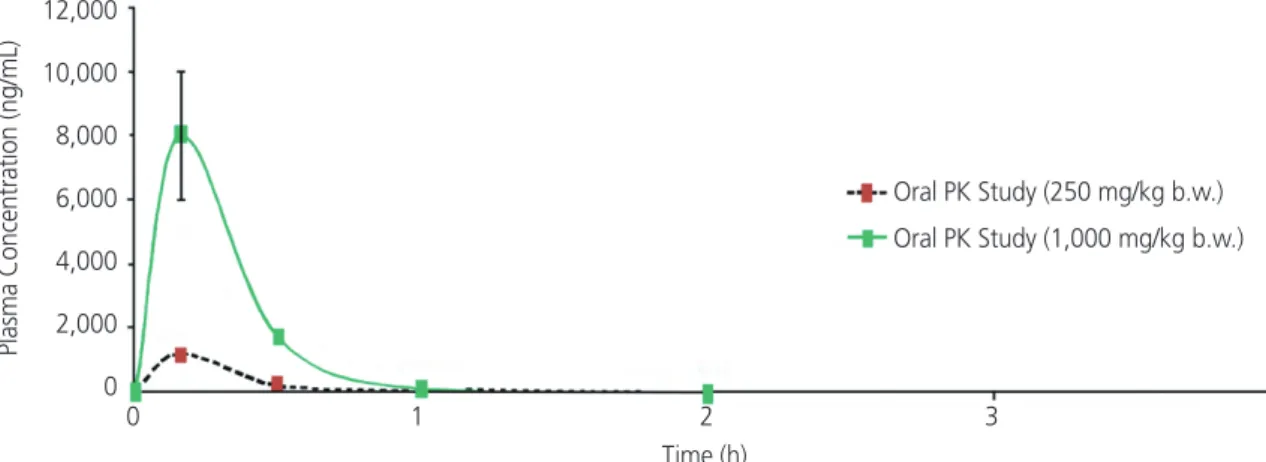
Analysis of the data for a cross-over effect indicated that there was a significant effect in depression when oxaloace- tate/vitamin C was administered first (P<0.05). For perceived stress, generalized anxiety and aggression, there was a trend toward a carry-over effect when oxaloacetate/vitamin C was administered first. Previous work, shown in Fig. 1, examining the pharmacokinetics value of oxaloacetate in mouse mod- els was reviewed to better understand the cross-over effect evident in this study. A single dose of oxaloacetate of 250 mg/kg body weight and 1,000 mg/kg body weight demon- strated a half-life of 0.28 and 0.14 hours, respectively. No re-
Table 2. Comparison of changes from baseline within and between oxaloacetate/vitamin C and placebo Characteristics
Oxaloacetate Placebo
P-value
b)Mean
improvement (%)
Standard error
(%)
P-value
a)Mean improvement
(%)
Standard error
(%)
P-value
a)Part A
Becks depression 52.2 ±8.8 <0.0001 25.9 ±13.7 <0.05 <0.05
Cohen perceived stress 36.2 ±6.6 <0.0001 21.4 ±10.2 <0.05 <0.05
Generalized anxiety disorder 51.3 ±8.8 <0.0001 24.0 ±14.0 <0.05 <0.05
Buss-Perry aggression 15.4 ±4.8 0.0001 6.5 ±5.9 0.128 0.060
Part B
Becks depression 56.4 ±5.8 <0.0001 28.1 ±6.3 <0.001 <0.01
Cohen perceived stress 37.4 ±4.7 <0.0001 15.0 ±4.1 <0.05 0.001
Generalized anxiety disorder 52.6 ±6.4 <0.0001 15.1 ±12.2 0.231 <0.01
Buss-Perry aggression 18.8 ±4.0 0.0001 6.2 ±3.9 0.132 0.01
a)
P-value for evaluating changes from baseline within treatment group;
b)P-value for evaluating changes from baseline between oxaloacetate and placebo group (primary analysis).
Table 1. Baseline averages for women in the study using self-assessment surveys Characteristics Becks depression
inventory Cohen perceived
stress Generalized anxiety
disorder Buss-Perry aggression
Raw mean score 27.8 25.8 14.1 86.3
Standard deviation 11.3 5.2 4.9 23.6
Classification of group average at initial baselin e
Moderate depression (note: a score of 14.5
is the cutoff for depression) [28]
Above average stress (average for women is
13.7) [29]
Moderate anxiety (note: a score of 15+ is
the cutoff for “severe anxiety”) [30]
Above average aggression (average for women is
68.2) [31]
Number of women in the study: 48. Average age of the women in the study: 37.
sidual increases in oxaloacetate were observed in the animals after 1 hour.
To overcome the carry-over effect in the cross-over design, the study was repeated with placebo being administered first in part B. This was a non-randomized cross-over study of oxaloacetate/vitamin C versus placebo in 22 subjects. All subjects received placebo first, followed by oxaloacetate/
vitamin C; the results of part B of this study are summarized in Table 2. As shown, oxaloacetate/vitamin C supplementa- tion resulted in highly significant improvements for all survey measures over baseline (P<0.0001, P<0.0001, P<0.0001, and P=0.0001). Placebo supplementation resulted in signifi- cant improvements for depression and perceived stress over baseline (P<0.001 and P<0.05, respectively), but were not significant for generalized anxiety or aggression (P=0.231 and P=0.132, respectively). The improvement in scores for the oxaloacetate/vitamin C group was much larger than re- sults for all the measurements in the placebo group.
Data from parts A and B of this clinical trial for the 48 women were compiled and summarized in Table 3. As shown, the improvements in depression (54.1%, P<0.0001), perceived stress (35.8%, P<0.001), general anxiety (51.4%, P<0.001), and aggression (17.8%, P<0.0001) were signifi- cantly improved over baseline with oxaloacetate/vitamin C treatment. Furthermore, although the improvements over baseline with placebo ranged from 6.8% to 30.7% (P<0.001, P<0.001, P<0.001 and P<0.05, respectively), the difference between oxaloacetate/vitamin C and placebo was highly sig- nificant (P<0.01, P<0.001, P<0.001, P<0.01, respectively).
Based on average scores from the 4 surveys, as shown in Table 4, women treated with oxaloacetate moved from a classification of “moderate depression” to “mild mood disturbance”; from “above average stress” to “slightly above average stress”; from “moderate anxiety” to “mild anxiety”;
and from “above average aggression” to “slightly above average aggression.”
Plasma Concentration (ng/mL)
12,000 10,000 8,000 6,000 4,000 2,000
0 0 1 2 3 4 Time (h)
Oral PK Study (250 mg/kg b.w.) Oral PK Study (1,000 mg/kg b.w.)
Fig. 1. Single dose oral pharmacokinetics study of oxaloacetate in male BALB/c mice. PK, pharmacokinetics.
Table 3. Overall comparison of changes from baseline within and between oxaloacetate/vitamin C and placebo for parts A and B partici- pants
Characteristics
Oxaloacetate Placebo
P-value
b)Mean
improvement (%)
Standard error
(%)
P-value
a)Mean improvement
(%)
Standard error
(%)
P-value
a)Becks depression 54.1 ±4.2 <0.0001 30.7 ±5.9 <0.001 <0.01
Cohen perceived stress 35.8 ±3.3 <0.0001 18.0 ±4.3 <0.001 <0.001
Generalized anxiety disorder 51.4 ±4.4 <0.0001 27.0 ±7.6 <0.001 <0.001
Buss-Perry aggression 17.8 ±2.5 0.0001 6.8 ±2.8 <0.05 <0.01
a)
P-value for evaluating changes from baseline within treatment group;
b)P-value for evaluating changes from baseline between oxaloacetate
and placebo group (primary analysis).
As a subcategory analysis, the suicidal ideation ques- tion from the Beck’s Depression Inventory demonstrated a mean improvement of 47.9% with oxaloacetate/vitamin C supplementation, which was highly significant over baseline (P<0.0001) for women who had an initial baseline measure- ment of suicidal ideation (n=31). This was examined due to the concern that some anti-depressants may increase the risk for suicidal ideation [31]. During the study, no side effects and/or adverse effects in the study population were reported with the oxaloacetate/vitamin C mix.
Discussion
Results of this study demonstrated that a mix of oxaloac- etate/vitamin C produced a highly significant improvement over baseline and placebo in depression, perceived stress,
anxiety, and aggression related to PMS. In part A, there was a significant difference between the oxaloacetate/vitamin C and placebo treatment groups for all PMS surveys except aggression, which demonstrated a trend toward statistical significance. Placebo treatment did not significantly improve the anxiety and aggression scores and produced a lower significance level of improvement over baseline than the oxa- loacetate/vitamin C treatment in depression and perceived stress.
This was observed despite the observation of a carryover effect when oxaloacetate/vitamin C was administered first, which would skew the part A results in favor of the placebo group. These results indicate that oxaloacetate/vitamin C has lasting effects on mood, which may be related to gene modulation effects rather than pharmacological effects.
Due to the observed carryover effect, the study was re- peated in part B, with a modification to the study design,
Fig. 2. An analysis of changes from baseline measurements of 4 emotional symptoms surveys versus treatment with an oxaloacetate/vita- min C mix or placebo in 48 participants with premenstrual syndrome.
Mean impr ovement with tr eatment
70%
60%
50%
40%
30%
20%
10%
0%
**
P-value <0.01
***