Abuse experienced by older adults is a serious public health issue around the world. Major global institutions, such as the World Health Organization (WHO) and United Nations, have emphasized the severity of abuse in older adults in their re- ports.1,2 Abuse is a stressful life event that adversely affects the physical and mental health of older adults. It is also associated
with premature morbidity, increase in hospitalization rate, and increased likelihood of death, according to existing re- search.3-5 Physical abuse is the most commonly recognized form of abuse in older adults, although sexual and emotional abuse, as well as financial exploitation and neglect, are preva- lent. A recent meta-analysis estimated an overall incidence of elder abuse of 15.7% in community-dwelling in older adults, and that of psychological abuse was 11.6%, accounting for 73.8% of all instances of abuse in older adults.6
Increases in older adult populations are a global trend. South Korea, in particular, has experienced an unprecedented in- crease therein, and is faced with many dilemmas resulting therefrom. In this aging society, many elderly persons suffer from chronic diseases, loneliness, disability, and dementia; they need support from their families and society more than ever.
Moreover, psychiatric problems and emotional distress, such Received: January 25, 2018 Revised: March 16, 2018
Accepted: April 24, 2018
Corresponding author: Jong-Il Park, MD, PhD, Department of Psychiatry, Chonbuk National University Medical School, 20 Geonji-ro, Deokjin-gu, Jeonju 54907, Korea.
Tel: 82-63-250-2577, Fax: 82-63-275-3157, E-mail: [email protected]
•The author has no financial conflicts of interest.
© Copyright: Yonsei University College of Medicine 2018
This is an Open Access article distributed under the terms of the Creative Com- mons Attribution Non-Commercial License (http://creativecommons.org/licenses/
by-nc/4.0) which permits unrestricted non-commercial use, distribution, and repro- duction in any medium, provided the original work is properly cited.
Relationship between Emotional Abuse and Depression among Community-Dwelling Older Adults in Korea
Jong-Il Park1,2
1Department of Psychiatry, Chonbuk National University Medical School, Jeonju;
2Research Institute of Clinical Medicine of Chonbuk National University-Biomedical Research Institute of Chonbuk National University Hospital, Jeonju, Korea.
Despite recent advances, there is little research on factors associated with emotional abuse among Korean older adults. The pres- ent study investigated the relationships between depression and emotional abuse among community-dwelling Korean older adults. We analyzed the dataset from the Survey of Living Conditions and Welfare Needs of Korean Older Persons conducted by the Korea Institute for Health and Social Affairs in 2011. Older adults (aged >65 years, n=10674) were randomly selected. Multi- variate logistic regression was used to investigate factors associated with emotional abuse in terms of sociodemographic, health- related, and psychological variables, including depression using the short version of the Geriatric Depression Scale. In our study, 9.4% of the older adults reported experiencing emotional abuse in the previous year. In addition, 44.0% of those experiencing emotional abuse suffered from depression. Multiple logistic regression modeling showed that depression in older adults was in- dependently associated with emotional abuse [odds ratio (OR)=1.788, p<0.001]. Along with depression, poor social support (OR for no social support=1.712, p<0.001) and having chronic illnesses (OR for more than 3=1.481, p<0.005) were associated an in- creased risk of emotional abuse. Our results showed that emotional abuse among older adults in Korea is prevalent. Our findings suggest that depression, poor social support, and having chronic illnesses are significant factors associated with emotional abuse among the Korean older adult population. Addressing these factors with preventive interventions could have significant public health implications. Further studies are warranted to gain a better understanding of emotional abuse in older Korean adults.
Key Words: Elderly abuse, emotional abuse, elderly depression
pISSN: 0513-5796 · eISSN: 1976-2437 Yonsei Med J 2018 Jul;59(5):693-697
https://doi.org/10.3349/ymj.2018.59.5.693
as suicide, depression, etc. are common.7 Therefore, this study aimed to investigate the relationship between emotional abuse and depression in a large, representative sample of communi- ty-dwelling older adults in Korea.
Our study analyzed the dataset of the Survey of the 2011 Liv- ing Conditions and Welfare Needs of Korean Older Persons conducted by the Korea Institute for Health and Social Affairs.8 This survey is a government-approved statistical survey (Sta- tistics Korea, approval No. 11771), which has been conducted every 3 years since 2008 with representative samples using a stratified two-stage cluster sampling design of non-institu- tionalized in older persons in Korea. This survey collected in- formation via face-to-face interviews. All participants provided written informed consent. A total of 11542 persons aged over 60 years completed the survey (response rate=76.2%). We lim- ited our analysis to 10674 persons over 65 years of age. This study was approved by the Research Ethics Committee of Chonbuk National University Hospital (CUH 2017-12-020).
We collected information on socio-demographic (age, gen- der, living alone, educational status, economic status), health- related (number of chronic illness, functional impairment), and psychological variables (social support, depression, emo- tional abuse). Emotional abuse was assessed via one question
“Have you ever been emotionally hurt by other’s word or ac- tion?” and possible responses were yes/no. The number of chronic illnesses was ascertained with the question “Do you currently have a chronic illness for more than 3 months that was diagnosed by a physician?” The type of chronic illness in- cluded hypertension, stroke, hyperlipidemia, ischemic heart disease, etc., and their numbers were categorized into no chron- ic illness, 1, 2, or more than 3. Functional impairment was de- fined as the need for help with personal care in at least one item in the Korean Instrumental Activities of Daily Living (K- IADL),9 which categorizes activities into 10 domains (personal grooming, doing housework, preparing meals, doing laundry, going out for a short distance, using transportation, shopping, managing money, using a telephone, and taking medicine).
Social support was assessed with the question “How many close friends and relatives do you have (people with whom you can talk about what is on your mind)?” and answers were cat- egorized into none, 1–2, 3–5, or more than 6 persons. Depres- sion was assessed using the Korean version of the Short Geri- atric Depression Scale (SGDS),10,11 a 15-item self-administered questionnaire with scores ranging from 0 to 15. Participants who scored higher than 8 were defined as having depression.
This questionnaire has shown high sensitivity (0.8548) and specificity (0.6957) for depression in a previous study.11
Descriptive statistics (including frequencies and percentag- es) were used to describe demographic, health-related, and psychological variables. Univariate analyses were performed to identify associations between emotional abuse and each de- pendent variable using chi-square tests. A multivariate logistic regression analysis was used to calculate adjusted odds ratios
(ORs) of emotional abuse after controlling for confounding variables.
Of the 10541 older adult participants assessed in the present study, 9.4% had experienced emotional abuse in the last 12 months. The univariate analyses revealed independent vari- ables that were associated with emotional abuse (Table 1). Par- ticipants who had experienced emotional abuse were more likely to be female, less educated, and functionally impaired and to have poor social support, chronic illnesses, and depres- sion. The prevalence of depression was significantly higher in elderly persons with emotional abuse than in those without emotional abuse (44.0% vs. 28.9%, p<0.001).
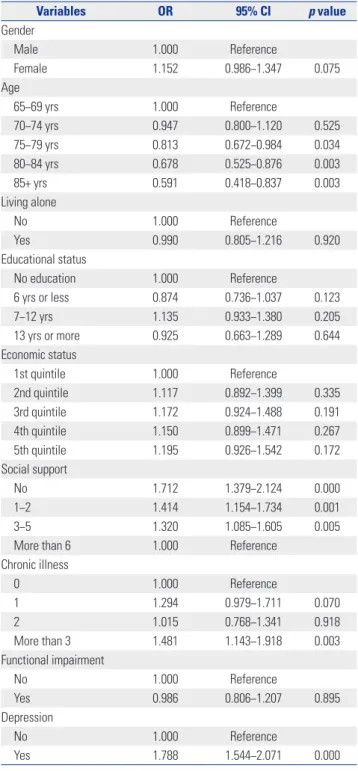
Multivariate regression analysis revealed that emotional abuse was independently associated with older age (ORs=
0.813, 0.678, and 0.591 for participants aged 75−79, 80–84, and
≥85 years, respectively), poorer social support (ORs=1.320, 1.414, and 1.712 for 3−5 persons, 1−2 persons, and no social support, respectively), a higher number of chronic illnesses (ORs=1.294 and 1.481 for 1 and more than 3 chronic illnesses, respectively), and depression (OR=1.788) after controlling for confounding variables (Table 2).
This study sought to examine the relationship between de- pression and emotional abuse in a sample of older Korean adults. Studies on emotional abuse and depression among el- derly persons in the community have been conducted mainly in Western countries. There have been few studies conducted in Asia, and no study has been conducted using a large sam- ple. The fact that research related to older adults abuse in Ko- rea is in its early stage makes this study especially important.
The population of older adults in Korea has been rapidly in- creasing due to an increase in life expectancy and a decrease in the fertility rate. South Korea will be an aged society, with 14% of the total population over 65 years of age, and will ac- count for 14.3% of the total population by 2018, which is a very rapid change, compared to other developed and less devel- oped countries’. It is expected that South Korea will enter a post-aged society with 20% of its population over 65 years by 2026.12 Concerns surrounding emotional abuse of elderly per- sons increase when the support system for elderly persons becomes deficient, owing to sudden changes in the social structure, in the family structure from extended to nuclear fam- ilies, and decreased supporting attitude toward the care of older persons.
In the present study, a substantial proportion of older per- sons (9.4%) reported experiencing emotional abuse in the past year. The rate of depression in older adults who experienced emotional abuse (44.0%) was higher than in those who did not (28.9%). The results of the regression analysis after controlling confounding variables showed that age, social support, chronic illness, and depression were factors associated with emotional abuse in older adults in Korea, among which depression had the greatest effect (OR=1.788).
The identification of depression as a factor associated with
emotional abuse is consistent with the results of previous stud- ies. Older patients who visited the Baylor College of Medicine Geriatric clinic in Texas, USA were found to have depression (based on DSM-IV criteria13); there was a statistically signifi- cant, higher prevalence rate of depression among those who experienced abuse (62% vs. 12%), compared to the compari- son group who did not have such experience.14 The Chicago Health and Aging Project, a large-scale research with commu-
nity-dwelling persons in the US (n=7841), reported that a high- er level of depressive symptoms, measured using a modified version of the Center for Epidemiologic Studies of Depression Scale,15 was associated with an increased mortality rate among older persons who had experienced abuse.16 An ad hoc study of 4000 older adults aged 65 years or older who were receiving health and/or social community services in 11 European coun- tries showed that the presence of depression (indicated by a cut-off score of 3 on the Minimum Data Set Depression Rating Table 1. Sociodemographic, Health-Related, and Psychological Char-
acteristics of the Participants
Variables Emotional abuse
p value
No Yes
Gender 0.006
Male 4161 (43.6) 387 (39.1)
Female 5390 (56.4) 604 (60.9)
Age 0.058
65−69 yrs 2840 (29.7) 310 (31.3)
70−74 yrs 2903 (30.4) 325 (32.8)
75−79 yrs 2170 (22.7) 219 (22.1)
80−84 yrs 1068 (11.2) 92 (9.3)
85+ yrs 570 (6.0) 44 (4.4)
Living alone 0.935
No 7660 (80.2) 793 (80.1)
Yes 1890 (19.8) 197 (19.9)
Educational status 0.008
No education 2985 (31.3) 341 (34.4) 6 yrs or less 3422 (35.8) 321 (32.4)
7−12 yrs 2461 (25.8) 276 (27.9)
13 yrs or more 682 (7.1) 52 (5.3)
Economic status 0.872
1st quintile 1917 (20.1) 195 (19.7) 2nd quintile 1911 (20.0) 210 (21.2) 3rd quintile 1898 (19.9) 202 (20.4) 4th quintile 1920 (20.1) 195 (19.7) 5th quintile 1905 (19.9) 189 (19.1)
Social support 0.000
No 1663 (17.4) 231 (23.3)
1−2 2411 (25.2) 276 (27.9)
3−5 3128 (32.8) 311 (31.4)
More than 6 2347 (24.6) 172 (17.4)
Chronic illness 0.000
0 1061 (11.1) 78 (7.9)
1 1844 (19.3) 180 (18.2)
2 2365 (24.8) 189 (19.1)
More than 3 4280 (44.8) 543 (54.8)
Functional impairment 0.034
No 8343 (87.4) 843 (85.1)
Yes 1200 (12.6) 148 (14.9)
Depression 0.000
No 6782 (71.1) 554 (56.0)
Yes 2757 (28.9) 436 (44.0)
Table 2. Multivariate Logistic Regression Analysis of Variables Affecting Emotional Abuse
Variables OR 95% CI p value
Gender
Male 1.000 Reference
Female 1.152 0.986−1.347 0.075
Age
65−69 yrs 1.000 Reference
70−74 yrs 0.947 0.800−1.120 0.525
75−79 yrs 0.813 0.672−0.984 0.034
80−84 yrs 0.678 0.525−0.876 0.003
85+ yrs 0.591 0.418−0.837 0.003
Living alone
No 1.000 Reference
Yes 0.990 0.805−1.216 0.920
Educational status
No education 1.000 Reference
6 yrs or less 0.874 0.736−1.037 0.123
7−12 yrs 1.135 0.933−1.380 0.205
13 yrs or more 0.925 0.663−1.289 0.644
Economic status
1st quintile 1.000 Reference
2nd quintile 1.117 0.892−1.399 0.335
3rd quintile 1.172 0.924−1.488 0.191
4th quintile 1.150 0.899−1.471 0.267
5th quintile 1.195 0.926−1.542 0.172
Social support
No 1.712 1.379−2.124 0.000
1−2 1.414 1.154−1.734 0.001
3−5 1.320 1.085−1.605 0.005
More than 6 1.000 Reference
Chronic illness
0 1.000 Reference
1 1.294 0.979−1.711 0.070
2 1.015 0.768−1.341 0.918
More than 3 1.481 1.143−1.918 0.003
Functional impairment
No 1.000 Reference
Yes 0.986 0.806−1.207 0.895
Depression
No 1.000 Reference
Yes 1.788 1.544−2.071 0.000
Scale17) predicted the occurrence of abuse in older adults.18 Relevant research on the subject conducted in Asia also identified significant associated factors. A study of 441 urban Chinese elderly persons reported that the risk of abuse in older adults was higher among those with depression (OR=4.47 for men, OR=8.54 for women), defined as more than 3 points for five questions of the Geriatric Depression Scale.19 A study showed that the dependency of Korean elderly persons (n=246) whose spouses had passed away was affected directly or indirectly by emotional abuse.20 In a study of abuse and its related factors among elderly stroke patients (n=934) living in the communi- ty, the risk of abuse was higher in participants with depression (SGDS score 8 or higher, OR=2.72).21 The fact that depression is an associated factor for emotional abuse among older adults has several important implications. Because depression in el- derly persons is often found together with executive dysfunc- tion, it is difficult for seniors to make appropriate judgments in major decision-making processes related to medical treat- ments, institutional care, and other kinds of care they might receive.14,22 Depression could lead to suicidal ideation and at- tempts in severe cases. Based upon the possibility of recovery through various approaches, such as pharmacotherapy and psychosocial therapy, it is important to offer treatment oppor- tunities and a systematic approach through which to treat el- derly depression with emotional abuse. In addition, screening for depression in older adults suffering emotional abuse and developing preventive strategies for depression may reduce the distress caused by emotional abuse.
The results of this study verified that, along with depression, the number of chronic illnesses and lack of social support were also associated with a higher risk of emotional abuse among elderly persons. It was reported that physical illness and lack of social support were major factors associated with abuse in older adults,19,23 which implies that chronic diseases and social support as associated factors are also associated with depression in elderly persons experiencing abuse. Social support is also a major factor influencing elderly depression and suicide, and depressive patients may not receive adequate medical treatment for physical illnesses due to depressive symptoms or not being treated on time. Therefore, it is impor- tant to examine social support systems for older adults who are experiencing emotional abuse, to address any shortcomings, and to approach the treatment of chronic diseases appropriate- ly. Furthermore, it is necessary to discuss societal problems and solutions, to strengthen support services for the older adult population, and to establish preventive programs for abuse in older individuals.
This study has several limitations, and as a result, the find- ings should be interpreted cautiously. First, our study design was cross-sectional, and we did not investigate the onset of emotional abuse and depressive episode. Therefore, we could not infer a causal relationship. Further longitudinal study is required to explore the diverse relationship between emotional
abuse and the main variables of interest. Second, questions about emotional abuse were non-validated and self-reported, which might lead to recall bias.
In conclusion, the results of this study indicate that emotion- al abuse among older persons in Korea is a serious issue. The major factors associated with emotional abuse were social support, chronic illness, and depression. In order to reduce the level of emotional distress among abused older persons, it is imperative to create a systematic method to approach these associated factors. Further research is essential to develop ef- ficient and systematic prevention strategies and a manage- ment system for abuse in older adults.
ACKNOWLEDGEMENTS
This paper was supported by research funds for newly appoint- ed professors of Chonbuk National University in 2017.
ORCID
Jong-Il Park https://orcid.org/0000-0003-4690-397X
REFERENCES
1. World Health Organization. Global status report on violence pre- vention 2014. Geneva: WHO Press; 2014.
2. United Nations Office of the High Commissioner for Human Rights (OHCHR). Human rights of older persons: summary of the report of the Secretary-General to the General Assembly (Report A/66/173). New York: United Nations; 2010.
3. Dong X. Medical implications of elder abuse and neglect. Clin Geriatr Med 2005;21:293-313.
4. Dong X, Simon M, Mendes de Leon C, Fulmer T, Beck T, Hebert L, et al. Elder self-neglect and abuse and mortality risk in a commu- nity-dwelling population. JAMA 2009;302:517-26.
5. Dong X, Simon MA. Elder abuse as a risk factor for hospitaliza- tion in older persons. JAMA Intern Med 2013;173:911-7.
6. Yon Y, Mikton CR, Gassoumis ZD, Wilber KH. Elder abuse preva- lence in community settings: a systematic review and meta-anal- ysis. Lancet Glob Health 2017;5:e147-56.
7. Park JH, Kim KW, Kim MH, Kim MD, Kim BJ, Kim SK, et al. A na- tionwide survey on the prevalence and risk factors of late life de- pression in South Korea. J Affect Disord 2012;138:34-40.
8. Jung KH, Lee YK, Park BM, Lee SJ, Lee YH. Analysis of the survey of living conditions and welfare needs of Korean older persons.
Sejong: Korea Institute for Health and Social Affairs; 2012.
9. Won CW, Rho YG, Sunwoo D, Lee YS. The validity and reliability of Korean Instrumental Activities of Daily Living (K-IADL) Scale. J Korean Geriatr Soc 2002;6:273-80.
10. Sheikh JI, Yesavage JA. Geriatric Depression Scale (GDS): recent evidence and development of a shorter version. In: Brink TL, edi- tor. Clinical gerontology: a guide to assessment and intervention.
New York (NY): Hallworth Press; 1986. p.165-74.
11. Bae JN, Cho MJ. Development of the Korean version of the Geri- atric Depression Scale and its short form among elderly psychiat- ric patients. J Psychosom Res 2004;57:297-305.
12. Statistics Korea. The aged statistics. Daejeon: Statistics Korea;
2010.
13. American Psychiatric Association. Diagnostic and statistical manu-
al of mental disorders. 4th ed. Washington: American Psychiatric Association; 1994.
14. Dyer CB, Pavlik VN, Murphy KP, Hyman DJ. The high prevalence of depression and dementia in elder abuse or neglect. J Am Geriatr Soc 2000;48:205-8.
15. Kohout FJ, Berkman LF, Evans DA, Cornoni-Huntley J. Two shorter forms of the CES-D (Center for Epidemiological Studies Depres- sion) depression symptoms index. J Aging Health 1993;5:179-93.
16. Dong XQ, Simon MA, Beck TT, Farran C, McCann JJ, Mendes de Leon CF, et al. Elder abuse and mortality: the role of psychological and social wellbeing. Gerontology 2011;57:549-58.
17. Burrows AB, Morris JN, Simon SE, Hirdes JP, Phillips C. Develop- ment of a minimum data set-based depression rating scale for use in nursing homes. Age Ageing 2000;29:165-72.
18. Cooper C, Katona C, Finne-Soveri H, Topinková E, Carpenter GI, Livingston G. Indicators of elder abuse: a crossnational compari- son of psychiatric morbidity and other determinants in the Ad- HOC study. Am J Geriatr Psychiatry 2006;14:489-97.
19. Dong X, Beck T, Simon MA. The associations of gender, depres- sion and elder mistreatment in a community-dwelling Chinese population: the modifying effect of social support. Arch Gerontol Geriatr 2010;50:202-8.
20. Kim OS, Yang KM, Kim KH. [Dependency, abuse, and depression by gender in widowed elderly]. Taehan Kanho Hakhoe Chi 2005;
35:336-43.
21. Kim O, Jeon HO, Kim BH. The relating factors of elder abuse among community-dwelling elderly with stroke. Korean J Adul Nurs 2012;24:466-76.
22. Elderkin-Thompson V, Mintz J, Haroon E, Lavretsky H, Kumar A.
Executive dysfunction and memory in older patients with major and minor depression. Arch Clin Neuropsychol 2007;22:261-70.
23. Wu L, Chen H, Hu Y, Xiang H, Yu X, Zhang T, et al. Prevalence and associated factors of elder mistreatment in a rural community in People’s Republic of China: a cross-sectional study. PLoS One 2012;7:e33857.