INTRODUCTION
Stenosis of the subclavian artery (SCA), although not com- mon, occurrs in a number of patients. Most etiologies are ath- erosclerotic, and patients may present with vertebrobasilar insufficiency (subclavian steal syndrome), angina due to re- versal of flow from an internal mammary arterial graft (coro- nary subclavian steal syndrome), and arm ischemia or weak- ness due to distal embolization or claudication. Treatment of these lesions has traditionally been through surgical bypass.
Because of the lower complication rate, high technical suc- cess rate and good long-term patency rate (>80% at 5 years), catheter-based treatment has become more and more popu- lar.
1We present a case of patient with total situs inversus and
stenosis of the left SCA, who was treated with catheter-based revascularization with stent that was complicated with SCA perforation with hemothorax. Percutaneous stenting with a graft stent was used as a rescue, but this procedure was com- plicated with occlusion of the common carotid artery. The oc- clusion of the common carotid artery was finally re-opened by carotid stenting. We present a way to rescue perforation of large artery during percutaneous intervention.
CASE REPORT
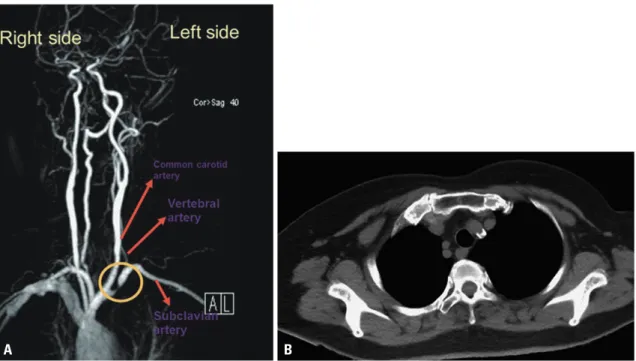
This 73-year-old female, with a history of coronary artery dis- ease and situs inversus, had recently noticed left arm exercise weakness. The magnetic resonance angiogram and computer tomography of the upper limb vessels showed critical stenosis of the left-side SCA with calcification near the orifice (Fig. 1).
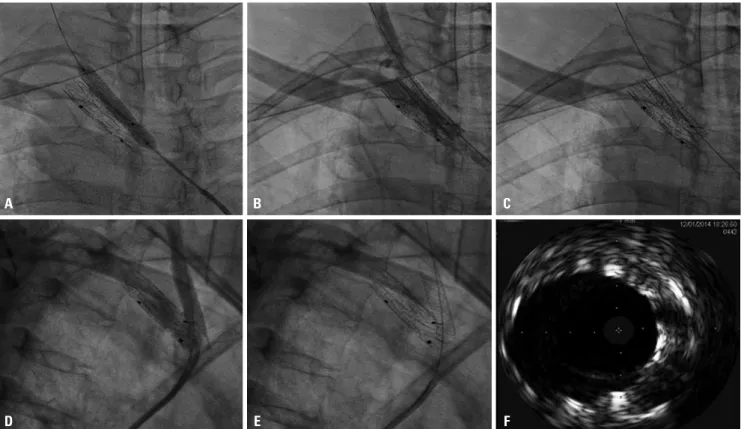
Percutaneous revascularization was done via right femoral artery approach, and severe left SCA stenosis was confirmed (Fig. 2A) (Supplementary Video 1, only online). Direct stenting in the left SCA was carried out with a balloon-expansible Ex- press LD 10×25 mm stent (Boston Scientific Corporation, Natick, MA, USA) (Fig. 2B) up to 8 atmospheres for 13 seconds.
However, severe shortness of breath and hypotension devel- oped after stenting. The blood pressure was down to 88/56, Chih-Hung Lai , Chung-Lin Tsai , Wei-Chun Chang , Chieh-Shou Su , and Wen-Lieng Lee
1
Divisions of Interventional Cardiology and Adult Cardiac Surgery, Cardiovascular Center, Taichung Veterans General Hospital, Taichung;
2