SYMMETRIC SURFACE WAVES OVER A BUMP
J. W. Choi, Daniel An, Chaeho Lim, and Sangro Park
Abstract. We study the surface waves of an incompressible fluid passing over a small bump. A forced KdV equation for surface wave is derived without assuming that flow is uniform at far upstream.
New types of steady solutions are discovered numerically. Two new cut off values of Froude number are found, above the larger of which two symmetric solutions exist and under the smaller of which two different symmetric solutions exist.
1. Introduction
In this paper, we consider two-dimensional steady flow of inviscid and incompressible fluids of constant density with free surface and bounded below by a rigid boundary with a small bump.
Numerical studies of steady flows past a semi-circular obstruction were carried out by Forbes and Schwartz [7], Vanden-Broeck [10], and Forbes [4]. They discovered two critical values F
−, F
+of Froude number F = c/ √
gh, where g is the constant gravitational acceleration, h is the constant depth of the fluid far upstream, F
−< 1 and F
+> 1. For F < F
−, there exists only one branch of solutions of the free surface elevation η(x), which is almost zero behind, but periodic ahead, of the obstruction. In F
−< F < F
+, there exists no steady flow. For F >
F
+, there exist two symmetric solutions of solitary-wave type. One approaches the uniform flow far upstream and the other approaches the solitary wave solution for a fluid with constant depth, as the obstruction size tends to zero. An asymptotic theory for small amplitude steady one or two-layer flow past an obstruction has been developed by Shen, Shen and Sun [9] and Shen [8], Choi, Sun and Shen [4], Choi and Shen [3], and Choi [2]. There, by assuming that the fluid is uniform at far upstream,
Received January 23, 2003.
2000 Mathematics Subject Classification: 76B07.
Key words and phrases: periodic wave, FKdV equation.
The research reported here is supported by Korea Research Foundation Grant (KRF-2000-DP0041).
they derived the Forced Korteweg-de Vries equation (FKdV) as a model equation governing the flow as follows:
m
′0η
x+ m
′1ηη
x+ m
′2η
xxx= b
x(x),
where x is the horizontal distance, m
′0, m
′1, m
′2are constants and z = b(x) is the equation of obstruction.
In the problem considered here, we derive a FKdV equation, as a model equation of surface wave, by assuming that the fluid is periodic at far upstream instead of assuming that the fluid is uniform at far upstream. New types of steady symmetric solutions are discovered nu- merically. Two new cut off values of Froude number are found, above the larger of which two symmetric solutions exist and under the smaller of which two different symmetric solutions exist.
2. Derivation of the FKdV equation
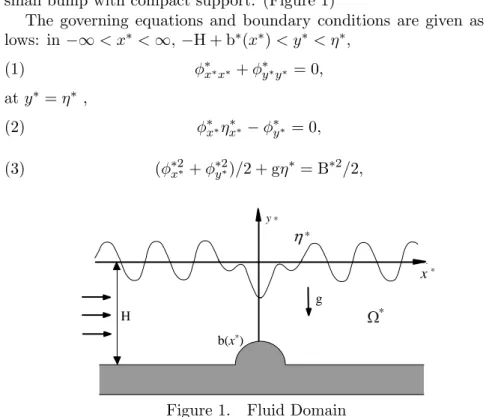
The problem considered here concerns steady two-dimensional inter- facial waves of an inviscid fluid with constant density passing over a small bump with compact support. (Figure 1)
The governing equations and boundary conditions are given as fol- lows: in −∞ < x
∗< ∞, −H + b
∗(x
∗) < y
∗< η
∗,
(1) φ
∗x∗x∗+ φ
∗y∗y∗= 0, at y
∗= η
∗,
(2) φ
∗x∗η
x∗∗− φ
∗y∗= 0, (3) (φ
∗2x∗+ φ
∗2y∗)/2 + gη
∗= B
∗2/2,
y*
H
b(x*)
g
*
*
x*
Figure 1. Fluid Domain
at y
∗= −H + b
∗(x
∗) ,
(4) φ
∗y∗− φ
∗x∗b
∗x∗(x
∗) = 0
where (x
∗, y
∗) are horizontal and vertical variables, respectively, φ
∗is a flow potential, η
∗is a function of free boundary elevation, g is the gravitational acceleration constant, y
∗= −H + b
∗(x
∗) is the equation of obstruction, where b
∗(x
∗) has a compact support, B
∗is a Bernoulli constant, and H is the equilibrium mean depth of the fluid.
We introduce the following dimensionless variables: x = x
∗/L, y = y
∗/H, ǫ = (H/L)
2≪ 1, η = η
∗/ǫH, φ = φ
∗/ǫ
1/2H(gH)
1/2, B = B
∗/(gH)
1/2, b(x) = ǫ
−2b
∗(x
∗)/H.
In terms of the above dimensionless quantities, (1) to (4) become as follows: In −1 + ǫ
2b(x) < y < ǫη ,
(5) ǫφ
xx+ φ
yy= 0,
at y = ǫη,
(6) ǫφ
xη
x− ǫ
−1φ
y= 0, (7) ǫ(φ
2x+ φ
2y/ǫ)/2 + η = B
2/2ǫ, at y = −1 + ǫ
2b(x) ,
(8) φ
y− ǫ
3φ
xb
x(x) = 0.
We seek solutions for periodic water waves of wavelength µ
∗, and intro- duce the dimensionless wavelength
(9) µ = µ
∗/L.
The Froude number F is defined as
(10) F = ǫ
µ
Z
xf+µ xfφ
xdx ,
where x
f≪ 0 since we assume that the fluid is periodic with mean depth H at far upstream. We note that, by taking µ → ∞, (10) becomes the same as the Froude number c/ √
gH in [7], [9] and [10] if we assume the fluid is uniform at far upstream where c is the uniform speed.
We assume that B, φ, F and η possess an asymptotic expansion of the form:
(11)
B = B
0+ ǫB
1+ ǫ
2B
2+ ǫ
3B
3+ · · · φ = Bx/ǫ + φ
0+ ǫφ
1+ ǫ
2φ
2+ ǫ
3φ
3+ · · · F = F
0+ ǫF
1+ ǫ
2F
2+ ǫ
3F
3+ · · ·
η = η
0+ ǫη
1+ ǫ
2η
2+ ǫ
3η
3+ · · · .
By substituting (11) into (5) to (8) and rearranging equations accord- ing to the order of ǫ, we obtain the relations of variables by the order of ǫ.
O(ǫ
−1): at y = 0,
(12) φ
0y(x, 0) = 0.
O(ǫ
0): in −1 < y < 0,
(13) φ
0yy(x, y) = 0,
at y = 0,
(14) B
0η
0x− η
0φ
0yy− φ
1y(x, 0) = 0, (15) φ
20y/2 + B
0φ
0x(x, 0) + η
0= 0, at y = −1,
(16) φ
0y(x, −1) = 0.
O(ǫ): in −1 < y < 0,
(17) φ
0xx(x, y) + φ
1yy(x, y) = 0, at y = 0,
(18) B
0η
1x+ B
1η
0x+ φ
0xη
0x− φ
2y− η
0φ
1yy− η
1φ
0yy= 0, (19) φ
20x/2 + B
1φ
0x+ B
0η
0φ
0xy+ B
0φ
1x+ η
1= 0, at y = −1,
(20) φ
1y(x, −1) = 0.
O(ǫ
2): in −1 < y < 0,
(21) φ
1xx(x, y) + φ
2yy(x, y) = 0, at y = −1,
(22) φ
2y(x, −1) = B
0b
x(x).
Next, we solve (12) to (22) in terms of η
0(x). (12), (13) and (16) imply φ
0(x, y) = φ
0(x) and we obtain
(23) φ
1y(x, y) = −φ
0xx(x)(y + 1) from (17) and (20). From (14), (15) and (23), we have (24) B
0η
0x− φ
1y= 0, B
0φ
0x+ η
0= 0,
(25) φ
1(x, y) = −φ
0xx(y
2/2 + y) − φ
0xx/2 + φ
1(x, −1).
(23) and (24) imply
(26) B
0= 1, φ
0x(x) = −η
0(x).
Let
(27) R
1(x) = −φ
0xx/2 + φ
1(x, −1), then from (19), (25), (26) and (27) it follows that (28) φ
1x(x, y) = −φ
0xxx(y
2/2 + y) + R
1x(x), (29) φ
1xx(x, 0) = R
1xx= −η
1x+ B
1η
0x− η
0η
0x. From (21), (25), (27) and (29)
φ
2yy(x, y) = φ
0xxxx( y
22 + y) + η
1x− B
1η
0x+ η
0η
0x. Integrating above equation with respect to y from −1 to y yields
φ
2y(x, y) − φ
2y(x, −1) = φ
0xxxx( y
36 + y
22 ) − 1 3 φ
0xxxx+(η
1x− B
1η
0x+ η
0η
0x)(y + 1).
(30)
We also obtain from (22), (26) and (30) (31) φ
2y(x, 0) = 1
3 η
0xxx+ η
1x− B
1η
0x+ η
0η
0x+ b
x. From (18), (26), (28), (29) and (31), we finally derive (32) 2B
1η
0x− 3η
0η
0x− 1
3 η
0xxx= b
x. Using (10) and (11),
F = F
0+ ǫF
1+ O(ǫ
2)
= ǫ µ
Z
µ+xfxf
( B
0+ ǫB
1+ O(ǫ
2)
ǫ + φ
0x+ O(ǫ))dx
= B
0+ ǫ(B
1+ 1 µ
Z
µ+xfxf
φ
0xdx) + O(ǫ
2).
By (26) and by the fact that mean value of periodic solution η
0(x) over a period is zero for x ≪ 0, we find that
(33) 1
µ
Z
xf+µ xfφ
0xdx = − 1 µ
Z
xf+µ xfη
0dx = 0 , and hence, we have
B
0= F
0= 1, B
1= F
1.
Then (32) becomes
(34) − 3
2 η
0η
0x+ λη
0x− 1
6 η
0xxx= ^ b
x(x),
where ^ b
x(x) = b
x(x)/2, F
1= λ. We note that, in above derivation of the forced KdV equation(FKdV), η
0and η
′0need not be 0 at x = −∞, which have been used to derive the FKdV in other researches ([3], [8], [9]).
3. Forced KdV equation
Since b(x) is has a compact support, we assume b(x) = 0 for x < x
−and x > x
+and shall construct the solutions of the equation (34) in the following way. We first find homogeneous solutions of (34) for x < x
−and x > x
+on which b(x) = 0 and then find the global solution of (34) by using the matching process at x = x
−and x = x
+as was in [7]-[10].
First we find periodic solution of mean value zero of (34) when ^ b
x(x)
= 0. The periodic solution is required to be of mean value zero to avoid the infinite mass dilemma.
(35) 0 = 3
2 η
0η
0x− λη
0x+ 1 6 η
0xxx.
Equation (35) has periodic solutions ([1], [8]). Since we look for solutions of mean value zero, let us assume that η
0has a negative local minimum α < 0 at x = x
0. η
0and let η
′′0(x
0) = β > 0. Integrating (35) from x
0to x reduces (35) to a second order equation. By multiplying η
0xto the second order equation and integrating the resulting equation from x
0to x > x
0, we obtain
(η
0x)
2= −3η
03+ 6λη
02+ P η
0+ N = f (η
0), where P = 9α
2− 12λα + 2β, N = 3α
3− 6λα
2− P α.
Define
A = p
(3α − 2λ)
2+ 8β/3 , B = α − 2λ.
Then the three roots of f (η
0) = 0 are −B + A/2, α and −B − A/2 with
−B + A/2 ≥ α ≥ −B − A/2 and, when these three roots are distinct, the periodic solutions of (35) is given as follows:
(36) η
0(x) = −Ak
′2Sn
2(
√ 3A
2 (x − x
0) + K
′, k
′) + A − B 2 ,
where k
′2= 1/2 − (3α − 2λ)/2A, η
0(x
0) = α < 0, η
′0(x
0) = 0, η
0′′(x
0) =
β > 0, K
′= K(k
′2) and K is the Complete Elliptic Integral of the First
Kind. Sn is the Jacobian Elliptic function [5]. As α ↑ (−B + A/2),
-8 -6 -4 -2 0 2 4 6 -10
-8 -6 -4 -2 0 α
λ
Figure 2. The relation between λ and α when β=4
(36) tends to a constant solution and as (−B − A/2) ↑ α (36) tends to a solitary wave solution. The period of η
0(x) in (36) is 4K
′/ √
3A and R
2K′0
dn
−2(u, k)du = 2E(k
′2)/k
2, where k
2= 1 − k
′2and E is the Complete Elliptic Integral of the Second Kind. Since we seek the solution η
0(x) with zero mean value, η
0(x) must satisfy the following:
Z
4K′/√ 3A +x0x0
η
0(x)dx = 4AE(k
′2)
√ 3A − A + B 2
4K(k
′2)
√ 3A = 0, and hence the following condition must be satisfied:
(37) 2 r
(3α − 2λ)
2+ 8
3 βE(k
′2) = ( r
(3α − 2λ)
2+ 8
3 β+α−2λ)K(k
′2).
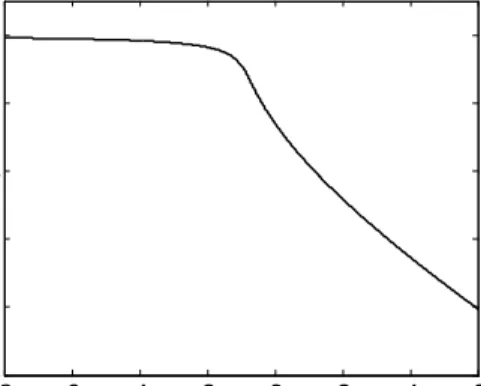
For given β, pairs of α and λ satisfying (37) can be found numerically.
Figure 2 is the relation of α and λ satisfying (37) when β = 4.
Next, we try to find symmetric global solutions of (34) numerically.
For numerical computation it is assumed that g b(x) = √
1 − x
2for −1 ≤ x ≤ 1 and g b(x) = 0 for x / ∈ [−1, 1]. We also assume that some mollifiers are multiplied to g b(x) on each of very small intervals containing 1 and
−1 so that g b(x) is differentiable everywhere. For x < −1, Let (38) η
0(x) = −Ak
′2Sn
2(
√ 3A
2 (x − x
0) + K
′, k
′) + A − B 2 , where A = p
(3α − 2λ)
2+ 8β/3 , B = α−2λ. k
′2= 1/2−(3α−2λ)/2A,
η
0(x
0) = α < 0, η
′0(x
0) = 0, η
0′′(x
0) = β > 0, K
′= K(k
′2) and K is the
Complete Elliptic Integral of the First Kind. Here, α, β, and γ satisfy the
relation (37) and η
0has its negative minimum at x
0. Since we concerns
-5 -4 -3 -2 -1 0 1 2 3 4 -10
-5 0 5 10 15 20 0(0)
λλλλ
ηηηη
p1
p2
p3
p4
λλλλ1111=−2.133=−2.133=−2.133=−2.133 λλλλ2222=−0.949=−0.949=−0.949=−0.949
Figure 3. The relation between η
0(0) and λ when β=4
symmetric solutions, to find a solution in |x| < 1 we need only consider (34) in −1 ≤ x ≤ 0 subject to (η
0x)
2= −3η
03+ 6λη
02+ P η
0+ N at x = −1 and η
′0(x) = 0 at x = 0, where P = 9α
2− 12λα + 2β, N = 3α
3− 6λα
2− P α. This problem can be solved numerically by a shooting method and the location of x
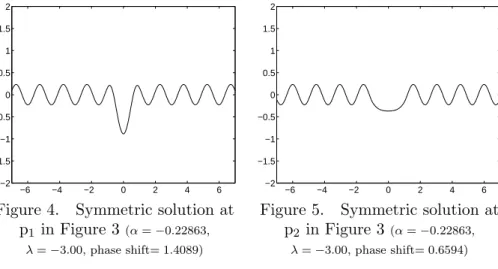
0is then determined by (38) for x = −1. The numerical results are presented in Figures 3-7. In Figure 3, we show the relationship between η
0(0) and λ when β = 4. This numerical results illustrates that two critical values λ
1and λ
2of λ exist.
Two types of symmetric solutions exist for λ > λ
2and another two types of symmetric solutions exist for λ < λ
1. No symmetric solution exists for λ in between λ
1and λ
2. We note that only one critical value of λ is found if we consider solitary wave solution for x ≤ −1 [4]. Four
−6 −4 −2 0 2 4 6
−2
−1.5
−1
−0.5 0 0.5 1 1.5 2
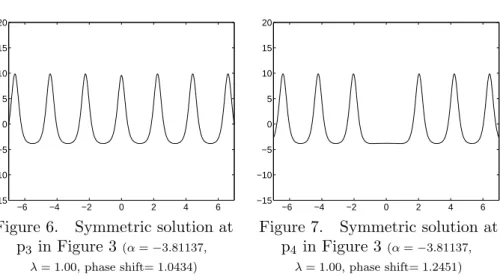
Figure 4. Symmetric solution at p
1in Figure 3
(α = −0.22863,λ = −3.00, phase shift= 1.4089)
−6 −4 −2 0 2 4 6
−2
−1.5
−1
−0.5 0 0.5 1 1.5 2
Figure 5. Symmetric solution at p
2in Figure 3
(α = −0.22863,λ = −3.00, phase shift= 0.6594)
−6 −4 −2 0 2 4 6
−15
−10
−5 0 5 10 15 20
Figure 6. Symmetric solution at p
3in Figure 3
(α = −3.81137,λ = 1.00, phase shift= 1.0434)
−6 −4 −2 0 2 4 6
−15
−10
−5 0 5 10 15 20
Figure 7. Symmetric solution at p
4in Figure 3
(α = −3.81137,λ = 1.00, phase shift= 1.2451)
typical symmetric solutions are given in Figures 4 to 7. Figure 4 and 5 shows two different types of symmetric solutions at p
1and p
2in Figure 3 respectively when β = 4 and λ = −3. Another two different shape of symmetric solutions are given in Figures 6 and 7 at p
3and p
4in Figure 3 respectively when β = 4 and λ = 1.
4. Concluding remark
In this paper we consider the physical problem of steady state flow past a positive symmetric body at the horizontal bottom. Two new results have been found. First, a forced KdV equation for surface wave is derived without assuming that fluid being considered is of constant depth at far upstream, which allows to consider periodic waves ahead of the symmetric body at the horizontal bottom. Secondly, two cut off points of Froude number F
1= 1 + ǫλ
1and F
2= 1 + ǫλ
2for symmetric wave solutions have been found numerically by considering periodic solutions in the set on which the forcing term of the Forced KdV equation is zero.
Acknowledgments. We thank to the one of the referees for helpful suggestions and to the Korea University’s supports.
References
[1] J. W. Choi, Free Surface Waves over a Depression, Bull. Austral. Math. Soc. 65 (2002), 329–335.
[2] , On the atmospheric interfacial waves, Phys. Fluids 12 (2000), 3293–3296.
[3] J. W. Choi and M. C. Shen, On a critical case of internal solitary waves in a two-layer fluid, Phys. Fluids 9 (1997), 2804–2807.
[4] J. W. Choi, S. M. Sun, and M. C. Shen, Steady capillary-gravity waves on the interface of two-layer fluid over an obstruction-Forced Modified K-dV Equation, J. Eng. Math. 28 (1994), 193–210.
[5] H. T. Davis, Introduction to Nonlinear differential and integral equation, Dover Publication, 1960.
[6] L. K. Forbes, Critical free surface flow over a semi-circluar obstruction, J. Eng.
Math. 22 (1988), 3–13.
[7] L. K. Forbes and L. W. Schwartz, Free surface flow over a semi-circular obstruc- tion, J. Fluid Mech. 144 (1982), 299–314.
[8] S. P. Shen, Forced solitary waves and hydrauric falls in two layer flows, J. Fluid.
Mech. 234 (1992), 583–612.
[9] S. P. Shen, M. C. Shen, and S. M. Sun, A model equation for steady surface waves over a bump, J. Eng. Math. 23 (1989), 315–323.
[10] J. M. Vanden Broeck, Free surface flow over a semi-circular obstruction in a channel, Phys. Fluids 30 (1987), 2315–2317.