• 검색 결과가 없습니다.

Octyl Gallate Inhibits ATP-induced Intracellular Calcium Increase in PC12 Cells by Inhibiting Multiple Pathways

N/A
N/A
Protected

Academic year: 2022

Share "Octyl Gallate Inhibits ATP-induced Intracellular Calcium Increase in PC12 Cells by Inhibiting Multiple Pathways"

Copied!
8
0
0

로드 중.... (전체 텍스트 보기)

전체 글

(1)

DOI: 10.4196/kjpp.2010.14.1.21

21

ABBREVIATIONS: AM, acetoxymethylester; DMEM, Dulbecco’s modified Eagle’s medium; FBS, fetal bovine serum; HS, horse serum;

HEPES-HBSS, HEPES-buffered Hanks’s solution; PKC, protein kinase C; PLC, phospholipase C; EGCG, (-)-epigallocatechin-3-gallate.

Received December 17, 2009, Revised January 18, 2010, Accepted January 26, 2010

Corresponding to: Shin Hee Yoon, Department of Physiology, College of Medicine, The Catholic University of Korea, 505, Banpo-dong, Seocho-gu, Seoul 137-701, Korea. (Tel) 82-2-2258-7276, (Fax) 82-2- 532-9575, (E-mail) [email protected]

Octyl Gallate Inhibits ATP-induced Intracellular Calcium Increase in PC12 Cells by Inhibiting Multiple Pathways

Yujie Guo, Yi Jae Hong, Hyun-Jong Jang, Myung-Jun Kim, Duck-Joo Rhie, Yang-Hyeok Jo, Sang June Hahn, and Shin Hee Yoon

Department of Physiology, College of Medicine, The Catholic University of Korea, Seoul 137-701, Korea

Phenolic compounds affect intracellular free Ca

2+

concentration ([Ca

2+

]

i

) signaling. The study examined whether the simple phenolic compound octyl gallate affects ATP-induced Ca

2+

signaling in PC12 cells using fura-2-based digital Ca

2+

imaging and whole-cell patch clamping. Treatment with ATP (100 μM) for 90 s induced increases in [Ca

2+

]

i

in PC12 cells. Pretreatment with octyl gallate (100 nM to 20 μM) for 10 min inhibited the ATP-induced [Ca

2+

]

i

response in a concentration-dependent manner (IC

50

=2.84 μM). Treatment with octyl gallate (3 μM) for 10 min significantly inhibited the ATP-induced response following the removal of extracellular Ca

2+

with nominally Ca

2+

-free HEPES HBSS or depletion of intracellular Ca

2+

stores with thapsigargin (1 μM). Treatment for 10 min with the L-type Ca

2+

channel antagonist nimodipine (1 μM) significantly inhibited the ATP-induced [Ca

2+

]

i

increase, and treatment with octyl gallate further inhibited the ATP-induced response. Treatment with octyl gallate significantly inhibited the [Ca

2+

]

i

increase induced by 50 mM KCl. Pretreatment with protein kinase C inhibitors staurosporin (100 nM) and GF109203X (300 nM), or the tyrosine kinase inhibitor genistein (50 μM) did not significantly affect the inhibitory effects of octyl gallate on the ATP-induced response. Treatment with octyl gallate markedly inhibited the ATP-induced currents.

Therefore, we conclude that octyl gallate inhibits ATP-induced [Ca

2+

]

i

increase in PC12 cells by inhibiting both non-selective P2X receptor-mediated influx of Ca

2+

from extracellular space and P2Y receptor-induced release of Ca

2+

from intracellular stores in protein kinase-independent manner. In addition, octyl gallate inhibits the ATP-induced Ca

2+

responses by inhibiting the secondary activation of voltage-gated Ca

2+

channels.

Key Words: Ca

2+

, Flavonoid, Octyl gallate, PC12 cells, Phenolic compound, Purinergic receptor, Voltage-gated Ca

2+

channels

INTRODUCTION

ATP is a neurotransmitter or neuromodulator in many areas of the peripheral and central nervous system [1,2].

ATP induces an increase in intracellular free Ca

2+

concen- tration ([Ca

2+

]

i

) in PC12 cells by activating both P2X-re- ceptor-regulated non-selective cation channels [3] and P2Y-receptor-mediated phospholipase C (PLC) [4,5]. In ad- dition, the ATP-induced activation of non-selective cation channels induces an increase in [Ca

2+

]

i

through the depola- rization-induced activation of voltage-gated L-type Ca

2+

channels [5].

Fruits, vegetables, beverages, plants, and some herbs are enriched with powerful antioxidant polyphenols. Phenolic compounds are attracting increasing interest from consum- ers and manufacturers because numerous epidemiological

studies have suggested associations between the con- sumption of polyphenol-rich foods or beverages and the pre- vention of certain chronic diseases such as cancers and car- diovascular diseases [6,7]. Moreover, these compounds have been reported to be able to protect neuronal cells in various in vitro and in vivo models through different intracellular targets [8-13]. Phenolic compounds affect the function of voltage-gated ion channels [14-17] including voltage-gated Ca

2+

channels [18]. Phenolic compounds have ability to af- fect agonist-induced [Ca

2+

]

i

increase in neuronal cells [19-22]. Octyl gallate is a simple phenol compound that po- tently inhibits the flux of Ca

2+

into rat pituitary GH

4

C

1

cells [23].

ATP-induced [Ca

2+

]

i

increase in PC12 cells may be in- volved in the release of catecholamine in PC12 cells [24-26]

and in cell death [27]. Although octyl gallate has been re-

ported to have inhibitory effects on Ca

2+

flux into rat pitui-

tary GH

4

C

1

cells, there are no reports on the effect of octyl

gallate against ATP-induced Ca

2+

signaling in cultured

(2)

er reagents were purchased from Sigma-Aldrich (St. Louis, MO, USA).

Cell culture

PC12 rat medulla pheochromocytoma cells were grown in DMEM supplemented with 10% FBS and 10% HS at 37

o

C in a humidified atmosphere of 10% CO

2

and 90% O

2

. To measure [Ca

2+

]

i

, cells from a stock culture were plated in wells of six-well culture plates at a density of 3×10

4

cells /well; each well contained a 25 mm-diameter coverslip (Fisher Scientific, Pittsburgh, PA, USA). Cells were used for experiment 2∼3 days after plating.

Ca

2+

imaging

Digital imaging of Ca

2+

was performed as described pre- viously [28]. Cells were loaded with 12 μM fura-2 AM in HEPES-buffered Hanks’s solution (HEPES-HBSS; 20 mM HEPES,137 mM NaCl, 1.26 mM CaCl

2

, 0.4 mM MgSO

4

, 0.5 mM MgCl

2

, 5 mM KCl, 0.4 mM KH

2

PO

4

, 0.6 mM Na

2

HPO

4

, 3 mM NaHCO

3

, and 5 mM glucose) containing 0.5% bovine serum albumin for 45 min at 37

o

C. CaCl

2

was removed for nominally Ca

2+

-free HEPES HBSS. To elicit depolariza- tion-induced activation of the voltage-gated Ca

2+

channels, we used 50 mM KCl HEPES-HBSS, in which 137 mM NaCl and 5 mM KCl were replaced with 92.3 mM NaCl and 50 mM KCl, respectively. The loading was terminated by washing with HEPES-HBSS for 15 min before starting the experiment. The coverslip was mounted in a flow through chamber, which was superfused at 2 ml/min. Solutions were selected with a multi-port valve coupled to several reser- voirs. The chamber containing the fura-2-loaded cells was mounted on the stage of an inverted microscope and alter- nately excited at 340 or 380 nm by rapidly switching optical filters (10 nm band pass) mounted on a computer-controlled wheel placed between a 100 W Xe arc lamp and the epi- fluorescence port of the microscope. Excitation light was re- flected from a dichroic mirror (400 nm) through a 20× ob- jective (Nikon; N.A. 0.5). Digital fluorescence images (510 nm, 40 nm band-pass) were collected with a cooled charge- coupled device camera cascade 512B (512×512 binned to 256×256 pixels; Photometrics, Tucson, AZ, USA) controlled by a computer. Image pairs were collected every 3∼60 s using an Imaging Work Bench 6.0 (INDEC BioSystems, Santa Clara, CA, USA) exposure to excitation light was 120 ms per image. Cells were delimited by producing a mask that contained pixel values above a threshold applied to the 380 nm image. Background images were collected at

were controlled using pClamp 6.03 software (Molecular Devices, Sunnyvale, CA, USA). Drugs were dissolved in the external solution and delivered with a linear array of 0.32 mm inner diameter microcapillary tubes. The tips of the drug application pipettes were placed within 100 μm of the cells [29].

Statistical analyses

Data are expressed as means±SEM. Significance was de- termined with a one-way ANOVA followed by a Bonferroni’s test and non-paired or paired Student’s t-test.

RESULTS

Effect of octyl gallate on ATP-induced [Ca

2+

]

i

increase in cultured PC12 cells

Treatment with ATP (100 μM) for 90 s transiently in- duced increased [Ca

2+

]

i

in PC12 cells. Reproducible re- sponses could be elicited by applying ATP (100 μM) for 90 s at 30 min intervals (relative to peak 1=103.0±3.0%, n=99) (Fig. 1A). To determine whether octyl gallate specifically affects the ATP-induced [Ca

2+

]

i

increase, cells were pre- treated for 10 min with 100 nM, 300 nM, 1 μM, 3 μM, 10 μM, or 20 μM octyl gallate. Treatment with 100 nM oc- tyl gallate for 10 min did not significantly affect the ATP-in- duced [Ca

2+

]

i

increase (relative to peak 1=109.0±7.4%, n=35) (Fig. 1B), whereas treatment with the increasing con- centrations of octyl gallate (300 nM to 20 μM) significantly inhibited ATP-induced responses in a concentration-dependent manner (relative to peak 1=84.8±2.7%, n=26 at 300 nM;

74.8±3.1%, n=30 at 1 μM; 56.9±4.0%, n=39 at 3 μM;

20.5±4.0%, n=21 at 10 μM; 14.7±3.1%, n=15 at 20 μM;

Figs. 1C∼H). A non-linear least-squares fit by the prism 5.0 to the concentration-response data yielded an IC

50

of 2.84±0.18 μM for octyl gallate (Fig. 1H). Thereafter, 3.0 μM octyl gallate was used to quantify and confirm the in- hibitory effects of octyl gallate on ATP-induced [Ca

2+

]

i

response.

Inhibitory effects of octyl gallate on ATP-induced Ca

2+

release from intracellular stores and Ca

2+

influx from the extracellular space

ATP induces releases Ca

2+

from intracellular stores or

Ca

2+

influx from the extracellular space in PC12 cells. The

nature of the octyl gallate-mediated inhibition of ATP-in-

(3)

Fig. 1. Concentration-dependent inhibitory effects of octyl gallate on the ATP-induced [Ca

2+

]

i

increase in PC12 cells. (A∼G) After pretreating cells with various concentration of octyl gallate, subsequent ATP-induced [Ca

2+

]

i

response was observed. Image pairs were collected at 3∼60 s intervals. ATP and octyl gallate were applied as indicated by the horizontal bars. (H) Summary of concentration-response data.

The ATP-induced response amplitude is presented as a percentage of the initial control (relative to peak 1) (n=99, 35, 26, 30, 39, 21, 15 at 0, 100 nM, 300 nM, 1 μM, 3 μM, 10 μM, 20 μM, respectively). A non-linear least-squares fit by the prism software 5.0 to the concentration-response data yielded an IC

50

of 2.84 μM for octyl gallate. Data represent mean±SEM.

duced [Ca

2+

]

i

increase was investigated. Specifically, we tested whether the removal of extracellular Ca

2+

by treat- ment with nominally Ca

2+

-free HEPES HBSS or the deple- tion of intracellular Ca

2+

stores by treatment with thapsi- gargin which depletes and irreversibly prevents the refill- ing of intracellular stores [30], affected ATP-induced [Ca

2+

]

i

increase in the absence or presence of octyl gallate.

Reproducible responses were elicited by applying ATP (100 μM) for 90 s at 30 min intervals (103.0±3.0% of the control responses, n=99) (Fig. 2A, D). Removal of Ca

2+

for 2 min markedly inhibited the subsequent ATP-induced [Ca

2+

]

i

response, but ATP still induced a small response (relative to peak 1=17.2±5.6%, n=33). These results suggest that the ATP-induced [Ca

2+

]

i

increase in PC12 cells is largely medi- ated by Ca

2+

influx from the extracellular space. Pretreat- ment with octyl gallate (3 μM) for 10 min significantly in- hibited the ATP-induced response in the presence of nomi- nally Ca

2+

-free HEPES HBSS for 2 min (relative to peak 1=12.4±5.4%, n=33) (Fig. 2B, D). Pretreatment with thapsi-

gargin significantly decreased the subsequent ATP-induced response (relative to peak 1=73.9± 2.7%, n=59). Treatment with octyl gallate for 10 min significantly inhibited the ATP-induced responses in thapsigargin-treated cells (relative to peak 1=48±2.8%, n=59) (Fig. 2C, D).

Inhibitory effects of octyl gallate on ATP-induced secon- dary Ca

2+

influx through voltage-gated Ca

2+

channels ATP activates secondarily voltage-gated L-type Ca

2+

channels in PC12 cells through the P2X receptor-mediated depolarization by influx of Ca

2+

and Na

[5]. We tested whether octyl gallate affects the ATP-induced secondary ac- tivation of voltage gated L-type Ca

2+

channels (Fig. 3).

Pretreatment with nimodipine (1 μM) for 10 min sig- nificantly inhibited the subsequent ATP-induced [Ca

2+

]

i

re- sponse (relative to peak 1=58.8±2.7% , n=25) (Fig. 3A1).

Treatment with octyl gallate (3 μM) for 10 min also sig-

nificantly inhibited the subsequent ATP-induced [Ca

2+

]

i

re-

(4)

of Ca

2+

from intracellular stores and Ca

2+

influx from the extracellular space. (A) Reproducible [Ca

2+

]

i

in- creases were elicited by super fusion with 100 μM ATP for 90 s at 30 min intervals. ATP-induced [Ca

2+

]

i

were recorded after treatment with nomi- nally Ca

2+

-free HEPES-HBSS for 2 min (B) or with thapsigargin (1 μM) for 15 min (C); then 20 min later the ATP-induced responses were recorded in the presence of octyl gallate (3 μM) for 10 min. (D) Summary of the effects of octyl gallate on ATP-induced [Ca

2+

]

i

increase. The amplitude of the ATP- induced response is presented as a percentage of the initial control (rela- tive to peak 1) for the control (n=99), nominally Ca

2+

-free HEPES-HBSS- treated (0 Ca

2+

, n=33), 0 Ca

2+

plus octyl gallate-treated (n=33), thapsi- gargin-treated (n=59), and thapsigar- gin plus octyl gallate-treated (n=59) cells. Data represent mean±SEM.

*p<0.05 relative to respective control (paired Student’s t-test).

p<0.05 relative to respective non-octyl gallate- treated cells (paired Student’s t-test).

sponse (relative to peak 1=54.8±3.6%, n=25). Moreover, treatment for 10 min octyl gallate (3 μM) further inhibited the ATP-induced response in the presence of nimodipine (relative to peak 1=39.3±3.7%, n=25).

Since ATP increases [Ca

2+

]

i

by the release of Ca

2+

from intracellular stores as well as extracellular Ca

2+

influx (Fig. 2), the next experiment assessed whether octyl gallate could inhibit ATP-induced Ca

2+

influx in intracellular store-depleted cells (Fig. 3A2). Cells were pretreated with thapsigargin (1 μM) for 45 min during the fura-2 loading period, since the thapsigargin-induced [Ca

2+

]

i

increase re- turns to near basal levels after a 15 min exposure to thapsi- gargin [5]. Treatment with nimodipine (1 μM) for 10 min significantly inhibited the subsequent ATP-induced [Ca

2+

]

i

response (relative to peak 1=50.7±3.6%, n=30) (Fig. 3A2), as did treatment with octyl gallate (3 μM) for 10 min (relative to peak 1=57.6±3.8%, n=30). Moreover, treatment with 3 μM octyl gallate for 10 min further inhibited the ATP-induced response in the presence of nimodipine (relative to peak 1=37.1±3.5%, n=30).

To confirm the inhibitory effect of octyl gallate on the

secondary Ca

2+

influx through the ATP-induced activation of voltage-gated Ca

2+

channels, it was determined whether octyl gallate could inhibit the depolarization-induced acti- vation of Ca

2+

channels using 50 mM KCl HEPES HBSS (Fig. 3B). Reproducible [Ca

2+

]

i

increases were induced by treatment for 90 s with 50 mM KCl HEPES HBSS at 30 min intervals (relative to peak 1=98.5±3.0%, n=31). Pre- treatment for 5 min with octyl gallate (3 μM) significantly inhibited the subsequent high KCl-induced [Ca

2+

]

i

response (relative to peak 1=30.7±4.0%, n=26).

Effects of protein kinase inhibitors on the ATP-induced [Ca

2+

]

i

increases

ATP induces activation of phospholipase C (PLC) in PC12

cells [5], which can activate protein kinase C (PKC) and

tyrosine kinase. Phenolic compounds also potently inhibit

several kinases involved in signal transduction, mainly

PKC and tyrosine kinases [31], and tyrosine phosphor-

ylation can induce Ca

2+

influx [32]. Appropriately, an ex-

periment was done to ascertain whether octyl gallate could

(5)

Fig. 3. Inhibitory effects of octyl gallate on the ATP-induced secondary Ca

2+

influx through voltage-gated Ca

2+

channels. Effects of nimodipine and octyl gallate on ATP (100 μM)-induced [Ca

2+

]

i

increase in untreated cells (A1) and thapsigargin-treated cells (A2).

Cells were pretreated with thapsigargin (1 μM) for 45 min during the fura-2 loading period, since thapsigargin-induced increase in [Ca

2+

]

i

returns to near basal levels after a 15 min exposure to thapsigargin. The amplitude of the ATP-induced response after treatment of vehicle (control) (n=25, n=24), nimodipine (n=25, n=24), octyl gallate (n=25, n=24), nimodipine plus octyl gallate (n=25, n=24) is presented as a percentage of the initial control in untreated and thapsigargin-treated cells, respectively. (B) Effects of octyl gallate on KCl (50 mM K

HEPES-HBSS)-induced [Ca

2+

]

i

increase. The amplitude of the KCl-induced response after treat- ment of vehicle (n=31) or octyl gallate (n=26) is presented as a percentage of the initial control. Data represent mean±SEM. *p<0.05 relative to respective control or KCl-treated cell;

p<0.05 relative to respective nomodipine or octyl gallate-treated cells (one way ANOVA followed by Bonferroni’s test and paired Student’s t-test).

Fig. 4. ATP-induced [Ca

2+

]

i

increase were not inhibited by treat- ment with PKC inhibitors staurosporin, GF10923X or the tyrosine kinase inhibitor genistein. ATP-induced responses were induced in the presence of vehicle (control, n=59), octyl gallate (3 μM, n=39), staurosprin (100 nM, n=30), staurosprin (100 nM) plus octyl gallate (3 μM) (n=29), GF 109203X (300 nM, n=32), GF 109203X (300 nM) plus octyl gallate (3 μM) (n=29), genistein (50 μM, n=35), genistein (50 μM) plus octyl gallate (3 μM) (n=34) for 10 min following 90 s exposure to ATP and a 20 min wash. The amplitude of the ATP- induced response is presented as a percentage of the initial control responses. Data are expressed as mean±SEM. *p<0.05 relative to respective non-octyl gallate-treated cells (one way ANOVA followed by Bonferroni’s test).

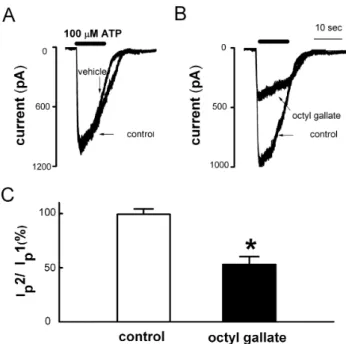
Fig. 5. Inhibitory effects of octyl gallate on ATP-induced inward currents in PC12 cell. (A) Application of ATP (100 μM, 10 s) evoked inward currents (control). In the same cells, a second application of ATP induced inward current after 10 min washout (vehicle) (n=9).

(B) Pretreatment with 3 μM octyl gallate for 10 min inhibited the ATP-induced inward current (octyl gallate, n=6). (C) Summary of the effect of octyl gallate on ATP-induced inward currents. The amplitude of second ATP-induced response (I

p

2) is presented as a percentage of the initial control (I

p

1) (I

p

2/I

p

1). Data are expressed as mean±SEM. *p<0.05 relative to control (non-paired student’s t-test).

inhibit ATP-induced [Ca

2+

]

i

increase via inhibition of PKC

or tyrosine kinase (Fig. 4). Pretreatment for 10 min with

the non-specific PKC inhibitor staurosporin (100 nM), the

specific PKC inhibitor GF109203X (300 nM), or the tyrosine

kinase inhibitor genistein (50 μM) did not affect the

ATP-induced response. However, treatment with octyl gal-

late (3 μM) significantly inhibited the ATP-induced re-

sponse in the presence of the non-specific or specific PKC

inhibitors, and the tyrosine kinase inhibitor. Moreover, no

differences were observed in the response induced by treat-

ment with octyl gallate in the presence or absence of the

kinase inhibitors.

(6)

Pretreatment with octyl gallate (3 μM) for 10 min sig- nificantly inhibited the ATP-induced currents (I

p

2/I

p

1=

52.9±7.3%, n=6) (Fig. 5B).

DISCUSSION

The present results demonstrate that octyl gallate clearly inhibits ATP-induced [Ca

2+

]

i

increases in PC12 cells, by in- hibiting both non-selective P2X receptors from extracellular space and P2Y receptor-induced release of Ca

2+

from intra- cellular stores. In addition, octyl gallate inhibited the ATP-induced currents and the depolarization-induced [Ca

2+

]

i

increase.

In this study, the removal of extracellular Ca

2+

markedly inhibited the ATP-induced [Ca

2+

]

i

increase. Treatment with nimodipine (1 μM) inhibited the ATP-induced [Ca

2+

]

i

in- crease in thapsigargin-treated and non-thapsigargin-treated cells by 49.3% and 41.2%, respectively, confirming our ear- lier observations [5]. Treatment with octyl gallate further significantly inhibited the ATP-induced response in the presence of nimodipine in untreated or thapsigargin-treated cells, suggesting that the inhibition of Ca

2+

influx by octyl gallate may be both nimodipine-sensitive and nimodi- pine-insensitive. ATP also induces [Ca

2+

]

i

increases partly by an influx of non-selective cations, such as Ca

2+

and Na

, in PC12 cells [3]. In fact, using a whole-cell voltage-clamp- ing technique in the present study, it was demonstrated that octyl gallate inhibits ATP-induced inward currents.

These data suggest that octyl gallate inhibits ATP-induced Ca

2+

influx by inhibiting non-selective cation channels.

Octyl gallate inhibits voltage-gated Ca

2+

channels in rat pituitary GH

4

C

1

cells [23]. In PC12 cells, ATP induces Ca

2+

influx through the secondary activation of voltage-gated Ca

2+

channels following depolarization of the membrane by the ATP-induced activation of non-selective cation channels [34]. In addition to L-type voltage-dependent Ca

2+

chan- nels, it has been reported that ATP can induce a [Ca

2+

]

i

increase in PC12 cells through dihydropyridine- and CTX- insensitive-voltage-dependent Ca

2+

channels [34]. In this study, octyl gallate inhibited high KCl-induced [Ca

2+

]

i

increase. Treatment with octyl gallate or nimodipine in- hibited ATP-induced Ca

2+

influx in PC-12 cells. In addition, treatment with octyl gallate further inhibited the ATP-in- duced Ca

2+

influx in the presence of nimodipine. Collectively, these data suggest that octyl gallate inhibits the ATP-in- duced Ca

2+

influx in PC12 cells through inhibition of the secondary activation of voltage-gated L-type Ca

2+

channels and dihydropyridine- and CTX-insensitive-voltage-depend-

kinase-independent manner.

In this study, octyl gallate inhibited the ATP-induced [Ca

2+

]

i

increases in concentration- dependent manner.

Pretreatment with the Ca

2+

-ATPase antagonist thapsigargin decreased the ATP-induced [Ca

2+

]

i

responses. Pretreatment with octyl gallate inhibited ATP-induced Ca

2+

release from intracellular stores following the removal of extracellular Ca

2+

. In the present study, however, we could not de- termine how octyl gallate inhibits the ATP- [Ca

2+

]

i

increase through the inhibition of P2Y receptor-mediated signaling.

The inhibitory effects of flavonoid on ion channels have been reported to be mediated by binding to ligand-gated channels, voltage-gated channels, and the membrane lipid bilayer. Apigenin has been reported to inhibit GABA-acti- vated Cl- currents through binding to the benzodiazepine site [39]. Genistein blocked the voltage-sensitive Na

chan- nels through a direct binding to the channels [40].

(-)-Epigallocatechin-3-gallate (EGCG) inhibits rKv1.5 chan- nels [41]. In addition, polyphenols have also been reported to interact with the membrane lipid bilayer to exert their biological functions [42, 43]. Membrane lipid can affect ion channel structure and fuction [44]. Collectively, it is possi- ble that octyl gallate in the present study exerted inhibition effects by directly binding to the P2X receptors and IP

3

re- ceptor or L-type Ca

2+

channels and then reducing allosteric inhibition of the channels. However, the present study has provided no further information on how octyl gallate might exert its inhibitory effects on channels at molecular level.

ATP is a widely distributed neurotransmitter and neuro- modulator in the peripheral and central nervous system [1,2].

ATP receptors regulate various functions including the re- lease of neurotransmitters in the peripheral and central nervous systems [45-47]. ATP-induced [Ca

2+

]

i

increases in PC12 cells may be involved in the cell death [27]. The pres- ent study provides available information that octyl gallate inhibits ATP-induced [Ca

2+

]

i

increases by inhibiting multi- ple pathways. More research is needed to assess the alleged heath benefits of octyl gallate including synaptic trans- mission and neuroprotective effect by modulating calcium homeostasis.

ACKNOWLEDGEMENTS

This research was supported by a grant No. R13-2002-

005-04001-0 (2009) from the Medical Research Center,

Korea Science and Engineering Foundation, Republic of

Korea.

(7)

REFERENCES

1. Jahr CE, Jessell TM. ATP excites a subpopulation of rat dorsal horn neurones. Nature. 1983;304:730-733.

2. Inoue K. ATP receptors for the protection of hippocampal functions. Jpn J Pharmacol. 1998;78:405-410.

3. Fasolato C, Pizzo P, Pozzan T. Receptor-mediated calcium influx in PC12 cells. ATP and bradykinin activate two indepen- dent pathways. J Biol Chem. 1990;265:20351-20355.

4. Murrin RJ, Boarder MR. Neuronal "nucleotide" receptor linked to phospholipase C and phospholipase D: Stimulation of PC12 cells by ATP analogues and UTP. Mol Pharmacol. 1992;41:561- 568.

5. Kim HJ, Choi JS, Lee YM, Shim EY, Hong SH, Kim MJ, Min DS, Rhie DJ, Kim MS, Jo YH, Hahn SJ, Yoon SH. Fluoxetine inhibits ATP-induced [Ca

2+

]

i

increase in PC12 cells by inhibiting both extracellular Ca

2+

influx and Ca

2+

release from intracellular stores. Neuropharmacology. 2005;49:265-274.

6. Manach C, Mazur A, Scalbert A. Polyphenols and prevention of cardiovascular diseases. Curr Opin Lipidol. 2005;16:77-84.

7. Duthie SJ. Berry phytochemicals, genomic stability and cancer:

evidence for chemoprotection at several stages in the carcino- genic process. Mol Nutr Food Res. 2007;51:665-674.

8. Levites Y, Amit T, Mandel S, Youdim MB. Neuroprotection and neurorescue against Abeta toxicity and PKC-dependent release of nonamyloidogenic soluble precursor protein by green tea polyphenol (-)-epigallocatechin-3-gallate. FASEB J. 2003;17:952- 9. Ono K, Yoshiike Y, Takashima A, Hasegawa K, Naiki H, 954.

Yamada M. Potent anti-amyloidogenic and fibril-destabilizing effects of polyphenols in vitro: implications for the prevention and therapeutics of Alzheimer's disease. J Neurochem. 2003;87:

172-181.

10. Ramassamy C. Emerging role of polyphenolic compounds in the treatment of neurodegenerative diseases: a review of their intracellular targets. Eur J Pharmacol. 2006;545:51-64.

11. Silva JP, Proenca F, Coutinho OP. Protective role of new nitrogen compounds on ROS/RNS-mediated damage to PC12 cells. Free Radic Res. 2008;42:57-69.

12. Zhao B. Natural antioxidants protect neurons in Alzheimer's disease and Parkinson's disease. Neurochem Res. 2009;34:

630-638.

13. Bastianetto S, Yao ZX, Papadopoulos V, Quirion R. Neuro- protective effects of green and black teas and their catechin gallate esters against beta-amyloid-induced toxicity. Eur J Neurosci. 2006;23:55-64.

14. Ko FN, Huang TF, Teng CM. Vasodilatory action mechanisms of apigenin isolated from Apium graveolens in rat thoracic aorta. Biochim Biophys Acta. 1991;1115:69-74.

15. Saponara S, Sgaragli G, Fusi F. Quercetin as a novel activator of L-type Ca

2+

channels in rat tail artery smooth muscle cells.

Br J Pharmacol. 2002;135:1819-1827.

16. Losi G, Puia G, Garzon G, de Vuono MC, Baraldi M. Apigenin modulates GABAergic and glutamatergic transmission in cultured cortical neurons. Eur J Pharmacol. 2004;502:41-46.

17. Kim HJ, Yum KS, Sung JH, Rhie DJ, Kim MJ, Min do S, Hahn SJ, Kim MS, Jo YH, Yoon SH. Epigallocatechin-3-gallate increases intracellular [Ca

2+

]

i

in U87 cells mainly by influx of extracellular Ca

2+

and partly by release of intracellular stores.

Naunyn Schmiedebergs Arch Pharmacol. 2004;369:260-267.

18. Formica JV, Regelson W. Review of the biology of quercetin and related bioflavonoids. Food Chem Toxicol. 1995;33:1061-1080.

19. Han JH, Kim KJ, Jang HJ, Jang JH, Kim MJ, Sung KW, Rhie DJ, Jo YH, Hahn SJ, Lee MY, Yoon SH. Effects of apigenin on glutamate-induced [Ca

2+

]

i

Increases in aultured rat hippo- campal neurons. Kor J Physiol Pharmacol. 2008;12:43-50.

20. Lin F, Xin Y, Wang J, Ma L, Liu J, Liu C, Long L, Wang F, Jin Y, Zhou J, Chen J. Puerarin facilitates Ca

2+

-induced Ca

2+

release triggered by KCl-depolarization in primary cultured rat hippocampal neurons. Eur J Pharmacol. 2007;570:43-49.

21. Ban JY, Jeon SY, Bae K, Song KS, Seong YH. Catechin and epicatechin from Smilacis chinae rhizome protect cultured rat

cortical neurons against amyloid beta protein (25-35)-induced neurotoxicity through inhibition of cytosolic calcium elevation.

Life Sci. 2006;79:2251-2259.

22. Shimmyo Y, Kihara T, Akaike A, Niidome T, Sugimoto H.

Three distinct neuroprotective functions of myricetin against glutamate-induced neuronal cell death: involvement of direct inhibition of caspase-3. J Neurosci Res. 2008;86:1836-1845.

23. Summanen J, Vuorela P, Rauha JP, Tammela P, Marjamaki K, Pasternack M, Tornquist K, Vuorela H. Effects of simple aromatic compounds and flavonoids on Ca

2+

fluxes in rat pituitary GH

4

C

1

cells. Eur J Pharmacol. 2001;414:125-133.

24. Majid MA, Okajima F, Kondo Y. Characterization of ATP receptor which mediates norepinephrine release in PC12 cells.

Biochim Biophys Acta. 1992;1136:283-289.

25. Nakazawa K, Inoue K. Roles of Ca

2+

influx through ATP- activated channels in catecholamine release from pheochromo- cytoma PC12 cells. J Neurophysiol. 1992;68:2026-2032.

26. Suh BC, Lee CO, Kim KT. Signal flows from two phospholipase C-linked receptors are independent in PC12 cells. J Neurochem.

1995;64:1071-1079.

27. Sun AY, Chen YM. Extracellular ATP-induced apoptosis in PC12 cells. Adv Exp Med Biol. 1998;446:73-83.

28. Rhie DJ, Sung JH, Kim HJ, Ha US, Min DS, Kim MS, Jo YH, Hahn SJ, Yoon SH. Endogenous somatostatin receptors mobilize calcium from inositol 1,4,5-trisphosphate-sensitive stores in NG108-15 cells. Brain Res. 2003;975:120-128.

29. Choi JS, Choi BH, Ahn HS, Kim MJ, Rhie DJ, Yoon SH, Min do S, Jo YH, Kim MS, Sung KW, Hahn SJ. Mechanism of block by fluoxetine of 5-hydroxytryptamine

3

(5-HT

3

)-mediated currents in NCB-20 neuroblastoma cells. Biochem Pharmacol. 2003;66:

2125-2132.

30. Thastrup O, Cullen PJ, Drobak BK, Hanley MR, Dawson AP.

Thapsigargin, a tumor promoter, discharges intracellular Ca

2+

stores by specific inhibition of the endoplasmic reticulum Ca

2+

- ATPase. Proc Natl Acad Sci U S A. 1990;87:2466-2470.

31. Agullo G, Gamet-Payrastre L, Manenti S, Viala C, Remesy C, Chap H, Payrastre B. Relationship between flavonoid structure and inhibition of phosphatidylinositol 3-kinase: a comparison with tyrosine kinase and protein kinase C inhibition. Biochem Pharmacol. 1997;53:1649-1657.

32. Munaron L, Distasi C, Carabelli V, Baccino FM, Bonelli G, Lovisolo D. Sustained calcium influx activated by basic fibroblast growth factor in Balb-c 3T3 fibroblasts. J Physiol. 1995;484:557 33. Nakazawa K, Fujimori K, Takanaka A, Inoue K. An ATP-activated 566.

conductance in pheochromocytoma cells and its suppression by extracellular calcium. J Physiol. 1990;428:257-272.

34. Gollasch M, Haller H. Multiple pathways for ATP-induced intracellular calcium elevation in pheochromocytoma (PC12) cells. Ren Physiol Biochem. 1995;18:57-65.

35. Ferriola PC, Cody V, Middleton E Jr. Protein kinase C inhibition by plant flavonoids. Kinetic mechanisms and structure-activity relationships. Biochem Pharmacol. 1989;38:1617-1624.

36. Duarte J, Perez Vizcaino F, Utrilla P, Jimenez J, Tamargo J, Zarzuelo A. Vasodilatory effects of flavonoids in rat aortic smooth muscle. Structure-activity relationships. Gen Pharmacol.

1993;24:857-862.

37. Revuelta MP, Cantabrana B, Hidalgo A. Depolarization-dependent effect of flavonoids in rat uterine smooth muscle contraction elicited by CaCl2. Gen Pharmacol. 1997;29:847-857.

38. D'Ambrosi N, Murra B, Cavaliere F, Amadio S, Bernardi G, Burnstock G, Volonte C. Interaction between ATP and nerve growth factor signalling in the survival and neuritic outgrowth from PC12 cells. Neuroscience. 2001;108:527-534.

39. Avallone R, Zanoli P, Puia G, Kleinschnitz M, Schreier P, Baraldi M. Pharmacological profile of apigenin, a flavonoid isolated from Matricaria chamomilla. Biochem Pharmacol.

2000;59:1387-1394.

40. Paillart C, Carlier E, Guedin D, Dargent B, Couraud F. Direct block of voltage-sensitive sodium channels by genistein, a tyrosine kinase inhibitor. J Pharmacol Exp Ther. 1997;280:

521-526.

(8)

수치

Fig. 1. Concentration-dependent inhibitory effects of octyl gallate on the ATP-induced [Ca 2+ ] i  increase in PC12 cells
Fig. 5. Inhibitory effects of octyl gallate on ATP-induced inward  currents in PC12 cell

참조

관련 문서

It also suggest that cell proliferation inhibits by a novel signal transduction for adenosine effect in human FaDu hypopharynx squamous cell carcinoma cells....

interaction with anti-apoptotic Bcl-2 family members, we investigated whether Mcl-1 can inhibit the Noxa-induced cell death.. As expected, Mcl-1 significantly inhibits

In other words, pomegranate extract has an effect of inhibiting the progression of alveolar bone loss due to periodontal inflammation by reducing the expression of COX-1 and

(d) displays the CA curves of the Ni2P2O7 electrocatalyst at an applied potential of 1.47 V (vs. • The steady-state CA curve acquired by the Ni 2 P 2 O 7 microsheets

In this study, it is shows that the stream of CO 2 is more effective in the reduction of unreacted TEGDMA and the increase of surface microhardness than that of N 2

Glutamate excitotoxicity induced by excessive activation of NMDA receptor causes various damage to cells, which leads to cell death.. In previous studies, increased ROS

Taking account of these results, in this work, it looks that chlorogenic acid depresses the CA secretory effect revealed by cholinergic secretagogues as well as Ang II

These results suggest that the bilobalide inhibits the cell proliferation and induces the apoptotic cell death in FaDu human pharyngeal squamous cell carcinoma via both