Loquat (Eriobotrya japonica) extracts suppress the adhesion, migration and invasion of human breast cancer cell line*
Min-Sook Kim
1, Mi-Kyoung You
1, Dong-Young Rhuy
2, Yung-Jae Kim
3, Hum-Young Baek
3and Hyeon-A Kim
1§1
Major in Food & Nutrition, Mokpo National University, 61 Dorim-ri cheonggye-myeon, Muan-gun, Jeonnam 534-729, Korea
2
Major in Medical Plant Resources, Mokpo National University, 61 Dorim-ri cheonggye-myeon, Muan-gun, Jeonnam 534-729, Korea
3
Korea INSpharm Research institute, 1065 Daepo-ri, Dong-myeon, Hwasun-gun, Jeonnam 519-882, Korea
Abstract
We examined the inhibitory effects of loquat methanol extract on the adhesion, migration, invasion and matrix metalloproteinase (MMP) activities of MDA-MB-231 human breast cancer cell line. Cells were cultured with DMSO or with 10, 25, or 50 μg/ml of loquat methanol extract. Both leaf and seed extracts significantly inhibited growth of MDA-MB-231 cells in a dose-dependent manner, although leaf extract was more effective.
Adhesion and migration were significantly inhibited by loquat extracts in a dose-dependent manner. Loquat extract also inhibited the invasion of breast cancer cells in a dose-dependent manner and leaf extract was more effective than seed extract. MMP-2 and MMP-9 activities were also inhibited by loquat extract. Our results indicate that methanol extracts of loquat inhibit the adhesion, migration and invasion of human breast cancer cells partially through the inhibition of MMP activity and leaf extract has more anti-metastatic effects in cell based assay than seed extract. Clinical application of loquat extract as a potent chemopreventive agent may be helpful in limiting breast cancer invasion and metastasis.
Key Words: Loquat (Eriobotrya japonica), adhesion, migration, invasion, MMP
Introduction
1)Metastasis is a series of events including the detachment of tumor cells from the primary site, adhesion, migration and invasion of tumor cells into the blood or lymphatic vessel, extravasations out of the vessel, and interactions with the target tissues. Motility and invasion into the new target tissue result in the formation of a secondary tumor (Song et al., 2006; Weber, 2008). These events occur repeatedly during tumor invasion, and inhibition of adhesiveness, motility and invasiveness is likely to contribute to prevention of cancer progression (Festuccia et al., 1998; Festuccia et al., 1999; Weber, 2008). These stages are determined by characteristics inherent to the tumor cells, such as hormone receptor status, production of proteolytic enzymes, expression of cell adhesion molecules and increase in motility (Kohn & Liotta, 1995; Shaikh et al., 2008), as well as by a number of growth factors, matrix molecules and cytokines in the metastatic microenvironment (Yoneda et al., 1994).
Matrix metalloproteinases (MMPs) promote tumor progression by degrading normal barriers (Johansson et al., 2000). MMP-2 and MMP-9 (gelatinase A and B) are related to tumor invasion
and metastasis because of their capacities for tissue remodeling via the extracellular matrix, basement membrane degradation and induction of angiogenesis (Sun et al., 2009).
Loquat (Eriobotrya japonica Lindley) has been used as a medicinal plant in Japan and China. Astringent leaves of loquat have been used for a long time to treat chronic bronchitis, coughs, phlegm, high fever and gastroenteric disorders. Terpenoids isolated from loquat leaves have anti-tumor, antiviral and anti-inflammatory properties (Liang et al., 1990; Nozato et al., 1994; Shimizu et al., 1996; Tommasi et al., 1992). Euscaphic acid, one of triterpene acids isolated from the methanol extract of loquat, was reported to exhibit marked anti-tumor promoting activity in an in vivo two-stage carcinogenesis test of mouse tumor (Banno et al., 2005). Polyphenol compounds in loquat leaves are cytotoxic against human oral tumor cell lines (Ito et al., 2000). In contrast, loquat seeds have the inhibitory effect of oxidative-stress and hypoglycemic property (Kim et al., 2009).
However, a little has been performed on the investigations of their pharmacological importance.
Thus, we investigated anti-metastatic effects of loquat leaf and seed extracts in this study and reported the inhibitory effects of
* This research was financially supported by the ministry of Education, Science Technology (MEST) and Korea Institute for Advancement of Technology (KIAT) through the Human Resource Training Project for Regional Innovation.
§Corresponding Author: Hyeon-A Kim, Tel. 82-61-450-2525, Fax. 82-61-450-2529, Email. [email protected]
Received: September 24, 2009, Revised: November 23, 2009, Accepted: November 30, 2009
ⓒ2009 The Korean Nutrition Society and the Korean Society of Community Nutrition
This is an Open Access article distributed under the terms of the Creative Commons Attribution Non-Commercial License (http://creativecommons.org/licenses/by-nc/3.0/)
which permits unrestricted non-commercial use, distribution, and reproduction in any medium, provided the original work is properly cited.
loquat extracts on the adhesion, migration, invasion and MMP activity of MDA-MB-231 human breast cancer cells.
Materials and Methods
Preparation of the methanol extract
Loquat leaves were collected from the Herb Garden of Mokpo National University in Muan, Korea. Leaves were freeze-dried and powdered. Loquat seeds were collected from Wan-Do in Jeonnam, Korea and used for preparation of extract after peeling of hard shells. The methanol extracts were obtained by macerating leaf powder and seeds with 80% methanol for 2 days at room temperature, and this procedure was repeated twice. The respective extract was filtered under reduced pressure and freeze-dried. The yields obtained were 32% for leaves and 27%
for seeds.
Cells and culture conditions
The MDA-MB-231 human breast cancer cells were obtained from the American Type Culture and Collection (Rockville, MD).
All cells were grown in Dulbecco’s modified Eagle’s medium (DMEM; Gibco, Gaithersburg), supplemented with penicillin 100units/ml, streptomycin 100 μg/ml and 10% fetal bovine serum, and incubated in a humidified incubator at 37℃ and 5%
CO2. Cultures used in subsequent experiments were at < 20 passages.
Cell proliferation assay
To determine the effect of leaf and seed methanol extracts on MDA-MB-231 cell proliferation, cells were seeded in 6-well culture plates at a concentration of 6×10
4/well. Complete medium with DMSO or with 10, 25 or 50 μg/ml of leaf or seed extract were replaced every other day, beginning the day after seeding.
Cells cultured in complete medium were harvested with trypsin-EDTA on day 5 after treatment and counted by a model Z1 Coulter particle counter (Coulter Corp, Miami, Florida).
Cell adhesion assay
Plates (12-wells) were coated with 30μg of Matrigel (Becton Dickinson, Bedford, MA). To block nonspecific binding sites, Matrigel coated culture plates were re-hydrated with serum free DMEM containing 0.1% BSA for 90 min at 37℃ and then washed with the same medium. MDA-MB-231 cells were trypsinized and resuspended in serum free DMEM containing 0.1% BSA. Cells were seeded at a concentration of 2×10
5/ well in the presence of DMSO or of 10, 25 or 50 μg/ml of leaf or seed extract and incubated for 90 min at 37℃ and 5% CO
2. At the end of 90 min, the medium was removed and the cells
were washed gently two times with PBS to remove unattached cells. The attached cells were harvested by trypsinization, resuspended and counted. Each assay was performed in triplicate and repeated in three independent experiments. Values were expressed as the average of triplicate experiment.
Cell migration assay
Motility was assessed using a scratch wound assay (Goodman et al., 1985). Cells were seeded into 6-well cell culture plates at a concentration of 3×10
5cells and cultured in 10% FBS DMEM to near confluence. The confluent monolayer was carefully wounded using a sterile pipette tip and cellular debris was washed gently with PBS. The wounded monolayer was incubated in 10%
FBS DMEM containing 20 μg/mL fibronectin and DMSO or 10, 25 or 50 μg/ml of leaf or seed extract for 24 hours. Migrating cells were examined under 10× by phase contrast microscope and photographed.
Invasion assay
The ability of cells to migrate across a Matrigel barrier (invasion) was determined by a modified Boyden chamber.
Briefly, Boyden chambers were assembled using 8 μm Falcon transwell inserts (Becton Dikinson, Bedford, MA) as the upper chamber and 12-well plates as the lower chamber. Matrigel was applied to the insert and left overnight to dry in a laminar flow fume hood. The insert was re-hydrated with serum free DMEM for 90 min at 37℃ and 5% CO
2. Following rehydration, Matrigel coated inserts were washed with serum free DMEM.
Exponentially growing breast tumor cells were harvested by trypsin/EDTA and resuspended in 0.1% BSA DMEM. Cells were seeded at a concentration of 2×10
5cells. DMSO or 10, 25 or 50 μg/ml of leaf or seed extract was carefully added to the upper chamber. Twenty micrograms of fibronectin was added as a chemoattractant to the lower chamber. The Boyden chamber was incubated for 24 hours at 37℃ and 5% CO
2. At the end of incubation, the cells in the upper chamber were removed by wiping gently with a cotton swab. Cells that transversed the Matrigel and attached to the lower surface of the insert were fixed with 10% formalin and stained with 0.5% crystal violet.
Inserts were examined under 20× or 40× phase contrast field microscopy and photographed. Values for invasion were expressed as the number of migrated cells per microscopic field.
Four fields were counted. Each assay was performed in triplicate and repeated in three independent experiments. Values were expressed as the average of triplicate experiments.
Gelatin zymography
The activity of MMP-2 and MMP-9 in the conditioned media
was assayed by gelatin zymography. Briefly, MDA-MB-231 cells
were seeded at a concentration of 2×10
5/well in 6-well plates.
0 20 40 60 80 100 120
DMSO 1 10 25 50 75 100 200
(ug/ml)
% of control
Leaves Seeds
a ab
g
hi
c d
bc d
f d
a
e
h ab
hi i
(μg/ml)
Fig. 1. Effect of Eriobotrya japonica Lindley extracts on MDA-MB231 cell proliferation. Cells were seeded in 6-well culture plates at a concentration of 6X10⁴/well. Complete medium with DMSO or with 10, 25 or 50 μg/ml of leaf or seed extract were replaced every the other day. Cells cultured in complete medium were harvested on day 5 after treatment and were counted. Data were expressed as mean ± SD. Stand error bars represent three independent experiments and each experiment was triplicated. Means with the same letter are not significantly different by Duncan's multiple test (P< 0.05).
0 20 40 60 80 100 120
DMSO 10 25 50
(ug/ml)
% of control
DMSO Leaves Seeds
a
b b
c
d
e
f
(μg/ml)Fig. 2. Effect of Eriobotrya japonica Lindley extracts on MDA-MB231 cell adhesion. Cells were added to matrigel coated plates and incubated for 90 min in present of DMSO or 10, 25 or 50 μg/ml of leaf or seed extract. Attached cells were counted. Data were expressed as mean ± SD. Stand error bars represent three independent experiments and each experiment was triplicated. Means with the same letter are not significantly different by Duncan's multiple test (P< 0.05).
After treatment with DMSO or 10, 25 or 50 μg /ml of leaf or seed extract for 24 hours, the supernatants were collected and subjected to gel electrophoresis on 10% running gels containing 0.1% gelatin. The gels were washed in 2.5% Triton X-100 for 30 minutes, followed by incubation for 20 hours at 37℃ in the incubation buffer containing 50 mM Tris-HCl (pH 7.5), 0.2 M NaCl, 1 mM CaCl
2and 0.2% NaN
3. The gels were stained for 10 hours in 0.5% Coomassie brilliant blue, then destained with destaining solution (45% methanol and 10% acetic acid) and photographed.
Statistical analysis
Statistics were analyzed using Sigma Stat software. Results were expressed as the mean ± S.D. of three independent experiments. Comparisons were based on one-way ANOVA followed by Duncan's multiple range test. A p-value < 0.05 was considered statistically significant.
Results
Effect of loquat on the proliferation of breast cancer cells Loquat leaf extract inhibited the proliferation of MDA-MB-231 cells at all concentrations and was more effective than seed extract (Fig. 1). Seed extract significantly inhibited proliferation at the concentrations of 25 and 50 μg/ml, but not at 10 μg/ml.
At the concentration above 100 μg/ml of loquat leaf or seed extract, the number of cells on the day 5 after treatment was
decreased to less than 6×10
4/well, the number of cells seeded at the beginning of proliferation assay. However, extracts at the concentrations of 10, 25, and 50 μg/ml inhibited the cell growth and no cytotoxicity was observed. Thus, we used extracts at the concentrations of 10, 25, and 50 μg/ml for further investigation of anti-metastatic effect of loquat.
Effect of loquat on the adhesion of breast cancer cells Loquat inhibited the adhesion of cancer cells. Leaf extracts down-regulated the binding of the cells to Matrigel and significantly inhibited adhesion of MDA-MB-231 cells in a dose dependant manner (Fig. 2). At a concentration of 50 μg/ml, adhesion was reduced by 56% compared to the control. Seeds had a significant inhibitory effect on adhesion only at a concentration of 50 μg/ml.
Effect of loquat on the migration of breast cancer cells The effect of loquat on MDA-MB-231 cell migration was analyzed using the scratch wound assay. In the absence of loquat extract, MDA-MB-231 cells migrated along the edges of the wound and covered the wound. Significant inhibition of cell flattening and spreading was observed in the presence of loquat leaf and seed extracts (Fig. 3).
Effect of loquat on the invasion of breast cancer cells
We analyzed the invasion of MDA-MB-231 using a Boyden
chamber model, and both leaf and seed extract dose dependently
suppressed the invasion of MDA-MB-231cells (Fig. 4). Loquat
leaf extract inhibited the invasion of breast cancer cells more
effectively than seed extract.
L: leaf extract S: seed extract
Fig. 3. Effect of Eriobotrya japonica Lindley extracts on MDA-MB231 cell migration. Cells were seeded into 6 well cell culture plates and cultured in 10% FBS DMEM to near confluence. Confluent monolayer was carefully wounded and washed cellular debris gently with PBS. The wounded monolayer was incubated in 10% FBS DMEM containing 20 μg/ml fibronectin and DMSO or, 10, 25 or 50 μg/ml of leaf or seed extract for 24 hours.
L: leaf extract S: seed extract
0 20 40 60 80 100 120
DMSO 10 25 50
(ug/ml)
% of control
DMSO Leaves Seeds a
b b
c
d e
f
Fig. 4. Effect of Eriobotrya japonica Lindley extracts on MDA-MB231 cell invasion (P < 0.05). Boyden chamber was used for the invasion assay. Cells were treated with DMSO or 10, 25 or 50 μg/ml of leaf or seed extract for 24 hours during assay. Stand error bars represent three independent experiments and each experiment was triplicated. Means with the same letter are not significantly different by Ducan's multiple test (P< 0.05).
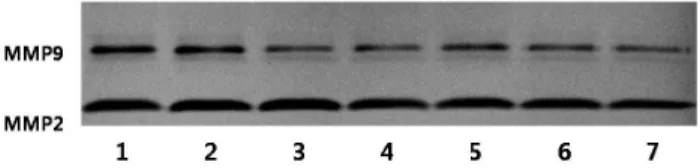
Fig. 5. Effects of Eriobotrya japonica Lindley on the activities of MMP2 and MMP9 of MDA-MB231 cells. 1: DMSO 2: seed10 μg/ml 3: seed 25 μg/ml 4:
seed 50 μg/ml 5: leaves 10 μg/ml 6: leaves 25 μg/ml 7: leaves 50 μg/ml