* Corresponding author : Han Ouk-Kyu, Central Area Crop Breeding Division, NICS, RDA, Suwon 16429, Korea.
Tel: +82-31-695-4052, Fax: +82-31-695-4029, Email: [email protected].
Research Article
추위에 강하고 수량이 많은 조사료용 트리티케일 품종 ‘세영’
한옥규1*, 박형호2, 박태일2, 조상균3, 최인배2, 노재환1, 김기종2, 오영진2, 박기훈2, 김대욱2, 구자환1, 권순종1, 안종웅1
1국립식량과학원 중부작물부, 2국립식량과학원, 3진안군청
‘Saeyoung’, a Winter Forage Triticale Cultivare of High-Yielding and Tolerance to Cold
Ouk-Kyu Han1,
*
, Hyung-Ho Park2, Tae-Il Park2, Sang-Kyun Cho3, In-Bae Choi2, Jae-Hwan Noh1, Kee-Jong Kim2, Young-Jin Oh2, Ki-Hun Park2, Dea-Wook Kim2, Ja-Hwan Ku1, Soon-Jong Kweon1, and Jong-Woong Ahn11Central Area Crop Breeding Division, NICS, RDA, Suwon 16429, Korea
2National Institute of Crop Science, RDA, Jeonju 54875, Korea
3Synthesis civil affairs administration in Jinan Country Office, Jinan, Korea
ABSTRACT
‘Saeyoung’, a winter triticale (X Triticosecale Wittmack) for forage, was developed at the Department of Rice and Winter Cereal Crop, NICS, RDA in 2012. The cultivar ‘Saeyoung’ has narrow and long leaves of light green color, middle size and thin culm, and a medium grain of brown color. The heading date and yellow ripe stage of ‘Saeyoung’ was May 3 and May 27, which were similar to check cultivar ‘Shinyoung’, respectively. ‘Saeyoung’ showed a little stronger in cold tolerance and a little weaker in resistance to lodging than the check, and wet injury, powdery mildew, and leaf rust were similar to those of the check cultivar. The forage fresh and dry matter yields of ‘Saeyoung’ at milk-ripe stages were 47.2 and 15.6 MT ha-1, respectively, which was 9% and 4% higher than those of the check. The crude protein content of ‘Saeyoung’ was 0.4% lower than 6.8% of the check, while was higher than the check cultivar ‘Shinyoung’ in neutral detergent fiber, acid detergent fiber. Total digestible nutrients of ‘Saeyoung’ was also 3% lower than 62.8% of the check cultivar. It showed grain yield of 4.1 MT ha-1, which was 11% higher than that of the check. ‘Saeyoung’ is recommended for fall sowing forage crops in areas in which average daily minimum mean temperatures in January are higher than -10 ℃.
(Key words : Triticale, Winter, Forage, Cultivar, Saeyoung)
Ⅰ. 서 론
트리티케일은 밀의 양질성과 호밀의 왕성한 생장능력 및 내재저항성을 결합한 작물을 육성하기 위해 밀과 호밀의 속 간 교잡에 의해 인위적으로 만든 작물이다. 이 작물은 듀럼밀 (Triticum turgidum, AABB)과 호밀(Secale cereale, RR)을 교잡 한 6배체, 빵밀(Triticum aestivum, AABBDD)과 호밀을 교잡한 8배체 등이 있으나 생육이나 종자 생산 면에서 안정성이 있 는 6배체가 널리 재배되고 있다(Mergoum et al., 2009;
Simmonds, 1976).
트리티케일은 식용뿐만 아니라 청예·건초·사일리지 형태의 가축사료로 이용되는데, Chiba(1983)는 트리티케일의 건물수 량이 밀·보리·귀리 등의 맥류와 대등하다고 하였고, Han et
al.(2012)과 Poysa(1985)는 다른 맥류에 비해 조사료 생산성이 높다고 보고하였다. Later et al.(1968)은 트리티케일의 조사료 가 밀이나 호밀에 비해 단백질 함량이 높다고 보고하였다. 이 렇듯 품종, 재배조건, 수확시기 등 여러 가지 요인에 따라 차 이는 있으나 트리티케일이 사료작물로서 큰 장점을 가지고 있는 것이 알려진 사실이다.
국내에서는 동계 사료작물로서 트리티케일의 높고 안정적 인 수량성이 입증되어 재배면적이 증가하고 있는 추세이다. 품종도 과거에는 국내에 트리티케일 용어가 없어 호밀 이름 을 붙여 품종 등록한 신기호밀(Youn et al., 1986)과 더불어 신영(Park et al., 2003), 조성(Han et al., 2012) 등 여러 품종이 개발되었다. 그러나 기존 품종들이 만생종이거나 답리작 재 배에 유리한 조생종이라고 해도 추위에 약해 재배지가 남쪽
Year ’98 ’99 ’00 ’01-’02 ’03 ’04 ’05 ’06 ’07 ’08 ’09 ’10 ’11 ’12 Generation Cross F1 F2 - F3 F4 F5 F6 F7 F8 F9 F10 F11 F12
ASAD*2/J UN//ANOAS- 5/3/SONNI_6/
4/ASAD/ELK 54//ERIZO_10
CTSS98Y00005S 0MXI Introduction,
CIMMYT
B 2
4 4 10PYTz
&
AYTy
Iksan35
ERIZO_7/
BAGAL_2//F ARAS_1
Remark Pedigree selection Yield trial RYTx
Fig. 1. Pedigree diagram of triticale cultivar, ‘Saeyoung’.
zPYT : preliminary yield trial, yAYT : advaced yield trial, xRYT : regional yield trial.
지역으로 제한돼 있으므로 재배면적 확대를 위해 중·북부 등 월동기온이 낮은 지역에서 재배가 가능한 내한성 품종 개발 이 필요한 실정이었다.
따라서 국립식량과학원에서는 추위에 강해 충청 이북지역 에서도 높은 수량을 낼 뿐만 아니라 종실 수량이 많아 자급용 종자를 생산할 수 있는 월동용 트리티케일 품종을 개발하고 자 하였다.
Ⅱ. 재료 및 방법
1. 육성경위
트리티케일 품종 ‘세영’은 1998년에 멕시코의 국제밀옥수 수연구소(CIMMYT)에서 ‘ASAD*2/JUN//ANOAS-5/3/SONNI _6/4/ASAD/ELK54//ERIZO_10’ 계통과 ‘ERIZO_7/BAGAL_2 //FARAS_1’ 계통을 교잡하여 육성되었다. 육성과정은 Fig. 1 과 같이 F2 세대인 ‘CTSS98Y0005S-0MXI’를 국내에 도입하 여 F3 세대부터 계통 선발을 실시하였으며, 최종적으로
‘CTSS98Y0005S-0MXI-B-2-4-4-10’ 계통을 선발하였다. 이 계통은 농업적 특성이 우수하여 2008년부터 2009년까지 2년 간 생산력검정시험을 실시하였고, ‘익산35호’로 계통명을 부 여하고 2010년부터 2012년까지 3년간 제주・익산・청원・예산・
나주・대구 및 진주 등 7개 지역에서 지역적응시험을 실시하 였다. 그 결과 ‘익산35호’는 한해·도복·습해 등 내재해성이 강 하며, 조사료 생산성이 우수하한 계통으로 판명되어 2012년 8월 농촌진흥청 농작물 직무육성 신품종선정위원회에서 신 품종으로 결정되었으며, 품종명이 ‘세영’으로 명명되었다.
2. 시험방법
지역적응시험은 충청북도 청원, 충청남도 예산, 제주도 제 주에서 밭 재배, 전라북도 익산, 전라남도 나주, 경상남도 진주 및 대구에서는 논 재배로 실시하였다. 파종은 청원·예산·대구 가 10월 중순, 익산·나주·진주가 10월 하순, 제주는 11월 상순 에 하였다. 종자의 파종량은 밭이 180 kg/ha, 논이 220 kg/ha 이었다. 파종방법 (휴폭 × 파폭 × 휴장)은 밭이 25 cm × 5 cm
× 6 m로 세조파하였고, 논은 150 cm × 120 cm × 6 m로 휴립 광산파하였다. 시비량은 청보리 표준시비량인 ha당 질소 118, 인산 74, 칼리 39 kg을 기준으로 진단시비를 하였고, 시비방 법으로 질소는 기비 40 % : 추비 60 %로 나눠 주었으며, 인 산과 가리는 전량 기비로 시용하였다. 수확은 출수기로부터 30일경에 하였는데, 생초수량은 전체 시험구를 예취하여 ha 당 수량으로 환산하였다. 건물수량은 각 품종별로 생초수량 을 평량하고 난 후 1 kg을 취하여 70℃ 순환식 송풍 건조기 내에서 60시간 건조 후 건물률을 산출한 다음 생초수량을 곱 하여 ha당 수량으로 환산하였으며, 시료는 성분 분석용 시료 로 이용하였다. 내한성은 국립식량과학원 연천시험지와 전북 남원 소재 운봉시험지에서 고휴 재배로 실시하였으며, 월동 후 생육재생기에 고엽률로 강약 여부를 평가하였다. 기타 생 육과 수량 특성 및 병충해 저항성 등의 관련 조사는 농촌진흥 청 신품종개발 공동연구사업 과제 수행계획서 조사기준에 준 하여 실시하였다(RDA, 2010a, 2010b, 2011). 육성계통의 조 사료 품질평가를 위하여 조단백질은 AOAC법(1995), NDF (neutral detergent fiber)와 ADF(acid detergent fiber)는 Goering and Van Soest(1970)의 방법으로 분석하였다. TDN 함량은 88.9 - (0.79 × %ADF)의 계산식을 이용하여 산출하였 다(Holland et al., 1990).
Table 1. Morphological characteristics of cultivar ‘Saeyoung’ estimated in Iksan, 2012 Cultivar No. of
chromosome
Leaf Culm Grain
Color Width Length Diameter Color Size Saeyoung 42 Light green Narrow Medium Thinness Brown Medium Shinyoung 42 Dark green Medium Long Thickness Dark brown Medium
Fig. 2. Photos of ‘Saeyoung’ (left) and ‘Shinyoung’ (right) at heading time.
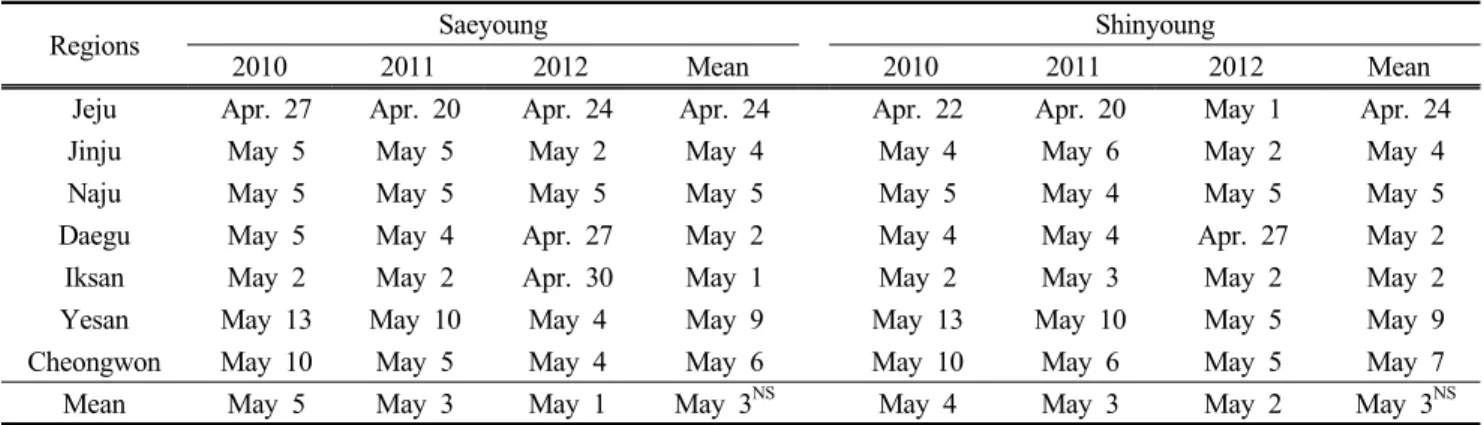
Table 2. Heading date of ‘Saeyoung’ estimated in 7 regions from 2010 to 2012
Regions Saeyoung Shinyoung
2010 2011 2012 Mean 2010 2011 2012 Mean
Jeju Apr. 27 Apr. 20 Apr. 24 Apr. 24 Apr. 22 Apr. 20 May 1 Apr. 24 Jinju May 5 May 5 May 2 May 4 May 4 May 6 May 2 May 4 Naju May 5 May 5 May 5 May 5 May 5 May 4 May 5 May 5 Daegu May 5 May 4 Apr. 27 May 2 May 4 May 4 Apr. 27 May 2 Iksan May 2 May 2 Apr. 30 May 1 May 2 May 3 May 2 May 2 Yesan May 13 May 10 May 4 May 9 May 13 May 10 May 5 May 9 Cheongwon May 10 May 5 May 4 May 6 May 10 May 6 May 5 May 7 Mean May 5 May 3 May 1 May 3NS May 4 May 3 May 2 May 3NS
NSMean of days calculated from January 1 to heading date is not significant difference between ‘Saeyoung’ and ‘Saeyoung’.
Ⅲ. 결과 및 고찰
1. 고유특성
트리티케일 신품종 ‘세영’의 고유특성은 Table 1에서와 같 다. ‘세영’은 실용성이 높아 트리티케일 재배종에서 대부분을 차지하고 있다고 알려진 6배체로서(Mergoum et al., 2009;
Lukaszewski and Gustafson, 1987; Randhawa et al., 2015), 42 개의 염색체를 가지고 있다. ‘세영’의 잎은 색이 담녹색이며
폭이 좁고 길이가 중간 정도로서, 색이 농녹색이고 폭이 중간 이며 길이가 긴 표준품종 ‘신영’과 구별된다. 또한 ‘세영’의 줄기는 매우 가늘고, 종실의 종피색은 갈색이며, 크기는 중간 정도이다.
2. 출수기, 황숙기
‘세영’의 출수기는 Table 2에서와 같이, 시험지 전체에서 평균 5월 3일로 표준품종인 ‘신영’과 같았다. 지역별 ‘세영’의
Table 3. Yellow ripe stage of cultivar ‘Saeyoung’ estimated in Iksan from 2010 to 2012
Regions Saeyoung Shinyoung
2010 2011 2012 Mean 2010 2011 2012 Mean
Iksan May 27 May 27 May 27 May 27NS May 27 May 29 May 29 May 28NS
NSMean of days calculated from January 1 to yellow ripe stage is not significant differences between ‘Saeyoung’ and ’Shinyoung’ by t-test.
Table 4. Resistances to the environmental stress, lodging, and disease of ‘Saeyoung’ cultivated in 7 regions from 2010 to 2012
Cultivar Cold tolerance (0~9)z Wet injury (0~9)z
Lodging (0~9)z
Disease (0~9)z
2010y 2011 2012 Mean Powdery mildow Leaf rust
Saeyoung 3 1 2 2 0 3 0 0
Shinyoung 5 3 1 3 0 2 0 0
zRating score : 0 = excellent or strong, 9 = worst or weak.
yCold tolerance was tested for Yeoncheon in 2010, and Namwon in 2011 and 2012, respectively.
Table 5. Forage fresh matter yield of ‘Saeyoung’ cultivated in 7 regions from 2010 to 2012
Regions
Saeyoung (MT ha-1) Index (A/B)
× 100
Shinyoung (MT ha-1) 2010 2011 2012 Mean
(A) 2010 2011 2012 Mean
(B) Jeju 52.3 32.9 61.6 48.9 111 37.7 32.3 62.5 44.2 Jinju 46.4 44.5 38.4 43.1 103 47.1 43.7 34.9 41.9 Naju 43.2 69.6 33.0 48.6 115 38.9 62.2 25.5 42.2 Daegu 61.6 59.6 28.9 50.1 111 57.6 52.0 25.5 45.0 Iksan 52.1 46.5 54.0 50.9 107 49.0 44.6 49.0 47.6 Yesan 45.6 59.3 36.3 47.0 106 41.2 61.0 30.8 44.3 Cheongwon 42.9 43.0 35.7 40.5 108 44.7 38.4 29.5 37.5 Mean 49.2 50.8 41.1 47.2a 109 45.2 47.8 36.8 43.2b
*Forage fresh matter is significantly different between cultivar ‘Saeyoung’ and cultivar ‘Saeyoung’ at 5% probability by t-test.
출수기는 제주에서 평균 4월 24일로 가장 빨랐고, 예산에서 5월 9일로 늦었다. 표준품종인 ‘신영’도 제주에서 4월 24일로 출수가 가장 빨랐고, 예산과 청원에서 각각 5월 9일, 5월 7일 로 늦어 ‘세영’과 같은 경향이었다.
종자를 수확하는데 중요한 지표인 황숙기는 Table 3에서와 같다. 황숙기는 신품종 ‘세영’과 표준품종 ‘신영’이 각각 5월 27일과 5월 28일로 두 품종간 유의성이 없었으며, 황숙기에 대한 연차간 변이도 크지 않았다. 따라서 국내에서 ‘세영’의 종자를 채종하고자 할 경우 장마가 오기 전인 6월 상순 이전 에 수확이 가능할 것으로 판단되었다.
3. 내재해성
‘세영’의 내한성과 도복, 습해 및 내병성 등은 Table 4와 같 다. 월동기온이 낮은 경기도 연천군과 전라북도 남원시 운봉에 서 내한성 검정방법인 고휴 재배로 평가한 ‘세영’의 내한성은
‘신영’에 비해 약간 강하였으나 도복은 다소 약하였다. 그리고 흰가루병과 잎녹병은 신품종 ‘세영’이나 표준품종 ‘신영’ 모두 에서 피해가 발생하지 않았다. Randhawa et al.(2015)은 트리티 케일이 여러 가지 환경 스트레스 내성이 강해 척박한 토양에서 생산하기에 적당한 작물이라고 보고하였는데, 이 시험에서도 트리티케일 품종 ‘세영’은 우리나라의 겨울철 답리작 재배 환 경에서 발생할 수 있는 한해와 도복에 잘 견디고, 습해나 흰가 루병 등 병해가 발생하지 않아 재해에 강한 면을 보였다.
4. 조사료 생산성
출수기로부터 30일에 평가한 ‘세영’의 ha당 생체수량은 Table 5에서와 같다. 생체수량은 시험지 전체에서 평균 47.2톤 으로 표준품종인 ‘신영’의 43.2톤 보다 9%가 많았다(p<0.05).
지역별로는 익산이 50.9톤, 대구가 50.1톤, 제주가 48.9톤으로 시험지 평균보다 많았고, 나머지 지역에서는 적은 편이었는
Table 6. Dry matter yield of ‘Saeyoung’ cultivated in 7 regions from 2010 to 2012
Regions
Saeyoung (MT ha-1) Index (A/B)
× 100
Shinyoung (MT ha-1) 2010 2011 2012 Mean
(A) 2010 2011 2012 Mean
(B) Jeju 19.2 11.1 20.1 16.8 106 14.6 11.3 21.6 15.8 Jinju 16.1 13.3 12.5 14.0 106 16.3 11.2 11.9 13.2 Naju 13.5 21.5 14.9 16.6 112 12.4 20.1 12.1 14.9 Daegu 22.8 16.5 12.2 17.1 111 20.9 14.4 11.1 15.5 Iksan 15.0 13.7 18.7 15.8 101 15.5 14.3 17.3 15.7 Yesan 13.1 13.6 18.6 15.1 90 16.0 16.8 17.7 16.9 Cheongwon 13.9 11.9 16.5 14.1 103 15.7 9.9 15.2 13.6 Mean 16.2 14.5 16.2 15.6a 104 15.9 14.0 15.3 15.1a
NSNo significant differences between cultivar ‘Saeyoung’ and cultivar ‘Shinyoung’.
Table 7. Percent crude protein, acid detergent fiber (ADF), neutral detergent fiber (NDF) and total digestible nutrients (TDN) of ‘Saeyoung’ cultivated in 2011∼2012, Iksan.
Cultivar Crude protein (%)
NDFy (%)
ADFx (%)
TDNw (%)
TDN yieldv (MT ha-1)
Silage qualityu (Ⅰ∼Ⅴ)
Saeyoung 6.4NS 62.5a 36.9a 59.8b 9.4NS 2NS
Shinyoung 6.8NS 56.8b 33.1b 62.8a 9.9NS 2NS
zThis results were measured by whole crop plant harvested at milk-ripe stage. yNDF : Neutral detergent fiber, xADF : acid detergent fiber,
wTDN : Total digestible nutrients. uFlieg’s evaluation : 1 (superior, above 81), 2 (good, 61∼80), 3 (common, 41∼60), 4 (no good, 21∼40), 5 (very bad, under 20). a, bPercent NDF, ADF, and TDN were significantly different between cultivar ‘Saeyoung’ and cultivar ‘Shinyoung’
at 5% probability by t-test. NSNo significant differences between cultivar ‘Saeyoung’ and cultivar ‘Shinyoung’.
데, 특히 진주가 43.1톤, 청원이 40.5톤으로 매우 적었으며, 이 러한 경향은 표준품종인 ‘신영’에서도 같았다.
건물수량은 Table 6에서와 같이 시험지 전체에서 ‘세영’이 ha당 평균 15.6톤으로 표준품종인 ‘신영’의 15.1톤에 비해 4
%가 많았으나 통계적인 유의성은 없었다. 지역별로는 대구가 17.1톤, 제주가 16.8톤, 나주가 16.6톤, 익산이 15.8톤 순으로 지역 평균보다 많았으며, 예산이 15.1톤, 청원이 14.1톤, 진주 가 14톤 순으로 낮았다. 표준품종은 예산이 16.9톤, 제주가 15.8톤, 익산이 15.7톤, 대구가 15.5톤 순으로 평균보다 많았 고, 나주가 14.9톤, 청원이 13.6톤, 진주가 13.2톤 순으로 낮은 수량을 보였다. 따라서 신품종 ‘세영’과 표준품종 ‘신영’은 지 역에 따라 건물수량의 경향이 다른 것으로 보아 두 품종 간 건물 축적에 대한 반응을 다른 것으로 판단되었다.
‘세영’은 대구, 나주가 다른 지역에 비해 표준품종보다 11∼
12 %의 높은 건물수량을 보였고, 예산지역에서는 10 %가 적었 다. 이는 ‘세영’이 줄기가 가는 특성을 가지고 있고, 또한 이 계통이 춘파형 트리티케일 품종이 재배되는 멕시코에서 선발, 도입되었기 때문에 국내 환경에서 선발된 ‘신영’에 비해 줄기 의 건물축적이 빠르게 완성되었을 것으로 추정되었다.
5. 사료가치
전북 익산에서 출수기부터 30일에 총체 시료를 분석하여 평가한 ‘세영’의 조사료 품질 특성은 Table 7에서와 같다. ‘세 영’의 조단백질 함량은 6.4 %로 6.8 %인 표준품종 ‘신영’보다 0.4 % 낮았다. 그러나 섬유소인 neutral detergent fiber(NDF) 와 acid detergent fiber(ADF) 함량은 각각 62.5 %와 36.9 %로 각각 33.1 %와 56.8 %인 ‘신영’보다 많았으며(p<0.05), 이에 따라 total digestible nutrients(TDN) 함량이 59.8 %로 ‘신영’
의 62.8 %에 비해 다소 낮았다(p<0.05). 그러나 ‘세영’이 ‘신 영’보다 건물수량이 많기 때문에 TDN 수량은 큰 차이를 보 이지 않았으며, Flig 점수에 의해 평가된 사일리지 품질등급 은 두 품종 모두 2등급이었다.
6. 종실 생산성
조사료용 트리티케일은 총체사료로 이용하므로 식용 맥류 와는 달리 별도로 종자를 생산해야 하므로 파종용 종자 확보 를 위해 종자 수량이 많은 품종이 유리하다(Han et al., 2016).
Fig. 3. Cultivation areas of ‘Saeyoung’.
Table 8. Seed productivity of cultivar ‘Saeyoung’ in Iksan Cultivar Plant height
(㎝) No. of spikes per ㎡ Yield (MT ha-1)
Index (A/B)×100
Saeyoung 126 726 4.1a 111
Shinyoung 119 645 3.7b 100
a, b
Seed productivity was significantly different between cultivar ‘Saeyoung’ and cultivar ‘Shinyoung’ at 5% probability by t-test.
종자 채종을 위한 ㎡당수수와 ha당 종자 생산량은 Table 8에 서와 같이, ‘세영’은 ‘신영’에 비해 ㎡당수수가 726개로 81개 많고, 종실수량이 ha당 4.1톤으로 ‘신영’의 3.7톤보다 11 %가 많았다(p<0.05). 따라서 ‘세영’은 종자 생산성이 좋아 조사료 생산을 위한 종자 확보에 도움이 될 것으로 사료되었다.
7. 적응지역 및 재배상 유의점
트리티케일 신품종 ‘세영’은 1월 최저평균기온이 -10℃ 이 상 지역인 지역에서 월동이 가능하다. 따라서 남한의 전 지역 에서 월동 재배가 가능하나, 일교차가 심해 지표면이 동결과 융해가 반복되어 식물체의 경화가 어려운 지역이나 기온이
낮고 잦은 적설이나 강우로 인해 토양이 습한 지역에는 동해 가 심해 수량이 낮을 수 있다.
최근 기후의 온난화로 인해 가을에 일찍 파종할 경우 겨울 이 도달하기에 앞서 식물체의 생식생장의 진행으로 인해 동 해 피해가 발생하거나 심하게 되면 월동 중에 식물체가 얼어 죽을 수 있다. 또한 트리티케일의 생육재생기인 2월 중ᆞ하순 경에도 산간지 등 일교차가 심한 지역에서는 토양의 들뜸 현 상에 의한 단근이나 지상부의 한해 피해가 있을 수 있다(Cho et al., 2004). 따라서 지역별 표준재배법을 준수하여 적기파종 하고, 출현 및 월동 후에 배수 관리나 식물체를 진압하는 등 적절한 관리를 하여야 한다.
Ⅳ. 요 약
트리티케일 신품종 ‘세영’은 2012년에 농촌진흥청 국립식 량과학원에서 육성되었으며, 그 특성은 다음과 같다. ‘세영’
은 담녹색이며, 폭이 좁고 길이가 중간 정도인 잎, 가는 줄기 와 크기가 중간 정도인 종실, 그리고 갈색인 종피색을 가졌 다. ‘세영’은 출수기가 평균 5월 3일, 황숙기가 5월 27일로 표 준품종인 ‘신영’과 대등하였다. ‘세영’의 내한성은 ‘신영’에 비해 다소 강하였고, 도복는 ‘신영’보다 다소 약하였다. 습해 와 흰가루병과 잎녹병은 모두에서 피해가 발생하지 않았다.
‘세영’의 ha당 생체수량은 평균 47.2톤으로 표준품종인 ‘신영’
의 43.2톤 보다 9 %가 많았으며, 건물수량은 ha당 평균 15.6 톤으로 ‘신영’의 15.1톤에 비해 4 %가 많았다. ‘세영’은 ‘신 영’에 비해 조단백질 함량이 6.4 %로 6.8 %인 표준품종 ‘신 영’보다 0.4% 낮았으나, NDF와 ADF 함량은 각각 62.5 %, 36.9 %로 높았으며, TDN 함량은 59.8 %로 ‘신영’의 62.8 % 에 비해 3%가 낮았다. ‘세영’은 ‘신영’에 비해 ㎡당수수가 727 개로 81개 많고, 종실수량이 ha당 4.1톤으로 ‘신영’보다 11 % 가 많았다. 적응지역은 1월 최저평균기온이–10℃ 이상인 지 역이면 전국 어느 곳에서나 재배가 가능하며, 특히 추위에 강 한 장점이 있기 때문에 중·북부지역에서 겨울철 조사료 생산 에 유용할 것으로 기대된다.
Ⅴ. 사 사
본 논문은 농촌진흥청 연구사업(세부과제 : 사료용 트리티 케일 신품종 개발, 과제번호: PJ00919603)의 지원에 의해 이 루어진 것임.
Ⅵ. REFERENCES
AOAC. 1995. Official method of analysis (15th ed.) Association &
Official Analytical Chemists, Washington DC.
Chiba, A.J. 1983. Forage production of triticale relative to other spring grains. Agronomy Journal. 75:610-612.
Cho, C.H., Han, O.K., Lee, D.J. and Park, M.U. 2004. Wheat and science. Hanrimwon. Seoul. pp. 129, 183.
Goering, H.K. and Van Soest, P.Jt. 1970. Forage fiber analysis.
Agricultural Handbook no. 379, US Department of Agriculture, Washington DC. pp. 1-20.
Han, O.K., Park, T.I., Park, H.H., Song, T.H., Ju, J.I., Jeung, J.H., Kang, S.J., Kim, D.H., Choi, H.J., Park, N.G., Kim, K.K., Hwang, J.J., Baek, S.B. and Kim, Y.U. 2012. ‘Joseong’, a new early-heading forage triticale cultivar for paddy field of double cropping. Journal of the Korean Grassland and Forage Science. 32(3):193-202.
Han, O.K, Park, H.H, Park, T.I., Oh, Y.J., Song, T.H., Kim, D.W., Chae, H.S., Hong, K.H., Bae, J.S., Kim, K.S., Yun, G.S, Lee, S.T., Ku, J.H., Kweon, S.J., Ahn, J.W. and Kim, B.J. 2016. A new early-heading, high-yielding triticale cultivar for forage, ‘Shinseong’. Journal of the Korean Grassland and Forage Science. 36(2):142-149.
Holland, C., Kezar, W., Kautz, W.P., Lazowski, E.J., Mahanna, W.C.
and Reinhart, R. 1990. Pioneer forage manual: a nutritional guide.
Pioneer Hi-Bred., Des moines, IA.
Later, E.N., Tsuchiya, T. and Evans, L. 1968. Breeding and cytology of
triticale. Proceeding of 3rd International Wheat Genetics Symposium. Canberra. pp. 213-221.
Lukaszewski, A.J. and Gustafson, J.P. 1987. Cytogenetics of triticale.
Plant Breeding Reviews. 5:41-93.
Mergoum, M., Singh, P.K., Pena, R.J., Lozano-del Rio, A.J., Cooper, K.V., Salmon, D.F. and Gomez Macpherson, H. 2009. Triticale : A
“New” crop with old challenges. In: M.J. Carena (Ed.), Cereals, Springer, ND, USA. pp. 267-269.
Park, K.G., Heo, H.Y., Park, H.H., Kim, M.J., Nam, J.H., Lee, C.K., Kim, J.G. and Kwon, Y.U. 2003. A new cold tolerant, lodging resistant and high grain yielding forage triticale cultivar
“Shinyoung”. Korean Journal of Breeding Science. 35(5):329-330.
Poysa, V.M. 1985. Effect of forage harvest on grain yield and agronomic performance of winter triticale, wheat and rye. Canadian Journal of Plant Science. 65:879-888.
Randlhawa, H., Bona, L. and Graf, R.J. 2015. Triticale breeding-progress and prospect. In: F. Eudes (Ed.), Triticale, Springer, CA. pp. 15-32.
Rural Development Administraion (RDA). 2010a. 2009/2010 year project plan for collaborative research program to develop new cultivars of winter crops. Regional yield trials of triticale. pp. 72-75.
Rural Development Administraion (RDA). 2010b. 2010/2011 year project plan for collaborative research program to develop new cultivars of winter crops. Regional yield trials of triticale. pp. 71-74.
Rural Development Administraion (RDA). 2011. 2011/2012 year project plan for collaborative research program to develop new cultivars of winter crops. Regional yield trials of triticale. pp. 81-84.
Simmonds, N. 1976. Evolution of crop plants. Longman. NY. p. 118.
Youn, K.B., Hwang, J.J., Sung, B.R., Lee, J.H., Hur, H.S., Kim, J.G., Kim, B.Y., Ahn, W.S., Kim, Y.S. and Cho, C.H. 1986. A good quality, lodging resistant and high yielding triticale variety ‘Shinkihomil’ as soiling crop. Research Report, RDA(Crops). 28(Ⅰ):143-147.
(Received : January 18, 2017 | Revised : February 7, 2017 | Accepted : May 15, 2017)