AVEVA Marine 강재마진의 선모델링 자동반영을 위한 인공지능 모델링 시스템 개발
김남훈1,†․ 박용석1․ 김정호2․ 김연용2․ 천종진3․ 최형순3
현대삼호중공업㈜ CAD개발팀1
현대삼호중공업㈜ 구조설계부2
인포겟시스템㈜ 선체개발팀3
Development of Artificial Intelligence Modeling System for Automated Application of Steel Margin in Early Modeling Process using AVEVA Marine
Nam-Hoon Kim
1,†․ Yong-Suk Park
1․ Jeong-Ho Kim
2․ Yeon-Yong Kim
2․ Jong-Jin Chun
3․ Hyung-Soon Choi
3CAD Development Team, Hyundai Samho Heavy Industry Co., Ltd.
1Structure Design Dep't, Hyundai Samho Heavy Industry Co., Ltd.
2Hull Development Team, Infoget System Co., Ltd.
3Abstract
Nowadays, automated modeling system for steel margin based on interactive user interface has been developed and applied to the production design stage. The system could increase design efficiency and minimize human error owing to recent CAD technique.
However, there has been no approach to the pre-nesting design stage at all in early modeling process especially where ship model should be handled at more than two design stages using AVEVA Marine. A designer of the design stage needs artificial intelligence system beyond modeling automation when 3D model must be prepared in early modeling process using AVEVA Marine because they have focused on 2D nesting traditionally. In addition, they have a hard time figuring out the model prepared in previous design stage and modifying the model for steel purchase size in early modeling process. In this paper, artificial intelligence modeling system for automated application of steel margin in early modeling process using AVEVA Marine is developed in order to apply to the pre-nesting design stage that can detect effective segments before a calculation to find if a segment locates near block butt boundaries by filtering noise segments among lines, curves and surface intersections based on IT big data analysis.
Keywords : Steel margin(강재마진), Early modeling process(선모델링), Pre-nesting design(강재취재), Artificial intelligence(AI, 인공지능)
1. 서 론
선박의 구조는 외판(Shell Surface), 갑판(Deck), 거더(Girder), 스트링거(Stringer), 종격벽(Longitudinal Bulkhead), 내저판(Inner Bottom), 호퍼(Hopper), 횡격벽(Transverse Bulkhead), 웨브 프 레임(Web Frame) 등 다양한 구조 부재들로 이루어져 있으며, 설 계된 형태에 따라 강재를 절단하여 조립하는 작업을 거친다.
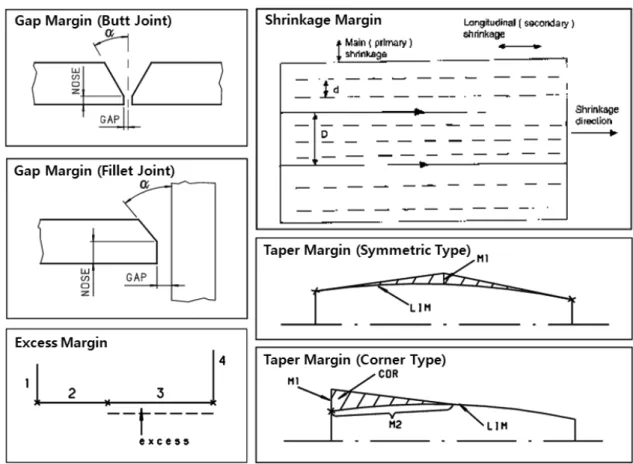
이때, 다양한 방법의 용접 기법을 선택하여 조립하게 되는데 각 기법 별로 용접 후 채워질 용접 비드(Welding Bead)를 고려하 여 부재와 부재 사이에 적정한 간격(Gap Margin)이 필요하다. 강 재를 용접한 후 냉각하는 과정에서 수축으로 인해 용접 방향 별 로 조립된 부재 수와 용접 각장(Welding Leg Length) 등에 비례
하여 정규 길이/폭보다 부재 길이/폭이 짧아지는 현상(Shrinkage Margin)이 발생한다. 또한, 조립과정에서의 정도 관리의 목적으 로 여유(Excess Margin)를 설계 단계에서 예측하거나 경험적으로 미리 부여하는 보상(Margin Compensation)이 필요하다. 단, 그 값이 균일하지 않을 경우 쐐기형(Taper Margin)으로 특화되며, 쐐기형은 다시 부재 경계면의 중앙에서 최대값(Symmetric Type) 과 가장자리에서 최대값(Corner Type)인 경우로 나뉜다(Fig. 1).
위와 같은 강재마진(Steel Margin)의 특징은 Table 1과 같다.
Fig. 2에서 강재마진 보상은 전체 설계 과정(Design Process) 중 구매발주용(POR) 강재규격을 결정하는 강재취재(Pre-Nesting Design) 단계에서 최초로 발생하며, 선모델링(Early Modeling Process)의 유무에 따라 약식 계산(2D Nesting)과 실제 적용(3D Nesting)으로 구분 할 수 있다.
2013년 12월 pp. 35-41, December 2013
대한조선학회 특별논문집Special Issue of the Society of Naval Architects of Korea
Fig. 1 Classification of Steel Margin (AVEVA Solutions Limited, 2013)
Table 1 Characteristic of Steel Margin
Type Main Cause Range Compensation
Shrinkage Welding Direction Whole Positive Gap Welding Procedure
Specification (WPS) Boundary Only
Negative
Excess Assembly
Fabrication
Either
Taper Positive
이때, 선모델링이란 Fig. 2에서 3D Model을 생산설계(Production Design) 단계 이전에 구축하여 구조해석(Structural Analysis), 의 장설계(Outfitting Design) 및 중일정관리(Block Scheduling)에도 활용하기 위한 설계 과정이다(Kim, N.H. et al., 2012).
Fig. 2 Design Process for Steel Margin Compensation
위와 같이 3D Model을 초기 설계 단계에서부터 구축하여 후 속 공정의 필요한 업무에 활용하는 개발과 적용(Roh, M.I. &
Lee, K.Y., 2006a; Roh, M.I., Yoo, S.J. & Lee, K.Y., 2006)은 매우 중요하며, AVEVA Marine 12 Series에서 특히 필수적이다.
Fig. 3은 생산설계 단계 적용을 위해 개발된 강재마진 보상 자 동화 프로그램이다. 주판(Principle Panel)과 보강재(Stiffener)에 Shrinkage Margin과 Excess Margin을 Interactive방식으로 시스 템화하여 설계 효율을 향상하고 에러 가능성을 줄일 수 있다.
(Kim J.T. et al., 2010)
Fig. 3 GUI of Automated Modeling System for Steel Margin (Kim J.T. et al., 2010)
김남훈․ 박용석․ 김정호․ 김연용․ 천종진․ 최형순
그러나, 강재취재 단계부터 선모델링된 3D Model에 강재마진 보상을 자동화하기 위한 개발은 자동화 이상의 인공지능(Artificial Intelligence, AI) 수준을 요구하기 때문에, 본 논문에서는 강재마 진을 인공지능으로 보상할 수 있는 모델링 시스템을 개발하였다.
2. 선모델링 강재마진 보상 검토
Fig. 4는 선모델링을 활용하여 3D Model에 강재마진을 보상 한 뒤 강재취재도를 작성하는 기존의 업무 흐름도를 나타낸다.
즉, 주판 별로 부재 경계면에 해당되는 Block Butt를 찾아서 조립 공법(Assembly Process)에 따라 Gap Margin과 Excess Margin을 조합하여 반영한 3D Model을 통해 강재취재도를 작성한다(Kim, N.H., Kim, J.H., Kim, Y.Y., & Park, Y.S., 2013).
Fig. 4 Flow of Steel Margin Application to Principle Panel Based on Early Modeling
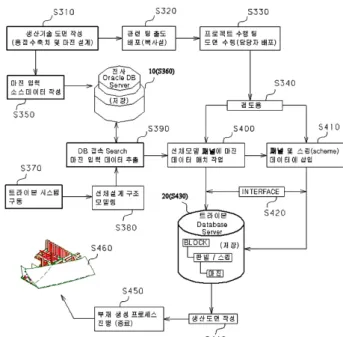
Fig. 5는 서론에서 잠시 설명한 생산설계을 위해 개발된 강재 마진 보상 자동화 프로그램의 흐름도이다. Tribon M3 기반으로 개발되어 AVEVA Marine 12 Series에는 아직 적용되지 않았다.
생산설계 직능의 모델링에 능숙한 설계자에 초점을 맞춘 시스 템 아키텍쳐와 사용자 인터페이스로 구성되어 있다. 따라서. 전 통적으로 2D Nesting에 주력해왔던 강재취재 직능에서 그대로 활용하기에는 어려움이 따른다.
또한, Fig. 4의 흐름도에서 3D Model이 강재취재에서 처음부 터 생성된 것이 아니라 이전 설계단계인 구조 상세설계에서 미리 생성된 내용을 파악한 뒤 다른 사람의 정의 방식에 익숙해져서 강재마진을 보상하는 과정에서도 문제가 발생할 수 있다.
Fig. 5 Flow of Ship Hull Steel Margin Design Automation (Kim J.T. et al., 2010)
결국, 모델링 능력을 새로 습득하지 않아도 3D Model을 적절 하게 승계하는 과정에 초점을 맞춘 시스템의 필요성이 대두된다.
이는 강재취재 뿐만 아니라 다음 설계단계인 생산설계에 3D Model을 다시 승계해 줄 때 신뢰성 확보와도 연관된다. 즉, 선모 델링의 품질이 생산설계에서 수정해서 활용할 수 있을 정도가 되 려면 선체설계 전 과정에서 충분한 모델링 직능이나 기량을 확보 해야 하는 조직과 인력 구성의 문제가 발생하며, 그렇지 않을 경 우에는 선모델링을 강재취재까지만 활용하고 생산설계에서는 다 시 생산모델링을 생성해야 하는 시간과 비용의 문제가 발생하게 된다(Kim, N.H. et al., 2012).
3. 강재마진 보상 인공지능 알고리즘
상기한 선모델링을 지원하는 모델링 프로그램은 생산설계 자 동화 프로그램과는 달리 모델링 직능이 아니거나 기량이 부족한 경우에도 강재마진 보상을 정확히 할 수 있도록 인공지능 알고리 즘의 개발과 실호선 적용이 필요하다.
여기서 인공지능이란 3D Model에서 Block Butt를 찾기 위해 설계자가 판단해야 하는 몫을 프로그램이 대신해서 담당하는 것 을 의미한다. 즉, 강재취재 단계에서 쉽게 식별하여 Block Butt를 구분할 수 있도록 이전 설계단계인 구조 상세설계에서 추가 정보 를 입력하지 않더라도, 프로그램에 미리 정의된 인공지능이 3D Model을 스스로 분석하여 강재마진 적용부위를 탐지하고 Aftward (AFT), Forward(FWD) 및 Center Line(C.L) 등과 같은 구조부재 의 방향 별로 반영한다.
위와 같은 인공지능의 3D Model 교차계산을 위해 구조 부재 간의 연관성을 이용한 Block Grouping Method와 탑재 순서를 고 려한 Block Material Information Generating Method의 연구결과
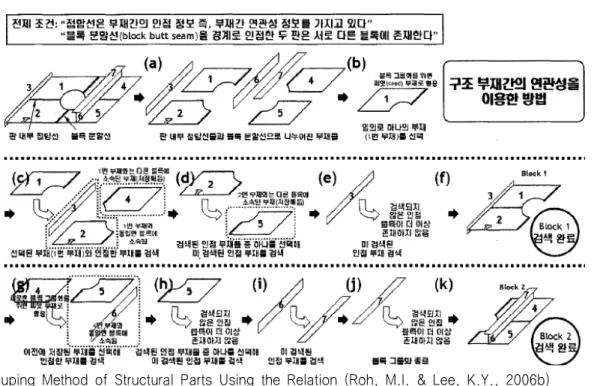
Fig. 6 Grouping Method of Structural Parts Using the Relation (Roh, M.I. & Lee, K.Y., 2006b)
를(Roh, M.I. & Lee, K.Y., 2006b) 참고하였다.
Fig. 6은 Block Grouping Method의 설명을 위한 예이다. 구조 부재의 소속 Block은 상세 구조설계에서 이미 정의된 관계로 본 Method는 Block 포함 조건에 수반되는 구조 부재의 각 경계선이 Block Butt에 인접되는 여부를 확인할 때 활용되었다.
Fig. 7은 Block Material Information Generating Method의 설 명을 위한 예로서 무게 중심, 내부 도장 면적, 블록간 용접장 및 내부 용접장 등을 탑재 순서를 고려하여 산출한다. 단, 탑재 순서 도의 정보가 Fig. 4의 WPS Drawing에도 반영되어 있으므로 용접 장 산출과정은 구조 부재의 Block Butt부 탐지과정과 매우 유사 하다.
Fig. 7 Block Material Information method of structural parts considering erection sequence (Roh, M.I.
& Lee, K.Y., 2006b)
그러나, Fig. 8과 같이 교차계산을 필요로 하는 기하학적 검사 를 이용하여 선체 구조 부재를 블록별로 그룹화 하기 때문에 많 은 시간을 필요로 하고 또한 오류 발생 가능성을 포함하고 있다 (Roh, M.I. & Lee, K.Y., 2006b).
Fig. 8 The Grouping Method of Structural Parts Based on Geometric Test (Roh, M.I. & Lee, K.Y., 2006b)
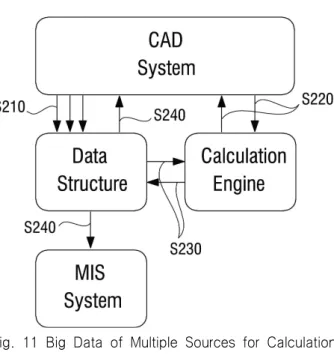
본 논문에서는 위와 같은 문제점이 Fig. 9에서 S230의 흐름 중 Data Structure에서 Calculation Engine으로 가는 방향에서의 병목현상에 기인한다고 분석하여, Fig. 10이 나타내는 클라우드 (Cloud Computing) 기반의 빅데이터(Big Data) 관점의 보다 진 보된 분산 처리 기술을 통해 조선-IT융합에 새롭게 적용하였다.
따라서, Fig. 11과 같이 S220과 같이 CAD System(AVEVA Marine 12 Series) 등 이전보다 다변화된 출처의 원본 Data를 하 둡(Hadoop) 파일 시스템의 MapReduce기능 수행 등과 같이 대 량의 자료를 구조화하고 분산 처리하는 알고리즘으로 계산시간 증가와 결과오류 발생의 한계를 극복하는 것이 매우 중요하다 (Kim, N.H., Kim, J.H., Kim, Y.Y., & Park, Y.S., 2013).
Fig. 12는 위에서 언급한 Fig. 11의 S220에서 CAD System
김남훈․ 박용석․ 김정호․ 김연용․ 천종진․ 최형순
Fig. 12 AI Algorithm of Steel Margin Compensation by Erection Joint Filtering Based on IT Big Data Analysis Fig. 9 Big Data of Single Source for Calculation Engine
Fig. 10 Big Data Characteristic Based on Statistical Analysis (Big Data: New Challenge & Opportunity, 2011)
Fig. 11 Big Data of Multiple Sources for Calculation Engine
(AVEVA Marine 12 Series) 내에 Block Butt Seam(or Erection Joint Limit)이 3D Model에서 정의된 방식을 직접 조사하여 오라 클 빅테이터 어플라이언스(Oracle Big Data Appliance)에 각 Geometry Segment가 Block Butt 부근에 있는지 확인여부를 저 장하기 위해 설계된 알고리즘을 나타낸다.
이때, Geometry Segment의 종류는 Amplitude의 유무에 EK라 Line Segment와 Amplitude Segment로 구분되고, 3D Model 내 에서 구조 부재의 각 Boundary를 정의하는 방식은 Planar Panel 참조, Ship Coordination 입력, Curve Limit 정의, Shell Surface 참조 등이 있다.
결국, 빅데이터 분석을 통해 기존 정보에서 Noise Segment를 제거한 Reasonable Segment 위주의 교차계산에서는 이전보다 전체시간이 단축되고 결과오류의 가능성 감소도 함께 가능하다.
4. 강재마진 보상 인공지능 시스템
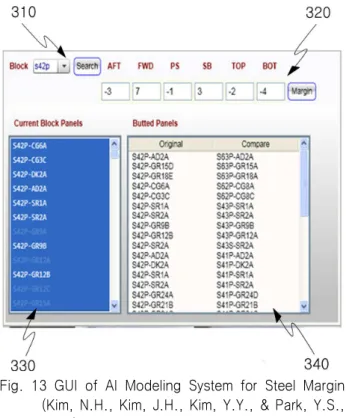
상기한 강재마진 보상 인공지능 알고리즘을 토대로 구성된 모 델링 시스템의 GUI는 그림 Fig. 13과 같다.
강재취재에서 취재하려는 각 Block별로 조회해서(310) Block Butt Seam 6방향의 강재마진을 WPS Drawing을 확인하여 입력 한다(320).
Fig. 13 GUI of AI Modeling System for Steel Margin (Kim, N.H., Kim, J.H., Kim, Y.Y., & Park, Y.S., 2013)
Fig. 14 Flow of Steel Margin AI Modeling System
현재 선택된 Block 소속의 모든 구조 부재를 불러와서(330) 위, 아래, 앞, 뒤, 내, 외 모든 방향으로 인접 Block 소속의 구조 부재를 찾아온다(340).
다음으로 본 논문의 인공지능 알고리즘을 통해 각 구조 부재 별 Boundary에 대해 Erection Joint Limit 여부를 분산처리 계산 하여 설계자가 입력한 강재마진 값을 적절하게 일괄적으로 반영 한다.
Fig. 14는 본 논문의 모델링 시스템으로 개선된 선모델링 강재 취재 업무 흐름도이다. 이전의 Fig. 4와 비교하여 전체 설계 공정 상 한 단계가 줄어든 것(Process Innovation, PI)을 확인할 수 있 다.
5. 결 론
본 논문에서는 강재마진 보상 시스템을 구축하면서 Automated Modeling 시스템에 국한되지 않는 선모델링이라는 협업 중심의 Process Innovation 기반 기술개발의 성격과 함께 최근의 주요 IT Trend인 클라우드 기반의 빅데이터 분석 기법을 활용한 인공지능 알고리즘을 Modeling 시스템에 적용함으로써 기존 강재취재 설 계 단계를 한 단계 축소할 수 있었다.
특히, 당사에서 적용 중인 AVEVA Marine 12 Series는 선체와 의장 간 Global 및 Local 협업 설계가 매우 강화되고 중요한 CAD System이다. 본 논문처럼 선체 내 협업 설계를 더욱 원활하 게 지원할 수 있는 시스템을 지원함으로써, 이를 바탕으로 의장 설계에서 품질이 높고 유지보수가 원활한 선모델링을 적시에 제 공 받아 선체와 의장 간 협업 설계 발전에 도움되길 기대한다.
향후계획으로는 Fig. 15와 같이 클라우드 원본 Data의 종류를 WPS Drawing까지 더욱 다변화하여 현재 시스템에서 사용자가 간단히 입력하는 강재마진 값 또한 실호선의 전체 Block별로 오
Fig. 15 Flow of Steel Margin Unattended Modeling System
김남훈․ 박용석․ 김정호․ 김연용․ 천종진․ 최형순
라클 빅테이터 어플라이언스에 저장하고 일괄적용 가능한 무인 (Unattended) 모델링 시스템으로 확장 가능할 것으로 예상된다.
참 고 문 헌
AVEVA Solutions Limited, 2013. Hull Model Concept User Guide. [photograph] AVEVA User Documentation 12 Series.
Big Data: New Challenge & Opportunity, 2011. Cloud Meets Big Data EMC FORUM 2011 [pdf] Available at:
<http://www.emcforum.co.kr/pdf/b02.pdf> [Accessed 10 May 2013].
Kim, J.T., Kim, S.M., Ryu, I.S., Kwon, K.C., Cho, J.H., Goo, K.J., Cho, H.S. & Jeong, Y.H., Daewoo Shipbuilding & Marine Engineering Limited. 2010. Ship Hull Welding Shrinkage Margin Design Automation.
Korea. Pat. 10-2010-0079692.
Kim, N.H., Kim, J.H., Lim, J.D., Huh, O.J., Chun, J.J., Park, C.H. & Choi, H.S., 2012. Algorithm Development on Artificial Intelligence Reasoning for an Erection Welding-Joint of Three-Dimensional Hull Modeling in Shipbuilding and Maritime Engineering. Conference of the Society of Naval Architects of Korea, Changwon, Korea.
Kim, N.H., Kim, J.H., Kim, Y.Y., & Park, Y.S., Hyundai Samho Heavy Industry Limited. 2013. The optimized method for applying margin of steel material in way of early modeling process for three-dimensional modeling in shipbuilding and maritime engineering. Korea. Pat.
10-2013-0017427.
Roh, M.I. & Lee, K.Y., 2006a. Development of a hull structural CAD system based on the data structure and modeling function for the initial design stage.
Journal of the Society of Naval Architects of Korea, 43(3), pp.362-374.
Roh, M.I. and Lee, K.Y., 2006b. Generation of the production material information of a building block and the simulation of the block erection based on the initial hull structural model. Journal of the Society of Naval Architects of Korea, 43(1), pp.103-118.
Roh, M.I., Yoo, S.J. & Lee, K.Y., 2006. Generation of the structural analysis model through the reconstruction of the topological information of the hull structural model. Journal of the Society of Naval Architects of Korea, 43(2), pp.246-257.
김 남 훈 박 용 석 김 정 호 김 연 용
천 종 진 최 형 순