이 성과는 정부(과학기술정보통신부)의 재원으로 한국연구재단의 지원을 받아 수행된 연구임(No. 2018R1C1B5046282).
*교신저자 : 김재호([email protected])
접수일 2020년 07월 27일 수정일 2020년 9월 2일 심사완료일 2020년 9월 15일
Agricultural Environment Monitoring System to Maintain Soil Moisture using IoT
Jung Kyu Park
1, Jaeho Kim
2*1
Professor, Deprt. of Computer Software Engineering, Changshin University
2
Associate Professor, Dept. of Aerospace and Software Engineering, Gyeongsang National University
토양 수분 유지를 위한 농업 환경 모니터링 IoT 시스템 구현
박정규
1, 김재호
2*1
창신대학교 컴퓨터소프트웨어공학과 교수,
2경상대학교 항공우주 및 소프트웨어공학전공 부교수
Abstract In the paper, we propose a system that measures various agricultural parameters that affect crop yield and monitors location information. According to an analysis by international organizations, 60% of the world's population lives on agriculture. In addition, 11% of the world's soil is used for growing crops. For this reason, agriculture plays an important role in national development. If a problem occurs in agriculture due to weather or environmental problems, it can be a problem for national development. In order to solve these problems, it is important to modernize agriculture using modern IoT technology. It is possible to improve the agricultural environment by applying IoT technology in agriculture to build a smart environment. Through such a smart environment, it is possible to increase the yield of agricultural products, reduce water waste, and prevent overuse of fertilizers. In order to verify the proposed system, an experiment was performed in a soybean cultivation farm. Experimental results showed that using the proposed system, the moisture in the cultivated soil can be automatically maintained at 40%.
Key Words : IoT, Smart Farm, Monitoring, Soil, Agriculture
요 약 본 논문에서는 농작물 수확량에 영향을 미치는 다양한 농업 매개 변수를 측정하고, 환경 정보를 모니터링 하는 시스템을 제안한다. 국제 기구의 분석에 따르면 전 세계 인구의 60%가 농업으로 생활을 유지하고 있다. 또한, 전 세계 토양의 11%가 작물 재배에 이용되고 있다. 이런 이유로 농업은 국가 발전에 중요한 역할을 담당하고 있다. 날씨 또는 환경 문제 등으로 인해 농업에 문제가 발생하면 국가 발전에 문제가 될 수 있다. 이러한 문제를 해결하기 위해서 IoT 기술을 활용하여 농업의 현대화를 하는 것이 중요하다. 농업에서 IoT 기술을 적용하여 스마트 환경을 구축하여 농업 환경을 개선할 수 있다. 논문에서 제안하는 시스템을 검증하기 위해서 콩 재배농장에서 실험을 수행하였다. 실험결과 제안하는 시스템을 이용하여 콩 재배 토양의 수분을 자동으로 40%로 유지할 수 있음을 보였다.
주제어 : 사물인터넷, 스마트팜, 모니터링, 토양, 농업
[Fig. 1] Architecture of smart farming[1]
1. Introduction
IoT refers to connecting to the Internet by embedding sensors and communication function chips in various objects. In other words, the object senses and measures the data of the environment in which it is placed. The collected data uses wireless communication technologies to exchange data between objects or perform analysis. Users can use the analyzed information and control objects remotely. All things connected to the IoT must have a unique ID so that they can be distinguished from each other.
In addition, objects may have various forms, such as home appliances, mobile devices, and wearables.
The Internet of Things like this is helping to further expand the value of the Internet[1-3].
The Internet of Things is changing the world through the provision of vast amounts of data.
Recently, the Internet of Things has been used in smart homes, smart cars, and healthcare, and all devices have been transformed into smart devices. In addition, IoT is being used in logistics delivery systems, business areas, and smart farms.
The IoT has four elements[4-9].
∙ Low energy embedded system
The Internet of Things is mostly used in an
environment that uses a battery rather than a continuous power source. For this reason, a low-power design of the battery is essential.
∙ Network connection
The Internet of Things requires an Internet connection for data communication. Each thing needs a unique IP address to distinguish each other.
∙ Cloud computing
Data collected from numerous devices is transmitted and stored on the cloud storage server. Even if cloud computing is performed using the stored data, this information can be used anywhere.
∙ Big Data
In recent years, various types of data that have been enhanced by rapidly increasing IoT devices are rapidly increasing. Such large-scale data is meaningful only when it is processed as soon as possible and made into information.
Unlike existing PCs, the Internet of Things can
be used to improve the quality of life for
everyone around the world. As of May 2020, the
global population exceeded 7.7 billion. In order
to sustain human life, we need to introduce IoT
technology in agriculture, which is the basis for
humanity. Although the population has increased,
agriculture is in a difficult situation due to the
increase of the elderly and various climate changes.
In order to solve this problem, agriculture needs to increase the production of agricultural products by making the most of IoT[10,11].
In agriculture around the world, with the exception of a few developed countries, most of the countries practice farming based on experience. Agriculture in developed countries uses machinery and IoT to conduct agricultural business like companies. Such agricultural projects are utilizing cutting-edge technology by investing a lot of capital to produce large amounts of agricultural products. Countries other than developed countries should gradually adopt IoT technology to reduce the labor of farmers and increase the productivity of crops. As such, IoT can be applied to various fields of agriculture. Figure 1 shows IoT technologies that can be used in various fields[12].
In this paper, we propose an IoT system that can be used in agriculture. The proposed system is configured to check the temperature and humidity of the agricultural environment in real time and supply moisture. Using the system can help improve the productivity of crops.
2. Related Works
Park et al. proposed a system that monitors the acidity and temperature of soil in the agricultural environment in real time using an embedded system[13]. The embedded board used at this time was a Raspberry Pi which is inexpensive and has excellent performance. The reason for choosing the board in the study is that it can be easily obtained and used in developing countries. In addition, in the study, a cloud platform was used to store and monitor the data measured by IoT. Through the experimental results, it was shown that real-time monitoring of the agricultural environment is possible[13].
Olatinwo et al. proposed a system to monitor
the water in the canal. In the system, a temperature sensor and a soil moisture sensor were used to monitor the environment of crops[14].
The study was designed to suggest a method of supplying water to farmers. In particular, the farmer sent the current status information via SMS and e-mail. Using the system's analysis information, the farmer can operate the motor pump. In order to verify the contents of the research proposal, a prototype was produced using a number of sensors and a water pump. As a result of the experiment, it was possible to more effectively maintain the soil head than the existing irrigation system. In addition, it was verified that the proposed system is energy efficient at low cost[14].
In previous studies, the supply of agricultural water is determined based on a single sensor[13-15]. In this case, it is not possible to accurately determine whether the soil contains moisture. In this study, we tried to solve this problem by using multiple sensors. Table 1 shows the relevant studies.
Author Irrigation Sensor
Park[13] No Pump Soil Moisture
Olatinwo[14] Water Pump Temperature
Soil Moisture
Mishara[15] Water Pump Soil Moisture
This paper Water Pump Temperature
Soil Moisture
<Table 1> Related Works
3. Proposed System
The system structure proposed in this study is shown in Figure 2. A microcontroller was used to control various sensors. The humidity sensor, temperature sensor, GPS module, and water pump were controlled using a microcontroller.
Information on the farming environment was
measured using a humidity sensor and a
temperature sensor, and a water pump was used
to maintain the humidity of the soil. The GPS module was used to identify the location of the agricultural environment.
[Fig. 2] Block diagram of proposed system
Farmers can check the location of the farming environment and sensor data in real time using mobile phones and smart devices. If the soil moisture content is low depending on the current temperature and humidity, a warning message is sent to the mobile app. In addition, manual control of the farming environment is possible through a mobile app. In particular, water can be supplied immediately when soil moisture is insufficient.
3.1 Microcontroller
NodeMCU is an open-source Internet of Things (IoT) platform, an MCU development board with Wi-Fi function implemented.
NodeMCU uses the ESP8266-12 Wi-Fi module.
This module is almost the same as the ESP8266 Wi-Fi module used a lot in Arduino and Raspberry Pi. As the name suggests, NodeMCU is an MCU for IoT nodes, and it can be thought of as an Arduino that implements network functions at a small size and low price. NodeMCU V1.0 uses ESP-12E, and CP2012 chipset is used to change USB signal to UART signal. The chip located in front of the microUSB is CP2012, and the antenna and aluminum shield on the right are ESP8266-12E SOC. Figure 3 shows a NodeMCU.
[Fig. 3] NodeMCU with ESP-12E
3.2 DHT11 sensor
DHT11 is a digital temperature and humidity sensor and is widely used in microcontrollers.
Using a capacitive humidity sensor and thermistor, it measures the temperature in the air and outputs a digital sensor signal. It's simple to use this sensor, but you have to pay attention to the timing to receive the output data. This is because it takes at least 2 seconds to measure a new on after measuring the ond. This sensor uses 3~5V power and has 4 pins. Of the four pins, two are used as power, the other is digital output, and the last one is used by connecting resistance according to the shape of the sensor. Figure 4 shows a DHT11 sensor which is used to measure temperature and humidity.
[Fig. 4] Temperature and humidity sensor
3.3 Soil Moisture sensor
The soil moisture sensor is a sensor that
measures the change in resistance according to
the moisture content in the soil. It is affected by
the moisture in the soil and the size and diversity
of particles that make up the soil. When the
moisture content in the soil is high, the resistance
value decreases, and when the moisture content
is small, the resistance value increases. However,
when the moisture content in the soil is very
[Fig. 7] Irrigation algorithm high, the electrical resistance is insensitive and
thus the error is large. The soil moisture sensor consists of a sensor terminal that plugs directly into the soil, a sensor board, and a cable. Connect the 2 pins of the sensor terminal and the 2 pins of the sensor board to each other (+- is not required). Then, connect the cable to the 3 pins (ACC, GND, AO) except the DO pin of the sensor board. The DO pin outputs only 0 and 1 as a digital output, and the AO pin outputs the amount of moisture in the soil in more detail as an analog output. Figure 5 shows a soil moisture sensor.
[Fig. 5] Soil moisture sensor
3.4 Water Pump Motor
A water pump is a motor that pumps in water.
In other words, it is put in water to suck water from the bottom of the pump and pull it out with a connected hose. However, the microcontroller alone cannot supply a sufficient amount of current to the DC motor, and current control becomes difficult and complicated. To solve the above problem, it is usually possible to control a DC motor easily by adding a motor driver or a relay module to the microcontroller. Figure 6 shows a water pump motor.
[Fig. 6] Water pump motor
3.5 Irrigation Algorithm
In the system produced in the study, a
temperature and soil humidity sensor were used to
supply agricultural water. Figure 6 describes an
algorithm for supplying agricultural water. The
th_temp represents the temperature threshold,
and th_moist represents the soil moisture
threshold. Depending on this value, agricultural
water supply is started, and the boundary value
may change depending on the crop. Also, temp
means the current temperature value, and moist
means the current humidity of the soil. It
compares the value measured by the sensor and
the threshold value to determine the level of
agriculture and water quality. However, at this
time, the value measured by the sensor could be
incorrectly measured, so the value was filtered
and used. The current value is compared to the
average value of the 10 previously measured
values. At this time, if the current sensor value is
greater than the sum of the average value and the
deviation value, this value is excluded from the
average value. If the average value obtained in
this way is smaller than the boundary value
defined above, agricultural water is supplied. Even after the agricultural water supply is started, the sensor value is continuously measured, and the supply is stopped when the value is greater than the threshold value.
In order to check whether the irrigation system operates normally, an experiment was performed on a bean cultivation farm. Water pipes were buried at 3m intervals in a 5m
2area on the farm. In addition, monitoring was performed by embedding a moisture-humidity sensor 10cm next to the water pipe and 1m away. In a typical environment where the irrigation system was not operating, the average soil humidity for two days was maintained at 10-20%.
The optimum condition for soybean cultivation is to maintain the soil humidity at around 40%. When the irrigation system was operated and the humidity fell below 40%, the pump was operated to maintain the moisture content above 40%.
4. Experiment Results
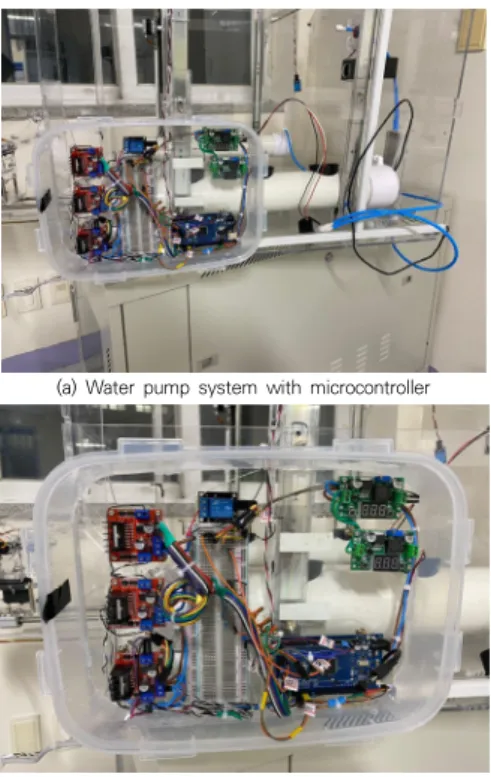
(a) Water pump system with microcontroller
(b) Arduino Mega and motor driver
[Fig. 8] Implementation of proposed system
Figure 8 shows a prototype of a system that monitors the agricultural environment and replenishes soil moisture proposed in the paper.
In the system, two microcontrollers were used, NodeMCU and Arduino Mega. In NodeMCU, monitoring was performed by connecting a soil moisture sensor, a temperature and humidity sensor, and a GPS module for measuring environmental data. In addition, at Arduino Mega, a motor driver for water pump control was connected and controlled. The environmental data measured in the NodeMCU was transmitted to the cloud storage using the ESP8266 WiFi module for immediate monitoring by the administrator.
The sensors used in the proposed system are connected to the NodeMCU and use the power of the board itself. Environmental data measured by sensors is transmitted to the cloud without processing the data in the microcontroller. However, based on the measured data, when the moisture in the current soil is below an appropriate level, a water pump is operated to supply water. In addition, while water is being supplied, the water pump is stopped when the moisture level in the soil is continuously measured.
In the experiment, ThingSpeak cloud was used among many cloud servers. And, the MQTT protocol was used to transmit the data measured by the sensor to the cloud server[16]. The MQTT protocol is a messaging protocol for IoT devices and is currently widely used in IoT environment.
In the experiment, the sensor value is acquired using NodeMCU and transmitted to ThingSpeak using the MQTT protocol. At this time, ThingSpeak acts as an MQTT broker and can send back to the received MQTT client[16,17].
Figure 9 shows the communication using the
MQTT protocol. ThingSpeak stores the received
message in the ThingSpeak channel. The data
stored in the channel can be easily visualized
using the dashboard. In addition, the saved data
can be analyzed using MATLAB[18].
[Fig. 9] Communication with MQTT protocol In the proposed system, the existing Blynk app was used without developing an app. The Blynk app displays sensor data from IoT devices and allows remote control. In addition, sensor data can be visualized and expressed. Fgiure 10 displays the Blynk app showing sensor data.
[Fig. 10] Blynk app with sensors data
Figure 11 shows the temperature and humidity data of the agricultural environment measured using the proposed system. In the morning before the temperature rose, the temperature was 25℃ and the humidity was about 71%, and in the afternoon, the temperature rose to 28〫℃ and the humidity decreased to 54%. From 1 pm when the humidity was lowered, it was confirmed that the water pump was operating normally.
5. Conclusion
In this paper, an IoT-based system that can be used in an agricultural environment is proposed.
The proposed system uses a microcontroller and various sensors to monitor the environment and to supply moisture to the soil so that the crops can grow well. In addition, it is possible to monitor sensor data in real time using a cloud platform. The actual implemented system, open source hardware and software, was utilized to the maximum. Using this system, it is possible to monitor and control the agricultural environment at low cost even in developing countries. In the future, the stored sensor data will be used to analyze the growth status of crops.
(a) Day graph of temperature
(b) Day graph of humidity
[Fig. 11] Temperature and humidity
ACKNOWLEDGMENTS
이 성과는 정부(과학기술정보통신부)의 재원으로 한국 연구재단의 지원을 받아 수행된 연구임(No.
2018R1C1B5046282).
REFERENCES
[1] M.Ayaz, M.Ammad-Uddin, Z.Sharif, A.Mansour and E.M.Aggoune, "Internet-of-Things (IoT)-Based Smart Agriculture: Toward Making the Fields Talk," in IEEE Access, Vol.7, pp.129551-129583, 2019.
[2] L.Chettri and R.Bera, "A Comprehensive Survey on Internet of Things (IoT) Toward 5G Wireless Systems,"
IEEE Internet of Things Journal, Vol.7, No.1, pp.16-32, 2020.
[3] K.Lee, "A Scheme on Anomaly Prevention for Systems in IoT Environment," Journal of The Korea Internet of Things Society, Vol.5, No.2, pp.95-101, 2019.
[4] J.K.Park and H.Y.Seo, "ZigBee-Based Smart Fire Detector for Remote Monitoring and Control,"
International Journal of Advanced Science and Technology, Vol.29, No.3, pp.10431-10441, 2020.
[5] A.Kirimtat, O.Krejcar, A.Kertesz and M.F.Tasgetiren,
"Future Trends and Current State of Smart City Concepts: A Survey," IEEE Access, Vol.8, pp.86448-86467, 2020.
[6] K.H.Nam and J.K.Park, "A Study on the Forestry Safety Helmet Development Based on IoT," Journal of the Korean Society of Industry Convergence, Vol.23, No.3, pp.419-425, 2020.
[7] J.K.Park and K.Nam, "Implementation of Multiple Sensor Data Fusion Algorithm for Fire Detection System," Journal of The Korea Society of Computer and Information, Vol.25 No.7, pp.9-16, 2020.
[8] J.K.Park, Y.H.Roh, K.H,Nam and H.Y.Seo, "Fire Detection Method Using IoT and Wireless Sensor Network," Journal of The Korea Society of Computer and Information, Vol.24, No.8, pp.131–136, 2019.
[9] D.Lee, K.Cho and S.Lee, "Analysis on Smart Factory in IoT Environment," Journal of The Korea Internet of Things Society, Vol.5, No.2, pp.1-5, 2019.
[10] M.S.Farooq, S.Riaz, A.Abid, K.Abid and M.A.Naeem, "A Survey on the Role of IoT in Agriculture for the Implementation of Smart Farming," IEEE Access, Vol.7, pp.156237-156271, 2019.
[11] J.Lee, "Analysis of the Hardware Structures of the IoT Device Platforms for the Minimal Power Consumption," Journal of The Korea Internet of Things Society, Vol.6, No.2, pp.11-18, 2020.
[12] M.Gupta, M.Abdelsalam, S.Khorsandroo and S.Mittal,
"Security and Privacy in Smart Farming: Challenges and Opportunities," IEEE Access, Vol.8, pp.34564-34584, 2020.
[13] J.K.Park and H.Park, "Implementation of a Smart Farming Monitoring System Using Raspberry Pi,"
Journal of Next-generation Convergence Technology Association, Vol.4, No.4, pp.354-360, 2020.
[14] S.O.Olatinwo and T.Joubert, "Enabling Communication
Networks for Water Quality Monitoring Applications:
A Survey," IEEE Access, Vol.7, pp.100332-100362, 2019.
[15] D.Mishra, A.Khan, R.Tiwari and S.Upadhay,
"Automated Irrigation System-IoT Based Approach,"
3rd International Conference On Internet of Things:
Smart Innovation and Usages (IoT-SIU), pp.1-4, 2018.
[16] J.K.Park and E.Y.Park, "Performance Evaluation of IoT Cloud Platforms for Smart Buildings," Journal of the Korea Academia-Industrial Cooperation Society, Vol.21, No.5 pp.664-671, 2020.
[17] D.T.Nguyen, C.Pham, K.K.Nguyen and M.Cheriet,
"Placement and Chaining for Run-Time IoT Service Deployment in Edge-Cloud," IEEE Transactions on Network and Service Management, Vol.17, No.1, pp.459-472, 2020.
[18] ThingSpeak for IoT Project, https://thingspeak.com.