• 검색 결과가 없습니다.

Analysis on the corneal thickness and anterior chamber depth of the Keratoconus using Pentacam

N/A
N/A
Protected

Academic year: 2021

Share "Analysis on the corneal thickness and anterior chamber depth of the Keratoconus using Pentacam"

Copied!
8
0
0

로드 중.... (전체 텍스트 보기)

전체 글

(1)

DOI: http://doi.org/10.15205/kschs.2018.03.31.1089

Analysis on the corneal thickness and anterior chamber depth of the Keratoconus using Pentacam

6)

Douk-Hoon Kim, MD, FIACLE

1

*; Kishor Sapkota, PhD, MSc, FAAO, FIACLE

2

1

Department of Optometry, Masan University, Korea

2

University of Minho, Portugal

(Received January 30, 2018; Received February 10, 2018; Accepted February 20, 2018) Abstract

Purpose: To investigate the corneal thickness and anterior chamber depth (ACD) of eyes with Keratoconus in the Korean population with the Pentacam .

Methods: The subjects consisted of 84 eyes from Keratoconic adults aged 7-59 years during 2010. The thinnest area, apex zone, and pupil centre of the corneal thickness were measured using the Pentacam pachymetry. ACD value was also measured with Pentacam.

Results: There was a statistically significant relationship between thickness of the cornea at the apex area and the pupil centre (p=0.0001). However, there was no statistical difference (p>0.5) in the mean thick- ness of thinnest area, apex zone, pupil centre of cornea between right eye and left eye. Also, correlation between ACD and corneal thickness in all subjects had no statistical differences (p>0.05) in all subjects.

Conclusion: These results suggested that the regional thickness of cornea and ACD with Pentacam can provide correct and useful diagnostic information of the morphology of Keratoconus for the RGP contact lens and diagnosis of abnormal corneal refraction surgery.

Key words: ACD, apex area, Pentacam system, pupil center zone, thinnest area

*Corresponding author : [email protected]

(2)

1. Introduction

Keratoconus has a congenital deformation of the anterior corneal morphology leading to myopia, irregular astigmatism, and eventually to a marked decrease in visual acuity

1-2)

.

For the clinical keratoconus research and diagnosis, the topographic system has provided excellent information about the fine structure of the cornea. The data acquired by topography tools has suggested significant important information in clinical diagnosis and management of keratoconus suspects

3)

, axial myopia

4)

, contactlenswear

5)

, and keratoplasty

6)

. Ccorneal thickness of each region is an indicator of corneal hydration and metabolism

7)

.

On the other hand, the topographic results of the central corneal thickness have been used to analyze the diagnosis of the glaucoma

8)

and intraocular pressure

9)

. Distribution of the central and paracentral corneal thickness and curvature has been studied in the European population

10)

. Especially, Age related changes in the central and peripheral corneal thickness seem to give the useful information to keratoplasty and refractive surgery

11)

. Recently, the relationship between the central corneal thickness and the anterior corneal curvature has been studied through the pachymetry system

10)

.

Furthermore, ethnic differences in the central corneal thickness have been described throughout the European, Hong Kong Chinese, Chinese, Japanese and Americans

8)

. Also, data on corneal pachymetry maps have been reported in Korean keratoconus population

12-13)

. However, thethinnest, apex, and pupil center corneal thickness and anterior chamber depth values of Korean keratoconus have not been reported yet. In this study, we research characteristics of the central, apex, thinnest corneal thickness and anterior chamber depth in Korean keratoconus by using

pachymetry data obtained from the Pentcam system. The purpose of our study was therefore to analysis in the thinnest, apex and pupil center corneal thickness and anterior chamber depth in Korean keratoconus subjects by the Pentacam system.

2. Materials and Methods

2.1. Subjects

This study included 84 keratoconus eyes of forty-nine Korean subjects, 35 had bilateral keratoconus and 14 had unilateral keratoconus.

Keratoconus was diagnosed with both subjective criteria like stromal thinning, Vogt striae, iron ring, munson sign, scissoring on retinoscopy as well as with objective criteria like corneal curvature 47.0D or more on SimK. They have no ocular disease, medication, systemic disease, contact lens wear, and refractive surgery. The subject's age ranged from 7 to 59 years. To exclude ocular disease, we tested the visual acuity and the IOP, and examined the slit-lamp and the funduscopy.

2.2. Examination

The corneal thickness and ACD values at a

distance of 5mm from central cornea were

obtained by measurements of the Pentacam

topography system (Bausch & Lomb, USA). The

measurements were obtained for each eye. The

Pachymetry was used for corneal topography

measurements while the subjects were silently

seated in a test room. The subjects were asked to

keep both eyes open and focus on a light source

in the center of the scan field. The measurements

automatically operated when the correct alignment

and focus of eye were achieved. The thicknesses

at the thinnest area, apex zone, and pupil center

(3)

of cornea were recorded automatically and analyzed by a SPSS 14 and a micro-soft excel program. All measurements were made from 10:00 A.M. to 12:00 A.M. During the test, the temperature ranged from 18

o

to 21

o

C, and the humidity ranged from 40% to 50%. Only the scans with the quality factor of 95% or more were selected for the analysis.

2.3. Data analysis

Analyses were performed by using SPSS software. Descriptive data were expressed as mean±standard deviation. The Pearson correlation and t-test were used to compare measurements in three zones of corneal thickness and ACD. P

values of less than 0.05 was considered as statistically significant.

3. Results

We acquired the corneal topographic data from 84 eyes (42 OD, 42 OS) with the mean age of 24.8±9.9 years (range 7-59 years). The mean age for the eyes was 24.3±9.2 years (range 7-54 years) for OD and 25.2±10.7 years (range 7-59 years) for OD. There was no significant difference in the mean age between OD and OS (p>0.523).

The OD and OS distributions of the thinnest area, apex zone and pupil center of the corneal thickness for these subjects were summarized in Table 1, and figure 1.

Item OD OS P-values

Ages 24.34±9.246 25.2±10.743 p=0.54

TA 484.90±72.644μm 482.075±64.391 μm p=0.836

AT 495.80±72.374μm 494.375±55.666 μm p=0.914

PZ 506.02±65.645μm 495.325±53.633μm p=0.571

ACD 3.33±0.376 mm 3.308±0.359mm p=0.778

thinnest corneal thickness, PA: apex zone thickness, PZ: pupil zone thickness, ACD: anterior chamber depth.

Table1. The distribution of the corneal thicknesses and ACD values in Korean subjects.

Fig.1. Typical keratoconus thickness with

Pentacam topography system.

(4)

The average thinnest corneal thickness was 484.900±72.644μm (range, 549-406μm) and 482.075±64.391μm(range, 428-450μm) for OD and OS, respectively. The mean thinnest corneal thickness of all subjects was 483.489 μm (Figure 2).

There was no significant difference in the mean thinnest corneal thickness between OD and OS (P=0.836, T-test). Also the mean apex corneal thickness was 495.80±72.374μm and 494.375±

55.666μm for OD and OS, respectively. There was no significant difference in mean apex corneal thickness between OD and OS (p=0.914).

Also the average pupil center thickness was 506.02±65.645μm and 495.325±53.633μm for OD and OS, respectively. There was no significant difference in mean pupil center thickness between OD and OS (p=0.571). On the other hand, mean of anterior corneal depth was 3.33±0.376 mm and 3.308±0.359mm for OD and OD. There was no significant difference in mean anterior chamber depth between OD and OS (p=0.778). However, correlation between ACD and corneal thickness in all subjects was had strong statistical differences (p>0.05) in all subjects.

thinnest Coenal thickness

Fig. 2. The thinnest corneal thickness of keratoconus subjects

Table 2 showed that the correlation between thinnest cornea and anterior chamber depth had a statistical significance differences in OD (p=0.026) and OS (p=0.004, t-test). On the other hand, Table 2 showed that the correlation between apex region and anterior chamber depth had a statistical significance differences in OD (p=0.035, t-test) and OS (p=0.010). At the same

time, Table 2 showed that the correlation between pupil zone and anterior chamber depth had a statistical significance differences in OD (p=0.009, t-test) and OS (p=0.004). As a results, in all subjects, Table 2 showed that the correlation between corneal thickness and ACD had strong significant differences (p>0.1).

Item TA & ACD AT & ACD PCT & ACD

OD 0.026* 0.035* 0.009

OS 0.004* 0.010* 0.004*

*p<0.5

TA: thinnest corneal thickness, PA: apex thickness, PZ: pupil center thickness
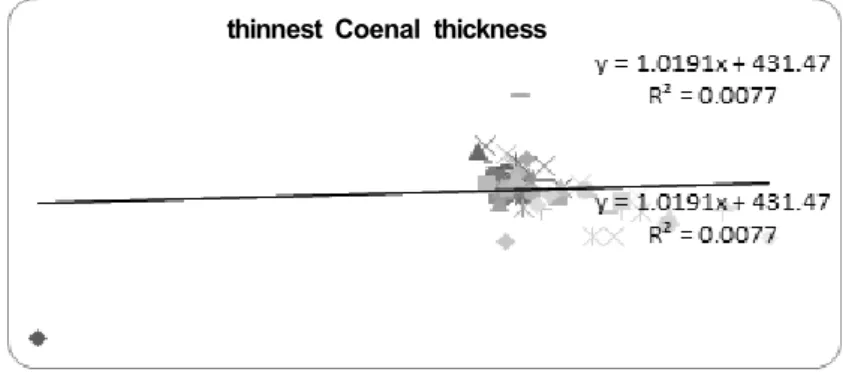
Table 2. The relationship between corneal thicknesses and ACD values in Korean subjects.

(5)

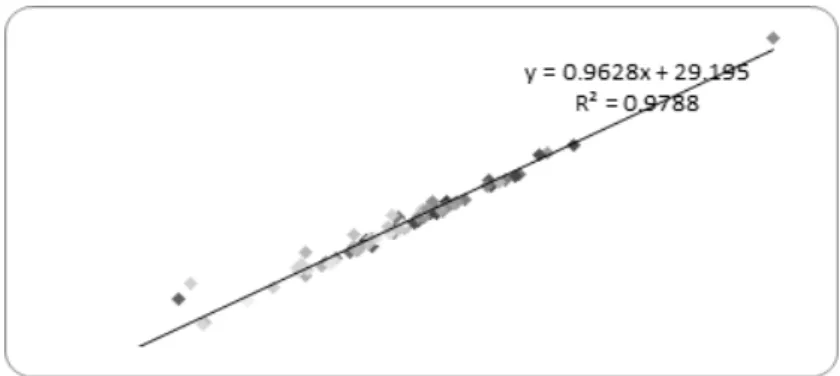
Figure 3 showed thath the correlation between thinnest zone (TZ) and apex region (AR) of the corneal thickness had not a statistical significance differences (p=0.27, t-test). However, figure 4 showed thath the correlation between thinnest zone (TZ) and pupil center (PC) of the corneal thickness had a strong statistical significance differences (p=0.06). Also, TZ(x) and PC(Y) were positively correlated, and correlation coefficient was moderate (y=0.9006x + 56.359; p=0.06; Fig.4).

On the other hand, figure 5 showed thath the correlation between apex region (AR) and pupil center (PC) of the corneal thickness had not a statistical significance differences (p=0.47).

Fig.3. Correlation between the change in the thinnest zone (TZ) and apex region (AR) of the corneal thickness.

Fig.4. Correlation between the change in the thinnest zone (TZ) and pupil center region (PC) of the corneal thickness. P=0.06

Fig.5. Correlation between the change in the apex region (AR)

and pupil center region (PCR) of the corneal thickness.

(6)

4. Discussion

In this study, we carried out and analyzed the data of the relationship between corneal thickness and anterior chamber depth in keratoconus Korean population. For this study, we used the top- ography system because it easily measures the corneal thickness across the entire surface corneal shape

6)

. We believe that topography measurements of corneal thickness are more reliable than ultra- sound pachymetry tests. Because the defect of the ultrasound pachymetry is that the target of fix- ation light and the test area are only dependent on the user

14)

, therefore, some results of ultrasound pachymetry are unstable. On the other hand, we made specia

15)

care to avoid outside condition changes that could change the physiologic corneal status because under stable physiologic states the corneal thickness is constant

15)

. We especially made care to avoid situations where corneal hy- dration might be altered because such conditions have been associated with more changes in cor- neal thickness

10)

. Therefore, temperature range during test was maintained as the same conditions (18℃ to 21℃), also the same applied for relative humidity (ranging from 40% to 50%).

Furthermore, we performed the corneal top- ography test at a constant time to avoid the diur- nal variation in corneal shape

16)

. In the last few years, knowledge of corneal thickness has become increasingly important in clinical diagnosis and treatment

17)

. So, pachymetry using the topography System become increasingly established. It shows good reproducibility and accuracy

18)

. In this study, we present specific reference values for the Pentacam system and investigate the influence of both eyes on the corneal morphology. In our study, the mean thinnest corneal thickness at all subjects was 483.488±9.995μm. Haque et al.

19)

study showed that the mean central corneal thick- ness of keratoconus was 494.2±50.0μm for

Canadian, 451.07±61.01μm for Korean

12)

from keratoconus population. We find out that the mean central corneal thickness of Koreans kerato- conus was similar to Canadian. Maybe, we think that these results were not affected by the genetics factors of the difference race.

In normal subjects, Florian et al.

17)

found that the sex or the side had significant influence on the central corneal thickness. Price et al.

20)

had not detected differences in the central corneal thick- ness between female and male subjects.

Nevertheless, Cosar et al.

8)

detected significant differences in the central corneal thickness among hyperopic, myopic, emmetropic subjects, emme- tropic corneas being the thinnest. In our study, we found that the central corneal thickness have not a significant difference between OD and OS in mean corneal thickness. However, we can find out that the mean cornea thickness at the thinnest (483.488±68.518μm), apex region (494.088±64.02 μm) and pupil center (500.673±59.639µm).

On the other hand, La Rossa FA et al.

21)

re- ported that young Europeans differ in corneal thickness values between populations. They ob- served that African American patients had lower central corneal thickness values than Caucasian patients. However, we can find out that the mean corneal thickness of Korean keratoconus subjects have a similar to Canadian keratoconus population. As a results, we can suggest that cor- neal thickness of keratoconus have no ethnic problem.

The corneal thickness and anterior chamber depth knowledge of corneal data is becoming more important. Also the increasing use of cor- neal diagnosis of refractive surgery is responsible for this. Information about corneal thickness and ACD thus permits the postoperative refractive power to be predicted within certain limits.

In our study, we cannot identify a statistically

significant difference at corneal thickness between

(7)

OD and OS measurements. Also we cannot identi- fy a statistically significant difference at ACD be- tween OD and OS measurements.

Arntz et al.

22)

reported that the ACD of kerato- conus subjects was 3.51mm. But, Leeatal.

12)

was 3.31mm in Korean keratoconus population. On the other hand, we find out that the mean of anterior corneal depth in Korean keratoconus subjects was 3.33±0.376 mm and 3.308±0.359mm for OD and OD. In contrast, we found out that the corneal thickness and ACD had statistically significant differences in all subjects (P=0.00).

Florian et al.

17)

reported that the peripheral cor- neal thickness may also prove useful in priding a better match between donor and host cornea and the information are related to anatomic changes also seems important to us with regard to re- fractive surgery. We think that corneal thickness and ACD was very useful information in regards to corneal diagnosis and treatment in clinic.

However, several studies have not researched dif- ferences in central corneal thickness between fe- male and male subjects

5)10)20)

. Nevertheless, we analyzed the difference between the mean central and ACD thickness obtained of each eye or individual. The difference between the central thickness and the ACD was also analyzed. In the corneal thickness and curvature studies, Giraldez Fernandez et al.

23)

indicated that the change in central and paracentral corneal thickness was strongly correlated with corneal curvature, except for 2mm nasal and superior semi-meridians. ur study showed that the relationship between the several corneal thickness and ACD was statisti- cally significant from 7 to 59 years of age (p=0.000).

5. Conclusions

In this study, we believe that the several values of Pentacam data were suitable for comparative

study of corneal thickness in the Korean keratoco- nus subjects because they represent a both eyes cross-section of the keratoconus population. Also, the topographic study of keratoconus Korean sub- jects has shown that the difference between the several corneal thickness and ACD have sig- nificant difference (p>0.01) at OD and OS of all subjects. On the other hand, the OD and OS re- lated changes in several corneal thickness in all subjects didn’t have a statistically significant difference.

References

1. Lawless M, Coster DJ, Philips AJ, Loane M.

Keratoconus: diagnosis and management, Aust N Z J Ophthalmol. 1989; 17:33-60.

2. Rabinowitz YS, Keratoconus, Surv Ophthalmol.

1998; 42:297-319.

3. Edmonds CR, Wung SF, Pemberton B, Surrett S. Comparison of anterior chamber depth of nor- mal and keratoconus eyes using Scheimpflug photography. Eye Contact lens. 2009;35(3):

120-122.

4. Ernst BJ, Hsu Hy. Keratoconus association with axial myopia: a prospective biometric study. Eye Contact Lens. 2011. 37(1);2-5.

5. Jinabhia A, Radhakrishana H, O’Donnell C.

Corneal changes after suspending contact lens wear in early pellucid marginal corneal degen- eration and moderate keratoconus. Eye Contact Lens. 2011;37(2) 99-105.

6. Kato N. Toda I, Kawakita T, Sakai C, Tsubota K. Topography-guided conductive keratoplasty : treatment for advanced keratoconus. Am J Ophthalmol. 2010. 150(4):481-489.

7. Lam AK, Douthwaite WA. The corneal-thick- ness profile in Hong Kong Chinese.

Cornea.1998;17, 384-388.

8. Cosar CB, Sener AB. Orbscan corneal top-

ography system in evaluating the anterior

(8)

structures of the human eye. 2003; Cornea 22, 118-121.

9. Marjanovic I, Kontic D, Hentova-sencanic P, Markovic V, Bozic M. Correlation between central corneal thickness and intraocular pres- sure in various age groups. Srp Arh Celok Lek.

2010; 138(5-6):279-286.

10. Liu Z, Pflugfelder SC. Corneal thickness is re- duced in dry eye. Cornea.1999; 18, 403-407.

11. Liu Z, Huang AJ, Pflugfelder SC. Evaluation of corneal thickness and topography in normal eyes using the Orbscan corneal system. Br J Ophthalmil. 1999; 83, 774-778.

12. Lee SK, Lee CH, Lee JE, Lee JS. Corneal Topography study using Orbacan II between keratoconus and keratoconus suspect. J Korean Ophthalmol Soc. 2007;48(1):

1599-1606.

13. Choi JC,Kim MK, Lee JE. Diagnostic Criteria for Keratoconus Uning Orbscan II Slit Scanning topography pachymetry System. J Korean Ophthalmol Soc. 2004;45(6):928-935.

14. A. Juan, LP. Antonio, A. Luis, MS. Rahhal, MS. Franciso. Anatomic study of the corneal thickness of young emmetropic subjects 2004;

23(7):669-673.

15. Bohnke M, Chavanne P, Gianotti R.

Continuous non-contact corneal pachymetry with a high speed reflectometer. J. Refract Surg.1998;14, 140-146.

16. Feng Y, Varikooty J, Simpson TL. Diurnal variation of corneal and corneal epithelial

measured using optical coherence tomography.

Cornea. 2001;20, 480-483.

17. Florian R, Anke S, Christine B, Carl E.

Age-related changes in central and peripheral corneal thickness-Determination of normal values with the Orbscan II topography system. Cornea. 2007;26(1), 1-5.

18. Cho P, Cheung SW. Repeatability of corneal thickness measurements made by a scanning slit topography system. Ophthalmic Physiol Opt. 2002; 22, 505-510.

19. Haque S, Simpson T, Jones L. Corneal and epithelial thickness in keratoconus : a com- parison of ultrasonic pachymetry, ORBscan II, and optical coherence tomography. J Refract Surg. 2006; 22(5): 486-493.

20. Price FW, Koller DL, Price MO. Central cor- neal pachymetry in patients undergoing laser in situ keratomileusis. Ophthalmology. 1999;

106, 2216-2220.

21. La Rosa FA, Gross RL, Orengo-Nania S.

Central corneal thickness of Caucasian and African Americans in glaucomatous and non- glaucomatous populations. Arch Ophthalmol.

2001;119, 23-27.

22. Arntz A, Duran JA, Pijoan JI. Subclinical ker- atoconus diagnosis by elevation topography.

Arch Soc Esp Oftalmol.2003;78:659-664.

23. Giraldez FMJ, Diaz RA, Cervino A. A Comparison of corneal of two pachymetric systems: slit-scanning and ultrasonic. CLAO J.

2002;221-223.

수치

Fig. 2. The thinnest corneal thickness of keratoconus subjects
Figure 3 showed thath the correlation  between  thinnest zone (TZ)  and apex region (AR) of the  corneal thickness had not a statistical significance differences (p=0.27, t-test)

참조

관련 문서

The signal has the same frequency of vibration and its amplitude will be proportional to the magnetic moment, amplitude, and relative position with respect to the pick-up

The “Asset Allocation” portfolio assumes the following weights: 25% in the S&amp;P 500, 10% in the Russell 2000, 15% in the MSCI EAFE, 5% in the MSCI EME, 25% in the

1 John Owen, Justification by Faith Alone, in The Works of John Owen, ed. John Bolt, trans. Scott Clark, &#34;Do This and Live: Christ's Active Obedience as the

(Note that when the number of scored questions for a given test is greater than the range of possible scaled scores, it is likely that two or more raw scores will convert to

We can compute all the thermodynamic properties relative to the ideal-gas state at 1 bat and at the same temperature and composition, provided that we have

For the analytic solution, define the subdomain vector in the same way, namely the summation of the fluxes obtained at the same discretized points as the numerical solution.. Do

Therefore, the aim of this study was to investigate the morphologic characteristics of the interalveolar foramen and to analyze according to sex and age using cone

In gi ngi va,LCs are found i n oralepi thel i um ofnormalgi ngi va and i n smal l er amountsi nthesul cul arepi thel i um,buttheyareprobabl yabsentfrom thejuncti onal epi thel