• 검색 결과가 없습니다.

Aorta Remodeling after Endovascular Treatment of a Chronic DeBakey IIIb Aneurysm and Simultaneous Palliation of a Renal Cell Carcinoma

N/A
N/A
Protected

Academic year: 2021

Share "Aorta Remodeling after Endovascular Treatment of a Chronic DeBakey IIIb Aneurysm and Simultaneous Palliation of a Renal Cell Carcinoma"

Copied!
4
0
0

로드 중.... (전체 텍스트 보기)

전체 글

(1)

ISSN: 2233-601X (Print) ISSN: 2093-6516 (Online)

− 142 −

Departments of

1

Thoracic and Cardiovascular Surgery,

2

Radiology, and

3

Urology, Gangnam Severance Hospital, Yonsei University College of Medicine Received: June 10, 2014, Revised: October 27, 2014, Accepted: October 31, 2014, Published online: April 5, 2015

Corresponding author: Suk-Won Song, Department of Thoracic and Cardiovascular Surgery, Gangnam Severance Hospital, Yonsei University College of Medicine, 211 Eonju-ro, Gangnam-gu, Seoul 135-720, Korea

(Tel) 82-2-2019-3380 (Fax) 82-2-2019-8282 (E-mail) [email protected]

C

The Korean Society for Thoracic and Cardiovascular Surgery. 2015. All right reserved.

CC
This is an open access article distributed under the terms of the Creative Commons Attribution Non-Commercial License (http://creative- commons.org/licenses/by-nc/3.0) which permits unrestricted non-commercial use, distribution, and reproduction in any medium, provided the original work is properly cited.

Aorta Remodeling after Endovascular Treatment of a Chronic DeBakey IIIb Aneurysm and Simultaneous Palliation of a Renal

Cell Carcinoma

Do Jung Kim, M.D.

1

, Kwang-Hun Lee, M.D., Ph.D.

2

, Sun-Hee Lim, R.N.

1

, Byung Ha Chung, M.D., Ph.D.

3

, Suk-Won Song, M.D., Ph.D.

1

We report the case of a patient with a chronic DeBakey type IIIb aneurysm who underwent thoracic endovascular aortic repair to seal the primary entry tear and stent-graft insertion to cover the re-entry tear at the renal artery.

The procedure was performed in order to achieve complete thrombosis in the entire thoracoabdominal false lumen, leading to favorable aortic remodeling. Simultaneously, ethanol ablation and renal artery embolization were per- formed to treat a renal tumor suspicious of renal cell carcinoma. Radical nephrectomy then confirmed clear cell carcinoma. To the best of our knowledge, no other cases of this type have been reported in the Korean literature.

Key words: 1. Endovascular procedures 2. Aortic dissection 3. Renal cell carcinoma

CASE REPORT

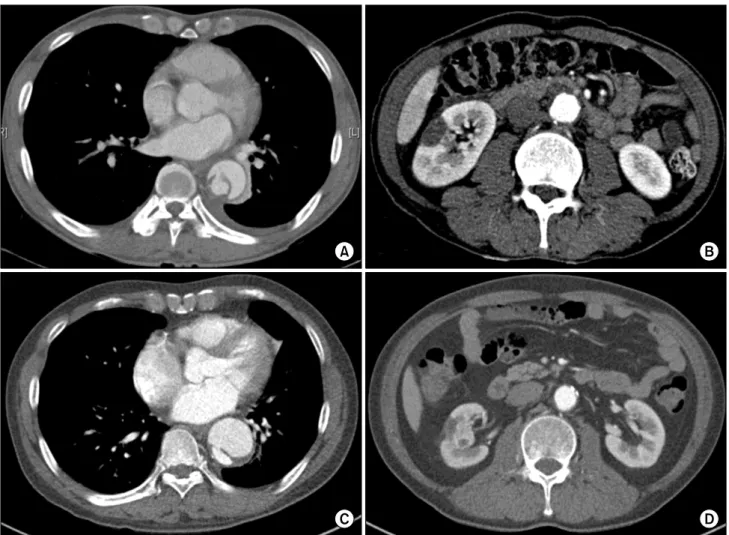
A 54-year-old man was referred to Gangnam Severance Hospital for acute DeBakey type IIIb aortic dissection extend- ing to the juxtarenal aorta. The primary entry tear and re-en- try tear were located at the T8 level and the right renal ar- tery, respectively. The celiac trunk, superior mesenteric artery, and left renal artery originated from the true lumen (TL). The right renal artery originated from both a false lumen (FL) and the TL. The maximum diameter of the aneurysm was 36 mm (Fig. 1A). A 23-mm cystic lesion was present in the right kidney with fine calcifications and septation (Bosniak IIF) (Fig. 1B). The patient was transferred to the intensive care unit for optimal medical treatment. The patient was dis- charged in good condition eight days later.

At the three-month and seven-month follow-ups, the patient showed no signs of malperfusion. A computed tomography (CT) scan revealed no significant interval aortic diameter change. By the 24-month follow-up, the maximum aortic di- ameter had grown from 36 mm to 46 mm (Fig. 1C).

Additionally, within a previously existing cyst, a renal tumor had developed that was suspicious for renal cell carcinoma (RCC) (Fig. 1D). The patient was readmitted and underwent zone 3 thoracic endovascular aortic repair (TEVAR) starting just behind the left subclavian artery and extending to the T12/L1 (Fig. 2A, B) supraceliac region with cerebrospinal fluid drainage. Two TX2 Pro-Form grafts (38-202-34 and 34- 157-30; Cook, Bloomington, IN, USA) were used. The cere- brospinal fluid pressure was maintained at 10 mmHg for the first 24 hours, and the mean arterial pressure was kept above

Korean J Thorac Cardiovasc Surg 2015;48:142-145 □ Case Report □

http://dx.doi.org/10.5090/kjtcs.2015.48.2.142

(2)

Endovascular Treatment of Chronic IIIb Aneurysm and Renal Cell Carcinoma

− 143 −

Fig. 1. (A) Initial preoperative computed tomography (CT) scan showing an acute DeBakey type IIIb aortic dissection with a maximum di- ameter of 36 mm. (B) Initial preoperative CT scan showing a renal cystic lesion about 23 mm in diameter on the right kidney (Bosniak IIF). (C) A CT scan performed twelve months later, showing that the aneurysm had grown to 46 mm. (D) Renal tumor formation on the right kidney.

90 mmHg to prevent spinal cord ischemia. The patient was discharged on the fifth postoperative day without any complications.

One month later the patient underwent a second stage op- eration covering the right renal artery re-entry tear with a Viabahn stent graft (6 mm in diameter, 25 mm in length;

W.L. Gore & Associates, Flagstaff, AZ, USA) (Fig. 2C).

Under the occlusion balloon, total ablation of the right kidney was performed using 99.9% ethanol (10 mL) mixed with lip- iodol (1 mL), and two 0.889-mm platinum Nester coils (Cook) (Fig. 2D). The postoperative course was without in- cident and the patient was discharged from the hospital on the seventh postoperative day. Follow-up CT scans at one

and fourth months postoperatively revealed that the right kid-

ney had atrophied and that the renal tumor size had de-

creased from 23 mm to 16 mm. The most recent CT scan,

performed 7 months after the secondary surgery, showed fa-

vorable aortic remodeling with complete thrombosis in the

entire thoracoabdominal FL (Fig. 2E), and partial response of

the renal tumor was achieved, as its diameter decreased from

23 mm to 16 mm without metastasis (Fig. 3A). Seventeen

months after the secondary surgery, radical nephrectomy was

performed (Fig. 3B) and pathological results revealed a

1.8-cm clear cell RCC of Fuhrman nuclear grade III. The pa-

tient is doing well, with no evidence of major aortic events

or recurrence of the tumor.

(3)

Do Jung Kim, et al

− 144 −

Fig. 2. (A) Zone 3 thoracic endovascular aortic repair (TEVAR) in the supraceliac trunk. (B) Complete thrombosis in the false lumen. (C) A re-entry tear at the origin of the right renal artery (top). A Viabahn stent graft (6 mm diameter, 25 mm length; W.L. Gore &

Associates, Flagstaff, AZ, USA) was inserted into the right renal artery (bottom). (D) Total ablation of the right renal artery using a mixture of 99.9% ethanol (9 mL) and lipiodol (1 mL) together with coil embolization. (E) A computed tomography scan taken 11 months later, showing favorable aortic remodeling with a decreased aortic diameter and resorption of the thrombosis of the false lumen.

Fig. 3. (A) Computed tomography scan showing an atrophied right kid- ney containing a renal tumor with a decreased diameter of 16 mm. (B) Gross finding after en bloc radical nephrectomy.

DISCUSSION

Endovascular treatment has emerged as an effective and ac- ceptable treatment with lower mortality and morbidity rates than open surgery [1-4]. However, controversy surrounds the TEVAR of complicated chronic (>three months duration) DeBakey type IIIb aneurysms [4,5]. In this case, surgical in-

tervention was performed on a patient in whom the diameter

of the thoracic aorta had increased 5–10 mm or more per

year [3,4]. Covering the primary and proximal tears with a

stent graft can induce FL thrombosis and regression, ex-

pansion of the TL, and aortic remodeling, which prevents the

abdominal aorta from dilating further [1,4]. In chronic aortic

dissection, the presence of a rigid and thickened intimal flap

(4)

Endovascular Treatment of Chronic IIIb Aneurysm and Renal Cell Carcinoma

− 145 − and multiple entry tears can adversely affect FL dilation [2-4]. Failure of the TL to re-expand after a stent graft is de- ployed usually occurs due to distal entry tears that pressurize the FL, potentially resulting in progressive dilation with pos- sible aneurysm formation and rupture [1,4].

The present case report confirms that the presence of re-en- try tears requires supplementary treatment, because continuous flow between the FL and TL is responsible for aneurysmal progression. However, one-step stent graft insertion from the descending thoracic aorta to the superior mesenteric artery may result in spinal cord ischemia due to occlusion of the lumbar arteries. The presence of persistent distal perfusion in the visceral branches through the FL, along with infrarenal aortic enlargement, required a staged procedure [3,5]. In order to preserve the flow of the lumbar arteries, TEVAR should first be performed from the descending thoracic artery to the supraceliac region. After one month, a secondary intervention involving stent graft insertion in the right renal artery in or- der to seal the re-entry tear resulted in thrombosis of the en- tire FL and favorable aortic remodeling.

In addition, total ablation of the right kidney using a 99.9% ethanol mixture and coil embolization was performed.

The initial CT scan revealed a renal cystic lesion with fine calcifications and septation. The Bosniak category IIF lesions were defined as slightly more complicated cysts with minimal wall thickening or thin septa, and required a serial imaging study because of the relatively low malignancy rate (approxi- mately 5%) in surgically treated lesions [6]. The patient in the present case underwent an additional follow-up study to confirm that the cysts remained stable and benign. A pre- viously existing complicated cyst became a renal tumor suspi- cious for RCC in the right kidney. RCC is the most common renal malignancy, accounting for approximately 90% of cases.

Active surveillance is recommended for the treatment of small renal masses (<4 cm) [7]. Although radical neph- rectomy remains the standard treatment for cT3 tumors, which show invasion into the hilum and sinus fat, this patient was unfit for surgery due to significant co-morbidities, in- cluding the presence of an aortic aneurysm. We decided to perform a selective renal artery embolization that resulted in

the successful palliative treatment of RCC. However, a fol- low-up CT scan seventeen months after embolization revealed the recurrence of RCC with growth of the renal mass.

Surgery was necessary to prevent potential metastasis.

In conclusion, endovascular stent grafts for chronic DeBakey type IIIb aneurysms are an attractive alternative treatment.

Endovascular treatment covering both the primary tear and re-entry tear can induce complete FL thrombosis and favor- able aortic remodeling. In the presence of comorbidities such as RCC, additional concomitant use of ethanol and coil em- bolization may prove to be a useful therapeutic option and play the role of a bridge to surgery.

CONFLICT OF INTEREST

No potential conflict of interest relevant to this article was reported.

REFERENCES

1. Berger L, Palcau L, Gouicem D, Coffin O. Persistent type B aortic dissection treatment by renal artery reentry stent grafting as an alternative to open surgery. Ann Vasc Surg 2013;27:498.e5-8.

2. Hager E, Moudgill N, Lipman A, Dimuzio P, Lombardi J.

Coil-assisted false lumen thrombosis in complicated chronic type B dissection. J Vasc Surg 2008;48:465-8.

3. Andacheh ID, Donayre C, Othman F, Walot I, Kopchok G, White R. Patient outcomes and thoracic aortic volume and morphologic changes following thoracic endovascular aortic repair in patients with complicated chronic type B aortic dissection. J Vasc Surg 2012;56:644-50.

4. Parsa CJ, Williams JB, Bhattacharya SD, et al. Midterm re- sults with thoracic endovascular aortic repair for chronic type B aortic dissection with associated aneurysm. J Thorac Cardiovasc Surg 2011;141:322-7.

5. Scali ST, Feezor RJ, Chang CK, et al. Efficacy of thoracic endovascular stent repair for chronic type B aortic dissection with aneurysmal degeneration. J Vasc Surg 2013;58:10-7.e1.

6. Hwang JH, Lee CK, Yu HS, Cho KS, Choi YD, Ham WS.

Clinical outcomes of Bosniak category IIF complex renal cysts in Korean patients. Korean J Urol 2012;53:386-90.

7. Ljungberg B, Cowan NC, Hanbury DC, et al. EAU guide-

lines on renal cell carcinoma: the 2010 update. Eur Urol

2010;58:398-406.

수치

Fig. 1. (A) Initial preoperative computed tomography (CT) scan showing an acute DeBakey type IIIb aortic dissection with a maximum di- di-ameter of 36 mm
Fig. 2. (A) Zone 3 thoracic endovascular aortic repair (TEVAR) in the supraceliac trunk

참조

관련 문서

Here, endovascular repair for a saccular aneurysm using endo- skeleton stent grafts showed a regional difference in endothelial cell coverage on the graft between the normal

D .Digital subtraction venogram obtained immediately after insertion of a stent-graft shows complete exclusion of the aneurysm.. Spiral CT scan obtained seven days after

A CT image before endovascular aneurysm repair (EVAR) shows abdominal aortic aneurysm and coexisting right psoas abscess (arrow) in a patient who underwent open surgical

Endovascular aneurysm repair using a branched stent graft is an- other option to treat an AAA involving CIA. A branched stent graft can be customized to each patient’s iliac

The indications for endovascular repair were abdominal aortic aneurysm in 5 patients, descending thoracic aortic aneurysm in 6 patients and acute type B aortic dissection in

Background: Endovascular aneurysm repair (EVAR) has dramatically changed the management of abdominal aortic aneurysms (AAAs) as the number of open aneurysm repairs

Review Article | Intervention eISSN 2005 8330 https //doi org/10 3348/kjr 2018 0927 Korean J Radiol 2019;20(8) 1247 1265 Endovascular Aneurysm Repair for Abdominal Aortic Aneurysm

We describe the imaging findings and the endovascular treatment of a patient with an aberrant splenic artery aneurysm using a combination of stent graft and coil