http://www.jomes.org | 147
A Case of Fulminant Type 1 Diabetes in a Patient with Type 2 Diabetes Mellitus
Ji Min Kim, Ji Hye Han, Kyong Hye Joung, Ju Hee Lee, Hyun Jin Kim, Bon Jeong Ku*
Department of Internal Medicine, Chungnam National University Hospital, Chungnam National University School of Medicine, Daejeon, Korea
Fulminant type 1 diabetes mellitus is a recently identified subtype of type 1 diabetes characterized by abrupt disease onset, a very short (<1 week) duration of diabetic symptoms, acidosis at diagnosis, negative status of is- let-related autoantibodies, and virtually no C-peptide secretion. Cases of fulminant type 1 diabetes are promi- nently observed in East Asia, with several case reports and studies having originated from Japan. Indeed, a re- cent study from Japan reported that fulminant type 1 diabetes accounts for 15-20% of type 1 diabetes cases as- sociated with onset of ketosis or ketoacidosis. Since 2005, several fulminant type 1 diabetes cases have also been reported in South Korea; however, there have been no reports of cases in patients previously diagnosed with type 2 diabetes mellitus. Here, we report a rare case of fulminant type 1 diabetes in a patient previously diag- nosed with type 2 diabetes.
Key words: Diabetes mellitus type 1, Diabetic ketoacidosis, Diabetes mellitus type 2
Received Junuary 21, 2016 Reviewed March 3, 2016 Accepted April 27, 2016
* Corresponding author Bon Jeong Ku
http://orcid.org/0000-0002-3414-8949 Department of Internal Medicine, Chungnam National University School of Medicine, 282 Munhwa-ro, Jung-gu, Daejeon 35015, Korea
Tel: +82-42-280-7149 Fax: +82-42-280-7995 E-mail: [email protected]
INTRODUCTION
Type 1 diabetes mellitus is a disease in which destruction or damage of pancreatic β-cells results in marked hyperglycemia and ketosis, and is classified as either autoimmune (type 1A) or idio- pathic (type 1B) diabetes. The destruction of β-cells in autoim- mune type 1 diabetes occurs slowly, with onset of ketosis several years after initiation of β-cell damage. However, unlike the manifes- tation of autoimmune type 1 diabetes, some patients experience rapid destruction of β-cells, resulting in an abrupt onset of hyper- glycemia and ketoacidosis. This condition is known as fulminant type 1 diabetes. In this type of diabetes, the duration of disease starting from a normal β-cell mass and normoglycemia to almost total destruction of β-cells and ketoacidosis is usually only a few days, and rarely exceeds 1 week. Thus, in patients with fulminant type 1 diabetes, symptoms occur within a week, but glycated he-
moglobin (HbA1c) levels remain normal or near-normal.1 Since 2005, several fulminant type 1 diabetes cases have been re- ported in South Korea; however, there have been no reports of cas- es in patients previously diagnosed with type 2 diabetes mellitus.
Here, we report a rare case of fulminant type 1 diabetes in a patient with type 2 diabetes.
CASE REPORT
A 51-year-old female presented to the Chungnam National Uni- versity Hospital emergency room complaining of general weakness and hyperglycemia in January 2015. She had previously been diag- nosed with type 2 diabetes at a local medical center in March 2014.
At the time of diagnosis, her fasting plasma glucose was 140 mg/dL and her HbA1c was 7.0%; C-peptide levels were not evaluated. The patient’s blood glucose levels were well controlled with glimepiride
Copyright © 2017 Korean Society for the Study of Obesity
This is an Open Access article distributed under the terms of the Creative Commons Attribution Non-Commercial License (http://creativecommons.org/licenses/by-nc/4.0/) which per- mits unrestricted non-commercial use, distribution, and reproduction in any medium, provided the original work is properly cited.
Case Report
pISSN 2508-6235eISSN 2508-7576 Journal of Obesity & Metabolic Syndrome 2017;26:147-150
https://doi.org/10.7570/jomes.2017.26.2.147
Kim JM, et al. Fulminant Diabetes in Type 2 Diabetic Patient
https://doi.org/10.7570/jomes.2017.26.2.147
148 | http://www.jomes.org
(0.5-1 mg/day) and her HbA1c level had been 6.5% four months prior to the current visit. Three days before admission, her blood glucose levels had gradually increased to over 400 mg/dL, and her symptoms of polydipsia and general weakness worsened.
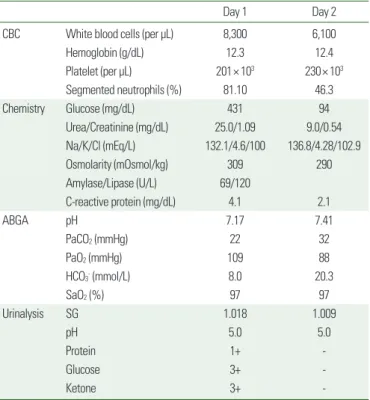
The patient was alert on admission, and her blood pressure was 100/60 mmHg, respiratory rate was 18 breaths per min, heart rate was 103 beats per min, and body temperature was 36.2°C. The pa- tient’s height and weight were 155.4 cm and 60.5 kg, respectively, her body mass index (BMI) was 25.05 kg/m2, and she had not ex- perienced any recent changes in weight. Arterial blood gas analysis (ABGA) showed a metabolic acidosis with an increased anion gap of 19.5 mEq/L. Her plasma glucose levels were elevated to 431 mg/dL, and her serum osmolality, urea, and creatinine were also slightly elevated. Urine testing was positive for glucose (3+) and ketones (3+) (Table 1). Based on these findings, the patient was diagnosed with diabetic ketoacidosis (DKA). To rule out infection and cancer, chest X-rays and computed tomography (CT) of the abdomen were obtained, which showed no abnormal findings be- sides a moderately fatty liver.
Continuous insulin infusion with fluid replacement was initiated
to treat DKA. Glucose levels were measured hourly and the insulin- infusion rate was varied from 2.5 to 10 units per hour to maintain adequate blood glucose levels (150-200 mg/dL). After 10 hours of treatment, the patient recovered from metabolic acidosis with a pH, pCO2, and HCO3- of 7.40, 30 mmHg, and 18.6 mmol/L, re- spectively, as measured by ABGA, and her anion gap recovered to normal levels. After resolution of DKA, her general condition im- proved and she was able to start a diet treatment. At that time, her insulin therapy was changed to a basal bolus insulin regimen. Addi- tional laboratory tests revealed that her HbA1c level was 7.0% and her fasting C-peptide level was very low (0.01 pmol/mL). Serum pancreatic lipase was elevated (two times above the upper limit of normal), but amylase was normal. Tests for glutamic acid decar- boxylase antibody (GAD-Ab), islet cell antibody (ICA), and insu- lin autoantibody (IAA) were all negative. After her glucose levels stabilized with the basal bolus insulin regimen, the treatment was changed to premixed insulin. She was discharged on an insulin regi- men consisting of 56 units of Novomix 30 FlexPen (70% insulin aspart protamine suspension and 30% insulin aspart) before break- fast and 20 units of Novomix 30 FlexPen before dinner. Three months after discharge, her HbA1c level had increased to 8.4% and her blood glucose levels were poorly controlled despite mainte- nance of the mixed split therapy. She achieved and maintained good glycemic control after her insulin regimen was changed to multiple injections. Six months later, we observed that the patient’s C-peptide level remained low at 0.01 pmol/mL, suggesting com- plete destruction of pancreatic β-cells.
DISCUSSION
Fulminant type 1 diabetes was first reported by Imagawa et al. in 2000.2 The clinical characteristics of fulminant type 1 diabetes are as follows: 1) remarkably abrupt onset of disease; 2) very short ( < 1 week) duration of diabetic symptoms including polyuria, polydipsia, and body weight loss; 3) acidosis at diagnosis; 4) nega- tive status of islet-related autoantibodies such as ICA, GAD-Ab, IAA, or anti–IA-2; 5) virtually no C-peptide secretion (< 10 μg/
day in urine); and 6) elevated serum levels of pancreatic enzymes.
Fulminant type 1 diabetes is observed particularly in East Asia, with several case reports and studies having originated from Japan.
Table 1. Initial and follow-up laboratory findings
Day 1 Day 2
CBC White blood cells (per μL) 8,300 6,100
Hemoglobin (g/dL) 12.3 12.4
Platelet (per μL) 201× 103 230× 103
Segmented neutrophils (%) 81.10 46.3
Chemistry Glucose (mg/dL) 431 94
Urea/Creatinine (mg/dL) 25.0/1.09 9.0/0.54 Na/K/Cl (mEq/L) 132.1/4.6/100 136.8/4.28/102.9
Osmolarity (mOsmol/kg) 309 290
Amylase/Lipase (U/L) 69/120
C-reactive protein (mg/dL) 4.1 2.1
ABGA pH 7.17 7.41
PaCO2 (mmHg) 22 32
PaO2 (mmHg) 109 88
HCO3- (mmol/L) 8.0 20.3
SaO2 (%) 97 97
Urinalysis SG 1.018 1.009
pH 5.0 5.0
Protein 1+ -
Glucose 3+ -
Ketone 3+ -
CBC, complete blood count; Na, sodium; K, potassium; Cl, chloride; ABGA, arterial blood gas analysis; SG, specific gravity.
Kim JM, et al. Fulminant Diabetes in Type 2 Diabetic Patient
https://doi.org/10.7570/jomes.2017.26.2.147 http://www.jomes.org | 149
Indeed, a recent study from Japan reported that fulminant type 1 diabetes accounts for 15-20% of type 1 diabetes cases associated with onset of ketosis or ketoacidosis.3 In another study from Korea, among 99 patients newly diagnosed with type 1 diabetes, seven pa- tients (7.1%) fulfilled the criteria for fulminant type 1 diabetes and among patients aged ≥ 18 years at onset, 30.4% had fulminant type 1 diabetes.4
The prevalence of fulminant type 1 diabetes differs between Caucasians and East Asians. The first case in a Caucasian patient was reported in 2008, and only a few cases since then have been re- ported.5 The mean age of patients at onset of disease is 39.1± 15.7 years. Among 161 reported cases, only 8.7% have been under 20 years of age6, and there is no difference in prevalence with respect to gender.2,3 Fulminant type 1 diabetes is also a well-known cause of pregnancy-related DKA.6 In such cases, the onset is usually in the third trimester or immediately after delivery, and the prognosis for the fetus is extremely poor.3,7,8
The exact pathogenesis of fulminant type 1 diabetes is unknown.
It has been suggested that certain genetic backgrounds pose an in- creased risk, including specific human leukocyte antigen (HLA) types. According to studies performed in Japan, fulminant type 1 diabetes occurs to a greater extent in HLA-DR4, whereas HLA- DR9 is more common in typical type 1 diabetes. In addition, hap- lotype analysis has revealed that DR4-DQ4 is significantly more frequent in fulminant type 1 diabetes.9,10 Viral infection is also sus- pected to play a role in the pathogenesis of this disease, with most patients exhibiting common cold-like and gastrointestinal symp- toms prior to onset of disease.11,12 According to biopsies of the pan- creas, severe reduction in the number of both β- and α-cells as well as lymphocytic infiltration of exocrine pancreatic tissue is often present.5,13 However, in our case, there was no evidence of infection based on the patient’s history and physical examination. In addition to infection, a case of fulminant type 1 diabetes accompanying Reye’s syndrome has been reported14, suggesting that anti-inflam- matory drugs may destroy β-cells in some patients with fulminant type 1 diabetes. There have been no reports regarding other drugs that may cause fulminant type 1 diabetes. The only medication be- ing taken by the patient in our case was glimepiride, and there is no known association of glimepiride and fulminant type 1 diabetes.
Autoimmune type 1 diabetes is associated with a reduced num-
ber of β-cells, while fulminant type 1 diabetes is associated with a reduction in both β-cells and glucagon-producing α-cells.3 As men- tioned above, the most important difference between these two diseases is the extremely rapid transition from hyperglycemic symptoms to ketosis in fulminant type 1 diabetes. In addition, pa- tients with fulminant type 1 diabetes need high-dose insulin thera- py and have a higher BMI compared to autoimmune type 1 diabe- tes patients. In the present case, the patient’s glucose levels were well controlled with one hypoglycemic agent. However, her glu- cose levels became rapidly elevated within 1 week of onset, at which time she developed DKA. In addition, more than 70 units of insulin and multiple insulin injections were eventually required to achieve glycemic control. Serum pancreatic enzyme levels are often elevated in fulminant type 1 diabetes, but fulminant type 1 diabetes is not necessarily accompanied by elevated serum pancreatic en- zyme according to some case reports.5,15
DKA is a potentially life-threatening complication in patients with diabetes mellitus. DKA occurs predominantly in patients with type 1 diabetes, but it can occur in those with type 2 diabetes as well. A recent study that evaluated 138 consecutive admissions for moderate to severe DKA at a large academic center observed that 21.7% of cases of DKA involved patients with type 2 diabetes. In addition, nearly 70% of the admissions involved discontinuation of medication, and infections were present in approximately 50% of cases.16 Therefore, when DKA occurs in patients with type 2 diabe- tes, physicians should check for the presence of comorbid diseases.
In the patient in our case, DKA occurred without interruption in medication or presence of comorbid disease. The patient also de- nied use of any medications or herbal supplements capable of alter- ing blood glucose levels. Finally, the patient’s history and laboratory tests were sufficient to diagnose fulminant type 1 diabetes accord- ing to the diagnostic criteria proposed by Imagawa et al.2 Therefore, fulminant type 1 diabetes mellitus should be included in the differ- ential diagnosis of DKA occurring in a patient previously diagnosed with type 2 diabetes mellitus.
CONFLICTS OF INTEREST
The authors declare no conflict of interest.
Kim JM, et al. Fulminant Diabetes in Type 2 Diabetic Patient
https://doi.org/10.7570/jomes.2017.26.2.147
150 | http://www.jomes.org
REFERENCES
1. Tanaka S, Endo T, Aida K, Shimura H, Yokomori N, Kaneshige M, et al. Distinct diagnostic criteria of fulminant type 1 diabe- tes based on serum C-peptide response and HbA1c levels at onset. Diabetes Care 2004;27:1936-41.
2. Imagawa A, Hanafusa T, Miyagawa J, Matsuzawa Y; Osaka IDDM Study Group. A novel subtype of type 1 diabetes mel- litus characterized by a rapid onset and an absence of diabetes- related antibodies. N Engl J Med 2000;342:301-7.
3. Hanafusa T, Imagawa A. Fulminant type 1 diabetes: a novel clinical entity requiring special attention by all medical practi- tioners. Nat Clin Pract Endocrinol Metab 2007;3:36-45.
4. Cho YM, Kim JT, Ko KS, Koo BK, Yang SW, Park MH, et al.
Fulminant type 1 diabetes in Korea: high prevalence among patients with adult-onset type 1 diabetes. Diabetologia 2007;
50:2276-9.
5. Moreau C, Drui D, Arnault-Ouary G, Charbonnel B, Chail- lous L, Cariou B. Fulminant type 1 diabetes in Caucasians: a report of three cases. Diabetes Metab 2008;34:529-32.
6. Shimizu I, Makino H, Osawa H, Kounoue E, Imagawa A, Hanafusa T, et al. Association of fulminant type 1 diabetes with pregnancy. Diabetes Res Clin Pract 2003;62:33-8.
7. Himuro H, Sugiyama T, Nishigori H, Saito M, Nagase S, Suga- wara J, et al. A case of a woman with late-pregnancy-onset DKA who had normal glucose tolerance in the first trimester.
Endocrinol Diabetes Metab Case Rep 2014;2014:130085.
8. Bresson L, Bourgain A, Depret T, Vambergue A, Dubos JP,
Deruelle P, et al. Ketoacidosis complicated by fetal death re- vealing fulminant diabetes during the third trimester of preg- nancy. J Gynecol Obstet Biol Reprod (Paris) 2010;39:588-91.
9. Imagawa A, Hanafusa T, Uchigata Y, Kanatsuka A, Kawasaki E, Kobayashi T, et al. Different contribution of class II HLA in fulminant and typical autoimmune type 1 diabetes mellitus.
Diabetologia 2005;48:294-300.
10. Kwak SH, Kim YJ, Chae J, Lee CH, Han B, Kim JI, et al. Asso- ciation of HLA genotype and fulminant type 1 diabetes in Koreans. Genomics Inform 2015;13:126-31.
11. Imagawa A, Hanafusa T, Uchigata Y, Kanatsuka A, Kawasaki E, Kobayashi T, et al. Fulminant type 1 diabetes: a nationwide survey in Japan. Diabetes Care 2003;26:2345-52.
12. Inokuchi R, Matsumoto A, Odajima H, Shinohara K. Fulmi- nant type 1 diabetes mellitus. BMJ Case Rep 2012;2012:bcr 2012006560.
13. Imagawa A, Hanafusa T. Fulminant type 1 diabetes-an impor- tant subtype in East Asia. Diabetes Metab Res Rev 2011;27:
959-64.
14. Imagawa A, Hanafusa T. Pathogenesis of fulminant type 1 dia- betes. Rev Diabet Stud 2006;3:169-77.
15. Aoki K, Taniyama M, Nagayama C, Oikawa Y, Shimada A. T cell immunity to glutamic acid decarboxylase in fulminant type 1 diabetes without significant elevation of serum amylase.
Ann N Y Acad Sci 2006;1079:181-5.
16. Newton CA, Raskin P. Diabetic ketoacidosis in type 1 and type 2 diabetes mellitus: clinical and biochemical differences.
Arch Intern Med 2004;164:1925-31.