pISSN 1598-9992 eISSN 2233-6869
ORIGINAL ARTICLE
체질량지수와 만성 위축성 위염 및 장상피화생과의 관계
김나리, 윤창호, 김아솔, 고혜진, 김효민
1, 문하나, 박수정
경북대학교 의학전문대학원 가정의학교실, 칠곡경북대학교병원 가정의학과1
Associations between Body Mass Index and Chronic Atrophic Gastritis and Intestinal Metaplasia
Nari Kim, Chang-Ho Youn, A-Sol Kim, Hae-Jin Ko, Hyo-Min Kim1, Hana Moon and Sujung Park
Department of Family Medicine, Kyungpook National University School of Medicine, Department of Family Medicine, Kyungpook National University Chilgok Hospital1, Daegu, Korea
Background/Aims: Chronic atrophic gastritis (AG) and intestinal metaplasia (IM) of the stomach are premalignant lesions. The present study aimed to examine the associations between obesity and these lesions.
Methods: A total of 2,997 patients, who underwent gastroscopy, participated in this study, excluding those who had been diagnosed with gastric cancer. Participants were divided into four groups based on their body mass index (BMI). The risk of AG and IM with increas- ing BMI was analyzed in men and women, separately.
Results: The association between BMI and AG was not significant. After adjusting for age, smoking, alcohol, and AG, the odds ratios for IM in the overweight, obesity, and severe obesity groups were 2.25 (95% confidence interval [CI], 1.50-3.37), 2.32 (95% CI, 1.58-3.42), and 4.86 (95% CI, 2.04-11.5) in men, and 2.66 (95% CI, 1.29-5.47), 4.46 (95% CI, 2.28-8.75), and 9.57 (95% CI, 3.26-28.12) in women, compared with the normal BMI group.
Conclusions: Gastric IM was significantly associated with increased BMI. (Korean J Gastroenterol 2017;70:81-88) Key Words: Body mass index; Atrophic gastritis; Metaplasia
Received January 17, 2017. Revised March 8, 2017. Accepted April 5, 2017.
CC This is an open access article distributed under the terms of the Creative Commons Attribution Non-Commercial License (http://creativecommons.org/licenses/
by-nc/4.0) which permits unrestricted non-commercial use, distribution, and reproduction in any medium, provided the original work is properly cited.
Copyright © 2017. Korean Society of Gastroenterology.
교신저자: 윤창호, 41944, 대구시 중구 국채보상로 680, 경북대학교 의학전문대학원 가정의학교실
Correspondence to: Chang-Ho Youn, Department of Family Medicine, Kyungpook National University School of Medicine, 680 Gukchaebosang-ro, Jung-gu, Daegu 41944, Korea. Tel: +82-53-200-5791, Fax: +82-53-200-5480, E-mail: [email protected]
Financial support: None. Conflict of interest: None.
서 론
비만은 전 세계적으로 증가 추세이며, 2014년 국민건강영 양조사에서는 체질량지수(body mass index, BMI) 25 kg/m2 기준으로 한국 성인의 31.5%가 비만인 것으로 나타났다.1 비 만의 유병률이 증가함에 따라 관련 질병에 대한 연구도 활발 히 이루어지고 있다. 비만은 대장암, 췌장암 등 다수의 소화기 암에서 위험인자로 보고되고 있으며,2,3 위암의 경우 BMI 증 가에 따라 분문부 선암(cardiac adenocarcinoma)의 위험이 증가하는 것으로 보고되었다.4비만이 위암을 일으키는 기전 에 대해서 명확히 정립된 이론은 없으나, 비만한 경우 복압의
증가로 식도-위 접합부의 위산 역류가 염증을 일으키고, 비만 과 관련된 호르몬의 변화로 암 발생의 위험이 증가한다는 가 설이 제시되어 있다.5
위축성 위염(atrophic gastritis) 및 장상피화생(intestinal metaplasia)은 위암의 전구 병변으로, 국내 유병률은 각각 9.4-63.8%, 7.1-42.5%로 다양하게 보고되고 있다.6 Correa7의 이론에 따르면 위축성 위염은 장상피화생, 위이형성(gastric dysplasia)의 단계를 거쳐 장형 위암(intestinal type gastric cancer)을 발생시키며, 이 과정에서 헬리코박터(
Helicobacter
pylori
)균의 만성적 감염이 주요한 역할을 하는 것으로 알려져 있다. 이들 병변과 비만과의 관련성에 대해서는 다수의 선행연구가 시행되었으나 뚜렷이 밝혀진 바는 없다. Torisu 등8과 Watabe 등9은 일본인을 대상으로 시행한 연구에서 BMI와 위 축성 위염 간에 역의 상관관계가 있다고 보고하였고, 유럽에 서 시행된 한 연구에서는 BMI와 장상피화생 간에 역의 상관 관계가 있는 것으로 보고하였다.10 한편, 국내에서 시행된 한 연구에서는 여성에 한해 비만과 위이형성의 관련성이 있는 것 으로 보고하였다.11
최근 내시경적 절제술의 발달로, 정기적인 위내시경 검사를 통한 조기 병변의 발견과 위암의 예방적 측면이 강조되고 있 다. 따라서 내시경적 진단이 가능한 위축성 위염과 장상피화 생의 위험인자에 대한 평가 및 선별, 추적 검사의 중요성은 더욱 확대될 것이다. 위축성 위염 및 장상피화생에 대한 기존 연구들에서는 헬리코박터균이 주요한 위험요인으로 알려졌으 나,12최근 연구에서는 장상피화생의 위험요인으로 세균 외에 숙주, 환경적 요인의 중요성이 보고된 바 있다.13,14 이와 같은 배경하에, 본 연구에서는 위축성 위염 및 장상피화생과 비만 의 관련성에 대해 알아보고자 한다.
대상 및 방법
1. 연구 대상
2013년부터 2014년까지 한국의 일개 지역 두 개의 종합병 원 건강증진센터를 방문하여 위내시경을 실시한 자 3,028명 중 위 절제술을 시행하였거나 조직학적으로 위암이 확진되었 거나 자료의 결측치가 있는 자를 제외한 2,997명을 대상으로 본 연구를 시행하였다. 본 연구는 경북대학교병원 임상연구윤 리심의위원회(institutional review board, IRB)의 심의, 승인 하에 이루어졌다.
2. 연구 방법
1) 설문 조사
연구 대상자들이 건강증진센터를 방문하여 작성한 자기기 입식 설문지를 통하여 연령, 성별, 음주력, 흡연력을 조사하였 다. 흡연 상태는 비흡연군과 과거 및 현재 흡연을 모두 포함하 는 흡연군으로 분류하였다. 음주 상태는 비음주군, 적절 음주 군, 과음군으로 분류하였고, 적절 음주를 남자의 경우 하루 2잔 이하, 여자의 경우 하루 1잔 이하로 정의하였다.
2) 신체 계측
신장 및 체중은 생체계측기를 이용하여 측정하였고, BMI는 체중(kg)을 키의 제곱(m2)으로 나눈 수치로 산정하였다. 남녀 각각에 대해 BMI 23 kg/m2 미만인 경우를 정상 체중으로 보 고, 23 kg/m2 이상 25 kg/m2 미만은 과체중군, 25 kg/m2
이상 30 kg/m2 미만은 비만군, 30 kg/m2 이상인 경우는 고도 비만군으로 분류하였다. 허리 둘레는 직립 자세로 최하위 늑 골하부와 골반 장골능선 사이에서 가장 좁은 둘레를 측정하였 다. 혈압은 측정 전 10분 이상 안정을 취한 후 앉은 자세에서 수축기와 이완기 혈압을 측정하였다.
3) 위축성 위염 및 장상피화생의 진단
위내시경 검사는 건강증진센터에 근무 중인 3명의 숙련된 내시경 전문의에 의해 표준화된 방법으로 시행되었다. 위축성 위염은 내시경 소견상 위전정부와 체부의 점막이 얇아지고 점 막하 혈관이 잘 관찰되는 경우로 정의하고, Kimura-Takemoto 의 분류법을 이용하여 진단하였다.15장상피화생은 내시경 소 견상 위점막에 흰색의 판(plaque)이나 반점(patch) 또는 균일 한 흰색의 변색이 있는 경우로 진단하였다.16
3. 통계 분석
연구 대상자 남녀 각각의 위축성 위염 및 장상피화생의 위 험인자를 알아보기 위하여 Chi-square test와 Independent t-test를 이용한 단변량 분석을 시행하였다. 위축성 위염 및 장상피화생의 유무에 따른 비만도의 차이를 알아보기 위하여 연령, 흡연, 음주, 위축성 위염 또는 장상피화생 여부를 보정 한 공분산분석(analysis of covariance)을 통해 남녀 각각 BMI의 추정 평균값을 산출하였다. BMI 그룹별로 위축성 위 염 및 장상피화생의 교차비(odds ratio)를 구하기 위해 로지 스틱 회귀분석을 시행하였다.
결 과
1. 연구 대상자의 일반적 특성
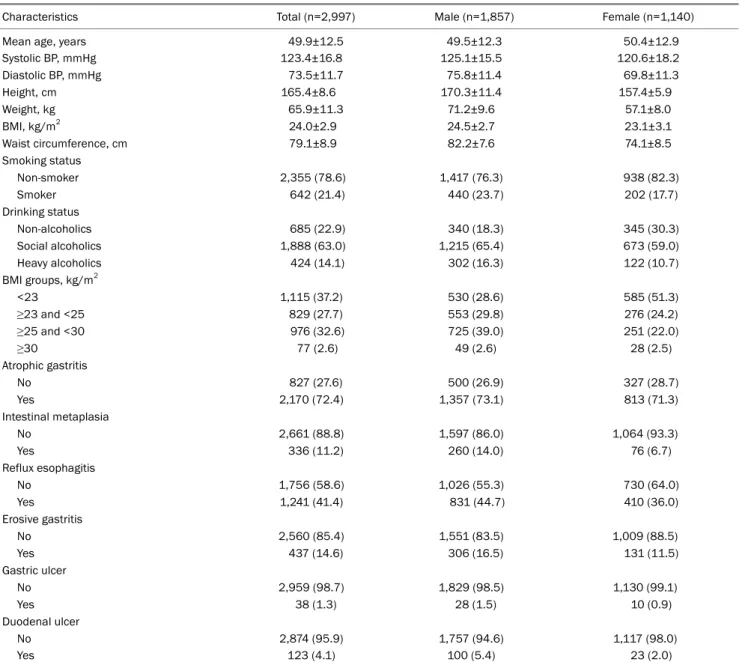
본 연구의 대상자 총 2,997명의 평균 나이는 49.9세였고, 성별은 남성 62.0%, 여성 38.0%였다. 평균 BMI는 24.0 kg/m2 였고, BMI에 따라 정상군은 1,115명(37.2%), 과체중군은 829 명(27.7%), 비만군은 976명(32.6%), 고도비만군은 77명(2.6%) 이었다. 위축성 위염의 유병률은 72.4%, 장상피화생의 유병 률은 11.2%로 나타났다(Table 1).
2. 위축성 위염과 장상피화생의 위험요인 분석
위축성 위염이 있는 남성의 평균 연령은 52.1세, 여성은 53.1세로, 위축성 위염이 없는 군에 비하여 평균 연령이 유의 하게 높았다(각각 p<0.001, p<0.001). 평균 BMI는 남성의 경 우 유의한 차이를 보이지 않았고(p=0.290), 여성에서 위축성 위염이 있는 군의 평균 BMI가 23.3kg/m2로 유의하게 높았다 (p<0.001). 수축기 및 확장기 혈압은 여성의 경우에만 위축성 위염이 있는 군에서 유의하게 높았다(Table 2).
Table 1. Baseline Characteristics of Study Subjects
Characteristics Total (n=2,997) Male (n=1,857) Female (n=1,140)
Mean age, years 49.9±12.5 49.5±12.3 50.4±12.9
Systolic BP, mmHg 123.4±16.8 125.1±15.5 120.6±18.2
Diastolic BP, mmHg 73.5±11.7 75.8±11.4 69.8±11.3
Height, cm 165.4±8.6 170.3±11.4 157.4±5.9
Weight, kg 65.9±11.3 71.2±9.6 57.1±8.0
BMI, kg/m2 24.0±2.9 24.5±2.7 23.1±3.1
Waist circumference, cm 79.1±8.9 82.2±7.6 74.1±8.5
Smoking status
Non-smoker 2,355 (78.6) 1,417 (76.3) 938 (82.3)
Smoker 642 (21.4) 440 (23.7) 202 (17.7)
Drinking status
Non-alcoholics 685 (22.9) 340 (18.3) 345 (30.3)
Social alcoholics 1,888 (63.0) 1,215 (65.4) 673 (59.0)
Heavy alcoholics 424 (14.1) 302 (16.3) 122 (10.7)
BMI groups, kg/m2
<23 1,115 (37.2) 530 (28.6) 585 (51.3)
≥23 and <25 829 (27.7) 553 (29.8) 276 (24.2)
≥25 and <30 976 (32.6) 725 (39.0) 251 (22.0)
≥30 77 (2.6) 49 (2.6) 28 (2.5)
Atrophic gastritis
No 827 (27.6) 500 (26.9) 327 (28.7)
Yes 2,170 (72.4) 1,357 (73.1) 813 (71.3)
Intestinal metaplasia
No 2,661 (88.8) 1,597 (86.0) 1,064 (93.3)
Yes 336 (11.2) 260 (14.0) 76 (6.7)
Reflux esophagitis
No 1,756 (58.6) 1,026 (55.3) 730 (64.0)
Yes 1,241 (41.4) 831 (44.7) 410 (36.0)
Erosive gastritis
No 2,560 (85.4) 1,551 (83.5) 1,009 (88.5)
Yes 437 (14.6) 306 (16.5) 131 (11.5)
Gastric ulcer
No 2,959 (98.7) 1,829 (98.5) 1,130 (99.1)
Yes 38 (1.3) 28 (1.5) 10 (0.9)
Duodenal ulcer
No 2,874 (95.9) 1,757 (94.6) 1,117 (98.0)
Yes 123 (4.1) 100 (5.4) 23 (2.0)
Values are presented as mean±standard deviation or number (%).
BP, blood pressure; BMI, body mass index.
장상피화생이 있는 남성의 평균 연령은 57.9세, 여성은 61.1세로, 장상피화생이 없는 군에 비하여 평균 연령이 유의 하게 높았다(각각 p<0.001, p<0.001). 장상피화생이 있는 군 의 평균 BMI는 남자 25.0 kg/m2, 여자 25.2 kg/m2로, 장상피 화생이 없는 군에 비하여 평균 BMI가 유의하게 높았다(각각 p=0.001, p<0.001). BMI를 네 그룹으로 나누어 비교하였을 때, 남녀 모두 BMI 그룹 간 장상피화생의 발생이 유의한 차이 를 보였다(각각 p=0.005, p<0.001). 혈압은 여성의 경우에, 흡연 여부는 남성의 경우에 한해 유의한 차이를 보였고, 음주 상태는 남성 및 여성 모두에서 유의한 차이를 보였다(Table 3).
3. 위축성 위염 및 장상피화생 유무에 따른 평균 체질량지수의 비교
위축성 위염 발생에 영향을 줄 수 있는 나이, 흡연, 음주 및 장상피화생 여부로 보정한 BMI 추정 평균값은 남녀 모두 유의한 차이가 없었다(Fig. 1A). 장상피화생이 있는 군에서 나 이, 흡연, 음주 및 위축성 위염으로 보정하여 구한 BMI의 추정 평균값은 장상피화생이 없는 군에 비하여 남성이 26.1 kg/m2, 여성이 24.9 kg/m2로 유의하게 높았다(각각 p<0.001, p=0.001) (Fig. 1B).
Table 2. Univariate Analysis of the Risk Factors for AG
Characteristics
Male (n=1,857) Female (n=1,140)
Non-AG (n=500)
AG
(n=1,357) p-valuea Non-AG
(n=327)
AG
(n=813) p-valuea
Mean age, years 42.7±12.1 52.1±11.4 <0.001 43.6±12.5 53.1±12.0 <0.001
Systolic BP, mmHg 125.3±14.0 125.1±16.1 0.755 115.5±16.1 122.7±18.6 <0.001
Diastolic BP, mmHg 75.6±11.3 75.9±11.4 0.669 68.1±10.5 70.5±11.5 0.001
Height, cm 172.4±5.8 169.6±5.8 <0.001 159.3±5.4 156.6±5.9 <0.001
Weight, kg 73.3±9.6 70.4±9.5 <0.001 57.1±7.8 57.2±8.0 0.850
Waist circumference, cm 82.4±7.6 82.2±7.6 0.557 71.9±8.2 75.0±8.4 <0.001
BMI, kg/m2 24.6±2.6 24.5±2.7 0.290 22.5±2.9 23.3±3.1 <0.001
Smoking status
Non-smoker 391 (27.6) 1,026 (72.4) 0.244 271 (28.9) 667 (71.1) 0.739
Current smoker 109 (24.8) 331 (75.2) 56 (27.7) 146 (72.3)
Drinking status
Non-alcoholics 106 (31.2) 234 (68.8) 0.120 107 (31.0) 238 (69.0) 0.176
Social alcoholics 320 (26.3) 895 (73.7) 193 (28.7) 480 (71.3)
Heavy alcoholics 74 (24.5) 228 (75.5) 27 (22.1) 95 (77.9)
BMI groups, kg/m2
<23 142 (26.8) 388 (73.2) 0.250 195 (33.3) 390 (66.7) 0.001
≥23 and <25 137 (24.8) 416 (75.2) 75 (27.2) 201 (72.8)
≥25 and <30 211 (29.1) 514 (70.9) 54 (21.5) 197 (78.5)
≥30 10 (20.4) 39 (79.6) 3 (10.7) 25 (89.3)
Intestinal metaplasia
No 486 (30.4) 1,111 (69.6) <0.001 323 (30.4) 741 (69.6) <0.001
Yes 14 (5.4) 246 (94.6) 4 (9.2) 72 (90.8)
Values are presented as mean±standard deviation, or number (%).
AG, atrophic gastritis; BP, blood pressure; BMI, body mass index.
ap-values were calculated by chi-square test for discrete outcomes and independent t-test for continuous outcomes.
4. BMI와 위축성 위염 및 장상피화생의 관련성에 대한 로지스틱 회귀분석
BMI와 위축성 위염 간 유의한 상관관계는 확인되지 않았다 (남녀 각각 p-trend=0.771, p-trend=0.746) (Table 4). BMI 와 장상피화생의 관련성에 대해 연령, 흡연, 음주 그리고 위축 성 위염 여부를 보정하여 분석한 결과, 남성에서는 정상 체중 군에 비해 과체중군, 비만군, 고도비만군의 교차비가 각각 2.25 (95% confidence interval [CI] 1.50-3.37), 2.32 (95%
CI 1.58-3.41), 4.86 (95% CI 2.04-11.5)로 BMI 증가에 따라 유 의하게 발생 위험이 증가하는 경향을 보였다(p-trend<0.001).
여성에서도 과체중군, 비만군, 고도비만군의 교차비가 각각 2.66 (95% CI 1.29-5.47), 4.46 (95% CI 2.28-8.75), 9.57 (95%
CI 3.26-28.12)로 유의한 경향성을 보였다(p-trend<0.001) (Table 5).
고 찰
본 연구에서는 건강검진 수검자를 대상으로 비만과 위축성 위염 및 장상피화생의 관계를 알아보았다. 위축성 위염과 BMI 의 유의한 상관관계는 확인되지 않았으나, 장상피화생의 경우
남녀 모두에서 BMI의 증가에 따라 위험도가 유의하게 증가하 는 것으로 나타났다. 이는 국내의 선행 연구에서는 보고된 적 이 없는 결과로, 비만과 위암의 전구 병변인 장상피화생과의 관련성을 밝혀냈다는 의의를 가진다.
위축성 위염과 장상피화생의 위험인자에 대한 한 국내 연 구에서는 비만은 유의한 위험인자가 아닌 것으로 보고하였 다.14 또 다른 국내 연구에서는 비만군 여성에서 위이형성의 발생 위험이 2.09배(CI 1.0-4.3) 증가하였으나, BMI 증가에 따른 유의한 경향성은 없는 것으로 나타났다.11 일본에서 시행 된 한 대규모 단면 연구에서 Watabe 등9은 BMI와 위축성 위염 간에는 역의 상관관계가 있다고 보고하였으며, 그 원인 으로는 위점막의 위축으로 음식 섭취를 증가시키는 호르몬인 ghrelin의 분비가 줄어들기 때문이라고 설명하였다.
한편, leptin은 지방세포나 위점막에서 생성되어 식후 포만 감을 일으키고 음식 섭취를 줄이는 역할을 하는 호르몬이다.17 Jun 등18은 헬리코박터균에 의해 leptin의 생성이 증가하였다 고 하였으며, Roper 등19은 헬리코박터 감염 시 위점막의 위 축과 장상피화생이 더 심하기 때문에 leptin이 감소한다고 보 고하였다. 그러나 최근 쥐를 대상으로 실험한 한 연구 결과, 비만은 leptin signaling pathway의 활성화를 통해 위축성
Table 3. Univariate Analysis of the Risk Factors for IM
Characteristics
Male (n=1,857) Female (n=1,140)
Non-IM (n=1,597)
IM
(n=260) p-valuea Non-IM
(n=1,064)
IM
(n=76) p-valuea
Mean age, years 48.2±12.1 57.9±10.1 <0.001 49.6±12.7 61.1±10.0 <0.001
Systolic BP, mmHg 125.0±15.4 125.8±16.2 0.439 119.8±17.7 132.1±21.0 <0.001
Diastolic BP, mmHg 75.9±11.5 75.4±11.0 0.561 69.6±11.1 73.1±12.5 0.008
Height, cm 170.6±5.9 168.3±6.1 <0.001 157.6±5.8 154.1±5.9 <0.001
Weight, kg 71.2±9.7 71.0±9.1 0.772 57.0±7.9 59.9±8.8 0.002
Waist circumference, cm 82.3±7.6 81.9±7.7 0.434 73.8±8.5 77.5±7.8 <0.001
BMI, kg/m2 24.4±2.7 25.0±2.6 0.001 22.9±3.0 25.2±3.4 <0.001
Smoking status
Non-smoker 1,258 (88.8) 159 (11.2) <0.001 877 (93.5) 61 (6.5) 0.634
Smoker 339 (77.0) 101 (23.0) 187 (92.6) 15 (7.4)
Drinking status
Non-alcoholics 324 (95.3) 16 (4.7) <0.001 336 (97.4) 9 (2.6) <0.001
Social alcoholics 1,050 (86.4) 165 (13.6) 626 (93.0) 47 (7.0)
Heavy alcoholics 223 (73.8) 79 (26.2) 102 (83.6) 20 (16.4)
BMI groups, kg/m2
<23 479 (90.4) 51 (9.6) 0.005 571 (97.6) 14 (2.4) <0.001
≥23 and <25 466 (84.3) 87 (15.7) 255 (92.4) 21 (7.6)
≥25 and <30 613 (84.6) 112 (15.4) 217 (86.5) 34 (13.5)
≥30 39 (79.6) 10 (20.4) 21 (75.0) 7 (25.0)
Atrophic gastritis
No 486 (97.2) 14 (2.8) <0.001 323 (98.8) 4 (1.2) <0.001
Yes 1,111 (81.9) 246 (18.1) 741 (91.1) 72 (8.9)
Values are presented as mean±standard deviation or number (%).
IM, intestinal metaplasia; BP, blood pressure; BMI, body mass index.
ap-values were calculated by chi-square test for discrete outcomes and independent t-test for continuous outcomes.
A B
Fig. 1. Adjusted mean BMI of patients with AG (A) and IM (B). Values are presented as adjusted mean±standard error. *p-values are from ANCOVA test after adjusting for age, smoking, alcohol intake, and IM; †p-values are from ANCOVA test after adjusting for age, smoking, alcohol intake, and AG. BMI, body mass index, AG, atrophic gastritis, IM, intestinal metaplasia, ANCOVA, analysis of covariance.
위염과 장상피화생을 유발할 수 있다고 보고하였다.20 선행 연구를 종합해보면, 위축성 위염이 체질량지수를 감소 시킨다는 이론과, 반대로 비만에 의해 위축성 위염이 유발된 다는 이론이 모두 설명 가능하나 아직은 근거가 부족해 보인 다. 본 연구와 같은 단면 연구만으로는 관련성을 명확히 밝히
기 어려운 한계가 있으며, 분자생물학적 기법을 활용한 대규 모 코호트 연구를 통해 자세한 기전이 밝혀질 수 있을 것이다.
본 연구에서 선행 연구와 달리 위축성 위염과 BMI에 유의 한 상관관계가 없었던 원인은 다음과 같이 추측할 수 있다.
첫째, 헬리코박터균의 감염은 BMI와 역의 상관관계가 있다고
Table 4. Odds Ratios of AG according to BMI Category
Males
BMI, kg/m2 Non-AG AG Unadjusted OR (95% CI) p-trenda Adjusted OR (95% CI) p-trenda
<23 142 (26.8) 388 (73.2) 1 (reference) 0.543 1 (reference) 0.771
≥23 and <25 137 (24.8) 416 (75.2) 1.11 (0.85-1.46) 1.18 (0.88-1.58)
≥25 and <30 211 (29.1) 514 (70.9) 0.89 (0.69-1.15) 0.94 (0.72-1.24)
≥30 10 (20.4) 39 (79.6) 2.73 (0.69-2.94) 2.58 (1.17-5.69)
Females
BMI, kg/m2 Non-AG AG Unadjusted OR (95% CI) p-trenda Adjusted OR (95% CI) p-trenda
<23 195 (33.3) 390 (66.7) 1 (reference) <0.001 1 (reference) 0.746
≥23 and <25 75 (27.2) 201 (72.8) 1.34 (0.98-1.84) 0.86 (0.61-1.21)
≥25 and <30 54 (21.5) 197 (78.5) 1.82 (1.29-2.58) 0.97 (0.66-1.42)
≥30 3 (10.7) 25 (89.3) 4.17 (1.24-13.97) 2.72 (0.75-9.83)
Values are presented number (%). Logistic model adjusted for age, smoking, alcohol, and intestinal metaplasia.
BMI, body mass index; AG, atrophic gastritis; OR, odds ratio; CI, confidence interval.
ap for trend were calculated by linear by linear association in which BMI group was put as a continuous variable.
Table 5. Odds Ratios of IM according to BMI Category
Males
BMI, kg/m2 Non-IM IM Unadjusted OR (95% CI) p-trenda Adjusted OR (95% CI) p-trenda
<23 479 (90.4) 51 (9.6) 1 (reference) 0.002 1 (reference) <0.001
≥23 and <25 466 (84.3) 87 (15.7) 1.75 (1.21-2.54) 2.25 (1.50-3.37)
≥25 and <30 613 (84.6) 112 (15.4) 1.72 (1.21-2.44) 2.32 (1.58-3.41)
≥30 39 (79.6) 10 (20.4) 2.41 (1.14-5.11) 4.86 (2.04-11.55)
Females
BMI, kg/m2 Non-IM IM Unadjusted OR (95% CI) p-trenda Adjusted OR (95% CI) p-trenda
<23 571 (97.6) 14 (2.4) 1 (reference) <0.001 1 (reference) <0.001
≥23 and <25 255 (92.4) 21 (7.6) 3.36 (1.68-6.71) 2.66 (1.29-5.47)
≥25 and <30 217 (86.5) 34 (13.5) 6.39 (3.36-12.14) 4.46 (2.28-8.75)
≥30 21 (75.0) 7 (25.0) 13.60 (4.97-37.19) 9.57 (3.26-28.12)
Values are presented number (%). Logistic model adjusted for age, smoking, alcohol, and atrophic gastritis BMI, body mass index; IM, intestinal metaplasia; OR, odds ratio; CI, confidence interval.
ap for trend were calculated by linear by linear association in which BMI group was put as a continuous variable.
보고된 바 있는데,21,22본 연구에서는 헬리코박터균 감염 여부 가 보정되지 않아 교란 변수로 작용하였을 가능성이 있다. 둘 째, 본 연구에서는 BMI를 정상군에서 고도비만군까지 총 네 그룹으로 분류하고 저체중군은 정상군에 포함하였다. 반면, Watabe 등9의 연구에서는 BMI를 저체중군(20.97 kg/m2 미 만)부터 비만군(25.7 kg/m2 이상)까지 총 다섯 그룹으로 분류하 였으며 고도비만군은 따로 분류하지 않았다. 따라서 Watabe 등9의 연구에서는 고도비만과의 관련성이, 반대로 본 연구에 서는 저체중과의 관련성이 분석 결과에 반영되지 않아 결과에 차이가 있을 수 있다.
본 연구 결과, 위축성 위염이 아닌 장상피화생에서만 BMI 와 유의한 관련성이 있었던 것은 Park과 Kim6이 보고한 바와 마찬가지로 위축성 위염에서는 주로 헬리코박터균의 감염이
주요 원인으로 작용하고, 장상피화생에서는 숙주, 환경적 요 인이 더 작용하기 때문인 것으로 생각된다. 장상피화생을 가 진 환자의 대다수는 이미 위축성 위염을 가지고 있으며, 위축 성 위염 환자에서 소수의 경우만 장상피화생으로 진행하게 된 다. Ohata 등22은 헬리코박터균의 감염은 위암으로 발전해가 는 과정에서 필수 요건은 되지만 충분 요건은 아니며, 그 과정 에서 다른 환경적, 유전적 요소가 작용할 것이라고 주장하였 다. 본 연구 결과에서 음주와 흡연 그리고 BMI는 위축성 위염 이 아닌 장상피화생에서만 유의한 차이를 보였다. 따라서 위 축성 위염이 처음 발생할 때는 대부분 헬리코박터균의 감염이 원인이 되지만, 이들 중 일부만이 장상피화생을 거쳐 위암으 로 진행하게 되는 원인으로는 감염 외에도 식이, 음주, 흡연, 비만, 운동 등 생활습관과 관련된 인자들이 복합적으로 작용
할 것으로 생각된다.
비만이 장상피화생을 일으키는 기전은 다음과 같이 설명할 수 있다. 첫째, 비만 시 위점막에서 leptin의 발현이 증가하고 leptin signaling pathway의 활성화로 인해 위점막의 장상피 화가 유발될 수 있다.20둘째, 비만한 경우 복내압이 증가하여 위식도 역류가 잘 일어날 수 있고, 위산에의 노출이 반복되면 위식도 접합부에 식도암, 분문부 위암의 발생이 증가하는데,23 유사한 기전으로 비만에 의한 위산 역류가 위식도 접합부의 만성적인 염증과 장상피화생을 일으킬 것으로 생각할 수 있 다. 셋째, 지방세포의 축적으로 인슐린 등의 호르몬 변화로 인해 전암성 세포의 성장이 촉진되고,24 비만으로 tumor ne- crosis factor-alpha, interleukin-6과 같은 염증성 사이토카 인이 증가하면서25 장상피화생이 진행될 수 있다. 넷째, 비만 한 경우 고염식과 육식을 선호할 가능성이 높고, 비타민 C나 엽산의 섭취는 부족할 수 있다. 위암에서는 소금에 절인 음식, 가공육의 섭취가 위험요인으로 보고되어 있으며,4위축성 위 염 및 장상피화생에 대해서는 엽산과 비타민 C의 결핍이 영 향이 있을 것으로 보이나,26,27 이러한 가능성을 입증할 만한 연구는 아직 충분히 이루어지지 않았다. 본 연구에서는 분석 에 포함되지 않았으나, 식이나 운동과 같은 생활습관의 차이 가 비만에 따른 장상피화생의 발생에 영향이 있을 것으로 예 상할 수 있다.
위암은 분문부에 위치한 경우에 한해 비만이 위험인자로 알려져 있다.4 우리나라와 같이 헬리코박터균의 감염률이 높 은 아시아 지역에서는 비분문부 위암이 대다수이나,28미국 등 의 선진국에서는 분문부 위암의 유병률이 점점 증가하는 추세 이다.4,29 우리나라도 식습관이 선진화되면서 비만이 위암의 발 생에 미치는 영향이 커질 것으로 생각된다. 비만과 같이 교정 가능한 위험요인과 위암의 전구 병변 간의 관련성을 밝혀낸다 면 효율적인 고위험군 관리가 가능하며, 보다 적극적인 정기 검진과 위험요인 관리를 통해 위암의 예방 및 조기 발견과 생존율 향상에 도움이 될 수 있다.
본 연구에는 다음과 같은 제한점들이 있다. 첫째, 종합병원 을 방문하여 위내시경을 시행한 건강검진 수검자들을 대상으 로 함으로써 평소 위장관 증상이 있거나 위염의 병력이 있는 사람들이 선택적으로 포함될 수 있다. 본 연구에서 위축성 위 염의 유병률이 다소 높게 나타났으며, 위축성 위염 등의 위암 고위험군이 위암 검진 가이드라인에 따라 2년보다 짧은 추적 검사를 권고받음으로써 기존의 병력이 있는 자들이 연구에 다 수 포함되었을 가능성을 생각해 볼 수 있다. 둘째, 위축성 위 염과 장상피화생의 진단이 내시경적 소견으로 이루어져 조직 검사로 진단이 이루어진 다른 연구들과는 결과에 차이가 있을 수 있다. 위축성 위염의 내시경적 진단에서 검사자 간 일치도 는 다소 낮게 보고되고 있다.30본 연구에서는 3인의 검사자에
의해 위내시경이 시행되었으므로, 검사자의 주관적 소견에 따 라 진단이 불일치할 가능성이 있다. 셋째, 위축성 위염과 장상 피화생의 주요 위험인자인 헬리코박터균의 감염 여부나 제균 치료 병력이 변수로 포함되지 않았다. 또한 식이, 운동과 같은 생활습관과 위암의 가족력, 만성 질환의 병력도 변수로 포함 되지 않았다. 넷째, 본 연구는 단면 연구로서 비만과 위암의 전구병변 간의 관련성에 대한 인과관계를 밝히는 데는 제한이 있다. 따라서, 향후 비만과 위암의 전구 병변들 간의 관련성 및 그 기전을 밝히기 위한 대규모 전향적 연구가 필요할 것으 로 사료된다.
요 약
목적: 본 연구에서는 위암의 전암성 병변으로 알려져 있는 만 성 위축성 위염 및 장상피화생과 체질량지수와의 연관성을 확 인하고자 하였다.
대상 및 방법: 2013년부터 2014년까지 한국의 일개 지역 두 개의 종합병원 건강증진센터를 방문하여 위내시경을 실시한 자 3,028명 중 위 절제술을 시행하였거나 조직학적으로 위암 으로 확진되었거나 자료의 결측치가 있는 자를 제외한 2,997 명을 대상으로 하였다. 연구 대상자 남녀 각각에 대해 만성 위축성 위염 및 장상피화생 유무에 따른 임상적 차이를 분석 하였고, 체질량지수를 기준으로 네 군으로 나누어 만성 위축 성 위염 및 장상피화생 발생의 교차비를 구하였다.
결과: 만성 위축성 위염 유무에 따른 체질량지수 평균치는 통 계학적으로 유의한 차이를 보이지 않았다. 장상피화생 유무에 따른 체질량지수 평균치는 남자에서 각각 24.4, 26.1 kg/m2, 여 자에서 각각 22.8, 24.9 kg/m2로 남녀 모두 통계적으로 유의한 차이를 보였다. 만성 위축성 위염의 발생에 영향을 줄 수 있는 연령, 음주, 흡연, 장상피화생 여부를 보정하여 시행한 다중 로 지스틱 회귀분석에서 남녀 모두 통계적 유의성을 보이지 않았으 나, 장상피화생의 경우 연령, 음주, 흡연, 위축성 위염 여부를 보정하였을 때 정상 체중군에 비해 과체중군, 비만군 및 고도비 만군의 교차비가 남자에서 각각 2.25 (95% CI, 1.50-3.37), 2.32 (95% CI, 1.58-3.42), 4.86 (95% CI, 2.04-11.5), 여자에서 각 각 2.66 (95% CI, 1.29-5.47), 4.46 (95% CI, 2.28-8.75), 9.57 (95% CI, 3.26-28.12)로 나타났다.
결론: 체질량지수의 증가는 장상피화생 발병과 유의한 연관성 이 있는 것으로 나타났다. 추후 전향적 대규모 연구가 필요할 것으로 사료된다.
색인단어: 체질량지수; 위축성 위염; 장상피화생
88
김나리 등. 체질량지수와 만성 위축성 위염 및 장상피화생과의 관계REFERENCES
1. The Sixth Korea National Health and Nutrition Examination Survey (KNHANES VI-2), 2014. [Internet]. Cheongju: Korea Centers for Disease Control and Prevention; 2015 Dec 23 [cited 2016 Sep 21]. Available from: https://knhanes.cdc.go.kr/knhanes/
sub04/sub04_03.do?classType=7.
2. Bardou M, Barkun AN, Martel M. Obesity and colorectal cancer.
Gut 2013;62:933-947.
3. Yadav D, Lowenfels AB. The epidemiology of pancreatitis and pancreatic cancer. Gastroenterology 2013;144:1252-1261.
4. Diet, nutrition, physical activity and stomach cancer. [Internet].
London: World Cancer Research Fund/American Institute for Cancer Research; 2016 [cited 2016 Sep 21]. Available from:
http://preventcancer.aicr.org/WhjIUhch78YhhhJKl987hhHJIl- JKy67Hgg&Yh/DRAFT-CUP-STOMACH-REPORT-FINAL.pdf 5. Chen Y, Liu L, Wang X, et al. Body mass index and risk of gastric
cancer: a meta-analysis of a population with more than ten mil- lion from 24 prospective studies. Cancer Epidemiol Biomarkers Prev 2013;22:1395-1408.
6. Park YH, Kim N. Review of atrophic gastritis and intestinal meta- plasia as a premalignant lesion of gastric cancer. J Cancer Prev 2015;20:25-40.
7. Correa P. Human gastric carcinogenesis: a multistep and multi- factorial process--first American Cancer Society Award Lecture on cancer epidemiology and prevention. Cancer Res 1992;52:
6735-6740.
8. Torisu T, Matsumoto T, Takata Y, et al. Atrophic gastritis, but not antibody to Helicobacter pylori, is associated with body mass in- dex in a Japanese population. J Gastroenterol 2008;43:762-766.
9. Watabe H, Mitsushima T, Derakhshan MH, et al. Study of associa- tion between atrophic gastritis and body mass index: a cross-sec- tional study in 10,197 Japanese subjects. Dig Dis Sci 2009;54:
988-995.
10. Felley C, Bouzourene H, VanMelle MB, et al. Age, smoking and overweight contribute to the development of intestinal meta- plasia of the cardia. World J Gastroenterol 2012;18:2076-2083.
11. Kim HJ, Kim N, Kim HY, et al. Relationship between body mass index and the risk of early gastric cancer and dysplasia regard- less of Helicobacter pylori infection. Gastric Cancer 2015;18:
762-773.
12. Uemura N, Okamoto S, Yamamoto S, et al. Helicobacter pylori in- fection and the development of gastric cancer. N Engl J Med 2001;345:784-789.
13. Kim N, Park YS, Cho SI, et al. Prevalence and risk factors of atro- phic gastritis and intestinal metaplasia in a Korean population without significant gastroduodenal disease. Helicobacter 2008;
13:245-255.
14. Joo YE, Park HK, Myung DS, et al. Prevalence and risk factors of atrophic gastritis and intestinal metaplasia: a nationwide multi-
center prospective study in Korea. Gut Liver 2013;7:303-310.
15. Lee JY, Kim N, Lee HS, et al. Correlations among endoscopic, his- tologic and serologic diagnoses for the assessment of atrophic gastritis. J Cancer Prev 2014;19:47-55.
16. Lin BR, Shun CT, Wang TH, Lin JT. Endoscopic diagnosis of in- testinal metaplasia of stomach--accuracy judged by histology.
Hepatogastroenterology 1999;46:162-166.
17. Klok MD, Jakobsdottir S, Drent ML. The role of leptin and ghrelin in the regulation of food intake and body weight in humans: a review. Obes Rev 2007;8:21-34.
18. Jun DW, Lee OY, Lee YY, Choi HS, Kim TH, Yoon BC. Correlation between gastrointestinal symptoms and gastric leptin and ghre- lin expression in patients with gastritis. Dig Dis Sci 2007;52:
2866-2872.
19. Roper J, Francois F, Shue PL, et al. Leptin and ghrelin in relation to Helicobacter pylori status in adult males. J Clin Endocrinol Metab 2008;93:2350-2357.
20. Inagaki-Ohara K, Okamoto S, Takagi K, et al. Leptin receptor sig- naling is required for high-fat diet-induced atrophic gastritis in mice. Nutr Metab (Lond) 2016;13:7.
21. Walker MM, Talley NJ. Review article: bacteria and pathogenesis of disease in the upper gastrointestinal tract--beyond the era of Helicobacter pylori. Aliment Pharmacol Ther 2014;39:767-779.
22. Ohata H, Kitauchi S, Yoshimura N, et al. Progression of chronic atrophic gastritis associated with Helicobacter pylori infection in- creases risk of gastric cancer. Int J Cancer 2004;109:138-143.
23. Corley DA, Kubo A, Zhao W. Abdominal obesity and the risk of esophageal and gastric cardia carcinomas. Cancer Epidemiol Biomarkers Prev 2008;17:352-358.
24. Deng T, Lyon CJ, Bergin S, Caligiuri MA, Hsueh WA. Obesity, in- flammation, and cancer. Annu Rev Pathol 2016;11:421-449.
25. van Kruijsdijk RC, van der Wall E, Visseren FL. Obesity and can- cer: the role of dysfunctional adipose tissue. Cancer Epidemiol Biomarkers Prev 2009;18:2569-2578.
26. Cao DZ, Sun WH, Ou XL, et al. Effects of folic acid on epithelial apoptosis and expression of Bcl-2 and p53 in premalignant gas- tric lesions. World J Gastroenterol 2005;11:1571-1576.
27. Zullo A, Rinaldi V, Hassan C, et al. Ascorbic acid and intestinal metaplasia in the stomach: a prospective, randomized study.
Aliment Pharmacol Ther 2000;14:1303-1309.
28. Lee JY, Kim HY, Kim KH, et al. No changing trends in incidence of gastric cardia cancer in Korea. J Korean Med Sci 2003;18:
53-57.
29. Abrams JA, Gonsalves L, Neugut AI. Diverging trends in the in- cidence of reflux-related and Helicobacter pylori-related gastric cardia cancer. J Clin Gastroenterol 2013;47:322-327.
30. Miwata T, Quach DT, Hiyama T, et al. Interobserver and intraobserver agreement for gastric mucosa atrophy. BMC Gastroenterol 2015;15:95.